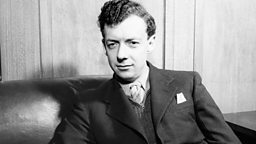
In the eyes of many, Benjamin Britten was our finest composer since Purcell (a figure who often inspired him) three hundred years earlier. He broke decisively with the romantic, nationalist school of figures such as Parry, Elgar and Vaughan Williams and recreated English music in a fresh, modern, European form. With Peter Grimes (1945), Billy Budd (1951) and The Turn of the Screw (1954), he arguably composed the last operas - from any composer in any country - which have entered both the popular consciousness and the musical canon.
He did all this while carrying two disadvantages to worldly success - his passionately held pacifism, which made him suspect to the authorities during and immediately after the Second World War - and his homosexuality, specifically his forty-year relationship with Peter Pears, for whom many of his greatest operatic roles and vocal works were created. The atmosphere and personalities of Aldeburgh in his native Suffolk also form another wonderful dimension to the book. Kildea shows clearly how Britten made this creative community, notably with the foundation of the Aldeburgh Festival and the building of Snape Maltings, but also how costly the determination that this required was.
Above all, this book helps us understand the relationship of Britten's music to his life, and takes us as far into his creative process as we are ever likely to go. Kildea reads dozens of Britten's works with enormous intelligence and sensitivity, in a way which those without formal musical training can understand. It is one of the most moving and enjoyable biographies of a creative artist of any kind to have appeared for years.
This is an excellent and very readable biography of one of the great British composers. Britten is still something of an enigma and contradiction; a difficult subject, just as he could be difficult in real life. Quintessentially English, he seemed to be part of the establishment, yet he was hated by many parts of the establishment. He was a pacifist and totally anti-war; spending the first two years of the war in the US. He was gay and made no pretence of heterosexuality by getting married like many of his contemporaries. He lived with his partner Peter Pears (also Britten’s muse, the voice for whom he wrote his greatest works) from 1937 until Britten’s death in 1976. The relationship was turbulent at times; they were apart a good deal when Pears was on tour with operatic companies. They always fell out on the telephone and made up by letter! The relationship survived and Britten died in Pears’ arms. Kildea works through Britten’s life in a systematic way, charting his great and minor works and their origins in clearly and informatively. He points out that Britten was often slated by the critics, often because he was too innovative, but also because he was not initially perceived to be part of the music establishment (and he was gay). Kildea also assesses (and he is competent to do so), those of Britten’s works which are weaker. Peter Grimes is clearly a magnificent opera, powerful, tragic and steeped in the land and sea of Suffolk where Britten lived. Come to think of it, most of Britten’s major operas have a tragic turn; Billy Budd (based on the Melville short story), War Requiem (based on Owen’s poems), The Turn of the Screw, Owen Wingrave and Death in Venice. Death in Venice has been read and discussed much on GR recently and it had slipped my mind that Britten had set it to music at about the same time as the Visconti film. I suddenly feel I would like to get hold of a copy and see what he made of it. Peter Pears was, of course, the key to much of Britten’s music, having one of the great operatic voices of the twentieth century. Not the strongest tenor, but Britten always said that Pears had a better sense of the music and the feeling it required than anyone else he worked with. And, of course they were partners. It was no secret and was accepted by their inner circle of friends. It has to be remembered that for the first 30 years of their relationship homosexuality was not legal and periodically well known actors, musicians etc were entrapped by the police. Britten had some influential friends and had been made a Companion of Honour, but there was a reaction. Other composers like William Walton were resentful and believed there was a homosexual conspiracy in music! In 1952/3 Sir David Maxwell Fyfe, the Home Secretary, launched a Mccarthyite witch-hunt against gay men; sending out young police constables to entrap men (dubbed the “pretty police”). Alan Turing, the mathematical genius who helped to break the Nazi enigma code was one of those caught (he later committed suicide (probably). The tabloid press were on board, especially the Daily Express. Britten was also interviewed by the police; sadly no records exist. However at this time Britten was writing an opera to celebrate the accession of Queen Elizabeth and maybe his response can be inferred by his actions at this time. The opera had a gay composer (Britten) and of course a gay tenor as Essex (Pears). It also had a gay librettist, director, conductor, choreographer, producer and a gay interior designer. It was also based on a book by a gay writer. This was seen as deliberately provocative and the opera was panned by the critics. What the Queen thought is not recorded, however Britten remained on friendly terms with the royal family and they commissioned further works from him. Kildea doesn’t think Britten was on a crusade, and he is probably right, but there is a sense of giving the music establishment, tabloid press and government the finger. Britten was in America in 1940 and lived for a year in a house in Brooklyn which he shared with W H Auden, Pears, Carson McCullers, Paul and Jane Bowles and the fiction editor of Harper’s Bazaar, George Davis. Others moved in and out staying for a while; Gypsy Rose Lee (I kid you not), Anais Nin, Kurt Weill, Salvador Dali and his wife (they moved in later in the year), various members of the Mann family (Britten became friends with Golo, which came in handy when he wanted permission to turn Death in Venice into an opera). Leonard Bernstein thought it was a mad house and Louis MacNeice said it was exactly what was to be expected from such a group of bohemian individuals. Whilst all the mayhem was going on Britten spent much of his time tinkering on the piano and writing stuff. This is a fascinating biography, well worth reading.
Blurb: Paul Kildea's major biography of the twentieth-century composer, Benjamin Britten, is published in the year that marks his centenary.
In this vivid portrait of the composer, Paul Kildea explores the private and creative life of the man who composed operas that have entered the popular consciousness as well as the musical canon. These include, Peter Grimes, Billy Budd and The Turn of the Screw. Kildea also explores his forty-year complex relationship with Peter Pears for whom Britten created an array of operatic and vocal roles. Kildea brings his experience as a conductor who has performed many of Britten's works to bear in his insightful interpretation of the composer's music. Radio 3 will be marking Britten's Centenary across the year including broadcasts of all his operas.
Read by Alex Jennings who is well known to Radio 4 audiences, and has appeared in many films, and television dramas. He is currently appearing at the National Theatre in Hymn by Alan Bennett. In 2009 he played Benjamin Britten in The Habit of Art also by Alan Bennett. Abridged by Richard Hamilton. Produced by Elizabeth Allard
Benjamin Britten, a life in the twentieth century is a beautiful biography that also contains a lively description of the development of musical life in twentieth century Great Britain. As an opera composer, Britten had a decisive influence on this. The book reads like an invitation to delve deeper into Britten's music. It would have been nice to have a supplementary book next to it with music examples and connections. The book has about 600 pages and is written so captivatingly well that I immersed myself completely in it. The book also worked as a good complement to Carpenter's biography of Auden.Paul Kildea writing is well researched and always finds the well nuanced and human point of view. I am curious about his other book on Chopin's stay in Mallorca.
I came to this book after reading about Wilfred Owen, and that Britten’s use of Owen’s poetry in the War Requiem was one of the things that made Owen a household name. Britten had always been a part of my life, in that from childhood I listened to his records, saw Pears sing Peter Grimes and saw the War Requiem performed in the new Coventry Cathedral. Later I lived in Essex and Suffolk and I met many people who had had contact with Britten in one way or another and heard him give a song recital with Peter Pears at Essex University.
Firstly, one think about this biography is that the writer is a musician and the detailed discussion of Britten’s major works is very illuminating and will be an invaluable reference to them for anyone who wants to listen further. Britten’s music is never simple, there are often sub-texts in the circumstances surrounding any particular piece. For example, of the Britten that I know (which is only a small part of his ouevre) I most love his settings of the Holy Sonnets of John Donne, and it’s illuminating to discover that they were the first things he composed, in a high fever, after travelling with Menuhin to perform for victims of the newly liberated Belsen concentration camp, an experience that continued to haunt him for the rest of his life.
At the time I went to University Britten was already an establishment figure, wealthy and loaded with gongs, so it was a surprise to read that in 1940 he lived with Pears in a brownstone in Brooklyn which he shared with such bohemian figures as WH Auden and Chester Kallman, Paul and Sally Bowles, where characters like Leonard Bernstein, Kurt Weill and Salvador Dali would come and go and which was nicknamed “February House” by no less a figure than Anais Nin. I had known that in his youth Britten collaborated with Auden (and Randall Swingler) but I had not realized what a profound influence Auden had on him. Words were obviously of critical importance to Britten and almost all his important works revolved around settings of words, and it is clear from this biography that the reason was Britten’s passionate hatred of war and deep unease about economic inequalities required words to put across. He was, of course, attacked from the right for his pacifism and support of the Peace Pledge Union, and from the left, later, for his willingness to lunch with the royals and take holidays with Princess Margaret of Hesse, but one never gets the feeling that he became right wing as he got older, even less that he “put his blinkers on” and became intellectually complacent. He seems to have been someone who lived from first to last with his eyes open, so that late in his life he confided to Sidney Nolan that he thought western civilization was in crisis and the result would be tragic.
Altogether then, my impression of Britten remains that he (like Owen) represents the best of England, really, the best we had to offer. He may have upset the left and the right at various times but he was always a high minded man, alert to the happenings in the culture from which he had sprung, The fact that he may have been prickly on occasions seems irrelevant really, when you look at his output and the pressures on him (one friend said that music simply “poured out of him”). He was always active, building bridges, promoting his musical values. As for his sex life, what I took most from the book was the feeling that a really solid marriage is the thing that allows creative people the freedom to get sex out of the way and concentrate on the things that matter. What kind of marriage it was seems private, and irrelevent.
This was a complete chance purchase - seen at the top of a pile of books in my local charity shop. And what a wonderful discovery it turned out to be, for me personally that is. I've not been a huge fan of Britten, and after checking my stores found I had only six CDs of his work, and not the biggest pieces like Peter Grimes, but some I love. However, one doesn't need to be intimate with the music works to enjoy this biography. My personal joy was to follow him from childhood onward, in England specifically, in all the places I know so well, from Lowestoft, Aldeborough, Flatford Mill, Ipswich, Cambridge, Friends House in Euston Road, and so forth. His political and moral stands against war, inequality, famine, all spoke to my condition. And so many of my favourite singers and musicians appeared along the way, along with a few other heroes. His personal life is so intriguing, his relationships, his contacts, his endeavours to build a music community are all so impressive. I rarely read non-fiction, and even rarer for me to read biographies, but this one touched my heart and soul. Very highly recommended.
Biographies are not one of my usual genres but I love Britten's music. A number of years ago I picked up a biography of him at a bookstore, but was very disappointed in browsing through it because the focus seemed to be too much on his sex life. He and Pears were together for some forty years, and so many of Britten's great works were written with that voice in his mind's ear as he wrote, and all you want to write about is who cheated on whom with whom?
By contrast, Kildea's book is fascinating, informative, and wonderfully well-written. His descriptions and opinions on Britten's works are invaluable.
Does a really brilliant job of living up to the promise of the subtitle, that is, of situating Britten's life amongst the composers and other artists of the twentieth century. It is also excellent at creating a portrait of a composer the author obviously admires, without descending into hagiography. In fact, the Britten that is on show here doesn't come across as a particularly nice or admirable person, though I must say, I ended up with more sympathy for him by the end than I had about halfway through. I think most of all, the book will drive people to the music. Well, at least people like me who don't know the music very well. The critiques offered of the music are the most compelling aspect of the story and it is very tempting to sit down with the music and use Kildea's comments as a way in.
Page 425 They gave press conferences (asked the difference between The Rape of Lucretia and TheTurn of the Screw by a keen reporter, he mischievously replied, "the notes are the same, but they are in a different order."
Page 430 [Alma Mahler] 17 years later in response to Britten's request to dedicate Nocturne to her, she telegraphed the composer: 'my happiness is enormous I cannot feel or think of anything else my deepest thanks.'
Page 370 He filled his fountain pen with black ink so the score could be easily photographed, apologizing to various correspondents for contravening the etiquette that restricted this color to condolence letters.
Page 406 Normally Britten responded to such letters in one of two ways: I think this is my best piece yet, he would say to his intimate friends. Or to those outside the circle, he might say: one is always fondest of one's youngest child.
I own both the Humphrey Carpenter biography and now the Kildea biography of Britten. I wouldn't be without either one. Kildea has the advantage of added documentation being available for his research. Kildea's biography provides more information on the artistic life and organizations within which and for whom Britten composed and performed. Carpenter's biography leans more towards a psychological study of Britten and his relationships. Both are compelling reading.
Bernstein..."When you hear Britten's music, if you really hear it, not just listen to it superficially you become aware of something dark. There are gears that are grinding and not quite meshing, and they make great pain." 14




 Talk about serendipity...


