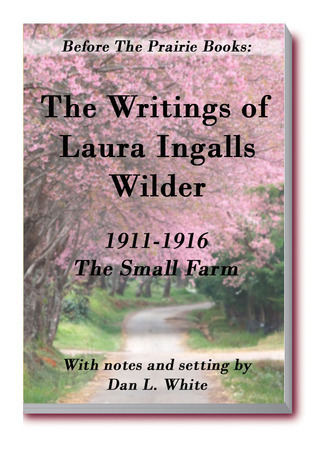
Laura Ingalls Wilder wrote the American classic Little House on the Prairie, from which the award winning television show was taken. Her first book was published in 1932 but long before that Laura wrote magazine articles on small farming and country living. She and her husband Almanzo lived on a small farm near Mansfield, Missouri from 1894 until their deaths, his in 1949 and hers in 1957, and it is from that happy life that the spirit of her books sprang. Laura’s articles are full of merriment, country lore, and old fashioned wisdom. They are the seed stock of the Little House® books.
“There is no place like a farm for raising children, where they can have in such abundance the fresh air and sunshine, with pure living water, good wholesome food and a happy outdoor life.”
“More than any other business, that of farming depends upon the home and it is almost impossible for any farmer to succeed without the help of the house. In the country the home is still depended upon to furnish bed and board and the comforts of life.”
“Life is often called a journey, “the journey of life.” Usually when referred to in these terms it is also understood that it is “a weary pilgrimage.” Why not call it a voyage of discovery and take it in the spirit of happy adventure?”
"The true way to live is to enjoy every moment as it passes and surely it is in the everyday things around us that the beauty of life lies.”
These nearly 40,000 words of Laura’s writings are accompanied by setting and notes by Dan L. White, a fellow Ozarker who has lived for the last quarter century in Laura’s neck of the woods and has authored several books on Laura, including Laura’s Love Story, Laura Ingalls’ Friends Remember Her and Devotionals with Laura.
Laura Ingalls Wilder was an American author, journalist, and educator whose "Little House" series transformed the arduous reality of the American frontier into a foundational pillar of children's literature. Born in the "Big Woods" of Wisconsin to Charles and Caroline Ingalls, Laura’s childhood was a nomadic journey through the heart of a shifting nation. Her family moved across Kansas, Missouri, Minnesota, Iowa, and the Dakota Territory—often staying just ahead of legal evictions or chasing the promise of fertile soil. These years were marked by extreme hardship, including the "Hard Winter" of 1880–81 in De Smet, South Dakota, where the family survived near-starvation. Despite the struggle, these experiences provided the raw material for her eight-volume record of pioneer life, a series that has since been translated into over forty languages. Before becoming a world-renowned novelist in her sixties, Wilder lived several distinct lives. At fifteen, she became a teacher in one-room prairie schools, a job she took primarily to support her family financially. In 1885, she married Almanzo Wilder, beginning a partnership that endured fire, paralysis from diphtheria, and the heartbreaking loss of an infant son. These trials eventually led them to Mansfield, Missouri, where they established Rocky Ridge Farm. It was here that Laura developed her voice as a professional writer, serving as a columnist and editor for the Missouri Ruralist for over a decade. The Great Depression and the 1929 stock market crash wiped out the Wilders’ savings, providing the ultimate catalyst for Laura to pen her memoirs. Her daughter, Rose Wilder Lane—a successful author in her own right—encouraged her mother to adapt her autobiography, Pioneer Girl, into a format more suitable for children. This resulted in a complex and often rocky literary collaboration; while Lane provided the professional "style," Wilder provided the "substance" and narrative heart. The first book, Little House in the Big Woods, was published in 1932 when Laura was sixty-five. Wilder’s legacy is a blend of immense literary success and modern historical scrutiny. While her books remain staples in classrooms for their vivid descriptions of 19th-century domestic life, her portrayals of Native Americans and African Americans have led to recent reevaluations. In 2018, the American Library Association renamed the "Laura Ingalls Wilder Medal" to the "Children's Literature Legacy Award" to reflect these evolving cultural sensitivities. Nonetheless, Wilder remains a monumental figure in American letters, a woman who successfully "saved the American soul" by documenting the grit, faith, and unyielding persistence of the pioneer spirit.
I did enjoy Laura's articles, but I think I enjoyed Mr. White's insightful intros even more! This was even more fun for me learning the Wilders lived their adult lives in the Missouri Ozarks. To see the connection, however small, to Rolla, St. Louis, Jefferson City (where I was born), and even a mention or two of the Gasconade River, was nostalgic and sweet. Such fun! I ordered the rest in this series, too. 😊
Dan L. White lives in Mansfield, Missouri, the final destination where Laura and Almanzo Wilder built Rocky Ridge Farm and spent the rest of their days. White and his wife have studied the Wilders and written many devotional books based on Laura's writings and earmarked Bible.
These Before the Prairie Books are compilations of articles that Laura wrote for the local farming magazine. White points out elements of Laura's writing style and personality, and also fills in the historical backdrop against which Laura was writing. By 1916, several people in Mansfield had automobiles, and World War I had begun with tanks and planes. This is a far cry from the Laura Ingalls we think of, riding through an empty prairie in the back of a covered wagon. Many of Laura's articles deal with the subject of new devices for the home that make work easier, or take away some of the joys of the work.
It has been fun reading these articles and watching her writing style change as she comes closer to the decision to write the Little House books. Reading what she has written about farm life as an adult takes me back to the same feelings I had reading the Little House books as a kid.
Five stars for Laura's writings (today's bloggers could learn from her), one star for Dan L. White's annoying and unnecessary introductions to every piece.