Jump to ratings and reviews
Rate this book

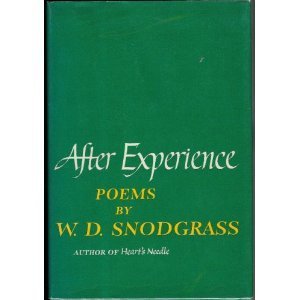
After Experience

Rate this book
hard back

92 pages, Unknown Binding

1 person is currently reading
27 people want to read

About the author

W.D. Snodgrass

85 books47 followers
William De Witt Snodgrass, pseudonym S. S. Gardons, is an American poet and a 1960 Pulitzer Prize for Poetry winner.

Snodgrass's first poems appeared in 1951, and throughout the 1950's he published in some of the most prestigious magazines: Botteghe Oscure, Partisan Review, The New Yorker, The Paris Review and The Hudson Review. However, in 1957, five sections from a sequence entitled Heart's Needle were included in Hall, Pack and Simpson's anthology, New Poets of England and America, and these were to mark a turning-point. When Lowell had been shown early versions of these poems, in 1953, he had disliked them, but now he was full of admiration.

By the time Heart's Needle was published, in 1959, Snodgrass had already won the The Hudson Review Fellowship in Poetry and an Ingram Merrill Foundation Poetry Prize. However, his first book brought him more: a citation from the Poetry Society of America, a grant from the National Institute of Arts, and, most important of all, 1960's Pulitzer Prize in Poetry. It is often said that Heart's Needle inaugurated confessional verse. Snodgrass disliked the term. Still, it should be pointed out that the genre he was reviving here seemed revolutionary to most of his contemporaries, reared as they had been on the anti-expressionistic principles of the New Critics. Snodgrass's confessional work was to have a profound effect on many of his contemporaries, amongst them, most importantly, Robert Lowell.


Ratings & Reviews

What do you think?
Rate this book

Friends & Following

Create a free account to discover what your friends think of this book!

Community Reviews

5 stars
7 (36%)
4 stars
7 (36%)
3 stars
4 (21%)
2 stars
1 (5%)
1 star
0 (0%)
Displaying 1 - 4 of 4 reviews
Profile Image for Bill Kerwin.
Author 2 books84.3k followers
July 15, 2019

After Experience is a title that resonates. Isn’t most lyric poetry, after all, a reflection upon the past, an attempt to recapture some “emotion recollected in tranquility”? But the attempt to chase after the experience and catch it—to speak of it through the mask of words, to contain it within the “still, unravished” vessel—is always doomed to fail. For all art is inevitably not “of” experience, but “after” it. Oh, this is chronologically true, of course, but it is also true in the sense that a verbal description of a painting is “after Matisse,” or a non-literal translation of a poem is “after Rilke”. It is never the thing that was, but always another thing: an homage, an elegy, a simulacrum.

The wisdom of what comes “after experience” hovers over these witty, well crafted poems like a melancholy cloud. Whether the subject be his occasional visits with a daughter from a previous marriage, an old photograph of his former wife, the farewell to an old farmhouse, farewell thoughts (from an airplane taking off) to a new mistress, or the painful parting with a married lover, each autobiographical poem vibrates with all that has been lost, and trembles for the artifice needed to maintain what is left.

The sense of loss—and our stratagems when faced with loss—is embodied in many of the less personal poems as well, three of which I believe to be masterpieces: “The Examination,” a surreal narrative in which black-robed figures operate upon a candidate for admission to some unspecified elite, making him “one of ours,” “A Flat One,” in which a cynical nursing home orderly describes what it means to care for his debilitated patient “Old Fritz,” and the title poem “After Experience,” in which two voices alternate (one a stuffy lecturer on existentialism, the other a self-defense instructor telling his students how to “rip off” an attacker’s “full facial mask.”)

The book ends with a series of imitations: five descriptions after famous paintings (Matisse, Vuillard, Manet, Monet, Van Gogh), and approximately two dozen free translations of European poets, more than half after Rilke. The poems about the paintings are the weakest part of the book, but the translations—particularly the Rilke—are wonderful.

I will conclude with the poem “A Friend” for two reasons: 1) it is the most heartbreaking poem about adultery I know, and 2) shows Snodgrass using language in a singularly effective early sixties formalist way: the discrete positioning of one—only one!—taboo word in order to create a shocking effect:

A FRIEND

I walk into your home, a friend.
Your kids swarm up my steep hillsides
Or swing in my branches. Your boy rides
Me for his horsie; we pretend
some troll threatens our lady fair.
I swing him squealing through the air
And down. Just what could I defend?

I tuck them in, sometimes, at night.
That’s one secret we never tell.
Giggling in their dark room, they yell
They love me. Their father, home tonight,
Sees your girl curled up on my knee
And tells her “git”—she’s bothering me.
I nod; she’d better think he’s right.

Once they’re in bed, he calls you “dear.”
The boob-tube shows some hokum on
Adultery and loss; we yawn
Over a stale joke book and beer
Till it’s your bedtime. I must leave.
I watch that squat toad pluck your sleeve.
As always, you stand shining near

Your window. I stand, Prince of Lies
Who’s seen bliss; now I can drive back
Home past wreck and car lot, past shack
Slum and steelmill reddening the skies,
Past drive-ins, the hot pits where our teens
Fingerfuck and that huge screen’s
Images fill their vacant eyes.
Profile Image for Matt.
19 reviews2 followers
October 4, 2024
So confused why people seem to think this is good, seems like a really clever and skilled poet who chooses to write drab rubbish. Really found this difficult to even finish, but there was the odd moment that was really beautiful and poignant. Who knows! might read it again in a few years
Profile Image for Ana.
275 reviews48 followers
January 29, 2013
It is a very dangerous strategy to wrap up your own poetry book with a (fantastic) translation of a few Rilke poems, let alone Sonnets to Orpheus, as the reader will most certainly give in to temptation and jump to the nearest Rilke tome in the house, forgetting all about your own poetry in the first place. That's if you are an average poet. Clearly, W.D.Snodgrass is not
494 reviews22 followers
July 19, 2014
I'm only giving this four stars because it is about equally divided into what I thought were three star poems and what I thought were five star poems. The beginning of the book is good, but not great. He is very much a personal poet, dwelling on his divorces and unhappiness and failed relationships, and after a while, that sort of poetry gets grating. As an example of that sort of poetry, Snodgrass' work is very well constructed, but not especially interesting in the quantity in which it appears in this book. While some of the earlier poems are great, such as "Flash Flood", it is once you hit "Powwow" that the poems really begin to sing. Everything from this point on, including the translations, is fabulous. Two of my favorite poems in the whole collection were "MANET: 'The Execution of the Emperor Maximillian'" and "VAN GOGH: 'The Starry Night'", both of which were absolutely beautiful.

A couple of the poems were odd, like "Inquest" which used repetition of lines in a manner not unlike a villanelle, but was not one, and "The Examination" which seems to be immediately about performing a lobotomy on a chicken, but contains shades of deeper warnings about being influenced by others. I also found the title poem, "After Experience Taught Me..." to be very strange. This one had two separate trains of thought, the one running thought the left-aligned stanzas and the one running through the center-aligned stanzas. While this would be fine, (Ellen Hopkins often does a similar thing with words aligned differently spelling a sentence, and the poem about the Manet painting does a similar thing) I was very confused by this poem because the two threads did not interact well to create a single, unified, poem that had a meaning all its own and a natural flow. I read it multiple times, reading both, reading just one, and could not get the poem to unify.
Displaying 1 - 4 of 4 reviews

Can't find what you're looking for?

Get help and learn more about the design.