

What do you think?

La máquina espacial
Edward Turnbull es un representante de comercio sin suerte que un día conoce por casualidad a Amelia Fitzgibbon, pariente de un conocido inventor. De visita en su casa, Amelia le enseña el último invento de sir William: la máquina espacial, y le sugiere que la tomen prestada para un viaje corto. Esta imprudencia desencadena toda una serie de acontecimientos nefastos que los lleva a un futuro cercano y a un rincón de la campiña, que creen que es la Tierra del futuro, pero que en realidad es el planeta Marte, que está a punto de lanzar un ataque contra la Tierra.
Combinando con maestría La máquina del tiempo y La guerra de los mundos de H.G. Wells, Christopher Priest trama una historia original que presenta otro punto de vista de ambas novelas y llena los huecos que Wells dejó inexplicados. Sin salirse de los limites de la ciencia victoriana de finales del siglo XIX.
Combinando con maestría La máquina del tiempo y La guerra de los mundos de H.G. Wells, Christopher Priest trama una historia original que presenta otro punto de vista de ambas novelas y llena los huecos que Wells dejó inexplicados. Sin salirse de los limites de la ciencia victoriana de finales del siglo XIX.
416 pages, Paperback
First published January 1, 1976
About the author
Christopher Priest
156 books1,105 followersChristopher Priest was born in Cheshire, England. He began writing soon after leaving school and has been a full-time freelance writer since 1968.
He published eleven novels, four short story collections and a number of other books, including critical works, biographies, novelizations and children’s non-fiction.
He also wrote drama for radio (BBC Radio 4) and television (Thames TV and HTV). In 2006, The Prestige was made into a major production by Newmarket Films. Directed by Christopher Nolan, The Prestige went straight to No.1 US box office. It received two Academy Award nominations. Other novels, including Fugue for a Darkening Island and The Glamour, are currently in preparation for filming.
He was Vice-President of the H. G. Wells Society. In 2007, an exhibition of installation art based on his novel The Affirmation was mounted in London.
As a journalist he wrote features and reviews for The Times, the Guardian, the Independent, the New Statesman, the Scotsman, and many different magazines.
He published eleven novels, four short story collections and a number of other books, including critical works, biographies, novelizations and children’s non-fiction.
He also wrote drama for radio (BBC Radio 4) and television (Thames TV and HTV). In 2006, The Prestige was made into a major production by Newmarket Films. Directed by Christopher Nolan, The Prestige went straight to No.1 US box office. It received two Academy Award nominations. Other novels, including Fugue for a Darkening Island and The Glamour, are currently in preparation for filming.
He was Vice-President of the H. G. Wells Society. In 2007, an exhibition of installation art based on his novel The Affirmation was mounted in London.
As a journalist he wrote features and reviews for The Times, the Guardian, the Independent, the New Statesman, the Scotsman, and many different magazines.
Ratings & Reviews
Friends & Following
Create a free account to discover what your friends think of this book!
Community Reviews
Displaying 1 - 30 of 118 reviews

September 14, 2017

It's war! For starters, martians vs. martians, then there is more, much more. A highly entertaining adventure story; a superbly imaginative tale of science fiction; a creative reworking of two classics: The Time Machine and The War of the Worlds. This Christopher Priest novel is simply too good to be true, a fanciful cross between Anthony Trollope and H.C. Wells, a must read for any lover of Victorian literature or science fiction, a work featuring the following two main characters along with several highlights of their astonishing saga:

Amelia Fitzgibbon: This photo of actress Keira Knightley captures the spirit of the novel's beautiful, brilliant heroine who is assistant to genius science inventor Sir William Reynolds. Shortly after the inventor leaves for London, Amelia persuades her new acquaintance, a proper young Victorian gentleman, to accompany her on a test run of Sir William's most astounding invention - a time machine.
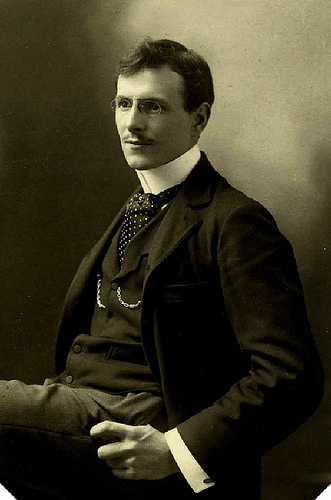
Edward Turnbull: Little does young Edward know what adventures lie ahead and how he will repeatedly be thrust into the role of an Indiana Jones-style hero. But through it all, Edward is forever the Victorian gentleman. And, yes, this novel is also a romance: Edward and Amelia fall completely and totally in love with each other.
The Space-Time Machine: Once aboard Sir William's miraculous machine and moving through future time, catastrophe hits: Edward detects Amelia is in danger. Edward instinctively kicks out, hitting a lever propelling the machine not only through time but also through space. Oh, my! - zoom-zoom-zoom and the machine finally comes to an abrupt halt. "Where do you think we are, Edward?" To which our Victorian gentleman replies something to the effect: "Toto, I've a feeling we're not in Kansas anymore."
Mars: One of the more charming parts of the novel is when Edward and Amelia stroll arm in arm across the strange, cold, desolate landscape. Judging from the thin air and barrenness, Amelia reasons they are on a Tibetan plateau. They explore further and discover even more strangeness. The author's descriptions are vivid and precise, making the couple's every step and encounter a believable event.
Martians: Amelia and Edward come upon human-like martians, tall with reddish skin, scant clothing, indecipherable language and strange gestures. But then they discover another race that isn't nearly as pleasant to be around.
War of the Worlds: There is good reason why the below illustration for the H.G. Wells classic is also most appropriate for this action-packed Christopher Priest story. You will have to read for yourself to find out exactly how and why this is the case. One of the most exciting adventure stories I've ever read. Also, there is a first-rate audio book available narrated by Barnaby Edwards.
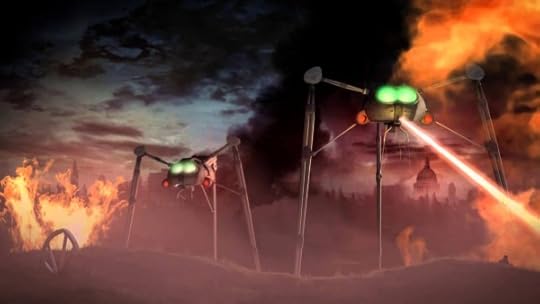

Looks like Christopher Priest is witnessing martians launching an attack against Earth complements of live footage via his iphone!

November 4, 2021
“Intelligence is no match for Nature.”
The English author Christopher Priest writes astonishingly original novels. Unusually, he is equally respected both in literary circles and in those of contemporary Science Fiction and Fantasy, and has won a substantial number of awards. His novels, twenty so far, are challenging and complex. They include “Inverted World”, “The Affirmation”, “The Glamour”, and “The Separation” … perhaps “The Prestige” is the most famous, since it was made into a film. The other one with potentially huge popular appeal is this one: The Space Machine: A Scientific Romance, an early novel written in 1976.
I began reading it with absolutely no idea of the plot—except that I strongly suspected it would be Sci Fi, and I do like Christopher Priest’s writing. It is likely that you will already have read the blurb, so will have a far clearer idea of what to expect. You may also know that Christopher Priest’s work is heavily influenced by H.G. Wells’s science fiction. In fact he has been Vice-President of the international H.G. Wells Society for just over 15 years.
So when I began listening to the complete audio book of The Space Machine, I was a little surprised to find myself in a Victorian boarding house, surrounded by characters who exhibited typical Victorian behaviour. The narrator is a very ordinary, slightly stuffy and dignified young man called Edward Turnbull. He is a travelling salesman in leather goods, but also has a keen interest in science and technology. He would actually like to be involved with its development, although he spends most of his time in boring conversation with others in his field. However, Edward Turnbull has a secret he wishes to keep under his hat (this pun was not intended). He has designed what he calls a “Visibility Protection Mask”—which we recognise with delight as motoring goggles—and which Edward hopes to promote to those who are taking up the latest craze of automobiles.
Since we are in England, this sets the novel nicely in 1893, and fans of H.G. Wells may well prick up their ears at this. To Edward’s surprise, he learns that there is a lady commercial traveller staying at his commercial hotel in Skipton. This is almost unheard of for the time, and indeed rather scandalous. The other reps staying in the boarding house have designs on Miss Amelia Fitzgibbon, which are not altogether honourable. Our hero Edward, though, is an upright fellow with no ulterior motives—except when he learns that she works for her uncle, Sir William Reynolds, an eccentric and wealthy inventor. What’s more, Sir William is a motoring enthusiast.
However, Amelia Fitzgibbon is closely guarded and chaperoned by the hotel’s lady proprietor, and never to be seen on her own. Edward is eager for an introduction, as this might lead to Sir William’s patronage.
By now the tone of the book is well established. It is an amusing pastiche of Victorian mores, with a very proper but introverted and not very bright young man (Edward) and a much more enterprising and confident young woman (the fair Amelia). What follows is an amusing section which borders on farce. Edward contrives a meeting which leads to him being closeted with Miss Fitzgibbon in her bedroom. These are perilous waters, not because Edward has any base intentions—he has far too much respect for any young lady to try anything untoward—but because of the ever-watchful proprietor. In fact Amelia is far more free and easy, and seems to regard it all as a bit of a lark, and Edward’s embarrassment as rather amusing.
Readers of H.G. Wells will by now have an idea of where we might be going with this rather lengthy, but hilarious, opening section. Christopher Priest has cleverly combined aspects of both novels, expanding some of the ideas such as closely examining the Martian civilisation, and incorporating them into his own new creation. This central section on Mars is very slow-burning; we do not recognise the elements at first.
The gentle humour continues, as these all too believable protagonists are not only at odds with each other, but ill equipped to deal with the situations they have found themselves in. The minutiae they are accustomed to in daily Victorian life is vast worlds away. Nevertheless, they try to survive as best they can,
This is a very enjoyable book, with a mischievous sense of humour I have not come across before in Christopher Priest’s work. I am tempted to give it five stars, but a more objective rating for a general reader is perhaps 4. H.G. Wells always tried to be scrupulously accurate with the known science of his time, but Christopher Priest tends to gloss over this. If you dislike steampunk, and prefer hard contemporary science fiction, rather than pseudo-science set in the Victorian era, this may not be for you. The denouement is extremely speculative, and you do also have to be familiar with (and enjoy) some of H.G. Wells’s stories to get the most out of it. Christopher Priest has clearly written this as a tribute to his literary hero, paying homage to the father of British Science Fiction, interweaving aspects from two of the master’s most popular novels into his own new and exciting adventure story.
A large part of the novel is an ingenious pastiche which sometimes made me laugh out loud. He has also captured the “voice” of H.G. Wells particularly well, accurately echoing his style of writing and keeping an authentic period writing style and cultural perspective. At no time did I feel this to be a parody; The Space Machine is consistent with those works he references, and equally captures the wonder of such a dramatic voyage. Christopher Priest does not touch on any of H.G. Wells’ social or political writings, although the wistful humour of his classic novels such as “Kipps” or “The History of Mr Polly” is there in the character of Edward Turnbull. Amelia Fitzgibbon is just the kind of emancipated end of the 19th century young woman H.G. Wells would have admired in real life, and aspects of class, authority and power, plus prescient environmental warnings are all there. At its core it reminds me of Stephen Baxter’s excellent “The Time Ships”, but it is a lot more fun! We even have a brief sojourn into metafiction , which means that this novel cannot be regarded as a straight sequel.
It’s no good, I simply can’t not give this one 5 stars, for pure reading pleasure. If you enjoy the Science Fiction stories of H.G. Wells as much as I do, please don’t miss this one. Here are some critical reviews:
“This is an astonishing change of pace for Mr. Priest, and one which extends his powers in ways which reveal him as one of the best and most persuasive young British writers.”—The Times
“First rate … science fiction at its best!”—Los Angeles Herald-Examiner
“A novel that is unusual for its kind, a science fiction story with recognizable characters and a sense of style, atmosphere and humour. Imaginative and full of amusing curiosities.”— Sunday Express
The English author Christopher Priest writes astonishingly original novels. Unusually, he is equally respected both in literary circles and in those of contemporary Science Fiction and Fantasy, and has won a substantial number of awards. His novels, twenty so far, are challenging and complex. They include “Inverted World”, “The Affirmation”, “The Glamour”, and “The Separation” … perhaps “The Prestige” is the most famous, since it was made into a film. The other one with potentially huge popular appeal is this one: The Space Machine: A Scientific Romance, an early novel written in 1976.
I began reading it with absolutely no idea of the plot—except that I strongly suspected it would be Sci Fi, and I do like Christopher Priest’s writing. It is likely that you will already have read the blurb, so will have a far clearer idea of what to expect. You may also know that Christopher Priest’s work is heavily influenced by H.G. Wells’s science fiction. In fact he has been Vice-President of the international H.G. Wells Society for just over 15 years.
So when I began listening to the complete audio book of The Space Machine, I was a little surprised to find myself in a Victorian boarding house, surrounded by characters who exhibited typical Victorian behaviour. The narrator is a very ordinary, slightly stuffy and dignified young man called Edward Turnbull. He is a travelling salesman in leather goods, but also has a keen interest in science and technology. He would actually like to be involved with its development, although he spends most of his time in boring conversation with others in his field. However, Edward Turnbull has a secret he wishes to keep under his hat (this pun was not intended). He has designed what he calls a “Visibility Protection Mask”—which we recognise with delight as motoring goggles—and which Edward hopes to promote to those who are taking up the latest craze of automobiles.
Since we are in England, this sets the novel nicely in 1893, and fans of H.G. Wells may well prick up their ears at this. To Edward’s surprise, he learns that there is a lady commercial traveller staying at his commercial hotel in Skipton. This is almost unheard of for the time, and indeed rather scandalous. The other reps staying in the boarding house have designs on Miss Amelia Fitzgibbon, which are not altogether honourable. Our hero Edward, though, is an upright fellow with no ulterior motives—except when he learns that she works for her uncle, Sir William Reynolds, an eccentric and wealthy inventor. What’s more, Sir William is a motoring enthusiast.
However, Amelia Fitzgibbon is closely guarded and chaperoned by the hotel’s lady proprietor, and never to be seen on her own. Edward is eager for an introduction, as this might lead to Sir William’s patronage.
By now the tone of the book is well established. It is an amusing pastiche of Victorian mores, with a very proper but introverted and not very bright young man (Edward) and a much more enterprising and confident young woman (the fair Amelia). What follows is an amusing section which borders on farce. Edward contrives a meeting which leads to him being closeted with Miss Fitzgibbon in her bedroom. These are perilous waters, not because Edward has any base intentions—he has far too much respect for any young lady to try anything untoward—but because of the ever-watchful proprietor. In fact Amelia is far more free and easy, and seems to regard it all as a bit of a lark, and Edward’s embarrassment as rather amusing.
Readers of H.G. Wells will by now have an idea of where we might be going with this rather lengthy, but hilarious, opening section. Christopher Priest has cleverly combined aspects of both novels, expanding some of the ideas such as closely examining the Martian civilisation, and incorporating them into his own new creation. This central section on Mars is very slow-burning; we do not recognise the elements at first.
The gentle humour continues, as these all too believable protagonists are not only at odds with each other, but ill equipped to deal with the situations they have found themselves in. The minutiae they are accustomed to in daily Victorian life is vast worlds away. Nevertheless, they try to survive as best they can,
This is a very enjoyable book, with a mischievous sense of humour I have not come across before in Christopher Priest’s work. I am tempted to give it five stars, but a more objective rating for a general reader is perhaps 4. H.G. Wells always tried to be scrupulously accurate with the known science of his time, but Christopher Priest tends to gloss over this. If you dislike steampunk, and prefer hard contemporary science fiction, rather than pseudo-science set in the Victorian era, this may not be for you. The denouement is extremely speculative, and you do also have to be familiar with (and enjoy) some of H.G. Wells’s stories to get the most out of it. Christopher Priest has clearly written this as a tribute to his literary hero, paying homage to the father of British Science Fiction, interweaving aspects from two of the master’s most popular novels into his own new and exciting adventure story.
A large part of the novel is an ingenious pastiche which sometimes made me laugh out loud. He has also captured the “voice” of H.G. Wells particularly well, accurately echoing his style of writing and keeping an authentic period writing style and cultural perspective. At no time did I feel this to be a parody; The Space Machine is consistent with those works he references, and equally captures the wonder of such a dramatic voyage. Christopher Priest does not touch on any of H.G. Wells’ social or political writings, although the wistful humour of his classic novels such as “Kipps” or “The History of Mr Polly” is there in the character of Edward Turnbull. Amelia Fitzgibbon is just the kind of emancipated end of the 19th century young woman H.G. Wells would have admired in real life, and aspects of class, authority and power, plus prescient environmental warnings are all there. At its core it reminds me of Stephen Baxter’s excellent “The Time Ships”, but it is a lot more fun! We even have a brief sojourn into metafiction , which means that this novel cannot be regarded as a straight sequel.
It’s no good, I simply can’t not give this one 5 stars, for pure reading pleasure. If you enjoy the Science Fiction stories of H.G. Wells as much as I do, please don’t miss this one. Here are some critical reviews:
“This is an astonishing change of pace for Mr. Priest, and one which extends his powers in ways which reveal him as one of the best and most persuasive young British writers.”—The Times
“First rate … science fiction at its best!”—Los Angeles Herald-Examiner
“A novel that is unusual for its kind, a science fiction story with recognizable characters and a sense of style, atmosphere and humour. Imaginative and full of amusing curiosities.”— Sunday Express

January 21, 2026
The Space Machine - Christopher Priest
بعد تعارف سريع في أحد المؤتمرات، تدعو الآنسة فيتزبون السيد تورنبل إلى منزل المخترع العظيم ويليام رينولدز، وهناك يعبثان بأحدث اختراعاته: آلة الزمكان. حيث لا يسافران بالزمن إلى المستقبل وحسب ولكنهما يسافران كذلك عبر الفضاء إلى كوكب جديد تمامًا،
ويحتجزان في ذلك المكان الغريب والجديد حيث تسيطر قوة خفية، في جو غريب ونباتات أغرب وآلآت مخيفة تقودها مخلوقات مرعبة وهناك يكتشفان أن هذه المخلوقات الغريبة تخطط لغزو الأرض يبدآن البحث عن طريقة للعودة وإنقاذ الأرض.
نشرت رواية بريست هذه عام 1976 وهي تحية لـ هـ.ج. ويلز، لأنها رواية تجمع اثنتين من أشهر رواياته: آلة الزمن" و"حرب العوالم".
هذه الرواية ممتعة وخفيفة ...
كلما قرأت عملًا ممتعًا -خاصة بين روايات الخيال العلمي، أفكر أن هذه الرواية كانت لتكون ممتعة كـ كوميكس،و هذا عمل يناسبه أن يكون مصورًا..
تقترب هذه الأيام الذكرى الثالثة لرحيل كريستوفر بريست، بريست الذي لم أعرفه حيًا، ولكن بدأت القراءة له بعد أن سمعت بخبر وفاته في بداية فبراير 2024، وانضم سريعًا لقائمة كتابي المفضلين، رواياته عبقرية ومدهشة؛ أنهيت العام الماضي بإحدى رواياته وها أنا أبدأ العام الجديد برواية أخرى له، وأخطط لقراءة 2 من رواياته الأخرى، رواية نشرت في بداية التسعينات ورواية نشرت عام 2018 ومن توصية صديقة عزيزة..
.
بعد تعارف سريع في أحد المؤتمرات، تدعو الآنسة فيتزبون السيد تورنبل إلى منزل المخترع العظيم ويليام رينولدز، وهناك يعبثان بأحدث اختراعاته: آلة الزمكان. حيث لا يسافران بالزمن إلى المستقبل وحسب ولكنهما يسافران كذلك عبر الفضاء إلى كوكب جديد تمامًا،
ويحتجزان في ذلك المكان الغريب والجديد حيث تسيطر قوة خفية، في جو غريب ونباتات أغرب وآلآت مخيفة تقودها مخلوقات مرعبة وهناك يكتشفان أن هذه المخلوقات الغريبة تخطط لغزو الأرض يبدآن البحث عن طريقة للعودة وإنقاذ الأرض.
نشرت رواية بريست هذه عام 1976 وهي تحية لـ هـ.ج. ويلز، لأنها رواية تجمع اثنتين من أشهر رواياته: آلة الزمن" و"حرب العوالم".
هذه الرواية ممتعة وخفيفة ...
كلما قرأت عملًا ممتعًا -خاصة بين روايات الخيال العلمي، أفكر أن هذه الرواية كانت لتكون ممتعة كـ كوميكس،و هذا عمل يناسبه أن يكون مصورًا..
تقترب هذه الأيام الذكرى الثالثة لرحيل كريستوفر بريست، بريست الذي لم أعرفه حيًا، ولكن بدأت القراءة له بعد أن سمعت بخبر وفاته في بداية فبراير 2024، وانضم سريعًا لقائمة كتابي المفضلين، رواياته عبقرية ومدهشة؛ أنهيت العام الماضي بإحدى رواياته وها أنا أبدأ العام الجديد برواية أخرى له، وأخطط لقراءة 2 من رواياته الأخرى، رواية نشرت في بداية التسعينات ورواية نشرت عام 2018 ومن توصية صديقة عزيزة..
.

October 28, 2018
Поредно упражнение върху сюжета на великия роман на Х. Дж. Уелс.
Кристофър Прийст е по-принцип интересен автор, но тук не му се е получило. Попровлачено, скучно на моменти и излишно клиширано, в опита да се пресъздадат викторианските нрави и норми на поведение.
Една от малкото книги от библиотека "Галактика", които не съм прочел навремето. И най-вероятно, тогава нямаше и да я дочета.
Линк към трилогията на Феликс Палма, която много ми допадна:
https://www.goodreads.com/series/6649...
Кристофър Прийст е по-принцип интересен автор, но тук не му се е получило. Попровлачено, скучно на моменти и излишно клиширано, в опита да се пресъздадат викторианските нрави и норми на поведение.
Една от малкото книги от библиотека "Галактика", които не съм прочел навремето. И най-вероятно, тогава нямаше и да я дочета.
Линк към трилогията на Феликс Палма, която много ми допадна:
https://www.goodreads.com/series/6649...

August 29, 2023
The Space Machine (January 1976) is a tribute to the genius of H.G. Wells, particularly his novels The Time Machine and The War of the Worlds, and includes a cameo appearance by Wells towards the end of the novel. Starting off slowly in Victorian England, it begins with a meeting between the two principal characters, Edward Turnbull and Amelia Fitzgibbon. Indeed, their clandestine meetings in a lodge seem to take forever and lead nowhere, but offer a flavor of the Victorian age. It offers a subtle glimpse of their burgeoning romance.
It all changes when they meet at Sir William Reynold’s laboratory, where waits a machine that does Well’s Time Machine one better. It is, in effect, a TARDIS for fans of Dr. Who as it travels in both time and space. Of course, Amelia would like nothing better than to demonstrate how it works and, of course, on a second try, something goes wrong and the machine whisks them across time and space rather far and, in fact, to Mars. There, the machine automatically returns to where it came from, leaving the two stranded on a strange planet much like John Carter when he first landed on Barsoom.
Not knowing how to get home, if ever that would be possible, the two make the best of it, eating strange plants and trying to fit in with strange people who are sort of like them, but depressed and beaten down. It appears to be a gray downcast communal society until Edward and Amelia realize that all these people are slaves to the overlords, who do battle in giant tripod machines (think Wells’ War of the Worlds). It is a society closer to Burroughs’ Pellucidar than anything John Carter ever found on Barsoom, particularly as the monster-creatures who are the overlords dine on human blood similar to the Mahars dining on human flesh. Eventually, of course, the creature monsters in the tripods come to conquer Earth just like in War of the Worlds.
Despite the fact that the Space Machine is, to some degree, derivative of two of Wells’ science fiction novels, it is such tremendous fun to read and just so hard to put down.
It all changes when they meet at Sir William Reynold’s laboratory, where waits a machine that does Well’s Time Machine one better. It is, in effect, a TARDIS for fans of Dr. Who as it travels in both time and space. Of course, Amelia would like nothing better than to demonstrate how it works and, of course, on a second try, something goes wrong and the machine whisks them across time and space rather far and, in fact, to Mars. There, the machine automatically returns to where it came from, leaving the two stranded on a strange planet much like John Carter when he first landed on Barsoom.
Not knowing how to get home, if ever that would be possible, the two make the best of it, eating strange plants and trying to fit in with strange people who are sort of like them, but depressed and beaten down. It appears to be a gray downcast communal society until Edward and Amelia realize that all these people are slaves to the overlords, who do battle in giant tripod machines (think Wells’ War of the Worlds). It is a society closer to Burroughs’ Pellucidar than anything John Carter ever found on Barsoom, particularly as the monster-creatures who are the overlords dine on human blood similar to the Mahars dining on human flesh. Eventually, of course, the creature monsters in the tripods come to conquer Earth just like in War of the Worlds.
Despite the fact that the Space Machine is, to some degree, derivative of two of Wells’ science fiction novels, it is such tremendous fun to read and just so hard to put down.

August 13, 2014
I picked up this book a couple of months ago ..after hearing about this Scientific Romance written by Christopher Priest, written as a homage to H.G Wells. And by God, this book lived up to my expectations!
An elegant pastiche of The Time Machine and The War Of The Worlds, written in a Victorian hand reminiscent of Wells, the Space Machine starts off as a seemingly innocent Victorian-era romance then, through a quirk of fate, the two main protagonists are accidentally shot off to Mars and encounter the Martian monsters before their invasion of Earth.
This may sound like heresy but I believe that Christopher Priest has surpassed Wells on a number of levels, most notably in describing the alien surroundings of the two main characters Edward Turnbull and Amelia Fitzgibbon with vivid descriptions of the Mars landscape and fascinating descriptions of the humans that inhabit Mars and the monsters that these humans have genetically created. Parts of the book reverberate with a sinister edginess, most notably in the heartbreaking descriptions of the "killing cubicles" that the Martian monsters use to drain human victims of their blood for the monsters cannibalistic sustenance. And who could possibly forget the images of the Thames Valley being clogged with the monstrous red weeds that the monsters bring with them and sow during their invasion of Earth ???
Countless twists also abound in the book. Most surprising (and most definitely enjoyable) is the inclusion of H.G Wells himself (known in the book as Mr Wells) as a third protagonist towards the book's ending.
Christopher Priest uses the inclusion of "Mr Wells" to great effect, parts of Mr Well's observations read like subtle versions of the fascist mouthings of the Artilleryman of The War Of The Worlds and a comical gem .... the part where Mr Wells implies he disbelieves Edward's and Amelia's story of having been on Mars and plans to turn their story into a book. I just about fell out of my chair laughing fit to bust at this point.
All readers of intelligent sci-fi should acquaint themselves with this wonderful book at least once in their lives. Both a homage to, and reassessment, of early genre forms, The Space Machine is for the intelligent reader of sci-fi who appreciates the style and structure of Scientific Romance and is a book to be cherished. Possibly the greatest Scientific Romance ever written.
An elegant pastiche of The Time Machine and The War Of The Worlds, written in a Victorian hand reminiscent of Wells, the Space Machine starts off as a seemingly innocent Victorian-era romance then, through a quirk of fate, the two main protagonists are accidentally shot off to Mars and encounter the Martian monsters before their invasion of Earth.
This may sound like heresy but I believe that Christopher Priest has surpassed Wells on a number of levels, most notably in describing the alien surroundings of the two main characters Edward Turnbull and Amelia Fitzgibbon with vivid descriptions of the Mars landscape and fascinating descriptions of the humans that inhabit Mars and the monsters that these humans have genetically created. Parts of the book reverberate with a sinister edginess, most notably in the heartbreaking descriptions of the "killing cubicles" that the Martian monsters use to drain human victims of their blood for the monsters cannibalistic sustenance. And who could possibly forget the images of the Thames Valley being clogged with the monstrous red weeds that the monsters bring with them and sow during their invasion of Earth ???
Countless twists also abound in the book. Most surprising (and most definitely enjoyable) is the inclusion of H.G Wells himself (known in the book as Mr Wells) as a third protagonist towards the book's ending.
Christopher Priest uses the inclusion of "Mr Wells" to great effect, parts of Mr Well's observations read like subtle versions of the fascist mouthings of the Artilleryman of The War Of The Worlds and a comical gem .... the part where Mr Wells implies he disbelieves Edward's and Amelia's story of having been on Mars and plans to turn their story into a book. I just about fell out of my chair laughing fit to bust at this point.
All readers of intelligent sci-fi should acquaint themselves with this wonderful book at least once in their lives. Both a homage to, and reassessment, of early genre forms, The Space Machine is for the intelligent reader of sci-fi who appreciates the style and structure of Scientific Romance and is a book to be cherished. Possibly the greatest Scientific Romance ever written.

November 22, 2021
Basically reads like well-written fanfiction. I say this merely in a descriptive sense, with no disparaging intent at all, because this is literally what it is: a reimagining of the behind-the-scenes of The Time Machine and the The War of the Worlds, and H. G. Wells even appears as a character. I found it completely and utterly uninteresting, however, and the book displays none of the usual Priestian vertigo that is typical of his novels. It left me wondering what the whole point was.

March 14, 2025
Priest penned a homage to H.G. Wells here, effectively producing a literary mashup of The Time Machine and The War of the Worlds. Indeed, there is even a Mr. Wells as a character in the last third of the book. I really enjoyed the prose here and found it reflected H.G. Wells' work pretty closely. If you have not read the classic novels by Wells mentioned here, it may take away from some of the experience, or maybe just prime your interest to read them. Life is strange.
Our protagonist, Edward Turnbull, starts the novel in a rooming house in England somewhere. Edward is a 'commercial', e.g., he represents a fine leather-goods firm and travels around taking orders. One day a single woman shows up at the house, Amelia, and Edward contrives to meet her. Why? Her employer, a famous inventor, was an aficionado of the new 'horseless carriage' (the book starts in 1893 or so) and he wanted to sell him some 'motoring goggles'. Instead, he falls head over heels for her and she invites him to her employer's house for a get together.
Well, the inventor, obviously like the protagonist in The Time Machine has in fact just invented such a thing! Edward and Amelia decide to play with it, in part to overcome Edward's suspicions, and they go 'futuring'! Unfortunately, (and for reasons I will not explain to avoid spoilers), they end up on Mars. The time machine, alas, has a safety feature that always takes it back, and by the time the pair orientate themselves, the machine is gone. They have no idea where they are (they first assume Earth somewhere), but soon enough find Martians and such...
Priest wrote a diverse array of novels and stories, and obviously had a love of H.G. Wells; in 2006 was appointed as VP of the H.G. Wells society. If you read and liked Wells' novels, this is well worth checking out. It felt like it could have been written in 1900! 3.5 fun stars!
Our protagonist, Edward Turnbull, starts the novel in a rooming house in England somewhere. Edward is a 'commercial', e.g., he represents a fine leather-goods firm and travels around taking orders. One day a single woman shows up at the house, Amelia, and Edward contrives to meet her. Why? Her employer, a famous inventor, was an aficionado of the new 'horseless carriage' (the book starts in 1893 or so) and he wanted to sell him some 'motoring goggles'. Instead, he falls head over heels for her and she invites him to her employer's house for a get together.
Well, the inventor, obviously like the protagonist in The Time Machine has in fact just invented such a thing! Edward and Amelia decide to play with it, in part to overcome Edward's suspicions, and they go 'futuring'! Unfortunately, (and for reasons I will not explain to avoid spoilers), they end up on Mars. The time machine, alas, has a safety feature that always takes it back, and by the time the pair orientate themselves, the machine is gone. They have no idea where they are (they first assume Earth somewhere), but soon enough find Martians and such...
Priest wrote a diverse array of novels and stories, and obviously had a love of H.G. Wells; in 2006 was appointed as VP of the H.G. Wells society. If you read and liked Wells' novels, this is well worth checking out. It felt like it could have been written in 1900! 3.5 fun stars!

August 2, 2010
I read this in the omnibus edition (with the wonderful A Dream of Wessex) that was done by the short-lived imprint Earthlight, 'way back when.
As will be evident to all, I'm a great fan of Priest's work. I read this novel many years ago and, while I enjoyed it on its own terms, felt it to be the weakest of his books. Rereading it recently confirmed both of these senses to me: the fact that his writing has gone from strength to strength in later novels makes The Space Machine seem even flimsier, yet I enjoyed the romp even more this time around. That said, I was more irritated this time by the constant stream, most especially in the earlier chapters, of arch knowingness on sexual matters and narrator Edward Turnbull's astonishing innocence of them; that aside, though, this was lots of fun.
Essentially this is a sequel to Wells's The Time Machine and a complement to the same author's The War of the Worlds. Edward, a travelling salesman and part-time inventor, encounters Amelia Fitzgibbon, the beautiful young ward of and assistant to famous inventor Sir William Reynolds, who proves to be the character known only as the Time Traveller in Wells's book. With a few drinks inside them and Sir William away on business, the young pair drunkenly experiment in his Richmond laboratory with the time machine, which -- as Amelia tells us -- is also a space machine, in that it moves in all four dimensions and not just the temporal one. When they manage to stop the device, they find themselves on Mars, with no immediate hope of return. There they discover a society ruled by the ruthless, soulless, near-immobile monsters of The War of the Worlds, who are creatures bred into existence from themselves centuries ago by the Martians, who are normally humanoid; the reason for developing these "thinking machines" was to tackle the problem of Mars's rapidly depleting resources, a problem the monsters have decided to solve by taking over the earth. Beneath the monsters in Martian society are the techs and slavemasters, and beneath those are countless slaves, who serve also as food animals for the monsters, who must feed regularly on human blood. After many adventures, Edward and Amelia find themselves in the cockpit of the first of the mighty projectiles fired at earth as the monsters mount their invasion. Landing near Richmond, they encounter H.G. Wells, who informs them that Sir William departed years ago aboard the time machine (whose automatic Snap Home feature returned it from Mars to the inventor's laboratory, without him being aware it had ever been gone) and has never been heard of since. The trio, in Sir William's home, build a second, more primitive version of the time machine, employing its space-machine capabilities to mount a resistance against the Martian conquerors . . .
While I was reading it occurred to me that, with The Space Machine, Priest must have more or less invented the recursive Steampunk novel. The only other one I can offhand think of that's of similar vintage is Tim Powers's The Anubis Gates, but that was published quite a few years later, in 1983. Hm. Checking in the Clute/Nicholls Encyclopedia of Science Fiction I find it mentions also Michael Moorcock's The Warlord of the Air which, published in 1971, predates The Space Machine. As with Colin Greenland -- another extremely literary writer -- being the one to trigger the great Space Opera Revival with his Take Back Plenty (and I can remember disbelieving him, a couple of years before that, when he told me he thought Space Opera was due for a comeback), it seems an unexpected matchup. All power to Priest's elbow that it should be so.

August 17, 2013
-Revisión de clásicos, uniendo sus conceptos y desarrollando alguna de sus ideas.-
Género. Ciencia-Ficción.
Lo que nos cuenta. A comienzos de la última década del siglo XIX en Inglaterra, Edward Turnbull es un viajante que está teniendo poca suerte con las ventas de los productos que representa. Cuando se hospeda en el mismo lugar que Amelia Fitzgibbon, secretaria del conocido inventor Sir William Reynolds, Edward ve una oportunidad para llegar hasta el científico y ofrecerle material que puede ser de su interés, lo que además de ser una venta daría más prestigio a sus productos a través de tan famoso usuario. Cuando le conoce en su mansión, a la vez hogar y laboratorio, uno de sus inventos hará que Amelia y Edward vivan una increíble aventura.
¿Quiere saber más de este libro, sin spoilers? Visite:
http://librosdeolethros.blogspot.com/...
Género. Ciencia-Ficción.
Lo que nos cuenta. A comienzos de la última década del siglo XIX en Inglaterra, Edward Turnbull es un viajante que está teniendo poca suerte con las ventas de los productos que representa. Cuando se hospeda en el mismo lugar que Amelia Fitzgibbon, secretaria del conocido inventor Sir William Reynolds, Edward ve una oportunidad para llegar hasta el científico y ofrecerle material que puede ser de su interés, lo que además de ser una venta daría más prestigio a sus productos a través de tan famoso usuario. Cuando le conoce en su mansión, a la vez hogar y laboratorio, uno de sus inventos hará que Amelia y Edward vivan una increíble aventura.
¿Quiere saber más de este libro, sin spoilers? Visite:
http://librosdeolethros.blogspot.com/...

January 13, 2013
Priest realiza en esta novela una especie de refrito con cierto sabor steampunk entre La máquina del tiempo y La guerra de los mundos, una magistral combinación de historias tan conocidas como elogiadas que, lejos de convertirse en el pretencioso desastre que cabría esperar, consigue explotar lo mejor de ambos relatos sin perder ni un ápice de su manifiesta originalidad. Además de su delicioso estilo, la increíble cantidad de vueltas que da la trama y la imprevisibilidad de la misma a pesar de que conocemos su desenlace de antemano, la obra de Christopher Priest destaca por la intensidad que se desprende en cada una de sus páginas, la espectacularidad visual de ciertas escenas bélicas o la increíble caracterización de sus personajes principales.
Reseña completa: http://generacionreader.blogspot.com....
Reseña completa: http://generacionreader.blogspot.com....

March 14, 2023
25th book for
I was looking forward to reading Christopher Priest's "The Space Machine," a novel that combines elements of H.G. Wells' "The Time Machine" and "The War of the Worlds," but unfortunately the execution fell short of its potential. Despite capturing the 19th-century writing style of the original works, the book is marred by weak character development and sluggish pacing.
If you're looking for a more engaging novel that pays homage to H.G. Wells, I highly recommend Stephen Baxter's The Time Ships. Baxter's work offers a much more satisfying exploration of the themes and concepts introduced by Wells, and breathes new life into this micro-genre of professional Wellsian fan-fiction.
2-stars
I was looking forward to reading Christopher Priest's "The Space Machine," a novel that combines elements of H.G. Wells' "The Time Machine" and "The War of the Worlds," but unfortunately the execution fell short of its potential. Despite capturing the 19th-century writing style of the original works, the book is marred by weak character development and sluggish pacing.
If you're looking for a more engaging novel that pays homage to H.G. Wells, I highly recommend Stephen Baxter's The Time Ships. Baxter's work offers a much more satisfying exploration of the themes and concepts introduced by Wells, and breathes new life into this micro-genre of professional Wellsian fan-fiction.
2-stars

July 11, 2011
I'm a massive Christopher Priest fan, and also loved the two HG Wells books in whose universe this story is set, so I had pretty high expectations of The Space Machine.
It didn't disappoint. The story is original enough and runs brilliantly parallel to the events of Wells's classics, as well as providing a humorous retrospective on social attitudes of the time.
I don't want to say much more or I'll spoil it. Suffice to say, it fits perfectly - and where it doesn't, Priest has a good explanation.
Not his best, but definitely a top read.
It didn't disappoint. The story is original enough and runs brilliantly parallel to the events of Wells's classics, as well as providing a humorous retrospective on social attitudes of the time.
I don't want to say much more or I'll spoil it. Suffice to say, it fits perfectly - and where it doesn't, Priest has a good explanation.
Not his best, but definitely a top read.

September 25, 2026
In 1895, budding author H.G. Wells released his very first novel, a short affair--some have even referred to it as a novella--called "The Time Machine." The book was a popular and critical success, announcing to the world the arrival of a new English author to be reckoned with. In the book, the unnamed Time Traveler has adventures in the year 802,701, later plunging on to Earth's final days before he returns to Victorian England and then sets off anew, never to be heard of again. Two more science-fiction classics--or, as Wells preferred calling them, "scientific romances"--would soon follow, "The Island of Dr. Moreau" (his third novel, in 1896) and "The Invisible Man" (his fifth, in 1897). And then, Wells managed to somehow top even himself in his sixth blockbuster, "The War of the Worlds" (1898), in which octopoid creatures from Mars lay waste to a large part of London using their tripodlike walking towers and destructive heat rays. This quartet of classics, in addition to a handful of others, has justly led to Wells commonly being thought of as "The Father of Science Fiction" (along, of course, with Frenchman Jules Verne). For those readers who had long been desirous of learning more about that wonderful time machine and its inventor, and for those who had been interested in viewing the Martian invasion through another set of eyes, good news arrived around, uh, 80 years later, with the publication of Christopher Priest's splendid novel "The Space Machine," which somehow melds the story lines of both masterpieces while expanding on Wells' original visions...and in a hugely entertaining manner, to boot.
"The Space Machine" was originally released in 1976 in a hardcover format by the U.K. publisher Faber & Faber, with a Harper & Row hardback issued in the U.S. later that year. In 1977, the novel would be issued as a paperback by the English house Orbit/Futura, with another paperback released in the States by Popular Library in 1978. Nine other editions would be released by 2015, including versions in German, French and Dutch. So yes, befitting its sterling qualities, the book has indeed enjoyed a lively publishing history. The most recent incarnation of "The Space Machine," however, and the one that I was fortunate enough to lay my hands on, comes from the fine folks at Valancourt Books; a big, beautiful volume, first released in 2016, with cover art by one Henry Petrides. The novel is Priest's loving tribute to Wells, the author who had a supposed influence on his own career; indeed, Priest at one time served as the vice president of the H.G. Wells Society. His fourth novel out of an eventual 21, released when Priest was 32, the book is indeed subtitled "A Scientific Romance," and understandably so.
"The Space Machine" is narrated to us by Edward Turnbull, an Englishman in his early 20s who works as a representative for a leather-goods manufacturer. During a business trip up in Yorkshire, he learns that a young woman, Amelia Fitzgibbon, is also a guest at his hotel; a woman who just happens to be the personal assistant of the famous scientist and inventor Sir William Reynolds. Turnbull has just invented a novel pair of goggles to be used while driving in those new horseless carriages, and manages to bump into Amelia at night in the hotel's hallway, hoping that she might introduce him to her employer. To escape the hotel's snoopy landlady, the two are forced to spend a (platonic) night in Amelia's room, during which time they become warmly acquainted. Our narrator is soon invited to Reynolds House, near Richmond Park, where Amelia shows him some of her mentor's most recent inventions...including his latest, a contraption that can not only move through space, but through time! After a few drinks, Amelia offers to demonstrate the device to Edward, and so the two actually travel 10 years into the future, to the year 1903. But they arrive at a moment of fire, explosions and destruction, and quickly try to retreat safely back into the past. However, due to a combination of factors, the machine goes haywire, and Edward and Amelia are plunged...elsewhere.
They come to in the midst of rapidly growing scarlet weeds, in what seems to be a desert, whose thin air suggests to them a high plateau, where on Earth they have no idea. But after several days of slogging travel, subsisting solely on weed sap and some of Amelia's chocolates, the awful truth is borne in on them when they espy two moons in the sky! Yes, somehow, the space/time machine has landed them on the planet Mars, and its preset controls have returned it back to Earth, marooning them quite effectively! Later, the young Victorians dwell in a city populated by the rather morose but humanoid Martians. But matters grow even more dire when the city is attacked by the other life-form of the planet: tentacled monstrosities with implements of superscience, who live on the humanoids' blood! In a calamitous turn of events, Amelia is captured by the monstrosities and taken away, and Edward is placed in a slave-labor team. The two are reunited half a year later in another camp, where Amelia has become the leader of a revolution to overthrow the octopoids. And before long, our two young travelers discover that the monsters have hatched a plan to conquer planet Earth! They manage to commandeer one of the many projectiles headed to Earth, and after a half a year of space travel arrive back here, just in time to witness the arrival of the invaders' 10 projectiles, each loaded with ambulatory tripod towers, heat rays and other cruel weapons of lethality. But fortunately for them, they manage to rescue a man who had almost been killed in one of the Martians' attacks; a man who will prove to be of invaluable assistance as they try to do something to combat the invaders; a man named Mr. Wells....
Beautifully written, loaded with incident and color, imaginative, clever and relentlessly exciting, "The Space Machine" really is a marvelous creation. To be quite honest, I absolutely adored it, and really, there is just so much to love here; I scarcely know where to begin. First and foremost, I suppose, would be our three main characters, whom the reader cannot help falling for immediately. Edward is a perfect gentleman, shy and awkward at first with Amelia but soon growing properly amorous; a man capable of great derring-do when pressed against the wall. Amelia is both beautiful and highly intelligent, very much a liberated woman in her prim Victorian era. Their relationship is a marvel to watch, from the initial "meet-cute" scene in the hotel, to their platonic night spent together, to their staid pressing together of bodies to preserve themselves from the freezing Martian nights, and to their ultimate coupling, when Amelia decides that, being marooned, Earthly morals can no longer be binding on them. And then, of course, there is Mr. Wells, the wise and kindly older gentleman who they ally themselves with. No, we never learn if his Christian names are "Herbert George," but his mentioning that he has met William Reynolds, and written a book about the scientist's time travels, leaves us with absolutely no doubt whatsoever.
I also loved the rather ingenious means by which Christopher Priest welds "The Time Machine" and "The War of the Worlds" together, giving us the backstories of each of them, and cleverly explaining why Wells omitted any references to Edward and Amelia in his books. In Priest's novel, we get to learn the origin of the octopoid invaders, and why they are at war with one another. We discover more about those tripods and the scarlet weeds, and learn much about Mars itself--its two discrete peoples, its flora and geography, and its fascinating history. Many of the battles depicted in "The War of the Worlds" are present here, too (such as the one in Weybridge), but we see them from a different POV. The same spineless curate who had appeared in the 1898 novel is seen here again, adding a nice touch of continuity. I also love the fact that we learn the Time Traveler's name here, and get to know him a bit, and see his other inventions (an electric bicycle, a failed airplane, a chair that molds itself to the person sitting in it). Curiously, the Time Traveler--or rather, Sir William Reynolds--is not at all like the handsome, suave scientist as portrayed by Rod Taylor in the famous 1960 film, but rather as an eccentric, absentminded oddball, with a wild head of hair and a "bushy beard"; some interesting choices on Christopher Priest's part.
Another aspect to love here: the various implements of superscience that the author regales us with. Thus, besides Sir William's remarkable inventions, and the Martians' heat rays, tripods, and domes of black liquid smoke that can cover whole villages (weapons that are present in the Wells book), we see hemispherical force fields that surround the Martian cities; a mile-long supercannon that propels the Martian ships into space; and bloodsucking manacles that the monstrosities use on their humanoid food supply. And I just love all the realistic details about Victorian life that Priest throws in to add a patina of verisimilitude to his story. And so, we see the broughams and phaetons in the street, raffia bonnets, gas-mantle lighting, Menier chocolates, and a mention of Parrish's Food. When our narrator describes the Martian ship that he and Amelia take over, he refers to it as a "space ironclad." And during their long desert trek, what is the thing that ultimately causes Amelia the most discomfort? Why, the corset that she is wearing, of course! It's just all so wonderfully convincing and winning!
Needless to say, many loveable and/or thrilling scenes and set pieces are given to the reader during the course of Priest's book. Some of this reader's favorites must include Edward and Amelia being forced to spend the night together in that Yorkshire hotel; the couple's accident with the time machine, and then finding themselves in an unknown locale; their trudge through the desert, and slowly coming to realize just where they are; their sojourn in that Martian town, which they dub "Desolation City"; the abduction of Amelia; Edward getting caught atop a tripod during a Martian civil war, and his subsequent hand-to-hand (or rather, hand-to-tentacle) battle with its pilot; the couple's supersuspenseful purloining of a Martian spacecraft; their six-month journey through space, with a hold full of Martian slaves and five octopoid monstrosities aboard in suspended animation; the ravaging of greater London; and, of course, their helping to save the day, with the invaluable assistance of Mr. Wells. It is all superbly brought off by Christopher Priest in bravura fashion.
And there are some other things to love here, as well. I love how Amelia, who is able to speak four Earthly languages, is, realistically, never able to pick up the complex Martian tongue. Too often in books such as this, our heroes manage to learn an alien language in a matter of weeks, which has always struck me as being rather implausible. Oh...and I also loved the fact that our Earthly germs being so lethal to Martians is telegraphed early on in Priest's book, but never explicitly mentioned or made much of at all; just a neat little bit of foreshadowing for those in the know. And speaking of being in the know regarding the two H.G. Wells classics spotlighted here, please be aware that although those readers who have experienced the pair of books will surely have a more enjoyable time with Priest's work here, a prior knowledge is absolutely not at all necessary. Reading "The Space Machine" cold, as it were, will still yield highly entertaining results. Having said that, I do wish that I had refamiliarized myself with Wells' books before going into Priest's melding. I believe that would be the way to approach this brilliant tribute.
You will notice that I have opted to give this novel the highest 5-star rating, and truly, any book as endearing as this one, as clever, as purely fun, deserves to receive a top grade. Having said that, I will confess that I do have some very minor quibbles with Priest's otherwise very fine work here, none of which have caused me to waver from those 5 stars. For one thing, some of the book's descriptions of both the English and Martian terrains are a tad difficult to envision at times. And then there is the matter of problematic dates. Early on, we are told that May 21, 1893--when Edward visits Reynolds House--was a Sunday, which it actually was. This impressed me, as I love when authors are sticklers about this kind of thing. But several hundred pages later, we are told that June 22, 1903 was also a Sunday, which it was not; it was a Monday. Oh, Christopher, how could you? The common grammatical problems regarding "further" and "farther," and "which" and "that," crop up repeatedly, but I'm willing to put the blame here on Priest's editors rather than on the author himself. A more vexing matter arises when Edward mentions that he and Amelia had been away from Earth for "several months," whereas it had been earlier established that he had spent six months doing Martian slave labor alone, not to mention his time with Amelia on Mars, plus the six months it took them to fly through space! Fourteen months would thus be closer to the mark! And finally, I can't help wondering if it would indeed be possible for Mr. Wells to accomplish the scientific feat that he manages to pull off toward the novel's end. Before becoming a professional author, H.G. had worked as a draper, a chemist's assistant and a teacher, but I'm not aware of his having undergone training in engineering. Please do correct me if I'm wrong. Anyway, these are my only complaints, minor and nitpicky as they may be. Again, surely not worthy of being docked even ½ a star. Personally speaking, "The Space Machine" was my most enjoyable read of 2026 so far, so a big thank-you to the late Mr. Priest--wherever in time or space he may be--for that. "It is a most extraordinary tale," Wells opines toward its conclusion, and that, remarkably, comes as something of an understatement! "Science fiction at its best," proclaimed the reviewer at the "Los Angeles Herald-Examiner" back when, and I feel that all readers fortunate enough to experience this glorious novel will heartily concur....
(By the way, this review originally appeared on the FanLit website at https://fantasyliterature.com/ ... a most ideal destination for all fans of well-written sci-fi fare....)
"The Space Machine" was originally released in 1976 in a hardcover format by the U.K. publisher Faber & Faber, with a Harper & Row hardback issued in the U.S. later that year. In 1977, the novel would be issued as a paperback by the English house Orbit/Futura, with another paperback released in the States by Popular Library in 1978. Nine other editions would be released by 2015, including versions in German, French and Dutch. So yes, befitting its sterling qualities, the book has indeed enjoyed a lively publishing history. The most recent incarnation of "The Space Machine," however, and the one that I was fortunate enough to lay my hands on, comes from the fine folks at Valancourt Books; a big, beautiful volume, first released in 2016, with cover art by one Henry Petrides. The novel is Priest's loving tribute to Wells, the author who had a supposed influence on his own career; indeed, Priest at one time served as the vice president of the H.G. Wells Society. His fourth novel out of an eventual 21, released when Priest was 32, the book is indeed subtitled "A Scientific Romance," and understandably so.
"The Space Machine" is narrated to us by Edward Turnbull, an Englishman in his early 20s who works as a representative for a leather-goods manufacturer. During a business trip up in Yorkshire, he learns that a young woman, Amelia Fitzgibbon, is also a guest at his hotel; a woman who just happens to be the personal assistant of the famous scientist and inventor Sir William Reynolds. Turnbull has just invented a novel pair of goggles to be used while driving in those new horseless carriages, and manages to bump into Amelia at night in the hotel's hallway, hoping that she might introduce him to her employer. To escape the hotel's snoopy landlady, the two are forced to spend a (platonic) night in Amelia's room, during which time they become warmly acquainted. Our narrator is soon invited to Reynolds House, near Richmond Park, where Amelia shows him some of her mentor's most recent inventions...including his latest, a contraption that can not only move through space, but through time! After a few drinks, Amelia offers to demonstrate the device to Edward, and so the two actually travel 10 years into the future, to the year 1903. But they arrive at a moment of fire, explosions and destruction, and quickly try to retreat safely back into the past. However, due to a combination of factors, the machine goes haywire, and Edward and Amelia are plunged...elsewhere.
They come to in the midst of rapidly growing scarlet weeds, in what seems to be a desert, whose thin air suggests to them a high plateau, where on Earth they have no idea. But after several days of slogging travel, subsisting solely on weed sap and some of Amelia's chocolates, the awful truth is borne in on them when they espy two moons in the sky! Yes, somehow, the space/time machine has landed them on the planet Mars, and its preset controls have returned it back to Earth, marooning them quite effectively! Later, the young Victorians dwell in a city populated by the rather morose but humanoid Martians. But matters grow even more dire when the city is attacked by the other life-form of the planet: tentacled monstrosities with implements of superscience, who live on the humanoids' blood! In a calamitous turn of events, Amelia is captured by the monstrosities and taken away, and Edward is placed in a slave-labor team. The two are reunited half a year later in another camp, where Amelia has become the leader of a revolution to overthrow the octopoids. And before long, our two young travelers discover that the monsters have hatched a plan to conquer planet Earth! They manage to commandeer one of the many projectiles headed to Earth, and after a half a year of space travel arrive back here, just in time to witness the arrival of the invaders' 10 projectiles, each loaded with ambulatory tripod towers, heat rays and other cruel weapons of lethality. But fortunately for them, they manage to rescue a man who had almost been killed in one of the Martians' attacks; a man who will prove to be of invaluable assistance as they try to do something to combat the invaders; a man named Mr. Wells....
Beautifully written, loaded with incident and color, imaginative, clever and relentlessly exciting, "The Space Machine" really is a marvelous creation. To be quite honest, I absolutely adored it, and really, there is just so much to love here; I scarcely know where to begin. First and foremost, I suppose, would be our three main characters, whom the reader cannot help falling for immediately. Edward is a perfect gentleman, shy and awkward at first with Amelia but soon growing properly amorous; a man capable of great derring-do when pressed against the wall. Amelia is both beautiful and highly intelligent, very much a liberated woman in her prim Victorian era. Their relationship is a marvel to watch, from the initial "meet-cute" scene in the hotel, to their platonic night spent together, to their staid pressing together of bodies to preserve themselves from the freezing Martian nights, and to their ultimate coupling, when Amelia decides that, being marooned, Earthly morals can no longer be binding on them. And then, of course, there is Mr. Wells, the wise and kindly older gentleman who they ally themselves with. No, we never learn if his Christian names are "Herbert George," but his mentioning that he has met William Reynolds, and written a book about the scientist's time travels, leaves us with absolutely no doubt whatsoever.
I also loved the rather ingenious means by which Christopher Priest welds "The Time Machine" and "The War of the Worlds" together, giving us the backstories of each of them, and cleverly explaining why Wells omitted any references to Edward and Amelia in his books. In Priest's novel, we get to learn the origin of the octopoid invaders, and why they are at war with one another. We discover more about those tripods and the scarlet weeds, and learn much about Mars itself--its two discrete peoples, its flora and geography, and its fascinating history. Many of the battles depicted in "The War of the Worlds" are present here, too (such as the one in Weybridge), but we see them from a different POV. The same spineless curate who had appeared in the 1898 novel is seen here again, adding a nice touch of continuity. I also love the fact that we learn the Time Traveler's name here, and get to know him a bit, and see his other inventions (an electric bicycle, a failed airplane, a chair that molds itself to the person sitting in it). Curiously, the Time Traveler--or rather, Sir William Reynolds--is not at all like the handsome, suave scientist as portrayed by Rod Taylor in the famous 1960 film, but rather as an eccentric, absentminded oddball, with a wild head of hair and a "bushy beard"; some interesting choices on Christopher Priest's part.
Another aspect to love here: the various implements of superscience that the author regales us with. Thus, besides Sir William's remarkable inventions, and the Martians' heat rays, tripods, and domes of black liquid smoke that can cover whole villages (weapons that are present in the Wells book), we see hemispherical force fields that surround the Martian cities; a mile-long supercannon that propels the Martian ships into space; and bloodsucking manacles that the monstrosities use on their humanoid food supply. And I just love all the realistic details about Victorian life that Priest throws in to add a patina of verisimilitude to his story. And so, we see the broughams and phaetons in the street, raffia bonnets, gas-mantle lighting, Menier chocolates, and a mention of Parrish's Food. When our narrator describes the Martian ship that he and Amelia take over, he refers to it as a "space ironclad." And during their long desert trek, what is the thing that ultimately causes Amelia the most discomfort? Why, the corset that she is wearing, of course! It's just all so wonderfully convincing and winning!
Needless to say, many loveable and/or thrilling scenes and set pieces are given to the reader during the course of Priest's book. Some of this reader's favorites must include Edward and Amelia being forced to spend the night together in that Yorkshire hotel; the couple's accident with the time machine, and then finding themselves in an unknown locale; their trudge through the desert, and slowly coming to realize just where they are; their sojourn in that Martian town, which they dub "Desolation City"; the abduction of Amelia; Edward getting caught atop a tripod during a Martian civil war, and his subsequent hand-to-hand (or rather, hand-to-tentacle) battle with its pilot; the couple's supersuspenseful purloining of a Martian spacecraft; their six-month journey through space, with a hold full of Martian slaves and five octopoid monstrosities aboard in suspended animation; the ravaging of greater London; and, of course, their helping to save the day, with the invaluable assistance of Mr. Wells. It is all superbly brought off by Christopher Priest in bravura fashion.
And there are some other things to love here, as well. I love how Amelia, who is able to speak four Earthly languages, is, realistically, never able to pick up the complex Martian tongue. Too often in books such as this, our heroes manage to learn an alien language in a matter of weeks, which has always struck me as being rather implausible. Oh...and I also loved the fact that our Earthly germs being so lethal to Martians is telegraphed early on in Priest's book, but never explicitly mentioned or made much of at all; just a neat little bit of foreshadowing for those in the know. And speaking of being in the know regarding the two H.G. Wells classics spotlighted here, please be aware that although those readers who have experienced the pair of books will surely have a more enjoyable time with Priest's work here, a prior knowledge is absolutely not at all necessary. Reading "The Space Machine" cold, as it were, will still yield highly entertaining results. Having said that, I do wish that I had refamiliarized myself with Wells' books before going into Priest's melding. I believe that would be the way to approach this brilliant tribute.
You will notice that I have opted to give this novel the highest 5-star rating, and truly, any book as endearing as this one, as clever, as purely fun, deserves to receive a top grade. Having said that, I will confess that I do have some very minor quibbles with Priest's otherwise very fine work here, none of which have caused me to waver from those 5 stars. For one thing, some of the book's descriptions of both the English and Martian terrains are a tad difficult to envision at times. And then there is the matter of problematic dates. Early on, we are told that May 21, 1893--when Edward visits Reynolds House--was a Sunday, which it actually was. This impressed me, as I love when authors are sticklers about this kind of thing. But several hundred pages later, we are told that June 22, 1903 was also a Sunday, which it was not; it was a Monday. Oh, Christopher, how could you? The common grammatical problems regarding "further" and "farther," and "which" and "that," crop up repeatedly, but I'm willing to put the blame here on Priest's editors rather than on the author himself. A more vexing matter arises when Edward mentions that he and Amelia had been away from Earth for "several months," whereas it had been earlier established that he had spent six months doing Martian slave labor alone, not to mention his time with Amelia on Mars, plus the six months it took them to fly through space! Fourteen months would thus be closer to the mark! And finally, I can't help wondering if it would indeed be possible for Mr. Wells to accomplish the scientific feat that he manages to pull off toward the novel's end. Before becoming a professional author, H.G. had worked as a draper, a chemist's assistant and a teacher, but I'm not aware of his having undergone training in engineering. Please do correct me if I'm wrong. Anyway, these are my only complaints, minor and nitpicky as they may be. Again, surely not worthy of being docked even ½ a star. Personally speaking, "The Space Machine" was my most enjoyable read of 2026 so far, so a big thank-you to the late Mr. Priest--wherever in time or space he may be--for that. "It is a most extraordinary tale," Wells opines toward its conclusion, and that, remarkably, comes as something of an understatement! "Science fiction at its best," proclaimed the reviewer at the "Los Angeles Herald-Examiner" back when, and I feel that all readers fortunate enough to experience this glorious novel will heartily concur....
(By the way, this review originally appeared on the FanLit website at https://fantasyliterature.com/ ... a most ideal destination for all fans of well-written sci-fi fare....)

May 21, 2015
I was given this book as a present,and I found that I did like it after all. It was written by a much respected author, but it is a kind of retro homage science fiction tale. Possibly more a vintage sci-fi style than I may usually read, but it was enjoyable.
I do read a wide range of books, and I found that this book started slow and was slightly literary or period drama. This did not grab me but I continued on reading as I hoped to encounter some kind of entertaining SF story.
Eventually, it did offer good characters, interesting plot and much to keep my attention righ to the last pages.
If you like some of the science fiction classic authors such as Wells and Verne or alternate history stories, this may be a suitable and good book for you.
I do read a wide range of books, and I found that this book started slow and was slightly literary or period drama. This did not grab me but I continued on reading as I hoped to encounter some kind of entertaining SF story.
Eventually, it did offer good characters, interesting plot and much to keep my attention righ to the last pages.
If you like some of the science fiction classic authors such as Wells and Verne or alternate history stories, this may be a suitable and good book for you.

October 26, 2018
Първите сто страници са класика.
Свенлив джентълмен попада в игра на съдбата, която му предоставя възможност да се докосне до изпреварила времето си мацка и пътуваща във времето машина.
И когато всичко звучи страхотно, двамата се озовават на Марс.
Не, че романът е лош, просто се надявах на нещо по-различно.
Четим, приключенски и закачливо-мъдър - честно да си кажа, няма да допрочета.
Свенлив джентълмен попада в игра на съдбата, която му предоставя възможност да се докосне до изпреварила времето си мацка и пътуваща във времето машина.
И когато всичко звучи страхотно, двамата се озовават на Марс.
Не, че романът е лош, просто се надявах на нещо по-различно.
Четим, приключенски и закачливо-мъдър - честно да си кажа, няма да допрочета.

November 28, 2013
Some people may tell you that this is an exciting adventure which brilliantly connects H.G. Wells' The Time Machine and The War of the Worlds. Don't believe a word of it! This is actually a devastating study of the effects of a repressively puritanical society on the psyches of its young men and women.
Our protagonist, Trumbull, begins the story as a young man making his way through Victorian gentility. His body is subject to the normal desires of any twenty-three year old man, but Trumbull would never for a moment admit to feeling any such urges, even to himself. Thus when he wishes to meet with the travelling Amelia Fitzgibbon, even though for totally professional reasons, he is forced to use stealth, subterfuge and extreme patience - and his efforts still result in him being ejected from his hotel! Fortunately their paths cross again, and the first buds of romance begin to bloom in our hero's heart. In one touching scene when some of Amelia's hair is accidentally blown into his mouth, he savours the sensation with such a passion it is made obvious that this is the most intimate moment he has had with anyone in his life.
After our young couple are wrenched from the rules of the society they know, the conditioning of their impulses remains in place for a long time, while events force them to take familiarities with each other they normally would not dream of. Their rigid behaviour and their rigid Victorian dress are both eventually lost and they are both finally free to express their love for one another. When Amelia is forced to once again adopt the neat, covered appearance of the Victorian lady, Trumbull literally weeps.
But are they tears of joy for a return to normality, or of loss of the freedoms he had grown accustomed to?
Our protagonist, Trumbull, begins the story as a young man making his way through Victorian gentility. His body is subject to the normal desires of any twenty-three year old man, but Trumbull would never for a moment admit to feeling any such urges, even to himself. Thus when he wishes to meet with the travelling Amelia Fitzgibbon, even though for totally professional reasons, he is forced to use stealth, subterfuge and extreme patience - and his efforts still result in him being ejected from his hotel! Fortunately their paths cross again, and the first buds of romance begin to bloom in our hero's heart. In one touching scene when some of Amelia's hair is accidentally blown into his mouth, he savours the sensation with such a passion it is made obvious that this is the most intimate moment he has had with anyone in his life.
After our young couple are wrenched from the rules of the society they know, the conditioning of their impulses remains in place for a long time, while events force them to take familiarities with each other they normally would not dream of. Their rigid behaviour and their rigid Victorian dress are both eventually lost and they are both finally free to express their love for one another. When Amelia is forced to once again adopt the neat, covered appearance of the Victorian lady, Trumbull literally weeps.
But are they tears of joy for a return to normality, or of loss of the freedoms he had grown accustomed to?

March 1, 2025
Not at all what I was expecting. I had the idea that this novel was about a Time Machine that was built in the Victorian era. But it just ended up being a rehash alternate telling of War of the Worlds with a smidgen of John Carter of Mars thrown in.

February 13, 2013
En ‘La máquina espacial’, Christopher Priest realiza todo un homenaje a la ciencia ficción de los precursores del género, esa literatura de finales del siglo XIX y principios del XX con sabor a romance científico cuyos mayores exponentes fueron H.G. Wells y Julio Verne.
Lo que nos propone Priest es un pastiche en toda regla, centrándose en dos obras de Wells, ‘La máquina del tiempo’ y ‘La guerra de los mundos’. La historia comienza en 1893, en Inglaterra, y el narrador es Edward Turnbull, un viajante de comercio. En el mismo hotel en el que se hospeda se encuentra con Amelia Fitzgibbon, amanuense de Sir William Reynolds, el famoso inventor, y Edward ve la oportunidad de ofrecerle unos productos con un gran potencial. A raíz de este encuentro, Edward y Amelia vivirán una aventura extraordinaria. Me niego a contar nada más sobre el argumento. Tanto en la contraportada como en el prólogo ya se encargan de destripar sucesos que tienen lugar pasada la página 150. El prólogo de Javier Negrete es estupendo, por otra parte, y debería leerse tras la lectura de la novela y no antes.
Priest realiza un buen trabajo de ambientación, y recrea perfectamente los escenarios de las novelas de Wells. La narración es absolutamente lineal, y se aleja de lo es habitual en Priest. En la parte final del libro hay un giro argumental con la aparición de cierto personaje que, francamente, no me ha gustado nada y encuentro innecesario. Para pastiches del tipo que podemos encontrar en ‘La máquina espacial’, Félix J. Palma está un paso por encima, tanto en argumento como en calidad.
No es la mejor novela de Priest, pero resulta una buena historia de aventuras con gusto clásico. Priest no tiene ninguna novela mala (al menos de lo que he podido leer hasta la fecha), y eso es mucho decir.
Lo que nos propone Priest es un pastiche en toda regla, centrándose en dos obras de Wells, ‘La máquina del tiempo’ y ‘La guerra de los mundos’. La historia comienza en 1893, en Inglaterra, y el narrador es Edward Turnbull, un viajante de comercio. En el mismo hotel en el que se hospeda se encuentra con Amelia Fitzgibbon, amanuense de Sir William Reynolds, el famoso inventor, y Edward ve la oportunidad de ofrecerle unos productos con un gran potencial. A raíz de este encuentro, Edward y Amelia vivirán una aventura extraordinaria. Me niego a contar nada más sobre el argumento. Tanto en la contraportada como en el prólogo ya se encargan de destripar sucesos que tienen lugar pasada la página 150. El prólogo de Javier Negrete es estupendo, por otra parte, y debería leerse tras la lectura de la novela y no antes.
Priest realiza un buen trabajo de ambientación, y recrea perfectamente los escenarios de las novelas de Wells. La narración es absolutamente lineal, y se aleja de lo es habitual en Priest. En la parte final del libro hay un giro argumental con la aparición de cierto personaje que, francamente, no me ha gustado nada y encuentro innecesario. Para pastiches del tipo que podemos encontrar en ‘La máquina espacial’, Félix J. Palma está un paso por encima, tanto en argumento como en calidad.
No es la mejor novela de Priest, pero resulta una buena historia de aventuras con gusto clásico. Priest no tiene ninguna novela mala (al menos de lo que he podido leer hasta la fecha), y eso es mucho decir.

July 9, 2017
Lectura perfecta para los fans de H.G. Wells, al que este libro rinde claro homenaje, tanto en temática como en estilo narrativo. A mí se me queda a medio gas, porque precisamente no soy gran fan de Wells, pues le falta un punto de emoción... supongo que si hubiera sido coetáneo, otro gallo nos cantaría, pero a estas alturas una ya ha visto de todo.
Esta novela mezcla "La Guerra de los Mundos" con "La Máquina del Tiempo", consiguiendo un delicioso tono victoriano, aunque le falta un poco de variedad de personajes y a veces abunda en exceso en descripciones científicas o, más bien, tecnológicas.
El final me ha parecido un pelín abrupto, pero casa con el homenaje a Wells.
Curiosamente, disfruto más los homenajes que a Wells mismo; y como esta novela es homenaje tan fiel, me sigo quedando con títulos como los 'Mapas' de Félix J. Palma o las maravillosas novelas gráficas de 'Wild End's'... aunque tengo pendiente todavía el segundo arco argumental.
Entretenida.
Esta novela mezcla "La Guerra de los Mundos" con "La Máquina del Tiempo", consiguiendo un delicioso tono victoriano, aunque le falta un poco de variedad de personajes y a veces abunda en exceso en descripciones científicas o, más bien, tecnológicas.
El final me ha parecido un pelín abrupto, pero casa con el homenaje a Wells.
Curiosamente, disfruto más los homenajes que a Wells mismo; y como esta novela es homenaje tan fiel, me sigo quedando con títulos como los 'Mapas' de Félix J. Palma o las maravillosas novelas gráficas de 'Wild End's'... aunque tengo pendiente todavía el segundo arco argumental.
Entretenida.

March 23, 2011
I really enjoyed this book. I love Sci-Fi set in Victorian times where you don't have to worry about justifying the science element.
It is the 'true' story behind the 'Time Machine
and War of the Worlds
It is a ponderous book and you will need to be patient.
It does amble and sometimes loses direction but again I think it works. Also if you have read the two books it is based on it is quite gratifying see things slot into place.
It is the 'true' story behind the 'Time Machine
and War of the Worlds
It is a ponderous book and you will need to be patient.
It does amble and sometimes loses direction but again I think it works. Also if you have read the two books it is based on it is quite gratifying see things slot into place.

April 28, 2012
If you love the finest writing, if you love science fiction, if you love humour, historical fiction and a page turning read, get this.
It is one of the real joys of twentieth century writing.
Priest is a master and this shows his skills in plenty.
I hope that it is soon published on ebook.
It is one of the real joys of twentieth century writing.
Priest is a master and this shows his skills in plenty.
I hope that it is soon published on ebook.

September 1, 2013
A fun little adventure story, with a tongue-in-cheek look at H.G. Wells and Victorian technology. It really feels like a contemporary pastiche, for fun more than for criticism. There are tripods and time machines, fast-paced adventure and everything. It's probably a little forgettable, but it's fun!

December 22, 2014
Love it. I regonize parts from War of the Worlds and it made it feel like a behind the scenes book. so it made me feel nostaligic and stuff.
Good if you want/need more after reading wars of the worlds.
Good if you want/need more after reading wars of the worlds.
August 21, 2013
It gets a bagging from many critics, but I loved the melding of Victorian England and science fiction and time travel.

June 2, 2022
https://fromtheheartofeurope.eu/the-space-machine-by-christopher-priest/
It’s a very entertaining mash-up of The Time Machine and The War of the Worlds. Our protagonist is a goggles salesman, who hooks up with the lovely Amelia (who is way better than he is; we can see this, though he does not know it); they are transported to Mars, where she undermines the structures of government by bringing them revolution; and return to Earth where they encounter H.G. Wells in the flesh. Witty and well-executed.
It’s a very entertaining mash-up of The Time Machine and The War of the Worlds. Our protagonist is a goggles salesman, who hooks up with the lovely Amelia (who is way better than he is; we can see this, though he does not know it); they are transported to Mars, where she undermines the structures of government by bringing them revolution; and return to Earth where they encounter H.G. Wells in the flesh. Witty and well-executed.

June 29, 2024
#4 Priest: A second look through the time machine
A wonderful homage to The Time Machine and The War of the Worlds by H.G. Wells!
Priest adopts Wells's first-person narrative and writing style, easily transporting the reader back to the late 19th century. We begin with Edward Turnbull, a young commercial traveller, describing his first encounter with one of the few women in his field, Amelia Fitzgibbon. We see Edward's gentle approaches in the light of the rather strict English society and his shyness. This is very sweet and appealing to read and Priest makes it easy to feel for this relationship. Already in the first few pages, I was totally involved in the story, which is rather slow paced at the beginning.
Amelia works for the famous (at least for Edward) scientist Sir William Reynolds and when he is able to meet him, he finds out that Reynolds has not only invented a bicycle which requires no effort to ride fast, but also a time machine...
After familiarising myself with the 19th century setting, the story suddenly takes a rather fast turn and Edward and Amelia are thrown through time and space, partly through their own fault or curiosity. Yes, of course, they got mixed up with the machine and something had to go wrong... But where have they landed? Why is the air so poisonous? Why are there only strange red fields of weeds? I don't want to give any more away, but anyone familiar with War of the Worlds will be able to guess where they have landed. Edward and Amelia have one of the most exciting adventures in human history, perhaps only surpassed by the original time traveller and his encounter with the fate of the Eloi...
This is truly a science fiction romance, and even though it can be seen as nothing more than fan fiction, the book has its own charm and is, in my opinion, an exciting page-turner. Similar to the original books by Wells, some points seem to be too unreliable and some passages, especially when unknown technologies are presented, are rather difficult to understand.
However, the main thing is that in many ways it takes you back in time, and Priest has done what every writer tries to do: make you forget everything around you and immerse yourself in the story. Overall a great read!
There are also other homages to Wells' novels by Stephen Baxter, The Time Ships and The Massacre of Mankind which I have added to my reading list. I'm totally fascinated again to go back to those melancholic beginnings of SF!
A wonderful homage to The Time Machine and The War of the Worlds by H.G. Wells!
Priest adopts Wells's first-person narrative and writing style, easily transporting the reader back to the late 19th century. We begin with Edward Turnbull, a young commercial traveller, describing his first encounter with one of the few women in his field, Amelia Fitzgibbon. We see Edward's gentle approaches in the light of the rather strict English society and his shyness. This is very sweet and appealing to read and Priest makes it easy to feel for this relationship. Already in the first few pages, I was totally involved in the story, which is rather slow paced at the beginning.
Amelia works for the famous (at least for Edward) scientist Sir William Reynolds and when he is able to meet him, he finds out that Reynolds has not only invented a bicycle which requires no effort to ride fast, but also a time machine...
After familiarising myself with the 19th century setting, the story suddenly takes a rather fast turn and Edward and Amelia are thrown through time and space, partly through their own fault or curiosity. Yes, of course, they got mixed up with the machine and something had to go wrong... But where have they landed? Why is the air so poisonous? Why are there only strange red fields of weeds? I don't want to give any more away, but anyone familiar with War of the Worlds will be able to guess where they have landed. Edward and Amelia have one of the most exciting adventures in human history, perhaps only surpassed by the original time traveller and his encounter with the fate of the Eloi...
This is truly a science fiction romance, and even though it can be seen as nothing more than fan fiction, the book has its own charm and is, in my opinion, an exciting page-turner. Similar to the original books by Wells, some points seem to be too unreliable and some passages, especially when unknown technologies are presented, are rather difficult to understand.
However, the main thing is that in many ways it takes you back in time, and Priest has done what every writer tries to do: make you forget everything around you and immerse yourself in the story. Overall a great read!
There are also other homages to Wells' novels by Stephen Baxter, The Time Ships and The Massacre of Mankind which I have added to my reading list. I'm totally fascinated again to go back to those melancholic beginnings of SF!

September 21, 2018
I was pretty stoked to read this book after having read The Prestige, and as the story began, I found it to be engaging, despite its slow beginning. It reminded me a bit of reading Aickman, in that the book opens with inconsequential scenes that have no real bearing on the plot, other than to lead the reader to it. He captures the characters of Edward and Amelia well, and that was enough to keep me reading through the beginning. Oddly, once the plot began to pick up speed, the story lost its steam.
Part of it, I think, is the fact that it starts off as a straightforward time travel story. These have been done to death, enough so that it makes me question why Priest chose to use this as the central plot of his novel. From what I understand, Priest is an author who challenges the reader with new ideas, or new takes on old ideas, so it was doubly surprising to find a story that was so banal.
As I reached the sixty percent mark of the book, though, it finally clicked: This book is a mash-up of Wells's The Time Machine and War of the Worlds. Not being that familiar with both books, it took me a while to make the connection, but realizing what Priest was doing with the story didn't make it that much more enjoyable. It plods along in places, and winds up being boring when it's supposed to be reaching its pivotal point.
Priest captures the tone and style of an early-20th century book, in both language and theme. It's odd, though, the things he chooses to focus on to center us in his setting. At around the forty percent point of the book, he pays an inordinate amount of attention to Amelia's corset, which didn't seem relevant to me. Was it intended to place us there and remind us of the tenets of that time in society? If so, he has accomplished that in other ways, and I didn't understand the need to make such a big deal over it.
I did like how Priest characterized his two main characters. Edward is, to be honest, fairly useless. He narrates the story, but he's less a man of action and more one of reaction. On the flip side, Amelia is a strong woman who can hold her own, despite the restrictions of women during this era. It's a progressive point in favor of the novel, but not so much that I would recommend people read it to experience it.
As strong as Priest's reputation is, I can see people wanting to read The Space Machine, but I wouldn't recommend it. Maybe it would have been different had I read this one before The Prestige (The Space Machine was his fourth novel), but my guess is if I had read it first, I might not have bothered to read anything else. I'm hoping this book is just a fluke in an otherwise remarkable career, especially since I already own other books of his I want to read.
Part of it, I think, is the fact that it starts off as a straightforward time travel story. These have been done to death, enough so that it makes me question why Priest chose to use this as the central plot of his novel. From what I understand, Priest is an author who challenges the reader with new ideas, or new takes on old ideas, so it was doubly surprising to find a story that was so banal.
As I reached the sixty percent mark of the book, though, it finally clicked: This book is a mash-up of Wells's The Time Machine and War of the Worlds. Not being that familiar with both books, it took me a while to make the connection, but realizing what Priest was doing with the story didn't make it that much more enjoyable. It plods along in places, and winds up being boring when it's supposed to be reaching its pivotal point.
Priest captures the tone and style of an early-20th century book, in both language and theme. It's odd, though, the things he chooses to focus on to center us in his setting. At around the forty percent point of the book, he pays an inordinate amount of attention to Amelia's corset, which didn't seem relevant to me. Was it intended to place us there and remind us of the tenets of that time in society? If so, he has accomplished that in other ways, and I didn't understand the need to make such a big deal over it.
I did like how Priest characterized his two main characters. Edward is, to be honest, fairly useless. He narrates the story, but he's less a man of action and more one of reaction. On the flip side, Amelia is a strong woman who can hold her own, despite the restrictions of women during this era. It's a progressive point in favor of the novel, but not so much that I would recommend people read it to experience it.
As strong as Priest's reputation is, I can see people wanting to read The Space Machine, but I wouldn't recommend it. Maybe it would have been different had I read this one before The Prestige (The Space Machine was his fourth novel), but my guess is if I had read it first, I might not have bothered to read anything else. I'm hoping this book is just a fluke in an otherwise remarkable career, especially since I already own other books of his I want to read.
January 11, 2016
Not having read any Christopher Priest before, I was a bit wary in case this proved to be "challenging" sci-fi or overly complicated. I was pleasantly relieved to find this was a joy to read. A great Victorian pastiche that provides a parallel story to the War of the Worlds, with a bit of the Time Machine thrown in (and maybe a dash of Bedknobs & Broomsticks). Our stiff upper lip hero and stiff-bodiced heroine are great fun as they embark on their thrilling adventures - a real rippping yarn.
The late appearance of H.G. Wells is a nice touch, although I there was less of a twist than I was expecting. I found the ending, like that of the War of the Worlds, a bit of an anti-climax. If you haven't read the original, then this book may not pack the same punch. Still, I'm being picky, this was great and will encourage me to return to H. G. Wells (the daddy) and maybe more Christopher Priest.
The late appearance of H.G. Wells is a nice touch, although I there was less of a twist than I was expecting. I found the ending, like that of the War of the Worlds, a bit of an anti-climax. If you haven't read the original, then this book may not pack the same punch. Still, I'm being picky, this was great and will encourage me to return to H. G. Wells (the daddy) and maybe more Christopher Priest.

January 19, 2014
A clever and enjoyable conflation of HG Wells' War of the Worlds and his The Time Machine. At first it read like a Victorian comedy of manners, but as it moved into SF adventure, became a 70's SF action-adventure. I wish Priest has kept up the Victorian sound of the prose. I found no other allegorical elements in the story, as some reviewers have suggested. Priest has expanded the Wellsian universe, but has not improved upon it. Read the originals first.
Displaying 1 - 30 of 118 reviews