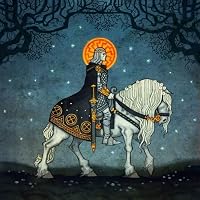
In the “universe next door” first introduced in S. M. Stirling’s The Sky People, aliens terraformed Mars (and Venus) two hundred million years ago, seeding them with life-forms from Earth. Humans didn’t suspect this until the twentieth century. Then American and Soviet probes landed on our sister worlds and found life—intelligent life, at that. By the year 2000, all the great powers of Earth are contending for influence and power amid the newly-discovered inhabitants of our sister planets.
In A.D. 2000, Jeremy Wainman is an archaeologist who has achieved a lifelong dream; to travel to Mars and explore the dead cities of the Deep Beyond, searching for the secrets of the Kings Beneath the Mountain and the fallen empire they ruled.
Teyud za-Zhalt is the Martian mercenary the Terrans hire as guide and captain of the landship Intrepid Traveler. But she conceals a secret—one that links her to the enigmatic Ancients, the Lords of Creation who reshaped the Solar System in the time of the dinosaurs.
When Jeremy and Teyud meet, the foundations of reality will be shaken—from the lost city of Rema-Dza to the courts of the Crimson Kings.
Stephen Michael Stirling is a French-born Canadian-American science fiction and fantasy author. Stirling is probably best known for his Draka series of alternate history novels and the more recent time travel/alternate history Nantucket series and Emberverse series.
MINI AUTO-BIOGRAPHY: (personal website: source)
I’m a writer by trade, born in France but Canadian by origin and American by naturalization, living in New Mexico at present. My hobbies are mostly related to the craft. I love history, anthropology and archaeology, and am interested in the sciences. The martial arts are my main physical hobby.
Even though I enjoyed The Sky People, the first novel in S.M. Stirling's duology, I was not really excited to read this book. I mean, it is a scifi novel about Mars, and my book list contains several of Edgar Rice Burroughs' books. Honestly, how can anyone top John Carter? But after finishing, I have to say that Stirling did a stupendous job of making this Mars a cool place with a haunting similarity to Barsoom, but a history and flavor all its own.
The story itself is standard pulp scifi; a continuation of the story begun in The Sky People. By 2000, both the Soviets and Americans have established small enclaves on Mars, but whereas Venus was a pristine wilderness with savage natives, Martian civilzation is millenium older than Earth's own with a very rich history. Indeed, the remnants of the world spanning Tollamune Empire still exists and functions upon the red planet, safe and secure under the gargantuam mountain called Olympus Mons. There the current emperor resides; his lordship belonging to a ruling dynasty that once ruled the whole planet and spans back thousands of years into Earth's remote past. Indeed, even in its death throws, Martian science still surpasses Earth's in such areas as genetic engineering; a skill which seemingly pervades all areas of Martian life including their weapons and landships.
Our tour guide through this ancient realm is archeologist Jeremy Wainman who has been rocketed to Mars by the U.S. Aero-Space Force; his mission to explore the lost city of Rema-Dza out in the "Great Beyond", i.e. the Martian desert. To aid Jeremy, his bosses in the USASF contracts with a female Martian mercenary, Teyud za-Zhalt, to lead the expedition and basically keep Jeremy from getting killed. Of course, while keeping Jeremy alive, our Martian mercenary falls in love with him.
But the fun doesn't stop there, because you see there is more to Teyud than meets the eye. When the expedition discovers an ancient Martian artifact at the lost city, she stops being Jeremy's lover and protector and turns into the one needing protection. From there, the book only gets better and better as political intrigue, duels, and unknown alien forces erupt in our story. And all the while, the reader gets to learn more and more about this very cool Mars and its intriguing science and history. Even the ending, though completely expected, is entertaining. My only reget as I laid the book down was that I would not read any more stories of Stirling's Mars.
Reread, and pure pleasure to read a colorful, lighthearted planetary romance after 3 or 4 dud books in a row for me. Second in Stirling's "Universe Next Door" series, a parallel-world tale (read the publisher's blurb above) that's light, easy to read and just plain fun. Pretty near perfect for a lazy summer afternoon. Not a book to try to analyze, and I won't, except to note that poor Jeremy, writhing under the cruel lash of a neural whip, promises the villain (in his head) "my girlfriend is SO going to kick your ass!" She does, after a fashion. And they live happily ever after, in a surprise ending that I'm sorry Stirling didn't follow up on. Highly recommended, for fans of updated pulp fiction.
In the Courts of the Crimson Kings, by S. M. Stirling: Stirling knocked it out of the park with this one. A wonderful revival of the Sword and Planet genre, and set on Mars no less. Great action, fantastic and wonderful characters, and a powerful ending. A truly enjoyable experience.
If you're a fan of ER Burroughs' Martian series (and I am in moderate doses), then you'll probably enjoy this latest homage to him.
Jeremy Wainman is no John Carter (or Northwest Smith or Eric John Stark, for that matter) but he's likable enough. I prefer this Mars' "Dejah Thoris" - Teyud za-Zhalt - over the original, cringing, always-being-kidnapped princess but as usual with books of this genre it's not overly strong on character development.
Stirling is much better than Burroughs at creating an alien Mars whose inhabitants are still human enough that you care for them (at least for as long as you're reading the novel).
Wow, just plain wow, one of the best new old-time SF novels I have read in years. It is filled with great ideas, good characterizations, and thrilling situations and is well written with a satisfying end. Although, it is the sequel of The Sky People and it stands alone on its own strengths. I decide not to wait to find a used copy of The Sky People and purchased one from Borders. If In the Courts of the Crimson Kings is sent in Edgar Rice Burroughs’ John Carter of Mars novels, than The Sky People is At The Earth’s Core only set on the planet Venus instead of inside the Earth. The Sky People storyline builds slowly but once it is up to speed it is like a train out of control; and it has not only a satisfying conclusion but epilogue as well.
Stirling has a knack for coming up with very cool premises for his books and series. He also then does good research on his premise, and thinks through some very cool consequences.
And despite this, his books tend to be diverting, but mediocre. He writes the same badass characters into almost every book of his that I've read. And the stories tend to run over well trodden ground. So, despite the cool premises from one book to the next, there's a kind of sameness that seems to pervade what he does.
Here, he takes us to an ancient Martian civilization. Because of the lack of fuel and uranium, the Martian technology advanced very rapidly in the bio-sciences. But it lagged considerably in the area of combustibles. He also makes the presumption that the Martian society is pretty much like a Chinese dynastic society on a very grand scale. Lineage is worshipped over all else, and the Martians are both treacherous and hyper-rational.
The story involves the quasi bastard offspring of the Emperor, her ties to an Earthling, and the pursuit of them by vying political factions. The plot moves quickly, but is basically dull. There are several times when winks at the Raiders of the Lost Ark movies, but the wink doesn't change the fact that he's pretty much writing the same thing, and not doing it as well as the first movie (though way better than Temple of Doom or the Last Crusade).
The other aspect of this book I found off-putting was the constant use of a kind of translation of the Martian demotic language. It's basically stilted, hyper-academic English in translation. A better writer could have made the language fun, or interesting, or both. Stirling tries, but I never got with the program and I just don't think he's a good enough writer to pull tis sort of thing off.
Overall, I think this is a pretty decent complement to The Sky People. But it is very thin. I've read elsewhere that this is a loving homage to Burroughs' John Carter books. Maybe so, and that put's me at a disadvantage since I haven't read them. But if so, then I feel about this sort of the way I do about Austen's Northanger Abbey. Homage, and/or satire, should stand on its own legs, and they both suffer if the derivative pleasures are the primary ones.
This would make a spectacular film, if done well. Unfortunately, it would be expensive to do well, and the book lacks the fan base of The Lord of the Rings or the Harry Potter series.
Stirling excels at scenarios, and here he's found an ingenious way to rationalize a romantic vision of Mars similar to that found in old sf: a habitable planet with deserts and canals, home to an almost-human civilization much older than ours. His alternative Mars is filled out in depth, and it’s a fascinating spectacle.
The story and the characters don’t quite live up to the setting, but both are quite competent and entertaining by normal sf standards.
This is a novel of normal size, but for me it’s too short, which is both a compliment (I’d like more of it) and a criticism (we seem to hurry through the plot a bit too fast).
Although Mars is habitable, it’s such a hostile environment in various ways that it’s rather difficult to believe individual humans being willing to move there permanently (as some do). It’s cold, it’s dry, the wildlife is very dangerous, and the Martians are dangerous too.
This is the sequel to The Sky People, but the two books are set on different planets, with mostly different characters, and rarely reference each other; so you can read this one as a standalone novel if you like. The Sky People is not a bad book, but this one is better.
Second in the LORDS OF CREATION series, this is a modern spin on what was called a "Planetary Romance" (or alternately a "Sword and Planet" story) in the 1920s-1950s, where Mars (and Venus) are able to support intelligent human-like life. Excellent worldbuilding by Stirling, who created a world hauntingly similar to Burroughs' Barsoom, but with more thought-out science, culture and history. The Martians are engaging and interesting, and their advanced biotech alternates between fascinating and creepy (and sometimes both). The author turns the "Martian Princess" trope on it's head; the main characters are a (male) Earth archaeologist and Teyud za-Zhalt, a female Martian mercenary with a significant backstory, who is DEFINATELY the tougher character. This book is set around the year 2000 (about a decade after the events if SKY PEOPLE), and contact with other habitable planets has changed Earth history since the 1950s, so the setting has some alternate history elements, but not as much as you might think. The story itself is pure pulp and very entertaining. I was NOT a huge fan of the surprise "ending after the ending" though, but, since Stirling never did a sequel, it may have been intended as a set up for some awesome further stories, so I will reserve judgement. 4 stars.
OK, Stirling finally published the final book of the series (LORDS OF CREATION) in 2025, so I'm giving this (and SKY PEOPLE) a re-read. On to LORDS OF CREATION!
Lots of fun to be had here, though the protagonist is a bit colourless - he says 'Yikes', for Pete's sake - and the real star is Thoughtful Grace Teyud za-Zhalt. The formulaic nature of Martian speech is neatly portrayed (or should I say: I express appreciative gratitude), and there is some nifty desert action. The cover illustration by Gregory Manchess is also very evocative. Downsides: the West good, Commies bad, skit rings very hollow in these more complex times; such simplicity is partly the point of such pulp-era homages, but this felt a bit too naive to stand up well. Some of the style grates at times, where the flow of the narrative was interrupted too often by the insights and internal monologues of various characters, even at moments when the focus should have been on the action. And I really disliked the sci-fi literati in-joke of the first chapter. Not Stirling's fault, but the formatting of the Tor hardcover is absymal, everything from spelling errors like 'abraid' for 'abrade' (even Noah Webster didn't sanction that one, and there were others), to inconsistences in the spelling and capitalisation of the indigenous Martian terms: vaz-Terranan appears as vas-Terranan at least once (I gave up keeping track). For us Indies, it's always a laugh to see bad editing and poor formatting in 'real books'. Overall, a decent story well carried, and a nice bit of fun. Teyud za-Zhalt also appears in a short story in Old Mars.
I think Stirling listens to King Crimson and reads a bunch of classic sci-fi about Mars. Oh yes I do. But what's come out of Stirling's head when he put this stuff all together with a lot of his own ideas is very interesting and fun.
So, like if you want to read about adventures on a Mars where there is intelligent life and similar-but-not-the-same-as-human Martians; where nearly all the tech is biotech; where a beautiful Martian princess falls in love with an earthling; and there are devices of such advanced tech as to seem magical along with a serious mystery of why things are the way they are--well, you'd love this book like I did.
This is a sequel to The Sky People which took place on Venus. It mostly stands on its own but you appreciate the story arc better if you've read The Sky People. Plus there you have dinosaurs on Venus which is also all kindsa fun.
I can't wait to read this, it has the single best title I've seen in a long time. Right away I'm drawn in, I want to know what goes on in these courts of these Crimson Kings and exactly who or what are the Crimson Kings...etc.
Well, I read it and now I know what goes on in the courts of the crimson kings. Pulse pounding action and enthrallingly good sci-fi. This was a very similar book to the first installment in the basic themes (taking pulp sci-fi ideas and elements, and meshing them with hard sci-fi logic and explanation), yet in most other ways its completely opposite. I can't really elaborate more with out giving some very cool stuff away.
This having been said, this book still has everything you loved from the first installment. Action, adventure, deadly and bizzare creatures, alien cultures, alien tech, romance, intrique, and cool alternative history. Oh, and a cave fight with Martian monsters that is not to be missed.
This was a fun little read. It was interesting to set a book in our "past" and it gave it a 1950's feel but more modern, if that makes any sense. The Martians play a game similar to chess, but they take the principles and apply them to real life. I also found the Martian society interesting and would have liked a bit more explanation and depth to that.
Criticism's include a darn romance. I just don't care for romance in my sf novels. Still, it was tolerable and didn't detract too much from the story. I had trouble swallowing it's probability - the world was set up where Martian's don't particularly like Terrans and here a tough mercenary woman falls in love with the archaeologist she's supposed to be protecting. And yes, if you are thinking Indiana Jones it was mentioned several times in the book as well.
Still the book was decent and I would consider reading S.M Stirling again.
In the second book of what I think is a duology the action moves to Mars (where Binkis traveled at the end of The Sky People) to the court of the Crimson Kings and the intrigue of the martian people. The book starts slowly, at least the first half was slow to me as I kept on expecting more connection with the first book and the pacing seemed off, perhaps because of my expectations. Where the Sky People was almost all action and the intrigue was the underlying story, this book was more about the intrigue between the martian people and the jockeying for the Throne and the action takes a necessary secondary role in the beginning. Overall a good read, Stirling paints the Martians as much more cerebral and unemotional than his Venusians contrasting the two cultures (species?) and their technology is quite different and well explained and serves as the backbone for the whole culture.
In the somewhat free-standing sequel to The Sky People, Stirling takes us to a Mars inspired by the work of Burroughs and the “science” of Percival Lowell. The arid and cold planet is nevertheless inhabited by close relatives of humans. Our hero, one of the U.S. team based on Mars, travels to a lost city on an archeological expedition. But the Martian head of the expedition team is more than she seems. Soon people are out for their heads as they are embroiled in the thick of Martian politics.
Stirling is masterful at characterizing alien cultures. Even minor dialogue lines are steeped in a deep imagined tradition. It is a pleasure to read, especially as Stirling’s unobtrusive understated humor pervades the prose. This tale of a Mars that never was but that dreamers really wished for is a great adventure yarn.
What a super book. This is a boy’s own outing to outdo them all! In the spirit of “The Peshawar Lancers”, “In the Courts of the Crimson Kings” is a parody on Burroughs but it outdoes that master of noble barbarian egg-laying princesses, green many-limbed monsters-cum-heroes and captain sensible supermen in alien environments. Stirling’s Martians are an admirable race with just that sense of aloofness and nobility yet commonsensical realism that makes me want to know one. Their language is superb! and I truly began to wish that ours also contained such lovely understatements and expressions, exuberance displayed. The story is a genuine adventure that sucks you in, absorbs you, chews you about a bit and then spits you out wanting more. You want escapist fun - read this!
the second book in the series, this one dealing with Mars. mars exists as it does now, however it has been terraformed several hundred million years ago with life from earth. More recently hominds from Earth were added to the life of Mars, and a martian civilization arose 25,000 years ago. The book paints an interesting picture of what life on Mars would be like with these, and manages to set up the potential of a sequal as well.
The best part of this book was the use of the Martian language, which after 25,000 years has evolved to a level of perfection more like a computer language.
Excellent conclusion to this duology. I wish there could be a third ... maybe harkening back to Lin Carter's Callisto series. An excellent read if you are a fan of the old Barsoomian and Carsonian novels of Edgar Rice Burroughs.
A little better than Sky people. Getting the two love interests together earlier is a major structural improvement, since the plot and the worldbuilding get to play out simultaneously. The characters are a bit more mixed. In The Sky People they were mostly shallow stereotypes, but it fit the milieu. Jeremy here is sort of bland, lacking the stereotype rudiment of a personality Marc had. He's supposedly intelligent, but he rarely draws any conclusions himself, usually having to ask others what's going on. He does have a couple of standout moments of bravery, but he's mostly sort of passive. Which is funny, because he actually fulfills the feminine prize role almost perfectly, whereas Teyud, the love interest, fits an almost perfectly generic hero's journey (royal birth under mysterious circumstances, life among commoners, call to adventure, finding an ancient treasure, confrontation with would-be usurper, reunion with father). She was definitely the more interesting of the two. The physical differences between the species do make the love story a little disconcerting - it'd be like having the hero fall in love with one of the neanderthals from the last book. They do make the point that Jeremy is very tall (by Earth standards), so it isn't quite as bad, but the disgust most of the other Martians express is pretty understandable. Humans in the eyes of the Martians are hairy, squat, disturbingly muscular, clownishly expressive, and disgustingly leaky. We're balanced out by being more creative, inquisitive, etc., but still.
The concept for the world here was great. A dying Mars, having been ruled by a single dynasty of a single world-empire for 20,000 years, with biologically based technology forming the basis of their society. Most "wildlife" are the descendants of genetically engineered domesticated animals, and the Martians are much more alien than the humans of Venus. There're tons of little asides that draw out the differences Martians and Earthlings, and their speech is very verbose (a device to convey that their language is highly precise) and somewhat Vulcan-like, combined with a human ruthlessness. Despite the added science fictional elements, the story still doesn't shy away from pulp elements, which are as well executed as before. It's a great setup where Earthlings have a technological advantage in many areas, but the Martians aren't so impressed, and keep doing things their own way. It's sort of like if space-faring chimps showed up on Earth, and they didn't know basic things about medicine and biology.
The meta-story about the ancient aliens terraforming the universe ended up kind of superfluous.
i stumbled across this book by accident, Id red the first one but was unaware of a sequel. I like a lot of Stirling's books which is why I picked it up. The book does start out a bit slow, or dry. But it does pick up by the middle and get pretty interesting. y the last quarter of the book I was pretty wrapped up it.
Another point worth mentioning is the Martian Language. At first it was off-putting and distracting fro the book. But it eventually grew on me, and I actually started looking forward to it. It was an interesting take on language in writing.
The story had some cool ideas, and themes and I could raise my raiting just for the beginning to middle story alone. It's fun and it's enjoyably paced....The final half does not hold the same sentiments as it has no care on how to progress, or clue where it's going and stumbles all the way to the last sentence...Essentially you have characters stop being characters, and they just need to figure out how to get to the end of the story...Also it's unfortunate, but the story feels like multiple writers wrote the book as many ideas or plots feel they belonged in different stories.
“In the Court of the Crimson Kings” is the 2nd novel in, S. M. Stirling’s “Lords of Creation” series. In the US and Russia discovered human life on Venus and Mars in the 1960’s. It is now the year 2000 and we have colonies on both planets and have learned that an ancient race had seeded the planets with human and animal ancestors. Mars had a great planetary empire which has all but disappeared. A human scientist and a Martian mercenary will discover secrets and power in the Court of the Crimson Kings.
On the planet Mars in the year 2000, Terran archeologists hire Martian mercenary Teyud Zha-Zhalt as guide and captain of the landship Intrepid Traveller. A secret links her to the deadly intrigues of Dvor il-Adazar, the City That Is A Mountain, where the last aging descendant of the Tollamune Emperors clings to the remnants of his power…and secrets that may trace their origin to the enigmatic Ancients, the Lords of Creation who reshaped the Solar System in the time of the dinosaurs.
Maybe it's just the audiobook, but it was hard for me to follow who was doing/saying what. It's an interesting alternative history sci-fi, but not my favorite genre. I liked the Venus book better because you weren't sure where it was going. This one was the "same thing only different" and not much different.
I really enjoyed the way this story acknowledges the science fiction past and the interaction between science fiction and the broader culture it inhabits. And on top of this, it's a straight-up rollicking good yarn. In a way that I find more reminiscent of Heinlein than other work by Stirling.
Stopped reading 1/4 way through. it's hard to remember the characters, none of them draw you in, and it's pacing isn't on par with sci-fi writing, I found myself Wonder off in thoughts rather than focus on the book. I picked up a Ian Flemming book instead.
Another solid by Burroughs-esk adventure set in an alternative universe where Venus. Earth and Mars are inhabited with life. The culture of Mars that is presented is very interesting, and the protagonist from Earths efforts to navigate the politics of the Crimson Throne is very cool.
Interesting follow up Sky People. While overall not bad, but I had a hard time staying as engaged or connected with the characters as I did in the previous book. I think part of it was the way the Martians spoke threw me off. In any case, looking forward to the next book.