

What do you think?

Wilson
From Pulitzer Prize–winning, #1 New York Times–bestselling author A. Scott Berg comes the definitive—and revelatory—biography of one of the great American figures of modern times.
One hundred years after his inauguration, Woodrow Wilson still stands as one of the most influential figures of the twentieth century, and one of the most enigmatic. And now, after more than a decade of research and writing, Pulitzer Prize-winning author A. Scott Berg has completed Wilson--the most personal and penetrating biography ever written about the 28th President.
In addition to the hundreds of thousands of documents in the Wilson Archives, Berg was the first biographer to gain access to two recently-discovered caches of papers belonging to those close to Wilson. From this material, Berg was able to add countless details--even several unknown events--that fill in missing pieces of Wilson’s character and cast new light on his entire life.
From the scholar-President who ushered the country through its first great world war to the man of intense passion and turbulence , from the idealist determined to make the world “safe for democracy” to the stroke-crippled leader whose incapacity and the subterfuges around it were among the century’s greatest secrets, the result is an intimate portrait written with a particularly contemporary point of view – a book at once magisterial and deeply emotional about the whole of Wilson’s life, accomplishments, and failings. This is not just Wilson the icon – but Wilson the man.
One hundred years after his inauguration, Woodrow Wilson still stands as one of the most influential figures of the twentieth century, and one of the most enigmatic. And now, after more than a decade of research and writing, Pulitzer Prize-winning author A. Scott Berg has completed Wilson--the most personal and penetrating biography ever written about the 28th President.
In addition to the hundreds of thousands of documents in the Wilson Archives, Berg was the first biographer to gain access to two recently-discovered caches of papers belonging to those close to Wilson. From this material, Berg was able to add countless details--even several unknown events--that fill in missing pieces of Wilson’s character and cast new light on his entire life.
From the scholar-President who ushered the country through its first great world war to the man of intense passion and turbulence , from the idealist determined to make the world “safe for democracy” to the stroke-crippled leader whose incapacity and the subterfuges around it were among the century’s greatest secrets, the result is an intimate portrait written with a particularly contemporary point of view – a book at once magisterial and deeply emotional about the whole of Wilson’s life, accomplishments, and failings. This is not just Wilson the icon – but Wilson the man.
818 pages, Hardcover
First published September 10, 2013
Ratings & Reviews
Friends & Following
Create a free account to discover what your friends think of this book!
Community Reviews
Displaying 1 - 30 of 549 reviews

August 9, 2021
“In asking his countrymen to engage in this first World War, [President Woodrow Wilson] had insisted that Americans were fighting for what he called a ‘peace without victory.’ Feeling as right as he was righteous, he hoped to show the world that foreign policy might have a moral component as well as political or economic objectives. ‘Never before in the history of mankind,’ [University of Virginia President] Edwin Alderman noted, ‘has a statesman of the first order made the humble doctrine of humanity a cardinal and guiding principle of world politics.’ Nor had any President ever suppressed free speech to so great an extent in order to realize his principles. The first sitting President to leave the territorial United States, ‘he enjoyed a prestige and moral influence throughout the world unequaled in history,’ said John Maynard Keynes, a young economist who was part of the British delegation to the [Versailles] peace talks. Indeed, concurred his colleague Harold Nicholson, Wilson came ‘armed with power such as no man in history had possessed: he had come fired with high ideals such as have inspired no autocrat of the past…’”
- A. Scott Berg, Wilson
When we judge American presidents, we usually sort them into two columns labeled “best” and “worst.” Perhaps a better column would be “impactful.”
If you were to make such a list, Thomas Woodrow Wilson would have to be at the top of it. In his eight years in office, he left a mark.
More than that, Wilson – unlike some of our most famous presidents – was not simply reacting to events, but charting a forward path based in large measure on his own will. Specifically, his decision to seek entry into the First World War – a European power struggle that only indirectly affected American interests – changed the course of history in profound ways.
A. Scott Berg’s Wilson is a hefty biography of an inordinately momentous life. Perhaps the best way to tackle it is to lay out the five things I look for in biographies: veracity; comprehensiveness; surrounding context; analysis; and literary merit.
***
Fundamentally, veracity is both the most obvious and most important aspect of a work of history. You want to know that what you’re reading is based on documentary facts. If “objective truth” itself is an impossible standard, there must at least be an evidentiary basis for what’s on the page.
I had no issues with Wilson on this score. Berg is a Pulitzer Prize-winning author, and he has done his homework here. Though he is not infallible – he failed to discover Charles Lindbergh’s additional German families in his bio on the famed aviator – I didn’t recognize any gaps, and the book is thoroughly sourced.
***
As to comprehensiveness, this category comes with a major caveat: a single volume cannot come close to capturing the entire scope of a person’s life, especially not one of such world-historical interest. At over 800 pages of text, though, Berg certainly gives a good effort.
This is a standard cradle-to-grave biography, told chronologically without any unnecessary ruffles or flourishes. Berg provides an unusually deep look at Wilson’s childhood, reflecting on his upbringing amid a defeated nation, to wit: the post-Civil War American South. He also thoroughly covers Wilson’s schooling, his early courtships, and the somewhat aimless career drift that is familiar to many young adults. Though this is slow reading, I appreciated it, because it provides an excellent sense of Wilson’s development. His self-righteousness, rectitude, and moralizing were all traits that developed young (as did his inclination towards writing saucy letters to the women he loved).
For obvious reasons, Wilson’s role as a wartime commander-in-chief – and later, as the proponent of the League of Nations – gets the most attention. Still, Berg does not neglect other aspects of his presidency, including the ambitious domestic agenda he set early in his administration.
The downside in trying to touch on just about everything, though, is that some topics don’t get nearly enough play. For example, while Berg gives a brief rundown on the Sedition Act of 1918 (and notes Eugene Debs’s imprisonment for having an opinion), it is not nearly enough to convey the tremendously unconstitutional – and un-American – nature of the legislation, or Wilson’s full-throated support for it.
***
Context is what suffers most in a single-volume biography. By the end pages, Wilson himself is fully revealed. The same cannot be said for the people in his orbit. Though Berg does a fine job sketching Edith Boling, his second wife, many other fascinating figures are only thinly drawn. Big personalities – such as Edward “Colonel” House and William Jennings Bryan – simply aren’t given enough space to become true characters in this drama.
The same holds true for larger world events. The prime example is Berg’s coverage of World War I, a complex geopolitical web that gets very little by way of explanation.
Like I said, however, this is to be expected. This is already a very long book, and there’s just no way that Berg adequately encompass it all. It’s for this reason that I vastly prefer multi-volume biographies, so that we can understand both the person and their times.
***
Related to context is the issue of analysis. While I appreciate an author giving me space to form my own perceptions, I also want – and expect – an expert opinion that scrutinizes, weighs, and ultimately judges the actions of the biographical subject.
Wilson is mostly a narrative in which the flow of the story takes precedence over an examination of Wilson’s thoughts, words, and deeds. This is not to say that Berg is completely out-of-sight. He does occasionally interrupt the proceedings to provide some commentary. For example, Berg is rightly critical of Wilson’s racial views, dubbing him a “genteel racist” and faulting him for re-segregating the federal bureaucracy, thereby closing off to black Americans one of the few governmental career paths open to them. Berg is also scathing regarding Wilson’s determination to hold onto the reins of power, even after suffering a major stroke that left him mostly incapacitated from September 1919 to the end of his term in 1921. During this interim, Edith Wilson and Dr. Cary Grayson (Wilson’s personal physician) tried to cover up the President’s illness and essentially took over the running of the White House, sidelining the Vice President in a breathtaking usurpation power.
At other points, though, Berg does not look deep enough. Wilson’s volte-face regarding World War I – keeping the U.S. out, then plunging in – was hugely consequential, yet Berg never investigates the President’s shifting views, his motivations, or all the variables at play. Indeed, the lasting image from Wilson is of a distracted President of the United States too busy writing horn-dog letters to Edith Bolling to pay attention to events in Europe.
***
The final category by which I rank biographies is literary merit. Wilson has that. Though Berg does not have the high style and prose of – for instance – Robert Caro, he is good at marshaling information, delivering an organized and coherent presentation, and giving the reader a real feel for Wilson as a man. By the final page, I sensed what it would have been like to share the same room as him.
***
So, how would it have felt to stand before Woodrow Wilson?
When seeking the final word on the 28th President, it is important to separate the concepts of “goodness” and “greatness.”
I don’t think Wilson was a “good” man. In fact, he kind of seems like a horse’s ass. He was an unreconstructed Southerner with a racist worldview that never acknowledged the first step towards change, which is changing yourself. Throughout his life, many people who met him used the same word to describe him: a “hater.” Prickly and petulant, if you crossed Woodrow Wilson once, he never forgave you. And since Wilson was – in his own estimation – always right, it was exceedingly easy to cross him. Those who admire Wilson see him as a man of principle. But as with many such men, he was also a glaring hypocrite, who found it easy to dispose of or repurpose his ideals as the situation warranted. Finally, Wilson was stubborn and inflexible, unwilling to compromise. It was this rigid inflexibility that ensured that America would never ratify the Treaty of Versailles, keeping the country out of Wilson’s beloved League of Nations. He was strikingly childish in this regard, forsaking a piece of the pie because he could not have the whole.
In other words, I don’t think I could’ve stood in his presence much longer than thirty seconds.
The question of “greatness” is another one entirely, separate and distinct from whether Wilson was a decent human being. Of his greatness there can be no doubt. Wilson had enormous influence on events, bending both America and the world to his vision. Whether or not he was always – or even mostly – right, Wilson changed the course of history. His choice to tip the scales of World War I, his actions during the Paris peace conference, and his intransigence following Versailles, all helped set the stage for the second half of a tumultuous century.
- A. Scott Berg, Wilson
When we judge American presidents, we usually sort them into two columns labeled “best” and “worst.” Perhaps a better column would be “impactful.”
If you were to make such a list, Thomas Woodrow Wilson would have to be at the top of it. In his eight years in office, he left a mark.
More than that, Wilson – unlike some of our most famous presidents – was not simply reacting to events, but charting a forward path based in large measure on his own will. Specifically, his decision to seek entry into the First World War – a European power struggle that only indirectly affected American interests – changed the course of history in profound ways.
A. Scott Berg’s Wilson is a hefty biography of an inordinately momentous life. Perhaps the best way to tackle it is to lay out the five things I look for in biographies: veracity; comprehensiveness; surrounding context; analysis; and literary merit.
***
Fundamentally, veracity is both the most obvious and most important aspect of a work of history. You want to know that what you’re reading is based on documentary facts. If “objective truth” itself is an impossible standard, there must at least be an evidentiary basis for what’s on the page.
I had no issues with Wilson on this score. Berg is a Pulitzer Prize-winning author, and he has done his homework here. Though he is not infallible – he failed to discover Charles Lindbergh’s additional German families in his bio on the famed aviator – I didn’t recognize any gaps, and the book is thoroughly sourced.
***
As to comprehensiveness, this category comes with a major caveat: a single volume cannot come close to capturing the entire scope of a person’s life, especially not one of such world-historical interest. At over 800 pages of text, though, Berg certainly gives a good effort.
This is a standard cradle-to-grave biography, told chronologically without any unnecessary ruffles or flourishes. Berg provides an unusually deep look at Wilson’s childhood, reflecting on his upbringing amid a defeated nation, to wit: the post-Civil War American South. He also thoroughly covers Wilson’s schooling, his early courtships, and the somewhat aimless career drift that is familiar to many young adults. Though this is slow reading, I appreciated it, because it provides an excellent sense of Wilson’s development. His self-righteousness, rectitude, and moralizing were all traits that developed young (as did his inclination towards writing saucy letters to the women he loved).
For obvious reasons, Wilson’s role as a wartime commander-in-chief – and later, as the proponent of the League of Nations – gets the most attention. Still, Berg does not neglect other aspects of his presidency, including the ambitious domestic agenda he set early in his administration.
The downside in trying to touch on just about everything, though, is that some topics don’t get nearly enough play. For example, while Berg gives a brief rundown on the Sedition Act of 1918 (and notes Eugene Debs’s imprisonment for having an opinion), it is not nearly enough to convey the tremendously unconstitutional – and un-American – nature of the legislation, or Wilson’s full-throated support for it.
***
Context is what suffers most in a single-volume biography. By the end pages, Wilson himself is fully revealed. The same cannot be said for the people in his orbit. Though Berg does a fine job sketching Edith Boling, his second wife, many other fascinating figures are only thinly drawn. Big personalities – such as Edward “Colonel” House and William Jennings Bryan – simply aren’t given enough space to become true characters in this drama.
The same holds true for larger world events. The prime example is Berg’s coverage of World War I, a complex geopolitical web that gets very little by way of explanation.
Like I said, however, this is to be expected. This is already a very long book, and there’s just no way that Berg adequately encompass it all. It’s for this reason that I vastly prefer multi-volume biographies, so that we can understand both the person and their times.
***
Related to context is the issue of analysis. While I appreciate an author giving me space to form my own perceptions, I also want – and expect – an expert opinion that scrutinizes, weighs, and ultimately judges the actions of the biographical subject.
Wilson is mostly a narrative in which the flow of the story takes precedence over an examination of Wilson’s thoughts, words, and deeds. This is not to say that Berg is completely out-of-sight. He does occasionally interrupt the proceedings to provide some commentary. For example, Berg is rightly critical of Wilson’s racial views, dubbing him a “genteel racist” and faulting him for re-segregating the federal bureaucracy, thereby closing off to black Americans one of the few governmental career paths open to them. Berg is also scathing regarding Wilson’s determination to hold onto the reins of power, even after suffering a major stroke that left him mostly incapacitated from September 1919 to the end of his term in 1921. During this interim, Edith Wilson and Dr. Cary Grayson (Wilson’s personal physician) tried to cover up the President’s illness and essentially took over the running of the White House, sidelining the Vice President in a breathtaking usurpation power.
At other points, though, Berg does not look deep enough. Wilson’s volte-face regarding World War I – keeping the U.S. out, then plunging in – was hugely consequential, yet Berg never investigates the President’s shifting views, his motivations, or all the variables at play. Indeed, the lasting image from Wilson is of a distracted President of the United States too busy writing horn-dog letters to Edith Bolling to pay attention to events in Europe.
***
The final category by which I rank biographies is literary merit. Wilson has that. Though Berg does not have the high style and prose of – for instance – Robert Caro, he is good at marshaling information, delivering an organized and coherent presentation, and giving the reader a real feel for Wilson as a man. By the final page, I sensed what it would have been like to share the same room as him.
***
So, how would it have felt to stand before Woodrow Wilson?
When seeking the final word on the 28th President, it is important to separate the concepts of “goodness” and “greatness.”
I don’t think Wilson was a “good” man. In fact, he kind of seems like a horse’s ass. He was an unreconstructed Southerner with a racist worldview that never acknowledged the first step towards change, which is changing yourself. Throughout his life, many people who met him used the same word to describe him: a “hater.” Prickly and petulant, if you crossed Woodrow Wilson once, he never forgave you. And since Wilson was – in his own estimation – always right, it was exceedingly easy to cross him. Those who admire Wilson see him as a man of principle. But as with many such men, he was also a glaring hypocrite, who found it easy to dispose of or repurpose his ideals as the situation warranted. Finally, Wilson was stubborn and inflexible, unwilling to compromise. It was this rigid inflexibility that ensured that America would never ratify the Treaty of Versailles, keeping the country out of Wilson’s beloved League of Nations. He was strikingly childish in this regard, forsaking a piece of the pie because he could not have the whole.
In other words, I don’t think I could’ve stood in his presence much longer than thirty seconds.
The question of “greatness” is another one entirely, separate and distinct from whether Wilson was a decent human being. Of his greatness there can be no doubt. Wilson had enormous influence on events, bending both America and the world to his vision. Whether or not he was always – or even mostly – right, Wilson changed the course of history. His choice to tip the scales of World War I, his actions during the Paris peace conference, and his intransigence following Versailles, all helped set the stage for the second half of a tumultuous century.

November 26, 2020
”The future is not for parties ‘playing politics,’ but for measures conceived in the largest spirit, pushed by parties whose leaders are statesmen, not demagogues, who love not their offices, but their duty and their opportunity for service.”---Woodrow Wilson

Woodrow Wilson was the eighth and last president from the state of Virginia. Ohio also can claim eight presidents, of whom four died in office. Only eight presidents have died in office so there is something extremely unlucky about winning the presidency from the great state of Ohio. Warren G. Harding, who assumed the presidency after Wilson, was the eighth and final president from Ohio and also was one of the men who died in office. It is interesting that the streaks for the two states who produced the most presidents ended within a matter of years of one another. Maybe the American public put two and two together to equal four and realized that, odds were, voting for another Ohio man for president was dooming the candidate to death.
I started reading this book because, after surviving the 2020 election, at least I think I have survived it, I was really wanting to read a presidential book, and Obama’s book release was still weeks away. I scanned my shelves and skipped quickly over Reagan, Nixon, and Coolidge. I wasn’t in the mood (the last four years have cured me of some of that interest) for dissecting Republican neurosis. I nearly decided to start the four, rather large volumes of the Caro LBJ biographies, but Wilson by A. Scott Berg caught my eye. Compared to the Caro books, the Berg book is a tidy 743 pages of what I hoped would be some escape from the crazed political environment of today. Of course, the Republicans were mucking about even back in the early twentieth century. Henry Cabot Lodge was gleefully trying to undermine everything that Woodrow Wilson attempted to do, including striking down the treaty that ended WW1 and he ensured as well that America would not join the League of Nations, which had a long lasting impact on world events, including, quite possibly, contributing to WW2.
Wilson was a very popular president with the American people. If not for ill health, I do believe that Wilson would have run for a third term. Despite the dire news on his medical chart, he did contemplate the idea. He was incapacitated, okay we might be able to use the word nearly incapacitated, by a stroke in his final term, leading many to call his wife Edith the first female president of the United States. I’m a Wilson fan, but I have to tell you that he should have stepped down from office. He had recovered enough to walk and talk, and most of his razor wit had returned by the time the 1920 election season rolled around, but fortunately, common sense won out over another grueling election.
”Seldom in the nation’s history had the change in government swung so far in the opposite direction.” Berg is talking of course about 1920, but for a moment there I thought he was talking about 2016. It was baffling to think that, after the vast popularity for our arguably most well-educated president, we would choose to elect, as Alice Roosevelt referred to him,...a slob. Warren G. Harding was enjoying life, drinking, gambling, and chasing skirts. He wasn’t really that interested in being president, but the powers that be in the Republican party selected him because he...looked presidential.
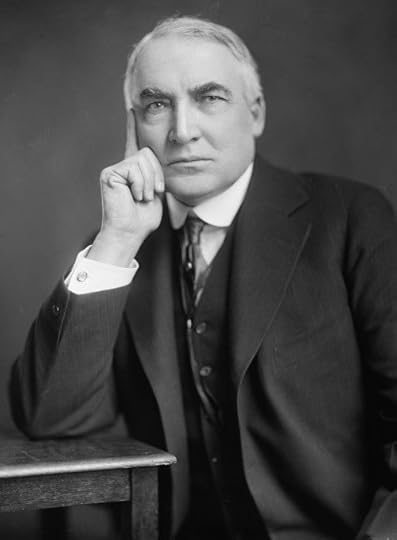
He did have a bit of the look of Roman Caesar about him, but below the face he was an empty suit. Henry Ford, after meeting him, decided that he was going to have to run for president in 1924 just to remove this immoral, useless man from office. Harding’s first order of business was to undo everything that Wilson ever accomplished. Sound familiar? The voting American public is certainly schizophrenic. They were thrilled with Wilson, but then voted for someone diametrically opposed to everything Wilson stood for. They were thrilled with Barack Obama, but then voted in...what’s his name? Can we erase history and chisel his name off everything in the tradition of the pharaohs of Egypt? Certainly, Harding and _____ tried to do that.
I was surprised to learn that Wilson was a great orator. I had always thought of him as this stiff academic. When he was a teacher at Princeton, he was the most popular lecturer. It wasn’t abnormal for his lessons to end to the sound of applause from his highly engaged students. One of his favorite sayings was,” Don’t learn history, learn from history.” He encouraged his students to place themselves in history, think about what they would have done, what they would have supported. I love to personally do that as well, and it certainly increases my enjoyment with any history book I read. When he became president of Princeton, he tried to turn the school back to a focus on learning instead of an obsession with social clubs. It was turning into a place to meet future powerful people, rather than to get an education. I think we can certainly agree that our institutes of higher learning have become too focused on the social aspects of college.
When he was president, he continued to use those oratory skills to override Republican opposition. If not for his health that derailed his cross country train trip to raise support for the treaty and the League of Nations, I have a feeling he might have forced Lodge to support both. Women finally achieved the right to vote in 1920, under his administration. Wilson deftly used their sacrifices and their contribution to the war effort to convince enough elected officials to finally get them the vote. It should have happened earlier in his administration, but thank goodness this was done before the beginning of a decade of Republican presidents. Otherwise, women might have had to wait until FDR was elected in 1933.
Wilson vetoed the Volstead Act, but Congress overrode his veto, ushering in yet another disastrous Republican policy that opened our country up to organized crime and spawned a generation of dedicated drinkers. There is a lot to love about Wilson, but one place that he really failed to come up to the mark was on Civil Rights. He was a man of Dixie, and like most men of his era, his speech was littered with racist allusions. For all that, black men in the South voted in great numbers for him. They saw that, despite his heritage, he was still a better choice for them. I wish that he had used WW1 to desegregate the armed forces, but he was too unsure of his position. He ran in 1916 with the slogan...he kept us out of war, then he promptly got us in the war in Europe. The Republicans were against going across the pond to fight, in their minds, a European war. When Wilson gave his rousing speech to convince Congress to vote for war, he found the excessive applause... heinous. He wept over his message of death.
It wasn’t until 1948 that another Democratic president, Harry S. Truman, desegregated the armed forces.
Wilson was quite the amorous man. As a young man he fell in love fast and hard and was so dedicated to winning a wife that he sent more than one scurrying away to the hills. He loved his first wife Ellen dearly and wrote her love letters long after the ardor of first love should have cooled. Whenever they were parted, he would write her salacious notes, not only of his love, but of his desire for her. One of my favorite lines from one of his letters was: ”Are you prepared for the storm of love making with which you will be assailed?”
Goodness Professor!
He was a man of grand passions, not only politically but also between the bedsheets. It was fascinating to discover a much more interesting, much more human person, behind the stuffy, academic persona.
So I came away from the biography with a more balanced view of Wilson. He was a much more complicated man than I first thought. I can’t help speculating, by taking Wilson’s own advice regarding history to heart, about what would have happened in the 1920 election if a healthy Wilson had been pitted against Harding. It’s difficult to know how many votes he would have lost from entering the war, but it never hurts to win a war in American politics. I think it would have been a close election; certainly, Harding would not have won by a landslide, like he did against Cox. I believe Wilson would have won his third term, and America would have been spared the disaster of Harding. If we take it a step further, in what universe would _____ have defeated Obama? Hopefully, not this one, but who knows? The schizophrenia of American voters is certainly hard to predict.
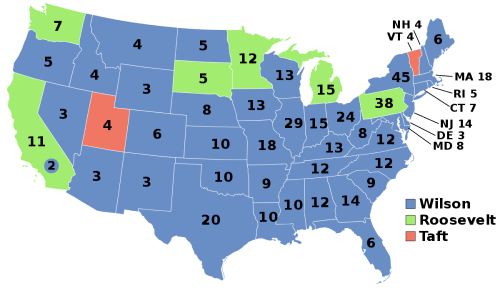
1912 Electoral Presidential map. It was a three way race with Roosevelt, unhappy with his picked successor Taft, deciding to run as an “independent” candidate.
Do take a few minutes and look up the electoral maps of Presidential elections from 1912 to the present and marvel at the changes. Wilson was looking at an entirely different path to the White House than Joseph R. Biden. I do believe that we may be on the cusp of seeing a very different map in 2024 and 2028, compared to 2020.
If you wish to see more of my most recent book and movie reviews, visit http://www.jeffreykeeten.com
I also have a Facebook blogger page at:https://www.facebook.com/JeffreyKeeten and an Instagram account https://www.instagram.com/jeffreykeeten/
Woodrow Wilson was the eighth and last president from the state of Virginia. Ohio also can claim eight presidents, of whom four died in office. Only eight presidents have died in office so there is something extremely unlucky about winning the presidency from the great state of Ohio. Warren G. Harding, who assumed the presidency after Wilson, was the eighth and final president from Ohio and also was one of the men who died in office. It is interesting that the streaks for the two states who produced the most presidents ended within a matter of years of one another. Maybe the American public put two and two together to equal four and realized that, odds were, voting for another Ohio man for president was dooming the candidate to death.
I started reading this book because, after surviving the 2020 election, at least I think I have survived it, I was really wanting to read a presidential book, and Obama’s book release was still weeks away. I scanned my shelves and skipped quickly over Reagan, Nixon, and Coolidge. I wasn’t in the mood (the last four years have cured me of some of that interest) for dissecting Republican neurosis. I nearly decided to start the four, rather large volumes of the Caro LBJ biographies, but Wilson by A. Scott Berg caught my eye. Compared to the Caro books, the Berg book is a tidy 743 pages of what I hoped would be some escape from the crazed political environment of today. Of course, the Republicans were mucking about even back in the early twentieth century. Henry Cabot Lodge was gleefully trying to undermine everything that Woodrow Wilson attempted to do, including striking down the treaty that ended WW1 and he ensured as well that America would not join the League of Nations, which had a long lasting impact on world events, including, quite possibly, contributing to WW2.
Wilson was a very popular president with the American people. If not for ill health, I do believe that Wilson would have run for a third term. Despite the dire news on his medical chart, he did contemplate the idea. He was incapacitated, okay we might be able to use the word nearly incapacitated, by a stroke in his final term, leading many to call his wife Edith the first female president of the United States. I’m a Wilson fan, but I have to tell you that he should have stepped down from office. He had recovered enough to walk and talk, and most of his razor wit had returned by the time the 1920 election season rolled around, but fortunately, common sense won out over another grueling election.
”Seldom in the nation’s history had the change in government swung so far in the opposite direction.” Berg is talking of course about 1920, but for a moment there I thought he was talking about 2016. It was baffling to think that, after the vast popularity for our arguably most well-educated president, we would choose to elect, as Alice Roosevelt referred to him,...a slob. Warren G. Harding was enjoying life, drinking, gambling, and chasing skirts. He wasn’t really that interested in being president, but the powers that be in the Republican party selected him because he...looked presidential.
He did have a bit of the look of Roman Caesar about him, but below the face he was an empty suit. Henry Ford, after meeting him, decided that he was going to have to run for president in 1924 just to remove this immoral, useless man from office. Harding’s first order of business was to undo everything that Wilson ever accomplished. Sound familiar? The voting American public is certainly schizophrenic. They were thrilled with Wilson, but then voted for someone diametrically opposed to everything Wilson stood for. They were thrilled with Barack Obama, but then voted in...what’s his name? Can we erase history and chisel his name off everything in the tradition of the pharaohs of Egypt? Certainly, Harding and _____ tried to do that.
I was surprised to learn that Wilson was a great orator. I had always thought of him as this stiff academic. When he was a teacher at Princeton, he was the most popular lecturer. It wasn’t abnormal for his lessons to end to the sound of applause from his highly engaged students. One of his favorite sayings was,” Don’t learn history, learn from history.” He encouraged his students to place themselves in history, think about what they would have done, what they would have supported. I love to personally do that as well, and it certainly increases my enjoyment with any history book I read. When he became president of Princeton, he tried to turn the school back to a focus on learning instead of an obsession with social clubs. It was turning into a place to meet future powerful people, rather than to get an education. I think we can certainly agree that our institutes of higher learning have become too focused on the social aspects of college.
When he was president, he continued to use those oratory skills to override Republican opposition. If not for his health that derailed his cross country train trip to raise support for the treaty and the League of Nations, I have a feeling he might have forced Lodge to support both. Women finally achieved the right to vote in 1920, under his administration. Wilson deftly used their sacrifices and their contribution to the war effort to convince enough elected officials to finally get them the vote. It should have happened earlier in his administration, but thank goodness this was done before the beginning of a decade of Republican presidents. Otherwise, women might have had to wait until FDR was elected in 1933.
Wilson vetoed the Volstead Act, but Congress overrode his veto, ushering in yet another disastrous Republican policy that opened our country up to organized crime and spawned a generation of dedicated drinkers. There is a lot to love about Wilson, but one place that he really failed to come up to the mark was on Civil Rights. He was a man of Dixie, and like most men of his era, his speech was littered with racist allusions. For all that, black men in the South voted in great numbers for him. They saw that, despite his heritage, he was still a better choice for them. I wish that he had used WW1 to desegregate the armed forces, but he was too unsure of his position. He ran in 1916 with the slogan...he kept us out of war, then he promptly got us in the war in Europe. The Republicans were against going across the pond to fight, in their minds, a European war. When Wilson gave his rousing speech to convince Congress to vote for war, he found the excessive applause... heinous. He wept over his message of death.
It wasn’t until 1948 that another Democratic president, Harry S. Truman, desegregated the armed forces.
Wilson was quite the amorous man. As a young man he fell in love fast and hard and was so dedicated to winning a wife that he sent more than one scurrying away to the hills. He loved his first wife Ellen dearly and wrote her love letters long after the ardor of first love should have cooled. Whenever they were parted, he would write her salacious notes, not only of his love, but of his desire for her. One of my favorite lines from one of his letters was: ”Are you prepared for the storm of love making with which you will be assailed?”
Goodness Professor!
He was a man of grand passions, not only politically but also between the bedsheets. It was fascinating to discover a much more interesting, much more human person, behind the stuffy, academic persona.
So I came away from the biography with a more balanced view of Wilson. He was a much more complicated man than I first thought. I can’t help speculating, by taking Wilson’s own advice regarding history to heart, about what would have happened in the 1920 election if a healthy Wilson had been pitted against Harding. It’s difficult to know how many votes he would have lost from entering the war, but it never hurts to win a war in American politics. I think it would have been a close election; certainly, Harding would not have won by a landslide, like he did against Cox. I believe Wilson would have won his third term, and America would have been spared the disaster of Harding. If we take it a step further, in what universe would _____ have defeated Obama? Hopefully, not this one, but who knows? The schizophrenia of American voters is certainly hard to predict.
1912 Electoral Presidential map. It was a three way race with Roosevelt, unhappy with his picked successor Taft, deciding to run as an “independent” candidate.
Do take a few minutes and look up the electoral maps of Presidential elections from 1912 to the present and marvel at the changes. Wilson was looking at an entirely different path to the White House than Joseph R. Biden. I do believe that we may be on the cusp of seeing a very different map in 2024 and 2028, compared to 2020.
If you wish to see more of my most recent book and movie reviews, visit http://www.jeffreykeeten.com
I also have a Facebook blogger page at:https://www.facebook.com/JeffreyKeeten and an Instagram account https://www.instagram.com/jeffreykeeten/

August 28, 2013
I have a hard time expressing in words what this book is doing to me. There is absolutely no way Wilson (1856-12924, the 28th President of the United States) can put someone to sleep. It is not dry. It is so emotionally engaging that it is literally tearing me apart.
I am torn apart not only by what happens to a man, who just happens to be a political figure, but also by the negotiations leading up to the Treaty of Versailles and by the failure of the US Congress to ratify the treaty that was eventually signed. (You think WW1 is bad, well wait for the debacle that follows!) I knew the bare facts before picking up the book, but now I know them emotionally. Wilson's battle has become my battle. I am infuriated by the demands made by the Allied Powers during the four months leading up to the actual signing of the treaty. I am infuriated by what the Republican Party did while Wilson was in France getting the treaty signed. After the signing of the treaty, do you know why the League of Nations was never endorsed by the US? Are you aware of Wilson's medical condition when he fought his battle against the Republican Senate? Keep in mind that Wilson never wanted to go to war.
Intellectually, there is an interesting question to consider. At what point does a president's health make him no longer able to continue in his role as president?
So much is covered in this book. The suffrage movement, religious and racist inequalities, tariff controls, antitrust legislation, pedagogy and of course the man Wilson, his family relationships, his beliefs and choices. I believe I know now who Wilson was, not only what he did but also how he thought and emotionally reacted.
The author does not shy from the truth. Wilson is portrayed without bias - his faults, his errors, his weaknesses and his strengths. He was from the South, and this shows. Today his views would have to be considered racist. He didn’t forgive easily.
Religion and health and idealism figure in strongly in the story of this man's life.
There is humor too. The author has included some fabulous lines, things that real people have said – a line by Teddy Roosevelt’s daughter, Alice, had me laughing. It was her view on the incoming President Harding.
This is a long book. The audiobook is 32.5 hours long! It is thorough. I sat glued to it. It gets better and better the further you get into it. The narration by Jeremy Bobb is just wonderful. He reads clearly and at a speed that gives you time to think. Only occasionally did I have to rewind.
This is one of my few five star books. It is one of those non-fiction books that people who dislike non-fiction should try. I cannot imagine a reader not being moved. A book of non-fiction can certainly be as engaging as a book of fiction. This book proves the point. Rarely is even a book of fiction this engaging. Fiction is based on how people have experienced real life; it is a step removed. If you find non-fiction dry, please try this one. You may change your mind.
This man fought for what he believed in.
I am torn apart not only by what happens to a man, who just happens to be a political figure, but also by the negotiations leading up to the Treaty of Versailles and by the failure of the US Congress to ratify the treaty that was eventually signed. (You think WW1 is bad, well wait for the debacle that follows!) I knew the bare facts before picking up the book, but now I know them emotionally. Wilson's battle has become my battle. I am infuriated by the demands made by the Allied Powers during the four months leading up to the actual signing of the treaty. I am infuriated by what the Republican Party did while Wilson was in France getting the treaty signed. After the signing of the treaty, do you know why the League of Nations was never endorsed by the US? Are you aware of Wilson's medical condition when he fought his battle against the Republican Senate? Keep in mind that Wilson never wanted to go to war.
Intellectually, there is an interesting question to consider. At what point does a president's health make him no longer able to continue in his role as president?
So much is covered in this book. The suffrage movement, religious and racist inequalities, tariff controls, antitrust legislation, pedagogy and of course the man Wilson, his family relationships, his beliefs and choices. I believe I know now who Wilson was, not only what he did but also how he thought and emotionally reacted.
The author does not shy from the truth. Wilson is portrayed without bias - his faults, his errors, his weaknesses and his strengths. He was from the South, and this shows. Today his views would have to be considered racist. He didn’t forgive easily.
Religion and health and idealism figure in strongly in the story of this man's life.
There is humor too. The author has included some fabulous lines, things that real people have said – a line by Teddy Roosevelt’s daughter, Alice, had me laughing. It was her view on the incoming President Harding.
This is a long book. The audiobook is 32.5 hours long! It is thorough. I sat glued to it. It gets better and better the further you get into it. The narration by Jeremy Bobb is just wonderful. He reads clearly and at a speed that gives you time to think. Only occasionally did I have to rewind.
This is one of my few five star books. It is one of those non-fiction books that people who dislike non-fiction should try. I cannot imagine a reader not being moved. A book of non-fiction can certainly be as engaging as a book of fiction. This book proves the point. Rarely is even a book of fiction this engaging. Fiction is based on how people have experienced real life; it is a step removed. If you find non-fiction dry, please try this one. You may change your mind.
This man fought for what he believed in.

July 15, 2015
Woodrow Wilson's rise to power must surely be the most vertiginous of any US leader. In October of 1910 he was still a middle-aged career academic, who had probably already suffered at least one minor stroke and who had never even run for public office. In November 1912, he was elected President of the United States.
It was a trajectory that brought its advantages and its disadvantages. His total lack of any grounding in practical politics tended, surprisingly, to work in his favour a lot of the time: he was motivated by grandiose strategic and ethical ideals rather than by partisan tactics, and this not only caught the public's imagination, it took the Senate by surprise as well. They supported him, at least in the early years, in what sometimes seems more like bewilderment than belief. Wilson's extraordinary skills as an orator didn't hurt, of course. The last president to compose all his own speeches, he could
On the other hand, his meteoric ascension also meant that there were big gaps in his knowledge. As a political historian he was familiar with the machinery of Washington, but of the wider world he understood basically nothing. It may seem surprising that a biography of someone who served from 1913 to 1921 should contain not a single mention of foreign politics or world affairs for the first two hundred and fifty pages; and yet this is not unrepresentative of its subject, ‘whose [international] worldview,’ says Berg, ‘hardly extended beyond England's Lake District.’ After Wilson was elected, he chuckled to a colleague that ‘it would be the irony of fate if my administration had to deal chiefly with foreign affairs’ – pause as modern readers bite their knuckles – and the importance he placed on international diplomacy can be summed up nicely by the fact that he tried to appoint a pacifist Quaker to the post of Secretary of War (A Mitchell Palmer, who declined).
When it came to home affairs, he was liberal and progressive, opposed to big business, and a vocal supporter of women's suffrage. Unfortunately, his overall record on social justice is marred by a race relations policy that was dilatory at best and racist at worst. He was, for instance, the first president to introduce segregation for black workers at the White House, which led editor James Weldon Johnson to give him ‘the discreditable distinction of being the first President of the United States, since Emancipation, who openly condoned and vindicated prejudice against the Negro’. Berg is, I think, too generous in suggesting that Wilson ‘did not equate segregation with subjugation’ but rather ‘considered it a way for Negroes to elevate themselves’; even in passing judgement, the author gives the impression of praising him with faint damnation, by characterising his position as ‘genteel racism’. Genteel racism?!
War broke out in 1914, though of course America in those days liked to be fashionably late to such occasions. Wilson pushed hard for a policy of neutrality, winning his second term primarily on the slogan ‘He kept us out of the war’. Though submarine warfare and the Zimmermann telegram eventually made this position impossible, I found Wilson's neutrality fascinating in light of how he himself would later treat opponents to the conflict. Just look at what happened to the great socialist leader Eugene Debs. He was thrown in jail in 1918 for urging Americans to resist the draft, and he remained locked up for several years after the war was over as Wilson repeatedly denied calls for his release. Although before the war Debs had been within his rights to protest, Wilson said,
Quite apart from the observation that impropriety is not the same as illegality, one has to pause over the fact that Wilson himself had spent three years arguing – while tens of thousands of boys were being massacred at the Somme and Verdun – that Americans should take no part in the conflict. It's something I wish this biography had taken note of and explored a little.
It was after the war that Wilson really came into his own. Of all those involved in the Paris Peace Conference, only Wilson was a truly great statesman; he towered over Lloyd George and Clémenceau (politically speaking – though I guess he was taller than them too), who were caught up in often rather petty nationalistic concerns. Wilson thought bigger. He looked forward to a world where peace was guaranteed by an international body that superseded the nation-state, and wrote the League of Nations into the very beginning of the Versailles Treaty. I am a passionate believer in this idea, the forerunner of the UN (whose benefits in my opinion far outweigh its many deficits), and for this reason alone Woodrow Wilson is something of a hero to me.
Unfortunately the Treaty of Versailles became Wilson's great tragedy. Mired in party politics when he returned to Washington, Wilson failed to convince his political opponents of his vision and the Senate refused to ratify the treaty. After it had been worked on for six months by the major leaders of the world and even signed by the enemy, only thirty-eight Senators backed it when it came to a vote. When the League of Nations met for its first assembly in November 1920, the US would not be present.
Berg lingers extravagantly over the tragedy of Wilson's final years, reinforcing the sense of hagiography that recurs throughout the book (each chapter begins with a Biblical epigraph where Wilson's life is equated with Christ's). The writing in general is inoffensive but without any flair, and sometimes a little pompous:
Some critics who have read both this and John Milton Cooper Jr.'s biography prefer the Cooper version. At any rate, whoever you read, Wilson's ideas and his reputation probably are due for a revival, and on the main issue, after all, history soon vindicated him along with so many others. He said in Paris that any treaty must be ‘founded on justice’ and that ‘excessive demands would most certainly sow the seeds for war’, especially with no credible international body to mediate. He was right; and all those junior officials like Winston Churchill and Franklin D. Roosevelt, who had been peering over their bosses' shoulders in Paris, would soon have problems of their own to worry about.
It was a trajectory that brought its advantages and its disadvantages. His total lack of any grounding in practical politics tended, surprisingly, to work in his favour a lot of the time: he was motivated by grandiose strategic and ethical ideals rather than by partisan tactics, and this not only caught the public's imagination, it took the Senate by surprise as well. They supported him, at least in the early years, in what sometimes seems more like bewilderment than belief. Wilson's extraordinary skills as an orator didn't hurt, of course. The last president to compose all his own speeches, he could
extemporize for an hour or longer without a pause or misplaced word. He thought in metaphors, spoke in perfect sentences, and composed entire paragraphs in his head, relying on a superior vocabulary.
On the other hand, his meteoric ascension also meant that there were big gaps in his knowledge. As a political historian he was familiar with the machinery of Washington, but of the wider world he understood basically nothing. It may seem surprising that a biography of someone who served from 1913 to 1921 should contain not a single mention of foreign politics or world affairs for the first two hundred and fifty pages; and yet this is not unrepresentative of its subject, ‘whose [international] worldview,’ says Berg, ‘hardly extended beyond England's Lake District.’ After Wilson was elected, he chuckled to a colleague that ‘it would be the irony of fate if my administration had to deal chiefly with foreign affairs’ – pause as modern readers bite their knuckles – and the importance he placed on international diplomacy can be summed up nicely by the fact that he tried to appoint a pacifist Quaker to the post of Secretary of War (A Mitchell Palmer, who declined).
When it came to home affairs, he was liberal and progressive, opposed to big business, and a vocal supporter of women's suffrage. Unfortunately, his overall record on social justice is marred by a race relations policy that was dilatory at best and racist at worst. He was, for instance, the first president to introduce segregation for black workers at the White House, which led editor James Weldon Johnson to give him ‘the discreditable distinction of being the first President of the United States, since Emancipation, who openly condoned and vindicated prejudice against the Negro’. Berg is, I think, too generous in suggesting that Wilson ‘did not equate segregation with subjugation’ but rather ‘considered it a way for Negroes to elevate themselves’; even in passing judgement, the author gives the impression of praising him with faint damnation, by characterising his position as ‘genteel racism’. Genteel racism?!
War broke out in 1914, though of course America in those days liked to be fashionably late to such occasions. Wilson pushed hard for a policy of neutrality, winning his second term primarily on the slogan ‘He kept us out of the war’. Though submarine warfare and the Zimmermann telegram eventually made this position impossible, I found Wilson's neutrality fascinating in light of how he himself would later treat opponents to the conflict. Just look at what happened to the great socialist leader Eugene Debs. He was thrown in jail in 1918 for urging Americans to resist the draft, and he remained locked up for several years after the war was over as Wilson repeatedly denied calls for his release. Although before the war Debs had been within his rights to protest, Wilson said,
once the Congress of the United States declared war, silence on his part would have been the proper course to pursue. […While] the flower of American youth was pouring out its blood to vindicate the cause of civilization, this man, Debs, stood behind the lines, sniping, attacking, and denouncing them.
Quite apart from the observation that impropriety is not the same as illegality, one has to pause over the fact that Wilson himself had spent three years arguing – while tens of thousands of boys were being massacred at the Somme and Verdun – that Americans should take no part in the conflict. It's something I wish this biography had taken note of and explored a little.
It was after the war that Wilson really came into his own. Of all those involved in the Paris Peace Conference, only Wilson was a truly great statesman; he towered over Lloyd George and Clémenceau (politically speaking – though I guess he was taller than them too), who were caught up in often rather petty nationalistic concerns. Wilson thought bigger. He looked forward to a world where peace was guaranteed by an international body that superseded the nation-state, and wrote the League of Nations into the very beginning of the Versailles Treaty. I am a passionate believer in this idea, the forerunner of the UN (whose benefits in my opinion far outweigh its many deficits), and for this reason alone Woodrow Wilson is something of a hero to me.
Unfortunately the Treaty of Versailles became Wilson's great tragedy. Mired in party politics when he returned to Washington, Wilson failed to convince his political opponents of his vision and the Senate refused to ratify the treaty. After it had been worked on for six months by the major leaders of the world and even signed by the enemy, only thirty-eight Senators backed it when it came to a vote. When the League of Nations met for its first assembly in November 1920, the US would not be present.
Berg lingers extravagantly over the tragedy of Wilson's final years, reinforcing the sense of hagiography that recurs throughout the book (each chapter begins with a Biblical epigraph where Wilson's life is equated with Christ's). The writing in general is inoffensive but without any flair, and sometimes a little pompous:
For this momentous address, he summoned the country's most successful speechwriter, one of its foremost historians, one of its first political scientists, one of its most elegant wordsmiths, a spiritual thinker to provide moral grounding, and, finally, his most trusted stenographer to get it all down on paper. There in the second-story study, Woodrow Wilson sat alone.
Some critics who have read both this and John Milton Cooper Jr.'s biography prefer the Cooper version. At any rate, whoever you read, Wilson's ideas and his reputation probably are due for a revival, and on the main issue, after all, history soon vindicated him along with so many others. He said in Paris that any treaty must be ‘founded on justice’ and that ‘excessive demands would most certainly sow the seeds for war’, especially with no credible international body to mediate. He was right; and all those junior officials like Winston Churchill and Franklin D. Roosevelt, who had been peering over their bosses' shoulders in Paris, would soon have problems of their own to worry about.

April 27, 2023
I haven’t been writing reviews lately. I must get my big old desktop computer fixed before I start up again. It’s too hard for this old lady to write reviews with her bad eyesight and shaky hands on my iPhone. The letter/number buttons are too small. And I have trouble dictating coherent reviews even though that option is available. I think my Apple iPhone has trouble understanding my South Jersey accent and it’s difficult to correct all the mistakes. But anyway, I like writing reviews and will be back at it as soon as I can.
This biography is great. Onward to Warren G Harding.
This biography is great. Onward to Warren G Harding.

March 7, 2023
The Wrong Man to Change History
A Scott Berg’s biography of the 28th president of the USA, Thomas Woodrow Wilson, is good but not great. The president himself is okay, but not good. So I found myself reading about a person who although had gifts, was forward thinking, intelligent and in some ways ahead of his time, was average as afar as world leaders go, in a work of history which was written well enough I guess, but is pure narrative and has zero analytical value. I have come away neither admiring or despising the man and no understanding of the authors thoughts on him. To some this is a good thing, unbiased work. For me I need a little more, although I do appreciate Berg’s hard work and cradle to the grave account of Wilson (I actually dislike biographies that dart around).
As Berg explains everything about Wilson is a contradiction, even his date of birth. Born in 1856 into a Scots-Presbyterian family, he was influenced by the civil war and devoted to Princeton. He was also a man immovable from his opinions, who believed in self determination for the people of Europe, who he didn’t understand, but not for the people of the American empire. His creation was the League of Nations, which he failed to get the US to join. He was unknown outside of his Princeton circle until he was 55 years of age, when he first took a public office. Within less than two years he would be president, being elected in 1912, taking full advantage of divided Republicans.
Wilson is a ‘famous’ president because of the time he was head of state. As the old world tore itself apart in the First World War, isolation in the USA became more difficult, until he sent in troops to fight on the fields of Belgium and France. The world looked to him as their saviour as he travelled to Paris in 1919 to set about rebuilding the world. Doing this personally was critical and commendable. He believed wholeheartedly in the 14 points, which although vague and undefined, he believed was the success to a future world. At the time he was heralded as a master of the world stage. But ultimately his presidency was a failure.
The Treaty of Versailles was a failure, if not especially harsh as the Nazi propaganda would have you believe. It did not prevent another world war, it failed to understand the nations involved in it, created power vacuums in weak and impotent states such as Weimar Germany and Hungry and alienated the Italians, Japanese and Arab world. Is Wilson to blame for this? No of course not, as I believe he did the best he could in the circumstances, even if these were misguided. Principles of an evangelical in the southern states could not translate to old Europe on the world stage. As I have said above, he could not be moved on his opinion and almost everyone walked away from the conference unhappy.
A brilliant orator, which contributed to his rapid rise. He was also prone to ill health and suffered multiple stokes, which were mostly covered up. Sadly in his last year of office he merely lived in the White House, rather than reigned from it. The first of these tragically occurred in 1919, when his second wife Edith found him on the bathroom floor. His left side paralysed. Unable to enforce the Treaty of Versailles or compel the US to join the League of Nations, the count down to WWII had begun. Unable to function properly he was out of office by the end of 1920 and dead three years later. A cruel fate.
Wilson for me was neither a hero or a villain, nor a great man of history or unimportant. He just sits in the centre, with some good foundations ill executed. I actually feel he and his life were quite boring, even though he was President of the United States of America in one of the most crucial periods of world history! Berg tackles his subject in a satisfactory way, however as I have said above, there is no analysis in this book, which lets it down. I don’t hate it, but I didn’t love it.
A Scott Berg’s biography of the 28th president of the USA, Thomas Woodrow Wilson, is good but not great. The president himself is okay, but not good. So I found myself reading about a person who although had gifts, was forward thinking, intelligent and in some ways ahead of his time, was average as afar as world leaders go, in a work of history which was written well enough I guess, but is pure narrative and has zero analytical value. I have come away neither admiring or despising the man and no understanding of the authors thoughts on him. To some this is a good thing, unbiased work. For me I need a little more, although I do appreciate Berg’s hard work and cradle to the grave account of Wilson (I actually dislike biographies that dart around).
As Berg explains everything about Wilson is a contradiction, even his date of birth. Born in 1856 into a Scots-Presbyterian family, he was influenced by the civil war and devoted to Princeton. He was also a man immovable from his opinions, who believed in self determination for the people of Europe, who he didn’t understand, but not for the people of the American empire. His creation was the League of Nations, which he failed to get the US to join. He was unknown outside of his Princeton circle until he was 55 years of age, when he first took a public office. Within less than two years he would be president, being elected in 1912, taking full advantage of divided Republicans.
Wilson is a ‘famous’ president because of the time he was head of state. As the old world tore itself apart in the First World War, isolation in the USA became more difficult, until he sent in troops to fight on the fields of Belgium and France. The world looked to him as their saviour as he travelled to Paris in 1919 to set about rebuilding the world. Doing this personally was critical and commendable. He believed wholeheartedly in the 14 points, which although vague and undefined, he believed was the success to a future world. At the time he was heralded as a master of the world stage. But ultimately his presidency was a failure.
The Treaty of Versailles was a failure, if not especially harsh as the Nazi propaganda would have you believe. It did not prevent another world war, it failed to understand the nations involved in it, created power vacuums in weak and impotent states such as Weimar Germany and Hungry and alienated the Italians, Japanese and Arab world. Is Wilson to blame for this? No of course not, as I believe he did the best he could in the circumstances, even if these were misguided. Principles of an evangelical in the southern states could not translate to old Europe on the world stage. As I have said above, he could not be moved on his opinion and almost everyone walked away from the conference unhappy.
A brilliant orator, which contributed to his rapid rise. He was also prone to ill health and suffered multiple stokes, which were mostly covered up. Sadly in his last year of office he merely lived in the White House, rather than reigned from it. The first of these tragically occurred in 1919, when his second wife Edith found him on the bathroom floor. His left side paralysed. Unable to enforce the Treaty of Versailles or compel the US to join the League of Nations, the count down to WWII had begun. Unable to function properly he was out of office by the end of 1920 and dead three years later. A cruel fate.
Wilson for me was neither a hero or a villain, nor a great man of history or unimportant. He just sits in the centre, with some good foundations ill executed. I actually feel he and his life were quite boring, even though he was President of the United States of America in one of the most crucial periods of world history! Berg tackles his subject in a satisfactory way, however as I have said above, there is no analysis in this book, which lets it down. I don’t hate it, but I didn’t love it.

August 2, 2013
First, a confession. I am a professional political scientist. And Woodrow Wilson was one of the more influential early political scientists in American higher education.
That said, this is a fine biography of a complex human being. There are some idiosyncratic moments in this biography, but--overall-this book works well.
In the course of over 700 pages of text, we learn much of Wilson. He was a product of the South, someone whose values were affected by the Civil War. His attitude toward African Americans was ambivalent. Sometimes, he showed empathy and sometimes he displayed a southern perspective (e.g., he increased segregation in some government agencies as president).
At the same time, as president of Princeton University, governor of New Jersey, and President of the United States, he had a Progressive impulse. Contradictions were a part of Wilson's life--as this work depicts well.
The book gives us a sense of Wilson's youth, his educational process, his early career and his turn toward academe. He ended up as a faculty member at Princeton University--and ascended to that University's president. The book well describes his idealistic impulse as what should be done at this University--and the obstacles and resistance that he later encountered. A good lesson in the power of economic wealth followed. Even as his presidency at Princeton was compromised, talk of his possible candidacy for governor of New Jersey ensued.
The book well describes his ascent from academic to governor to president. It also describes well how he moved toward implementation of his Progressive agenda.
But the book also describes challenges--the challenges created by German depredation of vessels carrying American citizens, his effort to keep the United States from precipitously entering the war, his stewardship of the war, and his effort to influence the peace after the war's end.
One key issue addressed in this book is Wilson's health. I had not realized how soon the health issues had emerged. Still, some idiosyncrasies. The author at one point suggests dementia in Wilson--but drops the topic shortly thereafter. Of course, the denouement is the struggle to have the peace treaty approved by the United States Senate. The consequence of his effort to shape public opinion is well told.
He suffered greatly--physically, medically, and emotionally--from this. His later years as president, his second wife's role in his presidency after the massive stroke, and so on is discussed in detail.
After having read this book, one will have a greater sense of who Woodrow Wilson was, what his contributions were, and how he sometimes undermined his agenda.
That said, this is a fine biography of a complex human being. There are some idiosyncratic moments in this biography, but--overall-this book works well.
In the course of over 700 pages of text, we learn much of Wilson. He was a product of the South, someone whose values were affected by the Civil War. His attitude toward African Americans was ambivalent. Sometimes, he showed empathy and sometimes he displayed a southern perspective (e.g., he increased segregation in some government agencies as president).
At the same time, as president of Princeton University, governor of New Jersey, and President of the United States, he had a Progressive impulse. Contradictions were a part of Wilson's life--as this work depicts well.
The book gives us a sense of Wilson's youth, his educational process, his early career and his turn toward academe. He ended up as a faculty member at Princeton University--and ascended to that University's president. The book well describes his idealistic impulse as what should be done at this University--and the obstacles and resistance that he later encountered. A good lesson in the power of economic wealth followed. Even as his presidency at Princeton was compromised, talk of his possible candidacy for governor of New Jersey ensued.
The book well describes his ascent from academic to governor to president. It also describes well how he moved toward implementation of his Progressive agenda.
But the book also describes challenges--the challenges created by German depredation of vessels carrying American citizens, his effort to keep the United States from precipitously entering the war, his stewardship of the war, and his effort to influence the peace after the war's end.
One key issue addressed in this book is Wilson's health. I had not realized how soon the health issues had emerged. Still, some idiosyncrasies. The author at one point suggests dementia in Wilson--but drops the topic shortly thereafter. Of course, the denouement is the struggle to have the peace treaty approved by the United States Senate. The consequence of his effort to shape public opinion is well told.
He suffered greatly--physically, medically, and emotionally--from this. His later years as president, his second wife's role in his presidency after the massive stroke, and so on is discussed in detail.
After having read this book, one will have a greater sense of who Woodrow Wilson was, what his contributions were, and how he sometimes undermined his agenda.

December 26, 2013
At the end of this book, Scott Berg describes what propelled him to undertake this biography. He says he had read a number of biographies, and none of them captured Wilson's essence.
Well, now we can add one more to that list.
Berg has written, but not quite crafted, a tome that is clearly hagiographic, and in being such, also clearly lacks analysis and depth, despite some 750 pages of body text.
I found myself by the end of the first chapter questioning Berg's claims about the depth of Wilson's support for women's suffrage, and simply shaking my head at Berg's conceit that Wilson alleged wrestled all his life with issues of race.
And, it is on that subject, throughout the book, that Berg's hagiography is most apparent. While mentioning that Wilson grew up in the South, and that his father was briefly a Confederate Army chaplain, he nowhere explicitly talks about his father owning slaves.
He does mention that his Presidential cabinet was almost all Southerners, most of them unreconstructed, but doesn't mention how unreconstructed they were.
He tries to downplay Wilson's official segregation of Washington. And fails.
On women's suffrage, the proper analytical dots aren't connected. He doesn't ask if Wilson's refusal to support woman's suffrage on the federal level isn't due to his worry that this would make his failure to support black suffrage on the federal level — black suffrage already in the 15th Amendment — all the more hypocritical.
There's plenty of evidence Wilson was a racist by enlightened standards of his day, let alone ours. No, Scott Berg, not nearly every white person made "darkie" jokes, thought blacks were lazy, etc. And never did Wilson seriously "wrestle" with issues of race.
But, the lack of analysis doesn't stop there.
Wilson believed, overtly, he had been directly called to his office by god in a way no other president afterward did until George W. Bush. Berg, despite giving each chapter of his book a Biblical title like "Sinai" or "Gethsamane" (titles eyebrow-raising in and of themselves) never asks how this affected Wilson's domestic record. And, even when connecting it to World War I and Versailles and the League of Nations, he still doesn't go into a lot of detail.
Given that Wilson's religious background was not like Bush's, but was a traditional Calvinism theoretically including double predestination, unlike Bush's psycho-therapeutic evangelical Protestantism, I certainly would, and do, wonder: After the Senate defeat of the League, rather than pour out ire at Sen. Henry Cabot Lodge, etc., did Wilson just once, for a moment, wonder if this meant he had been negatively predestined on this issue? Berg never asks.
More to the point, and also related to Wilson's belief he had been messianically chosen — why was Wilson such a "hater"? And, it's more than in modern social media buzzspeak. Once he started hating somebody, he kept on hating them. He cut his successor as Princeton president and Col. House, among others, permanently out of his loop after he started hating them. Berg doesn't take a look at the "why" of this at all.
And, the hagiography, combined with errors of omission, also doesn't stop there.
Berg almost totally glosses over Wilson's massive amount of interventionism in Central America. Oh, sure, several pages are devoted to Mexico. But the Caribbean? A couple of mentions, no more than a paragraph's worth.
He nowhere wrestles with the reality of Wilson's quote: "I am going to teach the South American republics to elect good men."
His discussion of the formation of the Federal Reserve is superficial. As part of that superficiality, Berg doesn't ask whether the Federal Reserve, as a solution to U.S. banking needs, really was that progressive. (The 2008 meltdown and the actions, or non-actions, of the New York Federal Reserve tell us "no.")
But, the hagiography is just warming up!
On page 328, he claims that Wilson's 1913 record of accomplishments, including the Federal Reserve, Clayton Anti-Trust Act, creation of the Federal Trade Commission, a new tariff and other things, was the greatest legislative outburst since the foundation of the Republic!
Wrong!
I'll take Lincoln's 1862 over that — Homestead Act, Morrill Act for land-grant colleges, transcontinental railroad legislation, first and second Confiscation Acts that were slowly setting the country on the road to emancipation in the Civil War, and the preliminary Emancipation Proclamation itself.
Wouldn't you?
But, we haven't gotten to the outright errors of fact yet! There's several related to World War 1.
First, no, Japan was NOT "forced" to declare war because of its treaty with Great Britain. Rather, said treaty gave Japan the legal cover to declare war and not be an aggressor. How Berg got this wrong is totally beyond me, and frankly, I don't even want to try to figure it out.
Second, on page 395, the torpedoing of the Sussex, as a ship traveling between two belligerents and not a belligerent and a neutral, had nothing to do with the United States needing to consider entering the war.
Which now leads us from errors of fact back to hagiography.
Berg talks about his hero worship of Walter Bagehot (along with William Gladstone), and his wanting to graft British parliamentary government onto the American tripartate system.
He never asks how this might have made Wilson un-neutral not just in heart, but how his heart expressed itself, from the start of the war. (Author Walter Karp details how it did.) For example, why did Wilson never protest Britain's blockade by extension, just as illegal under international law as the German submarine zones?
The Bagehot issue leads us back to analysis of Wilson as public policy intellectual. Why, if these ideas are so brilliant, have none of them been adopted? Even LBJ, for all his effort to be like a prime minister in some ways, didn't go that far.
Was it in part, in the early years after Wilson's presidency, the fact that he was seen as such a hater? Had that alone made these ideas that toxic?
We're not done with the errors of fact yet, though!
Why, if Wilson wanted "no part" of invading Russia, was the U.S. in Russia as long as all the other Western countries? Actually, Wilson overrode the Department of War to approve the Archangel campaign. That said, Berg also gets issues of Polish involvement, Versailles and post-Versailles (it was a Polish nationalist fight) and Japanese involvement wrong, too. Add to that something not strictly a factual error, like calling the Czech Legion "freedom fighters," and you can see how bad this section of the book is.
As for his coverage of Versailles? Margaret MacMillan's "Paris 1919" is far better.
The only interesting thing to the good is Berg covering Wilson's health and his apparently suffering several mini-strokes during Versailles and after, up to his major stroke in Pueblo. But, given that Wikipedia notes Wilson's first stroke may have been in 1895, I'm sure any good bio of Wilson does similar.
I had planned on two-starring this book when I started writing my review from my notes. But I can't. It's that bad, and needs a serious one-star review.
==
Update, May 30, 2021: Having now just read "Loyalty in the Time of Trial," about the Black experience in World War I, and several additional acts of racism, or acts of racism by non-acting, by Wilson during the war (all omitted by Berg, I'm sure by memory) I'd ZERO-star this book if possible.
Well, now we can add one more to that list.
Berg has written, but not quite crafted, a tome that is clearly hagiographic, and in being such, also clearly lacks analysis and depth, despite some 750 pages of body text.
I found myself by the end of the first chapter questioning Berg's claims about the depth of Wilson's support for women's suffrage, and simply shaking my head at Berg's conceit that Wilson alleged wrestled all his life with issues of race.
And, it is on that subject, throughout the book, that Berg's hagiography is most apparent. While mentioning that Wilson grew up in the South, and that his father was briefly a Confederate Army chaplain, he nowhere explicitly talks about his father owning slaves.
He does mention that his Presidential cabinet was almost all Southerners, most of them unreconstructed, but doesn't mention how unreconstructed they were.
He tries to downplay Wilson's official segregation of Washington. And fails.
On women's suffrage, the proper analytical dots aren't connected. He doesn't ask if Wilson's refusal to support woman's suffrage on the federal level isn't due to his worry that this would make his failure to support black suffrage on the federal level — black suffrage already in the 15th Amendment — all the more hypocritical.
There's plenty of evidence Wilson was a racist by enlightened standards of his day, let alone ours. No, Scott Berg, not nearly every white person made "darkie" jokes, thought blacks were lazy, etc. And never did Wilson seriously "wrestle" with issues of race.
But, the lack of analysis doesn't stop there.
Wilson believed, overtly, he had been directly called to his office by god in a way no other president afterward did until George W. Bush. Berg, despite giving each chapter of his book a Biblical title like "Sinai" or "Gethsamane" (titles eyebrow-raising in and of themselves) never asks how this affected Wilson's domestic record. And, even when connecting it to World War I and Versailles and the League of Nations, he still doesn't go into a lot of detail.
Given that Wilson's religious background was not like Bush's, but was a traditional Calvinism theoretically including double predestination, unlike Bush's psycho-therapeutic evangelical Protestantism, I certainly would, and do, wonder: After the Senate defeat of the League, rather than pour out ire at Sen. Henry Cabot Lodge, etc., did Wilson just once, for a moment, wonder if this meant he had been negatively predestined on this issue? Berg never asks.
More to the point, and also related to Wilson's belief he had been messianically chosen — why was Wilson such a "hater"? And, it's more than in modern social media buzzspeak. Once he started hating somebody, he kept on hating them. He cut his successor as Princeton president and Col. House, among others, permanently out of his loop after he started hating them. Berg doesn't take a look at the "why" of this at all.
And, the hagiography, combined with errors of omission, also doesn't stop there.
Berg almost totally glosses over Wilson's massive amount of interventionism in Central America. Oh, sure, several pages are devoted to Mexico. But the Caribbean? A couple of mentions, no more than a paragraph's worth.
He nowhere wrestles with the reality of Wilson's quote: "I am going to teach the South American republics to elect good men."
His discussion of the formation of the Federal Reserve is superficial. As part of that superficiality, Berg doesn't ask whether the Federal Reserve, as a solution to U.S. banking needs, really was that progressive. (The 2008 meltdown and the actions, or non-actions, of the New York Federal Reserve tell us "no.")
But, the hagiography is just warming up!
On page 328, he claims that Wilson's 1913 record of accomplishments, including the Federal Reserve, Clayton Anti-Trust Act, creation of the Federal Trade Commission, a new tariff and other things, was the greatest legislative outburst since the foundation of the Republic!
Wrong!
I'll take Lincoln's 1862 over that — Homestead Act, Morrill Act for land-grant colleges, transcontinental railroad legislation, first and second Confiscation Acts that were slowly setting the country on the road to emancipation in the Civil War, and the preliminary Emancipation Proclamation itself.
Wouldn't you?
But, we haven't gotten to the outright errors of fact yet! There's several related to World War 1.
First, no, Japan was NOT "forced" to declare war because of its treaty with Great Britain. Rather, said treaty gave Japan the legal cover to declare war and not be an aggressor. How Berg got this wrong is totally beyond me, and frankly, I don't even want to try to figure it out.
Second, on page 395, the torpedoing of the Sussex, as a ship traveling between two belligerents and not a belligerent and a neutral, had nothing to do with the United States needing to consider entering the war.
Which now leads us from errors of fact back to hagiography.
Berg talks about his hero worship of Walter Bagehot (along with William Gladstone), and his wanting to graft British parliamentary government onto the American tripartate system.
He never asks how this might have made Wilson un-neutral not just in heart, but how his heart expressed itself, from the start of the war. (Author Walter Karp details how it did.) For example, why did Wilson never protest Britain's blockade by extension, just as illegal under international law as the German submarine zones?
The Bagehot issue leads us back to analysis of Wilson as public policy intellectual. Why, if these ideas are so brilliant, have none of them been adopted? Even LBJ, for all his effort to be like a prime minister in some ways, didn't go that far.
Was it in part, in the early years after Wilson's presidency, the fact that he was seen as such a hater? Had that alone made these ideas that toxic?
We're not done with the errors of fact yet, though!
Why, if Wilson wanted "no part" of invading Russia, was the U.S. in Russia as long as all the other Western countries? Actually, Wilson overrode the Department of War to approve the Archangel campaign. That said, Berg also gets issues of Polish involvement, Versailles and post-Versailles (it was a Polish nationalist fight) and Japanese involvement wrong, too. Add to that something not strictly a factual error, like calling the Czech Legion "freedom fighters," and you can see how bad this section of the book is.
As for his coverage of Versailles? Margaret MacMillan's "Paris 1919" is far better.
The only interesting thing to the good is Berg covering Wilson's health and his apparently suffering several mini-strokes during Versailles and after, up to his major stroke in Pueblo. But, given that Wikipedia notes Wilson's first stroke may have been in 1895, I'm sure any good bio of Wilson does similar.
I had planned on two-starring this book when I started writing my review from my notes. But I can't. It's that bad, and needs a serious one-star review.
==
Update, May 30, 2021: Having now just read "Loyalty in the Time of Trial," about the Black experience in World War I, and several additional acts of racism, or acts of racism by non-acting, by Wilson during the war (all omitted by Berg, I'm sure by memory) I'd ZERO-star this book if possible.

September 21, 2013
Scott Berg's Biography Of Woodrow Wilson
Scott Berg's new biography, "Wilson", is the second lengthy biography of the 28th president written in the past four years, following the 2009 "Woodrow Wilson: A Biography" by Wilson scholar John Milton Cooper, Jr. Berg writes to a greater degree than does Cooper for a broad, popular audience with four previous biographies, including a Pulitzer-Prize winning book on Charles Lindbergh, to his credit. This new biography is a fully-researched thoughtful book. Berg draws on two sources of papers that had not been available to earlier biographers: the papers of Wilson's physician and confidante, Cary Grayson, and those of Jessie Wilson Sayre, the second of Wilson's three daughters. The result is a lengthy book of nearly 750 pages of text, a selection of well-chosen photographs, and a substantial bibliography.
Wilson's presidency has been the subject of widely varying evaluations, ranging from those who consider him a great or near-great leader to those who consider his presidency a failure. Berg writes with great admiration, especially for Wilson's domestic and progressive "New Freedom" program and for his staunch advocacy of the League of Nations following WW I. Wilson was an intellectual, an idealist, a dynamic speaker and writer, and a man of passion. He was a deeply religious individual. But Wilson suffered from self-righteousness, an inability to see points of view other than his own, stubbornness, and isolation.
The book is organized into four large parts, divided into 17 shorter but still extensive chapters. Tellingly, every chapter is given a one-word religious title, emphasizing the role of religion in Wilson's life. Because the book is a full biography rather than a history of the Wilson presidency or of WW I, Berg offers a great deal of material on Wilson's early life and days as a student, his early academic career, his lengthy tenure at Princeton, culminating in his presidency of the university, and his short tenure as the Governor of New Jersey before his successful run for the presidency in 1912. This background is interesting and important in understanding the man and his career.
Wilson wrote twelve important books about government and political science. His tenure as president of Princeton foreshadowed his presidency in many ways in that he emphasized merit and study and tried to eliminate much of the establishment, country-club atmosphere of the university at the time. But Wilson also engaged in severe avoidable fighting with his Trustees and left the university under a pall. My impression was that much of the fighting could have been mitigated by more flexibility and a willingness to compromise on matters that did not implicate ideals.
The book discusses the relationship between Wilson's personal life and the presidency. Wilson was married twice, with his first wife, Ellen, dying about a year into his presidency. Wilson was so disconsolate and depressed he thought of resigning the office. While in the White House he then conducted a short, intense courtship of Edith Galt, who shortly became his second wife. When Wilson suffered a series of strokes late in his second term, Edith became a powerful political figure, with some calling her the first woman president. Berg's study suggests that Edith had a substantially larger role than she should have had, after Wilson was disabled, and one outside the scope of the Constitution's provisions dealing with the disability of a president.
Berg describes Wilson's progressive agenda and accomplishments at the beginning of his presidency, including the reduction of the tariff, the creation of the Federal Reserve, and the strengthening of the antitrust laws among much else. He also points to deficiencies in Wilson's domestic agenda, including his support for Jim Crow and his segregation of the Federal workforce.
Nearly every aspect of Wilson's foreign policy and career as a wartime president remain controversial. Wilson tried to keep the country out of war, and then got the United States fully involved. The war effort produced a great outburst of patriotism at the cost of intense suppression of civil liberties. Wilson developed the "Fourteen Points" as a basis for peace. Following the war, he advocated strongly for the League of Nations but was unable to prevent the European powers from imposing harsh terms upon Germany. His efforts for the League were rejected in the United States, after a long disagreement with Congress that Wilson probably could have avoided or resolved with a more inclusive, tactful approach. While engaged in a speaking tour in the West in support of the League, Wilson became disabled for the last year of his presidency. The extent of his disability was kept hidden until after his death.
Berg's sympathies in this book are clearly for Wilson, for his internationalism and idealism and for his support for the League. The book might have developed in more detail the arguments critical of Wilson, at the time and since, to allow the reader a fuller perspective. As it stands, Berg tellingly observes at one point that idealism and devotion to the public good are not necessarily the sole possession of one individual and one particular position, as they were not in the years of WW I and its aftermath. Further, Berg offers a story of a very ill Wilson reflecting in private on the fate of the League and opining that perhaps the country was not ready for its commitments and it was better rejected. The failure to secure United States entry into the League seems, after reading Berg, in part Wilson's responsibility due to his sometimes inability to recognize more than one side to a question together with the obstructiveness of some of his opponents.
The book is long and suffers in places from slowness and from too much attention to unnecessary detail. It offers a thorough portrayal of Wilson's life and enigmatic character and a good, if not definitive, approach to his presidency, its achievements, and its shortcomings. Readers with a strong interest in American history will enjoy this book.
Robin Friedman
Scott Berg's new biography, "Wilson", is the second lengthy biography of the 28th president written in the past four years, following the 2009 "Woodrow Wilson: A Biography" by Wilson scholar John Milton Cooper, Jr. Berg writes to a greater degree than does Cooper for a broad, popular audience with four previous biographies, including a Pulitzer-Prize winning book on Charles Lindbergh, to his credit. This new biography is a fully-researched thoughtful book. Berg draws on two sources of papers that had not been available to earlier biographers: the papers of Wilson's physician and confidante, Cary Grayson, and those of Jessie Wilson Sayre, the second of Wilson's three daughters. The result is a lengthy book of nearly 750 pages of text, a selection of well-chosen photographs, and a substantial bibliography.
Wilson's presidency has been the subject of widely varying evaluations, ranging from those who consider him a great or near-great leader to those who consider his presidency a failure. Berg writes with great admiration, especially for Wilson's domestic and progressive "New Freedom" program and for his staunch advocacy of the League of Nations following WW I. Wilson was an intellectual, an idealist, a dynamic speaker and writer, and a man of passion. He was a deeply religious individual. But Wilson suffered from self-righteousness, an inability to see points of view other than his own, stubbornness, and isolation.
The book is organized into four large parts, divided into 17 shorter but still extensive chapters. Tellingly, every chapter is given a one-word religious title, emphasizing the role of religion in Wilson's life. Because the book is a full biography rather than a history of the Wilson presidency or of WW I, Berg offers a great deal of material on Wilson's early life and days as a student, his early academic career, his lengthy tenure at Princeton, culminating in his presidency of the university, and his short tenure as the Governor of New Jersey before his successful run for the presidency in 1912. This background is interesting and important in understanding the man and his career.
Wilson wrote twelve important books about government and political science. His tenure as president of Princeton foreshadowed his presidency in many ways in that he emphasized merit and study and tried to eliminate much of the establishment, country-club atmosphere of the university at the time. But Wilson also engaged in severe avoidable fighting with his Trustees and left the university under a pall. My impression was that much of the fighting could have been mitigated by more flexibility and a willingness to compromise on matters that did not implicate ideals.
The book discusses the relationship between Wilson's personal life and the presidency. Wilson was married twice, with his first wife, Ellen, dying about a year into his presidency. Wilson was so disconsolate and depressed he thought of resigning the office. While in the White House he then conducted a short, intense courtship of Edith Galt, who shortly became his second wife. When Wilson suffered a series of strokes late in his second term, Edith became a powerful political figure, with some calling her the first woman president. Berg's study suggests that Edith had a substantially larger role than she should have had, after Wilson was disabled, and one outside the scope of the Constitution's provisions dealing with the disability of a president.
Berg describes Wilson's progressive agenda and accomplishments at the beginning of his presidency, including the reduction of the tariff, the creation of the Federal Reserve, and the strengthening of the antitrust laws among much else. He also points to deficiencies in Wilson's domestic agenda, including his support for Jim Crow and his segregation of the Federal workforce.
Nearly every aspect of Wilson's foreign policy and career as a wartime president remain controversial. Wilson tried to keep the country out of war, and then got the United States fully involved. The war effort produced a great outburst of patriotism at the cost of intense suppression of civil liberties. Wilson developed the "Fourteen Points" as a basis for peace. Following the war, he advocated strongly for the League of Nations but was unable to prevent the European powers from imposing harsh terms upon Germany. His efforts for the League were rejected in the United States, after a long disagreement with Congress that Wilson probably could have avoided or resolved with a more inclusive, tactful approach. While engaged in a speaking tour in the West in support of the League, Wilson became disabled for the last year of his presidency. The extent of his disability was kept hidden until after his death.
Berg's sympathies in this book are clearly for Wilson, for his internationalism and idealism and for his support for the League. The book might have developed in more detail the arguments critical of Wilson, at the time and since, to allow the reader a fuller perspective. As it stands, Berg tellingly observes at one point that idealism and devotion to the public good are not necessarily the sole possession of one individual and one particular position, as they were not in the years of WW I and its aftermath. Further, Berg offers a story of a very ill Wilson reflecting in private on the fate of the League and opining that perhaps the country was not ready for its commitments and it was better rejected. The failure to secure United States entry into the League seems, after reading Berg, in part Wilson's responsibility due to his sometimes inability to recognize more than one side to a question together with the obstructiveness of some of his opponents.
The book is long and suffers in places from slowness and from too much attention to unnecessary detail. It offers a thorough portrayal of Wilson's life and enigmatic character and a good, if not definitive, approach to his presidency, its achievements, and its shortcomings. Readers with a strong interest in American history will enjoy this book.
Robin Friedman

November 9, 2025
This was a heavy detailed and thoroughly researched narrative on Woodrow Wilson. There was as much in-depth political as it was into his personal life. I learned about his time as a university professor, becoming the president of Princeton University, becoming governor of New Jersey, and then winning the 1912 presidential election.
There was much in learned as well: he being the first president to travel outside the continental United States, the first to create executive office & journalist transparency, creating the Selective Service Act of 1917 & military build-up in response to World War I, and the unfortunate implementating widespread "Jim Crow" segregation to "avoid friction", and that he suffered from severe depressive episodes, hypertension, progressive cerebral vascular disease & "mental breakdowns."
Overall this was a heavy book (physically) as well as dense in the narrative information. I would recommend this to anyone interested in American politics and history. Thanks!
There was much in learned as well: he being the first president to travel outside the continental United States, the first to create executive office & journalist transparency, creating the Selective Service Act of 1917 & military build-up in response to World War I, and the unfortunate implementating widespread "Jim Crow" segregation to "avoid friction", and that he suffered from severe depressive episodes, hypertension, progressive cerebral vascular disease & "mental breakdowns."
Overall this was a heavy book (physically) as well as dense in the narrative information. I would recommend this to anyone interested in American politics and history. Thanks!

October 7, 2013
I’ve given the fourth star to this exhaustive biography of Woodrow Wilson, not because it approaches the greatness of Morris’ Teddy Roosevelt trilogy or even the recent Meacham exploration of Thomas Jefferson, but rather because it I was given the book as a very thoughtful birthday gift by my children.
Through Berg’s eyes I have come to a higher regard for what I still believe is a flawed president. The narrative was able to bring more balance to my view of Wilson’s ideological inconsistencies – from profound progressive reforms, especially in his first term, to a staggering retrograde view to race relations with enactment of Jim Crow policies throughout his administration; from a prophet of new freedoms to a punisher of dissent during World War I unlike anything since Adam’s Alien & Sedition laws of the 1790’s.
Wilson was an enigma, so full of himself and his correctness, that he couldn’t see that others had valid contributions. Perhaps the most devastating result of this rigidity was the Peace of Versailles, which ended WWI. Despite the fact that Wilson saw the inherent risk that in crushing an opponent (Germany) to such a degree that it couldn’t recover would lead to future unrest, he also set his personal vision of a League of Nations as a higher value. Thus in getting consensus to a treaty that required the creation of a League (a treaty ultimately defeated in the US Senate due again to his intransigence), Wilson negotiated away much of the balance in the Peace. The final Peace of Versailles, almost wholly given over to the vengeful French agenda of Georges Clemenceau, was what John Maynard Keyes referred to as a “Carthaginian Peace – one so brutal that it would pulverize Germany into a wasteland” (ripe for the rise of a fanatic like Hitler).
Where Berg lets us down as readers is in his constant reminders of his view of Wilson as Jesus. The chapter titles and opening biblical quotes which parallel Wilson’s life with that of Jesus – especially The Way of the Cross in the pivotal chapters of World War I – force us always to be confronted with a question of the author’s impartiality. Some may see the religious references as simply Berg’s way of reminding us that a full understanding of Wilson is centered on understanding that he is a man of faith. But for me, it was off-putting. Perhaps this is the author reflecting the central inconsistencies in his subject. But given such facts as the racial intolerance of his administration and that Wilson’s first Secretary of State, William Jennings Bryant, would go on in the Scopes trial to rail against evolution, if the author intended Wilson to be elevated by the analogy, Jesus is the loser in the comparison.
Through Berg’s eyes I have come to a higher regard for what I still believe is a flawed president. The narrative was able to bring more balance to my view of Wilson’s ideological inconsistencies – from profound progressive reforms, especially in his first term, to a staggering retrograde view to race relations with enactment of Jim Crow policies throughout his administration; from a prophet of new freedoms to a punisher of dissent during World War I unlike anything since Adam’s Alien & Sedition laws of the 1790’s.
Wilson was an enigma, so full of himself and his correctness, that he couldn’t see that others had valid contributions. Perhaps the most devastating result of this rigidity was the Peace of Versailles, which ended WWI. Despite the fact that Wilson saw the inherent risk that in crushing an opponent (Germany) to such a degree that it couldn’t recover would lead to future unrest, he also set his personal vision of a League of Nations as a higher value. Thus in getting consensus to a treaty that required the creation of a League (a treaty ultimately defeated in the US Senate due again to his intransigence), Wilson negotiated away much of the balance in the Peace. The final Peace of Versailles, almost wholly given over to the vengeful French agenda of Georges Clemenceau, was what John Maynard Keyes referred to as a “Carthaginian Peace – one so brutal that it would pulverize Germany into a wasteland” (ripe for the rise of a fanatic like Hitler).
Where Berg lets us down as readers is in his constant reminders of his view of Wilson as Jesus. The chapter titles and opening biblical quotes which parallel Wilson’s life with that of Jesus – especially The Way of the Cross in the pivotal chapters of World War I – force us always to be confronted with a question of the author’s impartiality. Some may see the religious references as simply Berg’s way of reminding us that a full understanding of Wilson is centered on understanding that he is a man of faith. But for me, it was off-putting. Perhaps this is the author reflecting the central inconsistencies in his subject. But given such facts as the racial intolerance of his administration and that Wilson’s first Secretary of State, William Jennings Bryant, would go on in the Scopes trial to rail against evolution, if the author intended Wilson to be elevated by the analogy, Jesus is the loser in the comparison.

January 10, 2014
http://bestpresidentialbios.com/2015/...
“Wilson” is A. Scott Berg’s full-scale biography of the 28th president which was published in 2013. Like Wilson, Berg was a graduate of Princeton University. He is best-known for his 1998 Pulitzer Prize-winning biography “Lindbergh” but has also written about Samuel Goldwyn and Katharine Hepburn.
Taking more than a decade to research and write, “Wilson” was sparked by the author’s lifelong affinity for Wilson and by Berg’s service on Princeton’s Board of Trustees. Wilson, of course, was not just a graduate of Berg’s alma mater – he also taught at Princeton for more than a decade before serving as its 13th president.
With unique access to the personal papers of Wilson’s physician – as well as those of Wilson’s second daughter – Berg is able to explore terrain inaccessible to previous biographers. But while the book’s publisher promises to “fill in missing pieces” and “cast new light on his entire life” the end result is far less sensational. There is no dramatic re-appraisal of Wilson or his legacy. Instead, Berg tells a mostly familiar story in a unique and colorful way.
This biography’s key strength may well be the quality of Berg’s prose. He is a gifted, engaging writer and an excellent storyteller. By adding hundreds of new details and nuances to Wilson’s world, Berg adds texture and context not found in other Wilson biographies. Nothing earth-shattering is revealed, but Berg is able to add vibrancy and vitality to Wilson’s life and surroundings.
Berg is also particularly adept at introducing new characters. Unlike many biographers who almost ignore ancillary cast members, Berg provides a compelling, detailed background for nearly everyone who will prove important in his narrative. Figures such as William Jennings Bryan, Edith Galt, Charles Hughes and Georges Clemenceau are among those best introduced to the reader.
In addition, Berg delivers the most comprehensible (if not comprehensive) description of the tension between the United States and Mexico in Wilson’s early presidency and probably provides the best description of World War I to be found in any Wilson biography. This includes not only an appreciation for tactical elements of the war as well as its enormous human cost but also a terrific explanation of America’s mobilization for the war.
Finally, Berg provides a richly detailed and revealing portrait of the president’s condition after being incapacitated by a stroke during his second term. Despite his reverence for Wilson, Berg is quite critical of Wilson and his closest friends and family for their respective roles in the cover-up that allowed Wilson to remain in office while struggling to survive as a hollow shell of his former self.
Like most of Wilson’s biographers, Berg is clearly a huge fan of this high-minded and, ultimately, ill-fated president. And while he liberally points out Wilson’s shortcomings in the book’s earliest pages, Berg subsequently offers excuses for Wilson’s failures and tiptoes delicately through a number of potentially unpleasant topics (Wilson’s attitude toward racial issues and his possible extra-marital affair to name just two).
Based on eyewitness testimony from previous readers I was well-prepared for this biography to drip with admiration for its subject. But happily it proved somewhat less adoring than I feared. Nonetheless, Berg is adept at finding the silver lining in every Wilson encounter and sometimes fails to fully appreciate the dark clouds they surround.
Berg is also prone to emphasizing color and context at the expense of penetrating political observations and insight. His biography of Wilson is long on breathtaking scenery and relatively short on analysis. This is particularly true of Wilson’s reform-oriented presidency at Princeton and his impressive track record of domestic successes in his first term as the nation’s president.
This makes for a more sprightly reading experience than might be expected from a book of 743 pages but also results in less potency for a historically-minded reader. The scene-setting and the opportunity to see the world from Wilson’s perspective prove rewarding. But while you get to know Wilson well, you never truly understand him.
Finally, “Wilson” is missing a critical ingredient for a biography that seeks to recast Wilson’s historical portrait: a deliberate and thorough review of his legacy. Berg provides numerous early clues that convey his view of Wilson’s place in history, but there is virtually no concluding analysis of his mark on the nation – or the world. And given Berg’s apparent mission, that is a shame.
Overall, A. Scott Berg’s “Wilson” is an excellent biography for fans of great writing…but will prove disappointing for a more academically-oriented audience. As a ruthlessly balanced judge of Wilson and his legacy, Berg’s effort falls short. But as a colorful account of Wilson – and the world in which he lived – there may no better.
Overall rating: 4 stars
“Wilson” is A. Scott Berg’s full-scale biography of the 28th president which was published in 2013. Like Wilson, Berg was a graduate of Princeton University. He is best-known for his 1998 Pulitzer Prize-winning biography “Lindbergh” but has also written about Samuel Goldwyn and Katharine Hepburn.
Taking more than a decade to research and write, “Wilson” was sparked by the author’s lifelong affinity for Wilson and by Berg’s service on Princeton’s Board of Trustees. Wilson, of course, was not just a graduate of Berg’s alma mater – he also taught at Princeton for more than a decade before serving as its 13th president.
With unique access to the personal papers of Wilson’s physician – as well as those of Wilson’s second daughter – Berg is able to explore terrain inaccessible to previous biographers. But while the book’s publisher promises to “fill in missing pieces” and “cast new light on his entire life” the end result is far less sensational. There is no dramatic re-appraisal of Wilson or his legacy. Instead, Berg tells a mostly familiar story in a unique and colorful way.
This biography’s key strength may well be the quality of Berg’s prose. He is a gifted, engaging writer and an excellent storyteller. By adding hundreds of new details and nuances to Wilson’s world, Berg adds texture and context not found in other Wilson biographies. Nothing earth-shattering is revealed, but Berg is able to add vibrancy and vitality to Wilson’s life and surroundings.
Berg is also particularly adept at introducing new characters. Unlike many biographers who almost ignore ancillary cast members, Berg provides a compelling, detailed background for nearly everyone who will prove important in his narrative. Figures such as William Jennings Bryan, Edith Galt, Charles Hughes and Georges Clemenceau are among those best introduced to the reader.
In addition, Berg delivers the most comprehensible (if not comprehensive) description of the tension between the United States and Mexico in Wilson’s early presidency and probably provides the best description of World War I to be found in any Wilson biography. This includes not only an appreciation for tactical elements of the war as well as its enormous human cost but also a terrific explanation of America’s mobilization for the war.
Finally, Berg provides a richly detailed and revealing portrait of the president’s condition after being incapacitated by a stroke during his second term. Despite his reverence for Wilson, Berg is quite critical of Wilson and his closest friends and family for their respective roles in the cover-up that allowed Wilson to remain in office while struggling to survive as a hollow shell of his former self.
Like most of Wilson’s biographers, Berg is clearly a huge fan of this high-minded and, ultimately, ill-fated president. And while he liberally points out Wilson’s shortcomings in the book’s earliest pages, Berg subsequently offers excuses for Wilson’s failures and tiptoes delicately through a number of potentially unpleasant topics (Wilson’s attitude toward racial issues and his possible extra-marital affair to name just two).
Based on eyewitness testimony from previous readers I was well-prepared for this biography to drip with admiration for its subject. But happily it proved somewhat less adoring than I feared. Nonetheless, Berg is adept at finding the silver lining in every Wilson encounter and sometimes fails to fully appreciate the dark clouds they surround.
Berg is also prone to emphasizing color and context at the expense of penetrating political observations and insight. His biography of Wilson is long on breathtaking scenery and relatively short on analysis. This is particularly true of Wilson’s reform-oriented presidency at Princeton and his impressive track record of domestic successes in his first term as the nation’s president.
This makes for a more sprightly reading experience than might be expected from a book of 743 pages but also results in less potency for a historically-minded reader. The scene-setting and the opportunity to see the world from Wilson’s perspective prove rewarding. But while you get to know Wilson well, you never truly understand him.
Finally, “Wilson” is missing a critical ingredient for a biography that seeks to recast Wilson’s historical portrait: a deliberate and thorough review of his legacy. Berg provides numerous early clues that convey his view of Wilson’s place in history, but there is virtually no concluding analysis of his mark on the nation – or the world. And given Berg’s apparent mission, that is a shame.
Overall, A. Scott Berg’s “Wilson” is an excellent biography for fans of great writing…but will prove disappointing for a more academically-oriented audience. As a ruthlessly balanced judge of Wilson and his legacy, Berg’s effort falls short. But as a colorful account of Wilson – and the world in which he lived – there may no better.
Overall rating: 4 stars

January 27, 2017
I would have given this book 5 stars except for two reasons. One is the "Lost Cause" interpretation that the author appears to foster about Reconstruction and the other that there were a few factual inaccuracies. One of these inaccuracies was the claim that Jeannette Rankin was a Democrat. She was not. He was a Republican, although a progressive one. Now these inaccuracies don't have any profound impact on the book but they do suggest that the editing process wasn't as thorough as it should have been. Other than those two things, I found the book to be worthy of five stars.
I have read other biographies of Wilson but none of them provided the richness of detail and the depth of understanding of Wilson, the issues he confronted and the people around him. Berg provides a complete picture of the man, with all his flaws. I came away with much greater respect than I have ever had for Wilson. The information about TR, Lodge, and other senate Republican leaders demonstrate that the dirty tricks of the party have been around much longer than many people realize. Apparently, upon Wilson's departure to Paris to negotiate a peace treaty at the end of WWI, the aforementioned Republicans held a meeting at which it was agreed that it didn't matter what Wilson brought home with him, they would oppose it in an attempt to damage him and his presidency and to convince the country that it was the Republicans who deserve the credit for the peace and ultimately the League of Nations. I guess some things never change.
Wilson's life was ultimately a tragedy lived out on a majestic scale. Wilson's vision of America and the world was as lofty as can be imagined. An incorruptible man who gave his very life for his ideals was ultimately defeated in his crusade to gain approval for the League of Nations because of his own refusal to compromise.
This telling of the story of Wilson's life has led me to raise his presidential standing to great notwithstanding his racism which will forever stain his otherwise noble character.
I have read other biographies of Wilson but none of them provided the richness of detail and the depth of understanding of Wilson, the issues he confronted and the people around him. Berg provides a complete picture of the man, with all his flaws. I came away with much greater respect than I have ever had for Wilson. The information about TR, Lodge, and other senate Republican leaders demonstrate that the dirty tricks of the party have been around much longer than many people realize. Apparently, upon Wilson's departure to Paris to negotiate a peace treaty at the end of WWI, the aforementioned Republicans held a meeting at which it was agreed that it didn't matter what Wilson brought home with him, they would oppose it in an attempt to damage him and his presidency and to convince the country that it was the Republicans who deserve the credit for the peace and ultimately the League of Nations. I guess some things never change.
Wilson's life was ultimately a tragedy lived out on a majestic scale. Wilson's vision of America and the world was as lofty as can be imagined. An incorruptible man who gave his very life for his ideals was ultimately defeated in his crusade to gain approval for the League of Nations because of his own refusal to compromise.
This telling of the story of Wilson's life has led me to raise his presidential standing to great notwithstanding his racism which will forever stain his otherwise noble character.

November 22, 2013
Woodrow Wilson is an historical figure that deserves an updated in depth biography of both his life and times. In just over two years he went from a little to somewhat known scholar and university head to the White House. During his two terms as president, he took the Progressive baton that Theodore Roosevelt had handed to his hand-picked successor, William Howard Taft - who arguably didn't know what to do with it - and proceeded to lead the country into the 20th Century both domestically and internationally, with the US becoming a major world power during his tenure.
Echoing a previous review, I found this bio excellent in bringing Wilson the man to life, his upbringing, education, ambitions, passions, intellect, faults, stubbornness, personal relationships and "divine" single-mindedness.
Where this bio falls short - at least for this reader - is fitting Wilson into the historical context of his times and his significance to history; a for instance - Wilson's role as commander-in-chief. This book provides a thorough analysis of his almost tortured decision process in bringing the US into WWI - not so much on his actions once war was declared. On the flip-side, after the war the reader follows Wilson closely on his trips to Europe and on the road here in the US selling the League of Nations - again not so much on the post-war demobilization of the country - particularly after Wilson's debilitating stroke, arguably the "biggest presidential cover-up" in US history. (The author is also very sympathetic to the second Mrs. Wilson. Not a knock, just a noted difference from other books I've read.)
A thorough and at times engaging read on Wilson's life - (much more so than Heckscher's bio, I have not read Cooper's) - just not a complete analysis on his place in history.
Echoing a previous review, I found this bio excellent in bringing Wilson the man to life, his upbringing, education, ambitions, passions, intellect, faults, stubbornness, personal relationships and "divine" single-mindedness.
Where this bio falls short - at least for this reader - is fitting Wilson into the historical context of his times and his significance to history; a for instance - Wilson's role as commander-in-chief. This book provides a thorough analysis of his almost tortured decision process in bringing the US into WWI - not so much on his actions once war was declared. On the flip-side, after the war the reader follows Wilson closely on his trips to Europe and on the road here in the US selling the League of Nations - again not so much on the post-war demobilization of the country - particularly after Wilson's debilitating stroke, arguably the "biggest presidential cover-up" in US history. (The author is also very sympathetic to the second Mrs. Wilson. Not a knock, just a noted difference from other books I've read.)
A thorough and at times engaging read on Wilson's life - (much more so than Heckscher's bio, I have not read Cooper's) - just not a complete analysis on his place in history.

December 27, 2013
“Tommy” Woodrow Wilson was so many things- consistent in his inconsistency, if you will. A. Scott Berg captures Wilson in a very readable narrative with a flow that was only interrupted by Berg’s insistence on using biblical quotes at the beginning of each chapter drawing parallels between Wilson and Jesus (annoying- the quotes, not Jesus...to my knowledge).
Wilson garnered the most respect from me during his time at Princeton. While his ideas didn’t necessarily set in, he basically laid the framework for the liberal arts education. He definitely made some bad calls while in the White House (e.g. Jim Crow laws), and wasn’t exactly forward thinking when it came to social issues. At the same time, he was strikingly aware of the ramifications of some of the decisions he made, which was, in some ways, all the more painful. Yeah, destroying Germany too much might have some unintended consequences, so you may want to look into that. He was also a grudge holder to a fault- whether or not this was “medically-induced” is kind of irrelevant.
Wilson’s mental and physical decline during his presidency were pretty fascinating given the working hypothesis that he may or may not have been suffering from dementia while trying to pull together the League of Nations and/or that his wife and doctor may have been trying to pull a pseudo Weekend at Bernies (historical recreation below):
Wilson garnered the most respect from me during his time at Princeton. While his ideas didn’t necessarily set in, he basically laid the framework for the liberal arts education. He definitely made some bad calls while in the White House (e.g. Jim Crow laws), and wasn’t exactly forward thinking when it came to social issues. At the same time, he was strikingly aware of the ramifications of some of the decisions he made, which was, in some ways, all the more painful. Yeah, destroying Germany too much might have some unintended consequences, so you may want to look into that. He was also a grudge holder to a fault- whether or not this was “medically-induced” is kind of irrelevant.
Wilson’s mental and physical decline during his presidency were pretty fascinating given the working hypothesis that he may or may not have been suffering from dementia while trying to pull together the League of Nations and/or that his wife and doctor may have been trying to pull a pseudo Weekend at Bernies (historical recreation below):

June 11, 2025
The president that presided over the first World War has come to pass. “Wilson” and all its 743 pages flowed as good as a biography I’ve read and did an amazing job painting the picture of Wilson and his life. Berg’s writing did not disappoint and although the 60 page chapters were daunting, this biography has a ton of strengths. For readability, this book was the most like a story book in this journey thus far. It does it’s best to put you in the shoes of the 28th President and allows you to glide through pages while you’re imagining life in this era. Although it probably focused a little too much on stories and less on analyzing the politics and policies of the man and his time, the pages flowed as smooth as I’ve seen, 9.5/10. For depth, this book did an amazing job with the amount of pages it contained. Its review of Wilson’s childhood in the Confederate south and how he rose from an academic to a political figure, was so well described and covered so well. The author also covered america’s slow involvement in the great war flawlessly as well as Wilson’s physical decline following his stroke on his whistle stop tour advocating for the League of Nations. But, I felt it was lacking in how the war was fought by the Americans and what actually went on during it, but it did what it needed to do, 9.5/10. For engagement, as mentioned above, these chapters were VERY long, so it was hard to knock out 50 pages of a book like this and stay focused. But, then writing was superb and Wilson’s life as a whole was nothing short of remarkable. In my opinion, the author could have spent less time on the negotiations for peace at Paris, as I felt he included every little detail imaginable which was hard to get through at times, but still a super engaging book, 9.25/10. Although this book blew my stats out of the water, I have to factor in how BIAS this biography was. I knew this coming in, but Berg literally treats Wilson like he was the second coming of Jesus, and hides or excuses his flaws whenever they would come up. If you had no prior historical knowledge, you would have to believe that he is the consensus #1 president of all time, but we all know that is not the case. Other than that, this book did a lot of things very well and was an enjoyable read but just didn’t get into the details and weeds of Wilson, or really examine his legacy. Overall Rating: 8/10. As for Wilson himself, this man has got to be one of the most confusing men ever. He is an ardent believer, but is openly racist, he strives to be kind and be like Jesus, but holds life-long grudges towards his best friends for virtually nothing, and he voices trust in “Providence” but is blinded by delusion and ambition. His accomplishments are not widely dispersed but strong. He was a college professor at various universities and President at Princeton (where he brought on major reform), and then was Governor of NJ for a short time, where he fought for progressive policies, and then President for 8 years, where he presided over the passing of 3 amendments (income tax, prohibition, and women’s suffrage), fought to keep America out of the war, put America in the war, won the war, and tried to negotiate America into a world-wide treaty in which he failed. He had some success in domestic policy (not strongly covered by Berg sadly), and maintained a united democratic party and majority for 6 years. He also enforced segregation in government agencies, established the income tax (bum), and allowed the economy and standard of living to dip in his second term. This man did a lot in both positive and negative directions, so we’ll go 7/10. For “great” scale, in my eyes, he was a great man, but some things he stood for and his blatant hypocrisy keep me from ranking him with the greats. He was chosen in a time of war, and he preformed as a strong-willed man would, but hard to support a southern segregationist who also claimed to be a man of unwavering faith in God, 7/10. I have always found Wilson to be such a fascinating historical figure and this biography solidified him as one of the most interesting I’ve studied. It’s hard to understand, but looking objectively at what he did during his tenure, I close this book not putting him up with the greats. Now, welcome to the Jazz Age.

February 25, 2022
⭐️⭐️⭐️⭐️
I’ve held this lofty goal for a good number of years now: read one US president’s biography every year. Well, 2021 got away from me as the last time I completed my goal was when I finished a book about John Quincy Adams in February 2020. I’m just blaming the coronavirus and the lockdown. I’m back on track!
Did you know that Woodrow Wilson was the only president ever who came from an academic background? He finished college (Princeton, no less) and started his teaching at the new all girl’s school of Bryn Mawr College. Eventually he ended up back at Princeton, teaching history and “political economy”. In a 12 year span he moved from professor to head of the history department to president of the college.
Long story short, by 1910 he was approached my New Jersey’s most powerful Democratic bosses with regards to running for governor. The Democrats has lost the last five governor races in New Jersey. Wilson won by a landslide, 56% of the vote. Those Democratic bosses thought they had a patsy in their corner, but Wilson was a man of high ideals and did not pander to their whims. Two years later he was elected president of the United States in a 4 way race between Wilson, Roosevelt, Taft (the incumbent) and Eugene Debs (the socialist). He won with 41.9% of the vote, but still 50% more votes than his closest competitor (Roosevelt).
He was re-elected in 1916 although the race was tight. He campaigned on the motto “he kept us out of the war”, but by 1917 he felt the US had to help our European allies as Germany was kicking everybody’s butts on both land and sea. And the people over there were starving. He had many enemies, the worst was Henry Cabot Lodge, the Republican senator from Massachusetts.
While I did not agree with everything and all his policies, I learned a lot reading this biography. My interest is now sparked to learn more about both Henry Cabot Lodge and Eugene Debs.
ATY Goodreads Challenge 2022
Prompt # 34 - A book with an academic setting or a teacher that plays an important role
I’ve held this lofty goal for a good number of years now: read one US president’s biography every year. Well, 2021 got away from me as the last time I completed my goal was when I finished a book about John Quincy Adams in February 2020. I’m just blaming the coronavirus and the lockdown. I’m back on track!
Did you know that Woodrow Wilson was the only president ever who came from an academic background? He finished college (Princeton, no less) and started his teaching at the new all girl’s school of Bryn Mawr College. Eventually he ended up back at Princeton, teaching history and “political economy”. In a 12 year span he moved from professor to head of the history department to president of the college.
Long story short, by 1910 he was approached my New Jersey’s most powerful Democratic bosses with regards to running for governor. The Democrats has lost the last five governor races in New Jersey. Wilson won by a landslide, 56% of the vote. Those Democratic bosses thought they had a patsy in their corner, but Wilson was a man of high ideals and did not pander to their whims. Two years later he was elected president of the United States in a 4 way race between Wilson, Roosevelt, Taft (the incumbent) and Eugene Debs (the socialist). He won with 41.9% of the vote, but still 50% more votes than his closest competitor (Roosevelt).
He was re-elected in 1916 although the race was tight. He campaigned on the motto “he kept us out of the war”, but by 1917 he felt the US had to help our European allies as Germany was kicking everybody’s butts on both land and sea. And the people over there were starving. He had many enemies, the worst was Henry Cabot Lodge, the Republican senator from Massachusetts.
While I did not agree with everything and all his policies, I learned a lot reading this biography. My interest is now sparked to learn more about both Henry Cabot Lodge and Eugene Debs.
ATY Goodreads Challenge 2022
Prompt # 34 - A book with an academic setting or a teacher that plays an important role

April 18, 2014
I was hesitant about purchasing this book because I had read several reviews indicating that Berg was an unabashed Wilson supporter, whereas I wanted a biography more balanced than that of John Milton Cooper, Jr.'s work from 2009. Unfortunately, the reviews proved correct: Berg's biography is even more hagiographic than Cooper's was. Also, the chapters were long with very few breaks contained within them. Berg frequently goes from one topic to another without a clear demarcation on the page; typically I do not care for that as it causes me a slight moment of "Oh, now we are onto something else, I guess."
Before mentioning what I found disappointing about the book, I would like to note what I thought Berg did well. First, he is an excellent writer. Compared to Cooper's book, I found Berg's work to be much more interesting to read. He is a gifted storyteller, and he especially makes Wilson's early years up to his being elected Governor of New Jersey in 1910 more exciting to read about. Berg also correctly points out that Wilson was, at times, hemmed in by the period in which he lived where race and equality were concerned. And, he gives Wilson credit - as well he should - for recognizing that the failure of the Senate to ratify the peace Treaty and the America's entry into the League of Nations would end up leading to a second world war a generation hence. Wilson also adroitly steers clear of involving himself in the Teapot Dome oil leases - another disaster that he could see coming.
But Berg's overall depiction of Wilson is flawed by his continuing attempt to make excuses for Wilson, or rationalize many of his poor decisions. Wilson may or may not have had an affair with Mary Hulbert Peck in Bermuda while he was still president of Princeton. Berg examines the evidence and concludes that, most likely, Wilson did not engage in an "affair" as we tend to think of one today. However, Wilson most certainly was more intimate - even emotionally - with Peck than he should have been, and Wilson basically admits this. Berg's case that Wilson probably did not have sexual relations with Peck is a good one, but I was left wondering whether this was more because that is the most likely truth, or because Berg does not wish to believe that Wilson did that (Cooper, by the way, does not give an opinion either way).
Wilson was at his most regressive regarding race relations. Growing up in the South, Wilson was not really any more of a racist in his day than many white men were (that certainly does NOT excuse his attitude towards blacks, and also women for that matter, but he does need to be viewed in the context of the times within which he lived). He deplored lynching, yet did nothing to try to stop the hideous act. He refused to admit a qualified black applicant to Princeton, solely on the basis of race. Wilson allowed the federal government to openly discriminate within its ranks. If Wilson was truly the great leader that Berg makes him out to be, then why didn't he lead on this all-important issue? Is not that what a leader is supposed to do - go against the prevailing sentiment and advocate a cause if he feels that it is right and just to do so? Wilson allowed the viewing of The Birth of the Nation in the White House. Wilson did not strike back at whites who were openly violent towards blacks throughout the South and also in many large cities in 1919. Wilson's handling of race relations leaves a great deal to be desired, and I do not think Berg properly excoriates him for it.
While not being so cold-blooded about women's suffrage, Wilson seemed lukewarm to the idea of universal suffrage, despite beginning his teaching his career at an all-girls college. Wilson gradually came around to the concept, but it sure seemed to take him awhile to do so. Again, Berg is mostly silent about Wilson's tepid support of the movement. This is another category where he could have gotten out and led, instead of allowing others to do so.
Wilson campaigned in 1916 on the slogan "He kept us out of war." But, really, he knew that would not last much longer. While I do think that initially wanted to steer clear on WWI, as things stalemated in Europe, he started thinking about creating a world-wide body to try to prevent future wars (a noble cause) but realized that in order to help bring about such an organization, he could not let the U.S. sit on the sidelines and stay out of the fray of the battles. So he maneuvered the country into war. I do think that something needed to be done about the continued destruction of U.S. ships by German submarines. I am wondering why Wilson did not consider waging a naval war against Germany, versus sending troops to France to help the Allies. Wilson ended up in an uncomfortable position once the Paris peace conference got underway in 1919: the U.S., by having shed blood in the cause, had a legitimate right to help dictate the peace terms. Yet, the late entry into the war - three years after Britain, France, and Italy - made those countries resentful of Wilson's attempt to cram his League of Nations concept down everyone else's throats. Berg details the mistakes that Wilson made in composing the U.S. delegation to the peace conference, and his intractability and obsessiveness with it when he returned to the U.S. in the summer of 1919.
Berg gives a good amount of detail concerning Wilson's incapacitating stroke that he suffered in October 1919 and his subsequent semi-invalidity for the remainder of his term (and his life). Essentially, his second wife, Edith, his physician, Dr. Grayson, and his chief of staff, Joseph Tumulty, ran the White House. Berg, while noting that what those three did was deceptive and wrong, never takes Wilson himself to task for offering or insisting that he himself resign as he could no longer effectively carry out the demanding duties of the presidency. Wilson was, at times, delusional and stuck in the fog of being a stroke victim. But Wilson's ability to think and speak had not been impaired. He should have resigned, or at the very least temporarily ceded power to the Vice President, Thomas Marshall, while he tried to recuperate.
One final note: the biblical chapter titles suggests that Berg equates Wilson with Jesus Christ. That right there signifies that Berg is hopelessly biased towards Wilson and, while not incapable, certainly he was unwilling to write a balanced biography of a failed statesman.
Before mentioning what I found disappointing about the book, I would like to note what I thought Berg did well. First, he is an excellent writer. Compared to Cooper's book, I found Berg's work to be much more interesting to read. He is a gifted storyteller, and he especially makes Wilson's early years up to his being elected Governor of New Jersey in 1910 more exciting to read about. Berg also correctly points out that Wilson was, at times, hemmed in by the period in which he lived where race and equality were concerned. And, he gives Wilson credit - as well he should - for recognizing that the failure of the Senate to ratify the peace Treaty and the America's entry into the League of Nations would end up leading to a second world war a generation hence. Wilson also adroitly steers clear of involving himself in the Teapot Dome oil leases - another disaster that he could see coming.
But Berg's overall depiction of Wilson is flawed by his continuing attempt to make excuses for Wilson, or rationalize many of his poor decisions. Wilson may or may not have had an affair with Mary Hulbert Peck in Bermuda while he was still president of Princeton. Berg examines the evidence and concludes that, most likely, Wilson did not engage in an "affair" as we tend to think of one today. However, Wilson most certainly was more intimate - even emotionally - with Peck than he should have been, and Wilson basically admits this. Berg's case that Wilson probably did not have sexual relations with Peck is a good one, but I was left wondering whether this was more because that is the most likely truth, or because Berg does not wish to believe that Wilson did that (Cooper, by the way, does not give an opinion either way).
Wilson was at his most regressive regarding race relations. Growing up in the South, Wilson was not really any more of a racist in his day than many white men were (that certainly does NOT excuse his attitude towards blacks, and also women for that matter, but he does need to be viewed in the context of the times within which he lived). He deplored lynching, yet did nothing to try to stop the hideous act. He refused to admit a qualified black applicant to Princeton, solely on the basis of race. Wilson allowed the federal government to openly discriminate within its ranks. If Wilson was truly the great leader that Berg makes him out to be, then why didn't he lead on this all-important issue? Is not that what a leader is supposed to do - go against the prevailing sentiment and advocate a cause if he feels that it is right and just to do so? Wilson allowed the viewing of The Birth of the Nation in the White House. Wilson did not strike back at whites who were openly violent towards blacks throughout the South and also in many large cities in 1919. Wilson's handling of race relations leaves a great deal to be desired, and I do not think Berg properly excoriates him for it.
While not being so cold-blooded about women's suffrage, Wilson seemed lukewarm to the idea of universal suffrage, despite beginning his teaching his career at an all-girls college. Wilson gradually came around to the concept, but it sure seemed to take him awhile to do so. Again, Berg is mostly silent about Wilson's tepid support of the movement. This is another category where he could have gotten out and led, instead of allowing others to do so.
Wilson campaigned in 1916 on the slogan "He kept us out of war." But, really, he knew that would not last much longer. While I do think that initially wanted to steer clear on WWI, as things stalemated in Europe, he started thinking about creating a world-wide body to try to prevent future wars (a noble cause) but realized that in order to help bring about such an organization, he could not let the U.S. sit on the sidelines and stay out of the fray of the battles. So he maneuvered the country into war. I do think that something needed to be done about the continued destruction of U.S. ships by German submarines. I am wondering why Wilson did not consider waging a naval war against Germany, versus sending troops to France to help the Allies. Wilson ended up in an uncomfortable position once the Paris peace conference got underway in 1919: the U.S., by having shed blood in the cause, had a legitimate right to help dictate the peace terms. Yet, the late entry into the war - three years after Britain, France, and Italy - made those countries resentful of Wilson's attempt to cram his League of Nations concept down everyone else's throats. Berg details the mistakes that Wilson made in composing the U.S. delegation to the peace conference, and his intractability and obsessiveness with it when he returned to the U.S. in the summer of 1919.
Berg gives a good amount of detail concerning Wilson's incapacitating stroke that he suffered in October 1919 and his subsequent semi-invalidity for the remainder of his term (and his life). Essentially, his second wife, Edith, his physician, Dr. Grayson, and his chief of staff, Joseph Tumulty, ran the White House. Berg, while noting that what those three did was deceptive and wrong, never takes Wilson himself to task for offering or insisting that he himself resign as he could no longer effectively carry out the demanding duties of the presidency. Wilson was, at times, delusional and stuck in the fog of being a stroke victim. But Wilson's ability to think and speak had not been impaired. He should have resigned, or at the very least temporarily ceded power to the Vice President, Thomas Marshall, while he tried to recuperate.
One final note: the biblical chapter titles suggests that Berg equates Wilson with Jesus Christ. That right there signifies that Berg is hopelessly biased towards Wilson and, while not incapable, certainly he was unwilling to write a balanced biography of a failed statesman.

June 14, 2026
Wilson is a single-volume biography of Woodrow Wilson. Berg portrays Wilson, a Presbyterian minister's son, as a moralist who made decisions according to his core beliefs. His rise was improbable. He went from Princeton professor to university president to governor of New Jersey to president of the United States in roughly two years, with almost no prior experience in politics.
The book covers his academic years, his progressive domestic program, the painful path into the First World War, the passage of the women's suffrage amendment, the Fourteen Points, the Treaty of Versailles, and the catastrophe of the League of Nations fight. The closing section is the dramatic core of the book and its most engrossing. Wilson suffers a stroke during his cross-country campaign for the League, and for eighteen months his wife and physician shield an incapacitated president from public view.
Drawing on the diaries and letters of Wilson's family and physician, Berg renders a vivid portrait of his private life, especially his two marriages and his intense need for female companionship. The storytelling and psychological intimacy are the book's real strengths. The main drawback is the treatment of Wilson's record on race. He segregated the federal civil service and praised The Birth of a Nation. Berg does not hide these facts, but he tends to present them as products of the era rather than reckoning fully with their consequences. Even so, I came away with a better understanding of a complex, consequential man.
4.5
The book covers his academic years, his progressive domestic program, the painful path into the First World War, the passage of the women's suffrage amendment, the Fourteen Points, the Treaty of Versailles, and the catastrophe of the League of Nations fight. The closing section is the dramatic core of the book and its most engrossing. Wilson suffers a stroke during his cross-country campaign for the League, and for eighteen months his wife and physician shield an incapacitated president from public view.
Drawing on the diaries and letters of Wilson's family and physician, Berg renders a vivid portrait of his private life, especially his two marriages and his intense need for female companionship. The storytelling and psychological intimacy are the book's real strengths. The main drawback is the treatment of Wilson's record on race. He segregated the federal civil service and praised The Birth of a Nation. Berg does not hide these facts, but he tends to present them as products of the era rather than reckoning fully with their consequences. Even so, I came away with a better understanding of a complex, consequential man.
4.5
November 19, 2020
A brilliant unvarnished truth about a racist President. Wilson refused to allow blacks to attend Princeton when he was the Dean and flatly refused to have blacks fight with whites in World War 1. Not only was his mental capacity in error , his body endured a stroke so severe that he was blind in one eye and this was even before he ran for office !! His stroke as President is well documented as we was so feeble during those years that he hardly ever got out of bed.
Hs political career was also a mess and was not even nominated by democrats until the 46th ballot for his Presidential run and only won at all because Teddy Roosevelt and Taft split the Republican party. Wilson narrowly won a second term and only when his California campaign manager lied that Wilson would not send the doughboys oversea(which, of course he did.)
World War 1 found him not invading Germany, charging exorbitant money to Germany for causing the War and not setting up homelands in Israel, Palestine and for the Kurds which still plague us today. His 14 points of the League of Nations failed miserably in the US Senate.
Hs political career was also a mess and was not even nominated by democrats until the 46th ballot for his Presidential run and only won at all because Teddy Roosevelt and Taft split the Republican party. Wilson narrowly won a second term and only when his California campaign manager lied that Wilson would not send the doughboys oversea(which, of course he did.)
World War 1 found him not invading Germany, charging exorbitant money to Germany for causing the War and not setting up homelands in Israel, Palestine and for the Kurds which still plague us today. His 14 points of the League of Nations failed miserably in the US Senate.

February 19, 2017
Wilson
(This is re-read book #6 from my five star shelf)
He was known as Tommy for the early years of his life. Woodrow was actually his middle name. Tommy did not even learn to read until he was eleven. The Civil War had interrupted his education in his hometown of Augusta, Georgia. His father however was a minister from a long line of ministers and he educated Tommy in the oratory manner. Tommy was encouraged to think about all issues carefully. Despite his very late start to formal education, Tommy enrolled at Davidson College at the age of fifteen and transferred to Princeton in his next year.
During his first two years of college he was quite lonely and out of place but these experiences formed his unique world view. He learned to channel his loneliness, stubbornness and conviction into riveting speeches and exhaustive papers. By the time he left college he was a confident and well educated young man. He went on to earn a PhD from Johns Hopkins, our only President to earn such academic credentials.
Woodrow Wilson would go on to become President of Princeton and the governor of New Jersey. Views at the school were not so liberal then. And he would never shake his racist views. He never forgave Sherman for burning so much of Georgia on his march to the sea. This made an untouched Augusta the de facto refugee center for destitute and freed slaves. Despite the success he achieved as President of the United States and as the most popular world leader of his era, he did support segregation at a time when white nationalism was seeing a resurgence and lynchings increased even in northern states like Indiana. He was a flawed man. Maybe in different ways than Kennedy or Roosevelt as he was not a philanderer. But he was an idealist and visionary.
I won't go into further detail but wanted to shed some light on his origin as this was a top notch biography. Wilson's youth can explain much of how he became one of the great orators and leaders in American history. His cautious and even isolationist views during World War I and his creation of the League of Nations were consistent with his long held views and he undoubtedly saved millions of American lives during the war. He was anti-war through and through.
I would be remiss to not mention that the biography dedicates substantial time on his two marriages to Ellen and Edith. Ellen of course died early in his presidency and he was remarried to Edith two years later. They were each genuine love stories. He depended on his wives heavily as he suffered from poor health his entire life and he experienced his first stroke while still in his 40's.
A. Scott Berg is a pre-eminent author and a Pulitzer Prize winner with his biography Lindbergh. This book was written a decade after Lindbergh and is every bit as good. Berg is right up there with Caro, McCullough and Chernow and is one of America's best biographers.
I felt by the end that I understood Woodrow Wilson as well as any protagonist of any biography I've read.
5 stars
(This is re-read book #6 from my five star shelf)
He was known as Tommy for the early years of his life. Woodrow was actually his middle name. Tommy did not even learn to read until he was eleven. The Civil War had interrupted his education in his hometown of Augusta, Georgia. His father however was a minister from a long line of ministers and he educated Tommy in the oratory manner. Tommy was encouraged to think about all issues carefully. Despite his very late start to formal education, Tommy enrolled at Davidson College at the age of fifteen and transferred to Princeton in his next year.
During his first two years of college he was quite lonely and out of place but these experiences formed his unique world view. He learned to channel his loneliness, stubbornness and conviction into riveting speeches and exhaustive papers. By the time he left college he was a confident and well educated young man. He went on to earn a PhD from Johns Hopkins, our only President to earn such academic credentials.
Woodrow Wilson would go on to become President of Princeton and the governor of New Jersey. Views at the school were not so liberal then. And he would never shake his racist views. He never forgave Sherman for burning so much of Georgia on his march to the sea. This made an untouched Augusta the de facto refugee center for destitute and freed slaves. Despite the success he achieved as President of the United States and as the most popular world leader of his era, he did support segregation at a time when white nationalism was seeing a resurgence and lynchings increased even in northern states like Indiana. He was a flawed man. Maybe in different ways than Kennedy or Roosevelt as he was not a philanderer. But he was an idealist and visionary.
I won't go into further detail but wanted to shed some light on his origin as this was a top notch biography. Wilson's youth can explain much of how he became one of the great orators and leaders in American history. His cautious and even isolationist views during World War I and his creation of the League of Nations were consistent with his long held views and he undoubtedly saved millions of American lives during the war. He was anti-war through and through.
I would be remiss to not mention that the biography dedicates substantial time on his two marriages to Ellen and Edith. Ellen of course died early in his presidency and he was remarried to Edith two years later. They were each genuine love stories. He depended on his wives heavily as he suffered from poor health his entire life and he experienced his first stroke while still in his 40's.
A. Scott Berg is a pre-eminent author and a Pulitzer Prize winner with his biography Lindbergh. This book was written a decade after Lindbergh and is every bit as good. Berg is right up there with Caro, McCullough and Chernow and is one of America's best biographers.
I felt by the end that I understood Woodrow Wilson as well as any protagonist of any biography I've read.
5 stars

November 11, 2013
The author was generally flattering of President Wilson but did point out areas of criticism. I read the book as a story of a president without concern for two sides of issues and was not disappointed. Wilson was a strong and controversial president who, arguably, had the strongest influence on international relations for decades. He was one of the great orator leaders with great charisma who used his presence to move his agenda. He was also president during a time of great political disharmony, not unlike our government today.

October 29, 2025
Great biography—thorough, balanced, and well-written. (I was less impressed with the monotonous cadence of Jeremy Bobb’s reading in the audiobook.)
A genius, a shooting political star, an idealist, Wilson was perhaps one of the most educated and least experienced of our presidents. It seemed to me that he ran Princeton much the same way he led the USA: charging forward with idealistic goals regardless of whether or not anyone followed. In both cases, they did not. His obsession with the League of Nations led him to neglect other important tasks and downplay his health limitations.
It reminded me of the proverb, “He who leads but no one follows merely takes a walk.”
A genius, a shooting political star, an idealist, Wilson was perhaps one of the most educated and least experienced of our presidents. It seemed to me that he ran Princeton much the same way he led the USA: charging forward with idealistic goals regardless of whether or not anyone followed. In both cases, they did not. His obsession with the League of Nations led him to neglect other important tasks and downplay his health limitations.
It reminded me of the proverb, “He who leads but no one follows merely takes a walk.”

October 4, 2013
It is biographer A. Scott Berg’s contention that Woodrow Wilson belongs in the top tier of presidents. After his presidency, there were those that would compare him to Lincoln and Washington, but over time, he has fallen out of minds and hearts. Berg wants to change that. He has written a biography intended to exalt Woodrow Wilson back into the Christ-like figure he was remembered as shortly after his presidency. However, in doing so, Berg too often becomes an apologist for Wilson rather than really probing the depths of the man.
Berg thoroughly covers Wilson’s early years demonstrating the many influences on his life. A Southerner, his family came from a line of Scottish Presbyterian ministers. He adored his father and grew up in the Reconstruction South. A struggling student, his dyslexia would go undiagnosed and he would not learn to read until he was 11. This would lead him to become a dedicated student and professor. Always ambitious, he created secret worlds for himself where he was a Senator or a general. This ambition and drive would lead him to become the President at Princeton University. There he was exposed to corruption and greed. Princeton at the time was a wealthy loafer school. It wasn't the ivy league school it is today. In attempting to change that, Wilson was hit head on with the problem with wealth and privilege. It was unfair that those with resources got their way and those without were trampled upon. It’s this concept that made him an excellent candidate for Progressive Democrats for being Governor of New Jersey and then President of the United States.
There are some key points Berg skips over or makes dubious claims. Wilson was a man rather obsessed with women. Berg does demonstrate how he tried to woo women and when one was in his sights, he seemed to drop everything else. He then goes to claim that while married he did not have an affair with Mrs. Peck. He bases this on lack of evidence of the affair (no letters, other information). He might be putting the blinders on here in attempting to exalt the president making other leaps in logic not believable.
He was also a Southerner. He would often make jokes about African-Americans, horrible ones that I won’t recount. Berg then explains that it was common for people to make these kinds of jokes. Furthermore, he makes the claim that the President took a back seat to the creation of the Jim Crow laws when it would seems obvious with his background he would have a larger role. This would darken our nation’s history for the next 50 years and destroy any gains made during the Civil War and Reconstruction. Yet these aspects are quickly dismissed.
He does thoroughly cover the Wilson presidency on progressive issues and the events leading around World War I. However, he doesn't address the general belief about his reservations for entering World War I. Berg claims, as Wilson did, that he has seen the devastation from war and wouldn't send troops in unless he had to. People at the time and other historians claimed that this was just a re-election tactic. The US economy was benefiting as war-profiteers and most of the population would not re-elect a president that dragged them into war without just cause. Berg fails to address these claims.
After the war, it is clear that Wilson’s 14 point plan would have prevented most of the wars in the 20th century. The re-drawing of boundaries and the punitive damages to Germany would eventually lead them back to war. Many of today’s struggles in the Middle East come from that failed attempt to re-draw the world into a fairer one. His failure to get Europe to adopt it as well as the US would have devastating consequences. It’s this aspect and his stroke that the American people remember the most.
Berg adds to that while quoting from the Bible in every section. Chapters are arched in a way to resemble the life of Jesus Christ. While this is a dramatic use of chapters, and he does a good job with crafting this story, it blurs the real Wilson. I was very disappointed in this biography since I do feel the same way Berg does. Wilson does deserve more credit for his Progressive agenda, much of which we enjoy today, as well as his prescient view of the world post World War I. However, one must be a biographer of the man and all his faults not attempt to make the man into a saint.
Berg thoroughly covers Wilson’s early years demonstrating the many influences on his life. A Southerner, his family came from a line of Scottish Presbyterian ministers. He adored his father and grew up in the Reconstruction South. A struggling student, his dyslexia would go undiagnosed and he would not learn to read until he was 11. This would lead him to become a dedicated student and professor. Always ambitious, he created secret worlds for himself where he was a Senator or a general. This ambition and drive would lead him to become the President at Princeton University. There he was exposed to corruption and greed. Princeton at the time was a wealthy loafer school. It wasn't the ivy league school it is today. In attempting to change that, Wilson was hit head on with the problem with wealth and privilege. It was unfair that those with resources got their way and those without were trampled upon. It’s this concept that made him an excellent candidate for Progressive Democrats for being Governor of New Jersey and then President of the United States.
There are some key points Berg skips over or makes dubious claims. Wilson was a man rather obsessed with women. Berg does demonstrate how he tried to woo women and when one was in his sights, he seemed to drop everything else. He then goes to claim that while married he did not have an affair with Mrs. Peck. He bases this on lack of evidence of the affair (no letters, other information). He might be putting the blinders on here in attempting to exalt the president making other leaps in logic not believable.
He was also a Southerner. He would often make jokes about African-Americans, horrible ones that I won’t recount. Berg then explains that it was common for people to make these kinds of jokes. Furthermore, he makes the claim that the President took a back seat to the creation of the Jim Crow laws when it would seems obvious with his background he would have a larger role. This would darken our nation’s history for the next 50 years and destroy any gains made during the Civil War and Reconstruction. Yet these aspects are quickly dismissed.
He does thoroughly cover the Wilson presidency on progressive issues and the events leading around World War I. However, he doesn't address the general belief about his reservations for entering World War I. Berg claims, as Wilson did, that he has seen the devastation from war and wouldn't send troops in unless he had to. People at the time and other historians claimed that this was just a re-election tactic. The US economy was benefiting as war-profiteers and most of the population would not re-elect a president that dragged them into war without just cause. Berg fails to address these claims.
After the war, it is clear that Wilson’s 14 point plan would have prevented most of the wars in the 20th century. The re-drawing of boundaries and the punitive damages to Germany would eventually lead them back to war. Many of today’s struggles in the Middle East come from that failed attempt to re-draw the world into a fairer one. His failure to get Europe to adopt it as well as the US would have devastating consequences. It’s this aspect and his stroke that the American people remember the most.
Berg adds to that while quoting from the Bible in every section. Chapters are arched in a way to resemble the life of Jesus Christ. While this is a dramatic use of chapters, and he does a good job with crafting this story, it blurs the real Wilson. I was very disappointed in this biography since I do feel the same way Berg does. Wilson does deserve more credit for his Progressive agenda, much of which we enjoy today, as well as his prescient view of the world post World War I. However, one must be a biographer of the man and all his faults not attempt to make the man into a saint.

July 30, 2018
A very thorough, if hagiographic Wilson biography. Berg gets a lot of things right with this one. He faithfully captures many aspects of his life, personality, and politics. He also does a good job of putting Wilson’s decisions in their historical and geopolitical context. I finished with a greater appreciation of Wilson’s bold and visionary leadership on the world stage. Unfortunately, I think Berg’s admiration for his subject prevented him from offering a more balanced and objective analysis in other areas. Throughout, I felt Berg whitewashed, rationalized, or otherwise downplayed Wilson’s views on race. The segregationist policies of his administration are almost exclusively laid at the feet of his subordinates. Wilson was a product of a different era and it is always a dicey proposition to judge historical figures by the ever changing standards of acceptable behavior, but his views were what they were. I felt the author went out of his way to portray his views as more enlightened than they really were.
Similarly, I think he does a disservice to his readers by viewing the domestic fight over the League of Nations through a purely partisan lens. The League of Nations was a revolutionary change to world affairs. Painting the opposition as nothing but a spiteful Republican plot to injure a political rival is incredibly misleading. Were there partisan motivations? Of course…they were politicians after all. But were there other, principled reasons for many of the reservations or objections? Absolutely, but you would hardly know it from reading this book. The book could have been amazing had he taken the time to articulate the underlying reasons so many Republicans (and some Democrats) rejected the treaty, rather than offer an overly simplistic explanation for its demise. Those faults aside, I’d still recommend this one on Wilson simply because of its thoroughness. You just need to read it with a critical eye.
What follows are my notes on the book:
Thomas “Tommy” Woodrow Wilson was descended from Scottish Presbyterians. His father was a Presbyterian preacher in Augusta, Georgia. A boy during the Civil War, he remembered the sting of defeat and lasting resentment of the South. His father was influential, challenging him to think critically and hone his speaking abilities. He was a natural leader of other boys. He was not athletic but enjoyed participating in sports, writing constitutions for any group he joined. Though originally from Ohio, his father preached in defense of slavery. At age 16 he wrote a treatise called When a Man Comes to Himself, which discussed the point when you leave behind your obsession with your own interests and discover your role in the bigger world. This was something of a conversion experience.
He sounded a bit like a young know-it-all while at Princeton. He considered our Republican form of government a “delusion” and lauded the English form of government. During his sophomore year, Rutherford B. Hayes won the presidency and he withdrew troops from the South, ending Reconstruction. Wilson was a budding writer and the managing editor of the Princetonian. Princeton transformed him from a quiet introvert into a man with vision. He wanted to go into law, believing it the pathway to public service. At UVA law school, he fell in love with his first cousin Hattie, who rejected his proposal.
He opened an office in Atlanta. Unfortunately, he was more interested in the subject of the law than its practice. He struggled with poor health. While visiting an uncle, he fell in love with the local minister’s daughter Ellen Axson and the two were engaged. He attended grad school at Johns Hopkins, where he wrote a popular book on Congressional government. He accepted a position teaching at the women’s college Bryn Mawr. He and Ellen were married in 1885. With a child on the way, he finished the requirements for his doctorate at Johns Hopkins. With his doctorate in hand, he broke his contract with Bryn Mawr and accepted a position teaching men at Wesleyan University. He and Ellen would have three daughters.
The last five national elections were contentious (in two, the Electoral College winner lost the popular vote). Finally, the people spoke loud and clear for McKinley and the Gold Standard. He moved back to Princeton and was a popular professor where he contributed to the national dialogue on big issues (like the Spanish-American War). To stave off offers from other institutions, the Board of Trustees paid off the current president’s contract and promoted Wilson. His father died shortly after. Wilson initiated a culture of intellectual rigor, higher faculty standards, and started a mind-boggling $16M expansion. His vision was to turn Princeton into a place that transformed thoughtless boys into thinking men. The daily duties and fundraising took a toll on his health (2 strokes and partial blindness). After four years, he single-handedly transformed Princeton University and its national reputation. Yet challenges mounted and he lost a high-profile confrontation with the board over some of his programs.
After NJ elected five GOP governors in a row, Dem party bosses needed a new kind of candidate. This “Presbyterian minister moralist” might be the answer to frustration with corrupt machine politics. The machine courted him, thinking him a good puppet whom they could control. Yet entering politics was risky; He was not rich and his current position offered him and his family a comfortable living. Wilson told party bosses he wasn’t seeking the nomination but would accept it if nominated unanimously. Party bosses ensured he received twice as many votes as any other rival. Wilson was a prolific campaigner, winning over many with his oratory. He stressed his independence from party bosses on the campaign trail and won in a landslide.
Wilson proved his independence early, breaking with party bosses over the selection of the state’s next Senator. He arrived on the political scene right as “progressivism” was entering the mainstream of American life. He passed significant reform legislation in the state and conducted speaking tours through the West. Northerners and Southerners both claimed him as their own. After the initial success in his first year, the state legislature changed hands. Wilson’s absenteeism and a confrontational legislature produced nothing but gridlock. At the DNC convention, he was nominated for president on the 46th ballot. Wilson thought Trusts would be the key issue and reached out to Louis Brandeis to get smart on the subject. With the lowest turnout in 75 years, he won with 40% of the vote in a 4-way race. The Democrats added 60 seats in the House and 7 in the Senate. He was the first Democrat elected in 20 years and the first southerner since the Civil War.
Colonel Edward House became his most trusted advisor and sounding board. In politics for two short years, Wilson had few political debts to pay. Nevertheless, he had to dole out patronage (which he despised but was vital to winning over congressmen needed to support his reform agenda). His Cabinet was largely built of lawyers from the South who maintained their sectional biases. Three-time failed Dem nominee William Jennings Bryan at State. William McAdoo at Treasury. Texan Albert Burleson was made Postmaster General. When a sister-in-law fell and injured her head, Navy Doctor Cary Grayson responded and afterward would become one of Wilson’s few close friends during his presidency. He gave his cabinet secretaries free reign to run their departments and appoint their subordinates. The first cabinet meeting was about Latin America. Wilson refused to recognize any of the factions striving for power in the Mexican Revolution that had erupted during Taft’s tenure. Poncho via and other factions in Mexico were terrorizing each other, sometimes crossing into US territory.
Wilson intended to function as a prime minister rather than an executive, shepherding laws through Congress. For the first time since John Adams, he spoke to a joint session of Congress. The subject of his address was tariff reform and regulating competition to reduce special exemptions for monopolies. He hoped the new income tax would replace tax revenue lost from lower tariffs. He split the Federal Reserve into 12 regional centers. He established the first modern press conference. He backed McAdoo and Burleson segregating their departments. As the Panama Canal was about to open Wilson sought to change US foreign-policy. Rather than become a colonial power he wanted only an empire of ideals. He sent in federal troops to stop an armed revolt by Colorado mine workers.
As WWI broke out in Europe, he issued a proclamation of neutrality. Ellen died of Bright’s Disease (a fatal inflammation of the Kidneys). He was inconsolable. The war played havoc with the economy. Wilson initially prohibited US loans to belligerents but eased up as the economy suffered. Wilson developed four ideals: 1) no more territory gained by conquest, 2) all nations great and small are equal, 3) only states develop ammunition, and 4) some assembly of nations was needed to protect the integrity of smaller nations. As the war descended into a conflict of economic attrition, the UK implemented blockades and Germany unleashed their U-boats, both harming the US.
Wilson needed female companionship and felt hopeless as a widower in the White House. After an encounter arranged by Dr. Grayson, Wilson was smitten by Edith Galt. A friend of Wilson’s cousin, she became a regular guest and he proposed after only 2 months. The sinking of the Lusitania in 1915 became a rallying cry for war (even though it carried Allied ammunition). Wilson was distracted from his duties, writing 3 love letters a day. Secretary Bryan resigned, fearing Wilson’s actions constituted an ultimatum to Germany to cease submarine warfare which made war inevitable.
They were married in a small private ceremony. His 1915 State of the Union focused on “preparedness,” and the situation in Mexico. Despite rising U-boat attacks, he resisted clamor for war in an election year. He moved slowly, preparing the county not for war but national defense. Wilson favored a small army, but soon discovered it was so small it couldn’t even secure the border with Mexico, let alone compete in Europe. General Pershing was dispatched to stop Poncho Villa’s cross-border raids. Domestically, Wilson sided with labor, helping to avert a national railroad strike. He appointed liberal champion Louis Brandeis to the Supreme Court. The election hinged on CA’s 13 electoral votes. It took two additional days to get the results, but Wilson was reelected.
1916 was the bloodiest year in history. The belligerents ignored Wilson’s peace proposals. He saw himself negotiating the peace and sought a way to guarantee peace beyond the current struggle and the specific financial/territorial demands. Remembering the sting of defeat in his youth, he wanted “peace without victory.” Any peace imposed upon the vanquished would only fuel resentment and another war. Germany was receptive, but continued unrestricted submarine warfare. Wilson believed this meant war, but still he delayed hoping to bring about peace. TR fumed over Wilson’s cowardice. After the Zimmerman telegram, Wilson advocated for arming merchant vessels, which Congress filibustered. He cut diplomatic relations with Germany.
After Russia collapsed, his cabinet advised him to ask for a declaration of war. This was the ideal time to push for a League without any autocratic members. War mobilization was all consuming. Food tsar Herbert Hoover implemented rationing and price controls and encouraged people to grow victory gardens. Wilson nationalized the railroads by proclamation (his crusade against railroad trusts had prevented the creation of a national network available for war mobilization). He established the War Industries Board to coordinate economic and government actions. Most controversial was the propaganda and censorship by the Committee on Public Information (CPI). He imprisoned Socialist party candidate Eugene Debs (whom he never forgave nor pardoned). A Selective Service bill passed. Government spending skyrocketed as they built new Army camps to feed and house 4M men. The US had to purchase expensive European arms due to domestic shortages. American forces we’re not standardized as a result. Debt tripled since 1914 as billions were raised through Liberty Loans.
Entering the war, Wilson ignored the secret treaties/promises between Allied nations. He thought he could bring everybody around his way of thinking. Studying the world situation, he drafted his own map of the world which focused on self-determination, which he articulated in 14 Points. If enacted, this would be a seismic shift in European affairs as whole populations would no longer be handed off between competing powers. The “Spanish Flu” erupted and was responsible for half of all US war deaths.
Women suffragists harassed Wilson throughout the war. Prohibition passed in 1918. Xenophobia was on the rise. He sent troops into Russia to support 50k Czech soldiers, kicking off a century of distrust between Russia and the US. Throughout the war he delegated heavily to subordinates and generals in order to spend time with Edith. Wilson addressed the public looking to sway the 1918 mid-terms. He framed the election as a referendum on his leadership and called for national unity when negotiating the peace. In spite of the Allied victory, Wilson was the whipping boy for four years of upheaval and the GOP emphatically captured both houses.
As a head of state, Wilson’s attendance at peace talks was controversial. He considered his attendance non-negotiable, arguing he functioned as prime minister. England and France feared the US would rally the smaller nations against them. Wilson feared peace imposed by force and thought the League essential to the new world order. Though he faced experienced politicians, he had leverage as Europe was wholly dependent on US for food and finances. Wilson’s refusal to include Congress in the peace talks allowed resentment to fester. While he would be feted in Europe as a god, he had a chilly reception at the State of the Union after his ill-conceived attempt to sway the election.
Despite his rhetoric, the smaller nations quickly learned they were not equal participants. Many thought Wilson out of touch with European affairs. They were more concerned with the Realpolitik resolution of their affairs and conclusion of the peace settlement than in high-minded principles of the League of Nations. The Allies began to turn on each other as they arbitrated all the petty colonial landholding disputes in the Pacific, Africa, and the Middle East. The French made every effort to scold Germany. Europe needed the US and the only way to keep Wilson involved was to bend on his precious League, even if they had no intention to follow it.
Clemenceau allowed Edith to listen to the negotiations hiding behind a curtain. The first phase of the negotiations wrapped up and Wilson believed he had secured agreement for a League, but the hard part of a peace settlement was yet to come as numerous secret treaties gnarled the land disputes. Colonel House was left to continue negotiations as Wilson returned to America. The French tried to exploit his absence and stick it to Germany. Wilson met with a hostile Congress that opposed the League. Wilson thought they were trying to embarrass his administration.
He rushed back to Paris, infuriated to discover House had compromised on major points. Wilson (naively) grew frustrated that politics had dominated the talks. He was in a constant state of fatigue, his patience wearing thin. April 3, 1919 he collapsed in his room. Doctors have come to different conclusions on what afflicted Wilson (Spanish flu, encephalitis, dementia). He had suffered for 20 years with cerebrovascular disease. He recognized his forgetfulness enough to ask that important conversations be documented. His valet Ike Hoover was disturbed by his dramatic behavioral changes. Whatever viral infection hit him that month it had neurological implications. He became paranoid of French spies. Lloyd George and Clemenceau chipped away at his position during his illness. After emerging from his sickbed, he yielded on several previous red lines (reparations, trial for the Kaiser, creation of a Rhenish republic, etc).
Italy walked out when Wilson rejected their territorial claims. He issued a “levelheaded” address to the people of Europe. It did not play well. Wilson was condemned for going directly to the people of a sovereign nation. The same people who had beatified him were now burning him in effigy. Japan demanded an amendment on racial equality (that would not play well in the British Empire or with Congress). Wilson compromised his principles, ceding Chinese territory to Japan so they’d drop their amendment. Wilson began behaving erratically. Germany objected to the punitive terms. The US/UK/France were not prepared to restart the engine of war or occupy Germany. Germany’s counter proposal extended the negotiations for months. The Big 4 poured over a map drawing up new nations all over the globe (Yugoslavia, Czechoslovakia, Austria, Hungary, Jordan, Lebanon, Turkey, Iraq, etc). Strangely, he ignored Russia. The Middle East was like opening a can of worms (Sykes-Picot Agreement, Balfour Declaration, etc).
Would Germany sign? Opposition abounded (economists questioned the wisdom in creating an economic vacuum in the middle of Europe). The German government collapsed and the new government signed the treaty. Gone for more than six months, he was unaware how much public opinion had shifted. He was single-mindedly devoted to the League, but the most pressing national problem was the economy. Senators divided into supporters, irreconcilables, and reservationists. He relished the opportunity to speak to Congress, but it coincided with a marked mental decline and his testimony was riddled with errors and mistakes. He decided to take his case directly to the people. Without radio for fireside chats, he had to travel widely while his health was failing rapidly.
Labor and racial unrest exploded during this period, drawing attention away from his speaking tour. Back in DC, he was paralyzed after a stroke. His mind remained functional but he needed total rest to recover. Edith suggested he resign and the VP assume, but doctors argued this would remove his only motivation for recovery. Edith began what she would call her stewardship. She determined who got an audience and signed many decisions in his name! Gossip of a “petticoat government” was rampant.
Congressional opposition revolved around Article 10: Collective Defense, because it bypassed Congress’s right to declare war. A treaty with reservations was better than nothing, but Wilson refused to compromise believing that if we edited the document, other nations (including Germany) might do the same. Unwilling to yield, he strangled his own baby in the crib as Senate vote fell 7 votes short. With a year left in his term, he became the lamest duck ever to inhabit the White House. He nursed delusions of a third term to secure passage of the treaty. The Democrats nominated Cox, who made the election a referendum on the League. Harding won in a landslide and the GOP captured both houses of Congress.
His post-presidential life was marked by failing health and depression. He opened a law firm (with no success) to stay occupied. He remained popular and Wilson Societies sprang up across the country. He still harbored illusions of grandeur, planning to run again in 1924. The taciturn Coolidge had a steadying effect on the nation after Harding’s scandals and Wilson thought him a descent and honorable man. He died in 1924.
Similarly, I think he does a disservice to his readers by viewing the domestic fight over the League of Nations through a purely partisan lens. The League of Nations was a revolutionary change to world affairs. Painting the opposition as nothing but a spiteful Republican plot to injure a political rival is incredibly misleading. Were there partisan motivations? Of course…they were politicians after all. But were there other, principled reasons for many of the reservations or objections? Absolutely, but you would hardly know it from reading this book. The book could have been amazing had he taken the time to articulate the underlying reasons so many Republicans (and some Democrats) rejected the treaty, rather than offer an overly simplistic explanation for its demise. Those faults aside, I’d still recommend this one on Wilson simply because of its thoroughness. You just need to read it with a critical eye.
What follows are my notes on the book:
Thomas “Tommy” Woodrow Wilson was descended from Scottish Presbyterians. His father was a Presbyterian preacher in Augusta, Georgia. A boy during the Civil War, he remembered the sting of defeat and lasting resentment of the South. His father was influential, challenging him to think critically and hone his speaking abilities. He was a natural leader of other boys. He was not athletic but enjoyed participating in sports, writing constitutions for any group he joined. Though originally from Ohio, his father preached in defense of slavery. At age 16 he wrote a treatise called When a Man Comes to Himself, which discussed the point when you leave behind your obsession with your own interests and discover your role in the bigger world. This was something of a conversion experience.
He sounded a bit like a young know-it-all while at Princeton. He considered our Republican form of government a “delusion” and lauded the English form of government. During his sophomore year, Rutherford B. Hayes won the presidency and he withdrew troops from the South, ending Reconstruction. Wilson was a budding writer and the managing editor of the Princetonian. Princeton transformed him from a quiet introvert into a man with vision. He wanted to go into law, believing it the pathway to public service. At UVA law school, he fell in love with his first cousin Hattie, who rejected his proposal.
He opened an office in Atlanta. Unfortunately, he was more interested in the subject of the law than its practice. He struggled with poor health. While visiting an uncle, he fell in love with the local minister’s daughter Ellen Axson and the two were engaged. He attended grad school at Johns Hopkins, where he wrote a popular book on Congressional government. He accepted a position teaching at the women’s college Bryn Mawr. He and Ellen were married in 1885. With a child on the way, he finished the requirements for his doctorate at Johns Hopkins. With his doctorate in hand, he broke his contract with Bryn Mawr and accepted a position teaching men at Wesleyan University. He and Ellen would have three daughters.
The last five national elections were contentious (in two, the Electoral College winner lost the popular vote). Finally, the people spoke loud and clear for McKinley and the Gold Standard. He moved back to Princeton and was a popular professor where he contributed to the national dialogue on big issues (like the Spanish-American War). To stave off offers from other institutions, the Board of Trustees paid off the current president’s contract and promoted Wilson. His father died shortly after. Wilson initiated a culture of intellectual rigor, higher faculty standards, and started a mind-boggling $16M expansion. His vision was to turn Princeton into a place that transformed thoughtless boys into thinking men. The daily duties and fundraising took a toll on his health (2 strokes and partial blindness). After four years, he single-handedly transformed Princeton University and its national reputation. Yet challenges mounted and he lost a high-profile confrontation with the board over some of his programs.
After NJ elected five GOP governors in a row, Dem party bosses needed a new kind of candidate. This “Presbyterian minister moralist” might be the answer to frustration with corrupt machine politics. The machine courted him, thinking him a good puppet whom they could control. Yet entering politics was risky; He was not rich and his current position offered him and his family a comfortable living. Wilson told party bosses he wasn’t seeking the nomination but would accept it if nominated unanimously. Party bosses ensured he received twice as many votes as any other rival. Wilson was a prolific campaigner, winning over many with his oratory. He stressed his independence from party bosses on the campaign trail and won in a landslide.
Wilson proved his independence early, breaking with party bosses over the selection of the state’s next Senator. He arrived on the political scene right as “progressivism” was entering the mainstream of American life. He passed significant reform legislation in the state and conducted speaking tours through the West. Northerners and Southerners both claimed him as their own. After the initial success in his first year, the state legislature changed hands. Wilson’s absenteeism and a confrontational legislature produced nothing but gridlock. At the DNC convention, he was nominated for president on the 46th ballot. Wilson thought Trusts would be the key issue and reached out to Louis Brandeis to get smart on the subject. With the lowest turnout in 75 years, he won with 40% of the vote in a 4-way race. The Democrats added 60 seats in the House and 7 in the Senate. He was the first Democrat elected in 20 years and the first southerner since the Civil War.
Colonel Edward House became his most trusted advisor and sounding board. In politics for two short years, Wilson had few political debts to pay. Nevertheless, he had to dole out patronage (which he despised but was vital to winning over congressmen needed to support his reform agenda). His Cabinet was largely built of lawyers from the South who maintained their sectional biases. Three-time failed Dem nominee William Jennings Bryan at State. William McAdoo at Treasury. Texan Albert Burleson was made Postmaster General. When a sister-in-law fell and injured her head, Navy Doctor Cary Grayson responded and afterward would become one of Wilson’s few close friends during his presidency. He gave his cabinet secretaries free reign to run their departments and appoint their subordinates. The first cabinet meeting was about Latin America. Wilson refused to recognize any of the factions striving for power in the Mexican Revolution that had erupted during Taft’s tenure. Poncho via and other factions in Mexico were terrorizing each other, sometimes crossing into US territory.
Wilson intended to function as a prime minister rather than an executive, shepherding laws through Congress. For the first time since John Adams, he spoke to a joint session of Congress. The subject of his address was tariff reform and regulating competition to reduce special exemptions for monopolies. He hoped the new income tax would replace tax revenue lost from lower tariffs. He split the Federal Reserve into 12 regional centers. He established the first modern press conference. He backed McAdoo and Burleson segregating their departments. As the Panama Canal was about to open Wilson sought to change US foreign-policy. Rather than become a colonial power he wanted only an empire of ideals. He sent in federal troops to stop an armed revolt by Colorado mine workers.
As WWI broke out in Europe, he issued a proclamation of neutrality. Ellen died of Bright’s Disease (a fatal inflammation of the Kidneys). He was inconsolable. The war played havoc with the economy. Wilson initially prohibited US loans to belligerents but eased up as the economy suffered. Wilson developed four ideals: 1) no more territory gained by conquest, 2) all nations great and small are equal, 3) only states develop ammunition, and 4) some assembly of nations was needed to protect the integrity of smaller nations. As the war descended into a conflict of economic attrition, the UK implemented blockades and Germany unleashed their U-boats, both harming the US.
Wilson needed female companionship and felt hopeless as a widower in the White House. After an encounter arranged by Dr. Grayson, Wilson was smitten by Edith Galt. A friend of Wilson’s cousin, she became a regular guest and he proposed after only 2 months. The sinking of the Lusitania in 1915 became a rallying cry for war (even though it carried Allied ammunition). Wilson was distracted from his duties, writing 3 love letters a day. Secretary Bryan resigned, fearing Wilson’s actions constituted an ultimatum to Germany to cease submarine warfare which made war inevitable.
They were married in a small private ceremony. His 1915 State of the Union focused on “preparedness,” and the situation in Mexico. Despite rising U-boat attacks, he resisted clamor for war in an election year. He moved slowly, preparing the county not for war but national defense. Wilson favored a small army, but soon discovered it was so small it couldn’t even secure the border with Mexico, let alone compete in Europe. General Pershing was dispatched to stop Poncho Villa’s cross-border raids. Domestically, Wilson sided with labor, helping to avert a national railroad strike. He appointed liberal champion Louis Brandeis to the Supreme Court. The election hinged on CA’s 13 electoral votes. It took two additional days to get the results, but Wilson was reelected.
1916 was the bloodiest year in history. The belligerents ignored Wilson’s peace proposals. He saw himself negotiating the peace and sought a way to guarantee peace beyond the current struggle and the specific financial/territorial demands. Remembering the sting of defeat in his youth, he wanted “peace without victory.” Any peace imposed upon the vanquished would only fuel resentment and another war. Germany was receptive, but continued unrestricted submarine warfare. Wilson believed this meant war, but still he delayed hoping to bring about peace. TR fumed over Wilson’s cowardice. After the Zimmerman telegram, Wilson advocated for arming merchant vessels, which Congress filibustered. He cut diplomatic relations with Germany.
After Russia collapsed, his cabinet advised him to ask for a declaration of war. This was the ideal time to push for a League without any autocratic members. War mobilization was all consuming. Food tsar Herbert Hoover implemented rationing and price controls and encouraged people to grow victory gardens. Wilson nationalized the railroads by proclamation (his crusade against railroad trusts had prevented the creation of a national network available for war mobilization). He established the War Industries Board to coordinate economic and government actions. Most controversial was the propaganda and censorship by the Committee on Public Information (CPI). He imprisoned Socialist party candidate Eugene Debs (whom he never forgave nor pardoned). A Selective Service bill passed. Government spending skyrocketed as they built new Army camps to feed and house 4M men. The US had to purchase expensive European arms due to domestic shortages. American forces we’re not standardized as a result. Debt tripled since 1914 as billions were raised through Liberty Loans.
Entering the war, Wilson ignored the secret treaties/promises between Allied nations. He thought he could bring everybody around his way of thinking. Studying the world situation, he drafted his own map of the world which focused on self-determination, which he articulated in 14 Points. If enacted, this would be a seismic shift in European affairs as whole populations would no longer be handed off between competing powers. The “Spanish Flu” erupted and was responsible for half of all US war deaths.
Women suffragists harassed Wilson throughout the war. Prohibition passed in 1918. Xenophobia was on the rise. He sent troops into Russia to support 50k Czech soldiers, kicking off a century of distrust between Russia and the US. Throughout the war he delegated heavily to subordinates and generals in order to spend time with Edith. Wilson addressed the public looking to sway the 1918 mid-terms. He framed the election as a referendum on his leadership and called for national unity when negotiating the peace. In spite of the Allied victory, Wilson was the whipping boy for four years of upheaval and the GOP emphatically captured both houses.
As a head of state, Wilson’s attendance at peace talks was controversial. He considered his attendance non-negotiable, arguing he functioned as prime minister. England and France feared the US would rally the smaller nations against them. Wilson feared peace imposed by force and thought the League essential to the new world order. Though he faced experienced politicians, he had leverage as Europe was wholly dependent on US for food and finances. Wilson’s refusal to include Congress in the peace talks allowed resentment to fester. While he would be feted in Europe as a god, he had a chilly reception at the State of the Union after his ill-conceived attempt to sway the election.
Despite his rhetoric, the smaller nations quickly learned they were not equal participants. Many thought Wilson out of touch with European affairs. They were more concerned with the Realpolitik resolution of their affairs and conclusion of the peace settlement than in high-minded principles of the League of Nations. The Allies began to turn on each other as they arbitrated all the petty colonial landholding disputes in the Pacific, Africa, and the Middle East. The French made every effort to scold Germany. Europe needed the US and the only way to keep Wilson involved was to bend on his precious League, even if they had no intention to follow it.
Clemenceau allowed Edith to listen to the negotiations hiding behind a curtain. The first phase of the negotiations wrapped up and Wilson believed he had secured agreement for a League, but the hard part of a peace settlement was yet to come as numerous secret treaties gnarled the land disputes. Colonel House was left to continue negotiations as Wilson returned to America. The French tried to exploit his absence and stick it to Germany. Wilson met with a hostile Congress that opposed the League. Wilson thought they were trying to embarrass his administration.
He rushed back to Paris, infuriated to discover House had compromised on major points. Wilson (naively) grew frustrated that politics had dominated the talks. He was in a constant state of fatigue, his patience wearing thin. April 3, 1919 he collapsed in his room. Doctors have come to different conclusions on what afflicted Wilson (Spanish flu, encephalitis, dementia). He had suffered for 20 years with cerebrovascular disease. He recognized his forgetfulness enough to ask that important conversations be documented. His valet Ike Hoover was disturbed by his dramatic behavioral changes. Whatever viral infection hit him that month it had neurological implications. He became paranoid of French spies. Lloyd George and Clemenceau chipped away at his position during his illness. After emerging from his sickbed, he yielded on several previous red lines (reparations, trial for the Kaiser, creation of a Rhenish republic, etc).
Italy walked out when Wilson rejected their territorial claims. He issued a “levelheaded” address to the people of Europe. It did not play well. Wilson was condemned for going directly to the people of a sovereign nation. The same people who had beatified him were now burning him in effigy. Japan demanded an amendment on racial equality (that would not play well in the British Empire or with Congress). Wilson compromised his principles, ceding Chinese territory to Japan so they’d drop their amendment. Wilson began behaving erratically. Germany objected to the punitive terms. The US/UK/France were not prepared to restart the engine of war or occupy Germany. Germany’s counter proposal extended the negotiations for months. The Big 4 poured over a map drawing up new nations all over the globe (Yugoslavia, Czechoslovakia, Austria, Hungary, Jordan, Lebanon, Turkey, Iraq, etc). Strangely, he ignored Russia. The Middle East was like opening a can of worms (Sykes-Picot Agreement, Balfour Declaration, etc).
Would Germany sign? Opposition abounded (economists questioned the wisdom in creating an economic vacuum in the middle of Europe). The German government collapsed and the new government signed the treaty. Gone for more than six months, he was unaware how much public opinion had shifted. He was single-mindedly devoted to the League, but the most pressing national problem was the economy. Senators divided into supporters, irreconcilables, and reservationists. He relished the opportunity to speak to Congress, but it coincided with a marked mental decline and his testimony was riddled with errors and mistakes. He decided to take his case directly to the people. Without radio for fireside chats, he had to travel widely while his health was failing rapidly.
Labor and racial unrest exploded during this period, drawing attention away from his speaking tour. Back in DC, he was paralyzed after a stroke. His mind remained functional but he needed total rest to recover. Edith suggested he resign and the VP assume, but doctors argued this would remove his only motivation for recovery. Edith began what she would call her stewardship. She determined who got an audience and signed many decisions in his name! Gossip of a “petticoat government” was rampant.
Congressional opposition revolved around Article 10: Collective Defense, because it bypassed Congress’s right to declare war. A treaty with reservations was better than nothing, but Wilson refused to compromise believing that if we edited the document, other nations (including Germany) might do the same. Unwilling to yield, he strangled his own baby in the crib as Senate vote fell 7 votes short. With a year left in his term, he became the lamest duck ever to inhabit the White House. He nursed delusions of a third term to secure passage of the treaty. The Democrats nominated Cox, who made the election a referendum on the League. Harding won in a landslide and the GOP captured both houses of Congress.
His post-presidential life was marked by failing health and depression. He opened a law firm (with no success) to stay occupied. He remained popular and Wilson Societies sprang up across the country. He still harbored illusions of grandeur, planning to run again in 1924. The taciturn Coolidge had a steadying effect on the nation after Harding’s scandals and Wilson thought him a descent and honorable man. He died in 1924.

May 14, 2018
Many historians consider Woodrow Wilson one of the finest presidents in our country’s history. Yet compared to Lincoln, Teddy Roosevelt, or Franklin Roosevelt, few Americans know anything about him.
Why is Wilson—who presided over one of the modernizing eras in history—so unremembered? Partly because his reputation has fallen. When I told friends I was reading a biography about Woodrow Wilson, one of the most complicated figures in American political history, most reacted with ire. Dad told me how much he disliked Wilson for his domineering style. A friend charged Wilson as a racist. Another blamed Wilson for the Treaty of Versailles.
A. Scott Berg clearly likes Wilson and his biography mitigates some of Wilson’s worst flaws. Wilson’s domineering style? Likely the result of a stroke suffered after the Treaty of Versailles. Wilson’s racism? He inherited some backwards Southern notions about race but nevertheless made efforts to place African Americans in positions of authority. Wilson’s botch of the Treaty of Versailles? A vengeful French prime minister (Clemenceau) and a shifty British prime minister (Lloyd-George) wanted to punish Germany more than they wanted to achieve peace.
Unfortunately, our cultural memory highlights Wilson’s foibles while neglecting his incredible achievements. Under his watch, America
—became a global economic and military power,
—helped defeat the Axis powers during WWI,
—passed the 19th Amendment (women’s suffrage),
—reformed banking,
—provided federal aid to education and agriculture, and
—shifted the U.S. from isolation to internationalism.
Conservative critics see these reforms as the camel getting his nose under the tent. When Wilson began providing federal aid to education, big-government control inevitably followed. This slippery-slope argument might have merit. But should Wilson be be blamed for his wake?
Forgive me, reader: This review wasn't really about the book, but about Wilson's political legacy. So let me say a word about the biography. The writing is compelling and clear, but not riveting. Doris Kearns Goodwin (Team of Rivals) complimented the biography as brilliant, but that doesn't mean its as good as hers.
Some reviewers of biography/history complain the writer doesn't include newly unearth insights. I can neither complain nor compliment Berg here since this was my first acquaintance with Wilson.
In short, Berg's Wilson is a very thick (832 pages) book about a very complicated president who was one of the most influential man of the 20th century. Well worth the read.
Why is Wilson—who presided over one of the modernizing eras in history—so unremembered? Partly because his reputation has fallen. When I told friends I was reading a biography about Woodrow Wilson, one of the most complicated figures in American political history, most reacted with ire. Dad told me how much he disliked Wilson for his domineering style. A friend charged Wilson as a racist. Another blamed Wilson for the Treaty of Versailles.
A. Scott Berg clearly likes Wilson and his biography mitigates some of Wilson’s worst flaws. Wilson’s domineering style? Likely the result of a stroke suffered after the Treaty of Versailles. Wilson’s racism? He inherited some backwards Southern notions about race but nevertheless made efforts to place African Americans in positions of authority. Wilson’s botch of the Treaty of Versailles? A vengeful French prime minister (Clemenceau) and a shifty British prime minister (Lloyd-George) wanted to punish Germany more than they wanted to achieve peace.
Unfortunately, our cultural memory highlights Wilson’s foibles while neglecting his incredible achievements. Under his watch, America
—became a global economic and military power,
—helped defeat the Axis powers during WWI,
—passed the 19th Amendment (women’s suffrage),
—reformed banking,
—provided federal aid to education and agriculture, and
—shifted the U.S. from isolation to internationalism.
Conservative critics see these reforms as the camel getting his nose under the tent. When Wilson began providing federal aid to education, big-government control inevitably followed. This slippery-slope argument might have merit. But should Wilson be be blamed for his wake?
Forgive me, reader: This review wasn't really about the book, but about Wilson's political legacy. So let me say a word about the biography. The writing is compelling and clear, but not riveting. Doris Kearns Goodwin (Team of Rivals) complimented the biography as brilliant, but that doesn't mean its as good as hers.
Some reviewers of biography/history complain the writer doesn't include newly unearth insights. I can neither complain nor compliment Berg here since this was my first acquaintance with Wilson.
In short, Berg's Wilson is a very thick (832 pages) book about a very complicated president who was one of the most influential man of the 20th century. Well worth the read.

June 16, 2014
Woodrow Wilson our 28th President started his career out as a lawyer but quickly moved out of that business to get a doctorate degree in history and politics. After college he taught at the all-women’s college Bryn Mawr. He later moved to Wesleyan College to teach and finally to Princeton University. At Princeton he became the most popular and respected professor. Also at Princeton he published numerous articles and essays including a biography of George Washington. He became a hugely popular Speaker; so popular in fact that Princeton named him their Sesquicentennial orator. Then in 1902 Wilson was elected President of Princeton. As head of the University, Wilson created the modern College system which is still used to this day in order to garner a more rounded student.
Wilson was then tapped by New Jersey Democratic Party boss “Sugar” Jim Smith to run for Governor of New Jersey. He won the race for Govern and instituted progressive policies. In less than a year as Governor he was promoted by State Legislator Joseph Tumulty and newspaper man William Bayard Hale to run for the Presidency. He easily wins the Democratic nomination due to his electric speaking skills. Then luck went his way when former President Teddy Roosevelt entered the race on the Bull Moose Ticket. TR pulled votes away from sitting President William Howard Taft and Wilson pulled out a victory with 42% of the vote going his way.
President Wilson had a fairly good first term He enacted tariff reduction, banking regulations, antitrust legislation, beneficial farmer-labour enactments, and highway construction using state grants-in-aid.
However, President Wilson pushed for the graduated income tax raising the top rate from 2 % to 13%. It would rise to an incredible 67% before he left office. He also allowed Rail Road, Postal and Treasury department employees to segregate causing Jim Crow laws to flourish in Northern Areas for the first time.
He narrowly won a 2nd term beating Charles Evan Hughes by obtaining California’s electoral votes. He won primarily on the promise that he kept America out of War. He then broke his promise and drug us in to defend England who was on the verge of losing the war.
The author claims that patriotism abounded in support of the war with negating the fact that the Sedition and Espionage Act scared American citizens particularly those of German descent into a forced support of the War. President Wilson immediately proclaimed all German citizens “alien enemies.” In fact, German/Americans were barred from living near military facilities or airports, in all port towns and in the nation's capital. They had to disclose their bank accounts and any other property to an Alien Property Custodian appointed by the attorney general. German/Americans were the largest group of immigrants into America. Irish were second largest and most of them were very anti English. It also allowed for Postal employees to read peoples mail and arrest them for violations of the law. People could not show an ounce of disloyalty without risk of jail.
Woodrow Wilson is famous for his 14 points. I am going to go over which ones he failed on.
Point 2. Free navigation of all seas. In fact England obtained all Germany’s ships and they were once again masters of the seas.
Point 3. An end to all economic barriers between countries produced, in fact, economic barriers which became a method of punishing other countries
Point 8. France should be fully liberated and allowed to recover Alsace-Lorraine, Alsace Lorraine became a major point in Hitler’s retaliation against France.
Point 10. Self-determination should be allowed for all those living in Austria-Hungary. He didn’t hold Italy to this giving Italy the German speaking Tyrol as a prize. He also allowed France control of Syria and Lebanon and England in control of Iraq and Palestine.
Point 14 was his pride and joy, the League of Nations. He became obsessed with the Senate passing it. He made a grave mistake of not allowing amendments to it that would let the Republicans share in its predicted peace making. And it failed to become law.
To sum up President Wilson he was an egotistical man who banished long term friends for disagreeing with him. He was mildly racist as well. But more importantly, the country saw their taxes rise substantially, inflation gripped the country, and lynching’s rose to 83. A recession gripped the country as he left office. And his authorship of the Treaty of Versailles produced long term dire consequences that the world was forced to swallow in the 20th Century.
Wilson was then tapped by New Jersey Democratic Party boss “Sugar” Jim Smith to run for Governor of New Jersey. He won the race for Govern and instituted progressive policies. In less than a year as Governor he was promoted by State Legislator Joseph Tumulty and newspaper man William Bayard Hale to run for the Presidency. He easily wins the Democratic nomination due to his electric speaking skills. Then luck went his way when former President Teddy Roosevelt entered the race on the Bull Moose Ticket. TR pulled votes away from sitting President William Howard Taft and Wilson pulled out a victory with 42% of the vote going his way.
President Wilson had a fairly good first term He enacted tariff reduction, banking regulations, antitrust legislation, beneficial farmer-labour enactments, and highway construction using state grants-in-aid.
However, President Wilson pushed for the graduated income tax raising the top rate from 2 % to 13%. It would rise to an incredible 67% before he left office. He also allowed Rail Road, Postal and Treasury department employees to segregate causing Jim Crow laws to flourish in Northern Areas for the first time.
He narrowly won a 2nd term beating Charles Evan Hughes by obtaining California’s electoral votes. He won primarily on the promise that he kept America out of War. He then broke his promise and drug us in to defend England who was on the verge of losing the war.
The author claims that patriotism abounded in support of the war with negating the fact that the Sedition and Espionage Act scared American citizens particularly those of German descent into a forced support of the War. President Wilson immediately proclaimed all German citizens “alien enemies.” In fact, German/Americans were barred from living near military facilities or airports, in all port towns and in the nation's capital. They had to disclose their bank accounts and any other property to an Alien Property Custodian appointed by the attorney general. German/Americans were the largest group of immigrants into America. Irish were second largest and most of them were very anti English. It also allowed for Postal employees to read peoples mail and arrest them for violations of the law. People could not show an ounce of disloyalty without risk of jail.
Woodrow Wilson is famous for his 14 points. I am going to go over which ones he failed on.
Point 2. Free navigation of all seas. In fact England obtained all Germany’s ships and they were once again masters of the seas.
Point 3. An end to all economic barriers between countries produced, in fact, economic barriers which became a method of punishing other countries
Point 8. France should be fully liberated and allowed to recover Alsace-Lorraine, Alsace Lorraine became a major point in Hitler’s retaliation against France.
Point 10. Self-determination should be allowed for all those living in Austria-Hungary. He didn’t hold Italy to this giving Italy the German speaking Tyrol as a prize. He also allowed France control of Syria and Lebanon and England in control of Iraq and Palestine.
Point 14 was his pride and joy, the League of Nations. He became obsessed with the Senate passing it. He made a grave mistake of not allowing amendments to it that would let the Republicans share in its predicted peace making. And it failed to become law.
To sum up President Wilson he was an egotistical man who banished long term friends for disagreeing with him. He was mildly racist as well. But more importantly, the country saw their taxes rise substantially, inflation gripped the country, and lynching’s rose to 83. A recession gripped the country as he left office. And his authorship of the Treaty of Versailles produced long term dire consequences that the world was forced to swallow in the 20th Century.

December 13, 2014
Ooof, this was my first book by Scott Berg, who I understand is a great author. So hopefully he will understand my tearing this book a new one, as I am sure he recognizes something went wrong in this one.
The book has two main problems. One, this book tells you things, rather than show you. It reads like a children's encyclopedia entry. It says things like "Wilson was a very great man," Rather than showing you why he was great. Two examples. At one point in 1915 Berg writes that lynchings of blacks had become epidemic. But he does not say how many happened that year, how much of an increase it was from the previous year, or how much of an increase from ten years ago. He just states. Another example. Berg let's us know how bad WW1 was by saying that soldiers suffered from every malady, including trenchfoot. Well, what is trench foot, what causes it, what was the cure? Perhaps give us a quite from a WW1 soldier who had trench foot describing what it was like. But no. The book feels broad, but not very deep.
Second problem. Wilson is just a boring guy. He is a goodie two shoes. He is no Churchill, or Teddy Rosevelt, or Patton. He won't blow you away with what he does next. He just is a good man who is hard working and had a hard life. Furthermore, Berg does not do a good job of telling a story of his life. Like, what is Wilson's motivation? What is his goal at this period in his life, and how is he overcoming obstacles to get there?
Finally some assorted points. It will blow your mind how little this book has to do with WW1. I was floored by the non-coverage of that period in Wilson's life, and that was what I was most excited for. I did the audio book, and the WW1 portion did not last more than two hours.
Books I would recommend over this one: The Great Influenza, dealing with the WW1 time period, and doing a much better job at describing WW1 America than Wilson. The Bully Pulpit, about Teddy Roosevelt and Taft, this one is not amazing, but much better, and is around the same time period. The Last Lion; Churchill during the WW2 years - amazing read. And finally, The Liberation Trillogy by Rick Atkinson about WW2 - this book will have you bouncing like a pinball between laughing, learning, and crying.
The book has two main problems. One, this book tells you things, rather than show you. It reads like a children's encyclopedia entry. It says things like "Wilson was a very great man," Rather than showing you why he was great. Two examples. At one point in 1915 Berg writes that lynchings of blacks had become epidemic. But he does not say how many happened that year, how much of an increase it was from the previous year, or how much of an increase from ten years ago. He just states. Another example. Berg let's us know how bad WW1 was by saying that soldiers suffered from every malady, including trenchfoot. Well, what is trench foot, what causes it, what was the cure? Perhaps give us a quite from a WW1 soldier who had trench foot describing what it was like. But no. The book feels broad, but not very deep.
Second problem. Wilson is just a boring guy. He is a goodie two shoes. He is no Churchill, or Teddy Rosevelt, or Patton. He won't blow you away with what he does next. He just is a good man who is hard working and had a hard life. Furthermore, Berg does not do a good job of telling a story of his life. Like, what is Wilson's motivation? What is his goal at this period in his life, and how is he overcoming obstacles to get there?
Finally some assorted points. It will blow your mind how little this book has to do with WW1. I was floored by the non-coverage of that period in Wilson's life, and that was what I was most excited for. I did the audio book, and the WW1 portion did not last more than two hours.
Books I would recommend over this one: The Great Influenza, dealing with the WW1 time period, and doing a much better job at describing WW1 America than Wilson. The Bully Pulpit, about Teddy Roosevelt and Taft, this one is not amazing, but much better, and is around the same time period. The Last Lion; Churchill during the WW2 years - amazing read. And finally, The Liberation Trillogy by Rick Atkinson about WW2 - this book will have you bouncing like a pinball between laughing, learning, and crying.

July 21, 2013
The plan was to read chunks of this monumental book (800 pages of text, photos, bibliography, index, notes) and skim other parts. I was especially interested in finding out how this career academic went from non-politician to president in record time. And I wanted to read the story of the second wife as surrogate president story, which never seems to be told in a just-the-facts style.
My plan went to pieces right away. Practically every page had some fascinating story or event and I found myself reading the book straight through. A. Scott Berg's style is very readable and you get a picture of a man who, unlike his proper, almost priggish reputation, is quite the romantic.
The accounts of Wilson's rise to the presidency, his successful campaign for re-election on a campaign of "He kept us out of war," rapidly followed by entering the war, his fight nearly to the death for a League of Nations -- it's all here, and more.
I found the parts about Wilson and civil rights unexpectedly interesting. Wilson, who grew up in the South, had some old-fashioned ideas about black Americans. It's true that many people had the same opinions about segregation and equal rights, but Wilson actually moved backwards on rights for black Americans. He re-segregated the civil service. On women's suffrage, he was also behind the trend. He made the tired argument that it was up to the states to decide. Many states had already given women the vote and it wasn't until the trend was clearly moving toward a constitutional amendment that he found his thinking on the matter had "evolved" to the point that he supported women's suffrage completely.
My one complaint about this book is that the end notes, while apparently comprehensive and well-documented, are nearly impossible to decipher. I love to use notes to see who's being quoted or where I might find more information about some factual tidbit, but I gave up on these notes.
My plan went to pieces right away. Practically every page had some fascinating story or event and I found myself reading the book straight through. A. Scott Berg's style is very readable and you get a picture of a man who, unlike his proper, almost priggish reputation, is quite the romantic.
The accounts of Wilson's rise to the presidency, his successful campaign for re-election on a campaign of "He kept us out of war," rapidly followed by entering the war, his fight nearly to the death for a League of Nations -- it's all here, and more.
I found the parts about Wilson and civil rights unexpectedly interesting. Wilson, who grew up in the South, had some old-fashioned ideas about black Americans. It's true that many people had the same opinions about segregation and equal rights, but Wilson actually moved backwards on rights for black Americans. He re-segregated the civil service. On women's suffrage, he was also behind the trend. He made the tired argument that it was up to the states to decide. Many states had already given women the vote and it wasn't until the trend was clearly moving toward a constitutional amendment that he found his thinking on the matter had "evolved" to the point that he supported women's suffrage completely.
My one complaint about this book is that the end notes, while apparently comprehensive and well-documented, are nearly impossible to decipher. I love to use notes to see who's being quoted or where I might find more information about some factual tidbit, but I gave up on these notes.
November 17, 2013
Biography is an accessible way to study history, and as biographies go, this treatment of Woodrow Wilson is certainly one of the best I've read. Berg offers a relatively balanced view of our 28th president who had boyhood aspirations of serving his country in a political office. A student of U.S. and constitutional history, an eloquent writer and speaker, Wilson found a niche in academia, eventually becoming the popular president of Princeton (considered a 'southern" university at the time because it was the choice of so many students from the former confederate states), serving for two years as governor of New Jersey before being elected President of the U.S. in 1912. He was a believer in divine providence and a Presbyterian God and was an idealist whose big-picture philosophical constructs clashed with the realpolitik of the time. Wilson's entire tenure as President focused on foreign policy -- first, trying to stay out of the war in Europe, and later, in his obsessive efforts to sell the League of Nations to the American people. Much biography borders on hagiography, but Berg, though not unbiased, gives us a picture of Wilson that shows both his virtues and his flaws. It isn't hero-worship or sanctification to study a person's life so thoroughly that you come to understand and respect your subject. Berg's writing is excellent, and he moves between personal life and public life with a smoothness that makes this a terrific read. Highly recommended.
Displaying 1 - 30 of 549 reviews