

What do you think?
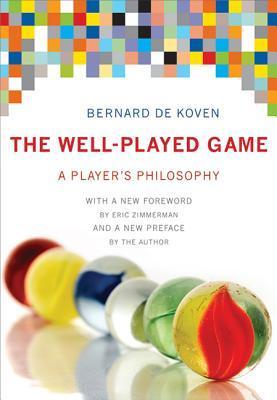
The Well-Played Game: A Player's Philosophy
The return of the classic book on games and play that illuminates the relationship between the well-played game and the well-lived life.
In The Well-Played Game , games guru Bernard De Koven explores the interaction of play and games, offering players—as well as game designers, educators, and scholars—a guide to how games work. De Koven’s classic treatise on how human beings play together, first published in 1978, investigates many issues newly resonant in the era of video and computer games, including social gameplay and player modification. The digital game industry, now moving beyond its emphasis on graphic techniques to focus on player interaction, has much to learn from The Well-Played Game .
De Koven explains that when players congratulate each other on a “well-played” game, they are expressing a unique and profound synthesis that combines the concepts of play (with its associations of playfulness and fun) and game (with its associations of rule-following). This, he tells us, yields a larger the experience and expression of excellence. De Koven—affectionately and appreciatively hailed by Eric Zimmerman as “our shaman of play”—explores the experience of a well-played game, how we share it, and how we can experience it again; issues of cheating, fairness, keeping score, changing old games (why not change the rules in pursuit of new ways to play?), and making up new games; playing for keeps; and winning. His book belongs on the bookshelves of players who want to find a game in which they can play well, who are looking for others with whom they can play well, and who have discovered the relationship between the well-played game and the well-lived life.
In The Well-Played Game , games guru Bernard De Koven explores the interaction of play and games, offering players—as well as game designers, educators, and scholars—a guide to how games work. De Koven’s classic treatise on how human beings play together, first published in 1978, investigates many issues newly resonant in the era of video and computer games, including social gameplay and player modification. The digital game industry, now moving beyond its emphasis on graphic techniques to focus on player interaction, has much to learn from The Well-Played Game .
De Koven explains that when players congratulate each other on a “well-played” game, they are expressing a unique and profound synthesis that combines the concepts of play (with its associations of playfulness and fun) and game (with its associations of rule-following). This, he tells us, yields a larger the experience and expression of excellence. De Koven—affectionately and appreciatively hailed by Eric Zimmerman as “our shaman of play”—explores the experience of a well-played game, how we share it, and how we can experience it again; issues of cheating, fairness, keeping score, changing old games (why not change the rules in pursuit of new ways to play?), and making up new games; playing for keeps; and winning. His book belongs on the bookshelves of players who want to find a game in which they can play well, who are looking for others with whom they can play well, and who have discovered the relationship between the well-played game and the well-lived life.
172 pages, Hardcover
First published January 1, 1978
Ratings & Reviews
Friends & Following
Create a free account to discover what your friends think of this book!
Community Reviews
Displaying 1 - 17 of 17 reviews

Read
February 4, 2022Should have been a (great) lecture

January 15, 2016
Originally written in 1978, it has the feel of the '70's. The book reads like a sort of stream of consciousness conversation as the author moves from one aspect to another of game-playing. I am a fan of the philosopher Ludwig Wittgenstein who famously used "games" as an example of a concept that could not be strictly defined, and yet had a unity through a series of commonalities that he called a "family resemblance." The author's approach is consistent with this, as he never tries to define the term. Instead he is interested in reflecting on the many and varied aspects of game-playing. Wittgenstein thought that the best way to gain a proper understanding of a concept was to offer an übersicht of the concept--a synopsis or overview. This is in fact what the author does, in examining its many facets. In fact, I have never seen this done so well for any concept.
For the most part the author's discussion remains at a fairly high level of abstraction, only occasionally illustrating his points with an example. I would have liked him to use more examples, especially as he has a huge fund to draw on. One odd aspect of his experience with games is an interest and apparently experience with them constantly changing during the very playing of them. And he is always discussing a myriad of variants that could be played. While I don't doubt that such changes could happen, my experience of game-playing is much more one in which people simply take the rules for granted and are not (so) interested in making modifications all the time. I suppose this is part of the author's being a kind of free-spirit.
For the most part the author's discussion remains at a fairly high level of abstraction, only occasionally illustrating his points with an example. I would have liked him to use more examples, especially as he has a huge fund to draw on. One odd aspect of his experience with games is an interest and apparently experience with them constantly changing during the very playing of them. And he is always discussing a myriad of variants that could be played. While I don't doubt that such changes could happen, my experience of game-playing is much more one in which people simply take the rules for granted and are not (so) interested in making modifications all the time. I suppose this is part of the author's being a kind of free-spirit.
November 4, 2024
This book, without even necessarily intending to, reframes and highlights the most important problems at the core of game design, being the duality of "the quality of the game" versus "the enjoyment of the player." Bernard DeKoven clearly has little foresight into the artistic heights that some videogames will eventually reach, nor into the fact that players will seek out non-communal (singleplayer) games for aesthetic satisfaction, and an addendum addressing this factor would have been a welcome change to later editions of the book.
That said, DeKoven's seemingly-unintentional blurring of the lines between player and designer as singular constituents of the play community is enough of a revelatory insight on its own: Play is for players, so to create great games, the designer needs to play too--they need to play their own games, as they're making them, in the process of making them. The making of the game needs to be a backward temporal dislocation of the play experience itself; in other words, the designer needs to maintain constant dialogue with all hypothetical future players (all members of the play community) in order to create something truly transcendent and transformational. This nugget of wisdom alone was more than worth this short read, and I will recommend this book to all other practitioners of my craft going forward.
That said, DeKoven's seemingly-unintentional blurring of the lines between player and designer as singular constituents of the play community is enough of a revelatory insight on its own: Play is for players, so to create great games, the designer needs to play too--they need to play their own games, as they're making them, in the process of making them. The making of the game needs to be a backward temporal dislocation of the play experience itself; in other words, the designer needs to maintain constant dialogue with all hypothetical future players (all members of the play community) in order to create something truly transcendent and transformational. This nugget of wisdom alone was more than worth this short read, and I will recommend this book to all other practitioners of my craft going forward.

September 7, 2024
Descriptions
De Koven devotes this section to clarifying the essential words that anchor his understanding of games, play, and the concept of well-played. De Koven defines games as activities built around a common goal that lacks practical consequences beyond the game’s own realm. He contrasts these with activities such as eating, making love, or reading. Those may be performed playfully or appear in games, but they lack a standalone structure that offers a shared objective with no bearing on external reality. He calls games 'social fictions' and likens them to art forms that endure only as long as people keep creating or reenacting them. They temporarily suspend real-world consequences, even as they reflect reality in a metaphorical sense. This dual nature of games as larger-than-life yet connected to reality, underscores their status as fleeting works of art that illuminate truths about human behavior.
Next, De Koven examines play as the enactment of anything that is not for real. He shows how play allows people to explore aggressive or fearful scenarios without sustaining actual harm. When we play, we can play with being other than we are, experimenting with new roles or identities. Genuine play also carries no hidden motive: When we are playing, we are only playing. De Koven points out that we might remain in a game’s structure yet not be truly playing, or we might be playing in a broader sense without following a formal set of rules. By uniting the concepts of games and play, De Koven highlights playing games as a special state where a scripted activity remains free of real consequences. At its best, playing a game fuses a designed structure with the liberating, imaginative spirit that invites experimentation.
De Koven then clarifies the term well, noting how it signifies both excellence and health. In English usage, it can describe performance ('You did that well') or physical/emotional wellness ('I feel well'). In his framework, well refers to wholeness—an experience or achievement that benefits both body and mind, individually and socially. Applying well to the gaming context, De Koven defines playing well as a state where participants remain fully engaged, totally present, yet remember they are only playing. De Koven concludes by defining the Well-Played Game as a game that becomes excellent because of the way it’s being played. This hinges on more than any rule set: it depends on the players’ collective willingness, trust, and intention. When each participant strives to involve others in a spirit of safety and fun, the result is a game whose excellence arises precisely from that shared engagement.
“Searching for the Well-Played Game”
De Koven opens with two scenarios that illustrate success and failure in finding a common understanding of what a well-played game might. First, he describes a visit to a professional stadium, where the crowd hopes for shared excellence but instead sees a lopsided victory. One team piles up points, leaving spectators disappointed because nothing feels balanced or mutually satisfying. De Koven points out that obvious victory offers little joy when the entire match lacks genuine challenge.
Next, he recounts an intimate Ping-Pong match in which he performs surprisingly well, only to learn that his opponent used the wrong hand. The discovery strips away the illusion of evenly matched skill and shows that winning doesn’t prove anything when the underlying engagement lacks transparency. Through these vignettes, De Koven affirms that a true well-played game emerges from the shared quality of play rather than the final score. This marks his emphasis on the quality of playing that we have been able to create together.
“Guidelines”
De Koven distills the lessons of Chapter 1 into guidelines that promote the discovery of a well-played game. He begins with establishing the intention of playing well together, cautioning that fixating on success can overwhelm camaraderie. Next, he stresses willingness to play, or remaining open to adjustments if the initial scenario falters. He then discusses safety, highlighting that participants must trust they will not be risking more than we are prepared to risk, whether physically or emotionally. This blend of willingness and safety fosters trust, crucial for ensuring any help or rule modifications occur in good faith. De Koven also underscores familiarity, which can come from either knowing each other or knowing the game itself. Lastly, he mentions conventions, including fundamental habits like taking turns or respecting communal decisions. These guidelines, taken together, form a protective shell for the group’s collective creativity and enjoyment.
“The Play Community”
Shifting from rules to relationships, De Koven explores how a play community differs from a more rigid game community. A game community typically dedicates itself to a particular system valuing consistent rules and the quest for victory. A play community, by contrast, places the players’ well-being and spontaneous interactions first. It is through a community of players that the well-played game happens. He points out that in children’s neighborhood games, the group stops if someone gets hurt or tailors the activity for a younger participant. This constant adaptability shows how players value each other more than the rules themselves. As trust accumulates, they might even discard official guidelines entirely yet continue in a spirit of shared discovery. De Koven contrasts this approach with many adult competitions, where strict adherence to standards and a drive to win crowd out the fluid spirit of play.
“Keeping It Going”
After describing how a play community forms, De Koven shows how players sustain a well-played game over time. In a Mastermind puzzle, one player places a hidden arrangement of colored pegs while the other tries to guess it. The puzzle-poser may offer a hint if the solver struggles, revealing that helpful nudges can keep the game engaging for both. Mutual respect ensures these gestures come across as sincere rather than condescending. He explains how participants might alter or suspend rules to prevent boredom. A group that focuses on fun can treat minor cheating as a creative allowance if it prolongs everyone’s enjoyment. De Koven emphasizes the point that no rule is absolute if it blocks the spirit of the game: if a rule prevents us from playing well, we should be ready to change it. Careful negotiation of fairness, skill gaps, and momentum allows the game to remain lively.
“Changing the Game”
Chapter 5 amplifies De Koven’s view that communities hold “the right and responsibility” to modify rules. Tic-tac-toe provides his example: once players master the simple 3×3 format, every match ends predictably. Enlarging the board or adjusting the strategy reacquaints participants with surprise and challenge. He stresses that effective revisions come from a genuine wish to keep it going, not from a desire to tilt outcomes unfairly. The community checks each proposed change against the goal of shared excellence. By adapting the game to suit changing moods, skill levels, or creativity, players honor the central values of trust and safety discussed in earlier chapters.
“Ending the Game”
Though De Koven championed keeping it going in the prior chapter, he recognizes that every game eventually concludes. A natural ending happens when players collectively sense that they have reached a satisfying high point, whereas a grudge match outlives its pleasure and continues from stubbornness or bruised pride. He describes this graceful conclusion as our shared need to let go. A well-played game’s finale feels organic and earned because participants trust that ending now preserves their best memories. If someone tries to hold onto the game purely to chase a victory or prove a point, the group’s positive energy wanes.
“Encore”
Occasionally, players crave more. De Koven calls this an encore, likening it to a performance extended by popular demand. This second wind arises spontaneously when everyone agrees the spark still glows: We’re not done yet, the group collectively decides. In contrast, if only one or two people want to continue while others are tired, the ensuing attempt might feel forced. This chapter underscores how listening to each other’s readiness or reluctance remains vital. The encore represents yet another sign of trust and communal synergy, matching the intuition that defines every phase of a well-played game.
"People, Places, Things”
De Koven broadens his focus to include physical context. He defines the surround as people, places, things, each of which shapes a game’s tone. A cramped space or ill-suited equipment can choke off creativity; conversely, a tailored environment invites participants to come out and play with confidence. He reminds readers that no matter how trusting or skilled the group might be, the environment can help or hinder their efforts. Everything from lighting and furniture to the size of a ball can tilt the mood toward exuberance or hesitation. Aligning the physical world with the group’s goals remains crucial to sustaining the game’s flow.
“Playing for Keeps”
Chapter 9 tackles the heightened stakes of playing for keeps, whether losing marbles in childhood or gambling real money in adulthood. This seriousness can energize a game but also erode the friendly openness of play if people feel real-world pain in losing. De Koven emphasizes that genuine consent determines whether such conditions still permit a well-played game. Players who feel forced to wager more than they wish lose the voluntary spirit that fosters creativity. We must not mistake seriousness for compulsion, he warns, reinforcing that the group’s shared choice remains paramount.
“Playing to Win vs. Having to Win”
De Koven clarifies the role of competition by contrasting playing to win' with 'having to win.' In playing to win, participants gleefully push each other’s limits and discover their collective best. Having to win, on the other hand, stems from external pressures or personal fear, which undercuts the freedom to enjoy the game’s unpredictability. He reiterates his core principle that If I have to play, I’m not really playing, pinpointing how the loss of choice unravels playful energy. Thus, competition must serve the group’s delight, not smother it. The game itself must still take precedence over the result. From De Koven’s perspective, a well-played game welcomes spirited challenge while avoiding the trap of outcome-obsession.
“Appendix: A Million Ways to Play Marbles, at Least”
De Koven concludes how a simple pastime like marbles contains at least a million ways to be reinvented. He details variations such as dropping marbles from different heights, crafting ice or steel marbles, or switching to “colored water drops on paper” (p. 100). Each twist underscores the book’s final argument: people who embrace creativity retain the option to transform any activity. By highlighting how nothing remains fixed, De Koven restates his central theme: we are free to change or invent or abandon rules at any moment if it serves the goal of playing well. This playful catalog of adjustments seals his broader point that the well-played game transcends standard formulas and emerges from each group’s collective spirit of innovation.
In conclusion, The Well-Played Game begins by defining “play” and “games” as complementary forces, “social fictions” with no real-life repercussions, powered by an imaginative freedom that invites experimentation. This conceptual grounding sets the stage for a layered journey: early chapters illustrate how a single-minded focus on winning often obstructs genuine fun, while later chapters demonstrate that joy emerges only when players unite around shared excellence. De Koven’s guidelines—such as willingness, safety, and familiarity—frame each phase of play as an opportunity for co-creation. He contrasts conventional “game communities,” driven by rigid rules and outcomes, with “play communities,” which remain flexible enough to revise or discard rules whenever that fosters deeper enjoyment. Whether describing the subtle art of giving hints in Mastermind or the “million ways” to reinvent marbles, De Koven consistently returns to the thesis that communal trust anchors true playfulness. The culminating insight is that no particular rule set, or score determines a game’s value; rather, a well-played game arises when everyone invests in a playful spirit, trusts each other’s intentions, and embraces the possibility of change in service of shared delight.
De Koven devotes this section to clarifying the essential words that anchor his understanding of games, play, and the concept of well-played. De Koven defines games as activities built around a common goal that lacks practical consequences beyond the game’s own realm. He contrasts these with activities such as eating, making love, or reading. Those may be performed playfully or appear in games, but they lack a standalone structure that offers a shared objective with no bearing on external reality. He calls games 'social fictions' and likens them to art forms that endure only as long as people keep creating or reenacting them. They temporarily suspend real-world consequences, even as they reflect reality in a metaphorical sense. This dual nature of games as larger-than-life yet connected to reality, underscores their status as fleeting works of art that illuminate truths about human behavior.
Next, De Koven examines play as the enactment of anything that is not for real. He shows how play allows people to explore aggressive or fearful scenarios without sustaining actual harm. When we play, we can play with being other than we are, experimenting with new roles or identities. Genuine play also carries no hidden motive: When we are playing, we are only playing. De Koven points out that we might remain in a game’s structure yet not be truly playing, or we might be playing in a broader sense without following a formal set of rules. By uniting the concepts of games and play, De Koven highlights playing games as a special state where a scripted activity remains free of real consequences. At its best, playing a game fuses a designed structure with the liberating, imaginative spirit that invites experimentation.
De Koven then clarifies the term well, noting how it signifies both excellence and health. In English usage, it can describe performance ('You did that well') or physical/emotional wellness ('I feel well'). In his framework, well refers to wholeness—an experience or achievement that benefits both body and mind, individually and socially. Applying well to the gaming context, De Koven defines playing well as a state where participants remain fully engaged, totally present, yet remember they are only playing. De Koven concludes by defining the Well-Played Game as a game that becomes excellent because of the way it’s being played. This hinges on more than any rule set: it depends on the players’ collective willingness, trust, and intention. When each participant strives to involve others in a spirit of safety and fun, the result is a game whose excellence arises precisely from that shared engagement.
“Searching for the Well-Played Game”
De Koven opens with two scenarios that illustrate success and failure in finding a common understanding of what a well-played game might. First, he describes a visit to a professional stadium, where the crowd hopes for shared excellence but instead sees a lopsided victory. One team piles up points, leaving spectators disappointed because nothing feels balanced or mutually satisfying. De Koven points out that obvious victory offers little joy when the entire match lacks genuine challenge.
Next, he recounts an intimate Ping-Pong match in which he performs surprisingly well, only to learn that his opponent used the wrong hand. The discovery strips away the illusion of evenly matched skill and shows that winning doesn’t prove anything when the underlying engagement lacks transparency. Through these vignettes, De Koven affirms that a true well-played game emerges from the shared quality of play rather than the final score. This marks his emphasis on the quality of playing that we have been able to create together.
“Guidelines”
De Koven distills the lessons of Chapter 1 into guidelines that promote the discovery of a well-played game. He begins with establishing the intention of playing well together, cautioning that fixating on success can overwhelm camaraderie. Next, he stresses willingness to play, or remaining open to adjustments if the initial scenario falters. He then discusses safety, highlighting that participants must trust they will not be risking more than we are prepared to risk, whether physically or emotionally. This blend of willingness and safety fosters trust, crucial for ensuring any help or rule modifications occur in good faith. De Koven also underscores familiarity, which can come from either knowing each other or knowing the game itself. Lastly, he mentions conventions, including fundamental habits like taking turns or respecting communal decisions. These guidelines, taken together, form a protective shell for the group’s collective creativity and enjoyment.
“The Play Community”
Shifting from rules to relationships, De Koven explores how a play community differs from a more rigid game community. A game community typically dedicates itself to a particular system valuing consistent rules and the quest for victory. A play community, by contrast, places the players’ well-being and spontaneous interactions first. It is through a community of players that the well-played game happens. He points out that in children’s neighborhood games, the group stops if someone gets hurt or tailors the activity for a younger participant. This constant adaptability shows how players value each other more than the rules themselves. As trust accumulates, they might even discard official guidelines entirely yet continue in a spirit of shared discovery. De Koven contrasts this approach with many adult competitions, where strict adherence to standards and a drive to win crowd out the fluid spirit of play.
“Keeping It Going”
After describing how a play community forms, De Koven shows how players sustain a well-played game over time. In a Mastermind puzzle, one player places a hidden arrangement of colored pegs while the other tries to guess it. The puzzle-poser may offer a hint if the solver struggles, revealing that helpful nudges can keep the game engaging for both. Mutual respect ensures these gestures come across as sincere rather than condescending. He explains how participants might alter or suspend rules to prevent boredom. A group that focuses on fun can treat minor cheating as a creative allowance if it prolongs everyone’s enjoyment. De Koven emphasizes the point that no rule is absolute if it blocks the spirit of the game: if a rule prevents us from playing well, we should be ready to change it. Careful negotiation of fairness, skill gaps, and momentum allows the game to remain lively.
“Changing the Game”
Chapter 5 amplifies De Koven’s view that communities hold “the right and responsibility” to modify rules. Tic-tac-toe provides his example: once players master the simple 3×3 format, every match ends predictably. Enlarging the board or adjusting the strategy reacquaints participants with surprise and challenge. He stresses that effective revisions come from a genuine wish to keep it going, not from a desire to tilt outcomes unfairly. The community checks each proposed change against the goal of shared excellence. By adapting the game to suit changing moods, skill levels, or creativity, players honor the central values of trust and safety discussed in earlier chapters.
“Ending the Game”
Though De Koven championed keeping it going in the prior chapter, he recognizes that every game eventually concludes. A natural ending happens when players collectively sense that they have reached a satisfying high point, whereas a grudge match outlives its pleasure and continues from stubbornness or bruised pride. He describes this graceful conclusion as our shared need to let go. A well-played game’s finale feels organic and earned because participants trust that ending now preserves their best memories. If someone tries to hold onto the game purely to chase a victory or prove a point, the group’s positive energy wanes.
“Encore”
Occasionally, players crave more. De Koven calls this an encore, likening it to a performance extended by popular demand. This second wind arises spontaneously when everyone agrees the spark still glows: We’re not done yet, the group collectively decides. In contrast, if only one or two people want to continue while others are tired, the ensuing attempt might feel forced. This chapter underscores how listening to each other’s readiness or reluctance remains vital. The encore represents yet another sign of trust and communal synergy, matching the intuition that defines every phase of a well-played game.
"People, Places, Things”
De Koven broadens his focus to include physical context. He defines the surround as people, places, things, each of which shapes a game’s tone. A cramped space or ill-suited equipment can choke off creativity; conversely, a tailored environment invites participants to come out and play with confidence. He reminds readers that no matter how trusting or skilled the group might be, the environment can help or hinder their efforts. Everything from lighting and furniture to the size of a ball can tilt the mood toward exuberance or hesitation. Aligning the physical world with the group’s goals remains crucial to sustaining the game’s flow.
“Playing for Keeps”
Chapter 9 tackles the heightened stakes of playing for keeps, whether losing marbles in childhood or gambling real money in adulthood. This seriousness can energize a game but also erode the friendly openness of play if people feel real-world pain in losing. De Koven emphasizes that genuine consent determines whether such conditions still permit a well-played game. Players who feel forced to wager more than they wish lose the voluntary spirit that fosters creativity. We must not mistake seriousness for compulsion, he warns, reinforcing that the group’s shared choice remains paramount.
“Playing to Win vs. Having to Win”
De Koven clarifies the role of competition by contrasting playing to win' with 'having to win.' In playing to win, participants gleefully push each other’s limits and discover their collective best. Having to win, on the other hand, stems from external pressures or personal fear, which undercuts the freedom to enjoy the game’s unpredictability. He reiterates his core principle that If I have to play, I’m not really playing, pinpointing how the loss of choice unravels playful energy. Thus, competition must serve the group’s delight, not smother it. The game itself must still take precedence over the result. From De Koven’s perspective, a well-played game welcomes spirited challenge while avoiding the trap of outcome-obsession.
“Appendix: A Million Ways to Play Marbles, at Least”
De Koven concludes how a simple pastime like marbles contains at least a million ways to be reinvented. He details variations such as dropping marbles from different heights, crafting ice or steel marbles, or switching to “colored water drops on paper” (p. 100). Each twist underscores the book’s final argument: people who embrace creativity retain the option to transform any activity. By highlighting how nothing remains fixed, De Koven restates his central theme: we are free to change or invent or abandon rules at any moment if it serves the goal of playing well. This playful catalog of adjustments seals his broader point that the well-played game transcends standard formulas and emerges from each group’s collective spirit of innovation.
In conclusion, The Well-Played Game begins by defining “play” and “games” as complementary forces, “social fictions” with no real-life repercussions, powered by an imaginative freedom that invites experimentation. This conceptual grounding sets the stage for a layered journey: early chapters illustrate how a single-minded focus on winning often obstructs genuine fun, while later chapters demonstrate that joy emerges only when players unite around shared excellence. De Koven’s guidelines—such as willingness, safety, and familiarity—frame each phase of play as an opportunity for co-creation. He contrasts conventional “game communities,” driven by rigid rules and outcomes, with “play communities,” which remain flexible enough to revise or discard rules whenever that fosters deeper enjoyment. Whether describing the subtle art of giving hints in Mastermind or the “million ways” to reinvent marbles, De Koven consistently returns to the thesis that communal trust anchors true playfulness. The culminating insight is that no particular rule set, or score determines a game’s value; rather, a well-played game arises when everyone invests in a playful spirit, trusts each other’s intentions, and embraces the possibility of change in service of shared delight.

September 18, 2019
Mostly high-level musings on the nature of play and what it means to play well with one another. The first half of the read is kind of a slog, but then it all comes together in the second half where more practical solutions are considered. The book is very optimistic in its belief in the potential of creating a play community, but seen as a somewhat lofty handbook for working out kinks and communication issues in your closest gaming group it's a pretty cohesive guide on changing your outlook.
The one quote that will stay with me is, funnily enough, this one: “Once again we return to the heart-warming realization that games are not life. Games are throwaway items. We play them only because we feel like playing them. They don't mean anything for real, and neither does quitting them.”
For a book about games and playing them, it's surprising that a large part of it is dedicated to giving games the right scope and place in our daily lives - something that I loose track of regularly.
The one quote that will stay with me is, funnily enough, this one: “Once again we return to the heart-warming realization that games are not life. Games are throwaway items. We play them only because we feel like playing them. They don't mean anything for real, and neither does quitting them.”
For a book about games and playing them, it's surprising that a large part of it is dedicated to giving games the right scope and place in our daily lives - something that I loose track of regularly.

July 25, 2018
I'm intrigued by the concepts and interested by the perspective, but this is not an easy read. It's fun for a while, but repetitive.
There's a section in chapter 7 that goes like this: "I was having fun being silly like this. My pseudo professorship was like a prelude—a way of savoring. It was fun taking so long to say what I could have said in perhaps less than a hundred words."
If it was at the start of the book, it would be called prescient. Whole chapters seem written just to "play" with the reader, which is fine if you're in the mood for it, and not if you're not.
There's a section in chapter 7 that goes like this: "I was having fun being silly like this. My pseudo professorship was like a prelude—a way of savoring. It was fun taking so long to say what I could have said in perhaps less than a hundred words."
If it was at the start of the book, it would be called prescient. Whole chapters seem written just to "play" with the reader, which is fine if you're in the mood for it, and not if you're not.

July 17, 2022
This was one of the stranger books I've read but I'm quite glad that I read it. Addresses what it means to play a game and to play it well (as in seeking wellness, not as in highly skilled execution, although that may be part of the wellness), how we think about play, rules, expectations, fairness, and community as they surround games. It's written in a very '70s style that can be a little wordy at times, but this book really did provide me with some unique thoughts and very glad that I read it. Particularly recommend for any current and former debaters
September 19, 2021
A deceptively-simple book about how to stabilize and maintain a set of relationships -- a game of marbles, an economy, a democracy -- without hardening it into inequality or blurring it into boredom. Yes, this is a book on the design of chess, tag, frisbee, but it's also a framework for the generating and awareness of a complex emergent system -- and an anarchist-tinged argument for a community's ability to self-regulate. Every parent, educator, politician, or hopscotch player should read this.

May 16, 2018
It's kind of an exploration of what Mihaly Csikszentmihalyi is talking about with flow. But pretty much in the context of playing games. But then, by the author's definition, lots of things can be games, even things like religious observance. What I like about this is that he brings theory into the world of practice.

October 9, 2018
An extraordinary book on what it means to be a good player and what games that are well-played look like. A work of philosophy at its heart, it is also a practical way of understanding the differences between play and games and how these differences illuminate aspects of our society. If you have any interest in this topic, start here and you won't go wrong.

August 7, 2022
Enjoyable for its conversational tone and organic structure. Unfortunately I'm not as chilled out as Bernie so the new age revelations about the power of autotelic activities (the well played game is basically proto-flow) seemed less meaty than his description of play communities.
July 12, 2017
Seminal book for people who aspire to bring more playfulness into the world, especially poets, game creators, play event creators, and inventors.

October 9, 2018
Really good thoughts, but suffers from poor organization, which sometimes gives the book a rambling feel, especially towards the end.
Even so, still worth the read.
Even so, still worth the read.

January 2, 2019
An easy read but a different perspective on why and how we play games.

June 1, 2022
The perfect entry point to any understanding of games from a modern lens, and a must-read for all designers.
October 20, 2025
Unreadable.
If you are in the slightest bit interested in playing games then you are already far ahead of where this book will take you.
If you are in the slightest bit interested in playing games then you are already far ahead of where this book will take you.

Read
August 20, 2026Incredibly insightful as to the nature of the social dynamics of play.
Displaying 1 - 17 of 17 reviews