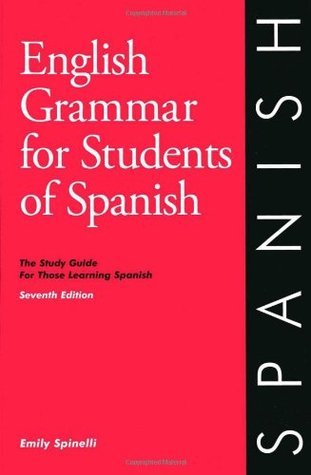
Thousands of students have found this book the ideal way to master and upgrade their Spanish grammar.
Bridging the Gap to Language Mastery Since 1979
The Olivia & Hill (O&H) Press provides a series of concise study guides designed to support students learning a variety of foreign languages, including Spanish, French, German, Italian, Chinese, Arabic, Japanese, Russian, Latin, and ESL. Since 1979, these guides have served as a “missing link” in modern language education by bridging the gap between basic immersion and professional mastery.
While immersion methods provide the “heart” of a language through cultural flow, O&H provides the “bones” by establishing a firm grammatical structure.
The O&H Methodology: English Grammar First A core tenet of the O&H approach is addressing the “English grammar blindspot.” Many students lack the metalinguistic awareness to understand complex foreign structures because they do not first understand the corresponding English concepts.
O&H solves this by teaching English grammar first, using side-by-side comparisons to show exactly how the target language differs from English. This method provides a “mental hook” that: ● Reduces Cognitive Overload: Students focus on one new concept at a time. ● Prevents “Fossilized Errors”: We address bad habits that often form in immersion-only environments before they become permanent.
Supporting the Modern Classroom These study guides are designed for self-study, enabling a “flipped classroom” model in which students learn the mechanics at home, freeing up valuable class time for communication. This efficiency is particularly beneficial in higher education, where instructional time is limited.
Beyond the classroom, the guides help learners overcome the “intermediate plateau” to achieve professional proficiency (such as ACTFL Superior or CEFR C1/C2 levels). This precision is essential for: ● High-stakes professional writing ● Technical reporting ● Standardized testing (OPI, DALF, DELE)
This book would have been nice to read earlier than I did. When your spanish teacher is demanding that you say something in the past perfect participle, it's not that you don't know the spanish words, it's usually that you don't know what a past perfect participle is in english. A useful tool.
As a self-proclaimed grammarian with both a love for and a degree in Spanish who speaks Spanish in a professional capacity, I decided to read this book to assist me in identifying the areas in which I could improve my Spanish grammar skills. While this book is certainly helpful in comparing Spanish grammar to that of English and in better understanding grammar in both languages, it is not a comprehensive guide to Spanish grammar—at least not for an advanced language student. I definitely found some of the explanations helpful and enjoyed perusing the study tips and utilizing the blank section in the back for writing notes. However, this guide was missing some more advanced grammatical concepts (e.g., verbs that change meaning between the imperfect and preterite verb tenses, etc.). I was hoping for more examples and for fewer suggestions to “[see one’s textbook for a detailed explanation].” All in all, though, I would recommend this book for anyone who is learning Spanish or who just wants an additional grammar resource.
Overview: Any English speaking person learning Spanish, or a Spanish person learning English should own this book! It's as imperative as the 501 Spanish Verbs book, and the Larousse translation dictionary.
Pros: The book is organized very well, with each grammatical topic well categorized and focused upon just enough without becoming too stretched or dry. There are plenty of examples with captions to point out exactly what the author is talking about. If you have any specific questions regarding words such as "a, the" you can find them in the well stocked Index.
Cons: My only con is that the verb conjugation chart isn't divided with a nice table. Those starting out conjugating Spanish verbs may find the chart a little confusing.
A useful concise grammar guide that first gives the grammatical terms and explanation in terms of English grammar and then explains the equivalent in Spanish, and also points out where there are differences in English vs. Spanish grammar i.e. Spanish uses double negatives, but double negatives would not be proper English grammar. A useful reference for High School Spanish, college classes, or self study. It doesn't have workbook questions or vocab sections, so it is strictly a grammar reference.
I'm learning Spanish using the Mango program available from my local public library (thank you, Manitowoc Public!). Mango relies on natural language-learning techniques in which words and phrases are introduced, repeated, then become sentences. It's like learning your first language as a child--you hear people talk and pick it up gradually, first in words, then in phrases, then in sentences. But I needed to know more. Like why did I use esa instead of esta--what's the difference? When do I use de and when en? So I pulled English Grammar for Students of Spanish off the shelf in the hope of accelerating my understanding of the language.
I appreciated the explanations, especially the way each chapter explained the English version of a grammatical concept, then described how Spanish treats it. So there is not really an equivalent for "does" in Spanish? I guess I don't have to search my brain for one anymore. Though helpful, the book just didn't give me enough. The format seemed crowded and 20th century in design (though since the book is from the 20th century, this is no surprise, but my eyes demand more white space now, so this is a barrier). The explanations were compressed, maybe too short--enough to confuse me, in the case of indirect object pronouns. Yet I love the way the book is indexed. It's very easy to find the concept I wanted to learn. And as a supplementary source, it's valuable.
I'm grateful to English Grammar for the help it's given me and for the help it will provide in the future. It's good.
Spanish is the only foreign language that I really tried to learn and this book helped muy mucho bueno y bien. Comprendes? Entiendes? No se y no conozco.
This is a practical and concise tool to accompany any language course. I took one semester in Spanish and loved this book! Our curriculum was through the Rosetta Stone program which is also a great resource, but this small book was priceless to me and I don't think I would have aced the class without it.
Marvelous!! I’m at the B1 level and was really struggling with my lessons in Spanish, trying to learn the Spanish grammar (taught in Spanish) without understanding it in English. This book has been super helpful. I went through it a couple lessons a day for a few weeks, but I’ll be keeping it around as a reference.
I used this book to augment my text book and I found it very helpful for that purpose. It doesn't work so well as a book that you would just sit down and read but it wasn't intended for that purpose. I'm sure I will continue to use it as a reference for each particular grammar point as I continue learning Spanish.
Great book for beginning Spanish students. When your teacher/tutor says “the infinitive form of the verb,” you’ll actually know what they’re talking about! It also clearly explains the differences in the ways English and Spanish words are used, and in how sentences are constructed.
This is a really helpful reference. The English grammar portions feel a bit basic but the author is doing everything possible to make sure readers understand how Spanish grammar relates to what we already know (or need help remembering) in English. My only complaint is that there could be more examples in her to better illustrate the comparisons. This would also be useful for someone interested in translating at some point.