Boydell & Brewer does a major service by the simultaneous reissue of Richard Vaughan's studies of the Valois Dukes of Burgundy. Four distinguished scholars add extra value by contributing an introductory chapter for each ducal reign, surveying its historiography since the original publication... The story, which Vaughan tells with verve, has its full share of dramatic turns(: ) this is much more, though, than simply a narrative history; Vaughan's meticulous explorations of the administrative and financial structures that underpinned ducal authority, and of the court and its culture, are integral to his exposition (...) His achievement remains monumental. There are no comparable, modern, in-depth studies of these four larger-than-life players on the late medieval European stage, in English or in any other language. They are, besides, eminently readable. Maurice Keen, TIMES LITERARY SUPPLEMENT
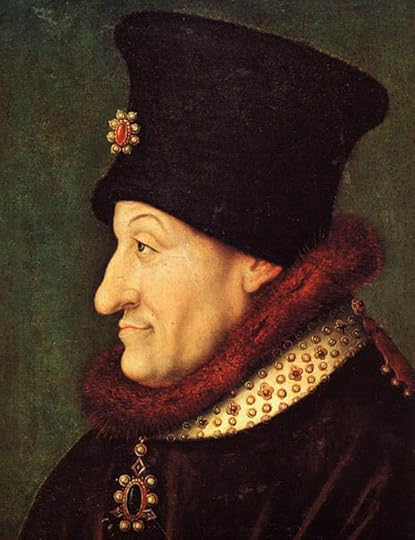
When in 1363 the duke of Burgundy died without an heir, the duchy returned to the French crown. John II's decision to give it to his fourth son, Philip, had some logic behind it, given the independence of the inhabitants; but in so doing he created the basis for a power which was to threaten France's own existence in the following century, and which was to become one of the most influential and glittering courts of Europe. Much of this was due to the character of Philip the Bold; by marrying the daughter of the count of Flanders, he inherited the wealth of the great Flemish towns in 1384, and the union of the two great fiefdoms to the north and east of France under one ruler meant that the resources of the duke of Burgundy were as great as those of the kingdom itself. From 1392 onwards, he was at loggerheads with the regent of France, his brother Louis, duke of Orleans, and this schism was to prove fatal to the kingdom, weakening the administration and leading to the French defeat by Henry V in 1415.
Richard Vaughan describes the process by which Philip fashioned this new power, in particular his administrative techniques; but he also gives due weight to the splendours of the new court, in the sphere of the arts, and records the history of its one disastrous failure, the crusade of Nicopolis in 1396. He also offers a portrait of Philip himself, energetic, ambitious and shrewd, the driving force behind the new duchy and its rapid rise to an influential place among the courts of Europe.
The Valois Duchy of Burgundy has fascinated me for a while. What was a spring-off of the Kingdom of France came very close to usurp its position in Europe so that today we could be speaking of The Republic of Burgundy (!!!) had not the French king Louis XI (1423-1483) reacted in time and managed to neutralize this powerful Duchy - its friend and foe. The Burgundian court is also renown for the luxury of its protocol and its art patronage becoming a model for subsequent circles of power.
I had already read Les Grands ducs de Bourgogne, but later purchased the four volumes by Richard Vaughan originally written in the 1960s dedicated to the four great Dukes: Philip the Bold (1342-1404), John the Fearless (1371-1419), Philip the Good (1396-1467) and Charles the Bold (1433-1477). My upcoming trip to visit Jan van Eyck exhibition prompted me to pull out from my shelves the first one of the series.
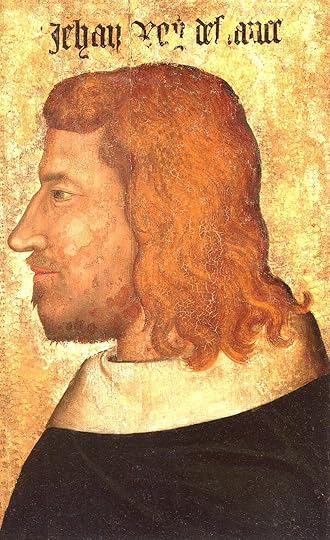
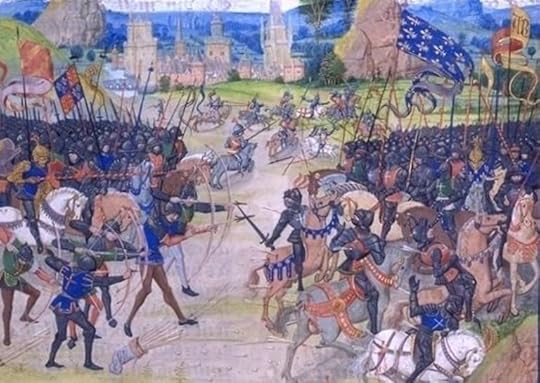
The story of this Duchy goes back to King Jean le Bon (1319-1364), who Vaughan believes was a pretty bad king. But his sons were all exceptional figures. His eldest, Charles, became Charles V, and the three others, Louis, John and Philip became the recipients of Dukedoms that would entertain chroniclers and historians. Anjou went to Louis – and this Dukedom soon made its way into Provence and Naples. Berry (plus Auvergne and Poitiers) for John who occupies a place of honour in the history of manuscript illumination. And Burgundy for the youngest, Philip, who accompanied the father during his imprisonment in England after he was captured in the battle of Poitiers.
Vaughan’s account is highly scholarly and methodical. It had way too much information for what my curious but limited mind could absorb, but he managed to convince me with his main argument, namely that Philip was the founder and creator of the Burgundian State. Granted, this Duchy, in the greater extension that Philip managed to attain during his time, remained in vassalage both to the Kingdom of France and to the Empire. But he succeeded in setting the foundations for his successors to endow their land holdings with sufficient political power so that around the mid fifteenth century it was regarded by the other European powers, including France, as a player in its own right.
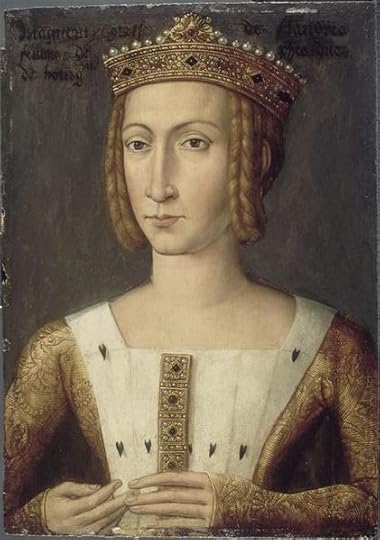
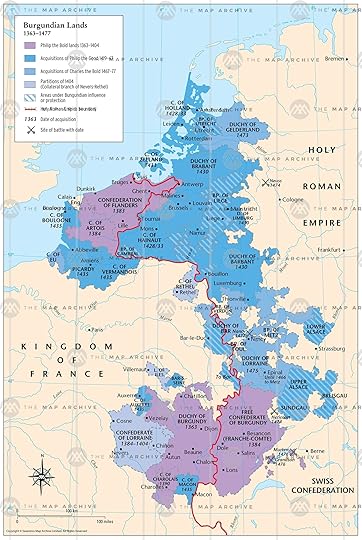
Apart from the actual Duchy of Burgundy, by marrying Margaret, the only offspring of the Count of Flanders Louis de Malle, when his father in law died in 1384 added the northern lands of Flanders, Brabant and the Artois to his domains. He also succeeded, again through his wife, to annex sections of the County of Burgundy that legally belonged to the Empire. As very often many of these dealings required considerable support and financing, Vaughan makes it very clear that Philip had no qualms to milk the Treasury of the French kingdom.
Vaughan traces the formation of this ‘State’ through various chapters: how Flanders was acquired; how the relations with France unfolded in particular when Philip’s brother dies and the young son succeeds him in the throne; how it related to the other powers – mostly England and the Empire; how the finances fared – a difficult subject to investigate since they had a very different way of conceiving aggregate revenues and expenses; how it was organized internally. But the chapter which would appeal to me most is the one discussing art patronage.
During Philip’s time the Burgundian court did not yet reach the levels of extravagance that it would display later on, in particular with his grandson Philip the Good. Vaughan compares the expenditures of the four sons of Jean le Bon, and expectedly, the king’s stands out. Overall the chapter on patronage remains too light for my interests but I particularly enjoyed reading about the development of private libraries. It is when comparing these French courts with an Italian one, he one of Giangaleazzo Visconti (1351-1402), that Vaughan provides a fascinating account of their respective. During the 1360s the two earliest princely libraries were installed: in the Louvre with Charles V and in Pavia with Giangaleazzo; each had about a thousand volumes. They chose different titles, however. There was more literature in Paris and, unsurprisingly, more classical authors in Pavia. Philip’s library stood in no comparison to that of his brother the king, and what is today the most famous manuscript from that time belonged to the other brother, Jean de Berry. But Vaughan reminds us that it was Philip who first employed the Limbourg brothers, before they moved to Jean’s scriptorium.
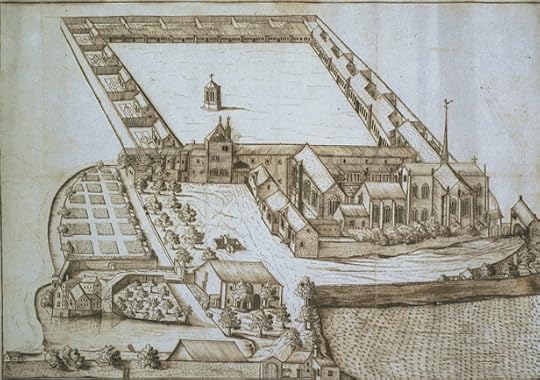
But it is to Philip the Bold that the dynasty owes the fabulous Chartreuse de Champmol - or what remains of it, compliments from the French Revolution. It was conceived as a dynastic mausoleum in which a large convent with double the number of usual Carthusian monks were to live and pray. The architect had been the French Drouet de Dammartin. Philip's initiatives in architecture saw other magnificent buildings, mostly in the Dijon area such as the Sluis castle and the Ducal palace, but were not limited to his were not limited to it. If the architects had been French, his sculptors came from the Low Countries, and the Van Eyck exhibit, I believe investigates the relationship between this art and painting.
As this read is loaded with facts, the epilogue provides a welcome final tie up of the various arguments Vaughan has developed to sustain that Philip created a new State. At the end Vaughan reveals to the uninitiated reader that his thesis opposes that of the historians Pirenne and Huizinga. I have not read those authors , so it is hard to compare, but Vaughan’s version will certainly stay on my mind.
Dry as an accounting textbook. Interesting as a description of how a late Middle Age state was run and governed.
Accounts are described and gone over extensively. "Following the money" is a good way to get a feel for how entities such as a government is run. It does not make for scintillating reader, however. The author also uses lists of people, a lot. This is also not scintillating reading.
As a work of scholarship, this seems well-researched. The detail is fantastic. I do wish someone had taken this as a summary for writing something that was more readable about Philip the Bold.
One last criticism is the author has a thesis and they attempt to "prove" it by repeating it at the end of every chapter, despite very little in the chapter actually supporting it. The thesis is "Philip the Bold created a modern, separate state in the Two Burgundies". However, the book presents very little evidence that this actually happened during Philip the Bold's lifetime nor that he was intending to do such a thing. Instead, we get a glimpse of a powerful French aristocrat (fourth son of John II of France) doing whatever was needed to govern the lands he was given to rule. There is little evidence in the book that Philip was trying to create a separate state nor that he did so "accidentally". Instead, he copied governance from France, used French resources where he could, he emulated French methodologies, and used French personnel interchangeably with "locals" to govern. At best, Philip laid the groundwork for a separate state that undeniably came into being later.
Richard Vaughan Studies The Political Career Of Philip The Bold & The Formation Of The Burgundian State.
Professor Richard Vaughan was an esteemed English historian who lived from 1927-2014 and specialized in medieval history, also teaching throughout his prestigious career at the University of Hull from 1965-81 in Yorkshire, England, and at the University of Groningen, in the Netherlands, from 1981-9. He was the author of numerous books, among them his history of Northwest Greenland and his groundbreaking work on Late Medieval Burgundy, with his most famous works being the four-volume set of the Valois Dukes of Burgundy - Philip the Bold: The Formation of the Burgundian State, John the Fearless: The Growth of Burgundian Power, Philip the Good: The Apogee Of Burgundy, and Charles the Bold: The Last Valois Duke of Burgundy. Vaughan also studied ornithology, or the zoological study of birds, and participated in field studies with a number of prominent ornithologists, including James Fisher, W.B. Alexander, H.N. Southern, and B.W. Tucker.
This edition of Philip the Bold: The Formation of the Burgundian State is Volume I in Richard Vaughan's four-book study on the Valois Dukes of Burgundy, and it is a reprint of a revision which was first published in 2002 with a new introduction by Malcolm Vale (Vaughan's first edition of the book was published in 1962). Vale's introduction explains the significance of Mr. Vaughan's unequaled contribution to Burgundian medieval history and seeks to reconcile its place amongst the modern titles which have been published in the forty years between the first edition and the 2002 revision. The 241-page study is divided into 11 chapters, with an additional 20-page bibliography & supplementary 17-page index as well as genealogical family trees & numerous maps of the Two Burgundies & the Low Countries.
Philip the Bold, youngest son of the French king John II the Good, was the first Valois Duke of France's Burgundy region, and is rightly considered amongst the preeminent politicians and statesmen of European history's Late Middle Age. Throughout his forty-year reign he established a reputation as a skilled negotiator who tirelessly strove to further the interests of the Burgundian state by expanding its borders with a series of advantageous peace treaties and by successfully brokering favorable marriage alliances with neighboring foreign powers, even delegating to his son, the future John the Fearless, the position of command for his Crusade of Nicopolis, which although tactically unsuccessful, greatly increased his house's international prestige and led to the Valois House of Burgundy's recognition as a major European power.
During the Middle Ages, the wealthy and prosperous County of Flanders ranked amongst the Burgundy region's most desirable territories, and Philip's opportunity early in his reign to wed Margaret of Flanders, daughter and heiress of the Flemish ruler Louis of Male, was a chance he absolutely could not afford to forego. Margaret had been courted by numerous prospective suitors in addition to Philip the Bold, but it was Earl Edmund Langley of Cambridge, the son of the English king, Edward III Lancaster, who posed the greatest threat to the duke's matrimonial ambitions. Despite Edward's repeated attempts to procure a papal dispensation sanctioning the marriage, it was the French Pope Urban V who tipped the scales in Philip's favor by issuing an edict on 16 January 1365 which forbade Edmund and Margaret's union on grounds of consanguinity.
Philip the Bold's territorial aggrandizement was fueled by his political cunning, which he employed effectively to pursue his objectives in an energetic combination of tactile foreign policy and farsighted marriage alliances, augmented by a successful practice of pandering to the French crown. Philip was an effective, if hawkish negotiator who did not hesitate to act in the Burgundian state's best interests, & his high level of favor with the French kings & queens afforded him an exclusive, almost unprecedented status upon the international sphere - one he made effective use of throughout his long reign. If a treaty or marriage pact's terms held provisions that ran contrary to his advantage or wish these were later callously repudiated, or in other instances simply ignored altogether.
In Chapter 4, The Crusade Of Nicopolis, Professor Vaughan discusses Philip's eldest son John of Nevers' ill-fated 1396 expedition to Hungary and its long-term political and social ramifications, as they affected Burgundy and the rest of Europe. Early in the chapter Vaughan stresses the medieval crusade's important role in European temporal affairs, observing that, "Although by now nearly devoid of political significance, the crusade was of considerable importance to secular rulers, for it was one of the few undertakings which brought them prestige & renown whether it succeeded or not." Prior to examining the battle of Nicopolis, Vaughan provides interesting background on other fourteenth-century crusades and stresses Philip the Bold's integral role in providing Burgundian troops and subsidies to several of his peers' ventures during this period.
The Duke of Burgundy spared no expense in preparation for his son John of Nevers' crusading venture, as evinced by Professor Vaughan's eloquent description of the elaborate accoutrements and equipment which were assembled months before the expedition's scheduled departure from Dijon on 30 April 1396. "Twenty-four cartloads of green satin tents and pavilions were provided or made for it, and more than two hundred persons were issued with John's livery. Four huge banners, painted by one of the foremost artists in France, Colart de Leon, displayed the figure of the Virgin Mary in gold surrounded by escutcheons and fleurs-de-lis, while others bore the count's name and device. Hundreds of smaller pennons were provided to decorate the tents, and twelve trumpeters were lavishly equipped in heraldic costume to stand before John's own tent. Everything was embroidered, emblazoned and burnished with gold and silver."
The well-oiled bureaucratic machinery of Philip the Bold's Two Burgundies ranked among Western Europe's most developed and finely-tuned institutions during the Late Middle Age, and in Chapter 5, The Burgundian State, Vaughan charts a detailed, compelling blueprint of each of the Burgundian government's constituent parts and their hierarchical structure, also providing an excellent overview of the diverse territories that constituted the Low Countries, a phrase which, as he states in the section's introduction, "is more convenient than accurate." In addition to the Artois and Rethel regions in northern France, the Low Countries comprised an area known as Flandre Gallicante, or French Flanders, which included the townships of Lille, Douai, & Orchies, and another area known as Flandre Flamigante, which translates to "Flemish Flanders", and encompassed Antwerp, Malines & after 1390, Limbourg. The author does not confine himself to a single genre; he instead combines elements of a structured political history with those of a more traditional historical biography for those sections which concern the life of Philip the Bold. The successful fusion of such disparate literary formats is assuredly an enormous and daunting task, but Vaughan has achieved magnificent results here, with a finished product that maintains his book's readability despite his subject matter's challenging nature and vast scope.
At the beginning of Chapter 11, The Finances of the Burgundian State, Professor Vaughan makes an interesting observation regarding modern attempts to reconcile a medieval state's financial records, and how they in turn relate to his own research on Burgundy. "In examining the finances of a medieval state, the historian is seeking answers to questions which seldom or never occurred to the rulers and financial experts of those days. He wants to know what was the total income and what the expenditure, and further, what were the different sources of income and the principal items of expenditure. While the accounts of a modern state or a commercial organization are specifically designed, by means of a classified analysis and final balance, to reveal and display this information, the primary aim of the accounts, in a medieval state, was to establish the financial position vis-à-vis the ruler of the individual officers who made them."
The author employs three strategies to assess Burgundy's fiscal status, one of which utilizes an extant document from 1394-5 that functions as a budget for the Nicopolitan Crusade to reconstruct what Philip's annual income might have been, based on his revenues from a variety of different sources. Among the chapter's more interesting statistics are the astronomical sums the duke received in royal gifts (65,000 francs from 1384-6, and 175,000 francs from 1400-3), and the author's conclusion that the King of France probably granted the duke an average of 60,000 francs per annum in royal aides, which were royal taxes in Burgundian domains that Philip was allowed to collect for himself.
Overall, Richard Vaughan's Philip the Bold - The Formation of the Burgundian State is a truly exemplary study, one which features such an unbelievable amount of research and polish that it has stood the test of time for over sixty years since its original publication, and will continue to serve as a benchmark upon which future medieval studies are measured. Vaughan's deft hand has created a one-of-a-kind book that combines elements of political, financial, and military histories and synthesizes them with the colorful and dramatic narrative of Philip the Bold's life. For the reader who enjoys the financial aspects of Vaughan's book, Raymond De Roover's 1966 The Rise & Decline Of The Medici Bank: 1397-1494 features an in-depth examination on every aspect of the most prosperous financial institution of the Italian Renaissance that is written in a style very similar to what can be found in certain portions of Vaughan's study, & it is highly recommended. It was truly a privilege and an honor to have read and reviewed this remarkable first entry in Richard Vaughan's wonderful quartet of studies devoted to the Dukes of Burgundy. Thank you so very much for your time, I hope that you enjoyed the review!
If you're interested in very dry, fact-based history, you might like this. If you like to read the dullest nonfiction available to help you sleep at night, this works well.
I really enjoyed this book. It was a very interesting look at how Philip the Bold acquired and managed his portfolio of territories in eastern France and the Low Countries. There's a good chronological overview of his rule, as well as more specific dives into the actual mechanisms and structures used for administering his lands, and how he went about unifying (and carefully keeping separate) certain aspects of his administration. My only real complaint is that there are a number of quotes included in the book that are only in French and aren't accompanied by a translation of said quote, so those you have to either look up on your own, or just go by context. Overall an interesting read. I'm looking forward to checking out the rest of this series.
A little dry. Would be much better with a section on the economies of Flander + the 2 Burgundies, specifically from which commodities, processes and forms of land tenure did Philip draw his revenue?