The American Notebooks contains selections from Hawthorne's journals from 1835 to 1853, shortly before his departure for England, as well as some extracts from his letters within the same period. This title also contains many initial ideas which were to become stories and parts of romances, as well as meticulous observations of people and nature. The Centenary Edition of the Works of Nathaniel Hawthorne, edited by William Charvat (1905-1966), Roy Harvey Pearce, and Claude M. Simpson, and with Fredson Bowers as textual editor, is the first of a major American author to be established in accordance with modern collating and editorial techniques, and the first, therefore, that can claim to be truly definitive. The texts established for the edition are in as close a form, in all details, to Hawthorne's final intentions, as the preserved documents of each work will permit. Born in 1804, Nathaniel Hawthorne is known for his historical tales and novels about American colonial society. After publishing The Scarlet Letter in 1850, its status as an instant bestseller allowed him to earn a living as a novelist. Full of dark romanticism, psychological complexity, symbolism, and cautionary tales, his work is still popular today. He has earned a place in history as one of the most distinguished American writers of the nineteenth century.
Nathaniel Hawthorne was a 19th century American novelist and short story writer. He is seen as a key figure in the development of American literature for his tales of the nation's colonial history.
Shortly after graduating from Bowdoin College, Hathorne changed his name to Hawthorne. Hawthorne anonymously published his first work, a novel titled Fanshawe, in 1828. In 1837, he published Twice-Told Tales and became engaged to painter and illustrator Sophia Peabody the next year. He worked at a Custom House and joined a Transcendentalist Utopian community, before marrying Peabody in 1842. The couple moved to The Old Manse in Concord, Massachusetts, later moving to Salem, the Berkshires, then to The Wayside in Concord. The Scarlet Letter was published in 1850, followed by a succession of other novels. A political appointment took Hawthorne and family to Europe before returning to The Wayside in 1860. Hawthorne died on May 19, 1864, leaving behind his wife and their three children.
Much of Hawthorne's writing centers around New England and many feature moral allegories with a Puritan inspiration. His work is considered part of the Romantic movement and includes novels, short stories, and a biography of his friend, the United States President Franklin Pierce.
For years I avoided Nathaniel Hawthorne's works. It must have been something I'd read about him somewhere, but his name always brought up a vague idea of a strange, gloomy man, feared by all the children, who spent his days staring at passersby on the street from behind a dark curtain and writing horror stories. But then one day I found a copy of The Scarlet Letter amongst my great-great aunt's books upstairs and I started reading it. While it will never be my favorite of Hawthorne's works, it sparked my interest in his writing and his life. Then after a trip to Mt. Washington last spring, my father introduced me to The Great Stone Face which I thoroughly enjoyed and which made me wonder even more about the life and character of this mysterious man who obviously wrote something more than just horror stories! I tried Twice-Told Tales next, and he became one of my favorite authors! Since then I have practically been studying Mr. Hawthorne because after reading these stories, I couldn't think he was the sort of man I'd imagined at first! Happily, I could hardly have been more wrong about him.
Reading The American Notebooks gave me a delightful glimpse into Hawthorne's daily life. It's a thick book...the journals take up well over 500 pages and then there are another 300 pages of notes on the text. It took me almost 2 months to finish, but not because it was at all tedious. There was just so much to take in. I was constantly pausing to take notes, or just to think about something profound he'd said. There are pages and pages of story ideas, and I found it exciting to see the original idea that gave rise to one of his tales. For example, here is the note from 1839 which became The Great Stone Face...
"The semblance of a human face to be formed on the side of a mountain, or in the fracture of a small stone, by a lusus naturae. The face is an object of curiosity for years or centuries, and by and by a boy is born, whose features gradually assume the aspect of that portrait. At some critical juncture, the resemblance is found to be perfect. A prophecy may be connected."
Also of great interest was this note, jotted down between 1838 and 1839...sound familiar?
"H.L.C. heard from a French Canadian a story of a young couple in Acadie. On their marriage day, all the men of the Province were summoned to assemble in the church to hear a proclamation. When assembled, they were all seized and shipped off to be distributed through New England, – among them the new bridegroom. His bride set off in search of him, –wandered about New England all her lifetime, and at last, when she was old, she found her bridegroom on his deathbed. The shock was so great that it killed her likewise."
I was so surprised when I read that! Knowing that Longfellow and Hawthorne were friends, I guessed that Longfellow must have heard the story then from Hawthorne, which according to this account from a 1920 edition of Longfellow's poems, isn't far from the truth!
"This is the story as set down by the romancer, which his friend, Rev. H. L. Conolly, had heard from a parishioner. Mr. Conolly saw in it a fine theme for a romance, but for some reason, Hawthorne was disinclined to undertake it. One day the two were dining with Mr. Longfellow, and Mr. Conolly told the story again and wondered that Hawthorne did not care for it. 'If you really do not want this incident for a tale,' said Mr., Longfellow to his friend, 'let me have it for a poem.'"
Many of his notes never got turned into stories, but are nevertheless beautiful just as he wrote them...
“The streak of sunshine journeying through the prisoner's cell; it may be considered as something sent from Heaven to keep the soul alive and glad within him. And there is something equivalent to this sunbeam in the darkest circumstances; as flowers, which figuratively grew in Paradise, in the dusky room of a poor maiden in a great city; the child, with its sunny smile, is a cherub. God does not let us live any where or any how on earth, without placing something of Heaven close at hand, by rightly using and considering which, the earthly darkness or trouble will vanish, and all be Heaven.”
“The human Heart to be allegorized as a cavern; at the entrance there is sunshine, and flowers growing about it. You step within, but a short distance, and begin to find yourself surrounded with a terrible gloom, and monsters of divers kinds; it seems like Hell itself. You are bewildered and wander long without hope. At last a light strikes upon you. You press towards it yon, and find yourself in a region that seems, in some sort, to reproduce the flowers and sunny beauty of the entrance, but all perfect. These are the depths of the heart, or of human nature, bright and peaceful; the gloom and terror may lie deep; but deeper still is this eternal beauty.”
Besides story ideas, the Notebooks are full of wonderful descriptions of nature and the people Hawthorne knew, many of whom are famous. He has an amazing ability to make pictures with words that made me feel almost like I was accompanying him on his walks through the woods or listening to conversations with such illustrious personages as Emerson, Thoreau, or Melville...
Thursday, September 1st. 1842— "Mr. Thorow [Thoreau] dined with us yesterday. He is a keen and delicate observer of nature, — a genuine observer, —which, I suspect, is almost as rare a character as even an original poet; and Nature, in return for his love, seems to adopt him as her especial child, and shows him secrets which few others are allowed to witness. He is familiar with beast, fish, fowl, and reptile, and has strange stories to tell of adventures and friendly passages with these lower brethren of mortality. Herb and flower, likewise, wherever they grow, whether in garden or wildwood, are his familiar friends. He is also on intimate terms with the clouds, and can tell the portents of storms."
"…he [Thoreau] being one of the few persons, I think, with whom to hold intercourse is like hearing the wind among the boughs of a forest-tree; and with all this wild freedom, there is high and classic cultivation in him too."
Monday, August 5th, 1842 — "About nine o'clock, Hillard and I set out for a walk to Walden Pond, calling by the way at Mr. Emerson's, to obtain his guidance or directions, and he accompanied us in his own illustrious person."
Monday, August 22nd, 1842 — [he takes the wrong way while returning from Emerson's house and comes upon Margaret Fuller in the woods] "...In the midst of our talk, we heard footsteps above us, on the high bank; and while the person was still hidden among the trees, he called to Margaret, of whom he had gotten a glimpse. Then he emerged from the green shade, and, behold! it was Mr. Emerson. He appeared to have had a pleasant time; for he said that there were Muses in the woods to-day, and whispers to be heard in the breezes."
Friday, August 1st, 1850 — "...a cavalier on horseback came along the road, and saluted me in Spanish; to which I replied by touching my hat, and went on with the newspaper. But the cavalier renewing his salutation, I regarded him more attentively, and saw that it was Herman Melville!"
[Later same day] "...Melville and I had a talk about time and eternity, things of this world and of the next, and books, and publishers, and all possible and impossible matters, that lasted pretty deep into the night."
August 31st, 1850 — "J. R. Lowell called in the evening."
Oh, I could share so much more, but I'm afraid I'll already have bored most of you! 😂 But seriously, if you want to know the real Hawthorne, this is a must-read. In it, you will see him as a loving husband and father and a good friend. My early impression is completely dispelled. According to different accounts by those who knew him, he was a very shy, quiet man, who had trouble during conversations putting his thoughts into words, but dark and gloomy and frightening to children he was not. In fact, he says in one of his early books that "If I pride myself on anything, it is because I have a smile that children love." His friend G. S. Hillard says "he was the shyest of men. The claims and courtesies of social life were terrible to him. The thought of making a call would keep him awake in his bed. At breakfast, he could not lay a piece of butter upon a lady’s plate without a little trembling of the hand—this is a fact, and not a phrase. He was so shy that, in the presence of two intimate friends, he would be less easy and free-spoken than in that of only one." But all of that could be said of me, for that matter! 😄 And yet, judging from the above passages in the Notebooks as well as many, many others, he was capable at times of holding some very interesting discussions! Here he is described at an "aesthetic tea" at Emerson's...
“Whatever fancies it inspired did not flower at his lips. But there was a light in his eye which assured me that nothing was lost. So supreme was his silence that it presently engrossed me to the exclusion of everything else. There was very brilliant discourse; but this silence was much more poetic and fascinating.” And elsewhere he says that “his sympathy was so broad and sure that, although nothing had been said for hours, his companion knew that not a thing had escaped his eye, nor had a single pulse of beauty in the day or scene or society failed to thrill his heart. In this way his silence was most social."
Beauty, not horror, is what I think of when I hear the name Hawthorne now. According to his wife, "Beauty and the love of it in him are the true culmination of the good and the true, and there is no beauty to him without these bases." As one early American critic writes, "The chambers of his tales are crowded with many grim and ghastly visions; they are full of moth and rust, of cobwebs and thick-piled dust; the atmosphere is often heavy with suggestions of horror, and the reader advances with a thrill of terror. But there are also everywhere passages of wonderful and tender beauty, descriptions as minute in detail as the rarest photographs, bringing back the old time and the men and women who lived in it as vividly and lifelike as the people whom the reader meets in his every-day walks." I think Helene A. Clarke says it best in her book Hawthorne's County (published in 1910)... "Hawthorne's gaze was directed into the souls of humanity....His interest in sin is not that, however, of a morbid observer of the pathological. On the contrary, he is so profound a lover of beauty that he is a specially keen observer of the unbeautiful, and would fain sweep it away by presenting the miseries it brings upon humanity and pointing the moral. One might as well say that Aesop's fables are morbid."
Truly, "he seized upon the dry and barren scenes and traditions of New England life, which to most minds seemed utterly destitute of all features of poetry or romance, and, touching them with the magic of his fancy, transformed them into realms of beauty and chronicles of wild mystery that are scarcely surpassed in the pages of any fiction that has been written."
To me, Hawthorne is (to take some of his own words entirely out of context), "a flower of strange beauty, growing in a desolate spot, and blossoming in the wind".
I had been looking for a book that could perfectly embody the sense of Fall and Halloween, the milieu of fallen leaves, cozy sweaters, and cauldrons of pumpkin blood bubbling in coffee shops. Plot be damned, but the spookier the better; surely there was a novelization of Hocus Pocus out there, or a high-atmosphere adventure with a slow burn set in Haddonfield, or Eerie, Indiana.
Or why not the most Halloween city in America?
Why not Salem?
It happened by chance that I came across exactly what I was looking for, because it usually happens that way when you’re looking for something else.
The uni library near me has an amazing set of The Centenary Edition of Nathaniel Hawthorne in copious volumes, comprising all of his novels, short story collections (in original form of release instead of compilations, which is so rare but always appreciated) and, quite interestingly, his notebooks, which comprise at least as many pages as his fiction.
It's always a bit of a gamble digging into the artist as opposed to the art. You risk seeing them as a human being instead of an author of amazing works. But I’d already delved deep into the psyche and person of Hawthorne with previous studies of him, and I’ve come to believe that it is him, not his stories, that interests me. The fact is I can relate to him—or at least I think I can—for better or worse. What would I learn by reading his private writings?
In Hawthorne’s fiction you get a lot of the man. That is you get his fears, his insecurities, his passions; in short, you get the things that drive him, and anytime this happens no matter what you get a a book that resonates.
The American Note-books, surprisingly, are no different. After their posthumous publication there was debate about whether or not he’d approve of them being published. I supsect he would have said he didn’t want them published, but the way they are written betrays that there is obviously one corner of his eye looking to see what people might think.
The entries, similar to those of a diary, are written in a literary way, which can be attributed to his strengths as a writer, or to the idea that he assumed someone would read them at some point. He’s a self-conscious guy; his notebooks show that this self-awareness never left him, even in private. He describes things beautifully, and for those who love “books about nothing” or mundane life events written in quality prose, they could (I don’t say will because I don’t pretend anyone will go and read this book) chug through the pages. There’s something satisfying about a days events recounted in even, descriptive prose.
Futhermore, while I think he had some inkling that they might be read later, one can tell he didn’t agonize over each sentence like he did in his books, he didn’t revise and edit and craft each paragraph into a delicate sculpture. The result is that it reads much easier and lighter than some of his fiction. I actually prefer the writer of the notebooks to the overly prolix, overly edited and scrutinized author of tales and romances.
On the flipside we get almost no interiority. We get very few opinions (except for those of people’s looks and manners, which often come off as not very forgiving). Dude has his guard up, even when he's alone. He is alone with himself even in a crowd.
We also get almost no emotional description or interaction with others. A key exception, however, is the mention of an absolutely glorious visit from the author of Moby Dick:
“While thus engaged [reading the paper], a cavalier on horseback came along the road, and saluted me in Spanish; which I replied by touching my hat, and went on with the newspaper. But the cavalier renewing his salutation, I regarded him more attentively, and saw that it was Herman Melville!” (448)
That passage is worth the price of admission alone. But still, where is the introspection? Where is the explanation of such gothic demons and ancestral guilt that so haunt his famous stories and novels?
Of that there is none. There are instead many little sketches, for premises and scenes, which are a joy to encounter, and the same persistent motifs—most predominately that of the decaying corpse, stuck in a place for centuries, which I take to symbolize ancestral guilt and an oedipal arrest of development—but alas, as for any deeper communion with Hawthorne the man, there is none.
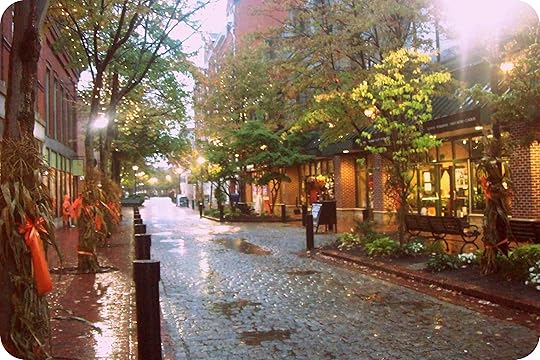
We must content ourselves to lonesome walks down dusky streets with the spirit of the author, to share his sidelong glances, at lights in upper windows of houses, through patches of dark woods, as the fall breeze drifts among the trees, with strolls along the beach at eventide, and the cast of 19th century characters who pass by.
One can’t complain too much, especially one like me, who was so much in the mood for a promenade down the streets of Salem in October. To get October of 1940s and 50s is even better. And I can think of no better guide, than Nathaniel Hawthorne himself.