Jump to ratings and reviews
Rate this book

Strange Highways: Reading Science Fantasy, 1950-1967

Rate this book
"Science Fantasy" blends science fiction AND fantasy, so it tends to be bolder and more highly colored than pure science fiction. In the middle of the last century, the British magazine SCIENCE FANTASY created its own distinctive strains of fantasy narrative, most famously by such writers as Brian W. Aldiss, J. G. Ballard, John Brunner, Michael Moorcock, and Thomas Burnett Swann, among others. This book looks closely at the whole trajectory of that lost magazine, from its birth in 1950 through 1967, when it was briefly called (SF) Impulse. John Boston provides a brilliantly insightful and often every funny account of the rise, evolution, and final fall of SCIENCE FANTASY, its writers, and its quirky editors. Boston is joined by writer and critic Damien Broderick, adding his own waspish and nostalgic comments. This volume, the first of three dealing with the history and development of the major British SF magazines, is a compelling night journey into the past, where the future took a turn down paths not often explored. It's a trip not to be missed.

372 pages, Paperback

First published October 8, 2012

2 people are currently reading
3 people want to read

About the author

John Boston

24 books5 followers

Ratings & Reviews

What do you think?
Rate this book

Friends & Following

Create a free account to discover what your friends think of this book!

Community Reviews

5 stars
0 (0%)
4 stars
2 (50%)
3 stars
1 (25%)
2 stars
0 (0%)
1 star
1 (25%)
Displaying 1 of 1 review
Profile Image for Darren Goossens.
Author 11 books5 followers
April 25, 2016
This review is from https://darrengoossens.wordpress.com/2016/02/23/more-than-a-fun-list-strange-highways-reading-science-fantasy-1950-1967/.

I recently 'reviewed' issue 1 of Impulse, the magazine that superseded Science Fantasy. The logical next step was to take a look at the epic summary of the whole life of the magazine -- Strange Highways : Reading Science Fantasy, 1950-1967 by Boston and Broderick. It's about 370 pages and was put out by Borgo Press (really Wildside) just a few years ago.

I dusted off my Kindle keyboard and got the e-book (only a few dollars, even these lousy Australian ones) and started to browse. A couple of days later...I'd read it.
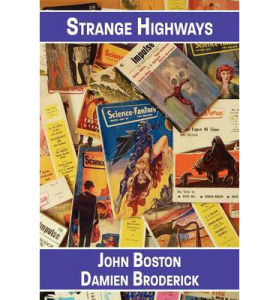
Cover of <em>Strange Highways</em> by Boston and Broderick.
Cover of Strange Highways by Boston and Broderick.

First, what is the book? It is, literally, a volume-by-volume review of the entire run of the magazine. This is a strength and a weakness. It does at times feel like a list. On the other hand, the sections (each dealing with about three issues) are short, pithy, and amusing, so there is always the temptation to just read one more. And another. And one more. And now it's midnight...

By the end, I think I've gained more of an appreciation of the reality of running a magazine on a slim budget when the 'literary' quality is just one of many factors influencing the editor's decisions. Science Fantasy itself comes across as a bit of an outlier. Despite its name it mostly published SciFi with a bit of weird. Much of it was awful -- of course -- and some of it was outstanding, and most of it was routine commercial fiction. The magazine was important in some important careers -- Brunner, Aldiss, Ballard and Moorcock, Priest and Roberts and Swann all published important and/or early works there. Late in its run it gave the world Make Room! Make Room! and Pavane.


A fourteen year old Terry Pratchett published his first story in a latish issue.

The best way to give a flavour of the book is to throw in some quotes:
If the works of Ballard were to be considered as a Friday night Rotarian bowling tournament, that sentence would be a strike.

and (after a particularly unpronounceable fantasy name):
...sometimes one gets the impression that Moorcock's mythic muse is Scrabble...

and (of Elric):
He has even broken his addiction to his sword and instead keeps up his strength by eating magical plants, in a sort of Sword & Sorcery version of methadone maintenance.

and:
...smacks a bit of what one might get if Tennessee Williams had ghost-written Peter Pan.

and:
Think Weird Tales meets The New Yorker and they beat each other to a pulp rolling in the gutter.

and (on the change of publisher (Nova to Roberts & Vinter) and editor (John Carnell to Bonfiglioli)):
There's not much evidence of any proofreading. This is the chief axis of continuity with the Carnell Science Fantasy.

and (on an editor's comments):
Well, his beef is cardboard characters, and Plague From Space managed at least sheetrock.

and (last for now):
...which is actually pretty good if you don't mind something like David R. Bunch on amphetamines.

A further comment notes that a couple of pretty good anthologies could be drawn from the pages of the magazine, even if one restricted oneself to unanthologised works. The authors then go on to give a couple of notional lists, lamenting that such a book would be quite a good read but it'll never happen and no one would ever buy it if it did. Well, it has happened -- the same editors have put together The Daymakers and City of the Tiger and Perchance To Wake, all available on Amazon and from the publisher and all drawn from the stories discussed here. The Daymakers even includes 'Same Time, Same Place' by the truly great Mervyn Peake. I may have to force myself to be too busy to read them... Given that the editors similarly remark that an excellent volume could be put together from the Brunner material in the magazine, but that no one would ever do that and if they did no one would buy it (etc), perhaps I need to keep an eye out for that volume. John Brunner was a great writer, even if he did not always write great stuff.


Obviously.
Displaying 1 of 1 review