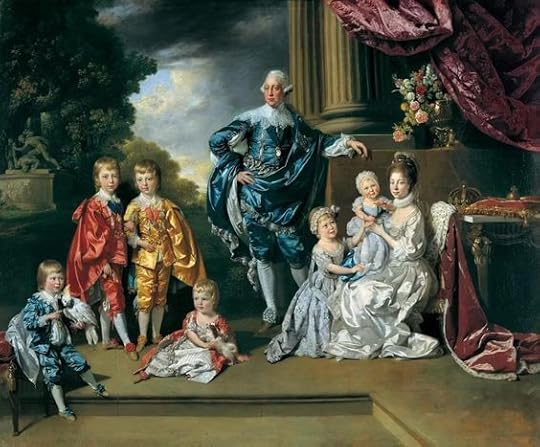
The surprising, deliciously dramatic, and ultimately heartbreaking story of King George III’s radical pursuit of happiness in his private life with Queen Charlotte and their 15 children
In the U.S., Britain's George III, the protagonist of A Royal Experiment, is known as the king from whom Americans won their independence and as "the mad king," but in Janice Hadlow’s groundbreaking and entertaining new biography, he is another character altogether—compelling and relatable.
He was the first of Britain’s three Hanoverian kings to be born in England, the first to identify as native of the nation he ruled. But this was far from the only difference between him and his predecessors. Neither of the previous Georges was faithful to his wife, nor to his mistresses. Both hated their own sons. And, overall, their children were angry, jealous, and disaffected schemers, whose palace shenanigans kick off Hadlow's juicy narrative and also made their lives unhappy ones.
Pained by his childhood amid this cruel and feuding family, George came to the throne aspiring to be a new kind of king—a force for moral good. And to be that new kind of king, he had to be a new kind of man. Against his irresistibly awful family background—of brutal royal intrigue, infidelity, and betrayal—George fervently pursued a radical domestic dream: he would have a faithful marriage and raise loving, educated, and resilient children.
The struggle of King George—along with his wife, Queen Charlotte, and their 15 children—to pursue a passion for family will surprise history buffs and delight a broad swath of biography readers and royal watchers.
Janice Hadlow has worked at the BBC for 28 years, including more than 10 years as a top executive. She was educated at comprehensive school in Swanley, in north Kent, and graduated with a BA in history from King’s College London. She currently lives in Bath. A Royal Experiment is her first book.
”I had always been interested in George III, that much-misunderstood man, in whom apparently contradictory characteristics were so often combined: good-natured but obstinate, kind but severe, humane but unforgiving, stolid but with the occasional ability to deliver an unexpectedly sharp and penetrating insight.”
George III
This all begins with Queen Anne dying without issue. Due to the passage of the Act of Settlement in 1701, only a Protestant was qualified to ascend to the throne of England. This leaves the Stuarts out in the cold, even though the self-styled James III, living in exile in Avignon, the son of the deposed Catholic king James II,considers himself the true king of England. He is called the Jacobite Pretender, and this sets off a series of Scottish rebellions ending in the marshy fields at Culloden in 1746 when Bonnie Prince Charlie, James’s son, leads his Scottish forces into the guns of the English with disastrous results.
The Stuarts cannot regain the throne through diplomatic means or through force, so that leaves us with the very German Protestant descendents of Anne, who are currently sitting on the throne of Hanover.
I’ve never been pleased that the English felt their only option was to put VERY German aristocrats on the throne of England. They didn’t even speak English until George III. They were in many ways anti-English, insisting that none of their children could marry into English families. In fact, they generally tried to find their children German husbands and wives. I find them, as a descendent of Plantagenets, frankly, intolerable. I understand the issues with putting a Catholic Stuart back on the throne, but seriously there had to be some English aristocrat with a royal bloodline who was Protestant.
George I, who really prefers to be in Hanover, is brought to England, and something else comes to light as to why the powers-that-be may have preferred a German king. This is the era of the rise of the power of Parliament. The Prime Minister is beginning to become the primary policy decision maker for the country. George isn’t quite a puppet or figurehead, but his powers are greatly reduced from the reign of Anne. How would he know anyway? The grumpy old bastard is too busy fighting with his heir, the future George II. There is a long tradition in Hanover with kings viciously arguing with and spurning their heirs. Obviously, none of them ever learned from how they were treated. None really attempted to break this ridiculous cycle of familial loathing. They became caricatures of the very people they used to despise, their fathers and grandfathers.
It’s madness.
I picked this book up because I didn’t really know much about the Hanoverians. My view of George III has always been colored by the Revolutionary War. He was not regarded very kindly by the rebels in America. He was always presented in my history classes as an oppressor and a crazed dunderhead. I realized that most of my impressions of him were formed by his enemies. Hardly fair, really. I felt this book would maybe right the ship and leave me with a more balanced view of George III. I also wanted to see the Revolutionary War from his perspective.
Janice Hadlow started out writing this book with more of an interest towards finding out more about the wives and families of the Hanovarian kings, and the book reflects this initial focus. Some of this is very fascinating, but certainly did not change my feelings too much towards the cold personalities of these distant, German Centric kings. They were capable of great kindness towards their families, but each story of kindness is offset by a story of narrow minded, controlling nastiness.
The biggest disappointment of the book for me was that Hadlow spent very little time on the Revolutionary War. It was over so quickly in her narrative that I assured myself she would return to this time period later in the book.
She did not.
George III and Queen Charlotte had fifteen kids, of which thirteen made it to adulthood. The two that died were both boys, but that still left six male heirs to the British crown. Two of those boys, George and William, became kings of England, but it was only Edward the Duke of Kent who managed to produce a legitimate heir to continue the royal line. This diminutive young girl became the renown Queen Victoria, who would prove to be as fertile as her grandmother Charlotte.
George and Charlotte had tried their best to produce the perfect, deliriously happy family life. They read books. They brought in experts, but in the end they produced very unhappy children, and a lot of that had to do with the iron control that was exerted on their daily lives. George, the heir, was kept in England, while his brothers were ordered to all corners of the world. The girls were kept penned up in England and became near spinsters before their father would deign to try and find them husbands. George, to further exert his control over his brood, had a law passed that his children could not marry without his consent. Many of them fell in love with various subjects of the English crown, but as I stated before, he refused to allow any of his children to marry someone from the very country he represented. This spawned clandestined, illegal marriages, illegitimate kids, and many tears and heartbreak.
The grand experiment in creating the perfect family life was a dismal failure.
I mentioned madness earlier. I have always assumed that the infamous madness of KIng George III was overblown. He was, after all, unlike his predecessors, an intelligent seeker of knowledge. I tried, unsuccessfully, to appreciate the man for his finer qualities. He was, if anything, marginally better. At least he could speak English and was the first of the Hanoverians to be born in England. George III was not just crazy. He was batshit crazy. He suffered from grand delusions and started to believe that he was married to an old flame rather than his wife of many decades. When he was allowed access to his daughters, he fondled them and had to be restrained. Needless to say, the man had no business being in charge of anything more complicated than his own bowel movements. He fell into this madness numerous times and should have been deposed in favor of his son, but politics played a part.
Parliament knew, if George IV were officially crowned, that there would be a shakeup in government. The son had favorites who were the political adversaries of the men in charge. Parliament held off allowing the change, hoping that III would rally, and he did, only to fall back into madness numerous times.
Madness was allowed to run amuck.
Hadlow tried to paint a more sympathetic view of the Hanovarians, but she didn’t really move me to change my original impressions of them. The best of them was the diminutive Victoria, who was really the first of the line to be a true English ruler, in my opinion. I am also a bit fond of the hapless Bertie, who had to follow in his mother’s footsteps, though perhaps a bit drunkenly. To bury their German heritage, George V changed the family name to Windsor, a good move given the number of British lads who died in the trenches trying to stop the Boche in WWI. We all, of course, like George VI who overcame a speech impediment to offer hope and comfort to a nation on the brink of catastrophic defeat during WW2. The royal Hanovarian family evolved into a symbol of what it means to be British.
English people like to proudly state that they have not been invaded since 1066, but I would assert that they were also invaded in 1714 when they opened their gates to the Hanoverians.
Even though I didn’t get what I wanted from this book, I have to say the impeccable research done by Hadlow is impressive. This will be considered the quintessential book on the family of George III. If anyone has any suggestions on the best book to explore the Revolutionary War from the perspective of the British, do please share.
You’d never know it from the way things turned out, but decades before his granddaughter Victoria was born George III had hoped to break the Hanover cycle of rampant family dysfunction to live a private life filled with affection, harmony, and virtue that would be a model for his people and prove British royalty worthy of the great tasks assigned to it by Providence. George III’s dream of a loving and prudent family fell apart long before madness claimed his mind, and ending up with a profligate heir like Regency Prince turned King George IV is just part of the story.
While the focus is on George III, A Royal Experiment begins with the first Hanover king, George I, who was imported from Germany to keep the British royalty Protestant and who was unimaginably cruel to both his wife and his son George II, and the book ends with Queen Victoria, who in some ways was able to bring her grandfather’s moral vision to life. In addition to covering the personal lives of several generations of the royal family, the book is filled with thought-provoking information about and reflections on the culture and attitudes of the time, including the differentiated roles of the sexes (not a good time to be an intelligent independent woman) and the changing views of marriage (love or practical alliance? equal partnership or male ruled household?), family life, childhood (coddled or challenged?), madness, religion, childbirth practices (female midwives or medically trained male doctors?), and the duties and/or rights of royalty.
As an American it was fascinating to read about the various ways the American Revolution looked to and affected George III, British politicians, the general population of Britain, and the French. Without being overly sensational, A Royal Experiment fully engaged my emotions as well as my mind--it was horrifying to witness George III’s descent into madness and heartbreaking to read about the early death of George IV’s daughter Princess Charlotte, a high-spirited young woman who self-identified with Marianne of Jane Austen’s Sense and Sensibility. Thoroughly researched, well organized, accessibly written, and unrelentingly interesting.
The string of Georges in the eighteenth century have always seemed like a wedge of Germanic pumpernickel between the glamorous Stuarts and the tartan tinged domesticity of Queen Victoria. But as Hadlow's enthralling book reveals, the psychodrama dancing from one generation to another is every bit as gripping as Henry VIII's marital dilemmas or Queen Victoria's tempestuous relationship with Albert. The heart of the story is the attempt by George III to be a model family man as well as monarch. He doesn't have much in the way of role models - the Georges were notoriously vile to their heirs, and were capable of great cruelty to their wives. George is determined to break the pattern, and this book is a compelling account of how his noble experiment foundered. What makes this book so compelling is Hadlow's novelistic eye for detail : Charlotte was a German princess so poor that she had no spare dress to send to London as a pattern, with the result that all her wedding clothes were too big. The fate of George's daughters was particularly poignant, one of them Sophia had an illegitimate child who she was forced to give up, while the sons gleefully ignored their father's uxoriousness. But the real revelation of the book is Charlotte, an intelligent woman who must have longed for her husband to take a mistress as she struggled through fifteen pregnancies. This book is long, but never boring. A must read for anyone interested in royalty, the eighteenth century or the intricate warp and weft of family disfunction across the generations. Full disclosure - Janice Hadlow is a friend, but I know lots of authors and I don't give them all five star reviews!
Wow! I come in with maybe a 3 1/2 star interest in King George. You put me more than 700 pages from adding this to my beloved book count and a switch of subject and voices. You, author, have your work cut out for you to stand out from the other books as they buzz by.
And you get what I think was my first five-star rating of 2021. You really got me caught up in the tenor of the times, from the rising economic tide, to the changing perspective on childhood, to the heady optimism of these figures' early reign, which made their later tragedy all the more painful, even personal. In a couple of days with His and Her Majesty, I felt like I knew them. Well done!
In this meticulously researched work, Janice Hadlow describes the family lives of the England's Hanoverian Kings, George I, II, III and IV. As she sees it, George III made a concerted effort to break with the sordid, feuding and hate-filled lives of his grandfather and great-grandfather. Hadlow poses that the ideals implanted by George III reached their fulfillment in what we have come to know as "Victorian" and that the standards he set for the British royal family have been a cornerstone in its survival.
The first third of the book sets the stage. The reader sees how George I banished his wife for an affair (while he had many). Her cruelly enforced seclusion was complete; she never saw or heard from her young children. Their son, who grew to be George II, similarly experienced George I's cruelty and was also separated from his children. As king, George II loathed son Frederick who tried to give his son, the future George III, a healthy childhood. While Frederick died too young to see his son fully grown and married (and too soon to accede to the throne) the seeds of a new way were planted.
While George's new style of family life did not have the anger of past generations, it was a stultifying mix of isolation and discipline. As a result not one happy person is described in the book. The Queen who bore 15 children was angry and bitter most of the time. The King revealed deep depression in his mental illness periods. The boys rebelled. That they produced perhaps 50 grandchildren, but only 1 born in wedlock, was clearly an affront to the family values espoused by their father. Only brief sketches are given of the boys' rebellions. The girls suffered the most and their sad lot is well defined.
The girls were closely supervised and tightly controlled. The queen says their tutors should balance their praise with "uprightness". Letters survive from Augusta (the youngest) and Royal (the oldest) that literally beg their tutor, Mary Hamilton, to love them (p.269-70). In their teens and twenties, any hint of flirtation or romance is cruelly squelched. The girls long to be married. The author seems to feel that the Queen is enforcing the King's wishes (p. 605), but when the King was incapacitated beyond recovery, The Queen fought not just against any marriage proposal but also attendance at various social engagements.
The Romanov Sisters: The Lost Lives of the Daughters of Nicholas and Alexandra shows these similarly cloistered teen and younger girls to have the same sweetness, charity and wholesomeness ascribed to these British counterparts. However, the British princesses' letters belie the happiness and calm they project. Few of the letters of the Romanov girls survive to draw their full portraits. Were they to have survived would their lives and happiness have been similarly thwarted?
The author shows the impact on the family of losing the 13 American colonies (the King is depressed and it cannot be mentioned), the French Revolution (horror) and the various issues facing Parliament. It can be wordy in areas such as modern opinions on illness (particularly the King's), descriptions of the novels family members read and assassination attempts to name a few.
Janice Hanold is to be commended in bringing this all together. It is recommended for those interested in this family and or the period.
You would think a 700+ page book on the private domestic life of a Georgian king I knew little more about than the fact of his madness would be boring, or at the very least would flag through the mass of pages. Not a bit of it! I could hardly put this book down. I came to feel real affection for all of the personalities in this tale (or almost all of them - it's hard to feel much sympathy or affection for the Prince Regent, later George IV) and I was sorry to come to the end of it.
Whilst George III's granddaughter Victoria is largely credited with the creation of the modern monarchy and the notion of the 'royal family' at the heart of it, it was George III was really blazed that trail, determined to bring an end to the Hanoverian tradition of family discord, suspicion and hostility. He was the first to really conceive of his royal role as one of duty and obligation, with the monarch as a role model and figurehead for his people, and this vision extended to his entire family.
He was a kindly, benevolent father to his enormous brood of children, but his paternal virtues were best on display when the children were young. He struggled with all of them, sons and daughters, when they grew older and developed wills and desires of their own; he could not understand and would not tolerate any deviation from his vision of royalty with the family at the heart of it. As a result his role as father and king degenerated into a form of emotional tyranny, keeping his daughters infantilised and dependent by refusing to allow them to marry, isolating and shunning his sons by his disapproval and rigidity. None of George III's children could really have been said to lead happy, fulfilling lives.
And yet George III is an immensely appealing figure, a simple, unassuming man who genuinely wanted those he loved to be happy, yet unable to see that his own actions to a certain extent perpetuated the Hanoverian legacy of family discord. One could argue his madness was the least of the burdens he bequeathed to his family.
My wife and I watched the TV series, Bridgerton, on Netflix. This was a very fictionalized account taking place in 18th century Georgian England. One of the continuing characters in the series was Queen Charlotte who was married to the Mad King, George III. We also watched the spinoff series called Queen Charlotte which told of Charlotte's travel from a kingdom in Germany to become Queen of England by marrying King George. This series was actually more interesting and enjoyable to me than the original Bridgerton series. It told of Charlotte's marriage to George and his struggle with mental illness. Again, both of these series were highly fictionalized and used a premise of Charlotte being at least partially black with other black personages being granted peerages in England. But how much in the series was close to what really happened in history? Anyway, I wanted to find out more about George III and Charlotte so checked this mammoth biography out from the library.
This is a very detailed biography of not only George III and his family but of the Georgian dynasty as a whole, including George I and George II who came before George III and ending with Victoria, George III's granddaughter. The German House of Hanover became the British royal family by default of the Act of Settlement of 1701, which assured only a Protestant monarch would rule England. George I and II were not fond of England and were miserable parents who despised their own offspring. George III came into power in 1760 at age 22, and was determined to be a better king whose power would be rooted in the affection and approval of his people. He wanted to escape the dysfunction of his predecessors by maintaining a faithful marriage with domestic harmony. His marriage to Charlotte was an arranged affair with Charlotte coming from the German kingdom of Mecklenburg-Strelitz. Charlotte agreed with George's sense of moral purpose and together they do everything possible to raise their thirteen sons and daughters with love and attention. However, as the children grow older, the men mostly stray and have affairs outside marriage while the women have difficulty in securing a husband who meets the requirements of a royal marriage. And then George III struggles through a time of change and tumult including both the American and French revolutions. Then at age 50, George is stricken with a mental illness that plagues him off and on through the rest of his life. This kept him confined and in strait jackets for many years. His symptoms included manic bouts of talking until he passed out, becoming obsessed with a certain Lady Pembroke of court and telling his wife he hated her and preferred Lady Pembroke (in front their children), trying to seduce his daughter-in-law, and using increasingly bawdy language in front of his daughters. George's illness has sometimes been identified as porphyria, a metabolic disorder caused by a genetic malfunction that alters the body's chemistry, resulting in the overproduction of toxins affecting the nervous system. However, more recent research questions this diagnosis and attributes his madness to the mental condition, late-onset bipolar disorder with recurrent manic episodes.
This biography was very well researched and contained a ton of information about life during that time period including things such as childbirth and midwifery, education of children including differences between how boys and girls are taught, religion and politics, and domestic and public life. So how does this compare to the Netflix series. Well there is some truth to the series including Charlotte's motherhood of 15 children, but the series is much more romantic than the actual life. George's mental illness is portrayed as something he was plagued with since childhood but in actuality, it didn't affect him until age 50. I would recommend this biography for anyone with an interest in Georgian England but it is a slog to get through — I admit that I did skim some of the later chapters.
This is a big, informative, but accessible history and biography, less of George III of England in particular than of the whole Hanoverian dynasty and their families, with George III as a focal point. Hadlow states in the introduction that she started out most interested in Queen Charlotte and their daughters, which is evident in the text, but the book begins several generations before George III and while it ends with his death, the later chapters focus more on his children and granddaughter Princess Charlotte.
The author is a good storyteller who also has done research in primary sources, so the book comes across as well-grounded and interesting. It’s very focused on the personal, with only brief forays into the politics of the time let alone their effects on regular people, and the occasional attempts at historical and social analysis are something of a weak point. However, the book shines in its psychological analysis of everybody involved. It does what group biographies do best, presenting a balanced view of all the family members, sympathetic to their circumstances but without ignoring their flaws and the way they hurt each other. To the extent that the book has a thesis, it’s that George III inaugurated the notion of the British monarchy as a symbol of domestic harmony and virtue, while prior kings went nuts with the mistresses and openly hated their heirs. However, with 13 children—7 sons and 6 daughters—surviving to adulthood and rigidly authoritarian views about what their family duties required, this was only a moderately successful project: he had fraught relationships with his sons (particularly his heir) and while his daughters all subordinated their wishes to his, they wound up miserable as a result.
It does seem to me that, while George III deserves his share of personal blame for the family difficulties, larger geopolitical forces than the author addresses were also at work here. Historically, monarchs only had a few surviving children, and in an era where the monarchy was more far powerful than today but far less than it had been centuries before, finding appropriate destinies for 13 of them would have challenged the best of intentions. In particular, Hadlow criticizes the king for failing his daughters by not arranging their marriages, which clearly was at least in part because he enjoyed their company at home and wasn’t willing to understand that their happiness might be inconsistent with his. But his grandfather, George II, also didn’t marry off 2 of his 5 surviving daughters. It seems to me that by the time of George III, marriage diplomacy was far less important than it had been, with national self-interest no longer requiring personal familial ties and Parliament heavily involved in international affairs. And furthermore, since his children could only marry Protestants, the available husbands were overwhelmingly small German princelings—alliances producing more burden than benefit to a world power. Marrying his children to British subjects, meanwhile, was out of the question because of the potential for intrigue and undue influence at home.
For better or worse, much of the information compiled here is also available from other popular sources, many of which go into more detail on the individuals discussed. For Electress Sophia and the family in Hanover, read Daughters of the Winter Queen; for the courts of George I and II and the conflicts between them, The Courtiers; for George III’s siblings (particularly sister Caroline Matilda) and his life as a young king, A Royal Affair. For his daughters, there’s also Princesses (though I found that one too dry to finish and was pleased to get the same information in a more engaging style here). Plenty of other books deal with George III’s periods of madness and with late 18th century British politics. Nevertheless, this is an engaging biography and in particular, there’s a lot of detail about Queen Charlotte that I hadn’t seen elsewhere. The younger sons are mostly on the sidelines, perhaps because their father sent them abroad at young ages and generally had little to do with them. But overall, I found this book an excellent overview, providing an insightful and empathetic treatment of the personalities involved, and worth the substantial time I spent with it.
Really, somewhere between 2 and 3 stars because a lot of it didn't hold my attention. But the positioning of George III as the antecedent to Victoria and Albert's domestic bliss is FASCINATING. And man, poor Queen Charlotte. Poor princesses. It's amazing the way that lives can get fucked up just from people trying to do what they think is right.
2016 Read Harder Challenge: Read a book that's over 500 pages long.
This is another book that could fit multiple challenge categories. But those I feel confident about finishing, while who knows if I can finish another super long book this year. And anyway, this book is just... really really long. In number of pages, but also in scope. Huge cast of characters, over a hundred years of history, 30% of the e-book is devoted to citing sources (and you're still going to be reading for 600+ pages all the same.)
Anyway, wow, this book was one of the most pleasant reading surprises I've had in a long time. So informative, but also so engrossing and riveting and so surprisingly sad in places. I knew absolutely nothing about George III's immediate predecessors, but they turned out to be fascinating in their own right. By laying out all their dysfunction, the author also shows just how revolutionary George III was being when he made a conscious effort along the lines of "yeah, I'm not going to cheat on my wife, and I'm not going to passionately hate my children." By living this life (and by living this life for a long, long time) George III completely altered the tone of relations in the royal family from then on.
Not that he was perfect. Far from it. The author makes a good case that George was an absolute tyrant to his family. For benign reasons, but still. It starts from his decision making when selecting a wife. One of his most important credentials was that she not challenge him ever. Cue 17-year-old Charlotte leaving Germany, arriving in England, and being ordered to not engage in politics and not have any real friends among her ladies-in-waiting. Hadlow is clear that he showed Charlotte a great deal of affection until his madness ruined things between them, but you still have the rather terrible reality of a man stifling basically all of a woman's independence and free thought. And Charlotte hated her lack of control, and wrote many letters to her brother that indicated having to suppress her emotions, and swallow all of her opinions. Between this and 20 years of near continuous pregnancy (she and George had 15 children) Charlotte often had to bear the brunt of keeping up a functional, happy royal family.
In turn, Charlotte often took out a natural need for control on her children. And what happened with their children is such a goddamn tragedy. They were given some of the best (and most progressive- yes, really, progressive!) education in all of Europe. The boys and girls alike. However, their parents often practiced a mix of controlling behavior and chilly reserve when it came to their children. Because George was away from them a lot of the time, Charlotte was often perceived as the reason for their boredom, when, in reality, she did almost nothing without George's say so. With the exception of the heir, all the boys were sent far from home to work. Whenever they came back, they were typically criticized for every way they'd failed while abroad. The girls were kept as permanent attendants to their mother, until they married. And, out of 6 girls, only 3 of them married. Only one of them married before menopause. There are a lot of complex reasons for their parents failing to secure marriages for them, but it led to the same life for all of them. Decades spent shut up with their mother, educated as hell, but rarely allowed any outlet for their energy. No projects, no travel, nothing.
Now imagine this pressure cooker situation, and what happens when the patriarch who controls it all goes mad.
I've really only touched on the surface of this book (despite rambling for paragraphs.) But it's just a really compelling, well-researched exploration of a turning point in history. It's also a family drama in which people fuck up majorly by trying so hard to do the right thing. After I finished I was left with a real sense of melancholy. There's something unchanging about people, isn't there? 99.9% of us won't be as privileged as the people studied in this work, but I think most of us have been caught up in family situations where people harm each other while being convinced they're doing right by each other. Despite her subjects' extraordinary life circumstances, Hadlow tapped into some universal characteristics in this work. I came away a lot more knowledgeable that I was about a whole century's worth of history, but I also came away reflecting on human nature in general.
I rather think one’s response to this book depends entirely on what one expects to get out of it. I expected a more intimate portrayal of George III and instead found myself inundated with information not only about him, but his parents, grandparents, their marriages, his children and their romantic affairs, his wife, and various members of their households and larger court, including mentions of Georgiana, the Duchess of Devonshore, and others like her.
It talks about the immorality of court preceding George’s ascent to the throne, his determination to remain separate from his ancestors in marital fidelity, his choice in a wife, their many children, his eccentric habits and desire for solitude, his unusual behavior as regards children (he was a playful, good natured father who crawled about on the floor with his brood, but as they got older took a more authoritarian tone with them all; the most odd thing about him was his love of having daughters, in a male-dominated society), and so on and so forth.
For one who wants a comprehensive look at the court of the period, and some of its more popular (and lesser known) characters, this is a decent book. It is not, however, an intimate biography of George III, since while the book revolves around him, one can read for pages and pages without running across any mention of him. Even more disappointing, though, was the section regarding the “Conflict with the American Colonies.” I looked forward to that section with anticipation, hoping that maybe it would shed some light on why such an honorable, good-natured monarch would walk away from that conflict with such shame and a reputation for stubbornness. Much to my surprise, the conflict is glossed over – a few paragraphs and then we are once more on to politics on a larger sphere, dealing with his advisers and moving on to family portraits and such.
The most wisdom gleaned from that section was that George regarded the Colonies as unruly children who needed brought into hand, but there was so little about his actual involvement in the process that I am no wiser than when I started. This trend continued into the later chapters (I started skim-reading shortly after this) where a huge amount of attention is paid to the embarrassing details of his “insanity” but with no resolution at all, or even suggestion as to what might have been wrong with him. I expected some sort of modern diagnosis, or at least addressing the various suggested illnesses that modern doctors have posed as reasonable suggestions for such a sever shift in his behavior. With hardly any warning, George went from a faithful husband, always appropriate and proper, to a lecherous head case locked up in a straight jacket half the time, destroying his previously wonderful marriage in the process.
In the end, I did search online for related symptoms and illnesses and his increasingly frequent episodes hold up nicely against the “manic” phase of someone with a severe case of bipolar disorder.
George’s life is a tragic one. He is most remembered for his insanity and “being the king that lost America,” which is unfortunate, because underneath the stoic monarch beat the heart of a romantic, who adored his wife and children, who was faithful in a court fraught with immorality, who has the indignity of the entire world knowing about his worst moments and having no insight into his kinder ones. This biography is a good read, if you want a generalized picture of the Georgian period and its more prominent characters at court, but it wasn’t quite what I hoped it would be.
"What happened in America between 1775 and 1783 genuinely changed the world. It also almost destroyed George III's kingship, and left him with a sense of failure from which he never fully recovered."
"The crisis also struck a blow at George's carefully constructed vision of kingship, demonstrating the limitations of its effectiveness when faced with a direct confrontation. His inability to deliver an outcome that he believed was both right and just instilled in him an anger and unhappiness as acute as anything felt by his wife. "The sense of having failed in an endeavor which was central to his conception of himself as a man and a monarch was hard enough to bear; but George's frustration was made more acute by the prolonged misery of the experience itself."
My motivation for picking up the book was, mostly, to gain a better understanding and knowledge of King George III and the era of the American Revolution. But I didn't want the American point of view of things. I've got that available in spades. What I wanted was to learn more about what was happening on the British side of events. All we are ever really taught here is that George III was a tyrant and mad.
This book was fascinating and engrossing from the start. I did need to keep a page marker on the family tree at first in order to refer back to it frequently but before long I had all the Georges, their wives, children and siblings sorted.
I definitely gained the insight I was hoping for and then some. King George had very strong, guiding beliefs about how a royal family should live and behave. He was trying to reform the idea of kingship during his reign. His ideals and values, while sometimes resulted in good, to often imposed obligations and pressures on his family at too high a cost. His daughters, I feel, suffered the most. If anyone needs help distinguishing between the fairy tale life of a princess and the reality they need only read about King George's daughters. Though his sons did not fare much better, they at least had a bit more freedom.
Reading about King George's recurring bouts of illness and madness and the effect it had on his family, especially the queen, was rather saddening at times.
Janice Hadlow has the wonderful, and sometimes rare, ability to write a non fiction book of over 600 pages that never feels bogged down or boring.
I was glued to this book. It can be heavy, ponderous almost, obsessively detailed with paragraphs that are the length of pages, or half pages, but the more I read, the more I wanted to read. I have not read very much historical non-fiction lately (I used to read everything I could find on Winston Churchill), but I am interested in history, and overall, my knowledge of history is fairly adequate. But this book throws such a spotlight on George III and his family, it's as if I knew nothing about this era in English history.
Starting with George III's great-grandfather, then grandfather and father, the Hanover line of kings is illustrated in a non-flinching, accurate and meticulously researched way. But instead of being a rather dry read, the book is rich with detail that delves into the emotional lives of the Hanover kings, their wives and children. Everyone is firmly fleshed out; every fact is continuously annotated. The use of diaries - and frequent quoting from them - gives life to what could be a dull topic (sometimes.) I was finding myself thinking, well that prince, or princess, is a lot like so-and-so...and the name of a politician, president, or even a celebrity would come to mind. I was also very aware how much George III was like so many present-day leaders, or celebrities, in that, since he was really answerable to no one, then no one could really tell him what to do. This proved fairly disastrous when it came to issues of his health, though at this time in history it's doubtful anything could really be done about his 'manic' episodes and eventual mental illness.
(I kept wondering: what are some of the other theories, in addition to porphyria, for the cause of King George III's illness? Lead poisoning? Did he drink from a favorite cup or tankard, one with a lead base? What about other kinds of heavy metal contamination? Or a brain tumor? Could he have been diabetic, or what about a combination of some of these? Anyhow, I found those parts of the books fascinating. It's also worth mentioning that the diagnosis of porphyria has been partly discredited, or downplayed by some recent researchers.)
I also was surprised to learn about all his children, and how they grew up, married - or in the case of the princesses, who the king really didn't want to marry, and what happened to them. I kept flipping to the family tree so many times I folded back the page. There are so many children - fifteen in all - and each one was well-delineated, described and sometimes 'dissected' as to what motivated them and how they reacted to the two dominating influences in their life: their father and their mother, the queen. Again, everything is backed up by the many letters each wrote and the diaries they kept. (Letter-writing in the 1700's is like texting today. Constant and required if one is to keep up with what's going on in one's social circle.)
I also thought, this would make a great mini-series, or similar. Fifteen children. Imagine the cast. And the interplay, the dynamics amongst them. Against a historical backdrop of the American, and then the French Revolution, the Napoleonic Era. Amazing time in history. Amazing family.
Near the end of the book the author mentions that George III laid the groundwork for the modern monarchy of the kind still found in England today: family first. This was carried on after his death by his eventual successor, Victoria, and then into modern times with Elizabeth II.
Anyhow, excellent book. A bit tough to bite into at first, but well worth it.
I received a copy of this book through the goodreads giveaway program.
Most American's have an opinion of King George III as the king who overtaxed the colonies, a stubborn and unreasonable tyrant. If you believe that then, "A Royal Experiment, by Janice Hadlow will intrigue you.
The American Revolutionary Era in American History stands out as one of my most favorite historical time periods. I have read and studied the history of this era in post-grad classes and it never fails to dominate my personal curiosity with an influence on my reading choices. Whether non-fiction history or historical fiction, I gravitate to this setting with un-satiability. I have read biographies, memoirs, primary documents, historical texts, articles and non-fiction books that focus on the American side of the Atlantic. However, this is the first book that I have read that takes place entirely on the other side of the ocean.
From the moment I read about this book, I planned to fit it into my TBR book list. I was then fortunate to receive a review copy by the publisher, Henry Holt and Company. Janice Hadlow has written an account of King George III and his wife Queen Charlotte that is not about the American Revolution, but instead depicts the man in his less familiar role as father and husband. Who would think King George !!! had any wish to provide a stable and loving home? He and Queen Charlotte had fifteen children. Charlotte was first pregnant at age eighteen. Remarkably, thirteen of their children survived infancy.
The king was determined to show that his commitment to fidelity and family life were paramount in his life. He planned to show his kingdom, a view far different from his ancestors. It was important to him that the world see him as a devoted father and faithful husband as well as king. It was to be, as Janice Hadlow so aptly titles her book, "A Royal Experiment."
Hadlow's author's notes offered new insight for this reader. I learned that Queen Charlotte, was a highly intelligent woman who resented her twenty plus years of pregnancy.She was a woman out of sync with her generation. King George III believed "the personal was always inextricably linked to the political" (pg xvi) and his hope was that the public would want to mirror his private life. I assumed that if his label as a tyrant in the colonies was genuine, it would carry over to his personal life. (No spoilers.)
Janice Hadlow relied on countless 18th century letters, diaries and correspondence to gather the most honest and personal account of this royal monarchy. The letters available by friends and family during the 18th century of her research are abundant. I found it humorous that she discovered they were inclined to gossip and they loved to write. One wonders what the 18th century Facebook would be like?
A Royal Experiment is a richly detailed book about King George III and Queen Charlotte. Hadlow is able to provide a fascinating full dimension view of the American Colonist's former monarch. A compelling and highly recommended history.
Taking a view of the House of Hanover's family life, and most specifically, George III and his queen, Caroline, and their 15 children, was a fascinating way to look at what made them the people they were. Some of their behavior was opaque to them, as much so as any "reality" family today. George couldn't see how his stifling and disapproving behavior affected his heir, and how he indeed repeated his grandfather's behavior to his son, Frederick. With all the earnestness of true believers, George and Caroline tried to make their family as happy as they imagined others without the strains of ruling might be. For a short time, when the children were small, they had the happy home life the king and queen had envisioned. But divisions in the family were inevitable as the boys (and the girls to a lesser degree) began to want lives of their own. The reading of that history,to any parent, is familiar even when the events are on a much grander scale. The writing is fairly good, with an occasional lapse into the "he must have thought" or "must have felt" that doesn't really work well in a biography. But the subject really matters, that determination to build a good family as rulers, and we can see its influence today in the Windsors.
On balance I would give this a 3+ rating. Overall, it is too ambitious a project for one book covering a vast historical period. I felt bogged down in places and longing for more in others. It is well written and worth reading as it presents the private life of George III from a different perspective. It is scary how much our decisions influence our families !!!
I have had this book on my Want list for a very long time but sadly nobody took the hint. This is not to complain, I am fully aware that I am a very lucky girl in terms of having generous family and friends who buy me books but this one really piqued my interest. I was in Brighton over the summer and visited the Royal Pavilion, leaving slightly flabbergasted that it was possible to spend quite that much money with quite such poor taste. The royal houses which proceeded the Hanoverians were hardly going to be mistaken for the Brady Bunch (Wars of the Roses was essentially a fall out between cousins) but the Hanoverians are still the by-word for familial dysfunction. With painstaking detail and a clear passionate interest in her subject, Hadlow seeks to explain exactly why that was.
Although the main focus of her book is on George III and his family, (which with fifteen children is no small task,) Hadlow devotes considerable time to the roots of the family, going back to his grandfather George I and that gentleman’s mother the Electress Sophia of Hanover. Ad Hadlow points out in her prologue, the Georgians are now best remembered as a ‘lull’ between the ‘religious intensity’ of the Tudor and Stuart period and the ‘earnest high-mindedness of the Victorians’, but these are the people of Jane Austen’s novels, who watched as revolutions raged on the continent and who lived through enormous industrial and social change. Despite indicating by the title of her book that they were an odd bunch, Hadlow is clearly determined to give them a more accessible voice.
I had a feeling that with this book I would be cutting fresh ground in terms of my own reading; despite having a fairly omnivorous interest in history, the Georgian period has rarely caught my eye. That being said, I realised rapidly that there were more than a few familiar faces. Georgiana Duchess of Devonshire and her husband have walk-on albeit non-speaking roles and it was with delight that I spotted the Lennox sisters, whose group biography Aristocrats was so much fun last year. All the same, the main stars were without contest George and Charlotte as well as their fascinating and complex relationship with their many children. George III ascended to the throne determined to be an entirely new kind of king and as Hadlow points out, his policies continue to be followed by our own monarchs today.
Having observed three generations of son-hating and infidelity, George was determined to do things differently. His great-grandmother had ended her days in enforced seclusion with no visitors having been caught in adultery, his grandfather George II had been roundly mocked for being over-managed by his wife and his own father Frederick had been so loathed by his relatives that when his mother waas on her deathbed, she consoled herself that she would at least never have to see the ghastly beast again. Husbands were unfaithful on a point of principle, with George II taking mistresses lest he be further mocked for being too fond a husband, ostentatiously waiting outside his mistress’ rooms checking his watch until the time came for their assignation. George III wanted to do things differently. Recognising that as a constitutional monarch, kingship was changing, he believed that his mission was ‘to graft moral purpose on to the nation’s policy’.
Time and again, it became clear that the fissures within the royal family reflected the changes in the world at large. George III was determined to conquer his private inclinations; upon his succession, he developed an infatuation for Sarah Lennox but cast aside romantic ambition in favour of his moral determination. He chose Charlotte of Mecklenberg only after having made extensive enquiries around the courts of Europe, with detailed questioning on appearance, interests, education and behaviour having to be satisfied before George was prepared to commit. Other candidates from more powerful states were rejected for reasons such as being interested in philosophy or a tendency to lightness in behaviour. George had no intention of repeating his great-grandfather’s error.
Still, although this was a match of Cinderella-esque proportions for a young girl from an almost forgotten duchy, there was a sad note to this. The marriage contract banned any other members of Charlotte’s family from marrying a Briton – bad news for Charlotte’s sister who was already in love with the Duke of Roxburghe. These plans had to be put aside and neither party ever did wed. George was determined to be a model uxorious spouse however and Charlotte appeared to have done very well. Still, what was clear – as in so many biographies of monarchs – was how their public role defined their private selves; there was so much of their lives that Charlotte would have wished to have done differently had she not been Queen, a role that stifled her wit, her intellectualism and her relationships with her children – quite apart from her twenty year long ‘campaign’ of child-bearing.
Another big social change was the decline in infant mortality, which some commentators feel led to a greater willingness on the part of parents to invest in their children emotionally, they being less likely to die. Hadlow argues that this is over-simplistic but does agree that changes in ideas of education did lead to a change in attitudes. Rather than being born wicked, the idea of childish innocence, the tabula rasa was born. These children were to be adored, as indeed they were so long as they never challenged their parents.
Historian Janice Hadlow has acquitted herself well with her dual biography of George III of England and his wife, Charlotte of Mecklenburg-Strelitz. Americans of a certain age have two modes of thinking about George III. First he is the heartless tyrant, oppressor of American Independence. We know it was this very George that John Hancock meant when he may or may not have declared that he was going to sign the Declaration of Indepence so large that the king would not need his spectacles. The other mode is as a raving lunatic whose diminishing mental stability left the kingdom in the hands of Georgie-Porgie. I say Americans of a certain age because my years of teaching have proven to me most of our youth don't know George III from George Clooney. Perhaps it is better that way since like other monarchs he has gotten some rabidly bad press.
Hadlow vividly portrays a man who went into his new role with a clear vision of recreating the role of the monarchy in England. Under John Stuart, Lord Bute's tutelage he came to understand that the king should first be a model of English virtue, and that virtue beginning at home in the loving care of one's children and a faithful and loving relationship with ones spouse. With George III's coming from a dynasty known for all but eating their young, especially their heirs, and who considered extramarital alliances not just their due, but a necessity in establishing their power, this makes his "experiment" all the more remarkable.
In her account of the private life of George III and Queen Charlotte, Hadlow presents a history which is both a well researched fount of information and very enjoyable reading. She hads a talent for making the two royals appealingly human. One quibble is that there were times the narrative bogged down. Information was perhaps redundant.
This was marvelous – interesting and entertaining all the way through! The author tells the story of George III and his family, keeping the focus personal rather than political, but she nevertheless succeeds in making the story of George's “royal experiment” relevant to the modern world. The “experiment” of the title refers to George III's goal of building a royal family which would function smoothly and happily, and which could become a model for his subjects to follow in their own family lives. Given his own incredibly dysfunctional family background (which Hadlow presents), and the circumstances of his position, one can see why this project was unlikely to see complete success, but despite George's and Charlotte's many rather monumental mistakes, Hadlow convincingly shows that their laudable project was not a complete failure
The back of my copy of A Royal Experiment says that the author, Janice Hadlow, “has worked at the BBC for twenty-eight years...” and I suspect that this experience may have helped her, but for whatever reason she does a great job of distilling what is obviously a vast amount of information gleaned from letters, journals, newspapers, etc. into a compelling, smoothly flowing narrative which reads like a juicy novel. She provides enough historical detail for context (I wouldn't have minded a bit more, actually), but focuses on the personal details of the lives of her characters. Even people who might easily appear purely stubborn and selfish (and George and his wife, Charlotte, were often both) become sympathetic through Hadlow's generous vision.
I received this book for free through LibraryThing's Early Reviewer program, but this did not affect my opinion or rating.
This is a biography of King George III of England – the man who was king during the American Revolution. This is probably one of the best and most readable biographies I have ever read. I wanted to read it because I had learned almost nothing about this king and what I did “learn” was from American History classes, where we are told that he was an evil tyrant. This book shows a very human side to the king and also shows that, rather than being a tyrant, he was actually quite moral.
The experiment that the title refers to is how he and his wife set out to show that, unlike their ancestors, the royal family could be the moral examples for England. George grew up witnessing the immorality and fighting that went on in his family and was determined to not let it happen anymore. He and his wife, Charlotte, had 15 children, 13 of whom survived childhood. They were determined to be good parents and make sure their children were well-educated and had plenty of attention. This book presents George as not only king, but as a son, husband, and father. Unfortunately, with all his good intentions and, I would say, his lack of a good example, he falls short of being a loving father.
As is well-known, George eventually succumbs to mental illness and the author handles this with compassion and it is heartbreaking to see how his mind fell apart toward the end of his life. This book is well-researched and almost reads like a novel, rather than a dry biography.
It is almost impossible to believe this is Janice Hadlow's first book, or that she is not a professional historian. Her look at King George III, Queen Charlotte and their 15 children is thorough, incredibly well written, and a delight to read. I've read many biographies of George (including that by John Brooke), and this is one of the best. Hadlow shows that the King's desire for his family to live a highly moral life as exemplars to the nation worked to a degree in his lifetime, but that (1) his disapproving reproaches to his sons tended to have the opposite effect to what he desired, and (2) his great love for his daughters, and desire to keep them close to him, stunted and warped their lives. But the groundwork had been laid, and his granddaughter Queen Victoria largely realized George's aims. The King's bouts with mental unbalance (likely the effect of porphyria), most notably that in 1788-89, fundamentally altered his relationship with Queen Charlotte, which to me was the great sadness at the heart of the story. A must read for anyone interested in modern British history, the monarchy, or the American Revolution.
One of the best history books i have read. It is both engaging and informative and almost reads like a piece of fiction in places. The author has managed to build up the relationship between the king, the queen and their children so well that you feel genuine emotion when the relationships start to sour and particularly when the king has his bouts of 'madness'. I thought this would be a mammoth undertaking as it is a huge book but it flows so easily that i found reading it pleasurable and easy without the dryness that can arise from some historical writing. Often historical non-fiction can have a feeling of remoteness to it - a constant stream of dates, names and events that you do not feel connected to even though you are interested in what is being written about. This book takes you right into the heart of an emotional family malestorm and never lets up. fantastic!
A really excellent look at the Hanoverians and their extraordinary family relationships. It is a well balanced account, neither condemning ideas and conduct, nor inflating virtues. I found my opinions of those concerned changed as time and experience changed them, it was also illuminating to find people, like Queen Charlotte, who I had previously thought of as no more than a baby factory, were in fact far more intelligent and many layered than popular history leads us to believe. The insights into George III's illness were both informative and moving, here was a compassionate, intelligent and decent man stripped of everything he held dear. Recommended to any interested in 18th/early 19thC history.
This is more than the private life of George III; it's a primer of the Hanoverian kings and a biography of George III's family, particularly that of his marriage. Americans tend to have a two dimensional image of George III (what what), and this provides nuance. Highly recommended, for academic readers (who will catch more oblique references and put them in proper perspective) but very much if your knowledge of George III consists primarily of the "No More Kings" Schoolhouse Rock clip and the film The Madness of King George.
It's an easy book to fall into, and although there's some repetition, mostly in the last third, it's not too distracting.
I first spotted this book seven years ago but either never found a copy when I was in the mood to read it or decided to hold off on picking it up when I did see it.
Frankly, I think it was left sitting for that long because I was interested but a bit lukewarm, rather than because it was a must read after all this time.
A Royal Experiment is a well researched and thorough look into King George III’s life and by extension the lives of his wife, Queen Charlotte, and their many children.
As someone who has read countless biographies, I completely understand the need for setting context of a time period. However, I felt like this one meandered a little too far afield sometimes, creating an unnecessary length. The legacies of George’s predecessors on the throne created an important scene. But we spent so much time weaving into them - and later, looking at the lives of other contemporaries - that it felt to me like an editor should’ve taken a slightly stronger pass before this was printed.
It’s the sort of information that’s interesting and worthwhile, but for a book can feel superfluous. Sometimes that sets the difference between a work of nonfiction and an academic piece. Whereas the latter can and should dig into the nuances of a situation, many of which are fascinating, it feels a bit out of place when they bog down what’s meant to be a more focused book.
On the whole, I appreciated the author’s commitment to showing the many ups and downs that faced the king and queen. Though before the king’s illness their lives were fairly pleasant, especially when considering what alternatives could have been, they and their children faced quite a slew of complications throughout the years.
This is at least somewhat confounded by the sheer number of children the couple had. Many differing opinions and the emergence of new social and educational norms over time meant they faced varied upbringings. Then there’s the age-old story of the queen, distraught as her husband’s mysterious illness worsened, tightening her hold on the children so they would stay nearby. It felt quite familiar from having read about her granddaughter, the future Queen Victoria, and her own treatment of her (also seemingly limitless amount of) children.
A Royal Experiment is a thoroughly executed and worthwhile read if this family is of interest. Though I think perhaps my greatest takeaway, aside from the intriguing research, was that I had likely put off reading this for seven years because, in reality, King George III and Queen Charlotte are simply - dare I say it - not the most interesting historical figures.
So, I’m glad I read it, but I don’t think I’ll be picking up any additional biographies on this immediate family too soon.
I'm a Janeite so the Prince Regent and the Regency period are something I knew about. But it was always kind of vague. I mean Jane Austen doesn't mention politics in her books. Also as a gardener Kew Gardens was at the top of my list when I visited the UK. Prior to that I didn't even realize that there was a Kew Palace. Sometime during that visit to Kew the penny dropped and the timeline clicked in my head.
Then came Hamilton the musical " When you're gone, I'll go mad and reading Alexander Hamilton by Ron Chernow . All these things made me want to know more about George III.
This book gives you background of Georges I and II to put George III's life in perspective. Focuses on all the messed up family drama. Not much on politics except for how it relates to the family interaction and succession. Here's a great review that goes more in depth: href=https://www.goodreads.com/review/show... link text
All in all Goodread (giggles at pun) for anyone with interest in history surrounding Jane Austen and/or English royalty. As a woman it will make you appreciate not being at the mercy of fathers, brothers, and angry mothers.
I learned a great deal from this book. It offers a comprehensive overview spanning from George I to Queen Victoria, with George III and his family forming the central focus of the narrative.
However, I found myself wishing it had been divided into three separate volumes. Despite its considerable length and broad scope, which attempt to capture the character of each family member, the project ultimately felt rather too ambitious for a single book. A volume devoted to George III and Queen Charlotte, followed by one on their sons and another on their daughters, would, in my view, have worked far better. Such an approach would have allowed for a more sustained and nuanced examination of each individual, all of whom possessed complex personalities shaped by considerable drama and tragedy.
I also felt that the female members of the family deserved deeper exploration. Although the author relays much of the gossip surrounding them and highlights their reputations, there is little attempt to reassess these portrayals from a modern perspective or to challenge the assumptions that underpin them. A more critical engagement with these narratives, questioning how and why such reputations were formed, would have added valuable depth and provided the reader with a clearer understanding of their experiences and constraints.
This is a historical book that read like a big fat juicy novel with all the characters coming alive through the 18th and 19th century. It was amazing!!
By the time George III came to the throne he and Charlotte decided to put aside the dysfunction of George I and II and raise their family with love and affection. This was an entirely new contemporary idea to play on the carpet with your little ones and be affectionate with them. This began as babies for their 15 children. This great mission somehow succeeded but failed as the children became adults and were kept reigned in under his total authority, not being allowed to live independently from the crown. It was a very jealous love by two people who reigned in England over 50 years.
George the III was the first known monarch to remain faithful to his wife. No mistresses and no illegitimate children. Dysfunctional years ensued and through all the letters and journals the author read for 10 years, The Strangest Family was published. Because of this family dysfunction, not a single grandchild was born to secede George IV except the great Queen Victoria!
I really enjoyed this biography. I loved how it detailed each of the four Georges that created the Georgian Era, and I particularly liked the focus on the children of each successive monarch. You’d have thought that they’d have learnt in turn to be kinder to their kids, but apparently not! I liked the focus on Charlotte, the future George IV’s daughter later in the book as I find her quite interesting, especially her interactions with the royal women and George III and Charlotte’s daughters attempts to marry. It was a very good biography that was all encompassing of the Georgian Royals.