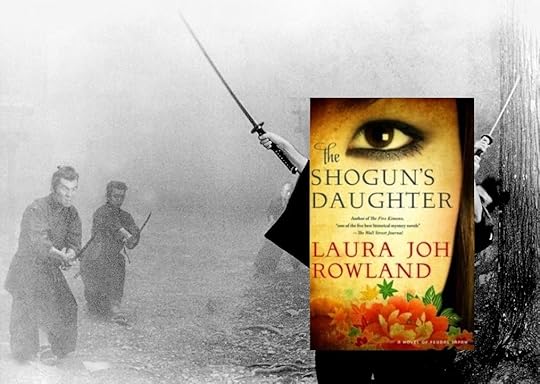
Japan, 1704. In an elegant mansion a young woman named Tsuruhime lies on her deathbed, attended by her nurse. Smallpox pustules cover her face. Incense burns, to banish the evil spirits of disease. After Tsuruhime takes her last breath, the old woman watching from the doorway says, “Who’s going to tell the Shogun his daughter is dead?”
The death of the Shogun's daughter has immediate consequences on his regime. There will be no grandchild to leave the kingdom. Faced with his own mortality and beset by troubles caused by the recent earthquake, he names as his heir Yoshisato, the seventeen-year-old son he only recently discovered was his. Until five months ago, Yoshisato was raised as the illegitimate son of Yanagisawa, the shogun's favorite advisor. Yanagisawa is also the longtime enemy of Sano Ichiro.
Sano doubts that Yoshisato is really the Shogun's son, believing it's more likely a power-play by Yanagisawa. When Sano learns that Tsuruhime's death may have been a murder, he sets off on a dangerous investigation that leads to more death and destruction as he struggles to keep his pregnant wife, Reiko, and his son safe. Instead, he and his family become the accused. And this time, they may not survive the day.
Laura Joh Rowland's thrilling series set in Feudal Japan is as gripping and entertaining as ever.
Granddaughter of Chinese and Korean immigrants, Laura Joh Rowland grew up in Michigan and where she graduated with a B.S. in microbiology and a Master of Public Health at the University of Michigan. She currently lives in New Orleans with her husband. She has worked as a chemist, microbiologist, sanitary inspector and quality engineer.
Seventeen books in and I'm still hooked on this series. Over the past few books, the series has taken a turn that has left me feeling let down even though I've still enjoyed each one.
The stories are still there. Rowland's richly detailed world is still intact. The change? The characters. One of my favorite characters during the series was Hirata, Sano's best friend and underling. Hirata was not a very complex character, yet he was intriguing to me. When he was injured in a previous book, I felt bad for him. With the addition of the mystic martial arts, used as a plot to help Hirata heal, his story took a nose dive. It's not the mystical martial arts that bothers me. It's the ghost part and the handling of the trances and powers by Rowland. In this book, it was all I could do not to skip over Hirata's storyline. It was kind of dreadful.
Then there's Sano. His spirits and samurai honor aren't as present in this book. I can't say I blame him. After everything he's done and suffered through for the regime, he deserves to finally snap. It just isn't the Sano Ichiro I've come to know. Besides, his emotions spiral out of control too fast at times. By the end, Sano's character feels twisted and disgusting. It's almost as if he's becoming like Yanagisawa. That's not good even if Yanagisawa is my favorite character.
Parts of the story didn't feel right. It also doesn't quite read the way her other books in the series have. I'm almost glad it's coming to an end, yet I know I'm going to miss the series once I've finished the last book.
I was captivated by this book from the first paragraph! I have always enjoyed fiction set in the Orient, and author Laura Joh Rowland does a magnificent job of transporting her reading right into the heart of feudal Japan of the 1700's with this novel. Her descriptive style of writing plus the fascinating narrative is a thing of joy to read. And if that isn't enough to keep the reader interested, then the intriguing mystery that weaves through this story will keep them on the edge of their seats until the very end.
I didn't realize that this book was the 17th (yes, 17th!) book in Rowland's series that features Sano Ichiro and his family, but even without previous knowledge of the characters or backstory this novel is easily read as a stand-alone work. But now that I've dived into this one, I fully intend to go back and see what I've been missing with the rest of the books!
I highly recommend this novel for anyone who loves a good mystery, and for those who enjoy historical fiction with exotic settings.
Even though this novel and this series of detective novels is set in 18th century Japan, the dialogue is fairly modern and the characters are so well drawn that we can easily relate to them. The plot is complex and though this story is fictional, the historical background and the detailed description of setting gives us a strong sense of the time and place, the atmosphere and political culture.
I have read several of the books in the series and enjoyed being transported to feudal Japan, by story and by the descriptions. The author conveys these admirably well.
The last available book was one of the best ones! I'm frustrated that my library doesn't carry the complete collection.
When the Shogun's adult daughter dies of smallpox, it seems like tragic misfortune. After a woman claims that she was deliberately infected, Sano is forced to look closer at what could have happened, and why.
Things spin up with my favorite nemesis, Yanagisawa, who steps forward with a claim he's been secretly fostering the Shogun's male heir to protect him from assassins (even the Shogun didn't know about him until recently.) Yanagisawa's story stinks like yesterday's trash, but Sano is prevented from investigating the truth because the heir apparent cleans house as part of his takeover, busting Sano down to a civil administrator.
Things have never looked more dire for Sano, his family and closest allies.
I really liked this one, although I'm still not sure why in the world LJR created the plotline she did for Hirata - it seems silly and unnecessary, adding very little to the overarching arcs. Maybe the next book has answers, but I'll never know. Bummer.
I've been trying to broaden my reading selections a bit this year, stepping out of the realms of American and European historical fiction to check out some books that I might not have normally picked up off a shelf. I was really intrigued by the description of The Shogun's Daughter and decided to give it a try. The story delves right into mystery and intrigue as the shogun's only legitimate child, his grown daughter, Tsuruhime, dies a gruesome death from smallpox at the same time a scheming member of the shogun's court, Yanagisawa, is attempting to pass his own son off as the shogun's long-lost heir. Doubts and questions swirl through the palace compound, and none more so than in the mind of Sano, the shogun's trusted councilor and top investigator, whose deeply ingrained sense of honor will not allow him to let the falsehoods he suspects go unchallenged, even if it causes a fall from grace and places his family in danger. Tasked with uncovering a plot to murder Tsuruhime by none other than the shogun's wife, Sano walks a dangerous line between rival court factions while uncovering a deeper conspiracy that could topple the empire and cost him and his family their lives.
I'm glad a branched out a bit into some historical territory that was relatively new to me, but I can't say I enjoyed The Shogun's Daughter as much as I'd hoped I would. I normally like to read a series in order, but I gave this one a go anyway since I'd seen some reviewers say that the books in this series could stand alone, and this one can, but it's because there's a lot of backstory on what happened in previous novels sprinkled throughout to fill the reader in. I felt like I walked in on a story already in progress and was being given the CliffsNotes version of the entire series. I found it a little distracting, and I can imagine if I had read all of the previous novels, that probably would have really annoyed me. And I have to say I was a bit disappointed in the writing. With sixteen novels in the series before The Shogun's Daughter, not a few of which have received stellar reviews and plenty of awards, I was expecting a much more sophisticated and sweeping style and tone. Instead I found it rather simple. The dialogue didn't feel very authentic--it seemed stilted and too modern at times. There was a tendency to explain things that were obvious. I found Sano and his wife and son likable, and they were surrounded by an interesting mix of characters, but aside from one or two stand-outs, most of the secondary characters were very stereotypical. And I'm usually a fan of some mysticism, but in this case, the subplot involving Sano's retainer Hirato and his secret society controlled by a murderous ghost seemed hokey. That could be due in part to not having become familiar with the deeper aspects of that storyline in previous books. But I had a hard time taking it seriously.
The Shogun's Daughter did have some good points to weigh against what I didn't like. It's an easy read, and a quick one, as the pace zips right along through the murder investigation and the surrounding political maneuverings. And it got pretty exciting there at the end as Sano and his family raced against time to solve the case and save themselves. Though the main mystery was solved, everything was not wrapped up in a tidy, happy, predictable ending. I was surprised by the final turn of events setting up the continuation of the story in the next book. And I did enjoy the glimpse into the feudal hierarchy of Japan and the ways of the samurai and the customs of the times, and I thought the setting of a city recovering from a devastating earthquake very interesting and evocative. It's a worthwhile read for its historical context, and I can certainly see how this series has carved out a unique position in the genre. But I would recommend that someone considering an introduction to the series via this book go back and start at the beginning instead. It's not often that all of the books in a long-running series maintain the same level of quality, some are always better than others, and based on what I read and what other reviewers are saying, I think The Shogun's Daughter may be a weaker link in the overall series.
Audiobook on CDs. This book felt like reading about dysfunctional suburbanite drama in Japanese drag. Other than a small amount of description on costume or the reference to bushido there little historic or cultural detail. The characters were so annoying. The preposterous dialogue was unbearable. I did not care for the reader.
I picked this up, attracted by the promise of a fictional story and historical look at 18c. Japan. I realized after that this is one of many in a series but I have no desire to go back to the beginning. I like a good Japanese yokai (ghost) but as far as I got the paranormal activity seemed extraneous but maybe this made sense later on. I'll never know. I did not even skip to and listen to the final disc to see how the murder mystery ended. Maybe everyone died but I doubt it as I see the series has continued.
After having read two incredibly textured novels (Hild and How the Light Gets In) filled with layers of sensations, it was kind of like moving from a 3D world into a 2 dimensional world. Short sentences, little description beyond what is necessary to propel the plot, THE SAMURAI 's DAUGHTER read like a novel for youngsters. I will admit I enjoyed learning about the characters, and the difficulties they got themselves into, but I wanted so much more.
Didn’t realize that this is part of a series, I liked the worldbuilding and the plot was pretty interesting. It started out really promising. Ending felt weak and lackluster though. It took away from the book because it didn’t feel like it could stand on its own, definitely the type of book where I’d need to read the next part to find out what happened later but the story wasn’t interesting enough where I think I’d pick up the next book.
I have long enjoyed this series though lately have not kept up as I would've wished to. Townsend's brilliant descriptive writing immediately transported me to Edo in Ancient Japan. The opening scenes plunged me into the horrific aspect of Edo (Tokyo) post an earthquake. All too fresh a reminder of the disastrous Tsunami of recent times. The aftermath of the earthquake has not only weakened the buildings but has left people exhausted and dispirited. Graft and corruption is threatening the reconstruction of the city. The Shogun as usual is apathetic to his people's needs and leaves all to his favoured few--whom come and go as regularly as the wind changes. Sano once again is an unenviable position. Fortune smiles upon his arch enemy Yanagisawa whilst Sano's star plummets dangerously. The Shogun has a new heir. Doubts have been raised over the heir's legitimacy. At the same time the Shogun's daughter had died from smallpox, or is it murder? Sano and his wife Reiko are investigating both these matters against the odds. Times are tense and all concerned stand on a hair trigger. Hirata, Sano's chief retainer, and follower of the mystical martial arts, has returned after a mysterious absence of four months. During his absence his wife Midori and daughter Taeko have moved in with Sano. Hirata's story continues alongside Sano's search for the truth surrounding the Shogun's daughter's death and revealing the Shogun's heir's as an imposter put in a place by Yangagisawa. Fortune deserts and Sano in turn is accused of murder. A guilty verdict means that Sano's family, servants and retainers will join him in death. His wife Reiko and son fight against time to solve the crime. Bravely,Hirato's young daughter, Taeko fights to find clues to Sano's innocence. The story ends with Hirata's plight as prisoner of his mystical martial companions and us wondering about what is to come. Because I know the backstory of Sano, his family and friends and enemies, I found little difficulty with reentering the story with this episode. I feel that newcomers to Sano's world need to enter with an earlier novel. Fans like myself however will enjoy seeing more of the battles between Sano and his arch enemy, Hirata's continuing struggle to become free of his mystical martial companions , Sano's struggle with Bushido discipline, and the hard task master that walking the Way of the Warrior is.
If this is what historical fiction set in Japan looks like, I’m in! I have always been hesitant to read novels set in Asia because the culture, especially in the historical sense, is very foreign to me and there is a lot that I do not really understand going into it. I was encouraged by this novel because the blurb reads like an adventure/thriller and that would help to keep it from being too mired in a culture I am very unfamiliar with. There were moments where I wasn’t sure what the characters were talking about or doing, like adding –san– sometimes to the end of someone’s name, but for the most part it was fairly easy to understand (or look up online). I found that the mystery kept the story moving and that the culture of feudal Japan was seamlessly woven throughout. I can say that I learned a lot about Japan and am intrigued about this era.
In many historical mystery type novels the mystery plot can tend to be rather thin and leave much to be desired or is too easy to figure out. In the case of The Shogun’s Daughter, we are given several viable suspects, and you might come up with some guesses, but it certainly wasn’t an obvious solution – which I very much enjoyed.
Although this is the 17th book in the series (of which I haven’t read any of the back list) I didn’t feel lost at all. There are certainly times that I can pin-point where I know a character or event is referencing something that must have happened in earlier novels, but you were always given enough information that it didn’t matter to your understanding. One such place is the relationship between Yanagisawa and Sano – you know a lot has happened between them to get them to the deep state of enmity that they are at now. I have a strong feeling that you can probably read most of the books in the series out of order – however reading chronologically will help with a deeper understanding of the characters.
This review was previously posted @ The Maiden's Court. Was received from the publisher in exchange for an honest review.
3.5 stars. "The Shogun's Daughter" is a historical mystery that centers around a potential murder in early 1700s Japan. When the story opens, Tsuruhime, the Shogun's Daughter, is on her deathbed with a horrible case of smallpox. Her ultimate death starts a investigation into what happened and it's quickly discovered that due to some of the political forces at play, her death may not have been all that natural. It's up to Sano Ichiro to investigate what happened, which may put his own family at risk. It's an interesting tale with an exotic setting.
This book is the 17th (seriously!) book in the Sano Ichiro series. I have not read any of these books. While "The Shogun's Daughter" is a standalone book, I could not help but to feel that I was missing some of the back story of some of the main characters, namely Sano. I feel like I had a lot of questions about his background and while some detail comes out in flashbacks within the story, I found myself wanting more.
The story itself was interesting. I don't read a lot of historical mysteries but this one made me wonder why I don't read more. Even though this book is quite long, it's a page turner and makes the time go by quickly. I really enjoyed putting together all of the pieces of the puzzle with Sano. There is also a really interesting story line about the trouble his own family is in because of his investigation, which I enjoyed.
The setting in this book was probably my favorite. You all know that I love exotic settings and this setting was truly special. 1700s Japan isn't a place that I have visited too much in my reading so this book was truly a treat in that regard.
Overall, I enjoyed this book for its fast pace and awesome setting.
I honestly can't get over how good this book is. It was so beautifully well written and I really feel like I learned a lot. It was extremely suspenseful and when one thing seemed resolved something else would happen. It was INCREDIBLE. Even characters like Yanagisawa whom you absolutely HATE you can't really hate. And even the fraud Yoshiato you love and are so sad to think he's dead. Even a character like Ienobu who is literally described as a slug and is literally the scum of the earth; you cant even really HATE him because he's so freaking conniving and it's just like yo what respect points how tf did you are you ok like WHAT so many emotions. SO MANY. And bbs Taeko and Masahiro I loved the development of their relationship it was truly beautiful. I especially loved how it was Taeko who was the one to save HIM and who didnt listen to what she was told because she was able to follow her own heart and in the end she was such a huge key to solving the crimes and in the end she saved Masahiro's life. And Sano bb Sano how can you not love him you love him from beginning to bitter end even when you're frustrated with him. He is truly an honorable character even when he doesnt believe it, even when he's back against a wall and his heart is tainted he chooses to be honorable rather than succumb and turn into the traitor Yanagisawa had painted him as and I thought that was incredible. I made the mistake of reading this book before any of the others so i'm going to start from book 1 now and read the others so i'm going to have to be super patient because i'm DYING to know what happens left. I feel so bad for Reiko. This book left me feeling so many different things. It's been a long time since i've been this impressed by a book. Truly 5 stars.
This entire review has been hidden because of spoilers.
I love stories set in Japan and The Shogun's Daughter does not disappoint. I had not know of the writings of Ms. Rowland prior to this and I'm so happy to have been introduced. I now have 16 books to look forward to in my spare time. (Pause for laughing fit.)
The book opens with the heartbreaking death of the Shogun's daughter which sets the intrigue in motion. And intrigue there is! The Shogun is well, not too bright and the factions within his cabinet for lack of a better word have been at war for a long time. At this juncture the enemy of our hero Sano Ichiro seems to gain the upper hand by convincing the Shogun that he has fathered a son. Most believe that the son really belongs to Yanigisawa himself but with the Shogun's backing nothing can be done to bring him down - or can it?
What follows is the intricate weaving together of several plots and yet I never felt confused. Nor did I realize that this was the 17th in a series; I never felt lost or confused about anything going on. The characters were amazing from the littlest children to the most evil of mystics. Yes, there is a mystical element to this novel that was executed perfectly. I am generally not one for the alternative realities in life (except for a love of time travel novels - go figure) but in this book it was well done and well suited. Sano Ichiro is a hero/detective for the ages and I will look forward to his further adventures.
Not at all what I expected, this book is a mystery inside a beautifully rendered oriental setting. Laura Joh Rowland has written a story that clips along at a good pace, meant to keep an audience turning pages for the next answer in a puzzle that stays just out of reach. I thoroughly enjoyed the novel for several reasons.
First of all, it's been a while since I read such lovely details of costumes, arts and interiors of Japan. These descriptions brought me right into the novel visually. I could "see" the samurai warriors, Shogun and officials' robes; as well as the womens' garments. Simply loved this element.
Secondly, the suspected murder of the Shogun's daughter and the following investigation was driven for me by the whole Sano-san family involvement. This was a great device which kept the story moving quickly. I fell in love with each of the characters through their separate parts in the mystery.
Finally, the mystical and magical elements of Japan's culture as displayed within the story were fascinating as a sub-story running in tandem with the main one.
You'll surely enjoy this novel of feudal Japan. Its many features make it rise above the ordinary mystery novel. And Laura Joh Rowland packs a hard punch! The surprise features will get you! The ending leaves things open for more adventures with these same characters.
Continuing series of Sano Ichiro and a solid plot in an interesting early 18th century feudal world. This one starts with a death which in itself strongly colors the succession/politico power structure. They are much alike in their style of the "telling", IMHO, these Ichiro series novels. Yet not in their plots. But in the "less is more" simplistic style noted by other posters. It emits a tone, a "face" that seems to me, intrinsically Japanese. And not at all a lack in the writing ability or skill in character depth as some judge. It is simple and direct, short and clipped information. It is not a Japanese investigation occurring within times of extreme kinds of class designation and exact placements of hierarchy, which is trying to be written within a Western verbose, emotion laden excess style. Instead it fits the time and the place- this "face".
But I am not reading any more Sano (I have read two others) until I read the first one (Shinju) and/or one or two of the very earliest. They are stand alone, but are much improved if read in order. Like a Tudor epic or War of the Roses conflict that bleeds into another century before or after the big event- this needs some context knowledge. And is better enjoyed if costume, oath, relationship to obedience, tribal loyalty- all that to every nuance most clearly understood.
Listen, I appreciate an ARC as much as any person; a beautifully-appointed hardcover ARC is relatively unseen, so I eagerly cracked open Rowland’s The Shogun’s Daughter. Some background: I have a B.A. in English literature and I also began my Masters in English Literature with an emphasis on the Japanese short story; I was and still am fascinated with the mystic realism inherent in Japanese literature.[return]Rowland writes well, in the sense that her syntax flows naturally, her imagery is rich, and she wraps up all of her plots points. However, this novel of feudal Japan left much to be desired. It is, essentially, a murder mystery, but given Japan’s loose definition of the word “justice,” many will be frustrated by the so-called “plot twists.” Also, there really is no “mystery”—it’s quite easy to discover who is responsible for what in this story.[return]Probably the most frustrating plot line is that of Hirata; everything about the mystic warrior is just so ridiculous and contrived, I found myself eventually skipping over anything having to do with him and his “ghost.”
Sano sets out to investigate the murder of the shogun's daughter Tsuruhime, the power struggle between him and Yanagisawa, who has freshly reclaimed his position as chamberlain, escalates to a new degree, the shogun's nephew Ienobu strives for the position of heir and a second murder might lead to ruin for Sano's entire family. Full of conspiracy, murder and betrayal as usual, this latest installment in the Sano Ichiro series was a captivating read that was almost impossible to put down - at least this main part of it. I'm still not a fan of the whole "Hirata & his mystic martial arts & magical secret society" storyline, which takes up quite some space in this book and obviously still isn't concluded - hopefully, it will be within the next few books.
I've followed all of Sano Ichirō and co's adventures, and this is perhaps one of the most engrossing stories of the series. I just could not put the book down. Finally, Sano stands up to his idiot boss the shogun, after a decade of keeping quiet in the name of Bushido. "Your honor will be the death of us all," his wife Reiko rightfully commented. Yet, some parts were rather hard to believe, like Reiko doing all the physical activity she did while six months pregnant. And Hirata -- the whole mystic martial arts story arc was farfetched from its conception. As much as I enjoy the series, I couldn't help but wonder how Laura Joh Rowland could conclude her story. S ano isn't getting any younger, after all. Perhaps it'll continue with the kids?
I just gave up. I love being challenged out of my historical-fiction comfort zone by Rowland and inserted into the mystery and newness of Imperial Japan but I think I was tired of it before I even knew it. Another time the family is in danger from the investigation. Another time his best friend is more of an idiot than a companion. Another weird sexual angle. Rowland is persistently well-phrased and she is able to wonderfully imagine Imperial Japan with all of its sights and smells. I hope she finds a new character to write about.
Far from the hustle, bustle, and hubris of the Jenner clan, Dr. Edward Jenner didn't know anything about reality TV, fam drama, cosmetics, or tapes leaked online in the late 1700s and early 1800s. What he did know about was variolation, vaccination, and smallpox. Spread throughout the world by expansionism and trade from the 4th century onward, smallpox was a contagious virus that claimed the lives of three out of ten affected, and often scarred the survivors in horrific ways. Declared free of the disease since May 8, 1980, the world has mostly moved on to different diseases and samples of smallpox are only kept by the most powerful nations in the world for research, experimental, and historical reasons.
Edo, 1704. The city is still in turmoil and chaos after yet another natural disaster (earthquake) and the royal court may see some shakeout. Heads may roll, alliances retied, and positions filled with new, influential blood. The reason: THE SHOGUN'S DAUGHTER succumbed to smallpox, eliminating her from producing an heir of natural succession for the Shogun, prompting suspicions of foul play. It's now the Hoei era, supplanting the Genroku period, apparently at the whim of the Shogun for cathartic reasons to erase the misfortunes that plagued the previous era and to usher in better times. The good times are still rolling for the former Sosakan-Sama (Most Honorable Investigator of Events, Situations, and People), Sano Ichiro, who's sitting pretty high up, working for the supreme leader. After 15 long years, Sano is still at the beck and call of the Shogun Tokugawa, who's as bumbling, indecisive, vacillating, and wavering as ever. And this time, he's tasked, albeit by the code of Bushido, with an impossible endeavor; prevent disaster for Japan by finding the true identity of a supposed heir to the throne. If only genetic testing websites were around...
Sticking to what works, THE SHOGUN'S DAUGHTER follows the template of the previous 17 iterations. Predictably, Yanagisawa, Sano's cunning, political, and scheming arch nemesis, is back in the fold and mixing things up at court, crafting a tangled web of death, murder, honor, favor, and power. Surviving a fire and an earthquake, Sano is beaten but not down for the count. After stepping into a pit of disgrace, he decides to fight back dirty, as his life and his family's lives are directly at stake. Bushido is the way of the warrior (and obedience), but is it enough to root out traitors and overcome power hungry murderers? When Samurai pride and Bushido clash, gut feel, instinct, and common sense prevail. And solve crimes and mysteries to boot.
Fans of the series and first time readers should skip the author's note about historical accuracy preceding chapter one since it contains spoilers that would affect the enjoyment of this novel and the rest of the series. THE SHOGUN'S DAUGHTER has plenty excitement, new twists and lots of characters with hidden agendas. Plus, the denouement's got a cliffhanger straight out of CLIFFHANGER. From samisen to soroban, the Sumida, shirasu, and Samurai, THE SHOGUN'S DAUGHTER has it all. Walk the way of the warrior and find redemption in feudal Japan.
Such a frustrating book. It's page-turning historical mystery with a disappointing, ridiculous, and unnecessary side plot that's soured a once very enjoyable series.
Longtime readers should be pleased enough with this penultimate installment of the Sano Ichiro novels. The mystery is well-plotted and fast paced, but this time, the usual life-and-death stakes are ratcheted up just about as high as they can go. Palace intrigue and political machinations get a thorough workout all the way through to the edge-of-your-seat climax. That part of the story was satisfying and enjoyable, and on that alone, I'd recommend it.
However…
The trouble is, as it has been since The Ronin's Mistress and The Incense Game, the inclusion of a superfluous, eye-rollingly ludicrous, supernatural secondary plot that only tangentially touches the main story. Much like the last book, it could be excised and virtually nothing would change—definitely nothing important to the novel's central plot. Hirata was once an indispensable character that added value and substance to the series, but once Rowland made him into a mystic martial artist with supernatural powers, the character's value and substance diminished, and the credibility of the series arc began to slide.
For the first 12 books, Rowland took such care to craft an immersive, realistic, and believable world in detail, plot, motives, and explanation of the crimes, only to screw it up with supernatural and fantastical elements that belong in an entirely different sort of book. Had that been a part of the series from the start, I'd be fine with it. But with the exception of the regrettable The Snow Empress (#12), the previous books were all firmly rooted in reality and history. (To be fair, there were tinges of the supernatural in The Samurai's Wife [#5] and The Assassin's Touch [#10], but nothing to the extent Hirata's side story. It's something akin to adding a wizard to the officers investigating on Law & Order.)
All that aside, I'd still recommend it—guardedly—since everything else is so engaging. I suppose a first time or occasional reader wouldn't notice, but as one who's been with the series since the beginning, I wish Rowland hadn't mucked it up with nonsense.
I had actually forgotten about this series for quite a while as my interest was more and more diminishing for it with how repetitive each book was beginning to feel, plus the feeling that it never seemed like this was going to end. Luckily I needed something to listen to and when I poked around the available digital audio books from my library that didn't have a billion holds on it, this was conveniently suggested and was the next in the series I needed. My interest was especially sparked when I found out this is the penultimate Sano Ichiro mystery and that Rowland had finally given her readers an ending for him.
This had a lot of the issues I'd had with previous books in the series, where more and more it felt like the writing got weaker and rushed, with the cast all feeling pretty weakly done all around. The kids get some character development as they age, but overall the adults are all static and unchanging throughout the entire series and it just makes for some dull moments when pretty much any interactions can be predicted. The mystery itself wasn't incredibly strong but I did enjoy the political intrigue here.
Interesting choice for this to end with a cliffhanger. I don't remember that being the case with anything previously in the series, but I imagine with the next book being the final she wanted to drum up some extra excitement for it.
Book number 17 of 18 in the Sano Ichiro series, set in 1704 during Japan's Edo period and against a backdrop of a city recovering from the ravages of earthquake (tsunami nearby) and fire, and the end of the Genroku period and beginning of the Hōei period, "The Shogun's Daughter" begins to wrap up the 18-book series while providing the TWO politically important murders for Sano, Reiko - and now, family too - to solve against the clock, and with disgrace and death lurking as the alternative outcome ( a hallmark of all the books in the series ).
There are three things that keep me coming back: (1) the interplay of man versus man and man versus himself themes, measured by Bushido code; (2) the creative detective "who-done-it" plots, interwoven with a (3) historical fiction backdrop with effective period-commentary by Rowland.
--- As for my rating ... as usual one of Rowland's Sano Ichiro novels, once started, I couldn't put it down! Hence, the 4 stars. It is not in my top five or bottom five as the series goes, but an important link in the chain.
This book was so disappointing. I really liked this series from the very first book. However, this one felt forced, the characters almost wooden, the story line blase. Sano experiences a turning point in the center core of his character -- upholding Bushido-- yet the telling was flat and left me with a 'so what' reaction. Some characters are just too unbelievable--the notion of a really young girl being a detective, and then having super human strength to save her future "boyfriend" is really not believable. And, all that magic stuff with Hirata--please! We don't care! It lends nothing to the story and is a distraction. I know Rowland ends this series with the next book. And, I know I will read it. I trust it's a better read than The Shogun's Daughter.
This mystery novel is set in Japan some 300 years ago and involves Sano Ichiro, a high ranking Japanese official. The story involves the death of the Shogun's daughter and the resulting search for her killer. While trying to solve the murder of the daughter, Sano is accused of setting fire to the home of the Shogun's heir who reportedly dies in a fire. Sano is falsely arrested for killing the heir and he and his family are sentenced to die. Sano and his family must find the real murderers in order to save their own lives.
This is my first time reading a novel in the Sano Ichiro mystery series and I found it fascinating. I would recommend it to anyone who loves historical mysteries.
Remarkable addition to the Sano series. I was, truly, wondering how he was going to get out of this one. The plot kept going to the very end. The Hirata, mystical, thread was left rather disconnected to the story. The thoroughly modern overtone toward the end was curious. Unless there is something planned for next time, this added little to the story except as it played on the irony Sano's sense of honor. The great disorder in this story begs resolution in the next. It was a very good story on its own, and well worth the read for the familial development.
The novel takes place as the second novel discussing the effect of the earthquake on Japan. Rebuilding, shifting of loyalties, changes in the power structure. Ichiro Sano, his wife Reiko, and son Masahiro become involved in solving yet another mystery. Once again, the villain Yanagisawa causes problems but then he too is troubled by problems of his own.
At this point where I have read most of the novels in the series, I think I am over it. It was a good run and represents many hours of recreational reading.
When I picked up this book I had no clue that it was a series and book #17 at that! If you are like me and don't know it, you don't have to be alarmed, the author is good at giving a brief history so you can read it without being lost in all the back stories.
The pace was like a train, first slow then it picked up pace and then it flew!
We start the book off by the death of the Shogun's daughter, but was her death natural or was she murdered? Soon after Sano looks into her death, but in doing so a domino of events crashes around him and soon he is on the chopping block.