LA HISTORIA DE TERESA LLEGA A SU FIN Con el aclamado ciclo Las Tres Noches, Borja González cierra su primer monumento gráfico. «Es tu cuento. Y terminará como quieras que termine». En el castillo, las mujeres aguardan a que los hombres lleguen de una larga expedición de caza. La dinastía es antigua y ceremoniosa,la perpetúan los ritos que dan a cada miembro un solemne papel que cumplir. Entre ellos, el de Matilde es quizá el más trascendental y estricto. Sin embargo, su hermana Teresa y ella, aficionadas a las historias de terror, habían acordado un final diferente… UNA HISTORIA TENEBROSA EN CUYO CENTRO VIBRA UN ENIGMA HECHO DE PALABRAS «La melancolía mágica millennial : con apenas tres obras y un puñado de fanzines, Borja González se ha posicionado como una de las voces más importantes del cómic español». Álvaro Pons, Levante «Borja González ha demostrado ser maestro de una escritura singular, profundamente marcada por el género fantástico y elaborada a la luz de una poesía extraña repleta de delicadas elipses e incursiones en una cotidianidad encantada». Nicolas Tellop, Les Cahiers de la BD Sobre Grito nocturno se ha «Borja González está construyendo obra tras obra un pequeño gran universo ... Extrañamente críptico y familiarmente cercano al mismo tiempo». Iván Galiano, Jot Down «Un cómic sobresaliente ... Una lectura esotérica y absorbente y un regalo para los ojos». María Pérez Recio, Trece millones de naves «Un trabajo que consolida a Borja González como uno de los autores más estimulantes del cómic actual». Diego García Rouco, Zona Negativa Sobre The Black Holes se ha «Un artista revelación». Iria Ros Piñeiro, El Español ( Vandal ) «No se resistan, léanlo pero para volverlo a leer.» Héctor G. Oliarte, El Cultural «El cómic español del año no se lee, se siente.» Paula Cantó, El Confidencial «Magia total.» Xavi Serra, Ara «Viene hasta arriba de belleza, misterio, ternura, punk y un buen puñado de preciosos hilos sueltos que se te quedan colgando de la nuca». Elisa Victoria, Tribus Ocultas (La Sexta) Sobre La reina Orquídea se ha «Una historia diferente que, tras su apariencia de cuento de hadas, es una reflexión sobre la creatividad». Pablo Delgado, ABC Cultural «Una joya … Sin duda entre lo mejor de la producción nacional de este 2016» Fran J. Ortiz, Abandonad toda esperanza
Borja González is a self-taught illustrator and comic strip artist. His first published title was La Reina Orquídea, a precious and haunting short piece that placed the author at the center of national attention in Spain. A Gift for a Ghost is his first long-form work. He lives in Badajoz, Spain.
So, this one is a mixbag. Of the "tough-to-make-sense-of" variety.
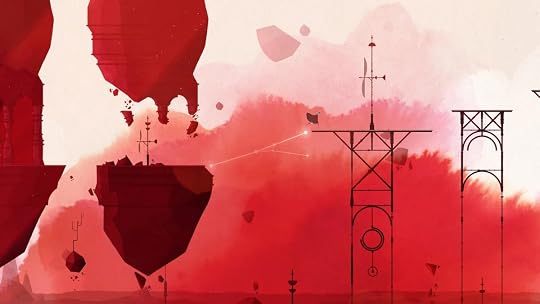
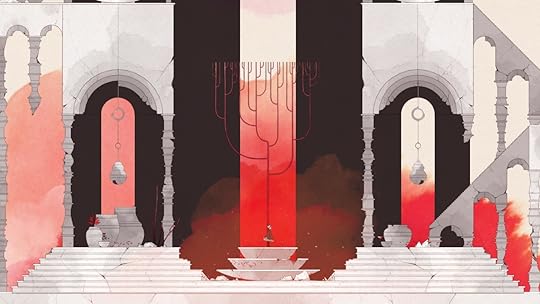
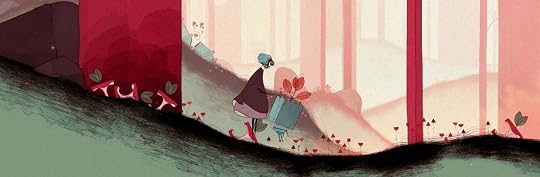
Let's begin with what first drew me toward this work in the first place. The art style of this comic is something truly distinctive, using a narrow palette - mostly blue, black, shades of beige, gris, and an occasional streak of red for the most part, allowing each colour, each subtle nuance to appear with maximum effect: some colours camp a scene, define the type of environment of a particular scene, the momentum of a certain action on the spot... Facing this first feature, I couldn't help remembering the masterful use of colour in Les Météores : Histoires de ceux qui ne font que passer another comic I read a few months ago, along with ABZÛ and GRIS, two ambient games I am very fond of....
-------------
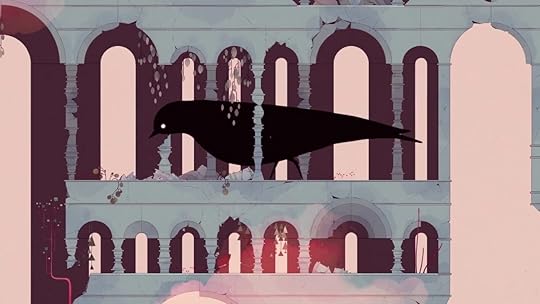
Even without taking the Bird-Entity into consideration, the parallel would have presented itself...
-------------
Another element playing in its favour are the large pieces of scenery with no dialogue, also reminiscent of Les Météores : Histoires de ceux qui ne font que passer in their own way, allowing spells of silence to write the story by themselves now and then.
Regarding the story, it is about a strange, grim castle, lost in the middle of wilderness, be it vegetal or animal, where the focus is on a community of women siblings, as they live in the absence of their male counterparts, on the hunt throughout the story. The young boy Manuel is the only exception to this rule, being tutored and taught about the history of the castle and the reasons behind its traditions: the founding myth of the great-grand-father killing the mighty Serpent Obéras during a primordial hunt - which also served as a symbolic birth certificate of the family lineage and a sort of spinoff of the myth of the original sin, where the slaughter of the serpent was the original sin, something that reminds me in turn of The Man Who Spoke Snakish - , the periodical hunt, the artistic legacy of the family, and other arcane elements that come into play later. One thing is certain: he is educated in order to become a hunter as is indiscutable custom in this community. In itself, this secluded world, screened by obscure rules was something akin to the women quarters in Les Jardins statuaires, a little known piece of French Weird Fiction, even though, honestly speaking it is almost uncategorizable. Underlying violence and trumpery are what cements the family together in their avowed hostility towards the wilderness and its manifold manifestations.
The "in medias res" beginning, devoid of dialogue is resolutely puzzling: a certain night, Matilda flees from the family domain, watched by her sister Teresa. Words are exchanged, but the bubbles are left blank at this stage. Led by a lovely blue swallow, Matilda threads further in the woods and immerse herself in a lake, only to surface... Mute and deeply altered albeit in a mysterious way. Regressing to the castle, from this day on, she is both a part of the family and a pariah. She seems to be destined to a highly peculiar fate, already experienced by one of her female ancestors, the only emotional bond remaining for her being the one with her sister Teresa, the one who witnessed her nightly departure... and helped her on her returnal. Or so it seems. Whatever the ritualistic, symbolical or cosmological reason given for this system of beliefs, the most obvious way it betrays its existence is the constant violence as the beating heart of: - the family myths (all about hunting) - the family conversations (riddled with insults), - the family paintings (either hieratic portraits so betraying life they are in themself a form of cruelty inflicted on their models or massacre-like hunt scenes) - the penalties for disobedience in the family... I also can't help thinking the ceremonial masks worn by the family are another hint at the fundamental violence ruling their relationships, as the pictorial choice of not drawing the character's facial features, with only two exceptions - both of them concerning the Gardenia, sick with jealousy - only underlines their constant duplicity. Or it can be me overthinking this artistic choice...
The whole family, minus Teresa, is preparing for her ritual sacrifice. A few days before the fateful ceremony, Teresa walks her listless sister in "the Garden of Tears, the damp hearth of Forbidden Things", where vestiges of the modern world can be seen, highly uncanny in this medieval atmosphere, that we now understand is a construct of some sort. The castle in itself is a brutal undertaking, an act of superlative hubris, proposing to even negate the existence of a embarrassing past with values seen as incompatible with the ones in force in the castle... Unless the castle is a mere redoubt, a futile token of resistance against a triumphant nature, taking over after a worldwide economical, societal, semantical, soteriological collapse and the resulting resounding collective failure of mankind as a species. That could acount for the rigid, maniacal observance of a mythical absolute separation between nature and culture enforced within the boundaries of the castle. Still, regardless of the way you look at it, something is amiss in this well-oiled machine, even according to its own reference system.
Be it as it may, in an uncanny coincidence, this story of secret rites passed down in the mother side of family for generations, along with the strange curse that seem to come hand in hand alongside it rang with booming echoes from L'Homme gribouillé, as if my reading choices, apparently dictated by mere aesthetics and fickle personal preferences had an underlying stream of recurring themes running, flowing underneath. Does this strange surfacing of common themes under the surface of apparently innocent reading choices often happen to you too?
On a surface level, this is a story about the hardships and rare joys of fellowship in a community of noblewomen from the same family. And yet, the boiling discontent perceptible under Gardenia's utterings and artistic creations, the uneasy relationship, tainted with guilt between Teresa and Matilda, the disturbing undertones perceptible in their mother's rare expressions and Manuel's frolics... All seem to shed light on a radically different reality.
A reality where all are somehow leagued against Matilda, even Teresa who would have broken her promise to join her on the following night, fleeing the castle too. Possibly, as an oathbreaker, Teresa is the first responsible for the brutal events to come, even more so as the swallow that is often seen fluttering about Matilda, which it is soon obvious, she is the only one seeing at all. Pointing out the psychological nature of this blue fowl. In this light, the gruesome, gory, tragic ending should not come as a surprise. The scorned, the unheeded, the negated nature comes back with a vengeance.
... Which strongly evokes the all-powerful wilderness, and the terrible prophecy of the pig-tailed boy, the last descendent of once formidable Buendia family in Cien años de soledad, if you ask me.
In the end, this comic leaves the reader with much more interrogations than answers... I tried to find answers of my own to some of them, shared above, but there are countless others:
- Are the crazed beasts (alluded to during a dialogue on the more and more extended hunting grounds) former members of the family, or at least of mankind? Reminiscent of The Factory and others...
- What is the meaning behind the story of Gardenia's drunk father, trapped in the belly of a wild boar? Is it a taboo to be eaten by other animals in this ficticious universe?
- Has the queen anticipated that Teresa would incite Matilda to flee from it, and in so doing trigger her final Kafka's The Metamorphosis-like metamorphosis? Or Is the episode of the bird leading her to the lake stranger to this transformation or is the metamorphosis due to Matilda's estrangement and resentment towards all of what her family stands for?
- What is the deep meaning behind Teresa's choice to ultimately remain in the castle instead of following her sister Matilda, as promised to her? If she loved her as much as she pretends, why not fulfilling her promise to follow her in the Garden of Tears (Is she trying to shield herself from certain difficult truths)? If she refuses the sacrificial ceremony, why does Teresa remain in the castle?
- And, most of all: what is the point of the sacrifice itself? Is it to prevent a metamorphosis or was Matilda's metamorphosis incidental, in which case... the question lingers. An inane offering intended to placate nature or favour the hunters, as a sort of twisted gift to nature in disguise, where a female member of the family is made to ritually embody the serpent Obéron?... My word, this stream of questions does not seem to be drying up... Quite the contrary.
A trippy read featuring nonlinear chronology, requiring some amount of backtracking and reading between the (few) lines, in the quasi-absence of facial features. It can be of interest for lovers of detective stories? Who knows?
******
As an example of the strangely arcane and poetry-like dialogue employed throughout the comic: "Here, everyone is afraid. The forest is encroaching, and its beasts hate us. The castle weeps strange poisons, and the wind whispers of our decay. But you, you are not afraid. For yours is the arrow, its death, its. For there is nothing hidden in the world, no great secret to be discovered. For you are all that is."
Como valorarlo, buff, complicado, porque suceden dos cosas Una que el dibujo me parece increíble, es precioso, me parece que el artista Borja dibuja y pinta brutal, pero La historia no se entiende, yo al menos no he entendido absolutamente nada, y eso ha hecho que lo deje en 2 estrellas en lugar de 3, porque no puedo aprobar algo que no he comprendido, es posible que sea culpa mia, pero creo que un autor tiene que conseguir dejar claro su mensaje para que sea entendible.No comprendí nada, porque actuan así las protagonistas, porque todas hablan mal, parece que todas se odian excepto las dos hermanas, tampoco me entere de lo del pajaro, ni vi la serpiente por lo que supongo que eso seria alguna alegoría, vamos que nada de nada, si lo leí súper rápido en 20 minutos pero porque apenas tiene texto, si hubiera tenido mucho creo que lo habría abandonado, así que, no puedo darle más.
Una lastima porque el dibujo es súper hermoso.
EDITO: Acabo de ver que es el tercero, voy a pillar el 1 en ebiblio para ver si asi entiendo algo, pero lo dudo mucho, porque es el final, y no he pillado nada de nada
EDITO 2: Pues ya leí el primero y me reafirmó, no tiene sentido alguno, ni este ni el primero, no se si molestarme con el segundo, porque veo que no tienen nada que ver unos con otros, solo los nombres de las protas, pero la historia no esta enlazada, eso si en el primero hay una viñeta que dice No entiendo nada, esto no tiene ningún sentido, TOTALMENTE CIERTO
EDITO 3: Leído el 2, y ese tiene más texto por lo que se me ha hecho mas pesado, nada yo no le encuentro sentido. Y leyendo los 3 menos aún.
Los tres cómics que componen esta serie dibujan un escenario extraño, enraizado en nuestro mundo pero tejiendo en él una trama que permanecería oculta a los demás.
Esta trama hila la vida de varias muchachas (tres jóvenes que quieren montar un grupo punk, una joven de una familia implicada en un oscuro ritual, una aspirante a bruja que regenta una tienda de libros de misterio y terror de segunda mano, un demonio otaku...) en dos épocas distintas: 1856 y 2016.
El hilo de la trama es confuso y no siempre está claro, los personajes viajan de una época a otra de forma extraña, casi onírica (no siempre tienen claro si su experiencia a sido real o si ha sido un sueño), no todos los hilos se cierran...
Hay muchas cosas que me han gustado de este cómic en tres tomos. Por una parte, por la misma trama, cómo se desarrolla y entreteje las vidas de todas las protagonistas pero sin hacer a las de un hilo plenamente conscientes de la existencia de las de los otros; la mayor parte de la trama permanece oculta a sus propias protagonistas.
Por otra, porque todos los personajes (excepto un niño en el tercer tomo) son femeninos, algo que llama la atención (y no debería, porque el caso contrario nos resulta demasiado normal); tampoco hay ninguna referencia a personajes masculinos como elementos importantes en sus vidas (amigos, novios, ex-parejas...). Tan sólo en el tercer tomo se menciona a los hombres de la familia, como una referencia a adultos brutales que se emborrachan durante una cacería previa al ritual.
Otro elemento que me ha gustado es la profunda sensación... no de tristeza, pero sí de melancolía, de pérdida... en todos los hilos hay algo que se anhela y no se consigue, pero que se acepta como necesario o inevitable.
Pero, sobre todo, me ha gustado el dibujo: líneas limpias y claras, colores planos de tono pastel, el uso de las paletas de colores para transportar al lector de una trama a otra, para destacar elementos que contrastan con la gama cromática imperante (mariposas rojas en un escenario azul, pájaros azules en un escenario de colores cálidos...), el uso del contraluz (una misma escena se muestra desde dos ángulos, uno de ellos con la luz de frente y otro a contraluz), largos planos de viñetas con voz en off que recorren los paisajes de la ciudad y el bosque para trasladar al lector de una época a otra...
Me ha resultado especialmente llamativo que ninguno de los personajes muestre rostro y que, sin embargo, esto no reste un ápice de emotividad a la trama; al contrario, intensifica la sensación de alienación, de impersonalidad, de soledad de los personajes frente a su entorno.
En resumen, aunque estamos estrenando el año, creo que esta va a ser una de las mejores lecturas del año.
Un château sorti tout droit d’un conte gothique. Deux sœurs dont l’une est promis à un funeste sort. Un oiseau bleu et un lac sans fond.
Comme toujours avec Borja González, il faut se laisser porter par les cases sans chercher à y trouver une histoire claire et linéaire. J’ai trouvé cette BD magnifique, comme détachée du temps. Une histoire cruelle mais surtout profondément onirique. Parfaite pour l’automne 🍁
Termina así el tríptico de Las tres noches y la historia de Teresa y Matilde. Una historia llena de enigmas e imaginería que puede inducir a confusión pero que sin duda está cargada de simbolismos, bellas escenas y una atmósfera casi onírica donde el pasado y el presente se mezclan de manera difusa
Je l'ai plutôt bien aimé mais je rejoins la critique sur le scénario sibyllin. Je l'ai lu avec The Black Holes et Nuit couleur larme ouverts devant moi et les jeux de références sont assez chouettes à voir mais l'ouvrage peine un peu à exister pour lui même. Je n'ai pas non plus tellement apprécié l'aspect incestueux des relations entre les personnages et au contraire on manque de scènes un peu légères et rigolotes des précédents ouvrages. L'auteur a dit dans une interview qu'il s'agissait plus où moins d'une nouvelle version de La Reina Orquidea (inédit en France et que je n'ai pas lu). J'ai l'impression que cette bande dessinée est un peu fondatrice du récit de Teresa (dans le rapport à Obéron par exemple, cité plusieurs fois ici mais jamais présenté plus que cela même si le personnage semble appartenir à une temporalité plus ancienne encore). Mais peut-être que des informations se sont perdues dans la réécriture. Après Borja Gonzalez assume de vouloir laisser des éléments sans explications. On peut essayer d'y trouver du sens mais dresser une fresque de la vie de Teresa qui fonctionne parfaitement semble improbable.
En bref c'est très beau, c'est un ouvrage qui fonctionne bien en miroire des œuvres précédentes et qui permet de créer des liens intriguants mais l'œuvre n'existe pas très bien pour elle même.
This entire review has been hidden because of spoilers.
Me ha parecido el más críptico de los tres tomos que forman esta extraña trilogía. El apartado gráfico no deja de ser fascinante y sobrecogedor, pero, en este caso, me ha resultado todavía más complicado seguir los acontecimientos que aquí se muestran. Los tres tomos piden a gritos una relectura, o más de una, pero, a día de hoy, creo que este es el más flojito.
Creo que tengo que aceptar que las obras de Borja González no son para mi. Lo he intentado! Y me da rabia porque tiene muchos ingredientes que me flipan: uso de folklore, misticismo, un rollo romántico, misterio, un toque críptico que no te lo da todo en bandeja... Pero aunque me gustan los enigmas, me gusta poder descifrarlos. Y aquí hay cosas que o no puedo descifrar o cuando lo hago me dejan insatisfecha. Creo que si ahora volviera a leer los dos comics anteriores entendería alguna cosa más, pero no creo que sea nada que me cambie mucho la opinión, y francamente, no tengo ganas. Siento sonar negativa, creo que es más que me siento frustrada después de oír el hype por estos cómics. Sin embargo, recomiendo que leáis ni que sea uno. El dibujo y el color son increíbles, y Borja tiene formas muy interesantes de mostrar su mundo y hacer avanzar la trama con las imágenes. Y conozco mucha gente a quien les gusta, así que quizá tú seas una de estas personas!
Graphiquement, c’est vraiment joli et mystérieux. J’ai l’impression qu’il y a un code couleur dans les planches entre ces nuances de bleu, beige, gris, rouge, et qu’il s’applique selon ce que vivent les deux sœurs, dont l’une est promise à un sombre destin. J’ai adoré l’ambiance sortie tout droit d’un conte gothique digne d’Edgar Allan Poe, et si j’ai été un peu froissée de ne pas tout comprendre, je veux bien accepter que peut-être il n’y ait pas de sens à cette histoire, pas de fin définie non plus. Chacun est libre de l’interpréter comme il le souhaite, et finalement, c’est peut-être tout aussi bien.
"Las cosas más brillantes se esconden en los rincones más oscuros". Este sí, el cierre perfecto para la trilogía de las Tres Noches. Una obra en la que se aprecia mucho más la influencia de Mignola que en los anteriores, pero que sabe desviarse con respeto y admiración para encontrar su estilo propio. Su aliento particular. Me ha encantado la relación entre Matilde y Teresa. Los guiños a sus otras obras. La composición de cada página, de cada viñeta, sirve a la perfección a la trama, casi sin esfuerzo, y la lírica de los dibujos es de sobresaliente. Y por fin vemos algún que otro ojo. Borja González se ha convertido en uno de mis autores de cabecera. Su mundo ha calado muy profundo en mí, me ha inspirado y me ha devuelto la fe en el cómic nacional. Ojalá Teresa y Matilde no desaparezcan como hojas secas en primavera, o como muertos que lloran bajo torres tapizadas de hiedra y ramas.
Les dessins sont beaux, très beaux même. Quoique les personnages sont sans visages, donc pour s'attacher aux personnages et à son histoire qu'entoure, c'est très compliqué. Et justement, en parlant d'histoire, il n'y a pas de trame, donc pas de récits. Et donc on ne comprends absolument rien. Quels sont les enjeux ? Quelle est l'histoire antérieure ? Qu'est-ce que les personnages vivent ? Qu'est-ce qu'on est censé ressentir ? Je comprends que le ton se voulait onirique et un peu orificique, mais je pense que je suis passé totalement à côté. Et à la fin de l'album, il est expliquer que ça fait partie d'une trilogie mais rien n'a été mentionné pour comprendre justement l'enchaînement des pages.
Si bien me cuesta muchísimo entender la historia que une a las protagonistas de este y los anteriores cómics de Borja González, con sus saltos en el espacio-tiempo tan oníricos y ambiguos, no puedo dejar de darle buena puntuación por lo increíblemente bello que es el dibujo.
Me queda una relectura pendiente de todos los libros seguidos y, si aún así, sigo sin pillar el concepto... me dará igual. Porque lo que hace Borja es, simplemente, una delicia visual sin precedentes.
P.D.: podría ser ésta la primera vez que veo ojos dibujados con detalle por el autor!?