Imagine you are Poseidon at the dawn of the twenty-first century. The oceans are dying and sailors have long since stopped paying tribute. They just don’t need you anymore. What do you do? Perhaps, seeking answers, you go exploring. Maybe you end up in Wisconsin and discover the pleasures of the iced latte. And then, perhaps, everything goes wrong.
Anders Nilsen, the author of Big Questions and Don’t Go Where I Can’t Follow, explores questions like these in his newest work, a darkly funny meditation on religion and faith with a modern twist. Rage of Poseidon brings all the philosophical depth of Nilsen’s earlier work to bear on contemporary society, asking how a twenty-first-century child might respond to being sacrificed on a mountaintop, and probing the role gods like Venus and Bacchus might have in the world of today.
Anders Nilsen is an American illustration and comics artist. He is the author of ten books including Big Questions, The End, and Poetry is Useless as well as the coloring book A Walk in Eden. His work has been featured in the New York Times, Poetry Magazine, Kramer's Ergot, Pitchfork, Medium and elsewhere. His comics have been translated into several languages overseas and his painting and drawing have been exhibited internationally. Nilsen's work has received three Ignatz awards as well as the Lynd Ward Prize for the Graphic Novel and Big Questions was listed as a New York Times Notable Book in 2011. Nilsen grew up in Minneapolis and Northern New Hampshire. He studied art in New Mexico and lived in Chicago for over a decade. He currently lives in Los Angeles.
This book and I got off on the wrong foot, or rather, hand.
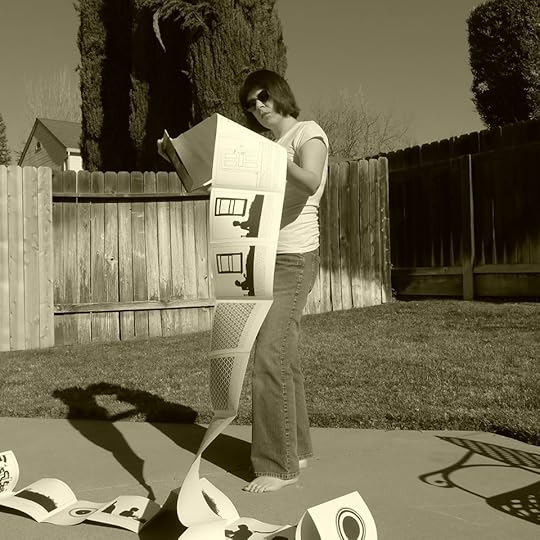
First of all, it came with a large velcro clasp that tore the cover on the book packed next to it. The velcro was necessary because, as it turned out, the pages printed paper is not bound into the spine at all and, left unrestrained, immediately falls out of the covers. Like so:
It is all one long strip of paper, printed on one side only, and connected to the cover only at each end. I assume this is supposed to be artistic or invoke a scroll or something, but I thought it was both a big waste of paper and a nuisance. When I'm reading I want to read, not manage the pages.
The story was fine if a little meager. The writing was adequate. I liked the art a lot. My rating breaks down like this:
art 4 stars text 3 stars book formatting choices 2 stars personal enjoyment 2.5 stars
I'd probably round up to 3.5 if goodreads had that option.
This is a departure in some ways from Nilsen's other work, in some ways a continuation. Stylistically, this silhouette style is different than anything that I'd seen from him; not so interesting to me as the sketch work, less attractive, I guess, but interesting and new as a stylistic choice. Also, there's a lot more words than in his early works, which I am guessing (tell me if I am wrong!) may be from Apocalyptica's 7th Symphony, a song also named "Rage of Poseidon." I don't really know the music well, but I have heard it and think the vibe might be right.
Anyway, the feel is minimal, because of the simple black and white silhouette work, but behind the simplicity is the interrelatedness of all these myths he sees as important. There are "big questions," here about the relevance of myth and religion today. And there's also some connection maybe to sly humor, gags, mixed in, so it's both thoughtful and a bit fun. But the questions in all Nilsen's work are about existential meaning. There are very few comics that explore such questions this "poetically." Experimental comics in a new direction of Nilsen.
Rage is a story in contrasts and a study in juxtapositions. Black meets white. And Christian meets pagan. With no other additives this is quite literally a black and white affair.
Yet even with the uniform deployment of a single panel above and a matching paragraph below semi-crudely implemented illustrations within are inversely lavished with creatively employed contradictions and creative admixtures. Present recollections of presently manifested anachronisms make for interesting takes on ancient classics.
NILSEN, Anders. Rage of Poseidon. Drawn & Quarterly. 2013. Tr $29.95. ISBN 9781770461284. LC 2019030573.
Adult/High School–Before content comes form: Nilsen’s attractively packaged graphic novel consists of a single, long sheet of paper that accordions together to fit between the book’s covers. Each “page” consists of a silhouetted, woodblocklike illustration, accompanied by a subtitle, and represents a single panel in a series of comic strips. Seven in all, these strips range in length from one to20 panels, but all address the same issues: the interaction between the mythologies of ancient Greece and Judeo-Christianity, and the continuing relevance of each. Despite the weighty subject, Nilsen’s primary mode is humorous: the story of Abraham’s near-sacrifice of Isaac as seen by Isaac, who is represented as a modern video-gaming teenager; the life of Poseidon after the Greek religion has passed on, climaxing in his destruction of a water park named The Rage of Poseidon; Jesus hitting on Aphrodite in Heaven. But the overwhelming prize of the collection is altogether more desperate: a strip called “The Girl and the Lions,” in which Athena–feeling old and obsolete, much like Poseidon in the title strip–tries to grapple with the reality of the Christian message that a God might not impersonate a human but actually become human. A very fast read, but one that leaves the reader’s mind provoked long after finishing it.–Mark Flowers, John F. Kennedy Library, Vallejo, CA
This book is only 74 pages long and it took me AGES to finish because the ebook copy that I read had the world's tiniest font and it was a real eyestrain. Luckily I found the stories really compelling and was always curious about the next one. The story of Jesus and his fucking rainbow are my favorite.
Anders Nilsen is, without a doubt, my favorite comic artist. This is quite the departure in style from his other work, but it works. This is an incredibly beautiful book both in content and in construction. I've never seen an accordion style book this large. It is exciting to see independent publishers embracing the book as an art object.
The narratives paired with the sharp, minimal images are striking. I'd call this a perfect winter book. Like all of Nilsen's work, it's beauty is dark and dreary. All the old gods have been forgotten and are feeling disenfranchised from the world they once ruled. Athena has left Olympus and gets in trouble with mortal law on a bender one night. Poseidon is pissed about ocean acidification, but what really sets him off is a coastal theme park. Old and New Testament characters make appearances as lotharios, addled dads and manic depressives.
This graphic novel starts off with a snarky Poseidon who complains about how much he despised Odysseus and if snarky Gods who hate their lives isn’t something that gets your blood a-flowin’, I don’t know what will.
However, Poseidon’s story isn’t the only one in this, and the snarkiness that is Poseidon doesn’t carry out throughout the entirety of the novel. I was a bit disappointed by this, seeing as I kind of wanted to see Poseidon on a slip-n-slide, but needless to say, I still trudged on.
This is basically putting the ancient Roman and Greek gods in a modern day setting (along with one of the stories from the Bible which was really effed up), kind of reflecting on all the things they had done for humanity and how unthankful little twits we are, running around rampant killing off the oceans and setting fires to everything. It was really fun, and dare I say, Cute AF. It was really gripping for me and I didn’t want to put it down. Maybe it’s just the English major in me wanting to come out, but some of the sections came across as really profound.
There were parts that I thought would feel really fun as a video game – particularly Athena’s story. Like a little more fleshed out, and adding the ability to point and click to figure out what had happened, I think it would have read really well as a detective game because it had the right amount of mystery and intrigue that I think would hook audiences.
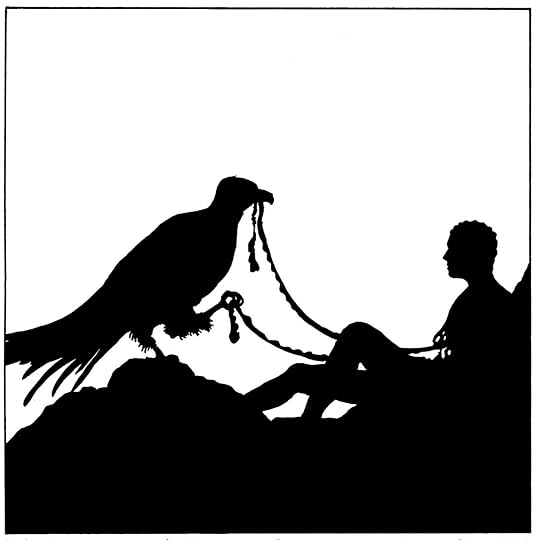
I loved the art in this. It’s very minimalistic seeing as it’s silhouetted, but it still portrayed really good emotion through body language and stuff. I’m not an artist so I can’t really say much more than that, but A+.
When I first picked this book up from the library, I figured that it was a really old copy because the binding was coming apart. (In my defense, the hardcover was ripping and had dents so it very well could have been fam.) Turns out, it was an artistic choice for an accordion format. It was really cool when I was reading it on my couch because I could lounge and the book would be a-okay. However, the problems started when I decided to more from the couch to my bedroom. Let me set the scene.
It’s time for bed. I come clobbering down the steps with a glass of water in my hands. I have a dilemma. Do I put the glass down and then get the book? Or do I carry the book and my glass of water? Let’s do the latter. So then, I walk over to the couch to my open book. Do I close it? Of course not, it’s a hardcover so eff if. It’s made to sit like that. So I pick it up from one end, and the other pages just tumble on out of the book onto the floor waking up everyone in the world and I, defeated, trudge back to my room disappointed because now I have a mess to clean up.
Anyway, this isn’t really the kind of book you read in bed. At least not for me. There were times when I absentmindly reached for water and the pages came tumbling down and smacking me. I eventually got to the point where I put it down for the night because I just couldn’t do it anymore, but that was for the better because the book is much better on a hard surface. To alleviate that pesky neck pain, I just picked the pages up out of the book as I went. Whether or not this was an artistic choice or if this way of packaging the book was just to make it seem unique, I kind of liked it.
Everything in this novel worked for me though, and I loved it and hope to pick up more from this author.
The artwork is done in silhouettes which are often interesting but rarely add anything to the narrative.
The POV is 2nd person. In my opinion this should only be used for Goosebumps-Choose Your Own Adventure
The layout of this book is ridiculous...the pages are not bound to the cover but rather the pages are one continuous piece of paper folded accordion style...wtf? Do you know how hard that made it to read!? What's the point?
The narrative is a collection of stories/chapters about Greek/Roman mythology, Odysseus and Prometheus, and Biblical stories, Noah and Abraham and Isaac, set in the 21st century. **Side note: it really bothered me that the author was not consistent with the names, using both Poseidon and Jupiter, Venus and Eros, in the same story, either use the Greek terminology or the Roman, not both.**
I didn't really get the point. The only chapter that I found to have any meaning or found to be the least bit interesting was "The Girl and the Lions", a story about Athena deciding to mimic Jesus and live on Earth as a legit human being, not just in the form of one. Athena, unlike the other Greek gods, is inspired after hearing about a Christian girl who allows herself to be eaten by lions rather than to renounce Jesus. This chapter best expressed the author's overall intent, but I think the other chapters just fell short.
Overall, I can appreciate the idea the author was trying to convey but the execution, from the ridiculous binding to the overreaching humor, left me rolling my eyes and scratching my head. I just thought this was trying to hard to be edgy and different.
Rage of Poseidon by Anders Nilsen is a gorgeous retelling and illustration of different Greek and Christian myths. It’s hard to take these stories and say/draw something new, but Mr. Nilsen does it, and with such aplomb and wit and whimsy - all while keeping a sense of endless time and swinging between myth and modern times.
I don’t know how I feel about the accordion paper/book layout - it seemed a conceit that didn’t lend itself to the stories and so felt gimmicky. And the book feels more like it’s falling apart than accordioning itself. Plus I would have liked a few more stories about goddesses and women as is my wont.
Rage of Poseidon is brilliant and I so enjoyed reading and re-reading it. The illustrations are spare and silhouetted, sharp and graphic and tender and the text is smart and perceptive and precise. I hope there’s lots more after this.
An accordion-fold, illustrated series of stories that reimagine and remix Ancient and Judeo-Christian gods. I totally dig Nilsen’s blend of religious mythology, dry humor, politics, and philosophy. There are also in this particular book a number of seeds that become much more fleshed out in his subsequent work, particularly in the way he often sets his mythologies in present-day, war-torn conflict zones. It’s surprisingly poetic and unsettling at the same time.
A quick read. The style and layout allows for thought and meditation on gods and modern day realities. An enjoyable read that I will return to in the future for sure.
Beautiful silhouette drawings on each page make this accordion book quite attractive, but the format is puzzling. The writing is good. I've seen and admired Nilsen's work before.
Nilsen makes several stylistic choices with this book that I had a hard time embracing, but it's still an interesting look at how we construct stories/images of humanity versus those of some supposed "higher" order of being (Greek mythology, Judeo-Christian religion).
The use of second person narrative viewpoint in the text is one of those love it/hate it things, I suppose. Some readers seem to feel that it places them "in" the story. Others find it very distancing in almost the exact opposite way. I don't generally enjoy reading second person very much. Here, I think it sort of works in making the viewpoint of a godlike character more mundane, which seems to be the aim. But I couldn't help wondering wether first or third person wouldn't have felt more alive.
The artwork utilizes silhouettes, which emphasizes the flat, inhuman, unkowable-ness of the diety characters. Once again, this seems like a double edged sword that helps to juxtapose the mythological element against the contemporary human world Nilsen is twisting them into, yet also removes most of the possibility for visual nuance or emotion in the drawings. Probably very intentional on Nilsen's part, but I didn't find it to be all that effective. I'll admit that I also just miss the amazing detail that makes a lot of his previous artwork so beautiful to me.
Lastly, the accordion fold book construction. I can't see what this achieves at all. The art on individual pages does not really interact much visually when you look at a section of a bunch of pages accordioned "out". It makes the book a bit physically awkward to read. And once again, if anything, I can only see it as a further distancing effect on the reader.
I think Nilsen is an amazing and ambitious artist/writer (his Big Questions is a monumental piece of comics/graphic novel work), but this one was more of a curious experiment for me.
Reads like a first draft, in both ideas and execution. The ironies could not come cheaper. The apparent understanding of base mythologies being riffed on: nursery school. The psychological reality our writer attempts to marry with this poor grasp: unreal; false; hackneyed; boilerplate.
The illustrations, while sometimes striking, rarely support or add to the text. They certainly don't compensate for its shortcomings. One star for the few silhouettes that gave me a moment's break.
Interesting to read this after reading Tongues as it shows a similar central interest - spinning Greek myths in a modern era. I really like the format of the book, super unique accordion style printing. The only other book I have on my shelf like it is Joe Sacco's Great War.
I read Anders Nilsen’s magnum opus, Tongues, when it came out a few months ago. Since then, I’ve gone back and read through his bibliography, chronologically. While his memoirs about the loss of his fiancée were incredibly moving, most of the books were a bit disappointing: abstract, odd, simple in the art, only slightly funny or clever.
But now, I feel like I have arrived. The Wrath of Poseidon feels like a dry run for Tongues. It covers a lot of the same ground. It is a series of episodes about Greek mythological figures and biblical characters in the modern era. Specifically, Anders retells the story of Prometheus, which he elaborates on considerably in Tongues.
These mythological episodes are all a bit humorous and a bit depressing at the same time. The gods and legendary figures are all suffering in some form: Poseidon has become bored with humanity and discovers a water park named “The Wrath of Poseidon,” Abraham and Isaac wrestle with the meaning of the near sacrifice (but it’s cool because Isaac gets a new video game), Prometheus gets reports of humanity from the vultures who eat his liver daily, Athena is hungover and doesn’t remember what happened with the cops and guns the night before, Jesus tries to pick Aphrodite at a bar.
The art is definitely interesting. Each page features just one image in silhouette black. Rather than speech bubbles and banners, there’s a paragraph under each illustration.
Entertaining, quick read. Seems like this is where Nilsen really starts hitting his stride (in my opinion).
EDIT: I read Big Questions before I started this chronological question. I forgot that it precedes Wrath. I’d say that’s where he hit his stride.
TLDR - This was 6/10 for me. Rage of Poseidon is a cute little graphic novel that deserves a place on your coffee table. It is a collectible. More show than tell. I had fun reading it and I loved the ending.
Trivia - This graphic novel has just one continuous page in the accordion format which makes it a bit of unique reading experience.
Rage of Poseidon (Graphic Novel) is an imaginative and provocative exploration of ancient mythology reimagined in the modern context. Through its unique accordion-style format and stark black-and-white silhouette art, the book merges the timeless struggles of gods with contemporary anxieties, creating a surreal commentary on faith, identity, and relevance.
At its heart, the book probes the vulnerability of deities as they wrestle with human emotions and insecurities. Poseidon emerges as an emotionally fragile figure, Athena’s wisdom falters, and Bacchus’s revelry seems hollow, and so on. Nilsen cleverly blurs the line between divine power and human frailty, pushing the boundaries of traditional storytelling.
Rage of Poseidon is anything but traditional. From its physical design to its selection of stories, this book is utterly unexpected. It contains several vignettes of varying length exploring themes of morality and the divine through the eyes of major religious icons. Each story describes some sort of profoundly dark idea ranging from paranoid emotional insecurity to the callous homicide of strangers. Together, they provide a much more human and three dimensional portrayal of these idealized figures.
This didn't factor into the review, but as other reviewers have mentioned, the book binding is sub-optimal to say the least.
This entire review has been hidden because of spoilers.
This graphic novel made quite a first impression. When I took it down from the shelf at the bookstore and started paging through it, all of the pages fanned out on the floor and I screamed. Naturally, it had to come home with me. From the brief preview and title, I assumed it would mostly be an environmentalism story, and there is a bit of that. Mostly, I appreciated how this book framed discussions around the passage of time, the role of belief, and what it is to become old/displaced/irrelevant/a lost context.
A little slight (a series of stories rather than a full on novel or novella), but totally charming and inventive nonetheless. The title story is basically perfect and should have been excerpted into "Best American Comics" or whatever.
This weirdly messed me up? Shockingly philosophical and oddly confronting, however also somehow raw, poignant and poetic. Nilsen got me feeling some kind of way, damn.
Not a bad collection. I love the modern take on classic tales, though i could see this being a tough read for people who are unaware of the original tales.