Jump to ratings and reviews
Rate this book

The Book of Dolores

Rate this book
William T. Vollmann has travelled to Soviet-occupied Afghanistan with Islamic commandos, shivered out a solitary stretch at the North Magnetic Pole in winter, hopped freight trains, studied the stately ancient beauties of Japanese Noh theater, and made friends with street prostitutes all over the world—all in the interest of learning a little more about life. Now in his mid-fifties, Vollmann sets out on what may well be impossible for a heterosexual genetic male: to envision himself as a woman. In these photographs, block prints, and watercolor drawings, he portrays his alter ego, Dolores, with whimsicality, and sometimes with cruelty—for Dolores would like to be attractive, or at least to “pass,” but the ageing male body in which she remains confined requires lowered expectations. Meanwhile, the drawings and block prints, composed with the artist’s glasses off, show Dolores as she imagines herself to be. The Book of Dolores brings the genre of self-portraits to a new level of vulnerability and bravery. In the process, it offers virtuoso performances of nineteenth, twentieth, and twenty-first-century photographic techniques, including the seductively difficult gum bichromate method. Each section of the book is accompanied by an essay on motives and techniques. 

200 pages, Hardcover

First published October 8, 2013

6 people are currently reading
246 people want to read

About the author

William T. Vollmann

100 books1,464 followers
William Tanner Vollmann is an American author, journalist, and essayist known for his ambitious and often unconventional literary works. Born on July 28, 1959, in Los Angeles, California, Vollmann has earned a reputation as one of the most prolific and daring writers of his generation.

Vollmann's early life was marked by tragedy; his sister drowned when he was a child, an event that profoundly impacted him and influenced his writing. He attended Deep Springs College, a small, isolated liberal arts college in California, before transferring to Cornell University, where he studied comparative literature. After college, Vollmann spent some time in Afghanistan as a freelance journalist, an experience that would later inform some of his works.

His first novel, You Bright and Risen Angels (1987), is a sprawling, experimental work that blends fantasy, history, and social commentary. This novel set the tone for much of his later work, characterized by its complexity, depth, and a willingness to tackle difficult and controversial subjects.

Vollmann's most acclaimed work is The Rainbow Stories (1989), a collection of interlinked short stories that explore the darker sides of human nature. His nonfiction is equally notable, particularly Rising Up and Rising Down (2003), a seven-volume treatise on violence, which was a finalist for the National Book Critics Circle Award.

Over the years, Vollmann has continued to write prolifically, producing novels, short stories, essays, and journalistic pieces. His work often delves into themes of violence, poverty, and the struggles of marginalized people. He has received several awards, including the National Book Award for Fiction in 2005 for Europe Central, a novel about the moral dilemmas faced by individuals during World War II.

Vollmann is known for his immersive research methods, often placing himself in dangerous situations to better understand his subjects. Despite his literary success, he remains somewhat of an outsider in the literary world, frequently shunning public appearances and maintaining a low profile.

In addition to his writing, Vollmann is also an accomplished photographer, and his photographs often accompany his written work. Painting is also an art where's working on, celebrating expositions in the United States, showing his paintings. His diverse interests and unflinching approach to his subjects have made him a unique voice in contemporary American literature.

Ratings & Reviews

What do you think?
Rate this book

Friends & Following

Create a free account to discover what your friends think of this book!

Community Reviews

5 stars
19 (36%)
4 stars
17 (32%)
3 stars
14 (26%)
2 stars
2 (3%)
1 star
0 (0%)
Displaying 1 - 18 of 18 reviews
Profile Image for Nathan "N.R." Gaddis.
1,342 reviews1,656 followers
Read
August 10, 2016
"Defiance might justly be called a sort of fantasy, because until the defier has prevailed (if he ever does), the reality principle's insistence that he cannot prevail appears true." -- William T. Vollmann


FAIR NOTICE//(fine=print) ::


The Book of Dolores contains three parts ; a triptych of characters, if you will.

Firstly, and most conspicuously, it is about Dolores. You may call her “Vollmann as a Woman” if you like ; but she is not he. She is the model, he the photographer and artist. Is she his muse? Not quite. In fact, I think her role is second fiddle to the role played by Vollmann as artist ; but discussion of this book will likely revolve mostly around her. There is no need really to discuss her shortcomings in front of her ; she is well aware of the limits of prettiness.

Secondly, The Book of Dolores is about another book, a novel written but not yet published called How You Are. We receive a few excerpts of this novel ; they are a bit disappointing only in so far as they are small fragments of a whole, and reading them in isolation from the whole scarcely causes literary tinglings. The novel is about a second woman, also named Dolores and also a Vollmann-as-Woman. This second Dolores is a fiction, one whom Good Society would have as a degradation ; to wit ::
The more some acquaintances saw and heard of what I will call my research, the more degraded they considered me. This encouraged me to embellish what they called my degradation. So in the book I became a physically unattractive Mexican street prostitute. How could anyone believe that women, Mexicans, prostitutes, street people are by nature inferior? But multitudes do....

Thirdly, this is an artist’s book, about an artist and by the same artist. It is also the part of the book which will likely be least discussed. By the second half it becomes clear that this is not a book so much about Dolores, but the art=work which surrounds her, creates her, honors her, portrays her, discovers her. Reading, one experiences Bill himself coming to know who this strange person, Dolores, is and what her aspirations are. The descriptions and discussions about Dolores and about How You Are melt into a discussion of Vollmann’s techniques of producing his visual art :: photographic prints, water colors, and block-printing. And having read the text (merely an hour or two’s reading) one looks backwards through the book and discovers the art ; Dolores melts into the form in which we will always have her, the work of art. No, she’s not pretty (who is?) but Vollmann’s art is more than pretty.

The Book of Dolores is only Vollmann’s second book of visual art ; the first being Imperial, also published by powerHouse Books, which accompanied his mammoth Imperial. His recent Kissing the Mask is the predecessor to Dolores which must serve as Mask’s photographic supplement given that his artwork received such poor treatment in Mask. I wish I could say something more than “I like it” about his visual art, but I possess about zero critical skills for such. I am happy to finally see some of his art available for those of us whose pockets are not $10,000 deep.

But what becomes clear is the enormous breadth/depth of Vollmann’s WORK, the variety and intensity of all of his work ; the infinity of 16-hour work=days one imagines in order for him to create all of this stuff. Not many contemporary artists work like Vollmann. Off the top of my head, only a few people like Frank Zappa have been as intense and as single-minded in the pursuit of their own idiosyncratic vision to such a degree ;; at least in so far as they’ve re-shaped my own world.

So, but here’s the word about disappointment. I’ve been reading Vollmann since the Summer of 2011. Since I first read The Ice-Shirt, this legendarily prolific writer has published precisely TWO books :: one an ebook-only to which I have no access, and the other, this book of his visual art. Whatever happened to the two-Vollmann-tomes per year release rate we crave? And on top of all of this, we have now for a year running been promised not only the publication of the next installment of Seven Dreams (for which we have waited more than a decade) but also teased with a collection of Ghost Stories. Okay, those two books -- but then too Bill announces that he has a THIRD book in his drawer about an unattractive, transvestite/transgender’d, Mexican street prostitute -- WHEN can we have this novel, Bill? We really want it.


Profile Image for Cody.
997 reviews307 followers
June 16, 2017
Considering the tendency, however unfortunate, to judge books by their covers, I know for an absolute fact (by individuals in my own life) that there are WTV fans that want nothing to do with The Book of Dolores. Rather than lament their prejudices, I’ll just say ‘your loss.’ Actually I won’t just say that; I’ll say this too: if you think that this Folio-sized offering is an excuse for Bill to dress in drag and little else, you’re missing the point. Entirely. If you’d open those sleepeyed peepers just a bit wider you would see that there is quite a healthy bit of text inside that provides…drumroll…CONTEXT! Who would have thought to open the fucking thing up and find out for themselves?!?

But no, take a look around the internet’s collective consensus of this one: hic sunt faggotry, deviance, depravity, even madness. Common sense dictates that this can’t be a surgical-precise experiment into the none-more-real fluidity of gender and the outsized role it has unwittingly come to have in the popular mechanics of polite society. Hell, that would challenge the dominant and enculturated hetero/XY/sun's-out, guns-out orthodoxy! My take: fuck em/look on face. If you think that a man dressing up like a woman to better inhabit the headspace of transgenderism—entirely conscious of his inability to truly ever do so, mind you—is the worst thing your kids are ever going to be exposed to, well, don’t click on lil’ Pips’ laptop folder named ‘HORSESUCK_GERMANXXX_BDSMNOPQRS.’

Vollmann again outdoes himself with his empathic nature, his ability to own up to his own flaws, and to endeavor into something that most writers—hell, most anyone—wouldn’t touch with a ten-foot pole of glittered lipstick. By attempting to address the chauvinisms and hostilities facing the transgender community (and getting literally stoned for it in the process), he affords them not only a fleeting leap at autonomy and a passing tinkle-piss on the American tropism of Natural Law’s ethical/sexual puritanism, he gives Dolores—real, imagined, Bill, all and none—the one thing she wants more than anything in the world: to be regarded as human.

And if you should find her beautiful, I do believe her heart would blossom into a copperpink flowerbloom from the compliment.
Profile Image for Zadignose.
308 reviews179 followers
Read
October 24, 2014
This book is very much a book about process, and it is also a fascinating artifact that may hold special interest for those who admire Vollmann's writings. At the same time it is a sort of companion piece to an as yet unpublished novel, so it does not give a sense of a completely satisfying work in and of itself, as divorced from knowledge of the artist, his career, and the forthcoming How You Are (which is now a book that I must read!) So, looked at from another angle, it's a sort of photo-memoir.

In terms of process, it starts out seeming to be about the artist's/writer's process. Vollmann is already noted as a writer who performs emotional/experiential experiments on himself in order to come to terms with characters, themes, and situations relevant to his writing projects. Here he experiments with becoming a cross-dresser, and finding out how much femininity is--or may be--a sort of performance, and what relationship it bears to identity. So this book is also about the processes of learning and performing a feminine role.

By the end of the book, one discovers this book is also largely about the processes of photography, printing, and... well... the process of the book's own creation.

Photography is certainly quite relvant to this artist, not only because he has published other photographic works, but also because he has revealed that taking and examining photographs has often been a part of his writing process... interesting because he is not an especially pictorial-descriptive author. He seems more inspired by what is evoked by an image than by a literal description of physical spaces and details. Even though he does, from time to time, indulge in a description of such details, there is often a questioning tone and sense of incompleteness in these descriptions... as though both pictures and words are insufficiently expressive to reveal the essence within... which is always ambiguous.

Another reflection: some of the images of this book, and some of the accompanying text, reveal a sort of three-way conflict, which I have previously observed in women besides Dolores: the conflict between what she thinks she looks like, what she wants to look like, and what she looks like to others.

... and... after a pause, I have a few moments for a couple of additional reflections. I wanted to speak a little about the images.

Dolores, I know, often wanted to look pretty, but she had her self-consciousness to contend with. I don't know if she realized that she often looked best when she was smiling, especially if she was sort of having a laugh. Also, glasses work. But, as in the dilemma faced by many women, she often avoids the glasses because she believes she will look her best without them. Perhaps it would have profited her to take a Korean attitude, as Koreans have embraced glasses as a fashion accessory to such a degree that people with good vision will sometimes purchase and wear glasses with flat "lenses", or even no lenses, just open frames, which is a bit weird when you get close up, but anyway there's no shying away from glasses... they're something to work with as part of one's image.

An exceptional image which is not smiley and playful would be the "Cave Witch" picture, which came out quite well while expressing a kind of ambiguous moodiness. But it's certainly enhanced by association with the story of the image's creation, which is kind of far out to think about: a heterosexual man without much cross-dressing experience, sneaking off in the night, alone, with a bag full of lady's clothes, artificial breasts, a flashlight for illumination, climbing into a somewhat spooky cave, dressing up and photographing himself with a laptop, not knowing for sure what other presences may be lurking about, human, animal, or spectral, hoping to produce something wonderful while already anticipating embarrassment and disappointment, perhaps wondering Will my wife see this picture some day? Will my child? And my friends who accuse me of self-degradation? Will this be hanging in a gallery someday, or printed in an art-book? And if I make a gum bichromate print, will it persist for three hundred years after my death? Will people see it who have no idea who I am or who I was, and what will such people think of me and my creation, and where is this Dolores whom I'm trying to create? Click! Oh, there she is.

But in many cases, Bill's not entirely cooperative with Dolores's interests and aspirations. The gruff images and the ones with the extremely overdone makeup sometimes seem like less of an effort to conjure up a feminine Dolores, and more of the artist trying to get into the mind of his heavily conflicted, ambiguously male-female fictional creation who is already well aware of the tension between his-her aspirations, the unkind world of observers, and the physical limit of what one has to work with in the body and face itself. Thus these images--as well as the "in-between" images--are most expressive of the three-way tension mentioned earlier, and they contain something painful, sad, accusatory, ambitious, blindly idealistic, and sometimes delusional.

I can't stop blathering until I make one more reflection. It's too late for me, but I'd really like to see how another person would react to this book if he or she came to it having no idea who Vollmann is, having no knowledge of or interest in Vollmann's work, and who might assume the artist to be an unaccomplished amateur. Divorce the book from context and see how the world really takes it.

Okay, there you have it, my reaction to Dolores.
Profile Image for M. Sarki.
Author 20 books238 followers
July 9, 2017
https://msarki.tumblr.com/post/162763...

…I had already reached adolescence before I realized that my nature could scarcely be changed; hence I might as well accept myself. At once I felt relief. I could not be like others. Very well; I need not try. Strange to say, I then began to be liked, and since then I have been blessed with as many loyal, loving friends as I could wish…

The quote above by William T. Vollmann came toward the end of a brilliantly “felt” essay titled How You Are in which he relates a personal history that naturally would evolve into his morphing into Delores. The emotional impact of the essay struck me to my core. In an instant I became completely enamored with the man Vollmann. The writer, artist, and celebrity he has and will become will always place second to me. Vollmann put his heart on the line here, and shared with this reader the greatest demand placed on it; his agonizing need to belong. How many of us are brave enough to say it, and strong enough to thrive in spite of it? Amazing, and I have only begun to scratch the surface of what he has to offer us, let alone what he might offer the world. And as an added bonus he has also written a few academic essays for the amateur photography buffs among us.
Profile Image for Jeff Bursey.
Author 13 books197 followers
May 16, 2022
As always with Vollmann, it's surprising the depths he reveals.
Profile Image for Aaron McQuiston.
601 reviews21 followers
February 2, 2014
William T Vollmann has been nothing but a fascination for me since I picked up "You Bright and Risen Angels" and heard the stories about how he wrote it in the office after dark, hiding from the janitorial staff and eating Snickers bars out of the vending machine to survive, because "You Bright and Risen Angels" is a monster that makes you think about being faithful to the vision that you see, even when the prospects of people around you, including the publishing community will probably not "get it." Vollmann's whole career has been based on him doing what he wants, whether we like it or not. He has traveled everywhere, talked to everyone, done things we wouldn't even dream to do, and yet some people are shocked that he decides to transform into "Dolores", an aging Mexican transvestite hooker, to better understand a novel he is writing.

He says in the essays that accompany the pictures of him that he is a writer and an empath. One and two. His empathy for the way that the world seems to be unfair to certain groups of people makes him want to become one, walk a mile in their shoes, so to speak. With this he creates situations after which he has a better understanding of society and the way things are perceived. When some kid decides to stay in a cardboard box in a church parking lot to understand homelessness, he is applauded, but when a man tries to slip into the skin of a transgender prostitute, there is a collective grumble from the audience. Why is there such a difference between the two acts? This is what makes Vollmann empathetic to the prostitute and wants to understand what is it is like to live that life.

I love Vollmann, have all of his books, and have slowly read my way through most of them. Usually he gets five stars, or at least four. I am only giving three to this because I don't feel like there is much substance that I care to know in his essays. A great deal of them regard the way that he develops his film and makes his woodcuts. It proves that he is always busy with what he wants to do, but as someone who doesn't really care about any of this, it leaves for boring reading. The essays at the beginning of the book are interesting and gives glimpses of his feelings as Dolores and why he does the things he does, but it feels as if it is an introduction to a book that is not yet published. Maybe after this book sees the light of day, I can revisit these essays and they will have more impact. As it is, it's kind of a book to avoid unless you have read some of Vollmann's other works and are familiar with his art. Otherwise you will just see a weird old man dressed like an ugly old woman.
Profile Image for Ian "Marvin" Graye.
951 reviews2,790 followers
Want to read
June 17, 2017
This review is not finished yet...Please come back later.

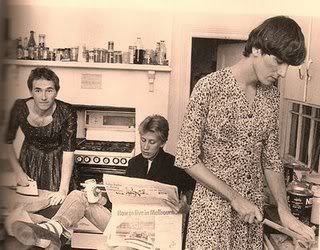
(Bill and) Grant and I

Sensative new age guy dons dress in quest for authenticity...just like the Go-Betweens had already don(n)e(d).

description

Photo courtesy of Jeremy Bannister:

SOUNDTRACK:

The Sleepy Jackson - "Miniskirt"

https://www.youtube.com/watch?v=_wsLq...

"If I was a girl I'd wear a miniskirt into town...
I began lifting my legs over railway tracks,
You just don't know when you might get hit by a truck."


An early Luke Steele band.

The Sleepy Jackson - "Come to This"

https://www.youtube.com/watch?v=uBKOP...

"Keep your mouth clean
Let the lying lips be put to silence
Keep your mind clean
Let the lying lips be put to silence
Lord I don't know
How it has come to this
Girl its a long time when your runnin'
Girl its a long time without lovin'."


Psalm 31:18

"Let the lying lips be put to silence;
Which speak grievous things proudly and
Contemptuously against the righteous."


The Sleepy Jackson - "(Just Like) Starting Over"

https://www.youtube.com/watch?v=TWExw...

"It's been so long since we took the time,
No-one's to blame,
I know time flies so quickly,
But when I see you darling,
It's like we both are falling in love again,
It'll be just like starting over - starting over."


[John Lennon]
Profile Image for Jesse.
156 reviews39 followers
November 18, 2023
In THE BOOK OF DOLORES, Vollmann channels a degree of vulnerability that most people will never reach in their lives. The portraits captured herein are often disturbing, even grotesque. Although most are selfies captured on an early MacBook camera, they are evocative and visually striking — the laptop quality adds another layer of vulnerability, as if we are viewing private images. The watercolors and wood-block prints are also highlights of Vollmann’s scribbly pen style, although I wasn’t very impressed by the low-contrast gum prints (an opinion that Vollmann would likely find discouraging, considering the immense effort put into developing them).

Visuals aside, I wish the text centered on Dolores and Vollmann’s motivation for becoming her, rather than on his printing techniques. Much of this contextual responsibility is passed on to brief excerpts from his novel HOW YOU ARE, which he had finished at this time but, over a decade later, still hasn’t been published (and with the recent news that his relationship with Viking has fallen through, the prospects of its arrival don’t look too good at the moment). From these excerpts, it becomes clear that THE BOOK OF DOLORES is more or less a companion piece for HOW YOU ARE, much like the book and photo-book duo of IMPERIAL. Consequently, I don’t think we can fully appreciate one without the other, so I will be returning to DOLORES when HOW YOU ARE is eventually published, hopefully sooner than later.
Profile Image for Alexander Weber.
277 reviews57 followers
August 13, 2025
I...don't get it. Also, it's been 12 years since this came out... how has How You Are not been published? I'm so confused
Profile Image for Larissa.
6 reviews1 follower
March 4, 2014
Fantastic. Beautiful.
There is nothing I can say. I am rendered silent - to be given the opportunity to learn so much about Mr. Vollmann, which I did not really expect at all. And the lovely Dolores…Cave Witch is such a hauntingly beautiful photograph, among many. I am stunned by the creativity and artistry of this book. Impressed, speechless, amazed.
1,537 reviews22 followers
June 4, 2025
I picked this book not knowing what it was. I quickly drew me in, though gets a bit long with all the various media. I have read several of Vollmann's book, a mix of fiction and nonfiction. I have enjoyed his writing and characters, and vibed with his passion to shine light in area's society wants to forget. I am disappointed that he hasn't published "How You Are," which was his reason behind the whole experiment.

I think what I liked the most was when the author talked about his life and his outlook. It was only a few pages, but I found it fascinating, something I connected with. He nails it describing life as, ”The dichotomy between the pleasure principal and the reality principal, the normal losses, lacks, and disappointments in any life.” p.47 Yup. That about sums it up.
Profile Image for Wendy.
66 reviews
April 22, 2021
A quality photography project. Wonderful thick paper. Vollmann indulging in makeup, dress up, illustrations, concepts, processes. Considering the source (Vollmann) it's a lighthearted romp. F...ing Vollmann, man (like I always say upon completion of one of his books).
Profile Image for Cary.
186 reviews1 follower
March 31, 2024
9780739322062; 0739322060
This entire review has been hidden because of spoilers.
Profile Image for Sean.
1,147 reviews29 followers
December 26, 2013
Vollmann is certainly a unique artist. In here, he details the existence of a sort of female version of himself, in words and, mostly, photos. It's a short book very much about process, both the technical photographic process (he uses old, labor intensive methods), and the process of learning about this other person by creating portraits of her. A curiously obsessive fellow, this Vollmann. What will he do next?
9 reviews
June 16, 2014
Outstanding. Great photography, great descriptions of the process behind the photography, and a perfect introduction to Vollmann, all things considered.
Displaying 1 - 18 of 18 reviews

Can't find what you're looking for?

Get help and learn more about the design.