Après nous avoir raconté sa guerre en Europe, Alan Ingram Cope évoque son enfance dans les années 30, dans une Californie du Sud provinciale totalement disparue et aujourd’hui devenue mythique. Avec cette voix de conteur si particulière, Cope évoque sa famille modeste et sans histoire, mais aussi toutes ces petites épiphanies de l’enfance faites de jeux, de rencontres et d’interrogations. Dans cette Amérique encore marquée par la grande crise de 29, l’auteur excelle dans l’évocation de grandes réunions familiales où les générations se côtoient et dont certaines ont même connu la guerre de sécession.
Sur cette parole de mémoire d’une très grande richesse, Emmanuel Guibert joue une partition graphique d’une grande beauté, en cultivant une simplicité lumineuse. Son sens inné de la mise en page, son rapport au dessin d’une subtilité exemplaire, lui permettent d’accompagner le rythme des mots et d’amplifier leur charge émotive. Véritable voyage dans d’autres temps perdus, « L’enfance d’Alan » est un livre qui mérite tout simplement le qualificatif de chef-d’œuvre.
Emmanuel Guibert has written a great many graphic novels for readers young and old, among them the Sardine in Outer Space series and The Professor’s Daughter with Joann Sfar.
In 1994, a chance encounter with an American World War II veteran named Alan Cope marked the beginning of a deep friendship and the birth of a great biographical epic.
Another of Guibert's recent works is The Photographer. Showered with awards, translated around the world and soon to come from First Second books, it relates a Doctors Without Borders mission in 1980’s Afghanistan through the eyes of a great reporter, the late Didier Lefèvre.
Guibert lives in Paris with his wife and daughter.
If you’ve read more than a sturdy handful of my reviews here, you’ll likely have gathered that I love to talk about myself. Or perhaps not so much about myself (in terms of ego) but rather about my life, about the things I’ve experienced, the way things have been. A couple months back, I was trying to describe what I do at Good Ok Bad and I happened upon the description: memoir-based, low-brow lit-crit. The reason I spend so much time telling stories about who I am and have been is that I believe knowing a critic is essential to understanding how his evaluations will intersect with your own interests, tastes, and values. But also because I find the distinction between now and then absolutely compelling.
I am not old but I’m not young either. I was born in the early ‘70s and so was part of perhaps the last bulk of free-range children. We roamed neighbourhoods in packs or on our lonesome. We hiked in the local wildernesses on our own or perhaps with a friend, rattlesnake buzzing be damned. Our parents routinely left us in the car to play while doing a half-hour of grocery shopping and no one was at all concerned. The smog in Los Angeles was so thick and constant that skies were perpetually orange and it often hurt a child’s lungs to play and on bad days you couldn’t see further than a hundred yards. Payphones were essential lifelines. Dialing a phone number containing nines and zeroes might have taken eternities. Not every middle class family owned a computer. People were afraid the D&D players were sacrificing each other in bloody masses in underground tunnels. And the difference between my childhood and my father’s immediately-post-WWII childhood is as vast as difference between now and 1980. Worlds tilt and shift and change, and if we don’t tell these stories, no one will remember to care.
[Nice win/loss rating.]
For this reason, Emanuel Guibert’s treatments of Alan Cope’s life are essential and fascinating. How the World Was follows on the heels of Alan’s War, which largely concerned itself with Cope’s place in WWII and its aftermath. How the World Was winds back the clock (another thing growing less and less common) to explore Cope’s childhood growing up in Southern California during the Depression. And it’s a world-and-a-half away from the Southern California I grew up in.
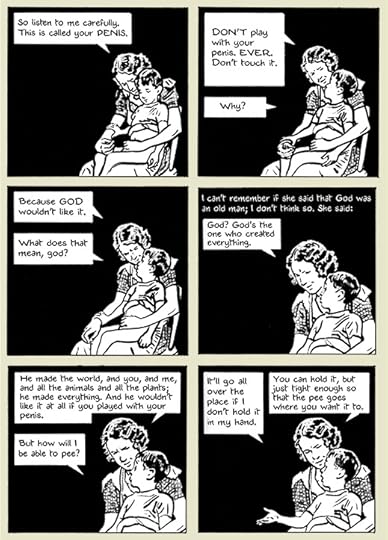
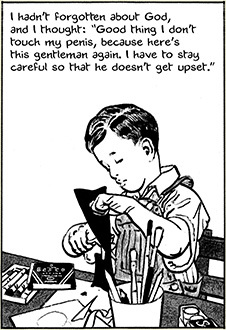
In both Alan’s War and How the World Was, Cope exists as a strange mix of social aloofness and integration. On the one hand he often remains free from the racist, sexist, and homophobic influences around him. He seems less a product of his time and more a product of ours.[1] Yet on the other hand, he sometimes represents himself as being deeply affected (even on a lifelong psychological level) by particular people and interactions. At one point he relates how a warning from his mother combined with a hornet later that day brought him a lifelong religious aversion to touching his penis—even after he rejects religion outright as a young adult.[2]
[Here mom. Let me explain how peeing works.]
And on a very brief note, Guibert recreates a number of Southern Californian environments now lost to time save but for the archival efforts of photograph collections and artistic renderings. They portray another kind of world and will be fascinating to students of human history and nature. Scenes from the early 20th century abound. Soda shops, old-town L.A. County, the boardwalk at Santa Monica, simple Depression-era housing. Leave it to a French work to inculcate a nostalgia for a thoroughly American world now lost to us for all time.
How the World Was is less focused than Alan’s War. Where the former work had WWII as its principal point of contact with Cope’s history (only spreading out in the latter half of the book), the present work culls from the whole of Cope’s history in California as well as his family history. The episodes related are all engaging for sure, but the book does suffer a bit from feeling a touch scattered. Focus ranges from Cope as young child to Cope’s grandfather in the Civil War to Depression-era living to the introduction of Cope’s new stepmother to cousins and aunts and uncles and other extended family. It’s almost all dead fascinating, but I can’t help but wish the vista was at least slightly more directed.
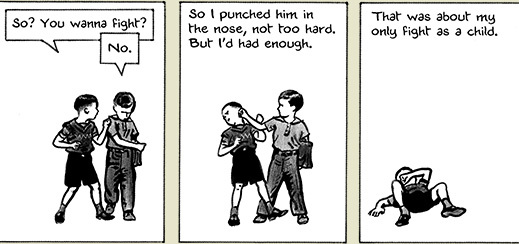
[Method acting.]
In How the World Was, Guibert sometimes relies on large blocks of text. As with the prior book, Guibert tells the entire story (such as it is) through narrative text that floats outside the action of the book’s panels. It worked exceedingly well in Alan’s War and is mostly effective here, though there are times when I wished Guibert would have taken a couple extra pages for a particular story, just so that those large blocks of text could be broken up and spread across more panels of art. Because, for whatever reason, a proliferation of words feels too much like an obstacle when encountered in the comics medium. I felt similarly in Joe Sacco’s Palestine, and that was one of my chief complaints in the recently reviewed With Only Five Plums.
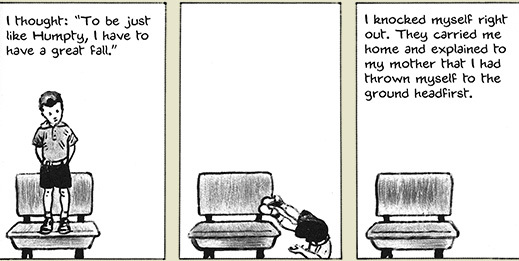
[We did awesome/stupid stuff like this all the time growing up.]
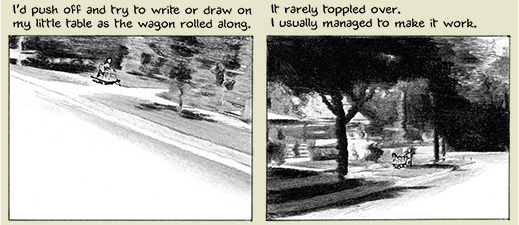
Despite these probably petty criticisms, How the World Was is a lovely and very often hilarious work. (There is an episode in which Cope relates how he would set up a writing desk atop a wagon and ride down a hill while calmly writing until having to bail out at ride’s end.) Cope’s life continues to enthrall and amuse and enlighten. I can only hope Guibert will continue to mine the wealth of Cope’s experiences and storytelling prowess. Even if future works are even more scattered, they will continue to provide a wealth of value to readers.
A Note on the Art I didn’t have time to mention it in my review of Alan’s War, but Guibert’s method for illustration is enchanting. He draws his line art with water and then drops ink in, which then spreads to fill the lines in a various and mottled effect. Here’re a couple samples demonstrating the method (completely worth your time!):
Additionally, Guibert uses a number of techniques to fill the greys that texture his work. His methods here remain a mystery to me. Some seem like spongework, but otherwise I am in the dark. All that matters is that his effects are universally lovely.
Footnotes 1) It’s easy to retain a measure of skepticism that Cope hasn’t self-edited his history for our interlocutor, Guibert.
2) Amusingly, even when he was motivated by a strong sense that God disapproved of him making physical contact with his penis, he is clear that he found ways to masturbate without breaking letter of the onanistic law.[3]
3) Trivia! The sin of Onan in the Hebrew scriptures from which we get the term onanism was not actually masturbation. Instead, he was punished for withholding progeny from his brother-in-law’s wife by pulling out—perhaps the only time in history that the method actually worked as birth control! In that culture at that time, brothers would take their widowed sister-in-laws into their household in order to continue the hereditary line of the brother. Children born to the widow would be legally considered the children of the deceased brother. Onan, a happy product of the patriarchal zeitgeist, was happy to enjoy sexual consummation with his brother’s widow but was careful not to intend actual procreation, thus robbing his brother (and his widow) of the continuation of his line.
So Onan’s sin, technically speaking, was greed (and perhaps envy of his brother—think “His Face All Red”) and its mechanism was Onan “spilling his seed on the ground.” From which, of course, we get the aphorism: “Better to spill your seed in the belly of a whore than to spill it on the ground.” Because leave it to horny religious people to find a loophole for a law they misinterpreted the whole time.
Guibert's art is magnificent. In particular, he has a real knack for drawing people, and he gets all the expressions, positions and proportions absolutely right. As for the story, mmmhhh... this book is following the childhood of Alan Cope, a friend of Guibert, and old guy who agreed to have his memories recorded by Guibert. Therefore, the book reads exactly like what it is: an old guy telling you about his distant past. Unfortunately, he does not come across as an interesting guy at all. I'd say there are some curious bits, and a disturbing TMI passage about his penis, but the fact remains that Cope had an entirely ordinary California childhood, with no special event taking place during his formative years. So I understand why some reviewers found it boring and wondered what was interesting about this. Frankly, this is not a "story worth telling" per se. If Alan Cope had not been a friend of Guibert, his childhood would never have been become a published story. So, my advice is, read this book if you want to enjoy Guibert's art, but not for the narration.
Emmanuel Guibert's HOW THE WORLD WAS is the companion story to our previously published graphic novel, ALAN'S WAR, which takes you through World War II from the perspective of one single man.
HOW THE WORLD WAS tackles Alan's youth, growing up in California. It's fascinating -- rather than being a historical story about Big Events or even Big Ideas, it's all the strange and weird and interesting points of an ordinary person's life, and what it was like to grow up in America's past.
Het is onaardig om te zeggen, maar dit boek vertelt een verhaal dat eigenlijk dodelijk saai is. De jeugd van Alan Cope is helemaal niet speciaal, er gebeurt niets bijzonders (op het overlijden van zijn moeder na) en de jeugdherinneringen zijn niet noemenswaardig eigenlijk. Tel daarbij op dat er, in elk geval in de Nederlandse vertaling, ongelooflijk stomme fouten gemaakt worden (het "episch centrum" van een aardbeving, really??), en dan zou je denken dat mijn drie sterren eigenlijk al te veel zijn. Maar: de tekeningen zijn wonderschoon, en dat vergoedt een hoop.
I really, really liked this book. I imagine it's not for everyone, but I like memoirs and since my daughter has moved to California, I enjoyed reading of that state in an earlier, simpler time. The author/illustrator has taken stories of his friend's childhood, as related to him before the man's death, and turned them into a lovely graphic memoir/biography. This childhood was during the Great Depression when California was much less crowded and glitzy. The separate little incidents don't particularly follow a pattern and are quite quirky, but there is a real feel for time and place. Reading it felt sort of like listening to a relative tell you about the olden days of his youth. Since the subject of the book was born in 1925, he was of my parents' generation, so I kept thinking about the fact that this was the world in which they grew up, although far away in California rather than in Kentucky. The book is not long---I read it in one sitting---but I have been thinking about it ever since.
Book blurb: In 1994, French cartoonist Emmanuel Guibert befriended an American veteran named Alan Cope and began creating his new friend's graphic biography. Alan's War was the surprising and moving result: the story of Cope's experiences as an American GI in France during World War II.
Telling someone's biography in Comics form is an interesting choice, and this form captures a sense of emotion that would be harder to do in prose. The art is fantastic, and wonderfully atmospheric, but I was not really interesting in the biography of this person. The telling seemed like snippets of memory, place and time, and not a point to point narrative one would except with a biography, and was too fragmented for my tastes. However, this book is worth getting your hands on to simply gaze at the artwork.
I know I was almost a third of the way through this graphic novel, so DNFing seems a bit silly, but holy shit am I bored. It's important to record what life was like on a daily basis, sure, but even the parts that should have been interesting are told in this way that makes me feel like a kid sitting in the Peanuts classroom. I don't find anything the slightest bit interesting, except for the full color illustrations that opened the book. Otherwise, bored bored bored bored bored.
This is an impressive, deceptively simple graphic novel. I think the artist's real strength lies in drawing people--rarely do you see such realism in movement and posture.
An OK biography that was a bit more interesting because of the California retrospective than the actual biography. I suspect those who don't have older family members who grew up in this period may not care for it as much.
Except for the few pages at the end where Guibert markedly shifts his tone to make a confusing connection between the protagonist’s emotions and the protagonist as an “artistic person,” this is a charming tale of the small and large events that make up a child’s life. Like his collaborator Joann Sfar, Guibert has a talent for writing about the introspective moments of a bygone era. He beautifully portrays a child’s foolishness, wonder and sadness.
Other reviewers may criticize the ordinariness of Alan Cope and his life, but I consider that part of the book’s charm. Cope has distinguishing characteristics that make him quite likable - for example, he’s inherently nonconfrontational and tolerant of differences. An example of that is his desire to meet estranged relatives and his complex emotions about them. At the same time, the book’s focus on common experiences transforms Cope into a sort of Everyman for his generation. Aspects of Cope’s childhood remind me of my grandparents’, also members of the Greatest Generation, and even my own.
This is one of those books that could benefit from being two or three times its length, so we could see more sides of Cope and the people close to him. Cope thinks about his father, “Maybe he was like me in some ways. He probably thought: ‘I have to put all that completely behind me.’” Really, that’s what Cope is like? I guess so, but would have wanted to see more of that if Guibert is adding this. Also, the proofreaders of the English translation let a few errors through. Despite these shortcomings, this is a book I’m really glad to own and an engaging, poignant, thought-provoking read about a dying generation.
In 1994 a French cartoonist named Emmanuel Gilbert met an American war veteran named Alan Cope. The two became fast friends and Emmanuel decided that Alan’s story needed to be shared with the world. Gilbert shared Cope’s experiences and story as an American GI in France in WWII in a graphic novel titled “Alan’s War.” But Gilbert was not done telling Alan’s story. He began working on his friend’s life growing up in California during the Great Depression. Sadly cope died before the work could be finished, but Gilbert continued work and “How the World Was” is the result. Gilbert captures Cope’s life growing up and what America was like during that time period in honor of his friend’s memory.
Gilbert is a master storyteller and illustrator and deftly honors his friend’s memory in this book. Instead of trying to create a plot or a story, Gilbert gives us snapshots of Cope’s life. Of what it was like to grow up in California, before WWII, before smog, before crowds, before anything that we consider “Californian” today. He captures the high and low points in the memories of Cope, of family, of life, and of the changes that occurred over time. He doesn’t try to sugarcoat things or try to create more drama than there is, Gilbert just tells Cope’s story. The art is beautiful and consists of soft lyrical watercolors in a muted tone that fit the time period and the journey well. And they give the reader a sense of what it was like growing up and living during that time.
This is a book that you’ll want to read and then go back to a few more times as you learn more about the history of the time period and of Cope’s memories. Gilbert has created a lasting memorial for his friend and it is well worth picking up. 4 out of 5 stars.
This is a beautiful graphic novel that tells of a life in California before WWII, before smog and crowds. For a second-generation native Californian like myself, this is like hearing a series of nostalgic family anecdotes and stories. There's no real sense of plot- the book is like a series of snapshots that come together to make a contemplative record of a life, of a family, of things gained and lost, of changes that occur over time. The ending is heartbreaking and hopeful.
The digital galley I've had the privilege of reading is missing quite a few pages of art-- presumably, it's still in production. But the full text is there, and even the text without the art is an excellent read. And from the finished parts I can see, the art is absolutely beautiful, and fits the period of the piece. I can't wait to get my hands on the finished version of this.
Entirely Engrossing! This is the prequel to "Alan's War", which I haven't read yet. Written in a first person perspective, it is the story of Alan Cole's life growing up, and his family's, during the Great Depression. A touching story from a man with deep insight into the human condition. Rivetting. Guibert's art is fantastic! Though I haven't read "Alan's War", I have read "The Photographer" and the style is similar to it. Guibert uses his own pencil sketches plus actual photographs along with a unique process whereby he combines photographs into sketches, sometimes leaving some of the photo behind, other times, completely turning it into a sketch. Loved every single thing about this historical memoir.
Some of the best slice-of-life biography since American Splendor. Yes, I know that was technically autobiography, but the feel is similar. This is real life in telling details. Very little happens in terms of earth-shattering events, but the wealth of detail bring's Alan Cope's--an American WWII veteran who became good friends with Guibert--story to marvelous life. California in the years leading up to the Depression was very different from the California of today. This graphic novel is a fine example of the medium at its best, and is well worth reading.
This graphic novel is more a collection of memories rather than a traditional story, with lovely artwork and languid pacing. It was so languid, in fact, that I was jolted by the story's major event when it arrived. Overall, I appreciated how the graphic novel form is used here—it refashions something larger out of what is basically reminiscing.
Un magnifique dessin qui sert une très belle narration. Un plongeon très sensible dans l'enfance d'Alan et un voyage dans la Californie avant la seconde guerre mondiale. Une rare justesse dans la manière dont le graphisme répond au texte.
nonfiction (childhood stories from a ww2 veteran/grandpa). More stories from Alan of Alan's War. Maybe not as riveting as the war stuff, but I enjoyed these. I miss having a grandpa.
I didn't realize until late in How the World Was that this was a continuation of Alan Cope's life story from Emmanuel Guibert's other book, Alan's War. The framing struck me as strange, as if the narrator was relaying his life to you, the reader, ad hoc. Once I realized that they were Cope's words being relayed to Guibert, the whole thing made a lot more sense.
Guibert's artwork, moody and gauzy like a memory, is perfectly suited to a calm recalling of long-ago times. Cope's story is never quite fascinating, though it is always interesting. Some parts, like when he first discovered Kleenex, could likely have been cut. But I largely loved the glimpse into life in the early 20th century. Particularly because Cope didn't come from rich or powerful stock - he was just a normal guy, descended from other normal folks. It's a take you don't often get when it comes to history.
Heads up that the conclusion takes a hard left turn from idle, low-key memories to painful tragedy. I was a bit blindsided. I also saw quite a bit of myself in Cope's Rodin quote at the end. I'm certain that I've read Alan's War before, but considering how much I enjoyed How the World Was, I'm thinking I need to pick up the sequel soon.
I really enjoyed this story. Alan's childhood was relatively normal, but it was still interesting to me. I thought the passage that briefly talked about masterbation was interesting, because you never expect an old man to admit to doing that--he even admitted to being a little pagan.
I wish we could've gotten more elaboration on why he was forbidden to see Ruthy ever again, it seemed to come out of nowhere. But I understand if he didn't remember. I wonder what it was like at his mother's funeral, since Ruthy's dad was the pastor for the funeral service. If that was before or after not being able to see her. I guess that's just what you get when you read nonfiction--there's natural gaps.
The artstyle was very good as well.
This entire review has been hidden because of spoilers.
I read this mostly for the California childhood aspect. It was interesting to see what's the same and different, and there were moments of nostalgia and even touching emotion. Overall, the feeling I had, though, was of waiting for something to happen. The book is like listening to an elderly relative tell you about their life, but without being related to them, or really connecting. There were moments I thought could have been plumbed for more depth. Sometimes the reactions portrayed were fairly glancing, along the lines of "well, that's what happened," and then moving right along to the next thing.
I bought it in August 2017 (two copies, because I got distracted) and I got to read it today. I didn't even read my copy, but the one I donated to a comics archive near here.
I was bored out of my skull...
I kind of like the depiction of a lifestyle completely different than the current one but the way the story is told makes it extremely slow and boring. In addition, I also had time connecting with the characters because they made me confused: I didn't know if they were talking about Alan Cope's grandfather or his father.
The part about religion and penis touching was so weird...
I love the art.
I have the second part, as well. I'll read it in a couple of days.
It's funny to read so many people describing this story as pointless: I think it's a sweet memoir of a man. Did he do or experience anything wild? No: but it has the charming and rugged feel an old, well-spoken friend talking about his life and revealing small truths in minor events.
Do we need every story to be a dramatic, world-shattering tale? Isn't there gentle poetry in all lives? Absolutely: and Guibert catches the contours of his friend's life in loving detail.
Want excitement and adventure? Read a brain-dead Marvel comic.
This book is a graphic memoir about Alan Cope. It's unlikely you've ever heard about him. That is because he isn't any celebrity, scientist, or businessman. Alan is just a man who would grow up around 1930's California, and then at 18 would serve his country in WWII.
This book retells all those little moments that defined his childhood. It can be thought of as a time capsule from when life was both simpler and harsher. I chuckled and awed, as well as I was angered and heartbroken about those little moments. It was beautiful storytelling.
Alan Ingram Cope ci racconta il suo passato remoto: quando era bambino e l'america avea un ritmo e un aspetto diverso. La povertà della grande depressione, i piccoli giochi inventati, con mezzi di fortuna, le amicizie fortuite e le grandi riunioni con i parenti. L'infanzia di Alan ha un sapore nostalgico, impreziosito dai soliti splendidi disegni di Guibert, come foto ricalcate a contorni spessi. Dopo la guerra di Alan un giusto complemento alla trilogia.
My first time reading a "graphic novel," one that is told as much in pictures as in text. And I loved it. Yes, very different than simply reading . . . the photos tell some of the story, too. It was a lovely experience, and this was such a good, well-told "story" of a California childhood, that I'm definitely going to look for more of this author's work. And other authors who are also producing graphic books.