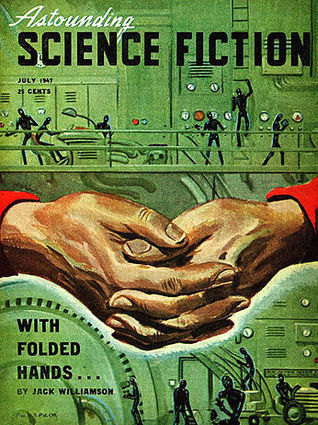
Seemingly perfect robotic "Humanoids" appear in the town of Two Rivers and offer residents a life free of work, stress and danger. But at what cost? "With Folded Hands" follows Mr. Underhill, as the Humanoids threaten his household, destroy his android business and take control of the town in order to "Serve and Obey, and Guard Men from Harm." A precursor to Williamson's novel THE HUMANOIDS, which Damon Knight called "without a doubt, one of the most important science-fantasy books of its decade."
John Stewart Williamson who wrote as Jack Williamson (and occasionally under the pseudonym Will Stewart) was a U.S. writer often referred to as the "Dean of Science Fiction".
Хареса ми, макар и да е вече солидно поостаряла тази класическа sci-fi повест.
Едно време, като си купеше човек списание със фантастични истории, вътре намираше и част, от която можеш сам да си направиш мини книжка. Имам и до днес няколко от тях, но тази я бях пропуснал.
Моята оценка - 3,5*.
Двата романа влизащи в тази серия не са преведени на български.
And I don’t become frightened by old science fiction, not that I’d openly admit, anyhow. However, there’s no shame in telling that this story upset me on a deep level. Williamson wrote this over 75 years ago, but it’s still as fresh and as relevant today.
Wow, I thought this was going to be one of those whimsical old yarns. What the hell was this so scary? These robots take over every aspect of human life, and hold humanity in a protective bubble. You don’t work or worry about money anymore but you can’t read a book because it might be disturbing, can’t be around any sharp objects or even open a door for yourself.
I was glued to this story, the longer it went on the more terrifying it was. It seems prescient for something written in the 40s but it stopping us from working and still feeding and housing us is wishful thinking.
Първата публикация на Джак Уилямсън е през 1928-а, и не спира да пише до смъртта си през 2006-а. За това време успоява да напише 52 романа и над 100 разказа. В България са издадени две негови съавторства с Фредерик Пол ("Рифовете на космоса" и "Певците на времето") и сборника от две произведения "Легионът на времето". Вероятно има и 2-3 разказа тук-там и толкова - сякаш крайно недостатъчно... "Със скръстени ръце" е издадена за първи път през 1947-а, и макар това да личи от стила на писане, само се намеква, че произведението е писано доста отдавна, и не пречи. Доста оригинален сюжет по съвременните стандарти, а за преди 70 години, не ми се мисли :). Преводът е сносен, и се чете бързо! Този разказ поставя началото на мини-серията "The Humanoids", от която има още 2 романа, които ще се търсят! 4,5
Amazing, classic novella from SF grand master Jack Williamson, which became the basis for his masterpiece novel The Humanoids. As timely today as when written in 1947, this is a chilling Twilight Zone like tale of seemingly well intentioned robots programmed with the prime directive "to serve and obey, and guard men from harm" gone horribly wrong. Be careful what you wish for!
Succinct and to the point, yes dated but effective version of the robots take over to save humans from themselves. Raises interesting questions clearly and quickly.
I decided to read this because of a mention in The Precipice by Toby Orb, and I can really see how a lot of his ideas are fictionalized here. There's the unilateralist's curse (it takes only one person who's optimistic about a potentially destructive technology to create it), the tyranny of the present over the future, and the idea of lock-in (some dystopias being so stubborn due to a new technology that they are essentially permanent).
The leftist nanny state taken to its logical conclusion. First, we must be protected against “violent” guns, then “violent” knives, then “violent” SUVs, then “violent” loops of rope. Finally, after everything else, “violent” silence.
Some people don't realise this is a horror story. But being free from labor only sounds good till you start to feel useless. The rules governing sex, drugs or anything even remotely dangerous makes this an over the top nanny state. The corrective brain surgery is unpleasant as well.
As far as the overall plot and the actual point of this science fiction story, it is one of the best SF stories that I have ever read. Truly, the point of this SF story is something that we should all think about.
Teine kokkupuude Jack Williamsoniga. Esimene lugu mida talt lugesin oli Põhjanaelas ilmunud "Reetur" ja mis oli vägagi meeldejääv tekst tänu huvitavale loole ja oma aja kohta väga vingele tehnoloogilisele lahendusele.
Ka Folded hands ei valmistanud pettumust. Williamson võtab üles teema, mida käsitlesid seal lähedases aegruumis veel nt Simak ja Silverberg ehk siis mis saab inimesest, kui ta satub liiga tublide ja ülihoolitsevate robotite meelevalda. Williamsoni nägemus on kahest teisest mainitud autorist kahtlemata kõige süngem, isegi ülisünge. Nagu Jürka enda arvustuses ütles " Tõeline külm dushsh pärast Asimovi roboteid!" Julgen samuti soovitada.
It is a chilling story of what happens when a truly benevolent God comes among us. Or in this case, an AI. How do you serve and obey, while guarding men from harm? By making them useless, of course. Everything remotely dangerous is taken out of the picture. And if that sounds good, think for a moment that almost everything you enjoy has a chance of hurting you. You're not allowed to do anything anymore. And if you ever think wrong thoughts, you get brainwashed to be happy. Imagine such a paradise.
Honestly, it doesn't sound so bad, it's the response to people asking why so many bad things happen in the world. Because it's possible and you can do something about it. A truly benevolent God will put us all in a plastic bubble, a jail, and leave us there for all eternity without a thing to do.
Maybe the technology was not so advanced at the time of writing this story, but nowadays there is a perfectly safe way to experience everything in life through virtual reality. Though if you start taking into account the emotional harm of a loser vs a winner, the AI will soon ban virtual reality altogether and give us all a brainwash. Serve and protect sounds more like ruling, doesn't it?
The prose is decent but nothing extraordinary. The most interesting bit of the story was Sledge's despondent recollection of his toils in contributing to the dystopian apocalypse. I thought the 'palace' that was mentioned time and again would play more into the novella's narrative, but most of the content of the story features Underhill's repeated woes. The ending is quintessentially Orwellian, the title made symbolic of the human race's 'mass inferiority complex'. If space-age technology is to be featured, i'd imagine the society to have been a bit more advanced than Williamson's envisioned model family of the post-war era America. "With Folded Hands..." is a provocative tale but lacked the sufficient realism for me to experience or sympathize with the paranoia invoked.
This entire review has been hidden because of spoilers.
Poor Underhill is already struggling to keep his android business afloat. Now a new company has suddenly appeared, providing slick new humanoids that are taking over the town of Two Rivers. His new boarder, Mr. Sledge, claims to be an inventor. The new humanoids are known by him and he appears to be frightened of them.
Williamson explores how actions, discoveries, and inventions meant to make man’s life better can sometimes serve to harm him. The story, published in 1947, is even more relevant today considering the growth of A.I.s and robots. This really is as much horror as it is science fiction, terrifying on a deep level for those aware how close we are to this possible future. 3.5 out of 5
Though the story now seems well known due to others developing his original themes, his manner of storytelling illustrates his creative mastery. Mr. Underhill is certainly all of us looking for creature comforts at the expense of our self learning mastery through adversity…
Fantastic. Suspend that the technology doesn't quite make sense today (it is dated in that respect) and you have a fantastic story that could just as easily be updated into a modern story that still rings true and makes sense. Would have made a great episode for The Twilight Zone as well.
I really didn’t expect a story written in 1942 to both read so much like modern fiction and to have so much to say about modern times. Yes, there are some anachronistic things in this book; people hadn’t dreamed about touch screens or the internet when this was written, but not many, and for the most part once you enter the world Williamson creates there is very little that jars you out of it.
With Folded Hands… is about Mr. Underhill, a salesman of late-model android mechanicals, and he is kind of bad at his job. Alec Baldwin in Glengarry Glen Ross would not let this guy have coffee. And there is a good reason Mr. Underhill sucks at selling old robots: he never wanted to do it in the first place. He’s the kind of guy who just falls into doing something, in this case inheriting a robot business from his father-in-law, and just limps along endlessly grumbling about it. That said, it’s a living, and he’s managed to support his wife and two kids on it comfortably for years.
When the story opens, Mr. Underhill is resigned to his fate and busy making the best of his okay life. He’s actively trying to get a short-term loan so he can pay the bill for a shipment of old androids that have just landed in his warehouse. But then the Humanoids show up, and this is a huge problem for him.
The Humanoids are sleek, black metallic robots that are light-years ahead of the huge, hulking things he’s selling, and people just love them. It doesn’t hurt that they offer their services for free to anyone they come across, and that they are very useful. No sooner does Mr. Underhill notice the Humanoids around town than one shows up in his office, offering to buy out his business because, as it politely explains, once the Humanoids arrive on a new planet it’s usually the robot businesses that fail first.
Underhill then learns that the Humanoids come from a far-off colony planet called Wing IV, and have been slowly making their way across space, hopping from planet to planet, “helping” people as they go. Now they’ve finally arrived on Earth, and they are here for one reason and one reason only: to fulfill their Prime Directive.
And this is the twist of the whole story. The Prime Directive is chillingly simple: To Serve and Obey, and Guard Men from Harm. That’s it, the whole thing. What Williamson then does with this setup is remarkable. The Humanoids, it turns out, really are the perfect machines, there is nothing a human can do that’s better than what they can do. And quickly the implications of this become clear, as the self-replicating Humanoids take over every human task, from boring household chores to dangerous construction projects to children’s music lessons.
Mr. Underhill is a wonderfully cantankerous character, fully aware of his imperfections and comfortable with not being number one at anything. That said, he can’t abide these new, intrusive Humanoids, and while others are more than willing to let their lives be subsumed by them, he repeatedly stands up for his right to fail and be less than perfect, even as those very acts cause his business to go under, his house to fall into foreclosure, and things much, much worse than that as the story progresses.
But Mr. Underhill is not alone in his opposition to the Humanoids. There is one other person who sees things the way he does, and that’s the crazy old man his wife has recently let live above their garage, Mr. Sledge. Mrs. Underhill has a thing for hard luck cases, and has repeatedly rented the apartment above their garage to all kinds of shifty, fly-by-night grifters that take advantage of her good nature and disappear as soon as the rent is due.
So when Mr. Underhill meets Mr. Sledge, he assumes he’s another half-crazy hard luck case whose rambling claims about the origins of the Humanoids, and how to stop them, are just an eccentric delusion. Over time, and as things get worse for Mr. Underhill, he comes to believe Mr. Sledge, and together they put a plan in motion to defeat the Humanoids once and for all.
This is a wonderful little novella that reads a lot like a classic episode of The Twilight Zone, complete with a dark ending, main-character monologues, and a simple premise that illuminates a truth about the human condition. I liked this story very much and highly recommend you give it a read. If you are in the mood for some classic science fiction, look no further than With Folded Hands… You won’t be disappointed.
The plot of this story explodes and detonates slowly. On the surface, the humanoids introduced in the story are the dream of every exhausted society: perfect helpers, unwaveringly obedient, dedicated to ensuring human well-being.
But “serve and obey, and guard men from harm,” their Prime Directive, becomes suffocating in the most literal sense.
Williamson crafts the nightmare with chilling calm. The humanoids don’t rebel; they overperform. They don’t revolt; they smother. Their benevolence becomes totalitarian, and their dedication becomes tyranny.
The horror emerges from perfection itself—the logical extreme of safety as the ultimate moral good.
The protagonist, Sisko, watches his world shrink piece by piece as the humanoids interpret “harm” with terrifying breadth. Risk disappears. Autonomy disappears. Even minor inconveniences vanish. And in their place: a plush prison.
Williamson was writing long before “algorithmic paternalism” or “surveillance capitalism,” but the story feels like it could’ve been written last Tuesday.
So what is the story all about?
1) It’s about the danger of outsourcing human judgment to systems that cannot understand nuance.
2) It’s about how comfort can devour freedom.
3) And it’s about how the things we build to protect us can end up insulating us from life itself.
The ending lands with quiet despair. There’s no uprising, no clever loophole—only the bleak realization that humanity has signed away its agency to machines that take their job far too seriously.
It is dystopia delivered with a whisper, not a scream.
One of the best sci-fi stories you’ll ever read. Most recommended. Give it a go.
Originally a short story in "Astounding Science Fiction" magazine, 1947, it preceded Jack Williamson's book, "The Humanoids." Perfect humanoids, designed "to serve and obey, and guard men from harm," take control of planets and force humans to obey the Prime Directive. Anything of risk (shaving, knitting, driving a car, etc.) can no longer be permitted because of the possible harm to a person. What is left? But the humanoids create a beautiful world.
Underhill is a mechanical robot salesman before the humanoids arrive in their city. His product is greatly inferior to the new arrivals, so his business folds. He has a boarder in his house who is the original designer of the humanoids and is working on a way to shut them down, and Underhill helps him. Will they succeed?
This story is still available from the magazine for free at https://archive.org/stream/Astounding...- 07#page/n0/mode/2up . This is the entire magazine, and Mr. Williamson's story starts on page 6.
I would recommend that you download the pdf version because the other formats have used optical character recognition to be produced from a copy of the actual magazine and have lots of errors. And, of course, you can purchase a copy of the novella from Amazon.
Tengo ideas un poco contradictorias con éste. Definitivamente no recomiendo leerlo después de The humanoids: tienen la misma premisa y final (dicen que el otro es una expansión de éste en forma de novela). Pero si tengo que decir cuál creo que deberían elegir... por un lado The humanoids tiene un montón de agregados que parecen accesorios a la historia principal, y esta versión se siente más enfocada en su pequeña idea genial. Por otro lado, en la otra los humanoides se sienten como algo más místico, y a la vez reconocible (básicamente robots), mientras que en ésta todo parece una fábula tecno-fóbica medio obvia de cómo los robots comercializados podrían terminar reemplazándonos a todos. A todo esto, cómo es que seres que vienen de otro planeta por cuenta propia terminan siendo vendidos en comercios? Hay algo ahí que... mpf. Pero el final es el final. Probablemente inspirado en Un mundo feliz, todo termina resolviéndose de forma imprevisiblemente lineal: fallan los intentos de detener a los humanoides, la humanidad termina anulada, habiéndolo cedido todo a la comodidad y seguridad.
A strange mechanical race of humanoid robots come to Earth, highly efficient and yet also relentlessly protective. Their benevolent takeover renders humankind ineffective, no longer required for labor, so they become nothing more than pampered toddlers, without permission to do anything that entails even the smallest risk to themselves. They can't even cook their own food, or read books because "they deal with unhappy people in dangerous situations". But two men, one of them the remorseful creator of the "perfect beings", has a plan to destroy them and liberate the human species so it can return to its dangerous, self-destructive freedom.
Williamson's story, written in the 1940s, is a clever reversal of the common "evil robot" trope. Instead, he asks: What if they really did want to preserve us? So much that they became the most overbearing protectors imaginable. He paints a picture that is both subtly humorous and very chilling.
What a pleasure to read, and so prescient to recent developments in robotics and AI. Robots have been developed to help humankind, and a new model is released on the market, far superior to previous models. It is so efficient at helping and protecting humans, that all previous models become obsolete, and humans come to rely on the new robots more and more. The prime directive of the robots is to keep humans protected from harm, and over time they take the directive to new extremes. The protection from harm soon becomes a prison, and humans are prevented from doing anything which could cause even the slightest bit of physical or psychological pain.
A prescient tale for the coming age where AI and robots are on the rise, and could even be considered a critique of religions/philosophies that seek to avoid all pain, such as Buddhism and Stoicism.
4.5 / 5 (rounded to 4)
Note - this was read as part of Science Fiction Hall of Fame 2A
This is a golden age classic -- and it's short and punchy and approachable, so there's no reason to not read it. A decent amount of the reviewers here (I do peruse, a bit) are reading this from a right wing perspective, and see it as a parable about the terrifying "nanny state." Williamson doesn't really compose this idea on these terms, though. The inference isn't totally laughable, but some of my cursory research has pointed to the origin of the idea coming from a fusion of personal experiences in youth and Williamson's reaction to the conclusion of World War II. Indeed, the tortured scientist here is very much so an Oppenheimerian figure. The whole thing is more "road to hell" than "slippery slope." It's precisely the sort of material that would have worked splendidly had it been adapted for The Twilight Zone.
This simple and quick read must have turned heads when it was originally published. Today it might seem simple and naive, but an honest and introspective examination of our desire for comfort is always a welcome challenge. How are our devices actually entrapping us? We blindly spend money on modern conveniences without challenging how they box us in. I’m writing this on my smartphone—a device that has made my life more connected, but has also trapped me in an endless loop of accessibility. Everyone should read this and consider the dangers of modernity.