Jesse Walker’s The United States of Paranoia presents a comprehensive history of conspiracy theories in American culture and politics, from the colonial era to the War on Terror.
The fear of intrigue and subversion doesn’t exist only on the fringes of society, but has always been part of our national identity. When such tales takes hold, Walker argues, they reflect the anxieties and experiences of the people who believe them, even if they say nothing true about the objects of the theories themselves.
With intensive research and a deadpan sense of humor, Jesse Walker’s The United States of Paranoia combines the rigor of real history with the punch of pulp fiction.
This edition includes primary-source documentation in the form of archival photographs, cartoons, and film stills selected by the author.
I recently floated the idea that victimhood is the central part of American identity (https://www.goodreads.com/review/show...). I now find that I am a late-comer to the party. Several others as long ago as the 1960’s had already made the point. More recently, Jesse Walker has expanded on the original hypothesis. The United States of Paranoia is the result. It is convincing, comprehensive, and scary as hell. American society seems to be imploding into its own hollowness. That vacant space at its core is, I think, the profound but unacknowledged racism which is an implicit principle of American society.
What could it be that provokes such a large part of the population of a technologically advanced country to believe any number of questionable and even obviously false assertions about the world? Conspiratorial obsession is not a fringe activity in America. From colonial times it’s has been part of popular culture as well as mainstream politics. But the obsession doesn’t seem to be something imported from Europe with its various waves of immigrants to North America. Every new immigrant group found it in place when they arrived. The obsession arose within a home-grown sociology unique to the place, and quickly adapted to by its new residents.
Several explanations for this peculiarly American phenomenon get made from time to time. Some blame technology itself for disseminating rumour and politically motivated lies. But America has been susceptible to threatening fantasy long before radio, television, or the internet. The 19th century version of the Deep State was Slave Power, the purported conspiracy of slave-owners to ensure their political dominance. It is that conspiracy which is responsible, according to its proponents, for the assassination of not only Lincoln, but also the death by poisoning of three other presidents, and the attempt on the life of a fourth.
Like religious heresy, any conspiracy rapidly creates its counter-conspiracy. So, of course, the counter-conspiracy among anti-slavery elements according to Slave Powerists is responsible for, among other things, delaying the annexation of Texas into the Union. And much more besides: “Southerners had elaborate conspiracy theories of their own, blaming slave revolts, both real and imagined, on the machinations of rebellion-stoking abolitionists, treacherous land pirates, and other outside agitators.” Conspiracy generates momentum for yet more conspiracy. As Walker says, “It was a paranoid time. In America, it is always a paranoid time.”
This sociology, according to one of its most prominent researchers, is dominated by a “style of mind” which is typified by “heated exaggeration, suspiciousness, and conspiratorial fantasy.” Historically, if this style of mind has nothing external, like immigrants, on which to alight for its edification, it will turn inwards. One third of Americans believe the US government was involved in 9/11. Almost three quarters believe there was a conspiracy to assassinate JFK. A similar proportion believes the government is hiding what it knows about UFO’s. Conspiracy becomes a habitual routine, a first port of intellectual call, and an abiding destination. Once conspiracy is mooted, it just doesn’t go away.
So it isn’t surprising that within minutes of the recent announcement of the suicide of the sex-criminal Jeffrey Epstein, accusations were made in the right-wing media against the Clintons. These were endorsed by the Rumour-Monger-In-Chief and will undoubtedly simmer on the media fires of sensation-seeking pundits for decades. This is only the latest instance of the frequent moral panics that seems to sprout when there seems least need - the Beatles tour, the O.J. Simpson trial, H.G. Wells broadcast of War of the World’s. It seems almost anything can set off a sociological hair-trigger looking for plots, secret cabals, and threats to democracy and religion.
Since this sort of repetitive behaviour is rather stupid on the face of it, one might suspect the level or quality of American education to be a factor in its prevalence. If the nuttiness were restricted to the economically less well off or those without access to better schools and universities, this might make sense. But it is often the elite in American society, those who have had what is generally considered the best of advanced education who share most enthusiastically in the most wild of conspiracy theories. From the Puritan leader, Cotton Mather, to Mark Twain and other popular intellectuals, to Senator McCarthy and his cronies, to a number of presidents (including at least Harrison, Wilson, Nixon, Clinton and the present one), cultural leadership has consistently promoted the idea of imminent conspiratorial threat.
It is as if the United States is haunted. And perhaps it is. The poet William Burroughs wrote that there was evil abroad on the continent even before the European settlers arrived. He might have been right in the sense that the native population was, by their very existence, a continuous threat to early settlers. They lived in close proximity but shared neither language, nor habit, nor religion. The native population were inhibitions to progress, to be either forced somewhere else, isolated, or eliminated. Even today, with native Americans snugly corralled on reservations, the suspicion and mistrust of tribal culture persists.
But of course as the native population was dispersed or destroyed, a much more potent threat was being created: African slavery. Slavery was an institution which was nowhere more prevalent than the United States. It was commercially profitable but carried with it exactly the same threat as a large native population. Arguably more of a threat since the proximity of slaves was even more intimate; and their relative number among the slave-owning population was much greater. Slaves too had their own languages, their own mores, and their own syncretistic religions. And they had even more reason than native Americans to wish harm on their captors.
Slaves could not be dispersed or destroyed. Rebellion from within was therefore a constant possibility. A slave-owning, or even merely a slave-tolerant society must be acutely aware of the slightest indication of seditious behaviour. It has to learn to listen for conspiracy. Acting quickly in error to suppress such a possibility is far less risky than failing to act while a factual assessment is undertaken. Conspiracy theory becomes, therefore, a positive adaptation for survival.
Emancipation did not reduce the racial threat but increased it. African-Americans might no longer be anyone’s property, but they still lived in proximity to the white majority in concentrated, segregated groups. They insisted on the integrity and validity of their own culture. They were quite literally alien, only encountered in controlled situations of racial subservience. Watch any sci-fi movie from the 1950’s with this in mind and it’s easy to see the racist metaphor being played out openly.
The obsession among Americans with UFO’s is yet another example of this displaced racial animosity. Even the most ‘liberal’ of white folk could enjoy the frequent reports of interplanetary threats as an incidental and harmless pastime. They are neither, but rather an aspect of pervasive cultural reinforcement of the dangers we should be prepared for from the dark-skinned intruder. It is no coincidence that domestic Communism and Jazz were considered as major cultural threats simultaneously with the rise in UFO sightings.
The great gay conspiracy panic from the 1950’s onward is yet another example of the dangers posed by people who are effectively of a different race. Their threat is essentially racial not ideological or religious. Americans don’t ‘do’ ideology, and they know little of the sources of religious doctrine; but they are first rate racists.*
Lest I be accused of creating yet another theory of conspiracy, it seems necessary to point out that the racial animosity that exists in America is not the result of conspiracy. It is too prevalent and too implicit to reach the level of discourse much less plotting. It is, rather, the very peculiar ‘style of mind’ which is spread and passed down generations without a thought about its origin or even its existence as the American way of being. It is an attitude hiding in plain sight which is what makes it so difficult to confront. Conspiracy is a symptom of what has become over centuries a cultural imperative, that is pre-emptive protection from those who pretend to be like us. ‘They are not like us. We are their potential victims. We know this is our DNA not in our brains.’
Walker does an outstanding job of cataloguing the history of conspiracy theories in America since the 17th century. And many of these involve the threat posed by African-Americans both before and after emancipation. And he is entirely clear in his conclusion about conspiracies in America: “They are at the country’s core.” My principal criticism is that while he supplies an enormous number of the dots, he doesn’t connect them with anything like a theory of the case. He provides no reason why Americans act, almost uniquely, with such repetitious stupidity. The book needs an additional chapter.
Here’s an idea for that chapter: My hypothesis is that the historical and current behaviour of Americans, even the most politically and socially liberal, is driven by the cultural imperative of racial threat. This makes them particularly vulnerable to the con artists, politicians and cultists who claim secret knowledge essential for survival. Conspiracies of all sorts emanate from this central social disfunction. The range of these conspiracies is unbounded but they all have their emotional home in the fears of racial attack and retribution. Until they confront this, Americans will remain victims of themselves.
* Of course racism is subtlety expressed in many other cultures. One well-known British author, for example, clearly fears the literal drowning of civilisation and world-dominance by Africans (https://www.goodreads.com/review/show...). But unlike typical American fiction, no conspiracy is involved; his Africans are simply not clever enough. This is more generally demonstrated as well in the differences between British and American sci-fi and mysteries. Doctor Who fights numerous alien forces but these aren’t conspiratorial, only obsessive. Sherlock Holmes has his nemesis in Moriarty but only as an individual, never a cabal.
3/12/2025 addendum: I wrote this review in 2015, just a year before America took a dump and voted in the Orange-Skinned Fuckwad. This was read before QAnon became a household term. It was written during a time in history when conspiracy theories were, well, somewhat more innocent. Maybe I'm fooling myself. Maybe they've never been innocent. I do remember a time, though, when conspiracy theories were a part of the Fringe, and that's where they stayed...
Conspiracy (n) 1.the act of conspiring. 2. an evil, unlawful, treacherous, or surreptitious plan formulated in secret by two or more persons; plot. 3. a combination of persons for a secret, unlawful, or evil purpose 4. Law. an agreement by two or more persons to commit a crime, fraud, or other wrongful act. 5. any concurrence in action; combination in bringing about a given result. (Dictionary.com)
Paranoia (n) 1. Psychiatry. a mental disorder characterized by systematized delusions and the projection of personal conflicts, which are ascribed to the supposed hostility of others, sometimes progressing to disturbances of consciousness and aggressive acts believed to be performed in self-defense or as a mission. 2. baseless or excessive suspicion of the motives of others. (Dictionary.com)
I admit, I’m a bit of a conspiracy theorist. I have a hard time believing that Lee Harvey Oswald acted alone, I’m fairly certain that a shadow government run by the Koch Bros.---who may or may not be a part of the Illuminati---is bent on world domination, and I have a sneaking suspicion that malevolent extraterrestrials have infiltrated the highest levels of government in an attempt to slowly steal our natural resources (air, water, marijuana) via a perfect storm of environmentally destructive policies, higher taxes, and indoctrination of our nation’s youth with anti-science curriculum. I can’t prove it, but I’m willing to bet that Ted Cruz is to blame for a lot of it, too.
Paranoid? You bet. I live by one simple axiom: If you think you’re too paranoid, then you ain’t paranoid enough…
Paranoia comes naturally, though. I am a citizen of the United States of America, possibly one of the most paranoid countries in the world. Well, if not the most paranoid, then the one with greatest number of off-the-wall and kooky paranoid conspiracy theories. We’ve honed paranoia down to a science. We’re extremely good at it.
Our nation’s history is a colorful and frenzied state of paranoia. Jesse Walker, in his book “The United States of Paranoia: A Conspiracy Theory”, joyously documents the many wonderful, weird, and (in some cases) tragic examples of American paranoia, from our early Puritan settlers to the Founding Fathers to the Civil War to the Cold War to our paranoid present.
Honestly, somewhere in our Constitution or that Declaration of Independence we so cherish, it should be stated that we are a people founded on the paranoid belief that someone is always out to get us, whether it is from foreign shores, outer space, hell, or even within our own borders. We are equal opportunity paranoids.
According to Walker, conspiracies can be broken down into four types: Enemy Outside, Enemy Within, Enemy Below, and Enemy Above. A fifth category, Benevolent Conspiracies, is worth mentioning briefly but actually kind of boring. Angels and/or good-natured Extraterrestrials stepping in to try and help humanity may make for cute Hallmark movies or documentaries on one of those Christian cable networks, but they don’t make for good conspiracy theories. We like our conspiracies bloody and mean.
**** “Indians were the first people to stand in American history as emblems of disorder, civilized breakdown, and alien control... The series of Red scares that have swept the country since the 1870s have roots in original red scares”---Michael Paul Rogin
The Enemy Outside Conspiracy is the quintessential evil “Them” of the “Us vs. Them” scenario. This has been around probably since man first started walking on two legs and huddling in tribes. The tribe you belonged to was good. Those tribes in the hills and in the neighboring valleys were bad.
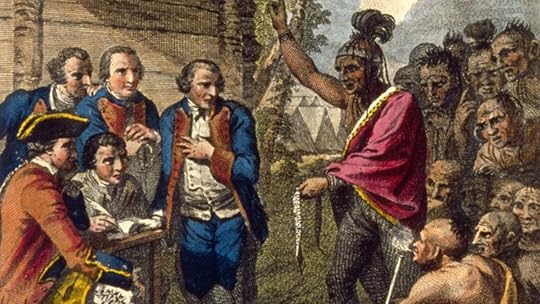
To the early American pilgrims, the red-skinned inhabitants of the New World were an Enemy Outside. They were the evil “Them” lurking in the woods, ready to snatch your children, and as the U.S. grew and set up a government, this fear became policy. Wars raged between U.S. soldiers and Native American warriors for centuries until 1877, which is considered the year the white man finally broke the red man.
Native Americans weren’t the only Enemy Outside during the early years of this country. Catholics were viewed with just as much fear and disdain as Indians, and the state of Maryland, which was originally set up as a Catholic state, suffered a violent revolution in the late 17th century. (Yes, a revolution. In this country!) Protestants formed an army and seized the Maryland State House, deposed the Catholic governor and leaders, and banned Catholicism. So much for freedom of religion. (To be fair, this took place almost a century before our Founding Fathers wisely decided to make it a rule not to establish any religion or deny the worship of any religion.)
Enemies Outside have since appeared in many guises throughout our history, whether in the form of Irish, Italian, Swedish, German, or Jewish immigrants. (Okay, just about every European immigrant has been vilified at some point in our history.) During World War II, we even built concentration camps for Japanese-Americans. (Yes, concentration camps. In this country!) It’s safe to say that today’s Enemy Outside is Muslim and Arabic.
According to Walker, “The Enemy Outside isn’t defined by any particular origin; he’s defined by the fact that you think he’s out there trying to come in. The details vary at different times and places, but several characteristics recur. There is the image of the world outside your gates as an unfriendly wilderness where evil forces dwell. There is the proclivity to see these forces as a centralized conspiracy guided by a puppet master or a small cabal. There is fear of the border zone where cultures mix, the suspicion that aliens at home are agents of a foreign power, and the fear that your community might be remade in the enemy’s image. And there is the tendency to see this conflict in terms of a grand, apocalyptic struggle---if not literally against Satan, then against something deeply evil. (p. 35)”
****
“There’s only one thing I need to know /Whose side are you on?/ Whose side are you on? /Well, there’s only one thing I need to know /Whose side, whose side, whose side?” ---Paul Simon, “Paranoia Blues”
Sometimes, the enemies of our conspiracy fears don’t come from outside. Sometimes the enemies are internal. Sometimes they are right next door. Sometimes they are sleeping next to us.
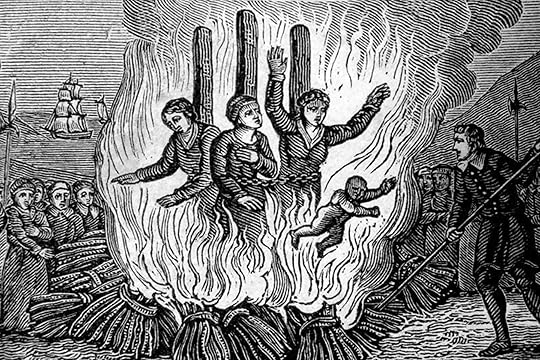
The Salem Witch Trials were a perfect example of the Enemy Within Conspiracy. Neighbors accused neighbors, spouses accused spouses, parents accused children, children accused parents. The brilliance was that none of the accusations could be substantiated or proved. These were, after all, witches. They could work magic and sorcery to eliminate evidence. They could even alter people’s memories. Best just to kill them. Worry about it later. Which is, essentially, what happened.
Strangely enough (but not really), many of our nation’s Enemy Within Conspiracies have to do with religion. Mormons, for example, were treated so badly and ostracized so much, that the group as a whole was sent packing out west, to Utah. Ironic, too, that many of Mormonism’s own dogmatic principles are founded on paranoid conspiracy theories. Apparently, they really were out to get the Mormons.
While certainly not as violent, the McCarthy-era anti-Communist fervor that swept the country was eerily similar to the Salem Witch Trials, if only in spirit. No one was burned at the stake (to Joseph McCarthy’s chagrin, I’m sure), but thousands of people lost jobs, families, and reputations. Sometimes for simply having attended a pro-Communist rally ten years before.
The Enemy Within has, of course, been with us for as long as the Enemy Outside has been with us. I’m sure early cavemen wondered about their neighbors and suspected their own cave-woman and cave-children of not being completely kosher.
Walker writes, “If the Enemy Within is the most dreamlike and fantastic of America’s primal conspiracy myths, it is also the most homely and prosaic. The suspicions that haunt our day-to-day lives usually feature our families, neighbors, and coworkers, even if we don’t believe they’re puppets of a Satanic cabal. Think back to New England’s earlier witchcraft cases, before the frenzy of 1692 broke out: petty feuds fueled by gossip and bad blood. A large-scale, Salem-style mania may seem bizarre to us, but the day-to-day misgivings that led Americans to cry witch shouldn’t seem so strange at all. (p.55)”
****
“Rumors flew about that black bands, numbering in the scores, even hundreds, were fanning out in all directions. Messengers galloped hither and yon to warn villages of approaching rebels. Invariably the rumors proved false---but no matter, an explanation was ready to hand. Black informers, it always turned out, had luckily alerted the white people to their impending doom, days or just hours beforehand, and the ringleaders were now safely in jail, the others having melted into the shadows. Yet everyone was warned to stay vigilant, no matter how normally the slaves were behaving in the quarters and fields.” ---Bertram Wyatt-Brown
It’s safe to say that slavery is a horrible thing. It is, however, not so safe to say that slavery in this country was particularly horrible. Some conservative historical revisionists would like us to believe that our nation’s brand of slavery wasn’t that terrible, that our slaves were treated much better than others, that our slaves were pretty happy and satisfied with their station in life.
Of course, that is bullshit. No amount of sugarcoating or whitewashing our history will wipe away the stain of slavery. Our nation’s treatment of black people was (and, arguably, still is) atrocious.
A large part of the reason is because black people, in the minds of many racists, are inferior people, subhuman, not really entitled to the same rights and respect as those above them, namely white people. The Civil War may have ended slavery, but the racism that spawned that evil institution never really went away. It existed in the Klu Klux Klan, the Jim Crow laws, the attempts at segregation. It exists today on our city streets and in our prisons, where a disproportionate number of black people are beaten, shot at, and imprisoned.
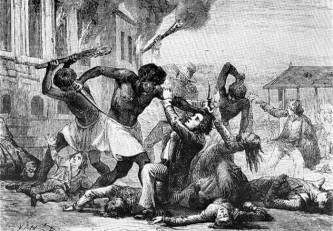
During the years of slavery, Enemy Below conspiracies constantly entertained the minds of white people. Always fearful of a violent slave uprising, whites were quick to dole out punishments and harsh treatment to their slaves for perceived attempts at gaining their freedom.
Of course, black people haven’t always been the only target of Enemy Below conspiracies in this country. The upper class has always had a fear of the lower class, white or black. It’s the “Haves” vs. the “Have-nots”, and it hasn’t changed. The wealthy classes in this country still like to think that poor people are fomenting “class warfare” and “hatred of the rich”. And yet, it’s the wealthy who continually lobby politicians to pass laws that hurt the poor and help the rich. So, who’s fomenting class warfare?
Granted, us poor people like to entertain our own conspiracy theories about the rich, which brings us to the fourth type of conspiracy, the Enemy Above.
We’ve all occasionally felt it: a nagging feeling that no matter what we do, the outcome will always be the same, that someone or something---call it what you like: Fate, God, Satan, Extraterrestrials, Ted Cruz---is pulling the strings, and we are all just puppets.
Walker calls this the Enemy Above conspiracy. There have been many manifestations of the Enemy Above throughout history, perhaps the most notorious and persistent one being the Illuminati, a secret society of powerful men (generally thought to be part of the Brotherhood of Masons) who are conspiring to take over the world and to create a vast slave workforce---namely us.
[image error]
Of course, it’s not just the Illuminati who want to control us. There’s multinational corporations, the Koch Bros., George Soros, Big Oil, NASA, Big Pharm, FEMA.
Basically, any large institution is a potential Enemy Above. The problem with these Enemy Above theories, according to Walker is that they “are the most disreputable sort of conspiracy narrative, since they challenge rather than reinforce the social order. In the media, the phrase “conspiracy theory” is often used as though it refers only to Enemy Above stories. You needn’t even invoke a conspiracy to earn the conspiracy-theorist tag, as long as you entertain suspicions about the people in charge. (p.131)”
****
“I’m kind of a paranoiac in reverse. I suspect people of plotting to make me happy.”---J.D. Salinger
Remember the Angel craze in the ‘90s? Angels were everywhere. Movie theaters were saturated with movies about angels: fallen angels (“Wings of Desire”), rogue angels (“The Prophecy”), drunk angels (“Michael”), and Nicholas Cage (“City of Angels”). Bookstores had entire shelves devoted to books about angels. Weekly, TV viewers had the pleasure of being “Touched by an Angel”.
Granted, there has been a craze for angels forever, not just the ‘90s. Perhaps it’s a need that people have, especially with all the negative conspiracies floating around out there. People need to know that someone is ultimately looking out for them.
Benevolent conspiracies are the fifth type of conspiracy theory. Like the Enemy Above conspiracies, the force acting upon us emanates from on high, but these forces don’t want to hurt us or enslave. On the contrary, these benevolent forces want to help us, individually and as a whole.
****
“The Cold War was supposed to end in a nuclear inferno that killed everyone. It wasn’t supposed to just have the air go out of it. And a deferred eschaton has unusual power. Culturally, we spent decades expecting that we were all going to die. The reprieve didn’t suddenly make everyone less pessimistic. It just turned that pessimism inward.”---Philip Sandifer
The second part of Walker’s book is a detailed look at modern-day conspiracies, our contemporary fears. Some of these conspiracies aren’t even theories. Take Watergate, for example: an event that brought to light the fact that even our President may have it in for us.
Paranoia reached an all-time high in the post-Watergate years, naturally. It had been building long before that, though, thanks to Cold War fears of nuclear proliferation and the Doomsday clock perpetually hovering around a minute to midnight.
Terrorism was also a fairly new fear. Plane hijackings, bombings, kidnappings: it almost made you want to hole up in your house and wait for the nuclear bombs to drop.
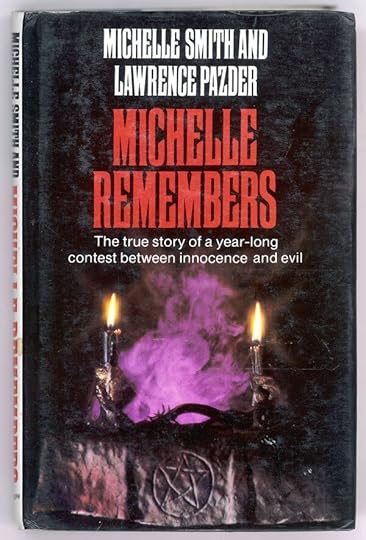
Then, sometime in the ‘80s, a new conspiracy began to brew: Satanism. Across the country, strange rituals were being performed, horrible acts were being committed, mostly by teenagers, although adults were clearly free to join. Everyone knew, too, that it was the drugs and that heavy metal music that caused it. It was the Satanic messages one heard when one played “Stairway to Heaven” backwards on the record player. Literally hundreds of thousands of teenagers were succumbing to Satan’s whims, and ritual animal and even baby sacrifice was at an all-time high.
Except it wasn’t.
The Satanic ritual hysteria was perpetuated by people with active imaginations and those who just wanted to fuck with people’s minds.
Of course, fucking with people’s minds is exactly what conspiracy theorists love to do. Never mind that there may be some truth to the conspiracy.
Conspiracy theorists love to convince us that a secret shadow government within the U.S. government choreographed and staged the 9/11 bombings of the World Trade Center. It’s clear to see on the videos on Youtube.
Oh, and conspiracy theorists also love to convince us that the Newtown Massacre didn’t really happen, that those poor kids and teachers didn’t really die. It was all staged by the media.
Maybe conspiracy theories are necessary for some people to process really horrible events. It’s a way of convincing one’s self that life can’t be that horrific.
Pareidolic apophenia is, according to Walker, the mental process of projecting patterns onto data and perceiving those patterns in meaningful ways. This is what occurs in the brain when people see images of Jesus Christ or the Virgin Mary in clouds, tree trunks, oatmeal, etc. It’s what enables some to hear satanic messages when one plays a Beatles album backwards. It’s what helps to create images in your brain when looking at Rorschach inkblot tests. It is, essentially, a necessary process that aids in the development of our selves, by engaging in the sensory overload that is life and finding the information we need to survive.
Walker seems to think that conspiracy theories are a coping mechanism for some people. He writes, “Human beings have a knack not just for finding patterns in chaos but for constructing stories to make sense of events, especially events that scare us... But when building a narrative you can fall into a trap, one where a combination of confirmation bias and serendipity blinds you to the ways your enticing story might fail to describe the world. (p. 337)”
I was slow to pick up this book for two reasons. One, the cover is butt-ugly. Two, Jesse Walker is associated with that wretched hive of villainy and scum, Reason magazine.
Walker should feel good about writing the book. It was interesting. Overly long, theoretically flabby, confusingly organized, poorly laid out, and ultimately serving a political agenda, but worth a look-see.
Walker begins where he has to: with Richard Hofstadter's "The Paranoid Style in American Politics." On the surface, Walker wants to argue with Hofstadter that paranoia is not a minor trend in American cultural history, but part of the mainstream. More subtly, he wants to pick a fight over who is the most paranoid.
One his first point, he does well. Paranoia--and conspiracy thinking--is rife in American history. Walker divides conspiracy thinking into five types: conspiracies by outsiders, by insiders, by those above, by those above, and, finally, benevolent conspiracies. This division is interesting but doesn't quite rise to the level of "primary myths," as he calls them. The division is schematic and doesn't really shed a whole lot of light on conspiracies generally. Indeed, Walker spends too much time classifying the various conspiracies as either belonging to one or the other class (even as he acknowledges that they do overlap in real life). Thus the Molly Maguires were a paranoid vision of conspiracy from below--the poor Irish--and not from outside--no one thought that the conspiracy was based in Ireland.
The fussing over the categories reveals a reificatory imagination: there are types of conspiracies. There are red scares and brown scares. There is left and right. There are the 70s, the 80s, the 90s. And there is something known as 'folklore,' which is supposed to be a unique form of discourse, but the idea is never really developed. walker missed an opportunity here, given the way that folklorists have recently struggled with the definition of their own field, and the subject that they study, to expand his ideas and make them something more than a taxonomy.
After the introductory matter, Walker devotes one chapter each to his different conspiracy types. He is careful to note that belief in conspiracies--paranoia--did not necessarily mean those conspiracies actually existed--just that the ideas were prominent and drove, at least partially, social life. In each chapter, he traces different examples of his types from the country's beginning to current times.
There are some nuggets here, and I suppose each person who comes to the book will find his or her own favorite. Me, I liked his (brief) discussion of how the definition of a criminal conspiracy was influenced by fears of slave uprisings. There are lots of stories here, and Walker clearly did a lot of research. Mostly, these are handled judiciously.
The problem, such as it is: there is too much stuff. Walker piles example upon example upon example until we acquiesce to his main thesis: paranoia about conspiracies is a central feature of American society. Sometimes, too, he can overreach, so that every thing starts to look like a conspiracy--when he takes up the McMartin Preschool Case of the 1980s, his definition of conspiracy starts to become indistinguishable from any sort of moral panic.
His prose, too, is uneven, varying from scholarly, or almost scholarly, to jaunty and bloggish.
Having covered his five types, he then moves on to a second part of the book--and it is not entirely clear why this second part needs to exist at all, or be so large. He says these are modern examples, but his earlier chapters already brought the book up to date, or nearly so. It's confusing, and seemingly done just so Walker could expand on a few favorite stories. But I don't want to be churlish: the two best chapters are here, numbers 8 and 9, the first on a character named John Todd and the second on Operation Mindfuck. Another chapter is devoted to the conspiracy theories motivating the various Rambo stories, and another is on Watergate, which Walker seems to want to pose as some kind of watershed moment (pun unfortunate)--although he offers no good reason why. He implies that the mainstream media started taking 'conspiracies from above' seriously afterwards, at least for a short time, but that doesn't seem especially significant. The weight of his book would suggest otherwise: there have been plenty of conspiracies, real and imagined, so that Americans should be used to the genre by now. Perhaps it is because it is so close to our own time that it seems central.
Walker builds on the work--only lightly acknowledged--of political scientist Michael Barkun here in arguing that recent conspiracy theories have become a mixed bag--no longer from distinct traditions, but a melange, left and right, black and white borrowing from each other. Surprisingly, he does not cite Michael Saler, who has also noticed the turn toward the ironic imagination, nor Susan Faludi, who, before him, noted the way Indian Capture stories structured a lot of America's response to 9-11. [I was wrong: he does cite both Saler and Faludi.]
This section is not so satisfying. First, one wonders if the reason these recent conspiracy theories seem heterogenous is because he was so tidy early in the book classifying them into distinct taxa. Robert Anton Wilson is great, and I love the way his Operation Mindfuck is described, using the abundance of conspiracy theories against the conspiracists themselves. But the blending of these kind of ideas predate him by quite a wide margin--the occultists of the late nineteenth and early twentieth century were happy to blend various conspiracies, too.
Second, I am not sure what the point is here, why this section is distinct.
Third, his political thesis, mostly subrosa to this point, comes to the fore and messes with the evidence. Walker disagrees with Hofstadter that conspiracy theories are mostly a phenomenon of the right: he wants to show that leftists are just as prone. And maybe that's the case, but--to start numbering again--the thesis fails on two points.
First, to get the balance he wants, Walker has to ignore some of the most recent conspiracy-mongering. He's only a few years older than me, and should have remembered it easily.
Walker says that the 1990s were another great time for conspiracy theories, comparable tot he 1970s, except that they came in the back door. Um, no. They came through the Wall Street Journal! The massive and unending amounts of conspiracy theories about the Clintons get only a short mention--short especially compared to an entire chapter on Rambo. Similarly, the conspiracy thinking that motivated the Bush administration to invent an "Axis of Evil" is dispatched in a footnote. Instead, the 1990s are marked (only) by paranoid (and incorrect) fears about right-wing militia--which were really a fairly ecumenical response to the government's overreach, Walker argues.
Showing that we are all conspiracists hints at the importance of libertarianism--Walker's chosen creed--although he never spells it out exactly. Still, he repeatedly makes the point that conspiracists, left and right, hate the government: a secret longing, then, for a more libertarian approach.
The second problem with Walker's thesis is that his cultural analysis is unwedded to a consideration of political power. So, he wants to make McCarthy's Red Scare equivalent to the Brown Scare (fear of Fascists). But one was conducted by the state, the other not so much (somewhat--but not nearly so much). Or, he compares Mildred Edie Brady's articles about Willhelm Reich--which accused of him being at the center of a cult--with her being fired from her government job for supposedly being associated with communists. On the one hand, two articles, from the New Republic and Harpers, on the other, actual firing. These things are not equivalent.
Again, I am not trying to say there are not conspiracy theories on the left. But we cannot compare them to those on the right from the evidence in this book.
Finally, the pictures are often just black blobs which seem to have been dropped into the text. Sometimes they are related, sometimes they are not. There are no captions, and they are not set off, giving the book an amateurish feel.
I’ve never met Jesse Walker; I did not receive a free review copy of this book from the author, from Harper-Collins, from the Tri-Lateral Commission, or from anyone. I became aware of Walker in his station as plenipotentiary at REASON, the ardently libertarian publication (and foundation) espousing “Free Minds and Free Markets.” Even those, and there are many, who disagree with Reason’s philosophical principles call it one of the most intelligent and best-researched political magazines available today. Walker numbers among Reason’s ablest investigators and most articulate writers. His preeminent expertise in a mélange of obscure topics, including the birth, growth, and maturation of underground or “pirate” radio, is widely acknowledged. Walker’s recent work, The United States of Paranoia: A Conspiracy Theory, examines the intricate history of American conspiracies and conspiracy theorists. While many academics ignore these forces, Walker explores ways in which they have helped shape our society. Despite the scattering of complaints and sour notes posted online, most readers (87% of goodreads) find The United States of Paranoia a creditable and witty rumination on a compelling and provocative theme. A few myopic reactionaries and paternalistic statists would dismiss all Reason editors and columnists (and even readers) as reckless, Transhumanist pro-gay anarchists, or libertine, leather-jacket-wearing, pot-puffing decadents, or atheist, capitalist radicals hell-bent on hedonistic dissipation. I’d call such ad hominem overgeneralizations & half-truths patently unfair. At its core, Reason defends personal liberty, autonomy, and tolerance for those who profess unpopular opinions and/or live idiosyncratic lives. Even if one disagrees with Reason, posting a venomous review of The United States of Paranoia (and/or disregarding its valid insights solely because of the author’s perceived politics) illuminates little beyond one’s own reflexive bias. As did 14 other Amazon reviewers, I rated The United States of Paranoia 5 stars. Without requiring, coercing, or insisting, I will encourage my students to obtain a copy of this text when next I teach a seminar on contemporary North American culture.
Excellent. A history of United States as told through its tales of fear and paranoia. Often unnerving, occasionally hilarious, always fascinating, Walker takes us on a sweeping ride through the history - from the Indian wars to the Birther movement. One main takeaway from the book is that conspiratorial ideation is much more prevalent then we might think and Walker does a great job of explaining and categorizing various forms of paranoid thinking. He makes a forceful case for recognizing that paranoid style of thinking is not limited to the fringes and does not belong solely to one part of the political spectrum, but can be found almost anywhere, from a militia bunker in the woods, to the halls of government and media.
Examining the American obsession with conspiracy theories
Jesse Walker holds a curious mirror up to us in this complex and fascinating book about conspiracy theories that daily make the headlines in the media and indicate a sustainable past history of how Americans fear secret cabals. It is an interesting and entertaining investigation of the core of paranoid thinking that has its beginnings centuries ago and persists to the present.
As Walker dissects our history he explains how we Americans have heard so many stories describing Nazis, communists and homosexuals nefariously and secretly trying to take over our government, our minds and our bodies to the extent that we began to see them everywhere. ‘In an earlier era, we feared murderous slaves and libidinous Native American kidnappers. And more recently: UFOs and satanic nursery schools. This is a book about America's demons. Many of those demons are imaginary, but all of them have truths to tell us. A conspiracy story that catches on becomes a form of folklore. It says something true about the anxieties and experiences of the people who believe and repeat it …’
‘Americans fear mobs: They are the dark force lurking inside "Enemy Below" conspiracy theories, a "primal myths". Over time, blacks, immigrant laborers and Jewish radicals have all been the protagonists in imagined "Enemy Below" conspiracy theories. A mythical group of black intellectuals called "The Organization" was said to be behind the 1965 Watts riots.’
Walker is willing to attack the sacred cows of the right and left with equal amounts of intelligence and flair. He is a tireless and thorough researcher. He takes on subjects as disparate as the hysteria that followed Orson Welles’ radio broadcast ‘The War of the Worlds’, the controversy of the Kennedy assassination, the findings when Osama Ben Laden was captured, etc. He also states an obvious fact many skeptics are unwilling to accept: Behind just about every conspiracy theory there is also, more often than not, a grain of truth. As a writer Walker is erudite yet immensely readable. He quotes such phrases as ‘semiotically aroused’: ‘To be "semiotically aroused" is to fall under the influence of signs and symbols. A few weeks after the 9/11 attacks, the constant broadcast of images of Islamic extremists caused such a spell to overcome several otherwise rational people in Tyler, Texas. An object made with wires and duct tape was found in a mailbox. Believing it was a weapon of mass destruction, the authorities called in the bomb squad. An entire neighborhood was evacuated. The object turned out to be an 8-year-old boy's homemade flashlight, built for his science class.’
This book proves to be both provocative and entertaining, and the manner in which the reader absorbs it depends on the intellectual and emotional construct of each reader. It is a fascinating new work.
Here we have a book that appears to be about conspiracies, cabals, mysterious omens, prestidigitation and the uniquely American tendency to attach evil, exotic and/or nefarious meanings to every event. I say seems to discuss this, because upon finishing this book a reader may have one of two reactions, depending on one's political, religious, spiritual or existential bent. One, the book is a historical treatise on the aforementioned sinister forces that weave their way through American life, and have since pre-colonial days--The Salem Witch Trials, secret societies and early paranoid groups. Two, that the state of American education, then and now, is sadly lacking in its ability to simply teach people to think for themselves. Mr. Walker, to his credit, avoids critique of the various conspiracy theories. He cites them as arriving either from above, below, within or without, but backs away from open criticism of the ongoing motivations of their adherents. His pursuit is almost journalistic in its reporting on and unpacking the various conspiracies and their originators. For anyone interested in the genesis and plausible reason for longevity of everything from the aforementioned Witch Trials, to the never-ending Kennedy Assassination theories, this book is for you. From Macarthyism, to 9/11 and subsequent anthrax scares, Ruby Ridge, Waco and on and on, Americans seem to demand some alternate explanation for what happens to us, a perplexing obsession with hidden meanings and opaque 'truth.' And those diversions into mystery often take us places where truth, for the seeker, becomes exactly the opposite of what was first reported, thus conjuring a new, more attractive plot. The book's only shortcoming may be that the author failed to include the one truly plausible reason many of those conspiracy buffs and purveyors promoted their crackpot theories, and that is the other oh so American habit of commodifying everything for monetary gain. If one is so inclined, there may well be evil lurking in the $$$ sign as well, but if a theory fills one's pockets, then it's worth promoting. Nonetheless, The U.S. of Paranoia is a satisfying study of why people choose to believe the sinister over the apparent, and why paranoia seems to be a national sport. Byron Edgington, author of The Sky Behind Me, a Memoir of Flying and Life
Overall, this is a very good book. Its strength lies in its demonstration that the conspiracy theory is not a modern paranoia, but a constant throughout American history (and, presumably, human history, though that is beyond the scope of the book), and further demonstrates that those paranoias are just as often held by elites and not just common folks. It is an excellent catalog of paranoias throughout American history, but too often it just mentions insights about these paranoias in passing and doesn't take the time to fully develop the implications. Sometimes, the cataloging can get a bit wearying.
The book is at its strongest when dealing with historical eras. It has some significant failings when it gets closer to the present day. The Watergate chapter is especially superficial. With more recent decades, Walker, an editor for the libertarian Reason magazine, is so dedicated to his thesis that modern conspiracy movements are a synthesis of all parts of the political spectrum and so eager to absolve the right-wing for its reputation for extremism that he glosses over the excesses of the militia movement. He buys into their own propaganda about being merely against government thuggery and gives them pretty much a pass on race, despite amply documentation regarding their racism. Nowhere to be found is a mention of the Turner Diaries. He also gives right-wing politicians a pass. In sections about earlier decades, he highlights the elites who peddle conspiracies, but in the 90s he thunders against Democrats blaming the GOP for extremism, taking the mendacious Dick Morris at face value that Clinton was engaged in deliberate McCarthyism, and totally ignoring GOP politicians like Steve Stockman and Helen Chenoweth-Hage who peddled their own conspiracies about Waco and black helicopters. And not a single word about anti-gun control conspiracy theories that have dominated right-wing discourse in the last few decades.
The strongest sections: The section on Native Americans stood out for me, but that might be perhaps the idea of connecting it to conspiracy paranoia was fresh to me. Walker also excels describing the hucksterism of John Todd, who peddled conspiracies about Satanism and the Illuminati to gullible Christians in the 80s, and the conspiracy satirists like Paul Krassner and Robert Anton Wilson, whom Walker clearly appears to identify with, or at least admire.
"The United States of Paranoia is based on historical sources, not interviews, and Walker is far less interested in the inner lives of the conspiracy theorists he profiles than in showing how their seemingly disconnected fantasies fuse together into one grand American paranoid pastiche.
Describing this pastiche is an ambitious intellectual project. But at times, Walker’s approach seems overly reductionist. As the author describes it, “paranoia” is a broad label that can be applied to just about any activist group, Internet discussion forum, lone nutbar, cleric, politician, or agency that exhibits any sort of unfounded fear. Toward the end of the book, as his libertarian stripes become more apparent, Walker exploits this broadly constructed definition of paranoia to draw dubious comparison between dangerous, hard-boiled conspiracy theorists and the government agents seeking to monitor them."
Compulsively readable, thoroughly documented history of the universal motivations for the most far out conspiracy theories. The mainstream is not rational and the fringe is not so extreme after all. There's a little conspiracy theorist in all of us.
Review title: "They're coming to get you, Barbara."
That classic line delivered in a desolate hilltop Western Pennsylvania cemetery leads into one of the most important movies of the 20th century. The sudden twist from cruel joke to the twisted reality of flesh-eating zombies signals a dystopian world where paranoia is not just normal, it is necessary for survival. In today's world, President Trump's "alternative facts" and the Internet's fake news have brought the paranoia indoors before we even knew we needed to board the windows.
Walker's surprisingly timely, strong, serious, and at the same time highly readable history documents the types and causes of conspiracy theories that throughout American history have driven its people (and governments) to paranoia. I had this book on my reading wish list for a couple of years before buying it in November 2016 during one of my forays deep into the stacks at Powell's in Portland, and certainly before I had any notion that Donald Trump would win the election or use the terminology he has made a part of the daily vocabulary. Neither this review nor the book it is based on is intended to imply that Donald Trump is either the source or the benefactor of any given conspiracy theory, but given the atmosphere of distrust to the point of paranoia of anything we see or read in the media today this book is very well worth reading and taking seriously for what it can tell us about conspiracy theories and how Americans react to them.
Walker's book is not just a list of conspiracy theories, although he hits the major ones--JFK's assassination, 9/11, the Illuminati--along the way to defining five categories of conspiracy theory into which all of the known variants can be shelved (some crossing multiple boundaries, of course) :
The Enemy Outside--enemies from across the border or across the sea who have it in for "us". The Enemy Within--"villainous neighbors who can't easily be distinguished from friends." The Enemy Below--fellow citizens who are distinctly "other" from "us" because of their race or beliefs or social outcast status. The Enemy Above--conspirators at the top of the social and governmental pyramid. The Benevolent Conspiracy--"a secret force working behind the scenes to improve people's lives".
Walker makes it clear he is focusing on American history not because Americans as a group or a nation are more susceptible to conspiracy, but so he could keep his topic within the bounds of his expertise and his book within a manageable size for readers. He also makes clear that he is not identifying conspiracy theorists with any political party or persuasion, and in fact he covers examples that fall within his categories from every political angle imaginable.
After the first part of the book where he lays out the definitions of the five categories, in the second part he moves on to discussions of some well known conspiracies to show how they fit the categories. And particularly when he talks about the citizens militia movements of the 1990s, he talks about some very surprising bedfellows as far Left and far Right, white supremacist and black separatist, groups and theories sometimes shared training materials, ideas, even venues and events. And in the fertile period of the 1960s through the 1980s he describes how ironic skeptics created mocking satire of conspiracies that were adopted or attacked by true believers as true conspiracies, feeding into a growing melange of paranoia where it became nearly impossible to separate fact from insanity. Then when undercover US government agents from the FBI, BATF, CIA and "other agencies" got involved spreading misinformation or entrapment attempts based on techniques honed to ferret out "Reds" in the 1920s, German spies in the 1930s, Communists in the 1950s, and Klansmen in the 1960s, the web of lies, deception, and conspiracy got so thick that paranoia seemed the only sane approach. And Walker describes a couple of those who approached the field as skeptics hoping to mine the topic for irony but got in so deep they actually started believed their own jokes.
One very timely point that Walker makes clear through explicit statement and through the examples he uses is that conspiracy theories are not the exclusive property of those on the fringes of society because of their race or religion or supposed lack of intelligence. He gives many examples of beliefs expressed from the highest and most respected members of the US government and "mainstream" media that fit one or more of his conspiratorial categories even though these respected voices never labeled or expected their beliefs to be labeled as such. This kind of demonizing of people by class or characteristic or creed by government and thought leaders (backed by very real police and military force) without credence or evidence has fed directly into the backlash against these leaders to the extent that we have to put quotes around the term mainstream when it is used to describe the media, and that we have a president whose false statements he labels as "alternative truths" but are accepted as truth by a segment of the population because of their justified distrust of some of the voices they hear and read.
And the key qualifier in that last sentence is "some of". How do we know when what we read or hear is truth? It is easy to be critical of "mainstream" sources these days, but when that term meant news and information vetted and edited for accuracy and context, weren't we in a better position to accept it as "real" truth, not the alternative kind--i.e. lies? It's the difference between the Encyclopedia Brittanica and Wikipedia. We certainly expect and accept that the edited Encyclopedia is more authoritative, but we just as certainly behave as if Wikipedia is "good enough" because it is often the first source we go to for information. And it is just a short slippery slide from "good enough" to the games our minds play trying to find patterns in the data that don't really exist there, a common pattern Walker identifies in conspiracy theories, like second shooters on the grassy knoll or images of Satan on the World Trade Center towers on 9/11. It is in those false patterns where the conspiracy theories live. After all, even if zombies were real, they wouldn't really be coming to get you, would they, Barbara?
I feel like I’m primed to enjoy this book, but I found it pretty disappointing and confused.
The material is mostly interesting enough, but the author fumbles it by imposing a typology that doesn’t actually clarify anything, or even draw interesting connections. So we get a worse-than-rote recital of conspiracy theories over the years, bouncing from topic to topic. It doesn’t even sprawl appealingly like a conspiracy theory might!
Back-half of the book is worse, with an extended detour on the four Rambo films(?) that stretches any idea of what would constitute a conspiracy or paranoia. And then he starts with militia apologism and other acts of libertarianism, like pretending “states rights” people are genuinely concerned with federalism. Not great, folks!
2.5 stars rounded down. The main detriment to this book was its sheer number of examples of different American conspiracy theories. Each chapter just felt like example after example, with little analysis to contribute to the greater points. Since so many of these theories are similar in nature (not the author’s fault), I also had trouble keeping everything straight as far as the separate histories of how these ideas came to be.
This might be a good book for someone that knows absolutely nothing about conspiracy theories, but even then I feel this might be a bit overwhelming.
Today’s Nonfiction post is on The United States of Paranoia: A Conspiracy Theory by Jesse Walker. It is 418 pages long including 75 pages of intense notes. The publisher is HarperCollins Publishing. The cover has words like White Water, Ku Klux Klan, Flying Saucers, and more on it; black text on white background with the title in a blue box, the subtitle in a yellow box and the author’s name in an orange box. The intended reader is someone who likes conspiracy theories and is an adult. There is no sex but some descriptions of violence and foul language used. The author does not use the language but it is in quotes. There Be Spoilers Ahead.
From the back of the book- The books editor of Reason magazine explores the origins, evolution, legacy, and effect of paranoia in American politics, and culture, from the colonial era to today. The United States of Paranoia is a history of America’s demons. Conspiracy theories, Jesse Walker explains, aren’t just a feature in the fringe: they’ve been a potent force across the political spectrum- the center as well as the extremes- from the colonial era to the present. Walker argues that conspiracy stories need to be read not just as claims either to be believed or debunked but also as folklore. When a tale takes hold, as something true about the anxieties and experiences of the people who believe and repeat it is revealed, even if the story says nothing true about the objects of the theory itself. With intensive research and a deadpan sense of humor, The United States of Paranoia combines the rigor of real history with the punch of pulp fiction. The first half of the book lays out five conspiracy narratives that recur in American politics and popular culture, zeroing in on particular examples from the seventeenth, eighteenth, and nineteenth centuries: the Enemy Outside, the Enemy Within, the Enemy Below, the Enemy Above, and the Benevolent Conspiracy. The second half of the book looks at how those primal stories have played out in different contexts in the last half century, from Watergate to Waco to the War on Terror.
Review- I was so excited to get and read this book. I am a conspiracy theorist. I find conspiracy theories to be a lot of fun and interesting. I loved this book. It is well written, clever, and the notes in the back are just great. When I was reading this book I had two bookmarks in it. One bookmark for where I was in the book and the other one for where I was in the notes. The notes are very detailed and sometimes you need to read the notes to get the full picture. The writing is strong and very readable. The only thing that I will warn you about is this- I could not read this with anything else going on. I had to be in a quiet place because this is so intense. The writing is so detailed that I could not read it with distractions. So if you are looking for a casual read; I do not think that this is for you. But if you willing to concentrate then this book is very rewarding. But I love conspiracy theories.
I give this book a Five out of Five stars. I get nothing for my review and I was given this book from HarperCollins in exchange for my review.
Full disclosure: I read and commented on a portion of this book while it was a work in progress, and I'm kindly credited in the acknowledgements.
I'll be using this as a required text in my "Witch Hunts, Conspiracy Theories, and U.S. Society" university course.
In a tale that stretches from the 17th century to the present, Jesse Walker proposes that five major conspiracy narratives recur not just on the fringes but also in the mainstream of U.S. politics and popular culture. They are the following:
1. The Enemy Outside, "who plots outside the community's gates";
2. The Enemy Within, "comprising villainous neighbors who can't easily be distinguished from friends";
3. The Enemy Above, "hiding at the top of the social pyramid";
4. The Enemy Below, "lurking at the bottom"; and
5. The Benevolent Conspiracy, "which isn't an enemy at all: a secret force working behind the scenes to improve people's lives."
Walker's careful research, ironic humor, and easygoing journalistic style make this a fascinating, entertaining, and at times mind-blowing read. I greatly appreciate his thorough notes, which also make this work a terrific springboard for further reading.
The United States of Paranoia is basically a history of conspiracy theories and the American identity, and it is fascinating. Walker lays out five different kinds of conspiracy theories-- from below, from above, from outside, from inside, and the benevolent kind-- and argues that these theories have always been a part of American society, from the Salem witch trials and the Native Americans lurking in the underbrush to the Red Scares and the conspiracy theories surrounding 9/11.
Walker, notably, does not make any arguments for the truth or otherwise of these theories, only lays them out and describes what they say about the society and the people from whence they sprang. This book is a lot of fun and a really interesting read, particularly in light of today's society. Definitely recommended for everyone
this is a great book. it isn't necessarily about particular theories but about how they wind their way into our collective imagination. the author divides them into the categories of the enemy outside, the enemy inside, the enemy above, the enemy below and the benevolent conspiracy. the author gives examples of how some of our past paranoias fit into these categories.
but, above all, the best part of this book is how the author follows the evolution of some of our current fears and shows us how things we fear as imminent threat may have been feared by folk in the 1700s or 1800s as imminent, just in a slightly different set of clothes. it reminds the reader that, in all honesty, there is nothing to fear but fear itself.
Intelligent and noble effort notable for its intellectual honesty which is usually dreadfully absent for a book covering this type of material - usually realized in something like the pro-censorship, anti-intellectual "Among the Truthers" by Jonathon Kay for example. I feel the book pulls some punches and is a little blind to current happenings, but in this case that isn't a detriment. What Walker delivers is well worth reading and it should definitely appeal to mainstream audiences. I can't wait for the day when chapter 7, "Water's Gate" is included in mainstream US history books. It's a book which will take a lot of its readers toward greater literacy and better logic.
A decent book with some unique insights which explores the history of conspiracies in America in order to put forward the argument that 'the paranoid style' is not a recent invention nor limited to the general population - but which, written as it was in 2013, can appear outdated in parts.
I read a Guardian article a few months ago called 'My months with chemtrails conspiracy theorists', with the subheading 'They prove conspiracies have gone mainstream – and aren’t just for the right wing'. I found this interesting - in the age of Trump (the conspiracy theory president himself), it seemed that virtually every crank belief out there seemed to follow a Right wing line, or otherwise benefited the Right.
Reading the article incensed this belief even further. Despite the text implying that conspiracies 'aren't just for the right wing', one of the believers in chemtrails - Tammi, a Canadian immigrant to the US who had previously been described as 'not an idiot' and 'hippie-dippy' - mentioned that though she thought Trump was a 'prick', she probably would have voted for him over the chemtrails issue.
This completely boggled me. The main thrust of the piece was that 'conspiracies have broken into the mainstream, and aren't just for the right wing anymore'. The author's evidence for this is that what might be an ordinarily left-leaning couple believing in chemtrails, despite the fact that this belief has pushed them into supporting a right wing demagogue. It's /technically/ right if you take the stance that conspiracy theories have always been fringe, but how can you say this while not also noting that these conspiracy theories have gone on to push someone to support the right, against (as they admit later) their best interests?
Since reading about that meeting, i've set myself the task of working out why conspiracy theories seem to benefit the Right wing far more than the Left - or whether my belief that they are more endemic on the Right is true, and why that might be. My working assumption until now has been that Right wingers tend to reject materialism; a mainstay of Marxian thought, leftists from those traditions tend to give more weight to structural and institutional issues. The rejection of material explanations for actions by the right leads them to rely more heavily on bad apples, secret cabals, and sinister plots to explain the bad things which are happening. This also coincides with my other belief that conservatives tend to avoid analysis, as I described in my Black Sun review.
Walker's 'United States of Paranoia' seemed promising, and I hoped i'd get some useful insight. The entire thesis of the book rejects the premise of the Guardian article that conspiracy theories in America are a recent invention unique to a fringe minority - i'd even argue that considering the prevalence of what I like to call 'everyday conspiracies' in the UK (widespread belief in ghosts, guardian angels, that Princess Diana was murdered, etc), there are lessons to be learned here for multiple countries. I think I got something of a mixed bag - sections which are extremely enlightening, sections which are honestly quite boring, and sections which are interesting but not anything to write home about.
The book is divided into two parts. The first part differentiates the general forms of conspiracy theory, with examples - 'enemy outside' (slaves and Native Americans), 'enemy within' (pod people and witches), 'enemy below' ('the masses', especially communists), and 'enemy above' (bilderbergs, trilateral commissions, etc etc ad nauseam); it also mentions 'benevolent conspiracies' (such as angels). These designations are, I guess, useful when describing the different forms of conspiracy, but they're... I dunno, extremely structuralist? Most of the conspiracies mentioned in the book blend multiple 'forms' - conspiracies about the UN and world government, for example, can be perceived as a threat to US sovereignty which is imposed from above by a complicit ruling class or elite, hence they are both 'enemy outside' and 'enemy above'; Walker does mention this, but generally puts a lot of faith in this four-way-plus-one model. I found this section vaguely useful, and the examples interesting (especially to someone with little knowledge of American history), but not groundbreaking by any stretch.
The second part of the book looks at different ways that conspiracies have affected the country as a whole - be it talking about individuals such as John Todd and how they captured the imagination of a lot of people eager to listen, or listing popular media which fall into one of the four archetypes mentioned previously, or discussing about the Discordians and the Church of the SubGenius, or describing Alternative Reality Games (ARGs). What I didn't really find was much analysis about why these are popular, or why they've caught on - at best, it seems to just be handwaved as 'part of the paranoid style'. For me, this part of the book dragged on since i'm honestly not that interested in how motifs from conspiracy theories come about. The epilogue is particularly disappointing, since it just points out that people like to assign agency to inanimate things, and like to see patterns which aren't there, and That's How Conspiracies Happen. Frankly, too much was written about this for it to be a mere throwaway (it's clear that this is Walker's sincere belief about how conspiracy theories get popular), but not enough was written to make it a worthwhile addition - there are plenty of instances of people finding patterns in something (especially amongst schizophrenics, who are particularly predisposed to it) without it developing into a full conspiracy theory: the example of ARGs, as well as people making 'fake' ARGs using random number generators as pranks, does demonstrate that people can find patterns without something becoming a sincere belief with tangible effects. There has to be an underlying motive for why these observed patterns become popular - as well as why the observed patterns tend to fit into a Right wing mindset, or otherwise benefit the Right. The entire second part of the book is peppered with both a tone and straight up statements which essentially say 'Look, conspiracies are neither unique to the right nor a recent phenomenon, therefore any 'Brown scare' is ultimately just paranoia itself'. The rise of Trump and the populist Right globally - who utilise a whole raft of conspiracy theories relating to immigration, the 'deep state', and government accountability - makes this claim look severely outdated.
To his credit, Walker is still making a valid and original contribution to the field; the paranoid style as described by Hofstadter concentrates almost exclusively on 'enemy above' conspiracies, and in general comes across as quite elitist - where Hofstadter apparently believes that conspiracies are the purview of the ignorant masses, rather than something which is present at every level of US society. Walker does an excellent job of pointing out that the paranoid style is not limited to the general populace, but rather lists several examples of extremely powerful people buying into conspiracies; one such example listed on the blurb being Lyndon Johnson's belief that communists were behind the riots happening at the time, despite his own staff firmly ruling it out.
I was ready to give the book a three star review when, in the last few pages right near the end, we see some serious analysis happening regarding the Birthers - people who believe that Barack Obama's birth certificate was faked and that he was actually born in Kenya, hence invalidating his presidency - and their motives. These few pages, for me, managed to add a tremendous amount to my working theory of conspiracies.
Unlike other books on conspiracies which i've read so far, which have grazed against reasoning motives but do not directly address it as such, Walker gives three reasons for Birthers believing as they do against the available evidence: first, 'Wishing for a magic bullet' - they wanted to end Obama's career. This isn't particularly interesting on it's own - it seems pretty uncontroversial to claim that people believe what they find convenient to believe, which is why so many rich people are conservative, and are especially oversubscribed to 'The Free Market' and laissez-faire economics more generally. Secondly, 'Fear of foreign influence' - again, it's something, but it seems academically lazy to just tar people as racists (even if they are), and that's why they believe in conspiracies. You could of course make the argument that racism itself is a conspiracy, but i'm sure there must be at least one Birther who isn't a racist.
The third point draws the previous two in, and creates something far more powerful - 'Excessive reverence'. Walker, while drawing on books like 'The Cult of the Presidency', notes that the people involved in Birtherism place excessive worth in the office of the President itself; that Obama is often treated as a 'usurper' (a direct quote from a Birther!), and that he is essentially besmirching the office of President itself.
This insight lead me to a sudden realisation. In Erik Olin Wright's book 'Envisioning Real Utopias', Wright describes social and state power - and how the left tends to value social power more, and conservatives tend to value state power more. I personally believe it's more useful to describe state power as 'institutional power' - conservatives are motivated by a defence of hierarchy (I like to describe conservatism as 'upside-down Marxism' - they tend to have class consciousness, but they want to keep the ruling class empowered!), and this hierarchy can be enforced through many extra-state institutions, the most obvious being the Church (for any given religion); conservatives will attempt to prove the legitimacy of their views through reference to Church doctrine, which in turn will usually claim legitimacy through tradition.
If we take Walker's insight into this, we almost immediately get a clear explanation for a huge number of Right wing conspiracies; not just 'against things we don't like', but the very defence of hierarchy-preserving institutions, which goes right to the core of conservatism, and explains not only why conspiracies are more popular on the Right, but also the motivation behind conspiracies on the Left. In the mind of a conservative conspiracy theorist:
* The presidency is Good, but what Obama's doing with it it's Bad - to square the circle, we simply say that Obama isn't a 'real' president, because he's not a US citizen. We can hence protect the sanctity of the presidency, avoiding any real change or reform to it, and allowing a conservative to take the mantle down the road, with all those powers (which were 'excessive' under Obama) intact.
* Guns (in the hands of white people, anyway - conservatives tend to go silent or on the offensive when it's black people defending themselves from police brutality) are Good, but the Sandy Hook shootings were Bad - instead of implementing gun control laws, or coming to terms with the effects of US gun law at the moment, we can simply note that the mass school shootings are actually just orchestrated by the government; no need to change anything!
* Trump is Good, but his inability to pass many of the (ridiculous and unethical) things he promised is Bad - but since Trump is Good, he can't be incompetent or ineffective. Rather, he is being hindered by a 'Deep State', and any apparent incompetency is actually intentional - in some extreme cases (such as believers in the Qanon superconspiracy), Trump's mishaps and typos are a secret code letting the privileged few into his sanctum.
The book doesn't say any of this explicitly - this is my own extrapolation - but from these few pages, I think this book has made an incredibly valuable contribution to understanding conspiracies, not only on the Right (as described above) but also for those on the Left. I would recommend this book to anyone interested in a book describing a history of the 'paranoid style' of US politics and how it's far more pervasive than has been initially thought (both at the top and bottom of society), as well as expanding the vocabulary we use to discuss conspiracy theories.
Paranoia in American culture is a topic worthy of a lengthy book. If one were writing such a book in the current political moment it would feel impossible to finish. You'd feel like you got to a good stopping point only to have the latest piece of paranoia pop up on the news. Unfortunately "The United States of Paranoia" isn't up to the task. Walker struggles with his early American history and reaches for little read and sometimes unpublished manuscripts in attempts to shows strains of American culture. What's worst is his insistence on labeling everything. There can't just be a indication of paranoia it must fall into one of his big 3 labeled and capitalized categories of above, below and within. Within those categories he further categorizes things whenever the opportunity presents itself like with red scares and brown scares. I'd love to see a more capable writer take on the subject.
It seems to me since the dawn of time people have made up stories or are willing to believe someone else's story to explain things they don't understand or have no knowledge of. Some of the theories sound plausible, some are manipulating and harmful, and some are just downright stupid but somehow there is always someone who will buy in. As far as special clubs that exclude others, well you don't have to be the Illuminati to know about those.
What makes us humans so unique is our ability to tell stories and the idea that people use those stories to convince others, both for good and for bad, won't change. There is a liar and a sucker born every minute and today they have a free digital platform to connect.
I would have preferred some information on why we fall for lies and our need for explanations of the unknowable or even social conditions that made a particular group susceptable to believing the lies. Instead this is more a litany of lies and manipulations that will just depress you. We are bombarded with untruths and misinformation and I have no answer for it and neither does this book.
Just because you are paranoid doesn't mean they aren't out to get you!
A MASTERFUL HISTORICAL ANALYSIS OF 100’s OF YEARS OF SUCH STORIES
Author Jesse Walker wrote in the first chapter of this 2013 book, “This is a book about America’s demons. Many of those demons are imaginary, but all of them have truths to tell us. A conspiracy story that catches on becomes a form of folklore. It says something true about the anxieties and experiences of the people who believe and repeat it, even if it says nothing true about the objects of the theory itself.” (Pg. 15) He continues, “I should make three things clear… to distinguish my project from some of the other conspiracy books out there. First: I’m not out to expose or debunk any particular conspiracy theories, It would be absurd to deny that conspiracies can be real… But this is ultimately a history of things people believe, not an assessment of whether those beliefs are accurate… Second: This book isn’t exhaustive. Every significant event in U.S. history has inspired at least one conspiracy theory… I will describe a lot of them, but it would be impossible to cover them all… I will generally ignore the political paranoia found in the rest of the world… Finally: When I say paranoia, I’m not making a psychiatric diagnosis… I’m using the word ‘paranoia’ colloquially. Not clinically.” (Pg. 17-18)
He explains, “Pundits tend to write off political paranoia as a feature of the fringe, a disorder that occasionally flares up until the sober center can put out the flames. They’re wrong. The fear of conspiracies has been a potent force across the political spectrum, from the colonial era to the present… Conspiracy theories played major roles in conflicts from the Indian wars… to the War on Terror… They are not simply a colorful historical byway. They are at the country’s core.” (Pg. 8-9)
He notes, “The historical Danites were a vigilante group created in 1838 to compel dissenting Mormons to exit the area and, subsequently, to protect Missouri Mormons from their neighbors’ attacks. It has never been proved that the organization lasted longer than a year, but it became a central part of anti-Mormon rhetoric for decades afterward, its reputation growing more fearsome over time.” (Pg. 63)
He says, “The actual Illuminati had been founded on May 1, 1776, by Adam Weishaupt, a professor … in Bavaria; he was motivated mostly by a desire to undermine the influence of the Jesuits… Weishaupt’s Illuminati were antiauthoritarian in theory and elaborately hierarchical in practice, with a baroque series of degrees and a careful system of secrecy… establishing a chain of command that outdid the most intricate image of the Jesuits’ secret machinations. Weishaupt’s group took hold within Freemasonry---a secret society inside a secret society… before the Bavarian authorities started cracking down… the group fell into disgrace. Soon Bavaria’s duke declared that anyone caught recruiting new members into the order would be put to death. That seemed to be the end of it. But rumors continued to circulate that the higher ranks of the Illuminati were still active…” (Pg. 117-118)
He notes, “In the twenty-first century, rank-and-file Republicans attack their enemies as the puppets of the billionaire George Soros while rank-and-file Democrats attack their enemies as the puppets of the billionaires Charles and David Koch. We’re told that only the fringe believes in the Enemy Above, yet tales of his machinations have become a routine part of partisan politics…” (Pg. 132)
He recounts, “in 1614, an anonymous pamphlet … told the story of the Rosicrucians, an invisible college of alchemists and philosophers working quietly to bring on a new age of enlightenment. The order’s founder, Christian Rosenkreuz, was said to have gone two centuries before on a pilgrimage to the East, where adepts imparted occult wisdom to their visitor… The pamphlets … set the European intelligentsia aflame. Many readers tried to find and join the Rosicrucians, while others waited eagerly for the fraternity to reveal itself. It never did, and most historians doubt that the order existed… In both Europe and the United States, various visionaries and/or con men claimed to be initiates of the Rosy Cross.” (Pg. 136-137)
He states, “A Los Angeles Theosophist, Manly Palmer Hall, gave the legend of the Benevolent Conspiracy its most thoroughly American form… he laid out the story… that the United States had been designed to be an enlightened empire and was being guided to this destiny by an ancient Order of the Quest... he repeatedly calls for a ‘world democracy,’ but the reader is left wondering just how democratic, let alone free, his world state would really be.” (Pg. 139-140)
He reports, “This is where the study of conspiracy theories becomes a hall of mirrors. The feds didn’t just infiltrate and disrupt dissident groups; they made sure the groups knew that they were being infiltrated and disrupted, so activists would suspect one another of being police agents. In effect, COINTELPRO functioned as a conspiracy to defeat subversive conspiracies by convincing the alleged subversives that they were being conspired against.” (Pg. 161) Later, he adds, “a particularly creepy program called MKULTRA… was the CIA’s response to the Korean Communists’ purported success in brainwashing prisoners of war… Among other things, the Church Committee reported … the CIA had dosed people with acid [LSD] without their permission.” (Pg. 164-165)
He then tells the story of “an intense young visitor from California named John Todd… According to Todd, he was a scion of … the family that had brought witchcraft to America. He had started studying for the witches’ priesthood at age thirteen…he learned that witchcraft wasn’t just another religion. It was the religion of a powerful political organization called the Illuminati. The chiefs of the Illuminati were the Rothschilds… Todd was initiated into the Council of 13… he was shown an eight-year plan for the Illuminati to take over the remainder of the world… to conclude in December 1980… Meanwhile, Charles Manson … was assembling an Illuminist army in America’s prisons… Todd walked away from all that… he got saved, and now he was out to tell the world about the conspiracy… Maybe after all that, you would have taken Todd’s stories to heart and started preparing for the bloodbath to come. Alternatively, you might have decided he was full of crap… And with time, you’d be able to read journalistic accounts that debunked many of the claims Todd made about his life…. His only significant supporter was Jack Chick… It isn’t clear to what extent Todd was a con man and to what extent he was a crazy man… his life was a long string of deception and exploitation, and it ultimately led to a prison cell [he was convicted of rape].” (Pg. 185-197)
He asks, “How did a half-forgotten bugaboo of the Federalist Party [the Illuminati] become the starring villain in the John Todd apocalypse show? The most important figure in this transition is Nesta Webster, an early twentieth-century British writer who had grown frustrated with secret societies and revolutionary movements… she argued that the Illuminati and related groups were responsible not merely for the French Revolution … but for all the revolutions to hit Europe since then… she was obsessed with her conspiracy’s Jewish qualities.” (Pg. 197)
He recounts, “the most popular rumor about subliminal messages in music …[was that] When played backward… many of the most popular records revealed references to Satan… More often, the supposed messages were the product of suggestible minds finding patterns in noise. If you listen to Led Zeppelin’s ‘Stairway to Heaven’ backward without being told what to expect, you’ll probably hear nothing but strange sounds. If you listen after being informed that there’s a Satanic message in there, on the other hand, you might pick up the phrase ‘sweet Satan.’… A decade earlier, rock fans had searched for evidence that Paul McCartney was dead. (‘Turn me on, dead man,’ a backmasked Beatle purportedly said in ‘Revolution 9.’) … The fact that the bands almost always denied that they’d put the messages there didn’t matter. Even if they were telling the truth, the argument went, Satan could have inserted the incantations himself.” (Pg. 203-204)
He states, “One man who was especially interested in [Roman Catholic] defectors’ stories was Jack Chick. In addition to endorsing Todd’s testimony, Chick became the preeminent platform for Alberto Rivera, a purported ex-Jesuit who blamed the Catholic order for everything from Jonestown to the Holocaust to the creation of Islam… Chick was also interested in Satan’s penetration of popular culture… And though his tracts weren’t exactly mainstream material, the ideas he expounded weren’t always confined to the county’s margins.” (Pg. 205-206)
He reports, “The third source of the ironic style was Discordianism, a spoof religion founded in the late 1950s by a couple of Californians…. If you believe the faith’s mock bible, the Principia Discordia… the church was born with a blinding epiphany in a bowling alley… It was natural that the Discordians would become fascinated by conspiracy theories, the fringier the better…” (Pg. 231-233)
He adds, “But the biggest development of the 1980s, on the ironist front at least, was the Church of the SubGenius… the SubGenii assembled their mythos from more modern sources, from UFO cults to sales manuals. It was centered on the worship of a pipe-smoking messiah named J.R. ‘Bob’ Dobbs… In fact, J.R. ‘Bob’ Dobbs never existed. The church was dreamed up in the late 1970s by a couple of Texas wiseacres… [who] referred to themselves … [as] Ivan Strang and Philo Drummond. The ironists liked the new church. Robert Anton Wilson joined… the Church of the SubGenius attracted some bona fide believers… Stang said in 2012… ‘I’ve been told by quite a few people that the Invisible College … was channeling this stuff through me. And I go, ‘No, they’re not. My buddies and I just get high and we come up with this crap.’” (Pg. 249-255)
He notes, “Thanks to platforms such as YouTube, it is relatively easy to rip and post clips from movies and TV and highlight the Masonic symbolism allegedly concealed within them. And people have found that symbolism EVERYWERE… You can attribute part of this increased interest to some relatively high-profile conspiracy theorists such as the radio host Alex Jones… And you can attribute a great deal of it to the hip-hop community… By the time Prodigy accused Jay-Z of being a member of the Illuminati, Adam Weishaupt’s organization had become the stuff of celebrity gossip…” (Pg. 329)
Turning to 9/11 theories, he states, “Search online and you’ll see … 9/11 pictures where people perceive the shapes of demons… the explanation I prefer [is that the] faces are the result of apophenia, the process of projecting patterns onto data. More specifically, they are pareidolia, in which these patterns are perceived as meaningful shapes and sounds. It is pareidolia that allows us to see a man in the moon…” (Pg. 334-335)
He concludes, “The conspiracy theorist will always be with us, because he will always be us. We will never stop finding patterns… We will always be capable of jumping to conclusions… And conspiracies… actually exist, so we won’t always be wrong to fear them. As long as our species survives, so will paranoia. Yet we can limit the damage paranoia does…. We should be skeptical, yes, of people who might be conspiring against us. But we should also be skeptical---deeply, deeply skeptical---of our fearful, fallible selves.” (Pg. 338)
This book is absolute “must reading” for anyone even marginally interested in such conspiracy theories.
I have plans for my nascent when-animals-attack research to contain an entire chapter on conspiracy narratives embedded in the genre. Thus, I've done a lot of recent reading on the topic. Out of everything I've waded through, Walker's book is currently the favored resource.
Other studies in this area are more in-depth. Karen M. Douglas and Daniel Jolley's work is unprecedented in its scope and breadth, but it suffers in that it's so academic it's nearly impenetrable. Hofstadter's seminal essay "The Paranoid Style in American Politics" is cumbersome, erudite, and poorly supported. Other entries masquerade as straight commentary only to pivot into specious affirmation of the veracity of certain conspiracy theories, an ironically conspiratorial move.
Walker's text doesn't attempt to affirm or deny any of the myriad theories he lists. He rightfully concedes that plots once marginalized as conspiracy theories turned out to be legitimate: e.g. Watergate, COINTELPRO, MK-Ultra, My Lai Massacre, etc. Furthermore, he admits that paranoia is not an exclusively American phenomenon. He only attempts to trace a historical narrative from America's earliest inception to the Obama administration.
The journey is insightful and fascinated. The text is dense and heavily footnoted but reads with the gusto of a spy thriller. I was able to knock it out over the course of a day. A structuralist's dream, he also manages to classify the types of conspiracy theories into four distinct categories: The Enemy Outside, The Enemy Within, The Enemy Below, and The Enemy Above. At the same time, he resists oversimplification by demonstrating how some theories can cross boundaries. For example, the fear of an American Indian insurrection against English settlers in colonial times (The Enemy Within) morphed into a calculated plot by--the Dutch, the French, the Spanish, the Pope, take your pick--to agitate the natives (The Enemy Outside).
I've deducted one star due to politics. Walker is a contributor to Reason magazine, and his libertarian bias comes through, particularly in the later chapters. Though many of the conspiracies he describes would appeal to the libertarian fringe, he keeps his word and doesn't proselytize about their likelihood or lack thereof. However, his politics do invade his discussion of certain reactions to unofficial narratives. I'm not a libertarian myself, but our differences in politics is not why I deducted the star. I simply feel as though he should have taken more time and backed up his conclusions and not begged the question.
But don't let that minor quibble deter you from going down the deep, wacky rabbit hole. And don't take my word for it anyhow. After all, I could be in the Illuminati for all you know.
I liked the idea behind this book, and some of the stories shared in it, a lot. It speaks to the fact that paranoia - and the conspiracy theories that accompany it - have been a constant in the United States since colonial times (King Philip's War, the Salem witch trials). Everywhere else in the world too, no doubt, but the book focuses on the US, from colonial times to the present.
Most striking to me were two points: - Conspiracy theories are not the exclusive habit of the right, or the left, or even of fringe elements in general. Conspiracy theories - defined as seeing a pattern and a controlling force in data, even if it is not there - are frequently quite mainstream, and certainly know no political boundaries - That there are few "new" paranoia or conspiracy theories - they are variants of one or more main archetypes: the Enemy Outside, the Enemy Within, the Enemy Above, and/or the Enemy Below. Some morph over time, or touch more than one category (for example, the famous War of the Worlds broadcast seemed to be a paranoia of the Enemy Outside, but in fact much of the reaction was over-stated, and the overstatement itself - of the uneducated hordes reacting to mind control - was an Enemy Below reaction)
Of course, most paranoia and conspiracy theories start because of a basis in fact (the antebellum south fear of slave rebellions was disproportionate and distorted, but that doesn't mean there were no rebellions at all). But they draw on the human tendency towards apophenia (the process of projecting patterns onto data).
So the book itself is a very useful review of the history of paranoia and conspiracy theories throughout US history, and by the end the reader will definitely be reminded to cross-check "gut reactions" and be extremely cautious about attributing random patterns to nefarious schemes and schemers. But it also gets a bit tedious - almost a recitation. Tighter editing would have been welcome.
I enjoyed the book overall, and I do believe that apophenia distorts our view of reality, and that the effect of media (mainstream and on-line) is to magnify small events, so I liked the reviews of where this had happened since time immemorial. But I can't give it more than 3 stars - the structure and repetitiveness makes gripping subject matter less gripping, not more. I recommend the book as a source of learning, and that's about where I stop.
I received an Advance Reader Copy from HarperCollins.
Jesse Walker's non-fiction account of the history of conspiracy theories in America gives a great overview of paranoia that has shaped both popular culture and politics in American history. In the first half of the book, five conspiracy narratives are explored including the Enemy Outside, the Enemy Within, the Enemy Below, the Enemy Above, and the Benevolent Conspiracy. These five narratives are grounded in historical examples from the seventeenth, eighteenth, and nineteenth centuries. The second half of the book then looks at how these stories have played out in the last half century with examples such as Watergate and the War on Terror. Walker proves that paranoia and conspiracy theories are not merely a concept for a few, but an integral influence on American mainstream life, and always have been.
The first half of this book really grabbed me, with historical stories I had never heard, and a well organized layout that made it easy to see the different types of conspiracy theories that had gripped our nation. I enjoyed reading examples such as John Sassamon, a native of the Massachuset tribe who was murdered, possibly as part of a conspiracy theory, which led to the bloody King Philip's War. Or the Salem witch trials, and fear of the enemy next door, infiltrating the community.
I was less impressed by the second half of this book, which was not as well organized and easy to follow as the first. It was composed of examples, which seemed randomly selected, rather than to prove a point such as the enemy below, above, etc. like the first half. I also lost interest in many of the examples of the second half, such as the chapter devoted to the Rambo movies. Maybe that's a personal choice, since I tend to have more interest in historical details of our country's origins than poorly made movies of the 1980s.
In sum, Walker describes his book the best: "This is a book about America's demons. Many of those demons are imaginary, but all of them have truths to tell us. A conspiracy story that catches on becomes a form of folklore. It says something true about the anxieties and experiences of the people who believe and repeat it, even if it says nothing true about the objects of the theory itself" (15).
Halfway through, I began to think the whole book was a conspiracy itself. I hadn't heard of any of these religious fringe people or satirists and was only vaguely familiar with much of the content. Sure, its probably just a hole in my knowledge, but it began to feel inescapably like this was a book of made up facts about made up people. Or is that what the author wanted me to think?
Walker's basic premise is this: conspiracies are neither new to American culture nor confined to the right wing lunatic fringe. Educated elitists often believe in conspiracies too, and not all conspiracies are necessarily wrong. This is more or less stated in the introduction. When I began, I'd heard the author was a libertarian, and unfairly assumed that the book would be an extended defense of reactionary nutjob Alex Jones types ("The Sandy Hook shooting never happened!"). I was wrong. Walker is a libertarian in the traditional sense, a Thoreau type, rather than the more modern less churchy Republican brand. As such, he gives equal time to how conspiracy thinking has demonized the left and the right. It's seemingly very balanced.
The best parts of the book, which incidentally only relate tangentially to conspiracies, are his moments of literary and film criticism. He spends a lot of time discussing how films and books of different eras reflect common fears and conspiracy-ish beliefs about, in his words, "The Enemy Outside, The Enemy Within, The Enemy Above and The Enemy Below." The book runs a little long and can be pretty repetitive as conspiracies blend together and start to resemble one another, but it certainly has its good moments.
I'm giving this book 4 stars, but I suspect I will continue to feel the impact of this book for some time.
I love a good conspiracy theory, so the title hooked me. Unlike other conspiracy theory works this book aims to be a framework for evaluating conspiracy theories and a guide on how to approach data, stories, news, tales, etc. with increased skepticism. A wide range and history is covered here, from early American Native American conflicts and wars, the Red Scare, to Rambo movies, to the Obama administration. I know for sure that I'll be wary of any stories of right wing violence spikes in the coming election years given the analysis of the recent scares reported by the media.
I appreciated Walker's style and presentation of material as well. A brief snipit, "And The Matrix: Revolutions (2003) is an over-the-hill pop star recycling someone else' material: the sort of music you'd hear on a Michelob commercial, circa 1987."
At times Walker's explanations were too brief so I took to the internet to have more of a background on the material being covered. I understand why he edited his information this way (or the book could have easily been 1000+ pages), but I wish some folks & groups (e.g., Lyndon LaRouche and the John Birch Society) had been detailed a little more. I took a long time to read this book, and I'm sorry I didn't have time to read all of the reference notes. I'm sure they are rich with material I would love to read. I hope to come back to this book in 10-20 years and see if I still look at the news, politics, and data the same way.