Jump to ratings and reviews
Rate this book

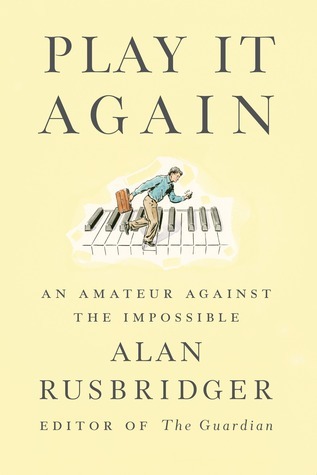
Play it Again: An Amateur Against the Impossible

Rate this book
The Guardian editor’s account of a remarkable musical challenge during an extraordinary year for news

As the editor of The Guardian, Alan Rusbridger’s life is dictated by the demands of the twenty-four-hour news cycle. It is not the kind of job that leaves time for hobbies.
     But in the summer of 2010, Rusbridger determined to learn, in the course of a year, Chopin’s Ballade No.1 in G minor, one of the most beautiful and challenging pieces of music ever composed. With passages that demand feats of memory, dexterity, and power, even concert pianists are intimidated by its pyrotechnical requirements.
     Rusbridger’s timing could have been better. The next twelve months witnessed the Arab Spring and the Japanese tsunami and were bookended by The Guardian breaking two major news stories: WikiLeaks and the News of the World phone-hacking scandal. It was a defining year for The Guardian and its editor.
     In Play It Again, Rusbridger recounts trying to carve out twenty minutes a day to practice, find the right teacher, the right piano, the right fingering—even if it meant practicing in a Libyan hotel in the midst of a revolution. He sought advice from legendary pianists, from historians and neuroscientists, and even occasionally from secretaries of state. But was he able to conquer the piece?
     A book about distraction, absorption, discipline, and desire, Play It Again resonates far beyond the realm of music, for anyone with an instinct to “wall off a small part of . . . life for creative expression.”

416 pages, Hardcover

First published January 17, 2013

154 people are currently reading
1586 people want to read

About the author

Alan Rusbridger

17 books27 followers

Ratings & Reviews

What do you think?
Rate this book

Friends & Following

Create a free account to discover what your friends think of this book!

Community Reviews

5 stars
379 (39%)
4 stars
391 (40%)
3 stars
161 (16%)
2 stars
26 (2%)
1 star
12 (1%)
Displaying 1 - 30 of 138 reviews
Profile Image for Michael Finocchiaro.
Author 3 books6,250 followers
November 16, 2016
This book is a fantastic journey into Chopin's Ballade #1 and in the author's quest to conquer it. I discovered the piece thanks to this book and it is now one of my favorites. The story is fascinating and engaging and made me wish I had a piano or keyboard so I could take lessons again (I stopped lessons when I was 9 or so because we didn't have a piano at home and practicing on the piano in church was more than slightly embarrassing). I felt invigorated by the author's tenacity and curiosity and wanted him to ultimately triumph and play the piece. I'll let you read it and find out if he does!
Profile Image for Emily.
687 reviews688 followers
January 22, 2015
This is partly a patient and sensitive book about classical music and partly a semi-nauseating 400-page humblebrag. I don't expect it to be Rusbridger's gratitude journal but there was something gratingly casual in how he writes about about his little get-together with Condoleezza Rice to chat about the piano or his £20,000 country-home second-string piano budget or his ability to get famous pianists to give him master classes the way I visit Starbucks. Much as he may wring his hands about how hard it is to scrape together twenty minutes to practice, he seems rather myopic about how he has a better chance of learning the difficult Chopin Ballade No. 1 than any other adult on earth.

I ended up liking the book, though, because Rusbridger seems appreciative of how serendipitous the braided elements of his cultural life are, and actually has a reasonable self-deprecating streak. This comes out mostly in how he describes his unfitness to scale these particular musical heights but also in his discussion of critics or opponents. (He quotes someone saying that he looks like "Harry Potter's lonely uncle" and another saying he is "a lily-livered git with eyes like marbles on a pogo stick." Someone who can recommit those words to the page has to be rather fun.) For Rusbridger, "amateur" appears to mean someone who is very good but happens to make their money doing something else, instead of what I am, which is more like a rank beginner with more enthusiasm than actual talent. Despite this different point of view, he manages to evince a sense of solidarity with anyone who's trying to do something admittedly quixotic, and that was very likeable.

Above all, the writing here is excellent on the topic of how playing the piano is hard--for amateurs, at least.
But first, what are the notes? Michael says it's in "B minor--apart from the E sharp," which might be a help if I'd ever learned my B minor scales... The next scale in [this section of the piece] is "C sharp minor, apart from the F double sharp," which is of equally limited use to my brain at this time in the morning (or, if I'm honest, ever.)
I somehow get to the top of the ascending patterns at bar 233 only to then fluff the journey back down the keyboard... There's a ghastly silence at the end and then polite clapping.

There are also good passages about Chopin's place as the sort of pianist's pianist-composer, the Ballade as a piece so drippily Romantic it primarily appeals to 14-year-olds, and Rusbridger's attempts to structure his practicing around his midlife memory challenges.

At the end of the book is the score of the Chopin Ballade, with his pencil marking and annotations by various of his pals like Emmanuel Ax and Murray Perahia. I was able to download the track before my plane took off and listen to it while reading the score and it made for a fun musical experience. If someone else wanted to start publishing just scores like this, I'd buy and read them.
Profile Image for GONZA.
7,414 reviews124 followers
May 28, 2019
This book is seriously inspiring, made me wondering about going back and re-start playing piano again, but ok I will stick to clarinet because it is way easier, in my opinion of course. I was just wondering how could Rusbridger did all he did: editor of The Guardian, flying all around the world, learning to play Chopin plus writing almost 400 pages about 1 year and half of his life, intertwined with Wikileaks, the Arab Spring and the scandal of News of the World, sometimes I order pizza because I do not enough energy to cook......

Questo é un libro inspirante, mi ha fatto pensare che forse potrei tornare a suonare il piano anche io, ma magari é meglio che resto sul clarinetto, che é molto molto piú facile, secondo me ovviamente. Mi chiedo soltanto come abbia fatto Rusbridger a fare tutto quello che ha fatto: essere editore del Guardian, volare in giro per il mondo, imparare a suonare Chopin e scriverci anche sopra 400 pagine mentre nel frattempo scoppiava la primavera araba, lo scandalo Wikileaks e quello di News of the world, se penso che io a volte non ho nemmeno voglia di cucinare e ordino la pizza.....
Profile Image for Corrie Kreisel.
9 reviews44 followers
January 29, 2014
Thoroughly enjoyed every page of this book. Now which of my adult piano students should I pass it on to first?

This book inspired me to do the following:

Put it down and practice the piano.

Spend a good solid two hours browsing imslp.org.

Seriously think about posting on craigslist that I'm looking for piano duo/ensemble partners. Anyone in Denver? I'm now in desperate need of my own spider club!

Go on Amazon and purchase a score of the Chopin Ballades (obviously!).

Seriously consider practicing a few scales, and then just assign them to my students instead.

Listen to more Alfred Brendel. And use Spotify to sample every artist mentioned in the book.

Put Pianomania on my "to watch" list.

Think about buying a third piano. My husband has vetoed this idea (for now).

122 reviews
January 29, 2016
It's amazing that someone who surely had one of the most interesting day jobs in the world -- Alan Rusbridger was, at the time of writing, editor-in-chief of The Guardian, during one of the most tumultuous and epochal periods in its history -- should have felt that something was missing from his life. It's even more amazing that the author, by his own account a mediocre amateur pianist, managed to fill this gap by learning to play Chopin's Ballade in G Minor, considered one of the most difficult works in the repertoire.

Rusbridger draws many parallels between the rise of amateurs in the world of journalism and the world of music. He argues that recording technology initially caused a decline in the tradition of amateurs making music among friends, since anyone can now hear recordings by professionals in their own home, but that companies such as YouTube are bringing amateurs back to the fore. Similarly, blogging technology has blurred the distinction between professional and amateur journalists.

Books written by journalists are almost always accessible and engaging, although this one does require some understanding of piano jargon. An engrossing and enjoyable read.
Profile Image for Lcitera.
580 reviews1 follower
April 23, 2014
Absolutely wonderful. The author is the editor of a top London newspaper, deals with Wikileaks, the hacking scandal, a reporter held captive in the MidEast...and in his spare time...sets the goal of mastering Chopin's Premiere Ballade In G Minor...it would have perhaps been a simpler task to learn how to remove a spleen. The book bounces between developments at the newspaper and frustrations with Chopin. Also...interviews with preeminent pianists...references to Charles Cooke's wonderful book PLAYING THE PIANO FOR PLEASURE...and a reminder that Czerny's velocity exercises have much value. I will never master this piece, nor do I have the talent of the author...but I am tenacious and have allowed myself one year to conquer the notes...year two I can attempt musicality. The author jokes that a bonus of conquering this ten minutes of impossible music encourages the thought that he perhaps could now beat algebra into submission. I taught algebra for 36 years...my turn to give the Ballade a run for the roses. This book is an inspiration.
Profile Image for Saskia.
80 reviews2 followers
December 4, 2023
I found this book extremely tedious to read but it was also really interesting ???? A very strange feeling to experience.

Some interesting stuff about the role of music and amateur music in society, how to learn instruments and practice, cool interviews. Plus stuff about being a journalist in some of the most intense media times ever. I think I’m glad I read it but I don’t think I would choose it again
89 reviews
July 9, 2014
I love this book as I have loved no other in years. I press it upon friends, accost strangers to tell them to read this book. As a disclaimer, you should know that I am a news freak and have spent many of my life's best moments earning a living in one art or another. But I am neither a pianist nor a reporter.

"Play It Again" is the personal chronicle of a remarkable 16 months in the life of Alan Rusbridger, editor of the "The Guardian" newspaper. In his mid-50's, Rusbridger feels his amateur pianist blood rising, and resolves to learn Chopin's daunting Ballade No. 1 in G minor (remind yourself--the piece from the movie, "The Pianist") He has never been able to memorize concert pieces, and the skill required to perform this piece he fears is beyond him. None-the-less.

August 6, 2010 he begins. What Rusbridger couldn't know as he tackled the piano, is that just ahead "The Guardian" would break the UK phone-hacking scandal (four years later the trials are just ending) AND the Julian Assange WikiLeaks story.

The book is a faithful telling of bad and good. Rusbridger has access to the finest pianists and teachers, and as he travels for news and "Guardian" work, he literally "stops in" for master classes or deep discussions on troubling stanzas in the Ballade. He asks Condoleezza Rice how she managed to be Secretary of State and keep playing in chamber groups. Steven Hough tells him he remembers playing the piece when he was 12. Daniel Barenboim says the piece is "slippery."

Meanwhile at his day job, Rusbridger is fielding calls from the U.S. State Department, cajoling Assange as Assange moves to "fire" the New York Times (he does), and breaking four, five, six stories a day as the phone hacking scandal snowballs beyond Buckingham Palace.

See page 103, "...it's a funny thing to discover about yourself in your mid-50's--that you spent the previous forty years not doing something on the assumption that you couldn't do it, when all along you could."

Keep sacred that place in your heart that holds the art of your life. Find time amid your own breaking stories and unending deadlines to try what you've been telling yourself you can't.
685 reviews40 followers
May 31, 2015
In which Alan, the editor of the Guardian (until about a day ago) and an amateur pianist, diaries his attempt to learn the fiendishly difficult Chopin Ballade No 1 - a piece that strikes fear into the hearts of even professional players - while simultaneously leading his newspaper through such minor travails as its part in the Wikileaks publications and its uncovering of the News of The World phone-hacking scandal.

It's a book with two main strands of interest: whether people with busy lives are capable of learning something extremely complex and how that might be of benefit to them, and the business of editing a major newspaper. Other strands include the position and value of amateurs vs professionals (considered mainly in terms of music but also a little in terms of journalism) and the intricacies of the piece itself.

I'm not a pianist and am but a fumbler in the world of classical music. And, having listened to the Ballade several times in the course of reading the book, I really don't like it. But I really liked Play it Again.

I found the parts relating to newspaper editing fascinating and the parts relating to learning, personal challenge and the minds of professionals almost equally so. The specifics about the score of the Ballade, fingering etc were mostly lost on me, but these comprise a very tolerable proportion of the whole.

So it's almost five stars, but the format of a diary based around Rusbridger's attempt to play the piece to an audience for the first time meant that it just ever so slightly outlived its interest vs a less chronologically arranged format, even if the diary form does make perfect sense and work very well.

I don't see how you could fail to be inspired, entertained, informed and charmed, whatever your interests. (Addendum: unless you have a social opportunity chip on your shoulder, in which case Rusbridger's constant hobnobbing with the great and the good might grate. But instead of moaning, why not make like the nurse + teacher with five kids in the book and get a hobby that lets you meet people? Music wins you friends, Alan's mother told him, and so he found.)
Profile Image for Mary.
810 reviews15 followers
February 14, 2021
I really enjoyed this! I loved the piano sections, and it has encouraged me to set some piano goals of my own. And, surprisingly to me, I equally enjoyed the news parts of the story. Both very interesting. (It was shaded with a bit of how nice things can be when you are rich, which seems to make things easier all around.)
Profile Image for Great-O-Khan.
463 reviews122 followers
May 4, 2025
Nachtrag. Das Buch war vor zehn Jahren, im Jahr 2015, mein absolutes Lieblingsbuch.
Profile Image for Glass River.
598 reviews
April 25, 2023
This book left me feeling conflicted. I found the sections on piano playing to be engaging. The author's journey to master a challenging piece of music was inspiring. His questions and struggles were relatable, and I rooted for his success and found myself more hopeful after reading this.

However, I was frustrated by the non-musical sections of the book. As an adult beginner, I value my practice time, and thus found these sections to be tedious and too time-consuming. I zoned out for 70-80% of the book which were basically listing irrelevant endless world events one after another. This is a personal opinion, but I feel they are merely chaotic and transient trivialities, urgent in the moment but of no lasting importance, specks of dust in the grand scheme of things. Music, on the other hand, offers a safe haven that allows mere mortals to reach for something higher, even spiritual.

While I appreciate the author's attempt to carve out a musical space among the chaos in his work, I felt that these trivialities detracted from the real meat of the book - the music. If it were up to me, I would have judiciously condensed or cut out those sections.

This book probably deserves a higher rating, but I’m sure the author would agree with me that if skimming through the endless trivialities which made up the majority if the book allows for more practice time, one should do it.
Profile Image for Tejas.
72 reviews14 followers
July 12, 2023
My full-review is available at: tejasrao.net/2020/02/06/old-dog-new-t...

Phenomenal read. In a series of diary-style entries, Rusbridger recounts taking up the challenge to learn and play Chopin’s Ballade No.1 in G minor Op. 23, which is one of the most daunting pieces of music ever written. There are added layers to the challenge, though. First, he gave up the piano when he was 16, and took it up as a serious hobby only past the age of 40. Second, he’s got a day-job (and not any day-job. At the time, he was Editor-in-Chief of The Guardian). Third, he wants to learn it in a year – committing to do so by giving himself 20 minutes a day of dedicated practice. To anybody, developing a habit over the course of a year by attempting it for just 20 minutes of a day sounds ludicrous enough. To commit to learning a fresh piece of music – and something that lasts 10 whole minutes isn’t just committing to a habit – it’s committing to teaching yourself something new that develops on past knowledge, which is incredible.

To give you a spoiler alert: yes, he manages to play it, and rather successfully, I might add. There are snippets of his playing in the video I’ve linked above
Profile Image for Alicia.
44 reviews
August 22, 2018
Really enjoyed reading this book from an amateur's pianist's experience in trying to learn what is probably the most difficult piano piece ever, Chopin's Ballade No 1. His book is also gentle reminder that busy should never be an excuse for putting something off.

P.S. I also tried to learn this piece years ago but gave up after awhile cause it was just too challenging (and ok also cause unlike him, I lack the determination and perseverance haha). I hope to be able to master this piece one day too!
Profile Image for Davide Nole.
173 reviews45 followers
March 23, 2017
A book about a fight for more time every day, about self improvement in the most basic way, and about coincidences. It's a memoir of what happened throughout a year in the life of the author, as he decided to tackle one of the most difficult pieces of partiture for piano. The story that surrounds the author and his fight is just as interesting, as we are talking about scandals and reportages in the whole world. I honestly didn't know the editor of an important newspaper had to face this much, but I'm glad I know now, just as much as I'm glad I read about an amateur tackling a giant, because that gave me a great drive for the future.
7 reviews
July 19, 2018
Good book, gained a better appreciation for the time and effort that goes into learning an iconic piece of classical music. Inspired me to accept the challenge👍
86 reviews3 followers
November 30, 2021
This is a pretty long and detailed book, and is mostly interesting although I admit I paged through some of the middle section. Even if I’d been learning this one piece, I’m not sure I would need this level of detail. I can’t help but wonder how much time that he spent writing or note taking could have been spent actually playing.

Also, he was besieged by taking care of then current events and the news cycle as editor of the Guardian. It’s a good illustration that no matter how busy you can make time—but years later the news detail has faded in importance.

Mostly I think this would be interesting to passionate piano students, but not to more generalists. For them, I recommend The Piano Shop on the Left Bank, Never Too Late, or Noah Adams book Piano Lessons.
Profile Image for Gabriela Francisco.
566 reviews16 followers
August 13, 2022
"The masterpieces of music are kept alive, not at the theatres and concert-halls, but at the pianofortes of lovers of music."

I made time to finish this book after what was two of the busiest weeks of my life!!

The start of every school year is always both a teacher's most happy and stressful time, with our deep joy at seeing the children balanced out by a heavier-than-usual work load. This historic year, with our school embarking on the hybrid method of teaching students both online and in campus AT THE SAME TIME, proved to be no different from previous years in this respect. Pile on some unexpected mini crises (professionally AND personally), and it's no wonder a co-teacher told me yesterday: "You look stressed." HAHAHAHA.

But how is my pandemic work experience different from that of any other adult in 2022?

Alan Rusbridger, former editor of THE GUARDIAN, was certainly no stranger to stress. His descriptions of 14-17 hour workdays, with 6 hours of the weekend spent just getting up to speed before the start of the next week, seemed familiar. But my own work woes seemed pathetically small compared to his, especially in 2010 when Rusbridger was juggling rescuing a kidnapped reporter from Libya during the Arab Spring, meeting the Royal Family at awards ceremonies, being summoned by Assange at the height of both the WikiLeaks and the NEWS OF THE WORLD hacking controversy... while squeezing in 20 minutes of piano a day and meeting up to four piano teachers for lessons. You see, Rusbridger had determined to play Chopin's (in)famous Ballade No. 1 in front of an audience within a year (it took him 16 months). This book is basically a diary-like account of his daily struggles to meet work obligations (championing the rights of democracy, ethics, and freedom of the press) with piano lessons, interviews with the likes of Daniel Barenboim and Condoleeza Rice, and the obligations of a father and a husband. It ends with a lovely reproduction of the Ballade's score, with annotations and commentary, so anyone with half a mind to try their hand at the Chopin piece could learn!

There is something in the book for everyone. Serious pianists and piano-teachers will appreciate the detailed and exhaustive accounts from his four piano teachers and pianists whom he took masterclasses with. Working adults will be inspired with his "pressure valve release" of 20 minutes of re-wiring his brain at the piano, something that I now see as essential and not a luxury in order to do one's job well, for much longer.

One of the things I loved best about the book was seeing detailed daily schedules on how to parcel out the 24 hours we all have, for maximum efficiency. It involves planning out how you'll spend every 15 minute chunk of time. I just spent one and half of those chunks typing out this review, which beats mindless scrolling through social media! :) And this book has inspired me to make time for music-making, something which I've done very little of these past few years.

I was also inspired by the lovely descriptions in the book of Hausmusik, which was always the part I loved best about my time as a music major! The lovely intimacy of making music with friends, not for profit, but for sheer pleasure... there's simply no equivalent for that kind of joy.

When the current Covid surge subsides, would anyone be up for some art song, Broadway, and kundiman jamming in the Southern part of Metro Manila? * wink wink * Let me know!!

In the meantime, I'm off to do more work. And hopefully squeeze in some piano-playing afterwards...not because I want to. But because I NEED to. It is in music that I found my deepest joy, before. And as this book reminds me, it is never too late, one is never too busy, to PLAY IT AGAIN. (Or in my case, to sing it again.)
14 reviews
Read
May 22, 2023
Engaging and interesting

This is a fascinating book on what it takes for an amateur to master a serious piece of music. The fact that it's a 200-page humble-brag doesn't detract from it at all.
Profile Image for Rebecca.
4,178 reviews3,434 followers
September 24, 2013
Alan Rusbridger has been editor of the Guardian newspaper since 1995. If his job sounds extremely stressful – those endless meetings and briefings, long hours, late nights, and little sleep – it also seems like it would be incredibly rewarding. Rusbridger is also an amateur piano player, and over the year and a half between August 2010 and December 2011 he undertook the challenge of learning to play Chopin’s Ballade No. 1 in G Minor.

It is a notoriously difficult piece, both technically and emotionally; when the score presents “a page which, on first glance, is all a nightmare,” it “can be broken down into stuff that’s merely difficult and stuff that’s unspeakably horrible.” The ludicrously fast coda, for example, looks like a bunch of “squashed flies” on the page. And all along there is the test of capturing the right mood for a piece that alternates despair and lightness – ranging from jaunty waltz steps and a metronomic heartbeat to a furiously pounding tempo.

With the kind of hectic life that often made finding even 20 minutes a day for practice impossible, Rusbridger soon came to wonder if he would ever complete his quest in time, especially as this period proved to be one of the busiest and most newsworthy periods of the paper’s life, let alone his own: there was the Wikileaks scandal, including direct dealings with the mercurial Julian Assange, the UK phone hacking scandal (involving the take-down of News International and Rupert Murdoch), the start of the Arab spring, the London riots and Occupy movement, and, of course, ongoing debates about the place of the press – especially traditional print media – in the modern world.

This memoir of learning the Chopin ballade is full of delightful surprises. He chronicles his attendance at an amateurs’ ‘piano camp’ in France plus weekends spent at his second home in the Cotswolds, where progress on the ballade often kept pace with construction on his custom-build music shed. He visits the Fazioli studio in Venice to have his piano repaired, and is also talked into buying a revamped 1978 Steinway – at more than double his original budget.

He seeks advice from many different piano teachers, and also interviews a myriad of musicians and brain specialists on how music is learned and what is feasible in middle age. He was 56 years old when he began this challenge, and was consistently encouraged by scientists who heralded the plasticity of the brain and the possibility of building new procedural memory. His wildly varied references – everything from a chat with piano-loving Condoleezza Rice to a Japanese manga series on Chopin – only serve to prove that when you set off on a journey like this you never know where it will lead.

Even for someone like me who has never taken a single music lesson, this book is a fascinating, unpredictable, and wide-ranging gem. It’s also a reassuring tale of setting a seemingly unattainable goal at a (somewhat) advanced age and a frantic time of life – the stereotypical triumph of the human spirit, but with a melodic and pleasant freshness that will keep you reading.

(This review formed part of an article about books on music for Bookkaholic.)
Profile Image for Kevin Hartley.
12 reviews
February 25, 2017
An inspiration read; showing what is possible for a person with an extremely busy and hectic career to accomplish - if they persevere and really try hard. Made me want to practice more myself!

I'm around the same age as the author but just started playing 15mos ago, so just a beginner. Even so, found lots of insightful tidbits here for improving practice habits. References to other books on similar topics were a good resource. Found the short interviews with famous pianists interesting and insightful.
Profile Image for Keith.
960 reviews63 followers
August 7, 2023
I picked up this book in the library thinking it was by a famous pianist. After realizing my mistake, I decided to check it out anyway since the subtitle is “an amateur against the impossible”, which is how I often feel as I try to get my playing to an acceptable level.

The book is quite engrossing with him giving himself a year to learn a ballade that even professionals find difficult to play and interpret. Then his “day" job becomes even more of a day and night job that it used to be. That year he was in the middle of Wikileaks and phone hacking news releases. The story alternates between three settings:
- Him trying to learn the Chopin Ballade #1 on only 20 minutes a day, and days when he couldn’t play at all.
- As an editor (and amateur pianist) he interviews famous pianists. (Whether this was part of his job or a privilege he gained by being an editor was not obvious.)
- He had to manage the onslaught of complications with news involving powerful people in high places who like to destroy anyone who opposes them.

In an interview with Daniel Barenboim “He announces one ‘fact’: “That we’ve all … experienced the difficulties of marrying passion and Discipline. When you get passionate about anything, about a woman or the job or about something that you're into and you lose complete sense of discipline. They have to coexist." (Page 210)

A very engrossing book. It was so engrossing that instead of taking notes of interesting parts, I just read on to see what happened next.
Profile Image for Ian.
159 reviews3 followers
Read
December 6, 2017
I took a break from Aubrey/Maturin as reading 20 novels in one go is a bit much. And I came across this in a second hand bookshop.

It's an interesting insight into the life of a modern, liberal newspaper editor. Especially during as challenging a year as 2011 - though aren't they all these days. He does have an agreeable life away from the office though, when he can escape it.

I'm not very familiar with Chopin but it doesn't take a genius to appreciate the difficulty of the Ballade that Rusbridger is attempting. A friend who was a classically trained pianist once described Chopin as "a sadist with big hands", but this is an optimistic book - it is possible for any sufficiently dedicated amateur to take on the most challenging of pieces.

I'm no classical musician but the book has inspired me to practice my guitar rather more often and diligently than usual. However, I don't regularly rub shoulders with world class professionals quite as often as Mr Rusbridger so advice and inspiration mostly comes from Youtube. But this is not a bad thing.

Recommended for non-musicians interested in current affairs, but highly recommend for anyone with any musical inclinations.
Profile Image for Didde Elnif.
184 reviews13 followers
July 1, 2013
This book made me want to become either a pro pianist or editor in chief - what ever comes first.
I'm a bit of a fan girl, when it comes to Rusbridger, and as a journalist I really enjoyed reading his reflections on meetings with Assange and the decisions made in relation to the News of the World scandal. But you have to be interested in both Chopin and the life of pianists if you want to finish the book, it's geekery on a whole new level, and the main focus - going over Ballade no. 1. bar by bar. I can only recommend it, but... consider yourself warned.
141 reviews3 followers
January 26, 2022
I have complicated feelings about this book, but I have to say that as a journalist and amateur musician, I liked it a lot.

Alan Rusbridger, when this book was written, was editor-in-chief of The Guardian. It's a formidably complex, stressful and labour-intensive role that sees him working 80-hour weeks with multiple trips abroad most months. A "light" weekend day of work might be six hours.

Despite this, he tells us, there comes a point in his life when he has reached his professional pinnacle, his daughters are capable of looking after themselves, and he feels a hole in his soul because culture, and specifically classical music, is being squeezed out of his life. After hearing taxi driver Gary give a majestic rendition of Chopin's Ballade in G minor at their yearly piano camp, he sets himself the challenge of learning the piece to performance standard by the following year's event. He will attempt to practice every day, even if only for 20 minutes.

What follows is a beautiful, honest and delicate reflection on the nature of learning music as an individual, ultimately probing the question of how far it's possible to go as an amateur. To many, his accounts of his exasperated teacher, his impatience with his own abilities and his occasional despair at how life seems to get on top of him will be relatable to the point of catharsis.

Less relatable but equally compelling are the ways his jet-setting, quasi-celebrity job brings him to interviews and practice venues in the unlikeliest of places: a piano in a clapped-out hotel in Libya on a hair-raising mid-revolution trip to negotiate the and an interview with Condoleezza Rice spring to mind.

The book is about the ballade itself at least as much as it is about amateurism and journalistic anecdotes. He illuminates the piece with an unbelievable degree of insight, curiosity and imagination, fleshed out to the point of plumpness with interviews from virtuoso pianists from across the globe. If he ever chooses to take the LRSM exam, he'll get top marks for his programme notes. Given the level of musical detail, I can't imagine this would interest non-musicians.

Rusbridger leads the life of the elite, charmed to the point of fairytale. He trod the well-trodden path from a boarding school to the University of Cambridge to the London media world. He spends more than I've made in my last two years as a foreign correspondent on a piano. He owns a whimsical second home in the Cotswolds, where he is overseeing the construction of a dedicated music room. One of the arguments of this book is supposed to be about how classical music can move the soul of anyone, but this part of his message is limited to brief references to Venezuela's El Sistema, a nurse single parenting five kids and making time for music, a taxi driver who can play Chopin. We hear not a single reference to him cooking or cleaning or doing the laundry, presumably because he pays people to do it for him or leaves it to his wife. He makes occasional reference to showing up at lessons on four hours' sleep, but rarely admits to exhaustion, limiting his discussion of tiredness to an early quote about how it's no excuse for not doing things. Even having also studied at Cambridge then moved into the London media world, these aspects grated: North London elite who?

Overall, though, this was a thought-provoking book that stimulated me to reconnect with my classical music roots. You don't have to be Alan Rusbridger to be inspired, stimulated, and motivated by it. I might not start with the Ballade, though.
190 reviews2 followers
July 13, 2023
I play the piano so I raced through this book at (for me) breakneck speed, because there was so much I could relate to that mirrors my own studies. For example, that it’s simply impossible to play challenging pieces with any sort of fluency without huge chunks of memorization. You simply have to look at your hands and not the score to have any hope of executing the tricky bits. Also, the endless decision/indecision about what is the best fingering. Then there is the fact that Alan, like myself, never learned scales properly as a kid, which is a real hindrance to technical progress.

On the other hand, I came away from the story as a whole with conflicted feelings. Yes, it is admirable to attempt to learn an extremely difficult and canonical piece (Chopin's Ballade #1, G Minor), but why set an arbitrary time deadline? This is music that demands time and attention to bring to performance level, particularly for an “amateur”. Would it have been all that bad to take an extra year or two, or five? Yes, he’s in his mid-fifties, at the time of writing, but come on. And it must be nice to own both a Steinway and a Fazioli, and have easy access to some of the finest pianists in the world so that he can pick their brains about the Ballade. Actually, these parts were pretty interesting. As is Alan’s chronicles of his day job - Editor in Chief of one of the UK’s premier newspapers, the Guardian. Suffice it to say he is extremely busy in his day job and doesn’t have a lot of time to spend practicing. All the more reason to take more time.

I definitely felt for him when he relates the story of his first attempt to perform the Ballade at “piano camp”, precisely one year after resolving to play it. It’s a disaster, and I couldn’t help thinking of all the easier (and perhaps no less beautiful) Chopin repertoire he could have learned and played very well at the camp, during that time period. He did get some great advice from the guest teacher however, which sets him on the path of his TRIUMPHANT performance of the Ballade for selected family and friends some four months later. Spoiler - he gets through it pretty well. So very good for him, and the inspiration he may be giving to anyone who really wants to go for something really, really hard, but I won't be doing what he did because:

https://www.youtube.com/watch?v=BSFNl...
Profile Image for Dominic H.
330 reviews7 followers
February 8, 2023
I read this book when it came out but had forgotten that some of Rusbridger's funniest and most interesting writing about taking up the piano again (which returning adult pianist for example would not smile at Rusbridger's surprise and attitude when his teacher suggests he work out fingering for a piece before doing anything else or which returning adult pianist would not be insanelv jealous of Rusbridger's acquisition of a Fazioli?) is actually in an article he wrote for Granta some time before this book was published.
'Play it Again' is a much more serious affair where Rusbridger is an established amateur pianist, obviously of some ability, and recounts his learning and eventual performance of the G Minor Ballade by Chopin, a foundational and extremely difficult part of the romantic piano repertoire. There's much of interest - some of it of course centred around Rusbridger's struggles and alternating confidence and insecurity and eventual resolution when he does perform the piece publicly. But also: advice from teachers, the different qualities of pianos, the varied attitudes of assorted virtuosi who have all played it (most at a ridiculously early age) and the experiences of other adults and what playing the piano has meant to them. There's also a lot of detail about playing the Ballade itself (both in the body of the book but also in a dedicated Annex which is interesting in a general way but probably only of real value to those readers who have played or attempted it (I have (could) not and I suspect that is true for the vast majority).
The other aspect of the book (I haven't calculated the proportions but I suspect it's around 30% of the content) is about Rusbridger's role as editor of The Guardian and the incredible pressures that bring (the Wikileaks affair is a large aspect of this). This is fine and not uninteresting but not really why I wanted to read it (and is now obviously quite dated) and overall the book is a not entirely satisfactory hybrid of memoir, fascinating amateur pianist material and so-so political history.
Overall definitely worthwhile though and I am pleased to have reread it even if in my memory it was a better book.
Profile Image for Nils Lid Hjort.
140 reviews5 followers
December 21, 2024
"Usannsynlig" er Morgenbladets første ord, i et tresiders oppslag om Guardian-redaktør Alan Rusbridger (22/v/15). Det er ganske riktig aldeles usannsynlig at Morgenbladet i en tresiders reportasje ikke med ett ord skulle nevne Chopins ballade nr. 1 i g-moll op. 23, og den boken jeg p.t. er dyktig imponert og inspirert av, "Play it Again: An Amateur Against the Impossible", og som åpenbart må leses av alle tenkende og våkne mennesker.

Ordene "må leses av alle tenkende og våkne mennesker" stod i sin tid med små bokstaver bakpå Gyldendals Lanterne-utgave av "1984" (og kanskje var det Sigbjørn Holmebakk som mente dette). Passer ordene på Rusbridgers bok, om hvordan han brukte ett år, altså alle de tidssmutthull han fikk plass til innenfor et av sine meget travle år på jord, til å lære seg Chopins ballade nr. 1 i g-moll op. 23 (og til å skrive en bok om det, samtidig)? Ja.

" To my later mother, Barbara Rusbridger, who forced me to practice and who told me that music would lead to friendship. She was right. "

Vi bør alle ha eller ha hatt en slik mor.

" More evidence of the international interest in the story this morning: a Norwegian journalist flies in unannounced and tells the people at the front desk that he won't leave the building until I've given him an interview (I don't). "

Vet noen hvem dette kan ha vært (side 271), og fra hvilken avis? Uansett, etter å ha lest Rusbridgers "An Amateur Against the Impossible" og hans kamp med og mot Chopin, forstår jeg hvorfor han er æresdoktor ved Universitetet i Oslo. Vel unt.

Chopin i sideværelset

Den skurk, nu spiller han igjen Chopin,
mens jeg skal skrive en av mine sange!
For fan, nu kan jeg skrive ned i flæng;
nu blir det bleke tøv med et til klange;
nu voldtar tonen dette arme ordet,
og som et orgel skjælver skrivebordet!

Min pen blir taktstok til hans melodier,
Chopin og jeg blir brødre - og genier;
et sælsomt yndigt rosenflor gror ud
paa tonestængler i papirets have;
men stanser han et øieblik - o Gud,
min store uransagelige Gud -
da visner alle over hvide grave!
Displaying 1 - 30 of 138 reviews

Can't find what you're looking for?

Get help and learn more about the design.