The Collected Works of W. B. Yeats, Volume XIII: A Vision is part of a fourteen-volume series under the general editorship of eminent Yeats scholar George Bornstein and formerly the late Richard J. Finneran and George Mills Harper. One of the strangest works of literary modernism, A Vision is Yeats's greatest occult work.
Edited by Yeats scholars Catherine E. Paul and Margaret Mills Harper, the volume presents the "system" of philosophy, psychology, history, and the life of the soul that Yeats and his wife George (née Hyde Lees) received and created by means of mediumistic experiments from 1917 through the early 1920s. Yeats obsessively revised the book, and the revised 1937 version is much more widely available than its predecessor. The original 1925 version of A Vision, poetic, unpolished, masked in fiction, and close to the excitement of the automatic writing that the Yeatses believed to be its supernatural origin, is presented here in a scholarly edition for the first time.
The text, minimally corrected to retain the sense of the original, is extensively annotated, with particular attention paid to the relationship between the published book and its complex genetic materials. Indispensable to an understanding of the poet's late work and entrancing on its own merit, A Vision aims to be, all at once, a work of theoretical history, an esoteric philosophy, an aesthetic symbology, a psychological schema, and a sacred book. It is as difficult as it is essential reading for any student of Yeats.
William Butler Yeats was an Irish poet and dramatist, and one of the foremost figures of 20th century literature. A pillar of both the Irish and British literary establishments, in his later years Yeats served as an Irish Senator for two terms. He was a driving force behind the Irish Literary Revival, and along with Lady Gregory and Edward Martyn founded the Abbey Theatre, serving as its chief during its early years. In 1923 he was awarded the Nobel Prize in Literature for what the Nobel Committee described as "inspired poetry, which in a highly artistic form gives expression to the spirit of a whole nation." He was the first Irishman so honored. Yeats is generally considered one of the few writers who completed their greatest works after being awarded the Nobel Prize; such works include The Tower (1928) and The Winding Stair and Other Poems (1929).
Yeats was born and educated in Dublin but spent his childhood in County Sligo. He studied poetry in his youth, and from an early age was fascinated by both Irish legends and the occult. Those topics feature in the first phase of his work, which lasted roughly until the turn of the century. His earliest volume of verse was published in 1889, and those slow paced and lyrical poems display debts to Edmund Spenser and Percy Bysshe Shelley, as well as to the Pre-Raphaelite poets. From 1900, Yeats' poetry grew more physical and realistic. He largely renounced the transcendental beliefs of his youth, though he remained preoccupied with physical and spiritual masks, as well as with cyclical theories of life. --from Wikipedia
I strongly recommend reading this on heavy psychedelics, that is, if your tolerance is kaleidoscopic to the point that you can read while hallucinating. I purchased this book when I was a teenager in California traveling after high school for the first time, because like many a good American boy I read the Beats extensively in my late teens. Lucien Carr, who killed Dave Kammerer with a Boy Scout knife, as a young football-playing John Kerouac went to the slammer over as well. On Carr, they found the knife, A Vision, and Rimbaud's Illuminations.
I have no idea what is going on here. I can easily find out, but I prefer to pick it up annually and take a look at Pound's packet and certain charts. It's like recommending someone a film like House, Symbiopsychotaxiplasm, In a Glass Cage, or, say, a novel like The Making of Americans; i.e. I guess I could tell you what's going on, if you give me a second, but I'd just rather plague you with the thing(s) and see if you ever get back to me, if the mind-fuck brought something, good or bad, out of you. I'll just call this one Amazing, at the sake of seeming archaic, as it's been some change short of a decade and I've never met a professor, prostitute, plebeian, pedestrian, punk, pornographer, puzzle-maker, print-shop apprentice, poet that's ever brought this one up, or had it out on the shelves. Take a look, see what happens.
‘A Vision’ is undoubtedly highly interesting, and sheds light on some of Yeats’ more obscure poems, but I was ultimately disappointed, being interested in the precession of the equinoxes and the Platonic Year. I guess I was hoping for a prophecy, but while Yeats has much to say about the Arian and Piscean eras, on the Aquarian he is totally silent.
life is round: we're stuck on this wheel. Living. And dying. An endless circle. Until. Someone breaks it. You came in here, you rupture the pattern. Bang: the whole world...gets wider...
no seriously this is an interesting read. Beautiful, impossible, yet fantastic none the less
I don't know what to categorize this book as. This book is Yeats' synthesis of the 'automatic writings' and nocturnal speaking (talking while she was asleep, by spirits) from his wife. The spirits described to him an overly elaborate system of the universe which is a mix of the Kaballah and 17th and 18th attempts at all encompassing history, with more than a healthy dose of astrology thrown in. Yeats expounds this theory of the world and the development of civilizations and individuals in a manner that I have to admit I didn't quite understand. I got the gist of what he was saying, but I kind of let the details fall away, because frankly this is kind of crazy shit that I didn't have the energy to wade through with an eye for detail. Yeats finds his kooky theories proved in lots of different places, through other writers both contemporaries of his and from antiquity, and when he doesn't have proof he seems to have no trouble giving his own spin on things. If anything this book proves that no matter how far out a theory you have you can and will find proof that you can't be wrong. That said parts of the book were quite interesting, and Yeats did have some interesting moments, I'm not sure if what he is writing can be called the truth, but it makes for a very interesting story of the world.
This book will spin you into a vortex of wild imaginings and gyre you around a philosophical hurdy-gurdy like no other book you will ever have read, enjoy.
5 stars for the edition. As for the contents, I can't avoid the thought that if Yeats had been French and written this forty years later no one would have thought he was nuts. And the advantage this has, over something like Ecrits, is that Yeats could manage the language he was using.
There's debate whether this is a genuine work from Yeats, or if it's like Joyce's Finnegans Wake or Tarantula from Bob Dylan, i.e. a literary jest. This review is from the genuine perspective. There are a lot of esoteric references in this, and the material is very dense--as expected--but it's worth the effort needed in beginning to understand the ideas Yeats presents. Metempsychosis is one of the most fascinating philosophical notions: one that can be studied, and even considered, by people from all beliefs and non, without compromising one's convictions or apprehensions. This is also a great read for admirers of poetry, particularly admirers of the powerful William Blake as well as Yeats' later poems. Don't be afraid if you don't understand more than 40% of the material, for there are numerous scholarly articles out there that will help to fill in any gaps.
The gall of this man. A work that is both transcendent and revolutionary, but also maddeningly frustrating, for Yeats is trying to play both mathematician and philosopher only he is a poet. There are gems here, but they are sparse like rubies in the mud. I also grant that I am not familiar with many of the works that other reviewers insist are requisite preliminary readings, so I perhaps will need to revisit A Vision in a couple decades time.
I read this and have no idea why. I finished it and had absolutely no clue as to what he was talking about. I'm not sure what I was expecting it other than I was reading a semi-obscure work by a very famous poet who was partly famous for his interest in the occult. Even "occult" here is a stretch of a term for what Yeats might be talking, and the only thing left to say after finishing it was that it all has something to do with "gyres".
If you like gyres, you will LOVE A Vision by W.B. Yeats.
At one level, it seems to be an eclectic attempt to fuse Hegelian metaphysics, astrology, neoplatonism and of course Yeats's own poetry. A few books of comparable abstruseness get written every decade or so. But the book is strangely effective, in a way that most other books in the "esoterica" category aren't. Doubtless this is due in large part to the author's own profound poetic sense. The overall effect is a book that moves over the border between philosophy and poetry as few other books can.
this is pretty heady stuff. interesting, i think, more because of its source -- WBY, a highly regarded literary figure and statesman. i mostly only read the introduction because i was less interested in the information communicated than by the process of the communion.
Liked this book less for the content itself and more for the insight it gives you into Yeats' poetry, especially his later, more Eastern-inspired stuff. Yeats was very much a genius, but also a bit of a whackjob.
yeats constructs confusing astrological systems and a weird mystical philosophy out of his wife's "automatic writings" and unconscious speech. creepy stuff.
kinda cool that it was written via his wife’s automatic writing… could have given her more credit though? or was it just a really convoluted way of sharing his weird occult belief system? idk… it was worth it for the image of Yeats on a train barking like a dog at his wife Georgia to wake her up from her cat dream. also, up Gort
During my brief stint in collection law I read with morbid interest form legal pleadings filed mainly by debtors in east Tennessee (and distributed, I later learned, by the KKK) that pled as a defense to repaying a credit card debt that FDR suspended the US Constitution, that the US has operated under admiralty law since 1932, and that this somehow meant that the Federal Reserve Bank owed any debts that “sovereign citizens” refused to honor.
I have a similar morbid fascination with weird conservative theories of history, I guess—Hegel, Toynbee, Spengler—which led me to read W.B. Yeats’ A Vision, one of the best-written piles of horseshit I have ever encountered. It’s as if (speaking anachronistically) one put Vico’s The New Science into a blender with an especially intricate, unironic book about the Enneagram and added some poems.
Added bonus: the obligatory refusal to acknowledge that Africa has any history or contributes to history in any way! (Africa—the whole continent—gets exactly one mention, then on the very next page Yeats says that the same putatively universal phenomenon can be encountered also in India, so let’s talk about *that* instead.)
This book is of interest to anyone seeking to understand Yeats’ later poetry or his relationship with Fascism. Otherwise, avoid, avoid, avoid.
"All the gains of man come from conflict with the opposite of his true being." Not entirely sure what I just read, but I will say I feel better about my own cognition relative to Yeats' desire to demarcate the human experience, pinning specimens to a 28 cell cork-board while pinning its genesis on his wife and various "Facilitators" (ghosts). The sui generis nature of this book makes it delightful--and I am a believer of Charles Fort's "intermediateness"--but what Yeats posits through the otherness of supernatural intelligence is only the reflection of his mask, one which thrives on hierarchy and an idea of individual destiny closer to Christian providence than I'm sure he would have ever admitted.
A vision is... well... how could I say?... I mean -- no I don't, I don't mean anything. A Vision is, if it was possible for it to be, a poet talking about poetry -- not any poetry: his own. You get what you get when people talk about their own inner feelings; to get it the clearest as possible, this text is what it isn't if you take it as an artist reflecting the artist he does not see when in front of a mirror. A Vision is not a mystical theory, nor has beautiful prose. Yeats on Yeats. Artist on artist. Doesn't really say anything. It is useless, but, hey, aren't we all useless?
life and death (and reincarnation) of human on individual, intellectual and historical level following the phases of the moon ... it's tough to make a logical understanding out of it but the explanation of human reaction of any event (dictated by the four faculties) was wonderful
another must read, a book, like its author, timeless coming from the true master of poetry and literature in the English language Yeats is the biggest dog on the block
in which yeats elaborates a largely impenetrable system of basically idiosyncratic astrology, divided into cones and gyres, that he got from unspecified entities communicating with him via his wife's automatic writing sessions. he mostly seems to have used this system to classify and fit artists and entire historical periods into a narrative of eternal recurrence. i don't really think anyone else would find the system particular applicable or useful in making art, but it clearly had a lot of behind the scenes influence on his later poetry, and writing about it seems to have been very necessary for him despite this book not really being 'for' anyone else. a lot of it is not really that interesting to read as such but there are some pleasant and/or striking sentences in the final section on the arc of history since the roman empire, including these ones:
"All the involuntary acts and facts of life are the effect of the whirring and interlocking of the gyres; but gyres may be interrupted or twisted by greater gyres, divide into two lesser gyres or multiply into four and so on. The uniformity of nature depends on the constant return of gyres to the same point. Sometimes individuals are primary and antithetical to one another and joined by a bond so powerful that they form a common gyre or series of gyres. This gyre or these gyres no greater gyre may be able to break until exhaustion comes." "Love is created and preserved by intellectual analysis, for we love only that which is unique, and it belongs to contemplation, not to action, for we would not change that which we love. A lover will admit a greater beauty than that of his mistress but not its like, and surrenders his days to a delighted laborious study of all her ways and looks, and he pities only if something threatens that which has never been before and can never be again."
I'd had this book on my to-read list since a podcast I listen to recommended it. What bumped it higher up the list was watching Kill Your Darlings (2013) and loving how much it referenced the book.
Overall it was...not what I expected. Just interesting enough that I was determined to finish it. It was fascinating at parts, tediously boring at others, and eye-roll inducing at still others. I read the original, unpolished 1925 version, so maybe the 1937 one is better. Either way, I felt a lot of the ideas in this book were over-complicated. There are other philosophies which state similar theories much more simply, without needing to go into nonsense on cones and gyres.
I found Yeats' explanation of the Tinctures and Four Faculties the most interesting and applicable. I can see how these Faculties can directly correspond to the four elements, or the four suits in the tarot: Will is fire, instinct, Wands. Creative Mind is air, reason/intellect, Swords. Mask is water, emotion, Cups. Body of Fate is earth, desire, Pentacles. The way he constructs a psychological schema using these Faculties is quite thought-provoking, and I had fun trying to figure out which zodiac sign fits which phase best.
Near the end Yeats discusses the different bodies. What he seems to be doing here is explaining what today we call the Seven Subtle Bodies. His Passionate Body seems to me like today's Emotional Body, with the Ghostly Self as likely the Astral Body or Etheric Body. His Celestial Body has obviously been retained.
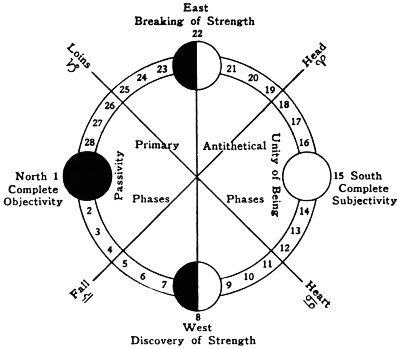
The premise for this one is interesting: Yeats takes notes while his wife produces automatic writings and sleep talk, during which she is possessed by unknown spirit communicators. ...and out comes a comprehensive system by which humanity and history can be categorized! Oh, and by the way, said system is predicated upon gyres, the turning of wheels, and, most importantly, lunar cycles.
No surprise, the used book store clerk left "wild book!" on the inside cover next to its price tag. A questionable $12 spent for sure.
Brief synopsis: The new moon at the start (and end) of cycles are marked by heightened conformance to that which is rational and suppression of subjectivity. The full moon, unsurprisingly, gives rise to high irrationality and less objectivity. Pepper in a myriad of signs and symbols. some terms like "will", "mask", "body of fate" and "creative mind" and viola!
This book is interesting if you think that spirits communicate with the living by means of automatic writing in order to give complicated revelations of how history and personality work. Coincidentally, it's also interesting if you wonder what it feels like to be an insane person. At least there's some good advice for Ezra Pound in the beginning: "My Dear Ezra, Do not allow yourself to be elected to the senate of your country."
ceva-ceva știe el. un 3.5 pentru entuziasm și convingere inexplicabilă. cândva, printr-o revelație, am să înțeleg perfect.
on Phase 25: He would use this religion and philosophy to kill within himself the last trace of individual abstract speculation, yet this religion and this philosophy, as present before his mind, would be artificial and selected, though always concrete.