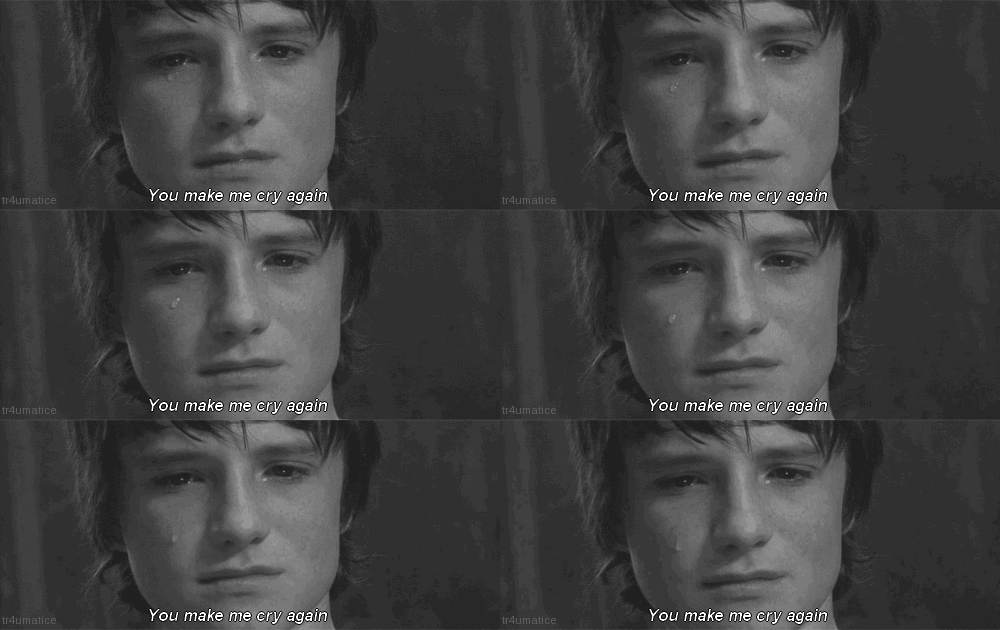
The haunting account of a teen boy who volunteers at a suicide hotline and falls for a troubled caller.
As her life spirals out of control, Jenney's calls become more desperate, more frequent. Billy, struggling with the deteriorating relationship with his depressed father, is the only one who understands. Through her pain, he sees hope. Through her tears, he feels her heart. And through her despair, he finds love. But is that enough?
Acclaimed author Janet Ruth Young has written a stunning and powerful story with no easy answers; it is about pain and heartbreak, reality and illusion, and finding redemption and the strength to forgive in the darkest of times.
Janet Ruth Young graduated from Salem State College and from the creative writing program at Boston University. She was a co-editor of the literary magazine stet and a founder of Writers' Circle, the writing workshop at the Cambridge Women's Center. Janet has published three novels with Atheneum Books for Young Readers, a division of Simon & Schuster.
The Opposite of Music (2007), about a teen boy who attempts to save his father from a life-threatening depression, won the PEN New England Discovery Award and was a Book Sense Pick, a Borders Original Voices selection, and an American Library Association Best Books for Young Adults nominee.
Things I Shouldn't Think (paperback edition 2012), about a babysitter who has thoughts of harming the child she cares for, was nominated for a CYBIL and received a starred review in Publishers Weekly. The hardcover was published in 2011 under the title The Babysitter Murders.
My Beautiful Failure (2012) tells the story of a teenage boy who volunteers at a suicide hotline and falls in love with a troubled caller.
An advocate for people with depression and OCD, as well as their families, Janet has given talks and interviews to the Depression and Bipolar Support Alliance, the local chapter of the National Alliance on Mental Illness, the podcast series Living with OCD, The Jordan Rich Show, The Writer's Block with John Ronan,the Massachusetts Library Association, the Marblehead Festival of the Arts, and many schools, book groups, bookstores, and libraries. She has published an article in the quarterly of the International OCD Foundation, and her books are widely used for bibliotherapy.
Billy is a new volunteer in the suicide hotline, and on the first day of his job, he receives a call from a girl named Jenny. Jenny told him that she was abused by her parents when she was a kid, and how her life went downhill after she started remembering the memories of the abuse. Billy wants desperately to help Jenney, but he is restricted by rules saying that it’s prohibited to form friendship with people who call. But Billy knows that Jenney is special to him, and he doesn’t hesitate to break rules and offer her his friendship. As Jenney’s calls become more frequent and more desperate, Billy has to race with time if he wants to save the girl whom he knows everything but her last name and her address.
My Beautiful Failure is undeniably melancholic, but it is also infused with lots of hope and wish for better days. The author might not be very successful in creating a guy’s voice, but the plots are very well-crafted and the story itself may as well happen in real life. To what extend you should push the boundaries between stranger and friend? There is a fine line between listening and being too much involved, and the main character, Billy, has problem differentiating the line.
Billy is not a character I liked instantly. With his caring personality and his obsession to become a psychologist, it shouldn’t be a problem to like him the moment I met him. However, Billy is a typical teenager with senseless belief that he knows everything about people, and it was hard to connect with him when he was being such a worrywart or a smartass. Billy is obsessed in saving people, and I can’t say that I don’t understand the need to do something amazing when you are young. I’m so glad that events in this book mold Billy into a more mature person in the end, and when I finished the book, it’s safe to say that I think of Billy as a friend.
Surprisingly, My Beautiful Failure is a short read and one I finished in no time. Despite my earlier difficulty to connect with Billy, I didn’t have difficult time appreciating the plots, the underlying message, and the supporting characters. All in all, My Beautiful Failure is not a book you would like to miss if you’re fans of contemporary or in need of something a little thought-provoking. The book itself is like a gentle reminder that after all, there’s always light at the end of the tunnel.
I rested my hand on one of the phones as if to test myself. The job was monumental, the ultimate responsibility. The way the rules were written, someday someone might call and mine would be the last voice that person would ever hear. In a few days I would start saving lives. But only if they wanted to be saved.
The main problem I had with this novel is that I just couldn't feel anything. I tried. I truly did but there was just something missing. Maybe it was the writing itself. I don't know.
Billy is a sophomore in highschool and he is having some problems with school after his father had a hard year. He was battling depression. Billy couldn't bring friends home because of his dad and he also couldn't confide with his best friend even though his mother died,so he is not totally clueless when it comes to dealing with pain.
But now that his father is busy and happy (or is he?) with painting which he loved doing before Billy and his sister came in the picture. But B(let's shorten his already short name)is still worried he will be end up disappointed and will return to his old problems so he questions everything the poor man does. After his parents tell him he needs to find a hobby he decides to join Listeners- a support hotline for potential suiciders. There he spends time talking to Jenney who is just now dealing with repressed memories of her parents abusing her when she was a small child.
My Beautiful Failure could have been so much better. I just can't explain it. There were some things that usually work like a charm with me, like. a lot of B's inner thoughts, dark and difficult subjects but in the end it just didn't quite leave an impression.
Also the book was rather slow until the last 20% which didn't increase the chance of me liking it very much. I could say a few things that bothered me about the ending but I don't want to spoil the novel.
Overall, I would be so much happier if we got to see more sides of other characters and more of those calls from crazy people. That part was interesting.
Let me start of by saying this was the most amazing first book of 2013 I could read! I liked it almost as much as I liked the Fault In Our Stars by John Green! Contemporary is my favourite genre but to be honest they are either love or hate books. This was a OMGTHISBOOKISBEAUTIFUL kind of book. Maybe I'm overreacting but it is my honest opinion. The main character Billy had some troubles with his father being bipolar the previous winter. Troubles is an understatement, it must have been so hard and I have to say I admired Billy for being so strong through all of it. You get short flashbacks to that winter throughout the story just so you can see what Billy, his mother, sister and father have been through.
Billy is smart, funny, kind, inspiring and wants to get away from his Fathers crazy problems. So he joins Listeners. Overall I though he was an amazing character and he has inspired me a lot. Not many characters have done that before. At listeners, he keeps getting calls from Jenny. You never actually meet Jenny but her stories and troubles were just so terrible. Although you could feel her getting weaker, she remained so strong and even cracked a few jokes. I fell in love with the love that Billy had for Jenny. It was beautiful. There are a few other characters like Billy's sister, her best friend, Gordon, people who worked at listeners and Billy's parents. I loved all of them, Billy's fathers crazy ways surprised me and annoyed me but in the end I understood him. Billy's sister and her best friend made me laugh and Billy's best friend (Gordon) was truly one of the bestest best friends you could have. Every character just added to the story.
I have to say the ending annoyed me because its not how I wanted it to end but that is what would have happened in reality and I understand. The storyline was a genius and I loved the idea of "Listeners", it's very unique. The writing style was beautiful, honestly I cannot say enough about this book. I cried not only at the end but in the middle because this book has genuinely opened my eyes. Janet Ruth Young, well done! I need to read more of her books and I hope she is writing more! I could not recommend this book enough, please just read it.
OK, so this book is getting a lot of coverage in VOYA and School Library Journal and a lot of praise from readers, but honestly, I'm a tad bit unsure as to why. The pacing is slow and I didn't really start enjoying it until the last 1/3 of the book. I didn't like Billy or anyone in his family and I was a bit annoyed with the entire cast of characters taking such a light outlook on poor mental health. It had a lot of potential, especially with all of the heavy issues woven into, but failed short of the mark for me.
'She was a girl talking to me in the dark.' A beautiful and quick read. It's the novel that every teen must read. It is about love, pain, depression and HOPE and the strength to forgive in the darkest of times. Depression deprives some people of their lives while others keep struggling and continue to live. . After putting up with his father who suffered from depression a whole year, Billy joins Listeners, a suicide hotline. After that, he keeps recieving calls from a girl, Jenney whose parents had abused her in childhood. With every passing day she gets more depressed and her calls become more frequent. Will Billy be able to stop from killing herself?
I haven't had such a reaction to a book in awhile. I am not even sure how I feel about this. Let me explain...
I started reading this book, and I didn't like it. But the chapters are short (some are only a few paragraphs or a single page) and that makes for a quick and easy read. The more I read, the more I didn't like Billy, the main character. Like, really not a fan. So much so, that I grabbed a notebook and started writing down all the things I didn't like about Billy. (I won't take up space with the list, but it is available upon request :) But, I kept reading. Because it is such a fast and easy read, I decided to stick it out. I thought that maybe this book would gain redemption at the end by Billy completing changing and turning into a character I actually liked...I mean, this all had to be going somewhere right? There is a lot of build up in this book: build up between Billy and Jenney's relationship, build up with Billy's dad. The two run parallel to each other.
The more I read, the more I still didn't like Billy. Then I hit the last third of the book...and I couldn't put this puppy down. Janet Ruth Young's pacing is fantastic, and the short chapters really make for a suspenseful story. I still didn't like Billy, but I was rooting for him. The end I was looking for didn't happen, in that Billy didn't undergo some amazing character growth and turn into this new and awesome person. But his perspective changed, and he was proven wrong about a lot of things.
This book brings up some, for lack of a better word, heavy things to think about. I mean, it's about a suicide hotline. But, really, it's about connections -- the importance of connecting to other people and of not taking our relationships for granted. It's about looking at other people and seeing them as they really are, not as they were or as you want to see them. It's also about taking an honest look at ourselves.
I love when a book changes my mind. I love when a book really makes me think. I love when I put a book down and can't stop thinking about. So, thank you Janet Ruth Young. And yes....I recommend this book.
See the other Book Nerds review of this book on our blog: BookNerdsAcrossAmerica.com
My Beautiful Failure is an EPIC story that all teens should read. I have to say that it took me a day and a half to read because I had to put it down. This is a haunting tale of love, loss and finding your way through tragedy.
Billy is a 16 year old boy who has been through a lot. His father is suffering from depression and even though he is some what okay Billy fears for his father everyday. So when his father decides he is going to start painting again Billy is scared. He does not want his father to suffer like he did in the recent past and he does not want his mother or sister to have to live through this pain again.
So Billy decides to tell his best friend Gordon what is going on with his father and Gordon suggests he volunteer at The Listener's which is a volunteer suicide hotline in town. At first Billy is like no way am I going to do that but as he watches the video and hears the people helping out he knows he will be a good listener. He applies and gets the volunteer position. AT first he is excited but the excitation comes to a screeching holt when Billy gets a call from Jenney.
Jenney is a tormented soul who is in therapy for abuse at the hands of her parents.With her therapist she is uncovering long lost buried secrets and Jenney's life spirals out of control. But as talks to Billy she forms a friendship with him. This is forbidden but Billy and Jenney share things they are not supposed to and soon Billy relys on Jenney and Jenney relys on Billy. But when she uncovers her secrets one secret in particular it drives her over the edge. Will Billy be able to save her or will she die? What will happen to Billy? What will happen to Billy's family if his father falls apart?
This is a MUST READ for all teenagers who have thought about suicide or even attempted it. There is always a better way out of the turmoil your in.
Spoiler alert: some novels just give everything away in their title. It was a "beautiful" story concept--teenage boy befriends female caller at suicide hotline--but the main character just "failed" to live up to his role entirely.
No offense to the author, but I felt like Janet Young made a mockery of this type of subject matter by turning it into a really bad soap opera, in writing:
1)the chapters were so short that I felt I was being deprived of depth, more insight into Jenney's situation, which is the main premise. Instead, all I got was useless fillers that strayed from it.
2) the characters were poorly written. There were so many of them, all given names, and thrown in just about anywhere to "fill" a scene.
3) This book is all TELL, and no SHOW. The only part that makes some sense is their multiple phone conversations.
4) Our protagonist, Billy, believes it's okay to be selfish and put all his focus on his lack of a romantic relationship, and dare to seek one out through a suicide hotline of all places. Um, hello?? You don't just take on this kind of job because you see it as your own personal "project" and then drop out whenever you feel like it! You had one job, Billy. And it wasn't to let Jenney die.
5) The novel ends with
Some(pessimistic yet insightful) words of advice: "Don’t depend too much on anyone in this world for even your own shadow leaves you when you are in darkness" -Ibn Taymiyyah
Billy’s father had a mental breakdown. A year later Billy can seem to stop himself from monitoring and analyzing his father’s every move. Finally things come to a head and Billy’s father suggests that it might be time for him to take on another project. Wanting to make a difference Billy starts to volunteer at Listeners, a suicide prevention hotline. Over the following weeks Billy becomes drawn to one of his regular callers an older teen named Jenney. Billy must decide what is more important the mission and rules of Listeners, or his own feelings for this lonely young woman whose world seems to be rapidly falling apart.
In this novel Young takes on the challenging issue of mental illness specifically depression. Unfortunately there was much to be desired in the execution. Perhaps the biggest flaw is was that Billy’s character is difficult to like. He is a know it all who is extremely judgmental, and unforgiving. He is to self centered to reflect on his own motivations or behavior. The other problem is the books pacing, far too much time is spent on the relationship between father and son (without any clear resolution) rather than the relationship build up with Jenney and its conclusion.
This book was just so utterly heartbreaking. I really thought that at the end Jenney would live and the good guys would win, that Billy would save her life. But no. I guess that's not the way it is in real life either. This book was well written, though a little stranger for me than I'd like. I didn't enjoy the light tone of the novel n the beginning that very suddenly escalated into all seriousness. The characters also seemed a little shallow at points, and Billy's sudden love for Jenney kind of annoyed me. But as I was reading, and Billy was racing to where Jenney lived, I felt my heart racing as well–to my immense surprise. I was also surprised though, when I didn't cry at learning of Jenney's death. That may have been because of the authors blunt way of putting it; Billy merely sent a text to Pep saying that she was dead, based on the fact that she wasn't moving and wasn't speaking. She could very well have been unconscious. But either way, this book was one that made me think, made me smile, and made my heart ache. Cheers to Janet Ruth Young for creating such a piece.
This entire review has been hidden because of spoilers.
EDIT AGAIN: ugh I have to fix my rating system and make 2.5 stars a 2 so that I can rate things 3.5 stars and not have to make them 4 stars but if I rate them 3 stars rn then it looks like I hated them as much as THIS book so from now on I round down
EDIT: talking to a friend and I just realized wtf is this title even
Three stars is generous, I think maybe it’s more like 2.5
I wanted to like this book more than I did. I was already having a hard time because the writing wasn’t the best. As bad as it sounds, I had a hard time sympathizing with the characters, and wasn’t invested in the outcome. Also, as someone who has done similar work in the past, I found the main character’s behavior to be INCREDIBLY inappropriate and it made me very uncomfortable, and while I don’t think the author attempted to justify his behavior, I also didn’t think she did the best job of making it clear why what he was doing wasn’t okay. Overall I’m just disappointed
My Beautiful Failure was an incredibly frustrating read, even as it touched upon important issues.
My Beautiful Failure follows young Billy as he and his family recovers from his father's debilitating depression in the winter of last year. When his father begins painting again in an almost manic fashion, Billy is worried that this is a sign that his father is either falling into depression once more or developing bipolar disorder. His father challenges him to find a project of his own which prompts Billy to join the Listeners, a group that serves as a suicide and general chat line.
While volunteering at Listeners Billy desperately wants to save someone. In time he falls in love with an Incoming named Jenney as she calls the line regulatory and reveals more and more about herself.
My biggest obstacle in enjoying this book was that I didn't particularly like Billy as a character (or any of the others, but we'll get there). Not liking the voice that tells you the story is a big obstacle to get over, as you never get an escape from this person. Billy is extraordinarily wet behind the ears, but he thinks he has a greater purpose in life and he actively reaches for it. He is petty, immature and controlling. While it's admirable that he helped his family through his father's depression, he then begins treating Bill Sr. as a child in need of fondling. We are led to believe that he's some great listener, when in reality is un-supportive and attacks his father's dreams. If Bill Sr.'s predisposition to depression and mental disease wasn't enough to make him sick again, constantly being told that he was making a horrible mistake by a sixteen-year-old likely pushed him to the edge.
Billy's motivation for joining Listeners wasn't so much about a desire to help people and make his society a better place, but for the gratification he would personally feel by saving a Likely (suicidal person). In fact, he shows little concern to his Incomings minus Jenney. Billy eventually places his own feelings and thoughts above Jenney, unnecessarily burdening her with his problems in her time of need. In the end, a Likely is all he actually desires.
Billy's family was another frustration. Billy's father's treatment of him and his obvious preference of Linda made him unlikable. He showed little regard for his own well being, and his own thirst for greatness overshadows his feelings on everything else. Billy's mother serves as a prop and does nothing besides acting as a tool for the family to have a stable income and the person that Billy occasionally whines to. Even though her husband is working himself to exhaustion she doesn't even bat an eyelash at the situation.
The Listeners as an organization is a shoddy one. Any help hotline that will limit a call for help to five minutes, or ten "in a real emergency", is a horrible one and shouldn't be reviving any sorts of funds whatsoever. Young manages to make their interactions a neat formula that doesn't line up with real life.
Jenney is the most engaging character in the novel. Her voice comes across as pure and strong, up to the last. True, she's very likely an unreliable narrator, but so is Billy. She has flaws and her struggles, but I truly enjoyed being there as she attempted to work through them.
The plot was a decent pass, though a lot didn't happen and the last 50 pages or so was a bit of a let down. Additionally, Billy didn't seem to really learn anything or grow beyond being forced to acknowledge that his dad's artwork wasn't the embarrassment that he thought it would be.
The reason I liked this book was that it was so different from other teen novels I've read recently. There is a quirkiness in the way it is written: the short chapters, the back and forth between the present and the future, and the dialog on the phone at the Listening center.
I didn't like whiney Jennie at all but could see why Billy might be drawn in by her and want to be her savior. On one hand he seems like a normal immature teen boy who is full of himself. On the other hand, he sounds like an adult especially in the way he wants to control everything. It was a bit unbelievable.
That said, it was the adult dialog that I thought would be helpful for teenagers. So I guess one of the main draws of the book was that it discusses mental illness and how to help people. The fact that Billy is taught to listen and repeat back what someone is telling him is a good skill. He really walks the reader through the whole 'Hotline' experience. It might encourage readers to volunteer for something similar in their community. In my own experience I could have used some pointers when my brother showed up on my doorstep totally deluded. I had no idea how to deal with it. Accepting that someone believes a certain thing and acknowledging it without agreeing is a hard thing to learn to do.
The book also talks about the impact of dealing with a family member that has a mental illness. Teens that are familiar with depression in their own family might be able to relate to Billy's flashbacks to the time he had to be the strong one and help out while putting his own life on hold. Personally I think he should have had festering rage about this but you never get the feeling that he hates his Dad and the illness that possesses him. He doesn't even hate his Mom who seems very unsupportive.
It appears that Billy's father is going through a manic phase with a spurt of insightful creativity. That is the great plus side of a bipolar disorder. I was glad the book brought that out. Many famous artists have had to cope with a mental/emotional imbalance. Seeing that through Billy's eyes may help a teen be aware of the problem when someone close to them goes over the deep end.
Most of the characters didn't strike me as particularly likeable. Billy was admirable for his desire to help people. I liked that about him.
I'm glad My Beautiful Failure shaped up pretty good from beginning to end. I was waiting for it to disappoint but it didn't. Instead, it impressed me in a way that I have a new found knowledge about life and hope written from a different perspective.
It was an easy read. It took me a day to finish everything with breaks in between even. But it didn't slack on depth and story. Sure, details may sometimes seem distant but it didn't matter because I am loving the flow of the story anyway.
The character of Billy, I admire the most. He urges himself to help others because he wanted to save people in his own way after witnessing his own father suffer from a manic attack "Last Winter". His eagerness to change somebody's life directed him to volunteer for "Listeners", a suicide hotline. I love the chapters focusing on his shifts, listening to calls and simply listening to their woes. Despite being good at what he does, he feels somewhat imbecile, listening to these people but cannot help them out directly. There are a few rules to follow at Listeners, and Billy find these restrictive.
One day, a call got to his line and he speaks to Jenney for the first time. Initially, Jenney feels down about her parents, life and friends. She finds comfort talking to Billy about her problems, and Billy finds talking to Jenney really amazing.
Eventually, Billy starts to fall for Jenney after deep, personal phone conversations about Jenney's problems. But as per Listeners' rules, you cannot build a personal relationship with the caller. Billy breaks all these rules that lead to somewhat shocking conclusion.
The character of Jenney is like the Cassidy Thorpe of The Beginning of Everything -- a catalyst that turns the protagonist's life upside down, propelling his life to a better path through her short relationship with the main character. A spark of some sort. Not entirely the focus of the novel, but a big part for change.
All in all, My Beautiful Failure tells a beautiful story about life and death; hopes and dreams. An easy, one day read but a MUST.
I'm glad I picked up this book and I hope you will too :)
Billy wants to be a psychologist and he's practically an expert already. After his dad's bout of clinical depression last year, Billy knows he'll be the best volunteer The Listeners, a depression/suicide hotline, has ever had, even better than the adults and college students who've had a lot of training and experience. He eagerly anticipates calls from a suicidal people, but mostly ends up talking to people just having a bad day. Then he answers Jenney's call nod slowing gets drawn into her drama. Soon he's bending guidelines, because surely those rules never anticipated a situation quite like the relationship he has with Jenney. At home, Billy worries his father is showing signs of a manic bipolar, he throws The Listener's rules out the windows and begins confiding in Jenney.
In this sequel to THE OPPOSITE OF MUSIC, Billy is a year older and a thousand times wiser in his own mind. Parentified the year before taking care of his dad, he hasn't been able to let go of his role as protector and caretaker. He comes across as critical and negative of his dad, and not always likable, although his head and heart are in the right place. If his parents had recognized he needed therapy to help process the PTSD he had from the last year, Billy could have gotten much needed support and help. Readers may want to grab him and scream, "You don't know what you don't know" but his attitudes are so typically adolescent. Janet Ruth Young masterfully captured the arrogance of adolescence and balanced that with a naive heart wanting to be helpful. Billy is one of the most multi dimensional characters I've read in a while. MY BEAUTIFUL FAILURE is Young's most nuanced novel to date. I can't wait to see what she writes next.
The only criticism is that Young dropped the ball on Bill Sr's bipolar behavior, the chance to delve deeper into his symptoms, and to show that success, creativity and mental need not be mutually exclusive.
While MY BEAUTIFUL FAILURE is a novel with a YA narrator, I encourage adults and teens interested in mental to pick up this book. Adults may just see themselves in Billy's adolescent omnipotence. I know I did.
This book was extremely problematic and harmfully triggering. It dealt with some pretty heavy topics and it did so fairly poorly. I started off enjoying this book quite a bit and I wish I could have rated it higher, but the end of the book just had so many problems. I don’t even know where to start. For me, there were two main halves to this book – Billy dealing with his father’s mental illness and the whole situation with Jenney. By the end, both halves left a really bad taste in my mouth. First, Billy’s father. I don’t think anyone in Billy’s family could deny that his father experienced a very serious decline in mental health last winter. The only debate here is whether or not he’s relapsing, so to speak. Now from what I saw, I think he absolutely is going through something that should be addressed or at the very least monitored. And it kind of seems like Billy’s mom is starting to believe him and then the art show is a success so, in her mind, all is well and good. And even Billy decides his father must be fine when he sees how much people like his father’s paintings. The fact that the art show went well does not negate the fact that his father may have been going through a manic period. Mentally ill people can be good artists and still need help. The whole resolution to that storyline was ridiculous. However, regardless of what was actually going on with his father, Billy is convinced that something is wrong and I think his parents should have cared a little bit more about that. What happened last winter was terrifying for everyone involved and it’s bound to leave its mark on the kids, especially. Billy is getting extremely worried that something bad is going to happen again. It’s affecting his sleep and his schoolwork and making him not want to spend any time at home. And neither of his parents seem to care about this at all. His mom disagrees with Billy’s assessment of his father’s mental health and so she dismisses her son’s concerns entirely and it’s just SO wrong. Really, really bad parenting. And then there’s Jenney. What happened between Billy and Jenney was more blatantly wrong and he at least got removed from Listeners so I’m satisfied with that. What I find disturbing is Billy’s behavior the night Jenney died and his entire reaction to the situation afterwards. Obviously, he does a few things wrong during his time at Listeners by getting attached to Jenney in the first place and then by opening up to her about his problems. But everything really came to a head the night she died. It disgusted me the way he reacted to Jenney not showing up to his dad’s art show. I’ve been stood up so many times so I understand the disappointment and frustration, but he’s supposed to be there for Jenney and he never should have asked her for anything in the first place. Every time Jenney calls Listeners, she’s calling for a reason so maybe let her talk when she calls instead of just piling all of this guilt on her the second you pick up the phone. Guilt that is entirely undeserved in my opinion as Jenney made it clear that she couldn’t guarantee she’d come. And when she tells him that essentially she was having a bad mental health day and couldn’t even get out of bed, that’s not even enough to shut him up – he just continues to tell her that he was really looking forward to it and she let him down. And in general she calls Listeners for help, not for added obligations. Ugh! And then Billy tells her that he loves her – which I still don’t get where that came from but I have so many bigger issues here – and that he’s quitting Listeners so they can be together when he doesn’t even know – or really seem to care – how she feels. He’s just forcing all of this extra pressure onto her and asking her for so much when he’s the one who’s supposed to be helping her. And then when he finally shuts up long enough for her to tell him that she might be feeling suicidal, things get a little voyeuristic when he’s asking if the pills are in her hand and he wants her to count them. I know that he’s supposedly panicking, but it comes off a little bit like he’s getting some sick pleasure out of what’s happening. And this section seems to me like it could be pretty triggering for someone who deals with depression and it’s very unnecessary. Books can be triggering when someone is just wanting to be really raw or maybe help someone through their book, but this was not that. As he’s racing across town to get to her, I hate that he’s still holding on to this fantasy of them being together and that’s his main motivation for going to save her. I hate that he doesn’t tell the firemen what’s going on or ask for their help. I know that he’s not supposed to but he’s already breaking rules and they’re right fucking there. And his reason for not asking for their help isn’t because he’s not allowed to and it isn’t to protect her privacy which is a reason he pulls out of his ass later in this scene. In that moment, the reason he gives is that he wants to be the one to save her and then he proceeds to fantasize about saving her and being her hero and this whole sequence is so disgusting. And then he finally does call for help when it’s way too late. If he was going to call for help anyway, he easily could have done so when there was still a chance help could get there in time. Gordy is right when he says that what happened was Jenney’s responsibility and it was her decision, but I feel like Billy absolutely deserves a fair chunk of responsibility and blame for what happened as well. And I am so disturbed by Billy’s reaction to this after the fact. He doesn’t think he did anything wrong. He doesn’t think he really could have done anything differently or any better. He doesn’t think he should have been let go from Listeners. He still feels like he was the best Listener to ever volunteer and that no one could have helped Jenney any better than he could. So, so, so much of what he did that night and leading up to that night was sooooo wrong and I’m so disturbed by the fact that he doesn’t even realize that. That really ends my biggest problems with this book, but I do have a smaller issue as well. I’m pretty annoyed that we never get any confirmation on Jenney’s back story. I’m pretty sure the memories she had aren’t real – hell I’m not convinced Melinda is real – but I want to know more about that situation. To be honest, aside from some minor frustrations, I was enjoying my time enough for most of this book, but the ending honestly made me feel sick to my stomach. I am honestly so disappointed in this author. I can’t say enough how poorly these heavy and important topics were handled in this book.
This entire review has been hidden because of spoilers.
I tried to finish this book. I tried to like this story. I tried, but I just couldn't do it. The main character was not appealing, the "savior" aspect of the book was not believable, and the "Listeners" help line was slightly rediculous.
Billy, the main character, begins working at a suicide hotline in an attempt to help people. He feels he needs to do something important after what happened with his dad. Last winter, Billy's dad had a breakdown. He began taking medication in order to even himself out, but that only made things worse. Eventually he was able to get things back on track. But lately he has been showing signs of a relapse, or at least Billy thinks he's on the verge of a relapse. No one else seems to notice. This pushes Billy to take a stand. He begins working at the Listener's hotline. Here he "meets" a girl in need of help. The story continues with Billy trying to keep an eye on his dad and lending a helping ear to the girl on the other end of the phone line.
The premise of the story sounds great, unfortunately the story is so slow and drawn out, you really just get tired of listening to him worry and not really do anything helpful or pro-active with all his worry. Sorry, but the story just couldn't keep my attention.
How do you imagined to meet your soulmate? Do you ever wonder how many ludicrous and unexpected ways is there for you to cross your soulmate's path? This novel is a unique story about Billy and his special connection with Jenny (literal connection). This is not a typical love connection. Because of all the places they can possibly talk/meet, they end up in a suicide hotline where all the callers if not obsessed in talking about how miserable they are, is consume by so much depression. Because of their own dilemma, they somehow find each other as a breathing room and as a shoulder to lean on. A single call, followed by numerous days of knowing each others lives, builds a strange relationship. Despite the lack of physical connection, the emotional and mental relation between them is very much intact. As I said earlier, this is not a typical love story. Something happen (no spoilers) that ends to that connection. An event that brought me to tears. huhu. In the end, as the title goes there is always something big and beautiful in our failures, we just have to be keen and open-minded.
What was written at the back of the book was really inviting. Now, I learned that you should not judge the book by its synopsis. :) I was indeed beautiful, from the title itself. But I am afraid that I should say, reading this book is one of my beautiful failures this summer. But its worth committing for. :) I am a fan of tragic love stories and i never really expected it to be one of those TLS. That was surprising though. It was not a cliche. I never really expected that apartment moment though I should know better from the very start. Overall, this book is written for teens. It talks about trusting your friends, your family,and the people you worked with. It's about being proud of your dad's creativity. It's about how you stay committed and true to what you love to do. It's about falling in lovbe you never really knew.
I bought this book because I want to read it. This deserves my four. :)
The book tells about a guy who volunteered to be a listener in suicide hotline. ☻[And I can’t imagine myself volunteering that kind of service cause even the people I know personally I don’t even know what to do when they are upset or in trouble, how can I help other especially strangers? And imagining that someone will tell me that they wanted to end their life or wanted to have a suicide, it is so frightening I may be stunned, if panicked rise through me I lost all my senses and became like an idiot.]☻ The story was so sad it makes my heart sank. Knowing someone you like making a decision using a permanent solution to a temporary problem which is ending their single life is so disappointing.
I respect Young for taking a non-traditional approach to the love story, and for making the ending actually realistic and brave, even if it isn't what readers want to happen. Loved the concept, and the writing flowed pretty well too.
However, I never connected to any of the side characters, and Billy and Jenny weren't strong enough to carry the entire book for me. I also didn't like how the possibility of was just dropped all of a sudden just because his art gallery ended up being successful.
Did not see that coming at all. It was very different from what I expected but it was okay. To me, this book is on a very serious note of how a problematic boy met a problematic girl. Definitely not a light read for me but I do appreciate it very much. I've learned a lot from this book as well. It also got my attention because I am interested with Psychology. Plus the hotline plot is very interesting as well. Can't really decide if I should give it a 3 or 4. I'm in between it so I'm going to give a 3.5
I started this because of the compelling story line and I can say, with all honesty, that I did not expect it to be this bad. It was extremely poorly written and all the characters seemed overly juvenile, as if the author was trying to prove that this was in fact a young adult book. It seemed like a mockery of a very serious topic, in fact Billy himself treated it as a mere "project". I was disappointed to say the least. I didn't even finish it because life's too short to put up with crap.
I really wanted to love this book. But I couldn't bring myself to it. I literally found myself hating the main character. He is so incredibly selfish and oblivious to how he is hurting his father. The ending was kind of predictable, about half-way through the book I kind of guessed what was going to happen.
WHAT THE HELL IS THIS!? WASTED MY DAMN TIME. Probably first book that I've hated and will never EVER read again. Predictable plot, I hate the way it was written and it has no direction.
Most of my Psychtember reviews will be formatted differently than my standard reviews, to reflect the mental health theme. I've structured things as though the book is the patient and I'm giving it an assessment. Each axis is an aspect of the book that I'll give my thoughts on (characters, plot, etc.), and the validity score refers to how psychologically accurate I think the book is. Then I may list some other books that this one "shares symptoms with" (i.e. novels dealing with similar topics) and provide the patient's "statement" (quote) before giving the "diagnosis" (my shooting star rating). The rating still reflects my overall view of the book, using my standard rating system.
Assessment:
Axis 1. Characters
Unfortunately, an emotional connection didn't happen for me with the characters in My Beautiful Failure. I just never cared about Billy or Jenney that much; Jenney we don't get to know that well because we only see her in phone conversations, and Billy kind of annoyed me with his know-it-all attitude. He's unusually intellectual (to the point of overthinking things at times) and in touch with his emotions for a teen guy, and frankly if I hadn't known his name and that he was a male narrator, I don't know that I'd have been able to tell right away from the voice. His friend Gordy is also pretty sensitive, and their heart-to-heart talks just didn't seem that believable for a couple of male teens.
We don't really get to know Billy's other friends very well, and his sister, while undeniably quirky, didn't seem to serve much purpose except irritating Billy. I quite liked the conversations with the unusual callers Billy gets (and would have loved more of these!), which show that you can get some pretty strange kinds of calls when working at a suicide hotline.
Axis 2. Premise/plot
My Beautiful Failure focuses on a type of relationship that's unusual, but quite conceivable in a hotline situation — one in which the two people have never met in person, but only communicated over the phone. Both the temptation to break the rules at a hotline, and the perils of doing so, are touched on. I wish the consequences of Billy's actions had been dealt with more; I felt like the ending didn't go into enough depth about this.
Outside of the Billy/Jenney storyline, there's also a subplot surrounding Billy's dad, and the possibility that he may have bipolar disorder. The interesting question of where the line might be drawn between creativity and mental illness (specifically mania) is raised, but unfortunately, this storyline is not resolved to my satisfaction. Instead, it just seems to be dropped when the plot involving Jenney escalates, and I never got the answers I wanted.
The second loose end I found frustrating is related to Jenney's time spent in therapy. The truth of certain details Jenney tells Billy is ambiguous, and remains so even at the end of the novel. I was looking forward to seeing a particular potential danger of therapy (specifically psychoanalysis) being explored, so it was disappointing that the book didn't end up going there.
We see how alluring Billy finds the temptation to share information about his life with Jenney, making it a two-way conversation. However, he doesn't know how this could affect her life. Just generally, this story shows really well how you don't actually know that much about someone who calls into a hotline. They could be putting on a front, and while Billy may have thought everything was going so peachy-keen for Jenney that he could unload his troubles on her, if he'd followed the rules he probably would have taken this possibility into consideration.
I didn't feel that satisfied by the ending (). Billy does undergo some thoughtful reflection in the last few chapters, and I think he realizes that part of the interpretation of their relationship on his part was overblown.
Axis 3. Writing Style
The chapters are short, which makes it more readable, since the plot is very slow-moving. Personally, I thought there was too much description and inner musings of Billy's mind; he reflects and philosophizes a lot. Unfortunately, it doesn't have the rising tension and sensationalized quality of Things I Shouldn't Think (formerly The Babysitter Murders) that keeps you reading; it's a slower and more gradual build. I found the writing kind of distancing and clinical, and I just didn't feel very close to any of the characters.
On the positive side, I think Billy's flashbacks/memories were an effective way to show what his dad was like before, and explain why Billy's acting the way he is now with his father — there's an interesting sort of role reversal going on.
Axis 4. Psychological Accuracy
The accuracy of portraying work at a suicide hotline is bang-on. The way the Listeners are supposed to respond is very reminiscent of humanistic therapy, Carl Rogers–style. Personally, I would probably find it annoying (I was far more impressed by CBT than Rogerian therapy in my counselling psychology class) but I can see why it would be used for a hotline. In that situation, there are no trained therapists, so really the volunteers are just there to listen and can't deviate too much from that. They're trying to standardize the experience, and while I can understand why that would frustrate Billy, it makes sense to me. (The importance of controlling variables was drilled into us during my psychology undergrad classes!) Introducing a personal relationship is not the purpose of the hotline, and Billy throws that all away when he starts falling for Jenney. The rules are there for a reason, and breaking them does have repercussions.
I liked that we see Billy actually referring to the Listeners' manual at one point, going through a series of questions there. The fact that the Listeners often tried to praise the callers didn't sit quite right with me, though; I feel like they should have been more neutral. Certainly, in Rogerian (aka. "person-centered") therapy, "unconditional positive regard" towards the client is supposed to be shown, but in some cases the praise Billy gives seems dishonest. For instance, he tells a caller who admits to watching his neighbor dress that "you obviously have a lot of concern for your neighbor's privacy" (and he's not being sarcastic.)
There are a few spots at which disorders are defined, which is helpful. While this might seem a bit dry, I think it's important that accurate definitions be given, and furthermore, it gives the reader a foundation for understanding what's being discussed and what behaviours to look for.
It's suggested at one point that antidepressants can turn major depressive disorder into bipolar disorder, and I'm afraid I have to take issue with this for a couple of reasons. To begin with, the wording used — "anyone taking antidepressants had to be careful of becoming irrationally happy ("hypomania") because it could lead to bipolar disorder and a lifetime of cycling up and down" — isn't the best, since it doesn't make clear that theoretically, an individual would have to have a predisposition for bipolar disorder in order to react that way to an antidepressant. Secondly, and surprisingly, the jury's still out on whether antidepressants actually do trigger manic episodes. Indeed, some of the researchdoesn't seem to back up this (admittedly logical) supposition.
As mentioned above, a couple of the storylines were not resolved to my satisfaction, making it difficult to assess the characters in terms of clinical psychology. Jenney's mental health is certainly in question — she was obviously undergoing some emotional trauma — but I can't say for sure if she was clinically depressed. We do get a glimpse at what seems to be a pretty textbook case of paranoid schizophrenia, complete with concerns about the CIA listening in...
Validity Score: How psychologically accurate was My Beautiful Failure?
Axis 5. Miscellaneous
I wasn't as impressed with this book as Things I Shouldn't Think, since that one was quite different from most YA "issue books" in drawing attention to a poorly-understood type of OCD. I just feel like there's a lot more that could have been done with the psychology here that wasn't, and instead it took a different route by focusing on Billy's reflections and reactions.
Patient's statement:
"On a scrap of paper I wrote a song title: "Check In Before You Check Out." Then, holy cripes, my phone lit. Line 3 was ringing. Someone needed me. Someone was in trouble, and I was going to save them. Margaret and Richie dropped their listening faces and glanced at me with big, encouraging eyes. For a second I felt overwhelmed. I hesitated. Richie covered his mouthpiece with one hand and motioned at me to pick up.
I grabbed the receiver."
Diagnosis: 3 shooting stars. There are a lot of topics covered here on an abstract, intellectual level, and many questions raised (but not answered!). However, for me the emotional heart of it just wasn't there.
Disclaimer: I received this book for review from the author.
What’s outrageously hilarious here is that I’m sitting here, dying of laughter while I’m writing this. I ACTUALLY LOVED THIS BOOK! *kisses the floor because of love* The thing is—you cannot even imagine how afraid I was to pick this up. I honestly expected so much worse. I was ready for dazing, daydreaming and procrastinating, anything to get me away from reading this book. But then, little did I know back then that I would finish the book in one short sitting, and that I’ll be sitting here, writing a positive review.
You see, when I read really good books, I’m not able to concentrate on anything else until I finish that book. This book started off amazing from the first page, but not as amazing as it turned out until the end. I sat there face-palming myself, over and over again, feeling mental and crazy because I was so rude to this book. YES, THEY HAVE FEELINGS, OKAY?
This book gave me a crazy amount of feels. I shipped, my ship sunk, and I cried.
I honestly wish that I was able to somehow film myself while reading this book and then post it onto here. I barely moved while reading, and I made such weird face expressions, as I remember. There were so many times when I was patting my heart, or where I was frowning. Like really, WHAT BOOK DOES THAT TO YOU? Let me tell you, only the keepers, my friends.
My Beautiful Failure was… exactly what I was hoping and praying for. It was so beautiful, and heart-breaking and crashing and shattering all at the same time. It was the cutest thing that you can ever imagine in a darker contemporary, and it dealt with such modern issues that many teens are sadly going through today. And plus, where did that idea of a suicide hotline worker come from? THAT WAS BRILLIANT, LET ME TELL YOU.
And for once, we have a love story with two broken people. Both Billy and Jenney were both struggling, with two different stories from behind. And to really understand how they both clicked and connected, you have to read in between the lines. In many ways, they both cured and helped each other, when no one else could have.
It all began with a call… And then another, and another.
Billy is almost teared apart. Everyday when he comes home, his depressed father is getting closer and closer to the point where he won’t be able to take himself as a person. He’s strongly depressed, and as Billy sees this happening to the person who was there for him from the start, he also begins to not be able to take it. To keep himself busy from paying attention, he volunteers at a suicide hotline, where he feels like he may not be able to stand to not help someone who wants to commit suicide. His first few calls go okay, and he’s nervous, as expected. One of the next callers is Jenney, a girl who has went through so much in her life, including abuse and psychotic hating parents. Everyday, her calls become more frequent and needy, and as they communicate more, Billy finds that he’s falling for the girl who can only understand him, and as he is the same back to her.
This book was the cutest thing ever. The storyline is so deep and dark, all at the same time. There’s such a large bursting message that is popping out at us throughout reading the whole time, and I feel like I need more from Janet Ruth Young—master of contemporary literature for mature audiences. But really, you can have a young soul and still have to deal with such horrid things, as Jenney did. It really tears a hole in my heart as I’m not able to expect anything else.
Didn’t I already mention that this concept is the most beautiful thing ever? It was fitted out and sculpted and written to perfection, every single bit of it. Every word was like a new breath from a baby when it’s brought into the real world.
As I began reading, everything wasn’t as clear as it became to be when Billy joined the hotline. I had a few mishaps with confusion, but as the story unfolded, a sunrise came out and the water turned crystal clear. After that, there was no looking back and I wasn’t able to live without knowing what would happen and how everything would turn out. The writing was powerful, moving, and heart-tearing, at the same time. As watching the characters becoming more and more experienced with each other, I got goosebumps and shivers all over. This really shows how issues can be solved and turned into something healing and stressless.
But when you read and really listen to Billy and Jenney’s story, you feel for them, you don’t feel guilt, but you feel sadness and sorrow. They were such gorgeous and amazing characters, I didn’t have enough of them and their strong voices. Billy was like the therapist, but inside, he had his own personal issues. But at the same time, you realize how much he cares about the people he loves. Just, look at his dad and Jenney. He did everything for them, and in the end….
I was done, and so was he. THE ENDING HIT ME SO HARD. I just am still not able to let it go and realize that it’s all over. *sighs*
I cried, I literally died of sadness, but I’m sitting here smiling from head to toe. I see everything differently now, and I’m surely am not going to forget about this gorgeous story. It was all there, and I didn’t ever have enough. Beautiful characters + a gorgeous story and concept = a Happy Michelle. What else can we ask for? A Beautiful Failure? Yep.