Jump to ratings and reviews
Rate this book

Commissario Brunetti #21

Beestachtige zaken

Rate this book
Wanneer het lichaam van een man gevonden wordt in het kanaal, staat Brunetti voor een raadsel. Hij heeft weinig aanknopingspunten: het lichaam is dermate aangetast door de stroming dat de man onherkenbaar is geworden. Hij draagt niets bij zich en is niet als vermist opgegeven. Bovendien wijst de autopsie uit dat de man leed aan de ziekte van Madelung, die een misvorming van het lichaam veroorzaakt.

304 pages, Paperback

First published January 1, 2012

949 people are currently reading
2053 people want to read

About the author

Donna Leon

107 books2,921 followers
Donna Leon (born September 29, 1942, in Montclair, New Jersey) is an American author of a series of crime novels set in Venice and featuring the fictional hero Commissario Guido Brunetti.

Donna Leon has lived in Venice for over twenty-five years. She has worked as a lecturer in English Literature for the University of Maryland University College - Europe (UMUC-Europe) in Italy, then as a Professor from 1981 to 1999 at the american military base of Vicenza (Italy) and a writer.

Her crime novels are all situated in or near Venice. They are written in English and translated into many foreign languages, although not, by her request, into Italian. Her ninth Brunetti novel, Friends in High Places, won the Crime Writers' Association Silver Dagger in 2000.

Series:
* Commissario Brunetti

Ratings & Reviews

What do you think?
Rate this book

Friends & Following

Create a free account to discover what your friends think of this book!

Community Reviews

5 stars
2,892 (31%)
4 stars
3,953 (43%)
3 stars
1,944 (21%)
2 stars
310 (3%)
1 star
84 (<1%)
Displaying 1 - 30 of 841 reviews
Profile Image for Jeanette.
4,088 reviews835 followers
March 15, 2025
WHEW, the funeral at the very ending gave it the 5th star. A Mass with the creatures honoring their doctor. This is a shock- my giving a Donna Leon Brunetti (#21 in the series on top of it) a 5 star. But this one meshed. Totally.

It's early to mid spring and Venice and its canals, the tides which carry a body, the columns and the water gates-all are cored completely into the story. Patta, Elettra, Vianello- and all of the Brunettis become defined in such dialogue! From literary asides of comparison to ethical decisions on each delicious plate- all of these issues come together within this case and within these spaces. Better than any of her others.

There was so much that could be quoted! If I had not held a Kindle read, I would have copied and pasted an entire list of Paola or Guido comments in this review. And the descriptions were sublime. But essentially this one grabbed the core of Guido and his work subordinate, far more than any other of this series. Life, death of humans and animals. Fairness. Corruption in each hierarchy. The spot in married life when the spouse CAN NOT be properly attended to with any fraction of a "listen". Covered all. And where does the illegal activities of breaking into private and governmental databases that Elettra does routinely fall within these "ethics" scale or fairness quotients? Guido speculates, but orders it.

And pertinent to our times! Sons and daughters after 9 years of higher education sitting home at computers with no jobs and living in the spare closet or back room. The Italian "family" icon ideal and tradition held in such modes of memory immemorial; is it just that- a memory? Or truly 20 plus years or 2 generations in larger context gone- the timeline depending upon your Italia location and the power of your Nonna's Rosary. And how much bad news, dire scientific outcomes predicted and served with a side order of guilt, or over emphasized celeb or politico "dilemma" media hype can common humans continue to take without gaining a hand tremble or a habit for anti-depressive or relaxation medications. And where does it end all this "becoming aware" and judgmentally enlightened?

And all of this conjuncture weaves the case. Which concerns the beasts.

The beasts that are our pets. The beasts we eat. The human beasts who eat us- because they do not care for other than their own purposes and living style. Those without a conscience and who kill for the 2000 Euros a month profit gain if getting rid of the "trouble" that prevents that 25% cut.

And Dr. Nava- sick himself and "a good dog" vet. He who tried to be the "good dog" and keep his people from harm.

Paola also gets to play a type of Borgia role at work in her cunning to get a non-ethical professor tossed and denied tenure. Can you believe he cuts pages out of library books?

Water gates, mainland farms and a slaughterhouse feature too. And the monstrosity in the harbor to keep the Veneto above the waves. But is that never finished or operating in stability steel obstruction as faulty as the tenets from Brussels are for majority of Italians?

This review could be longer. Vianello TRULY knows women- how they think and exactly what the widow regrets. He is a superb under character. Foa isn't shabby in this one either. So Italian to have him given the assignment of boating with his fiance and working at the same time. BY Guido's direction.

Regardless of all. I still know Guido is going to be eating veal chops at some point in book #29.
Profile Image for Robert.
518 reviews8 followers
November 15, 2012
I put these Commissario Brunetti novels in the same category as I do the TV series "Midsomer Murders" - a kind of comfort food for the mind. In neither case, nothing outstanding - just gentle humour and human kindness in a beautiful setting contrasted with the ugliness of real life. This is No. 21 in the Brunetti books I own, and as usual, Donna Leon did not let me down.

Once again, Brunetti pursues in his rather casual way his major interests: family, food and meting out justice (in that order). Once again, Venetian and Italian politics on general are treated to scathing comments, while Brunnetti, ably supported by his friend and colleague Vianello and the cunning Signorina Elettra despite being fiendishly hindered by his venial superiors, brings another murderer to justice while the bad boys in the background once again get away with it. At least this time, Brunetti manages to give one of them a bad scare.

If your thing is braincell by braincell forensics or fast car chases, I'm afraid Commissario di Polizia Guido Brunetti is not for you, but I have enjoyed every single book and can only hope that Ms Leon keeps on writing.

(For some strange reason, the Atlantic Press edition I bought omits one of the previously published works: "Acqua Alta (1996) also published as "Death at High Water")
Profile Image for Alex is The Romance Fox.
1,461 reviews1,242 followers
October 17, 2016
This still remains one of my favourite crime/thriller series.
From the 1st line..............I was hooked once again!!
A man lay still, as still as a piece of meat on a slab, as still as death itself.
Beastly Things, the 21st mystery in Donna Leon's Commisario Guido Brunetti Series starts with a body of a man stabbed to death is found floating in one of Venice's canal, whose identity is only revealed half-way through the story.

Brunetti and his side-kick, Vianello The dead man is identified as a gentle vet, whose part-time job at a slaughter house , was to certify that animals brought for slaughter were free from any disease that could be passed into the food-chain. The investigation leads them to a conspiracy of corruption and crime that is eroding the city of Venice.
“The city grew dirtier, hotels proliferated and rents increased, every available inch of sidewalk space was rented out to someone wanting to sell unusable junk from a portable stall, and still the waves of promises to sweep away all these ills rose up ever new and ever higher,” Brunetti laments
Again, the characters and the Venice setting are what makes this series so special.

A good addition as usual.
Profile Image for Ms.pegasus.
815 reviews179 followers
August 8, 2014
Leon has written a sombre book exploring themes of aging, death, and ethical choices. The sombre note is sounded with a two-page opening which leisurely inspects a nameless corpse in the police morgue. Despite his damaged condition and physical impairments he is viewed with hushed dignity, a mood created by the pronoun 'he' rather than 'it' and the many reminders that this man was recently alive. “It was cold in the room, the only sound the heavy wheeze of the air conditioning. The man's thick chest did not move up and down, nor did he stir uncomfortably in the cold. He lay there, naked under his sheet, eyes closed. He did not wait, for he was beyond waiting, just as he was beyond being late or being on time. One might be tempted to say that the man simply was. But that would be untrue, for he was no more.” (p.3)

Leon depicts an aging Commissario Brunetti, caught up with introspective musings about his mother, now bereft of memory, his own anxious bouts of hypochondria, and those innocuous but annoying memory glitches that herald the aging process. There are other hints of time's passage. The seaweed choking the waterways seems to have advanced; the children are adolescents. Brunetti takes on the mentoring of an eager neophyte, Pucetti, while he notes the growing bald spot on his junior officer, Bocchese.

Signorina Elettra has at last managed to secure a computer for Brunetti. His frequent requests had been ignored by his superiors. She, however, has managed to find a loophole by applying for Interpol funds on the pretext that the computer will be used to investigate the counterfeit goods trade. As far as any other purposes the computer might serve — who can predict? Brunetti is not so foolish as to look a gift horse in the mouth. “'Do I detect the voice of a Euro-sceptic, sir?'," asks the Signorina. "'You do.' 'Ah' she whispered; then as if unable to prevent herself from asking, she added, 'But that won't stop you from keeping the computer?' 'In the presence of a trough, it is difficult not to oink,' Brunetti replied.” (p.36)

Unlike many of the stories, the action is limited to Venice and its outlying precinct of Mestre, an industrial area which reminds Brunetti of Milan. A tangential social thread of animal rights is introduced early. Brunetti's efforts are focused on identifying the corpse in the morgue, and in the process, he collects impressions about the man's life from people who had seen him. He also is confronted with more evidence of the pervasive corruption that plagues Italian society.

Despite his acquisition of modern technology, it is old-fashioned human interaction that aids Brunetti in solving his case. He obtains a photograph of the victim when he remembers a recent protest covered by the media. Identification is achieved when the photograph is circulated within the police station. Brunetti learns about the currents in the canal where the body was found from a police vaporetto pilot named Foa. He obtains additional information from face-to-face interviews, and of course, his own shrewd instincts about the truthfulness of these interviewees.

The structure of this book is nearly perfect. The closing chapter is a bookend to the opening chapter — a moving reiteration of the humanity of the murder victim. The writing is beautiful and powerful.

Although each book Leon writes can stand alone, readers new to the series should start with some of the earlier books. Those familiar with the series will have greater appreciation for the serious tone of BEASTLY THINGS.
Profile Image for Lewis Weinstein.
Author 13 books610 followers
December 22, 2015
As she often does, Donna Leon raises issues of social and personal responsibility in a way that supports her exciting story and gives the reader much to think about. The political corruption and governmental incompetence strikes close to home for American readers.

All people are weak some times, and Leon positions those who love them to choose whether to accept/forgive that aspect of humanity or whether the offense is egregious enough to end the relationship. There are consequences.

For the faint-hearted, the slaughterhouse scene is rather graphic, but it's only a couple of pages. The background of Venice is, as always, marvelous.
Profile Image for Austra.
809 reviews115 followers
July 14, 2023
Sen nebija sanācis lasīt kādu no Brunetti detektīviņiem, un šī bija ļoti jauka atgriešanās Venēcijā. Brunetti un viņa sievas Paolas attiecības ir totāli #lifegoals. Šis bija tiešām labs gabals, pa vidu izcili derdzīga aina lopkautuvē un fināliņš tāds, ka pat man ar savu auksto sirdi izspruka asariņa.
Profile Image for Alan (on December semi-hiatus) Teder.
2,707 reviews250 followers
October 5, 2021
Animal Profits
Review of the Penguin paperback edition (2013) of the Atlantic Monthly Press hardcover original (2012)

I am continuing to enjoy the Brunetti series, especially for the Venice atmosphere created by writer Donna Leon, who lived in the city for 30 years until retiring recently to a small village in Switzerland. I am trying to read them in chronological order as best as I can source them, but I chanced on a copy of Beastly Things (Brunetti #21) and couldn't resist it.

Beastly Things finds Brunetti investigating the murder of a seemingly well-respected animal veterinarian whose body is found in the Venice canals. I don't know if Donna Leon overdid that as a body site, but I've now read 2 books in succession, after Brunetti #2, where it was also used. Brunetti discovers that the veterinarian moonlighted at a slaughterhouse in order to observe and maintain animal safety protocols. The actions of various characters at the abattoir provoke Brunetti's suspicions and the game is afoot!


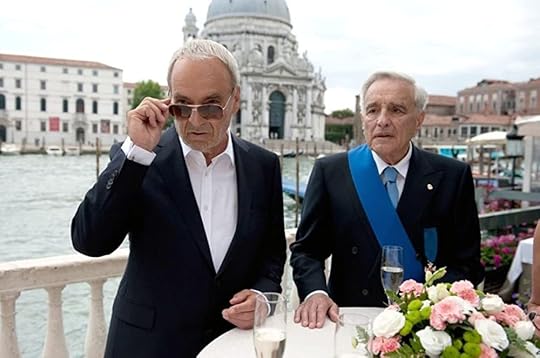
Actor Michael Degen as Vice-Questore Patta and actor Walter Kreye as Maurizio de Rivera, with a view of Santa Maria della Salute (Saint Mary of Health), Venice, Italy in the background in a film still from the German television adaptation of "Beastly Things" (2015). Image sourced from IMDB.

Trivia and Links
There is a really fascinating interview with author Donna Leon at ItalianMysteries.Com even if it was done 18 years ago. She discusses all sorts of background to the books and characters and also gives the reason that she won't allow the books to be translated into Italian (and it wasn't because she feared criticism by her neighbours in Venice).

Coincidentally Beastly Things, as the 21st Brunetti book, was filmed as the 21st episode "Tierische Profite" (Animal Profits) (2015) of the German language TV series (2000-2019) based on the Donna Leon / Commissario Brunetti series. The series was otherwise not filmed in the order of the books. That entire episode (German language, but you can turn on auto-generated English subtitles) is available on YouTube here.

An English language summary of the German language Commissario Brunetti TV series is available at Fictional Cities (Spoilers Obviously). As explained in the above interview, the TV-series was a German production as the books took off in popularity the most in the German speaking countries of Europe as Leon's publishing agent was Swiss-German and knew that market the best.
Profile Image for Rose.
2,016 reviews1,095 followers
April 21, 2012
Donna Leon's "Beastly Things" is one among a long standing series of mysteries revolving around Commissario Guido Brunetti, taking place in the heart of Venice, Italy. It's my first novel in the progressive series, but from what I understand, it's a mystery that's self-contained, so readers who are just joining the series can partake with it without feeling like they've missed anything. For me, I didn't have as intimate a connection with Guido Brunetti as perhaps other readers who've followed the series probably have, but there was enough of a balance between examining Guido's life and the case details to draw me into the story.

The story begins with a body found in the local river, an unidentified man with a very distinct condition. The man is later identified as a veterinarian who had a very complicated personal and professional life, involving quite a few players who could've had a hand in his death. The story toggles between the ongoing mystery and Brunetti's personal life and professional pursuits, with emphasis in the beginning on rounding out Brunetti's character and his routines. There's also special attention paid to atmosphere and political/social climate of the city. I do like the focus on these attributes, though it takes a bit longer for the story to gain momentum (I would say you learn very little about the actual mystery until about 100 pages in). Once the players are introduced as well as the conflicts, the story really takes off and keeps you guessing with some stark revelations. It starts with the illegal slaughtering of animals and develops into a complex intertwining of relationships, betrayal and corruptive practices.

If you're looking for an action oriented mystery with sharp turns, this isn't the kind of story that will engage you. It's more atmospheric and contemplative than most harrowing mysteries that I've had the opportunity to read. Thus, depending on how you like your mystery and its respective players - this will either be a hit or a miss. Even with that, I found myself enjoying the guesswork and allowing the mystery and its players to settle on me, almost as if I were just taking the details of the collective story as it came across. There are some gruesome descriptions (forewarning to those who love animals) contained in-text, but none to the point where it's out of context with the story progression.

Brunetti himself is a likable character, one I appreciated seeing the bird eye view into his personal as well as his professional life. I think there was only a limited window as to how much I could identify with his character since this was my introduction to him, but I liked his sense of morality and reflections. It does make me curious to see how his character comes across in the progressive series.

I would say this is probably a good novel to take on in and of itself, probably not the best introduction to Brunetti from what I can tell, but certainly worth a read for those who like a more reflective mystery with a likable detective.

Overall score: 3/5

Note: I received this as an ARC from NetGalley, from the publisher Grove/Atlantic Inc.
Profile Image for LJ.
3,159 reviews305 followers
May 3, 2012
First Sentence: A man lay still, as still as a piece of meat on a slab, as still as death itself.

It starts with a body found in a canal; stabbed to death, no wallet and wearing only one shoe. His physical structure should make him fairly easy to identify, and does. A man who loves animals and is separated from his wife who seems not to particularly care that her husband is dead. But it is the man’s secondary profession which raises questions, not only about the murder, but about the politics and ethics of being Italian.

Let’s start with the fact that I love the map on the inside covers. Maps are wonderful things. They accentuate the sense of place and allow you to “walk” with the characters.

Now let’s talk about Leon and how wonderful is her style and voice. “If a man who always lies tells someone he is a liar, is he telling the truth? If no one is alive in a room, is the room empty?” it is not only Leon’s narrative that is compelling, but her dialogue, which has a natural flow and intelligence particularly, in this book between Brunetti and Signorina Elettra, one of the most intriguing character currently being written. Brunetti is a true Venetian. He loves his city, his family and his food. He doesn’t understand how people can stand living where they need cars. He recognizes the pervasive dishonesty in the ways things are done, even in himself.

Usually, the descriptions of food usually leave the reader hungry. However, in this book rather than compelling you to the kitchen, it could forever change what you eat. There is an extensive scene which may leave readers extremely uncomfortable, however, it is factual and shows how easily greed can dominate ethics.

The story is, as always, extremely well written. Because of the focus on social issues, which were interesting and important, I did feel the plot taking an occasional second seat.

“Beastly Things” is not my favorite of Leon’s books, but saying it was very good, is comparable to lesser authors being excellent. I did appreciate that, in this book, justice is served.

BEASTLY THINGS (Pol. Proc-Comm. Guido Brunetti-Venice, Italy-Contemp) – VG
Leon, Donna – 21st in series
Atlantic Monthly Press, 2012
1,090 reviews17 followers
August 3, 2012
There usually are three common elements in any Guido Brunetti mystery: The City of Venice plays a central role. Then there is the crime for the Commissario to solve. And, lastly, there is a significant social issue running through the novel. This, the 21st novel in the series, is no exception. A man is fished out of a Venetian canal, having been stabbed in the back. Brunetti sets off to find the murderer, and witnesses corruption on a massive scale among public officials and private business.

Looking at the retrieved body, Brunetti has the feeling that he has seen the man before, recognizing his odd shape. Later, learning the man suffered from a rare disease causing his upper torso to enlarge, the Commissario remembers where he saw the victim, enabling him to identify the man. From this point, the novel essentially becomes a straightforward police procedural.

Sprinkled throughout the story are Brunetti’s observations and philosophical musings, giving the book a certain flavor and embellishing his personality. Unlike previous entries in the series, however, it lacks the usual deep look into his taste for food and his wife’s ability to provide haute cuisine to a family of four (including recipes at the back of the book). It’s unfortunate because such information really spices up the novels. However, any Brunetti mystery is well worth reading, and is recommended.

Profile Image for Beverly Swerling.
Author 23 books250 followers
April 26, 2012
I adore Leon's Brunetti series for the writing, the superb characterization, and the exquisite evocation of beautiful Venice. If her stories display cracks it is in the area of plot, and in Beastly Things that fissure is a bit wider than usual. It isn't that the events that create incident in BT are illogical or forced - sometimes what we mean when we talk of a less than wonderful plot. The problem here is predictability. Everything fits too well.

Leon writes with no foreshadowing, that's part of her technique and it creates the immediacy that is one of the great pleasures of her novels, but surprise is one of the linchpins of the mystery and there is none here. As the story unfolds we see the lives of the characters spread out on the page - happening in real time as it were. We sink into them sighing with pleasure as we too make our way through the crowds of tourists and struggle to find a place on the vaporetto. In the course of the passing days we make an immediate guess at the murderer. From there on it's a straight line until all is revealed.

I loved reading this nonetheless. I expect other pleasures from Donna Leon and those she delivers here as always, but I wish she would free her imagination and allow us the moment of astonishment at writerly cleverness.
Profile Image for Claire .
427 reviews64 followers
April 29, 2019
As always, Donna Leon presents an excellent story. As a detective writer, she raises often social issues ( here the bio industry), comparable to some of the the excellent scandinavian noir writers. But contrary to these writers, her commissario Brunetti is a likable character. Living in a world of beauty and elegance, he forms a serious contrast with the work he is devoted to.
Profile Image for Ashling.
129 reviews17 followers
July 9, 2023
Siempre me gusta reencontrarme con Brunetti y Venecia, esta vez el caso es tan actual a pesar de que el libro se publicará en 2012.
El final me ha parecido muy emotivo.
Profile Image for Laura.
7,132 reviews606 followers
January 18, 2015


I received this book as a digital ARC from the publisher through Net Galley in return for an honest review.

Publication date: April 17, 2012.

This is the first book I read by Donna Leon and I really liked it.

The plot is about a murder investigation when the body of a man is found in a canal without any kind of identification.

Commissario Brunetti is in charge of this crime and the police takes at least two days in order to find the true identify of the unknown victim since nobody claims for his disappearance even if he has a very rare disease, the Marlung disease.

After have found his true identity, the pace of the narrative accelerates. The reader is wrong to think that it is a simple case of a murder investigation because other developments of the story emerge as the search for the killers deepens.

I must confess that I was reluctant to read books of this author because I thought it was only the most best-selling author not realizing that it was more a master of crime fiction.

A very interesting aspect of this book and the author portrays the Commissioner Brunetti as a normal human being and not as a detective gifted with supernatural powers to solve a murder case.

Another very interesting aspect of this book is that the author throughout the narrative portraying aspects of contemporary daily life in Venice reporting, for example, how an old woman complains of the unwanted presence of tourists in her city but does not behave in a civilized way in this regard.
Profile Image for Andrew Smith.
1,252 reviews984 followers
June 16, 2012
The plot is incidental, reading Donna Leon is all about the people who live within the confines of the city of Venice. More accurately it's about the place, the history and the customs of Venice. I can drown happily in the daily routines and the rustic beauty of the place. Yes, I know you can't actually see it, but I feel that I can. This latest story focuses on a murdered vet and some shady goings on at a slaughter house, but don't worry about that. Pour yourself a glass of Prosecco, put your feet up and lose yourself in the atmosphere of this wonderful series.
Profile Image for Toni Osborne.
1,602 reviews53 followers
October 10, 2012
Book 21 in the Commissario Brunetti series

The appeal in this series has been the leisurely approach Commissiario Brunnetti has in solving crimes, it was refreshing to see him pick up the pace and exert himself with a lot more hands on action this time. The structure has not change a whole lot, we still experience Venice through the eyes of Brunetti and of course his wonderful family and their customs always play an important part in the staging of the mystery. This novel explores the dark side of Italy’s meat industry and covers the widespread corruption that drives it.

The mystery opens when a body of a man is discovered in a canal without any usual source of identification on him. It is his distinct medical condition that enables Brunetti and his team to eventually identify him. He is a veterinarian, separated from his wife and known to moonlight at times at a slaughterhouse. With the help of the devious Signorina Elettra, a hardened hacker, the team finds themselves slowly infiltrating the world of veterinarians and abattoirs. They soon realize there is an organised criminal side driven by human greed that may have something to do with the murder.

After reading this novel you may think twice about the food you eat and may even turn you into a vegetarian. As a counterbalance, the author adds her usual colour to the story by describing Brunetti’s leisurely lunches prepared for him by his lovely wife, pastries and pasta seems to be an Italian favourite. Ms. Leon’s characters are well developed and very believable and her plot doesn't shy away from dealing with social issues. The story is atmospheric and develops into a complex intertwining of relationships, betrayal and corrupt practices. I enjoyed the guesswork including the gruesome descriptions that came across in some of the chapters.

This is another captivating tale with Italy as a backdrop, the author’s speciality.
Profile Image for Jon.
1,456 reviews
May 12, 2012
Unlike several of Donna Leon's most recent Brunetti mysteries, this one has a very clear-cut position on exactly who is guilty of what, and the matter is resolved in pretty much the traditional mystery way. The title refers both to the murder victim, who is a veterinarian, and to a slaughterhouse and meat-processing plant where he worked. At one point Brunetti visits the killing floor, and I will not be surprised if he follows his daughter in becoming a vegetarian in the next book. Perhaps I'm just in a bad mood, but this one seemed a bit flat. As always, I enjoyed spending time with the main characters, but it all seemed a bit perfunctory, with the usual characters doing the usual things, and rampant corruption ruling pretty much every aspect of Venetian and Italian life.
23 reviews5 followers
November 25, 2012
Reading a Guido Brunetti novel is like meeting up with an old friend. You know what to expect, but it's always enjoyable, usually stimulating and sometimes surprising. Based broadly around issues of animal welfare and ethical food production, Beastly Things has the usual mix of Byzantine Italian politics, power and privilege. This one is a little more mainland-based than usual, but still provides a Venice fix for fellow Italophiles. There's more sexual politics than usual, and the novel has a harsher view of human nature than earlier Leon novels.

I'd place this as one of my favourite Brunetti novels. I was moved by the story, and the final scene brought tears. Highly recommended.
Profile Image for Gisela Hafezparast.
646 reviews61 followers
July 25, 2017
This is one of my favourite Brunetti novels so far. The characterisation of this one is more varied with all the characters being drawn well. It is another insight into Venetian life, this time also drawing on issues of the mainland. I have just come back from from a wonderful trip to Venice which made Venice even more vivid. Great background stories as well as a really interesting crime. Would really recommend this book.
Profile Image for booksofAhu.
287 reviews39 followers
September 8, 2017
This series is one of the books I read time to time. Though they are under the category of mystery/crime, I see these books more like fiction novels.
I like how author presents the social and emotional sides of each event. It is not just solving the crime, it is reasons, effects, before and afterwards.
* Though I like meat a lot, I am seriously considering going vegan.
* At the end the funeral, so touching..
Profile Image for Pamela.
1,673 reviews
March 19, 2025
Brunetti investigates the murder of a man whose body is found in a canal. First he needs to identify the man but he has very few leads, until a chance memory opens up a story of greed, corruption and cruelty.

This was a dark story without any of the usual lighter moments - Brunetti’s family make limited appearances and even his interactions with Signorina Elettra and Patta are subdued and serious - and at times it becomes positively gruesome (there is a rather unpleasant description of a visit to a slaughterhouse). However, it was compelling and very neatly put together, with a really touching final chapter.
Profile Image for Ed.
955 reviews148 followers
January 15, 2023
Six-word Review- Excellent story: plot. characters, dialogue, conclusion.

I've read most of the Commissario Guido Brunetti mysteries. This was one of the best. It starts with the discovery of a body in one of Venice's canals that had been stabbed to death. One obvious identifying characteristic was that he suffered from Madelung; a debilitating disease that resulted in the expansion of his upper body. The story moves rather slowly to identifying him and interviewing family, colleagues, and friends. It turns out his life as a veterinarian was somewhat complicated as he also had a job at a nearby meat slaughterhouse and was going through a legal separation from his wife.

At about the three-quarter mark, the story accelerates and Brunetti brilliantly not only solves the murder but arranges for the killer to be implicated beyond any doubt.

The beauty of Leon's writing is her working with all the people in Brunetti's life. His incompetent boss and super competent office administrator. His friend and colleague Vianello, his family, wife Paolo, an English literature professor, and his two very bright children. She also does a great job of exploring Brunetti's thinking and feelings as he deals with a corrupt system and still is able to successfully solve cases even when powerful people are involved.

Leon also knows Venice, the vagaries of the Italian psyche, the political climate in Italy, and everyone's commitment to eating well, Providing the reader with a full-bodied experience on the printed page.

It would be helpful I think to read some of the earlier volumes in this 24-book series but please don't deny yourself the pleasure of reading this book if it's what you have.
25 reviews
March 11, 2025
Another great read by Donna Leon set in Venice where Commissario Brunetti is asked to identify a dead man and uncovers a world of blackmail and corruption taking place at the local abattoir. Descriptive language throughout provides a vivid picture of Venice and the Venetian way of life, although the description of the abattoir is not for the faint-hearted ( and might even persuade you to become vegetarian....)
This entire review has been hidden because of spoilers.
1,602 reviews5 followers
May 19, 2017
Nopealukuinen ja ihan ok Brunetti-kirja, jossa tällä kertaa keskityttiin enemmän juoneen kuin Brunettin perheen tai ruoan kuvaamiseen. Näitä lukee aina mielellään, vaikkei näissä sen syvällisempää monesti olekaan. Tämänkin kirjan eläinsuojelullinen anti jäi aika ohueksi.
Profile Image for Heleen.
9 reviews7 followers
April 8, 2021
From the very start, this book struggled to inspire me. While a detective story, the book remarkably fails to be mysterious nor does the plot - which takes ages to get to (around page 300) - come as a surprise. Frankly, quite the waste of time.
110 reviews4 followers
April 26, 2012
Very exciting to go to the library and find the latest Donna Leon novel, set always in Venice. The author chooses a contemporary Italian problem as the nexus of each novel; in this case the safety of the meat industry. Commissario Guido Brunetti will find a way to deliver justice, but maybe not the legal way--in Italy, that could take too long. In this book Brunetti enters the 21st century--when he enters his office, there is a computer on his desk. Usually he relies on Pucetti and Signorina Elettra to gather information for him, but now he begins his own searches. Venice is always the background: the cafes, the tides, the white wine, the vaporetti, and it is always a pleasurable journey toward the solving of the murder. The chapter as Brunetti and Vianello gather information at the slaughterhouse is the foil for Venice, but necessary.

"None of the three men spoke as they passed under the bridge, nor when they passed under the nesxt one and the others, nor when they passed the Basilica, and San Giorgio on the right. What would it be, Brunetti tried to imagine, to see all of this for the first time? Virgin eyes? It came to him that this assault of beauty was the opposite of what had happened in Preganziol (the slaughterhouse), though each experience was overwhelming, each ravishing the viewer in his own way." (160)

Brunetti, his loyal colleagues, his family and Donna Leon all love their city.
Profile Image for Linda.
1,319 reviews52 followers
June 1, 2013
Vianello, Signorina Ellettra, and Guido Brunetti's daughter all gave up eating meat, especially beef, some time ago, for humanitarian reasons and also because so many diseased animals end up in the food chain. The topic is beginning to give gourmand Brunetti serious pause. When he's assigned to the case of a veterinarian whose body, punctured with stab wounds, is found floating in a canal, he'll soon have even more reasons to watch what he eats.

Beastly Things is a fine police procedural, in which readers can follow the steps to identifying, first, a John Doe (Giovanni Doe?), and second, the motive for his murder. Brunetti is at the top of his form, as always concerned with both justice and social ethics. Over the years (this is Brunetti #21), author Leon has developed into fine art the ability to inject and weave together both themes without resorting to preaching. One of the characters, for example, embeds a message to his little boy into a bedtime story. Brunetti and Vianello are so deeply affected by their visit to a slaughterhouse that they can't even talk about it between themselves. And her plotting and dialogue are impeccable. As always, La Serenissima is very much a character.

Leon closes this book with the most evocative, moving, and meaningful description of a funeral that I've ever read, or experienced, for that matter. She's another who's at the top of her form.
Displaying 1 - 30 of 841 reviews

Can't find what you're looking for?

Get help and learn more about the design.