A country gentleman named Van Cheele finds a wild adolescent boy living on his woodland property, after his friend Cunningham told him that there was a wild beast living in those woods.
He asks what the boy is doing there, and the boy tells Van Cheele that he lives in the woods and that he feeds on animal flesh...
British writer Hector Hugh Munro under pen name Saki published his witty and sometimes bitter short stories in collections, such as The Chronicles of Clovis (1911).
His sometimes macabre satirized Edwardian society and culture. People consider him a master and often compare him to William Sydney Porter and Dorothy Rothschild Parker. His tales feature delicately drawn characters and finely judged narratives. "The Open Window," perhaps his most famous, closes with the line, "Romance at short notice was her specialty," which thus entered the lexicon. Newspapers first and then several volumes published him as the custom of the time.
This has Saki staples: short sharp wit involving upper class Edwardians, aunts, animals, and children outsmarting adults. But his darker side (horror) and gay side (a bit of homoeroticism) are more evident than usual.
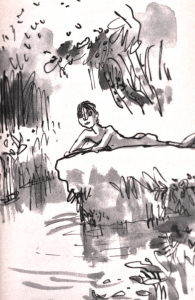
The plot is simple enough to be a children’s story - and Quentin Blake has illustrated it as such, with a few other Saki stories. But it’s also an exploration of duality and what’s beneath the veneer of respectability - especially during puberty.
“A boy of about sixteen lay asprawl, drying his wet brown limbs luxuriously in the sun. His wet hair, parted by a recent dive, lay close to his head, and his light-brown eyes, so light that there was an almost tigerish gleam in them, were turned towards Van Cheele with a certain lazy watchfulness.” Image: The boy in the wood, by Quentin Blake - somewhat sanitised? (Source.)
People tend to see what they want or expect to see: a painter sees a muse; a landowner sees a poacher; and a philanthropist sees a charitable cause.
The mix of mild horror and humour reminded me a little of Oscar Wilde’s The Canterville Ghost published 20 years earlier (see my review HERE).
Quotes
• “It was his custom to take mental notes of everything he saw during his walks, not so much for the purpose of assisting contemporary science as to provide topics for conversation afterwards.”
• “A naked homeless child appealed to Miss Van Cheele as warmly as a stray kitten or derelict puppy would have done.”
• “‘We must call him something till we know who he really is,’ she said. ‘Gabriel-Ernest, I think; those are nice suitable names.’ Van Cheele agreed, but he privately doubted whether they were being grafted on to a nice suitable child.” [Part archangel, part serious and honourable is a lot to live up to!]
More Saki
I'm gradually collating reviews of Saki short stories under The Best of Saki, HERE, as I read them in a rambling way, over several weeks and months.
You can find his stories, free, on Gutenberg. For example, HERE. Most are very short.
A friend is talking about a 'beast in the woods'. But what is that beast and what has a mysterious young boy to do with it? Uncanny story with interesting twists and a peculiar best. Recommended!
A short interesting take on a werewolf in Victorian England. A lot of tongue-in-cheek, but with a strong horrific element. Quite interesting & good. I got this through Librivox on Saki's page here: https://librivox.org/author/889?prima...
Well narrated & highly recommended. It can be listened to online.
This short story appears in numerous anthologies since it is long out of copyright and can therefore be reproduced at no cost. For me it has the flavor of a Rudyard Kipling Jungle Book tale, only told about an adult male in a British colonial village of indeterminate place who discovers a werewolf in its human guise by the watering hole. The story is about the man's process of discovering the situation and the suspense comes from wondering if his realization will come in time. It's a well-crafted read, highly recommended.
This story was really good. A bit of a werewolf story with a twist. Enjoyable but not as good as other stories by this author. In all it is entertaining. 3 stars.
First published in The Westminster Gazette in 1909 and then in Saki's second volume of stories 'Reginald in Russia' in 1911 it is, I believe, the first of Saki's first rate, astounding and guaranteed to live on, short story. At their finest his stories have an anarchic, subversive message that treats with utter contempt those in position of power and property and also he belittles their power and property. In Gabriel-Ernest the ostensible hero Van Cheele is man of substance, property a man at the head of his community. The fifteen year old boy he finds trespassing on his property is clearly without rank, property or position, the boy doesn't even have any clothes. Yet when confronting the no doubt elegantly and expensively clothed Van Cheele in the outdoors and then in the drawing room the naked boy is in control; in fact his nudity is a matter of complete indifference to him. It is Van Cheele who bustles about ineffectually attempting, when his aunt comes upon him and the boy, to conceal the boy's nakedness. It is the aunt who provides the boy with a name, and clothes, and sets the story in motion.
It is a wonderful story, the first to really move onto bizarre and cruel territory. Gabriel-Ernest was, not the first, but the first substantial realised and developed adolescent character who carried a whiff, along with their good looks, of complete assurance of their attractiveness. None of Saki's later adolescent males are naked the way G-E is, though his physique is not described. As a school boy only a year or so younger then G-E I noticed how Saki had described Van Cheele came upon G-E lying on his stomach on the bank of a river but, after a brief conversation G-E turns over onto his back thus putting himself very much on display. I thought this specificity on the author's part about how much and what parts of G-E body were on display was significant - though I was not sure what that significance was.
For such a short work there are many ways of looking at and interpreting this story and I haven't touched on the lycanthropic elements. Like all Saki best stories it is one that you read again and again. There are not many authors that I read at 13 and have continued to read, and enjoy. Stories like this are simply priceless.
Entertaining listening 🎧 A will written novella by Saki about a family finding a young lad who appears to become a wolf? And then disappears. I would recommend to anyone looking for a quick read. Enjoy 📖😎🎉 2022
Seemingly straightforward Aesopian fable with a reality check by the end. Spoilers.
Once the story has thoroughly made you aware that Gabriel-Ernest is not really an adorable young man, but actually a child-eating murderer, you're not surprised. It's not a reveal or a twist in that way. The darkness is that, by the end, he has a public statue in his honor, and no one knows (or is willing to learn?) the truth of his horrors.
This is a slightly iconoclastic story presented a bit like The Boy Who Cried Wolf in reverse. Instead of the boy being wrong, he's right, but the dark truth stays hidden away from the townsfolk who have come to revere it. Highly relevant story in the wake of USA's confederacy monuments, or even Andrew Jackson and his blood-soaked smugness on the 50-dollar bill.
The extra darkness comes out in juxtaposition to its kind of jolly and humorous manner of being told. It's presented like a children's fable with the lesson being "be careful what you believe and who you worship, they might actually be a monster in the night."
Lì giungevano a frotte coloro che amano molto la musica, cioè moltissima gente, e in numero ancora maggiore coloro che amano solo la musica e che sanno scrivere senza errori di ortografia il nome di Caikovskij e riconoscono molti notturni di Chopin se li si avvisa prima… (pagina 22)
Per una volta il grand'uomo era stato preso dal desiderio di osservare da vicino l'effetto dei suoi sforzi, proprio come se in un momento supremo la mente direttiva di un Krupp avesse desiderato insinuarsi nella linea di fuoco di un duello d'artiglieria. (pagina 24)
Such a creepy and well-writte short story. I've read up a bit on Hector Hugh Munro, or Saki, and apparently he is considered a master of the short story (at least by the publisher who sold me his compleat works) and I can totally see that. A very short (under 10 pages) and very effective story. Excited to read more short stories by Saki.
The newly baought collection of short fiction, which I read this from, is going to be very expensive if I insist on buying more stuff from every author in it.
Ho letteralmente adorato questi otto racconti di Saki, considerato il maestro di Roald Dahl (concordo pienamente) per via della sua vena ironica e crudele presente in ogni storia e in ogni bambina e bambino protagonista: c'è chi terrorizza gli ospiti, chi si vendica di una zia piuttosto cattiva, chi è un licantropo e mangia bambini. Insomma, non le solite storie della buonanotte, ma storie di rivalsa dei bambini sugli adulti spesso e volentieri ottusi e incapaci.
Crudelissimo e divertente! Saki propone racconti brevissimi e che lasciano il segno. Le illustrazioni di Quentin Blake sono perfette per queste narrazioni e permettono di entrare in un universo fatto di donzelle dalla comicità nera, licantropi affascinanti, bambini cattivissimi ma a giusta ragione. Da leggere tutto d'un fiato, o al massimo due!
My fav gay werewolf story not written by Anne Rice! I like that it's sorta hot, and you just know that AUNTIE wants a peak at the naked guy under all the newspapers! Did the werewolf eat the first child that disappeared, or is that child the werewolf? And did the bachelors conjure up this naked guy in the woods? There is a lot going on! Almost perfect but Saki doesn't land the ending.
Entertaining, but not my type of stories. It really don't surprised me much, but I think its an acceptable tale for people who wonders about werewolves and that kind of fantastic creatures.
This short story was very interesting but not a lot happened. This young man was “adopted” but ended up kidnapping a child after explicitly stating how he missed human flesh.
A great old werewolf story that veers between tongue in cheek humor and psychological horror.
The protagonist finds a sly, amiable naked sixteen-year-old boy in the woods, who tells him "it's quite two months since I've tasted child-flesh." You would think what follows would be quite straightforward, but the protagonist's aunt takes in this "naked, homeless child" and the protagonist spends the rest of the story desperately trying to stop the boy from eating a toddler.
This entire review has been hidden because of spoilers.