

What do you think?

A Nasty Little War: The Western Intervention into the Russian Civil War
The first comprehensive history of the failed Allied Intervention in the Russian Civil War, a decisive turning point in the relationship between Russia and the West
Overlapping with and overshadowed by the First World War, the Allied Intervention in the Russian Civil War was one of the most ambitious military ventures of the twentieth century. Launched in the summer of 1918, it drew in 180,000 troops from fifteen different countries in theaters ranging from the Caspian Sea to the Arctic, and from Poland to the Pacific. Though little remembered today, its consequences stoked global political turmoil for decades to come.
In A Nasty Little War , top Russia historian Anna Reid offers a sweeping and deeply researched account of the conflict. Initially launched to prevent Germany from exploiting the power vacuum in Eastern Europe left by the Russian Revolution, the Intervention morphed into a bid to destroy the Bolsheviks on the battlefield. But Allied armaments, supplies, and loans could not prevent Russia’s anti-Bolshevik armies from collapsing, and the Allies were forced to retreat in defeat. The humiliation sapped British imperial swagger, chastened American idealism, and stoked militarism and nationalism in France and Germany. Combining immersive storytelling with deep research, A Nasty Little War reveals how the Allied Intervention reshaped the West’s relationship with Russia.
Overlapping with and overshadowed by the First World War, the Allied Intervention in the Russian Civil War was one of the most ambitious military ventures of the twentieth century. Launched in the summer of 1918, it drew in 180,000 troops from fifteen different countries in theaters ranging from the Caspian Sea to the Arctic, and from Poland to the Pacific. Though little remembered today, its consequences stoked global political turmoil for decades to come.
In A Nasty Little War , top Russia historian Anna Reid offers a sweeping and deeply researched account of the conflict. Initially launched to prevent Germany from exploiting the power vacuum in Eastern Europe left by the Russian Revolution, the Intervention morphed into a bid to destroy the Bolsheviks on the battlefield. But Allied armaments, supplies, and loans could not prevent Russia’s anti-Bolshevik armies from collapsing, and the Allies were forced to retreat in defeat. The humiliation sapped British imperial swagger, chastened American idealism, and stoked militarism and nationalism in France and Germany. Combining immersive storytelling with deep research, A Nasty Little War reveals how the Allied Intervention reshaped the West’s relationship with Russia.
346 pages, Kindle Edition
Published February 6, 2024
Ratings & Reviews
Friends & Following
Create a free account to discover what your friends think of this book!
Community Reviews
Displaying 1 - 30 of 70 reviews
December 6, 2024
The West in Whites vs Reds
A review of the Basic Books (US) hardcover (February 6, 2024) of the original John Murray (UK) hardcover (November 9, 2023).
I may not have known very much about the ground forces, but it was definitely a part of my Estonian school upbringing to learn that the foundation of the Estonian navy was through the ships Vambola and Lennuk being turned over to Estonia in 1919 by the British forces that had captured them from the Russians.
That event is not even mentioned in this book, but there are a few instances where the Estonian part of the conflict is mentioned. For instance there was this comment by one of the former Tsarist generals, now a White Army warlord Nikolai Yudenich:
In terms of details about the conflict, I think a better overall view would likely be found in Antony Beevor's Russia: Revolution and Civil War 1917-1921 (2022). But in terms of learning about how misguided a military intervention can be, this overview by Anna Reid is well done.
A review of the Basic Books (US) hardcover (February 6, 2024) of the original John Murray (UK) hardcover (November 9, 2023).
With Putin’s full-scale invasion of Ukraine, history is in some ways repeating itself. Again, the West is sending weapons and money; again, it has imposed economic sanctions; again middle-class Russians are fleeing into exile. Most of all, Russia is again in the grip of a millennial ideology: its leaders denying that Ukraine exists and threatening nuclear Armageddon, its population, save for a brave few, cheering them on or burying their heads in the sand.I suspect, unlike many readers, that I had some degree of earlier knowledge about the intervention of various World War One allied forces into the Russian Civil War (1917-1922). That was through my knowledge about my heritage country's somewhat concurrent Estonian War of Independence (1918-1920).
I may not have known very much about the ground forces, but it was definitely a part of my Estonian school upbringing to learn that the foundation of the Estonian navy was through the ships Vambola and Lennuk being turned over to Estonia in 1919 by the British forces that had captured them from the Russians.
That event is not even mentioned in this book, but there are a few instances where the Estonian part of the conflict is mentioned. For instance there was this comment by one of the former Tsarist generals, now a White Army warlord Nikolai Yudenich:
That left the Estonians, about whom the Whites were even more emphatic. Estonia, Yudenich spluttered, was ‘a piece of Russian soil, a Russian guberniya’, and the Estonian government – led by a conservative half-Russian former newspaper editor called Konstantin Päts – ‘a gang of criminals’ with whom he could have ‘no conversation.’The other bit of Estonian trivia, was the story of how British envoy Colonel Stephen Tallent divided the town of Walk into Valga (on the Estonian side) and Valka (on the Latvian side):
His trickiest diplomatic challenge was settling the status of Walk, an ethnically mixed border town claimed by both Latvia and Estonia. After four months of deadlocked talks he lost patience and unilaterally drew a zig-zag line through the town centre. ‘I was determined not to wait and argue… So as soon as I had unrolled my map on the table, I walked quickly to the door without making any farewells, entered my car, and drove straight off.’Otherwise this book documents the somewhat hapless efforts by the Allied Forces (mostly the British, American, French and Japanese) into both arming and supplying the various former Tsarist commanders who raised forces to battle the Red Army of the Bolsheviks. This was primarily egged on by Churchill in the UK. The forces of the so-called Whites were increasingly subject to mutinies & desertions and to horrific lawless murdering, pillaging and rapes of the people in their path, particularly pogroms against the Jewish population. This is generally known as the White Terror. Of course there was an opposing Red Terror as well.
In terms of details about the conflict, I think a better overall view would likely be found in Antony Beevor's Russia: Revolution and Civil War 1917-1921 (2022). But in terms of learning about how misguided a military intervention can be, this overview by Anna Reid is well done.
February 20, 2024
This book has some immensely revelatory elements but, and I hate to add this qualification, it is unsatisfactory because it isn't really just about Western Intervention in Russia, such a study would have to concentrate on the underlying ideological reasons, if any, for getting involved. It is, sort of, about the Russian Civil War, but by concentrating purely the activities of a selection of the, mostly, UK and USA participants (France barely gets a look in and Japan only a mention) she underplays its complexities most notably by her clichéd and totally erroneous impression of the Russian officer corps as being dominated by offspring of the nobility. Before the outbreak of war in 1914, and even more so after it, the Russian army had a higher proportion of officers from not only non-noble but peasant backgrounds then that of Germany, UK, France or any other European army. That doesn't mean they were liberals, they just weren't the carboard cut out caricatures Reid presents.
Also, although Reid delights in presenting the various UK officers who took part as uniquely absurd and exemplifying a sort of Bertie Woosterish dimness but she doesn't acknowledge that there was absolutely no difference between the 'twits' who went to fight in Russia and the twits who went off to fight the UK's colonial wars or govern her imperial possessions. They were all dim, ill-prepared and with a staggering sense of both their own sense of entitlement and their superiority over any sort of 'Johnny foreigner'. To understand how the UK behaved in the intervention in Russia you have only to look at how it behaved everywhere else. As an Irish person I come from a country who experienced this. Post WWI conflicts in Eastern Europe were simply colonial methods coming home to roost (I highly recommend Sven Lindquist's 'Exterminate all the Brutes' and Robert Gerwarth's 'The Vanquished: Why the First World War Failed to End')
Reid highlights two areas which have previously not received the attention they deserve:
1. The general atrocities committed by the White armies and which were overlooked/excused/ignored by the Intervention forces
2. The horrific pogroms by White forces against the Jewish populations in areas they controlled/occupied
what Reid lacks though is context. There was nothing new about either UK army officers or politicians ignoring brutal or irresponsible behavior by either their own troops or of their allies. For anyone who doubts this I suggest they look at what happened in Ireland 1919-1922 or look at what happened in Palestine during Britain's 'Protectorate' when police tactics developed in the 'war' against Irish 'rebels' were used against 'uppity' civilians there. David Cesarani's splendid 'Major Farran's Hat: Murder, Scandal and Britain's War Against Jewish Terrorism 1945-48' provides an excellent account. A more relevant example is the help, encouragement and blindness to events of appalling hideousness that the UK gave to Greece's genocidal pogroms against the Muslim populations of Turkey as she attempted to recreate a Greek empire in Anatolia. That British officers ignored atrocious behavior by their White colleagues in Russia was not exceptional, it was the norm throughout the UK's history of overseas aggrandizement.
In highlighting the anti-Semitism of the White army, the pogroms committed by them and the casual acceptance and cover up of all this by so many UK officers in Russia Anna Reid is to be congratulated, in particularly the incredibly unsavoury remarks of Winston Churchill both in public and via internal documents (quite why anyone found the denouncement of Churchill as a racist by protesters a few years ago shocking is inexplicable). Unfortunately Reid has taken up the thesis of Jeffrey Viedlinger's 'In the Midst of Civilised Europe' that what happened in 1918-21 was prefiguring the Nazi holocaust and runs with it with great enthusiasm. Unfortunately Viedlinger's thesis is specious and, if accepted, actual undermines the real horror of the Nazi genocide.
Let me be clear, what happened in 1918-21 was horrible, evil and wrong but, like the pogroms under Tsarism and unlike what the Nazis undertook, these atrocities were the result of the weakness of regimes. That doesn't mean the Whites were not anti-Semitic but it does mean that rather then being a carefully crafted, developed and implemented policy of a strong government it was the result of local, unregulated, unrestrained and often unwanted actions by White commanders and troops who barely acknowledged let alone followed the dictates of any authority outside their own.
This is were Reid's concentration purely on the 'Intervention' side of the Russian Civil War is so problematic. It is easy to isolate out Britain's involvement in the North of Russia from the overall Civil War but that becomes problematic when dealing with Siberia and utterly impossible and misleading when it comes to Denekin and the war in Southern Russia and Ukraine. That she then goes and attempts retrospective comparisons between the Ukraine in 1918-21 and today is simply absurd. That attempts were being made to create a Ukraine state is true but without the background in the complex relations of Poland at that time it is absurd - needless to say Reid says nothing about this and has no mention of such complicated and problematic battles as that commemorated at the Polish Cementary
of Obrońców Lwowa, Cmentarz Orląt, Cemetery of Eaglets, Orlat Cemetery (Google it I've given enough lectures).
Despite my reservations this is a good, if flawed book. It will be enjoyed most by those who come to subject knowing nothing. If you do know something then the books problematic elements stand out. Still I do not regret reading it - I just wish it was better.
Also, although Reid delights in presenting the various UK officers who took part as uniquely absurd and exemplifying a sort of Bertie Woosterish dimness but she doesn't acknowledge that there was absolutely no difference between the 'twits' who went to fight in Russia and the twits who went off to fight the UK's colonial wars or govern her imperial possessions. They were all dim, ill-prepared and with a staggering sense of both their own sense of entitlement and their superiority over any sort of 'Johnny foreigner'. To understand how the UK behaved in the intervention in Russia you have only to look at how it behaved everywhere else. As an Irish person I come from a country who experienced this. Post WWI conflicts in Eastern Europe were simply colonial methods coming home to roost (I highly recommend Sven Lindquist's 'Exterminate all the Brutes' and Robert Gerwarth's 'The Vanquished: Why the First World War Failed to End')
Reid highlights two areas which have previously not received the attention they deserve:
1. The general atrocities committed by the White armies and which were overlooked/excused/ignored by the Intervention forces
2. The horrific pogroms by White forces against the Jewish populations in areas they controlled/occupied
what Reid lacks though is context. There was nothing new about either UK army officers or politicians ignoring brutal or irresponsible behavior by either their own troops or of their allies. For anyone who doubts this I suggest they look at what happened in Ireland 1919-1922 or look at what happened in Palestine during Britain's 'Protectorate' when police tactics developed in the 'war' against Irish 'rebels' were used against 'uppity' civilians there. David Cesarani's splendid 'Major Farran's Hat: Murder, Scandal and Britain's War Against Jewish Terrorism 1945-48' provides an excellent account. A more relevant example is the help, encouragement and blindness to events of appalling hideousness that the UK gave to Greece's genocidal pogroms against the Muslim populations of Turkey as she attempted to recreate a Greek empire in Anatolia. That British officers ignored atrocious behavior by their White colleagues in Russia was not exceptional, it was the norm throughout the UK's history of overseas aggrandizement.
In highlighting the anti-Semitism of the White army, the pogroms committed by them and the casual acceptance and cover up of all this by so many UK officers in Russia Anna Reid is to be congratulated, in particularly the incredibly unsavoury remarks of Winston Churchill both in public and via internal documents (quite why anyone found the denouncement of Churchill as a racist by protesters a few years ago shocking is inexplicable). Unfortunately Reid has taken up the thesis of Jeffrey Viedlinger's 'In the Midst of Civilised Europe' that what happened in 1918-21 was prefiguring the Nazi holocaust and runs with it with great enthusiasm. Unfortunately Viedlinger's thesis is specious and, if accepted, actual undermines the real horror of the Nazi genocide.
Let me be clear, what happened in 1918-21 was horrible, evil and wrong but, like the pogroms under Tsarism and unlike what the Nazis undertook, these atrocities were the result of the weakness of regimes. That doesn't mean the Whites were not anti-Semitic but it does mean that rather then being a carefully crafted, developed and implemented policy of a strong government it was the result of local, unregulated, unrestrained and often unwanted actions by White commanders and troops who barely acknowledged let alone followed the dictates of any authority outside their own.
This is were Reid's concentration purely on the 'Intervention' side of the Russian Civil War is so problematic. It is easy to isolate out Britain's involvement in the North of Russia from the overall Civil War but that becomes problematic when dealing with Siberia and utterly impossible and misleading when it comes to Denekin and the war in Southern Russia and Ukraine. That she then goes and attempts retrospective comparisons between the Ukraine in 1918-21 and today is simply absurd. That attempts were being made to create a Ukraine state is true but without the background in the complex relations of Poland at that time it is absurd - needless to say Reid says nothing about this and has no mention of such complicated and problematic battles as that commemorated at the Polish Cementary
of Obrońców Lwowa, Cmentarz Orląt, Cemetery of Eaglets, Orlat Cemetery (Google it I've given enough lectures).
Despite my reservations this is a good, if flawed book. It will be enjoyed most by those who come to subject knowing nothing. If you do know something then the books problematic elements stand out. Still I do not regret reading it - I just wish it was better.

August 13, 2026
Military, diplomatic, political, and cultural history of the Allied intervention in the Russian Civil War of 1918 - 1925.
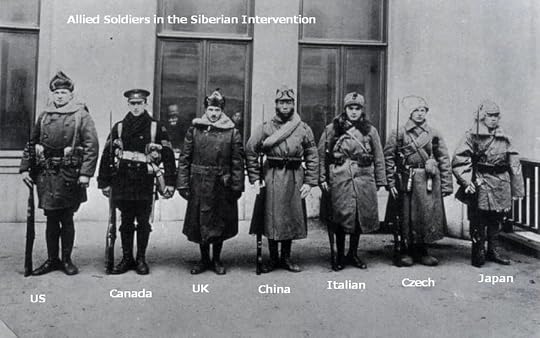
Allied Soldiers of the Siberian Intervention in the Russian Civil War centered on Vladivostok.
My audiobook version was a moderate 13 hours and 8 minutes long. It had a US 2024 copyright. A dead tree copy would be 400 pages and with a 2023 copyright. The paper or ebook versions include Maps, Notes, Illustrations, a Bibliography, and an Index, all omitted in the audio version.
Anna Reid is a British journalist and author focusing on the history of Eastern Europe. She is the author of four books and numerous articles. Interestingly, Reid narrated the audio version of her book. She was remarkably sure in her narration, which included the correct pronunciation of the period Eastern European and Russian place names. I eventually came to appreciate her posh English accent. This is the first book I've read by the author.
This was an intermediate-advanced work. Having background knowledge of the late 19th- and early 20th-century European military and diplomatic history, World War I, Eastern European and Russian geography, and the Russian Civil War would be helpful when reading this.
I have a strong interest in late 19th-century military and Diplomatic history, whose developments culminated in the second decade of the 20th Century with World War I. As Reid mentions in the concluding "Aftermath" chapter of her book, the end of that war and its peace treaty left Eastern Europe (including Russia) "fractured." Which meant that despite the war on the Western Front ending and the Treaty of Versailles being signed in 1919, warfare was still being waged in the territories of the ex-Imperial Russian and Austro-Hungarian empires for another six years. I've read a few books on this period. "It ain’t over till the fat lady sings" can be seen to apply to WWI and the Allies, given the very different war in Eastern Europe and Russia that was left running like a neglected faucet.
TL;DR
The Allied Intervention in Russia was intended to stave off the Bolsheviks and ensure a semblance of a Western democracy in the Baltic states, Poland, Finland, Russia, and the ex-Austro-Hungarian territories, principally the Ukraine, from the ongoing Civil War(s) there. This book chronicles the military and diplomatic actions and the internal politics of the Western Allies (Britain, the US, France, and Japan) to effect that. It also contains many anecdotes. In particular, descriptions of the conflict's barbaric nature and the Allies' political and diplomatic missteps were illustrative. The WWI Allies were only somewhat coordinated in their efforts despite their mutual involvement. The Japanese were undermining those efforts. This book mainly covers British and Commonwealth participation, but also American, French, and Japanese.
Reid's book contains a journalistic narrative of the conflict. It was similar to the American historian, ex-journo Rick Atkinson's type narrative. This made it easier to read than more scholarly efforts. The narrative also "checked all the boxes" I had on the conflict and added several new ones. If I'm critical, while the narrative had breadth, its depth was somewhat narrow. It was, firstly, very British-centric, and, secondly, American. These were the most important Western powers involved. However, minor Allies, like the French, and particularly the Japanese, who were preparing to extend their empire, and the Chinese, likewise at ringside in Siberia, received less or almost no attention. In general, Eastern Europe and European Russia received more attention than Asian Russia. She also drops a lot of names to bolster the cultural aspect of the history. I'm was not convinced all of them were important.
For a reader with the right preparation, this will be informative. However, this book is dense. I don't recommend Ear-reading it, let alone for missing the maps and illustrations.
The Review
“A nasty little war” was a term first used to describe the The Philippine-American War 1899 - 1902 by US General Frederick Funston and was used by the author to apply to the Allied Intervention in Russia. In retrospect, historically these "nasty little wars" of the early 20th Century have come to be considered ignominious affairs.
This was a polished semi-academic/popular work of history. It blended military and diplomatic, political, and cultural historical branches. I listened to the audiobook, ably narrated by the author. I could find no errors in its production. The speech was crisp, clear, and at the right level for an audience with some historical context.
My reservation is that the narrative was very much a Great Men (and rarely Women) narrative, with names named and deeds recounted. For example, one of the more interesting 'Great Men' was the British Brigadier General William Ironside. He was a larger-than-life figure in early 1900s Britain and a significant British military leader in the Intervention in Russia. His early acclaim led the author of a series of popular thrillers of the period John Buchan to use him as the model for his action hero Richard Hannay character. Unfortunately, the narrative only occasionally delved into the societal influences active during the Intervention, for example, the notorious corruption among the Whites being due to the collapse of the economy, which created hyperinflation of the ruble. Sea, land and air military actions were vividly described. However, these were tactical in nature. A solid operational and strategic description of the conflict as it unfolded was missing.
It should be noted that a closer reading would have been possible had I Eye-read this book and had access to the: Maps, Notes, Illustrations, Bibliography, and Index of the paper or eBook versions.
Allied expeditionary forces were sent to Russia in 1918. They came from Britain and Commonwealth countries, France, America, and Japan. The Intervention, as it was known, lasted seven years until a major western withdrawal in 1920, and a complete withdrawal with the Japanese in 1925. British influence was strongest in the North, around the Russian ports of Murmansk and Archangelsk, and in the Baltic, as well as in the South in the Black Sea and on the Caspian Sea and Iranian border. The French joined the British in the Black Sea at Odesa and Sevastopol. The Americans and Japanese were in Asiatic Russia, concentrated around the Russian port of Vladivostok. This region, like all of Russia east of the Urals, was referred to as Siberia.
The ostensible purpose of these forces was to safeguard Allied war supplies that had initially been provided to the Imperial Russians before the Bolsheviks. This was to occur before the Russian treaty with Germany, the Treaty of Brest-Litovsk, in late 1917, which took Russia completely out of WWI. After that, Russia descended into a civil war between the Reds (Bolshevik and related factions) and the Whites (Imperial and democratic factions). With the military defeat of Germany on the Western Front, the Intervention's mission changed to hindering a Bolshevik victory in the Civil War by abetting the creation of a friendly Western democratic, or at least monarchist, state through the Whites victory, and to opposing a hostile government whose objective was world revolution.
The change in the political objective of the expeditionary forces was disastrous. The different allied political leaders (Lloyd George, Woodrow Wilson , and Georges Clemenceau) had different visions of that objective reflective of their national priorities. They, except perhaps for the Japanese, also never committed enough military force to fulfill any of their objectives when the Whites turned out to be "a weak stick ."The Allied military leaders in Russia also either lacked or had only a vague grasp of their own nation's political objectives. In addition, there was no full understanding or in-depth knowledge of the Russian circumstances and situation in which the military forces were deployed. The western service personnel had the same "in-country" problem with Russians at all levels, as recounted in Reid's myriad anecdotes. In addition, the vastness of Russia, the primitive conditions outside urban areas, particularly in Siberia, and its climate were almost alien to the westerners in the expeditionary forces. The Intervention was likely the first practical instance of Winston Churchill's much later infamous description of Russia as "a riddle wrapped in a mystery inside an enigma." Note that Churchill, Minister of War in George's cabinet, was an avid interventionist in Russia. It temporarily ruined his political career. Finally, at the end of the Intervention, there was almost as much animosity between the Allies and the Whites as between the Whites and the Reds.
Part of the lack of understanding between the Allies and the Russians was the medieval level of brutality by both Reds and Whites in the Civil War. Reid carefully documents the rapine and murder, particularly the antisemitic pogroms of the Whites. In a great many cases, Westerners turned a blind eye to these barbaric behaviors. Reid maintained that antisemitism was endemic in British military and political leadership in Russia and at home at the time.
The fortunes of the Civil War seesawed back and forth. However, the Red faction under Vladmir Lenin and Leon Trotsky was more cohesive. The Red Army became more effective faster. The Whites split between the major factions of Anton Denikin in European Russia and Alexander Kolchak in Siberia never coalesced as the Allies had hoped for, and their troops became overly dependent on Allied military support. It should be noted that the Reds were more successful in their propaganda in enlisting the populace with promises of "Peace, Land and Bread" than the Whites were in what was the revival of an authoritarian Czarist-like regime. Finally, in parallel to the Russian Whites and the Reds conflict, there were armed nationalist independence movements in what is now Finland, Poland, Ukraine, and the Baltic states. Long after the Treaty of Versailles was ratified there was also German military and paramilitary influence in these countries. The national movements were fluid in the alliances they made and broke. Allied diplomacy with the Reds, the Whites, and the emerging nations was Byzantine.
The Russian Civil War took place against a backdrop of war weariness among the Western Allies, the hangover from World War I. All the major Western allies were under popular pressure to demobilize and cut taxes. The Intervention kept men at arms and spent a lot of money. Likewise, the wartime enlisted men of the Allied military wanted to return home. Paradoxically, for Allied officers, the Intervention was their last opportunity for advancement or recognition, now that the war in France was over. This resulted in aggressive behavior. Mutinies amongst Western service personnel were not uncommon.
Lloyd George eventually concluded Bolshevism "could not be suppressed by the sword," and pulled the British plug on supporting the Whites. With him followed the remaining Allies who withdrew, except for the Japanese. There was some effort to evacuate White leadership and sympathizers; however, the resources available were sparse. Only the rich, well-connected, and the lucky "got out" to form the "White Wave" of the Russian diaspora.
Reid stresses that the White Russian loss in the Russian Civil War was similar to the failed Intervention of the US in Vietnam: shifting political objectives, lack of understanding of Russia and Russians, inadequate commitment of forces, war weariness, and backing a corrupt and authoritarian regime all contributing to failure.
Summary
The Allied Intervention in Russia was a controversial issue in 1918 and has remained so. It spawned a "nasty little war ."The nastiness is the atrocities committed by both sides in the Civil War, but also the hardship and dislocation placed on the Russian and Eastern European non-combatants on both sides of the conflict.
This was a polished work of popular history, with scholarly use of primary sources evident in the supporting anecdotes. The audio prose was crisp, clear, and enunciated in proper Oxford-educated English to the correct level for this audience (myself).
The most interesting thing about this book was the organizational behavior of the post-war Imperial Britons who predominated in the narrative. The anecdotes were priceless in giving context. It's a very good example of late-19th-century and post-WWI British society.
However, the narrative was uneven. Only the Allied side of the conflict was present in the narrative. Even then, it was a majority-British, with a large American component and a much smaller French one. You'll have to read separately about Trotsky and Lenin's experiences in the Civil War to get the Bolshevik perspective. Also, the majority of the venues were Eastern European and European Russia. Siberia, despite the American presence, received short shrift. The Japanese Intervention, to which I have a particular interest and which was historically a prelude to their mainland Asian expansion later in the Century, receives only minimal dry reporting.
This was a combination of military and diplomatic, political, and cultural history. Reid succeeded with the cultural aspect, did very well with the British political aspect, and, to a lesser degree, with the Americans; did well with British diplomacy, and, to a lesser degree, with the Americans; and succinctly stated the facts of the military situation as it evolved. It did better as a cultural history than a military one, despite the nature of the Intervention.
That the Intervention occurred 110 years ago and was an abject failure, resulting in the loss of lives and treasure with no benefit to the Allies, is likely why it's so little known in the West, except by historians. However, there are important lessons to be learned in Russian Interventions. Reid notes that Vladimir Putin is the reincarnation of the White Russians. His drive is to reestablish the boundaries of Imperial Russia by incorporating Ukraine into the Russian Federation. This is an opportunity for Western Intervention. Sound strategic thinking and judgment are cautioned.
Armchair generals, early-20th-century political junkies, and 19th-century Russian and British cultural mavens will find Eye-reading worthwhile.
Allied Soldiers of the Siberian Intervention in the Russian Civil War centered on Vladivostok.
My audiobook version was a moderate 13 hours and 8 minutes long. It had a US 2024 copyright. A dead tree copy would be 400 pages and with a 2023 copyright. The paper or ebook versions include Maps, Notes, Illustrations, a Bibliography, and an Index, all omitted in the audio version.
Anna Reid is a British journalist and author focusing on the history of Eastern Europe. She is the author of four books and numerous articles. Interestingly, Reid narrated the audio version of her book. She was remarkably sure in her narration, which included the correct pronunciation of the period Eastern European and Russian place names. I eventually came to appreciate her posh English accent. This is the first book I've read by the author.
This was an intermediate-advanced work. Having background knowledge of the late 19th- and early 20th-century European military and diplomatic history, World War I, Eastern European and Russian geography, and the Russian Civil War would be helpful when reading this.
I have a strong interest in late 19th-century military and Diplomatic history, whose developments culminated in the second decade of the 20th Century with World War I. As Reid mentions in the concluding "Aftermath" chapter of her book, the end of that war and its peace treaty left Eastern Europe (including Russia) "fractured." Which meant that despite the war on the Western Front ending and the Treaty of Versailles being signed in 1919, warfare was still being waged in the territories of the ex-Imperial Russian and Austro-Hungarian empires for another six years. I've read a few books on this period. "It ain’t over till the fat lady sings" can be seen to apply to WWI and the Allies, given the very different war in Eastern Europe and Russia that was left running like a neglected faucet.
TL;DR
The Allied Intervention in Russia was intended to stave off the Bolsheviks and ensure a semblance of a Western democracy in the Baltic states, Poland, Finland, Russia, and the ex-Austro-Hungarian territories, principally the Ukraine, from the ongoing Civil War(s) there. This book chronicles the military and diplomatic actions and the internal politics of the Western Allies (Britain, the US, France, and Japan) to effect that. It also contains many anecdotes. In particular, descriptions of the conflict's barbaric nature and the Allies' political and diplomatic missteps were illustrative. The WWI Allies were only somewhat coordinated in their efforts despite their mutual involvement. The Japanese were undermining those efforts. This book mainly covers British and Commonwealth participation, but also American, French, and Japanese.
Reid's book contains a journalistic narrative of the conflict. It was similar to the American historian, ex-journo Rick Atkinson's type narrative. This made it easier to read than more scholarly efforts. The narrative also "checked all the boxes" I had on the conflict and added several new ones. If I'm critical, while the narrative had breadth, its depth was somewhat narrow. It was, firstly, very British-centric, and, secondly, American. These were the most important Western powers involved. However, minor Allies, like the French, and particularly the Japanese, who were preparing to extend their empire, and the Chinese, likewise at ringside in Siberia, received less or almost no attention. In general, Eastern Europe and European Russia received more attention than Asian Russia. She also drops a lot of names to bolster the cultural aspect of the history. I'm was not convinced all of them were important.
For a reader with the right preparation, this will be informative. However, this book is dense. I don't recommend Ear-reading it, let alone for missing the maps and illustrations.
The Review
“A nasty little war” was a term first used to describe the The Philippine-American War 1899 - 1902 by US General Frederick Funston and was used by the author to apply to the Allied Intervention in Russia. In retrospect, historically these "nasty little wars" of the early 20th Century have come to be considered ignominious affairs.
This was a polished semi-academic/popular work of history. It blended military and diplomatic, political, and cultural historical branches. I listened to the audiobook, ably narrated by the author. I could find no errors in its production. The speech was crisp, clear, and at the right level for an audience with some historical context.
My reservation is that the narrative was very much a Great Men (and rarely Women) narrative, with names named and deeds recounted. For example, one of the more interesting 'Great Men' was the British Brigadier General William Ironside. He was a larger-than-life figure in early 1900s Britain and a significant British military leader in the Intervention in Russia. His early acclaim led the author of a series of popular thrillers of the period John Buchan to use him as the model for his action hero Richard Hannay character. Unfortunately, the narrative only occasionally delved into the societal influences active during the Intervention, for example, the notorious corruption among the Whites being due to the collapse of the economy, which created hyperinflation of the ruble. Sea, land and air military actions were vividly described. However, these were tactical in nature. A solid operational and strategic description of the conflict as it unfolded was missing.
It should be noted that a closer reading would have been possible had I Eye-read this book and had access to the: Maps, Notes, Illustrations, Bibliography, and Index of the paper or eBook versions.
Allied expeditionary forces were sent to Russia in 1918. They came from Britain and Commonwealth countries, France, America, and Japan. The Intervention, as it was known, lasted seven years until a major western withdrawal in 1920, and a complete withdrawal with the Japanese in 1925. British influence was strongest in the North, around the Russian ports of Murmansk and Archangelsk, and in the Baltic, as well as in the South in the Black Sea and on the Caspian Sea and Iranian border. The French joined the British in the Black Sea at Odesa and Sevastopol. The Americans and Japanese were in Asiatic Russia, concentrated around the Russian port of Vladivostok. This region, like all of Russia east of the Urals, was referred to as Siberia.
The ostensible purpose of these forces was to safeguard Allied war supplies that had initially been provided to the Imperial Russians before the Bolsheviks. This was to occur before the Russian treaty with Germany, the Treaty of Brest-Litovsk, in late 1917, which took Russia completely out of WWI. After that, Russia descended into a civil war between the Reds (Bolshevik and related factions) and the Whites (Imperial and democratic factions). With the military defeat of Germany on the Western Front, the Intervention's mission changed to hindering a Bolshevik victory in the Civil War by abetting the creation of a friendly Western democratic, or at least monarchist, state through the Whites victory, and to opposing a hostile government whose objective was world revolution.
The change in the political objective of the expeditionary forces was disastrous. The different allied political leaders (Lloyd George, Woodrow Wilson , and Georges Clemenceau) had different visions of that objective reflective of their national priorities. They, except perhaps for the Japanese, also never committed enough military force to fulfill any of their objectives when the Whites turned out to be "a weak stick ."The Allied military leaders in Russia also either lacked or had only a vague grasp of their own nation's political objectives. In addition, there was no full understanding or in-depth knowledge of the Russian circumstances and situation in which the military forces were deployed. The western service personnel had the same "in-country" problem with Russians at all levels, as recounted in Reid's myriad anecdotes. In addition, the vastness of Russia, the primitive conditions outside urban areas, particularly in Siberia, and its climate were almost alien to the westerners in the expeditionary forces. The Intervention was likely the first practical instance of Winston Churchill's much later infamous description of Russia as "a riddle wrapped in a mystery inside an enigma." Note that Churchill, Minister of War in George's cabinet, was an avid interventionist in Russia. It temporarily ruined his political career. Finally, at the end of the Intervention, there was almost as much animosity between the Allies and the Whites as between the Whites and the Reds.
Part of the lack of understanding between the Allies and the Russians was the medieval level of brutality by both Reds and Whites in the Civil War. Reid carefully documents the rapine and murder, particularly the antisemitic pogroms of the Whites. In a great many cases, Westerners turned a blind eye to these barbaric behaviors. Reid maintained that antisemitism was endemic in British military and political leadership in Russia and at home at the time.
The fortunes of the Civil War seesawed back and forth. However, the Red faction under Vladmir Lenin and Leon Trotsky was more cohesive. The Red Army became more effective faster. The Whites split between the major factions of Anton Denikin in European Russia and Alexander Kolchak in Siberia never coalesced as the Allies had hoped for, and their troops became overly dependent on Allied military support. It should be noted that the Reds were more successful in their propaganda in enlisting the populace with promises of "Peace, Land and Bread" than the Whites were in what was the revival of an authoritarian Czarist-like regime. Finally, in parallel to the Russian Whites and the Reds conflict, there were armed nationalist independence movements in what is now Finland, Poland, Ukraine, and the Baltic states. Long after the Treaty of Versailles was ratified there was also German military and paramilitary influence in these countries. The national movements were fluid in the alliances they made and broke. Allied diplomacy with the Reds, the Whites, and the emerging nations was Byzantine.
The Russian Civil War took place against a backdrop of war weariness among the Western Allies, the hangover from World War I. All the major Western allies were under popular pressure to demobilize and cut taxes. The Intervention kept men at arms and spent a lot of money. Likewise, the wartime enlisted men of the Allied military wanted to return home. Paradoxically, for Allied officers, the Intervention was their last opportunity for advancement or recognition, now that the war in France was over. This resulted in aggressive behavior. Mutinies amongst Western service personnel were not uncommon.
Lloyd George eventually concluded Bolshevism "could not be suppressed by the sword," and pulled the British plug on supporting the Whites. With him followed the remaining Allies who withdrew, except for the Japanese. There was some effort to evacuate White leadership and sympathizers; however, the resources available were sparse. Only the rich, well-connected, and the lucky "got out" to form the "White Wave" of the Russian diaspora.
Reid stresses that the White Russian loss in the Russian Civil War was similar to the failed Intervention of the US in Vietnam: shifting political objectives, lack of understanding of Russia and Russians, inadequate commitment of forces, war weariness, and backing a corrupt and authoritarian regime all contributing to failure.
Summary
The Allied Intervention in Russia was a controversial issue in 1918 and has remained so. It spawned a "nasty little war ."The nastiness is the atrocities committed by both sides in the Civil War, but also the hardship and dislocation placed on the Russian and Eastern European non-combatants on both sides of the conflict.
This was a polished work of popular history, with scholarly use of primary sources evident in the supporting anecdotes. The audio prose was crisp, clear, and enunciated in proper Oxford-educated English to the correct level for this audience (myself).
The most interesting thing about this book was the organizational behavior of the post-war Imperial Britons who predominated in the narrative. The anecdotes were priceless in giving context. It's a very good example of late-19th-century and post-WWI British society.
However, the narrative was uneven. Only the Allied side of the conflict was present in the narrative. Even then, it was a majority-British, with a large American component and a much smaller French one. You'll have to read separately about Trotsky and Lenin's experiences in the Civil War to get the Bolshevik perspective. Also, the majority of the venues were Eastern European and European Russia. Siberia, despite the American presence, received short shrift. The Japanese Intervention, to which I have a particular interest and which was historically a prelude to their mainland Asian expansion later in the Century, receives only minimal dry reporting.
This was a combination of military and diplomatic, political, and cultural history. Reid succeeded with the cultural aspect, did very well with the British political aspect, and, to a lesser degree, with the Americans; did well with British diplomacy, and, to a lesser degree, with the Americans; and succinctly stated the facts of the military situation as it evolved. It did better as a cultural history than a military one, despite the nature of the Intervention.
That the Intervention occurred 110 years ago and was an abject failure, resulting in the loss of lives and treasure with no benefit to the Allies, is likely why it's so little known in the West, except by historians. However, there are important lessons to be learned in Russian Interventions. Reid notes that Vladimir Putin is the reincarnation of the White Russians. His drive is to reestablish the boundaries of Imperial Russia by incorporating Ukraine into the Russian Federation. This is an opportunity for Western Intervention. Sound strategic thinking and judgment are cautioned.
Armchair generals, early-20th-century political junkies, and 19th-century Russian and British cultural mavens will find Eye-reading worthwhile.

June 7, 2025
Covering similar ground to Antony Beevor’s 'Russia: Revolution and Civil War' ( which I’ve also been reading), this author focuses on the Russian Civl War after Lenin’s coup in 1917 - which is what it was rather than a popular Revolution - and the western involvement in it. Unlike Beevor’s book, there isn’t much about the events during the 20 years before which culminated in the overthrow of the Czar.
The book is focussed on western concerns and western characters, including those in the British and American armies sent initially to stop western supplied armaments and western assets finding their way into German hands, given that WW1 continued in France and Lenin was prepared to accept German demands for peace. The foreign forces then got involved in half hearted support of the ‘Whites’. A lack of western political will meant the western intervention was doomed to failure.
As with Beevor’s book, I haven’t yet finished it and might not do so. I’m about half way through and have lost enthusiasm for it.
The book is focussed on western concerns and western characters, including those in the British and American armies sent initially to stop western supplied armaments and western assets finding their way into German hands, given that WW1 continued in France and Lenin was prepared to accept German demands for peace. The foreign forces then got involved in half hearted support of the ‘Whites’. A lack of western political will meant the western intervention was doomed to failure.
As with Beevor’s book, I haven’t yet finished it and might not do so. I’m about half way through and have lost enthusiasm for it.

May 10, 2024
A fine piece of skilled and entertaining writing about an almost forgotten and overlooked part of European History.
The Western meddling in post revolutionary Russia is a subject that interested me from the moment I read about it. Unfortunatly it's not easy to find books about it, since this is an obscure part of history that's mostly swept under the carpet and rather forgot about. Especialy by the western powers who probably mostly have a feeling of shame about this failed little hiccup in their post imperialistic style of trying to control the world by violent means.
But not so much by Soviet Russia. Here this episiode was one of the reasons for a distrust in western powers and fed an already longer existing deeper resentment and paranoia in Russia about being encircled by Western Powers. This paranoia grew in Soviet Russia to immense hights under Stalin.
Together with the turning down of Stalin's proposal in 1938 to fight Hitler together, it is probably one of the main reasons why Stalin decided that the Soviet Union could only protect itself from be conquered from the west by creating a big block of protection in the eastern part of Europe after WW2.
In that way it's strange that this historical period has been largely overlooked by modern historians up to till now. It is mentioned in a few of the books written about WW1 and it's aftermath, but no thorough studies (the exception being Robert J. Maddox' 'The unkown war with Russia. Wilson's Siberia Intervention' from 1977. But finding a copy of this work is nearly impossible)
Anna Reid's book changes that. And rightly so.
Reid paints a vivid picture of a confusion historical period between the end of Tsarist Russia and the establisment of Bolshevik power. Some would say maybe a somewhat to vivid picture. Reid definitly prefers the renegade soldier of fortune story of, the mostly British and American, military men above the complicated and horrowing situation for a lot of local people. In my opinion though she keeps a fine balance. Moving the story forward with dashing anecdotes of difficult military action, but at the same time leaving room for the suffering of soldiers and locals during the fighting. And definitly not sparing the accountabiltiy of the western powers as far as cruelty is concerned. Even if it largely only consisted of looking away and closing their eyes for the torture and killing done by their white compatriots in the Civil war. This kind of cruelty was done by both sides in abundance, leaving a hopeless and desperate rural population as the real victims, caught between killing armies overtaking each other time after time. Some village changing rulers several time, each time having to plegde loyalty to their new 'victors'.
In this way 'A nasty little war' describes one of the most horrible episodes of modern history, with a lot of innocent people, mostly jews, being slaugthered, abused and driven away by both sides in a Civil War. Watched on from the sight lines by the Western Powers. Only to be outdone by the Nazi's 20 years later. Anna Reid disturbingly shows that the sentiments for this kind of behaviour in these parts of Eastern Europe were already there. They only needed to be organized to make it a Holocaust.
The Western meddling in post revolutionary Russia is a subject that interested me from the moment I read about it. Unfortunatly it's not easy to find books about it, since this is an obscure part of history that's mostly swept under the carpet and rather forgot about. Especialy by the western powers who probably mostly have a feeling of shame about this failed little hiccup in their post imperialistic style of trying to control the world by violent means.
But not so much by Soviet Russia. Here this episiode was one of the reasons for a distrust in western powers and fed an already longer existing deeper resentment and paranoia in Russia about being encircled by Western Powers. This paranoia grew in Soviet Russia to immense hights under Stalin.
Together with the turning down of Stalin's proposal in 1938 to fight Hitler together, it is probably one of the main reasons why Stalin decided that the Soviet Union could only protect itself from be conquered from the west by creating a big block of protection in the eastern part of Europe after WW2.
In that way it's strange that this historical period has been largely overlooked by modern historians up to till now. It is mentioned in a few of the books written about WW1 and it's aftermath, but no thorough studies (the exception being Robert J. Maddox' 'The unkown war with Russia. Wilson's Siberia Intervention' from 1977. But finding a copy of this work is nearly impossible)
Anna Reid's book changes that. And rightly so.
Reid paints a vivid picture of a confusion historical period between the end of Tsarist Russia and the establisment of Bolshevik power. Some would say maybe a somewhat to vivid picture. Reid definitly prefers the renegade soldier of fortune story of, the mostly British and American, military men above the complicated and horrowing situation for a lot of local people. In my opinion though she keeps a fine balance. Moving the story forward with dashing anecdotes of difficult military action, but at the same time leaving room for the suffering of soldiers and locals during the fighting. And definitly not sparing the accountabiltiy of the western powers as far as cruelty is concerned. Even if it largely only consisted of looking away and closing their eyes for the torture and killing done by their white compatriots in the Civil war. This kind of cruelty was done by both sides in abundance, leaving a hopeless and desperate rural population as the real victims, caught between killing armies overtaking each other time after time. Some village changing rulers several time, each time having to plegde loyalty to their new 'victors'.
In this way 'A nasty little war' describes one of the most horrible episodes of modern history, with a lot of innocent people, mostly jews, being slaugthered, abused and driven away by both sides in a Civil War. Watched on from the sight lines by the Western Powers. Only to be outdone by the Nazi's 20 years later. Anna Reid disturbingly shows that the sentiments for this kind of behaviour in these parts of Eastern Europe were already there. They only needed to be organized to make it a Holocaust.

December 17, 2024
Anna Reid's A Nasty Little War revisits the doomed Allied intervention in the Russian Civil War, where various foreign powers (Britain, France, the US, Japan and many other states) ill-advisedly sent troops and political support to the White Armies resisting the Bolshevik takeover of Russia. Reid shows that the intervention was really a series of loosely-related military campaigns with a variety of contradictory goals; initially designed to secure military supplies from German troops overrunning Russia, British and American intervention then hoped to revitalize the Eastern Front to draw troops away from Germany's onslaught in France. When World War I ended, the intervention's goals became more nebulous, some wanting to bolster the anticommunist Whites while others (particularly Japan) harboring nakedly imperialist designs. There was little political will among the Western Allies for collective action; Reid shows Woodrow Wilson's equivocations over the interventions, and how hawkish British statesmen like Winston Churchill had to overrule skeptical politicians and a war-weary public reluctant. With no direction or clear goals, Allied troops floundered in the frozen port of Arkangelsk, the South Russian oilfields and the vast expanses of Siberia, occasionally skirmishing with Bolsheviks, dying of disease and feuding with their Allies. Reid shows how the interventionists' greatest "accomplishment" was giving free rein to White leaders (from the Siberian strongman Admiral Kolchak to the demented Cossack Semyenov and dashing Baron Wrangel of the Crimea) to indulge in their worst impulses, from graft to endless pogroms targeting Jews. The war, Reid convincingly argues, with a massive waste of men and resources, not only failing in its alleged goals but antagonizing the Soviet Union, sewing the seeds of distrust that led to a decades-long Cold War.

November 23, 2024
This is a sweeping account of the intervention of Western Allies in the Russian Civil War. This account is a mix of politics and some of the skirmishes and atrocities that occurred in the presence of allied military personnel. It discusses the length and breadth of the War but does not concentrate on any one part for long. This was the author's intention, and she succeeded in this.
Russia was and is a big country. There were many facets to the war and several fronts. Books have been written about the Czech Legion, the Trans-Siberian Railroad, and the Polar Expedition, as well as the heroes and villains including Wrangel, Trotsky, Deniken, and Kolchak which tend to focus on a campaign rather than the overall war as this book does. This book filled in some gaps for me about the Baltic States and Finland. Even so, the reader should understand the book is about Allied intervention and is told from that perspective. It is not a book about who was right. The Bolshevik side is not detailed as it is not the focus of the author.
If you are interested in Russian history, especially the Civil War this book is a great book for your library.
Russia was and is a big country. There were many facets to the war and several fronts. Books have been written about the Czech Legion, the Trans-Siberian Railroad, and the Polar Expedition, as well as the heroes and villains including Wrangel, Trotsky, Deniken, and Kolchak which tend to focus on a campaign rather than the overall war as this book does. This book filled in some gaps for me about the Baltic States and Finland. Even so, the reader should understand the book is about Allied intervention and is told from that perspective. It is not a book about who was right. The Bolshevik side is not detailed as it is not the focus of the author.
If you are interested in Russian history, especially the Civil War this book is a great book for your library.

December 1, 2025
A vivid, balanced, and well-written work.
Reid does a good job explaining the American, British, Canadian, and Russian sides of this story, and the confused and ever-evolving aims of the powers who intervened, who never committed the sort of resources that would have contributed to “victory,” however defined. There were more nations involved in the intervention, such as the Japanese, Italians, French, Spanish, and Serbs, for example, but these stories aren’t described in as much detail, perhaps due to lack of source material. She also vividly describes the atrocities committed by the Bolsheviks, and how Allied officers often downplayed reports of White (and Polish) atrocities and pogroms. She also covers the disillusionment of Allied soldiers, who lacked their governments’ optimism about the ultimate success of their operations, and how the Whites often succeeded in manipulating the Allies. Reid also describes how the guns of the intervening powers were sometimes turned on on mutinous White forces.
The book is based largely on the letters, memoirs, and diaries of soldiers. Much of the narrative deals with the personal accounts of individuals. The portrait of commanders like Ironside, Knox, and Kolchak is also good. She also notes Churchill’s role in promoting intervention, and how, typically, he failed to really absorb any lessons from failure. She also attributes his motives to a desire to “retrieve his military reputation,” although his hostility to Bolshevism was genuine. Reid herself doesn’t address the question of whether the intervention had any chance of succeeding. The Kornilov affair is also summarized as “a right-wing general attempted a coup,” though the reality was almost the complete opposite.
A lively, engaging and well-paced work.
Reid does a good job explaining the American, British, Canadian, and Russian sides of this story, and the confused and ever-evolving aims of the powers who intervened, who never committed the sort of resources that would have contributed to “victory,” however defined. There were more nations involved in the intervention, such as the Japanese, Italians, French, Spanish, and Serbs, for example, but these stories aren’t described in as much detail, perhaps due to lack of source material. She also vividly describes the atrocities committed by the Bolsheviks, and how Allied officers often downplayed reports of White (and Polish) atrocities and pogroms. She also covers the disillusionment of Allied soldiers, who lacked their governments’ optimism about the ultimate success of their operations, and how the Whites often succeeded in manipulating the Allies. Reid also describes how the guns of the intervening powers were sometimes turned on on mutinous White forces.
The book is based largely on the letters, memoirs, and diaries of soldiers. Much of the narrative deals with the personal accounts of individuals. The portrait of commanders like Ironside, Knox, and Kolchak is also good. She also notes Churchill’s role in promoting intervention, and how, typically, he failed to really absorb any lessons from failure. She also attributes his motives to a desire to “retrieve his military reputation,” although his hostility to Bolshevism was genuine. Reid herself doesn’t address the question of whether the intervention had any chance of succeeding. The Kornilov affair is also summarized as “a right-wing general attempted a coup,” though the reality was almost the complete opposite.
A lively, engaging and well-paced work.

September 9, 2025
Exactly what I wanted in an overview. Not too many battles depicted, and a focus on the geopolitical issues. Useful maps for seeing where the various armies went. Stolid prose style, unfortunately. Character sketches of minor and major figures, all the main politicians behaving as poorly as imagined, and equally as bad were the military men. Much on the prevalent anti-Semitism that often led to pogroms throughout every level of every society. Recommended.

January 3, 2025
A Nasty Little War, Anna Reid
This is a very enjoyable book that looks at a very disreputable element of our history.
It concentrates on the Allied side of intervention, mostly on the British, with the Americans and the French taking lesser roles and the various other nations taking up even smaller space. The Red Army only really features as the enemy, with no narrative from their side, which does make this book somewhat unique.
For me, the most enjoyable part of this work is the extensive quotes from witnesses. These really do bring the history to life and make it more personal than just lists of divisions being moved about the map. There's a lot to be said for diary extracts and Reid comments on where the memoirs diverge from the known facts. This does make the work feel more intimate than Beevor, Smele, Swain or Mawdsley, etc.
I'm surprised that Reid didn't make more of the intelligence war, although in fairness this was a sideshow in a sideshow, but after watching Reilly, Ace of Spies, it is something that does capture your imagination. This is all dealt well with by Milton. The notoriously unhinged Ungern-Von Sternberg makes a brief appearance, but as he had nothing to do with the allied forces, swiftly exits stage left pursued by a (Red Russian) bear.
I was very pleased to find an account of what happened afterwards to people mentioned in the book and wouldn't have objected to this having been expanded.
This is a very enjoyable book that looks at a very disreputable element of our history.
It concentrates on the Allied side of intervention, mostly on the British, with the Americans and the French taking lesser roles and the various other nations taking up even smaller space. The Red Army only really features as the enemy, with no narrative from their side, which does make this book somewhat unique.
For me, the most enjoyable part of this work is the extensive quotes from witnesses. These really do bring the history to life and make it more personal than just lists of divisions being moved about the map. There's a lot to be said for diary extracts and Reid comments on where the memoirs diverge from the known facts. This does make the work feel more intimate than Beevor, Smele, Swain or Mawdsley, etc.
I'm surprised that Reid didn't make more of the intelligence war, although in fairness this was a sideshow in a sideshow, but after watching Reilly, Ace of Spies, it is something that does capture your imagination. This is all dealt well with by Milton. The notoriously unhinged Ungern-Von Sternberg makes a brief appearance, but as he had nothing to do with the allied forces, swiftly exits stage left pursued by a (Red Russian) bear.
I was very pleased to find an account of what happened afterwards to people mentioned in the book and wouldn't have objected to this having been expanded.

October 13, 2024
[P]olitical nonsense. Wasted time, money, and everything else. I suppose it kept a few of us from cluttering up the unemployment bureaux at home, but that’s about all…. It was an uncomfortable business really. A really nasty, dirty little war” was the harsh conclusion of British airman Christopher Bilney in a 1972 interview of the Allied involvement in the Russian civil war (1917-22). A judgement shared by all who look at the four years after the Great War when Russia’s erstwhile allies sent troops and materiel to bolster the anti-Bolshevik resistance to Lenin’s coup (this included both former Tsarist officials and right-wing militias as well as rival left-wing groups).
The Intervention, as Reid calls it, brings to mind more recent but similar operations in Viet Nam, Iraq or Afghanistan. And it suffered from many of the same things that afflicted those efforts: Imperial interests that ignored local; ill-informed foreign ministries; ill-conceived (and constantly changing) objectives; unwillingness to commit the resources necessary to have any hope of achieving said objectives; unmotivated troops with no idea why they were there; and support for local groups with little or no popular support.
Recommended. Reid does a good job of narrating a largely forgotten period following the Great War whose lessons still resonate over a century later (even if, by all indications, those lessons will be ignored).
The Intervention, as Reid calls it, brings to mind more recent but similar operations in Viet Nam, Iraq or Afghanistan. And it suffered from many of the same things that afflicted those efforts: Imperial interests that ignored local; ill-informed foreign ministries; ill-conceived (and constantly changing) objectives; unwillingness to commit the resources necessary to have any hope of achieving said objectives; unmotivated troops with no idea why they were there; and support for local groups with little or no popular support.
Recommended. Reid does a good job of narrating a largely forgotten period following the Great War whose lessons still resonate over a century later (even if, by all indications, those lessons will be ignored).
March 2, 2026
Like most people, I knew very little about the Russian Civil War when I started this book, despite being quite interested in the time period. This book taught me pretty much everything I was hoping to learn, and was an engaging read as well. It doesn't do anything out of the ordinary for a history book, but it gives justice to a period of history that isn't explored very often.


June 28, 2024
Anna Reid has written an excellent book here on an almost forgotten piece of military stupidity by various Western countries who attempted to stop the Bolsheviks from retaining power after 1917.
When the Bolsheviks took power and signed a peace treaty with Germany the allies - after some discussions - the Western powers decided to intervene. Seizing ports and helping the various war lords and 'whites' who fought the 'Reds' regardless of the incompetence, cruelty, venality, and stupidity of a lot of those people. But it was done on too small a scale, with troops that had no interest in being there - especially after the armistice. But it dragged on until 1920 when the Red Army finally wiped out most of their enemies or negotiated peace treaties with them.
The Americans seem to have regretted their involvement from the beginning and come out of this story the best. The French and the British on the other hand went in arrogant, fell for White propaganda, and helped make things worse by getting involved with the coups and schemes. They also looked the other way at cruelty, rape, murder, and looting. The pogroms undertaken by various allies of the West were ignored. Partly because a number of the men involved seemed to have been pretty antisemitic themselves to varying degrees and partly because they swallowed the 'Jews are revolutionaries are Bolsheviks' line.
Reid in her conclusion suggests that one of the seeds of this conflict grows into the Holocaust. She also suggests that Churchill's gung-ho support of the intervention undermined his standing to such a degree that when he tried to warn people about the Nazis no one took him seriously. He was a warmonger. And an antisemite - or at least a believer in the Jewish Bolshevik link. Churchill comes out of this book badly. Quite rightly.
Could the intervention have worked? No. Unless the West had sent in hundreds of thousands of men, banged heads together amongst the various White leaders - which almost certainly would have involved murder. And even then the size of Russia would have made it problematic. It could have been done but the death toll would have been horrific. And would any of the 'Whites' have ended up as better leaders that Lenin or Stalin?
The main victims, of course, were the Russian people and the men from the West who died in a pointless war.
Brilliantly written and with a nice touch for the occasional witty aside I highly recommend this as a way of learning about an historical event we don't hear much about.
When the Bolsheviks took power and signed a peace treaty with Germany the allies - after some discussions - the Western powers decided to intervene. Seizing ports and helping the various war lords and 'whites' who fought the 'Reds' regardless of the incompetence, cruelty, venality, and stupidity of a lot of those people. But it was done on too small a scale, with troops that had no interest in being there - especially after the armistice. But it dragged on until 1920 when the Red Army finally wiped out most of their enemies or negotiated peace treaties with them.
The Americans seem to have regretted their involvement from the beginning and come out of this story the best. The French and the British on the other hand went in arrogant, fell for White propaganda, and helped make things worse by getting involved with the coups and schemes. They also looked the other way at cruelty, rape, murder, and looting. The pogroms undertaken by various allies of the West were ignored. Partly because a number of the men involved seemed to have been pretty antisemitic themselves to varying degrees and partly because they swallowed the 'Jews are revolutionaries are Bolsheviks' line.
Reid in her conclusion suggests that one of the seeds of this conflict grows into the Holocaust. She also suggests that Churchill's gung-ho support of the intervention undermined his standing to such a degree that when he tried to warn people about the Nazis no one took him seriously. He was a warmonger. And an antisemite - or at least a believer in the Jewish Bolshevik link. Churchill comes out of this book badly. Quite rightly.
Could the intervention have worked? No. Unless the West had sent in hundreds of thousands of men, banged heads together amongst the various White leaders - which almost certainly would have involved murder. And even then the size of Russia would have made it problematic. It could have been done but the death toll would have been horrific. And would any of the 'Whites' have ended up as better leaders that Lenin or Stalin?
The main victims, of course, were the Russian people and the men from the West who died in a pointless war.
Brilliantly written and with a nice touch for the occasional witty aside I highly recommend this as a way of learning about an historical event we don't hear much about.

April 16, 2024
"Richard Nixon, delivering a Message of Friendship in Moscow in 1972, and Margaret Thatcher, receiving Mikhail Gorbachev at Chequers in 1984, both stated that their countries and Russia had never been at war. They were put right, but given its uniqueness the only time America has sent troops to Russia, and the only time since the Crimean War that Britain and France have - it is surprising how little discussed the Intervention still is today."
Reid gives a detailed account of the Allied intervention into the Russian Civil War - more comprehensive than I have read to date.
This conflict has always been an interest of mine - US troops sent to Russia during the conflict were sent from Michigan and other Midwest states because of our cold winters. I worked at a museum for a few years in Bay City one of it's main exhibits was an ambulance used by Michigan soldiers in the intervention.
The book is sectioned based on years, and each chapter outlines a region during that time period. Because of this, there is a lot of jumping around, but it does give the reader a wider picture of the conflict than books I've read that focused on a specific nation's intervention.
Included are maps I found myself keeping bookmarked and constantly flipping back to, and photographs from the conflict.
Reid gives a detailed account of the Allied intervention into the Russian Civil War - more comprehensive than I have read to date.
This conflict has always been an interest of mine - US troops sent to Russia during the conflict were sent from Michigan and other Midwest states because of our cold winters. I worked at a museum for a few years in Bay City one of it's main exhibits was an ambulance used by Michigan soldiers in the intervention.
The book is sectioned based on years, and each chapter outlines a region during that time period. Because of this, there is a lot of jumping around, but it does give the reader a wider picture of the conflict than books I've read that focused on a specific nation's intervention.
Included are maps I found myself keeping bookmarked and constantly flipping back to, and photographs from the conflict.

January 11, 2025
Great research. In reading this book, I realized that my own grandfather had been involved in this war. It was such a debacle, that history blurred it into WWI, but it was a separate intervention of the West into the Russian Revolution and it failed. Described are horrific pograms against Jews and gruesome killings, rapes, and atrocities. I wonder how much my grandfather was aware of. Sickening.
February 27, 2025
The amazing telling of an almost forgotten story that links directly to today's events in Europe's east

October 29, 2024
If you are looking for a history of the Russian Civil War, this is not it. Nor does it say very much about the politics and diplomacy of intervention within the Western Powers. It certainly tells us virtually nothing about what Russians, whether Red or White, thought they were doing.
No, this is just a fair-minded and well-written account of what the Western Powers (then including, as now, Japan) did on the ground on Russian territory between 1918 and 1920, largely drawn from the testimonies of British and American military participants of all ranks and some civilians.
The bias is only that of the evidence which tells a military tale on four broad fronts - the almost accidental involvement of the British out of Murmansk and Archangel, with Kolchak in the East, with Denikin in the South and in the Baltic.
The Baltic 'show' was a success insofar as the (temporary) independence of the three Baltic Republics was secured, thanks to some very innovative special operations derring-do by British officers who were at their adventurous best.
The High Tory/NATO Baltic Russophobic love fest can perhaps be dated to this intervention, much as can the countervailing affair of the Baltic nationalists with the German Far Right whose walk-on part here is perhaps a little under-reported.
The other three interventions were fairly disastrous though they had their moments. The entire interventionary movement had begun with a misunderstanding over the utterly reasonable intention of the Czech Legion to get home and mount their own nationalist revolution.
As usual, Western desk warriors assumed that these very capable (indeed, rather admirable) soldiers would willingly become pawns in the Allied game of crushing the Reds, forgetting that the Czechs had no intrinsic interest in doing so. It was downhill from that point on.
The recognised White Government was settled in Omsk under Admiral Kolchak. The logic was for the Americans and Japanese to support it from Vladivostok. The Americans concentrated on keeping their role restricted to ensuring supply and good order for aid, including humanitarian support.
The Japanese were on a practice run for their later imperial pretensions. They backed a particularly nasty White Russian warlord - the dissolute Semyonov who is assessed to have murdered 30,000 people in one year.
Then there was the mad Baron Von Ungern-Sternberg, an unhinged Baltic German ultra-monarchist, who appears to have wanted to create a Mongolian-Buddhist proto-empire but the less said about this figure out of nightmares the better.
Other than a bit of adventuring around Baku (oil, dontcha know!), the British were primarily involved on the Ukraine and Archangel fronts which were easily as nasty as the Kolchak Front. In both cases, there were some initial advances until the Reds began to get fully organised.
The Northern Front (Archangel) was a miserable business (especially for local peasants) of forest warfare, ambushes and trying to trek along snow-bound rail lines. It got bogged down (literally) and the Front became untenable.
Karelian Nationalist aspirations here are interesting. They show that every petty nationalist (in this case, the Finns) is an imperialist at heart. The Finns decided that Karelia was theirs. The Karelians begged to disagree while the White Russians decided that Finland was theirs.
British imperialists were somewhat embarrassed by the fact that the Karelians (though probably most peasants or herders had no idea what was going on) took Woodrow Wilson's pledges seriously but they helped the Karelians fight off the Finns without making any 'commitments'.
This war was one of ideological chaos with idealistic Americans, the Communist hard boys, every type of competing ideology on the White side, European and Japanese imperialists, petty nationalists and the eternally battered Jews all attempting to pursue divergent interests or merely survive.
As to the Ukraine front, the Ukrainians scarcely get a look-in - this is mostly a brutal story of Whites massacring Jews ((who they simply assumed to be Reds) and Reds massacring Whites while British Officers looked on aghast or (in some cases) thinking the Jews had it coming to them.
The French intervention was chaotic to say the least and ended with a haphazard evacuation of Odessa as mounted Reds appeared on the horizon. The British ended up undertaking similar evacuations in a more orderly way, bringing many Whites to the West to build new lives from nothing.
This is all took place well over a century ago. Yet one reason to read this book is to contextualise what is happening now. Reid is an establishment British writer but she is a good historian. The facts she lays out should give us pause for thought as we observe today's Western adventurism.
Whatever we may think of the Communists, the Whites were a pretty vile lot filled with antisemitic obsessions and encouraging the latest round of many pogroms against the Jews. We cannot say that the British were complicit but their attitude was uncannily like that of Pontius Pilate.
This was a particularly 'nasty little war'. The Allies blundered into it, achieving little except to create just cause for Russian Red and then national paranoia about the intentions of the West. Initially 'justified' by an attempt to keep Russia in the First World War, it degenerated rapidly.
A key figure here is Winston Churchill who I am increasingly inclined to believe was not a little unhinged. Rational politics (represented by Lloyd George) was displaced by a paranoid aggressive anti-communism which still infects British policy-making today as a maniacal Russophobia.
Rationally either the West should have decided that Communism was a threat sufficient to throw everything it had into a war of conquest and try to ensure that the neo-Tsarist regime that replaced it was at least superficially liberal democratic ((fat chance of that, I am afraid) ...
... or it should have concentrated on defending the Baltic (the most successful of the interventions) and Poland, grabbed a few strategic assets in the usual imperialist way (Baku, Sevastopol, Vladivostock), helped Whites out of the country and negotiated with the Reds from strength.
The first option was dead in the water because Britain and France were financially exhausted after the First World War, the ordinary soldiery wanted demobilisation and the American public (in a genuine democracy) did not appreciate the expense of being a global policeman.
The second option or a variant of it would have required imagination and intelligence but also the sort of attention paid to the problem that Western leaders could ill afford given the complexity of the issues that needed to be dealt with at Versailles.
The eye was off the ball, giving too much leeway (as so often) to petty militarists and ideologues until the latter got the West in too deep for a quick and honourable extraction. The whole thing turned into an 'Afghanistan', a run for home to escape the chaos turning into too obvious a defeat.
The Allies had no strategy, were divided amongst themselves, led by the nose by White propaganda. had a lot of second rate officers on the ground and had neither the political or financial capital to sustain anything worthwhile.
Churchill was in full-on Gallipoli mode. As usual, one branch of the American imperial system was trying to outwit another while the Japanese were already experimenting with their own strategy of brutal imperial plunder. The Lord knows what the French were supposed to be doing there.
The effect of it all sits with us today. The pogroms were to fuel the mentality that has emerged in radical Zionism. Russians were taught not unreasonably to see Western imperialism as something very material as a threat - British soldiers in particular lodged for two years on Mother Russia's soil.
Communism was radically militarised as not merely a struggle between ideologies within Russia but as a no-holds-barred struggle with imperialists determined to destroy it. Churchill's ideological loathing for Moscow would eventually translate into the Iron Curtain Speech and the Cold War.
The testimonies are what makes this book worth reading, not only for what is said but for what is covered up only to be revealed more honestly later (especially about what amount to war crimes). No one comes out of this with particularly clean hands and certainly not on 'our side'.
The Americans, barring the policy wonk nutters who still infest that country's upper reaches, come out of this best, being restrained and more concerned with maintaining supply lines, humanitarian issues and good civilised order in East Asia and in not acting as if Russia was just the Raj with snow.
The British officers were a varied lot - some nasty anti-semites with anger management problems, some incompetent, some straight out of P G Wodehouse, some effective and competent but the overall impression one gets is of no strategic direction and a lot of soldiers busking it.
The White Russians could be monstrously arrogant and stubborn but we are getting our testimonies here from the British. I have no doubt that British NATO advisers will be as patronising in their memoirs about the Ukrainians they are currently advising.
It is books like this that make me wonder how us British, a bunch of chancers if ever there was one, managed to create the largest empire (territorially) the world has ever known but not how they kept losing chunks of it until nothing was left.
The answer lies, as it does with the US today, in the sheer scale of capital accumulation coming out of first the slave trade and then industrialisation. This meant that there was plenty of cover for the blunders of men like Churchill ... until all that capital was thrown away on those blunders.
The disturbing thing about this book is that it suggests just how much our elites cannot think outside their own history. Even today, these fools are wasting resources on trying to 'contain' other empires instead of dealing with them and their concerns on equal terms.
What is Russophobia today was only the mania of the few in 1919. Today it is general. Turning a blind eye to the murders of Jews might be seen in the context of distance and impotence. Today, Western weapons can be seen by everyone delivered in real time to Israel as children are burned in Gaza.
Our political elites on all sides are certainly not masters of history or of themselves and so of their nations. They come across as sad, ignorant and self-destructive creatures. This book gives us just one tiny part of a pattern of delusive behaviour that echoes down the decades.

April 9, 2024
What is generally known as The Intervention is usually relegated to a few paragraphs or pages in books that deal with the period following the Russian Revolution. I've been aware of it since the late 60's when I read a novel, whose name I can't recall, about an American soldier caught up in this event.
Reid corrects this amnesia (most Americans don't realize that US troops fought and died in Russia) in her account. She writes with both wit and flair and sharply observes the actors in this drama. What began as an effort to keep arms and supplies from falling into German hands in 1918 morphed into an attempt to overturn the Bolshevik revolution by backing a number of the various White armies. The effort was half-hearted at best; the Allies never agreed on a single unified strategy and failed to devote enough resources to make a real difference. To make matters worse, none of the White factions appear to have been horses worth backing. What they did accomplish was to create an anti-Western mindset that continues to this very day and provide a preview of the Holocaust in the widespread pogroms the Whites perpetrated.
The Allies' willingness to turn a blind eye to these atrocities and their own wide-spread antisemitism which informed their response to events are inexcusable.
The maps accompanying the text are quite good and useful. Not so much the illustrations which are poorly reproduced and seemed to have been selected at random. There is not a single picture of any of the main participants.
Reid corrects this amnesia (most Americans don't realize that US troops fought and died in Russia) in her account. She writes with both wit and flair and sharply observes the actors in this drama. What began as an effort to keep arms and supplies from falling into German hands in 1918 morphed into an attempt to overturn the Bolshevik revolution by backing a number of the various White armies. The effort was half-hearted at best; the Allies never agreed on a single unified strategy and failed to devote enough resources to make a real difference. To make matters worse, none of the White factions appear to have been horses worth backing. What they did accomplish was to create an anti-Western mindset that continues to this very day and provide a preview of the Holocaust in the widespread pogroms the Whites perpetrated.
The Allies' willingness to turn a blind eye to these atrocities and their own wide-spread antisemitism which informed their response to events are inexcusable.
The maps accompanying the text are quite good and useful. Not so much the illustrations which are poorly reproduced and seemed to have been selected at random. There is not a single picture of any of the main participants.

May 4, 2025
Despite the wonderful storytelling of such a convoluted event and the range of eccentric characters, I was surprised that Yuri Zhivago was not mentioned.

September 28, 2025
Anna Reid's A Nasty Little War offers a deeply researched look into the mostly forgotten and often deliberately obscured military adventure known as the Intervention—where troops from Britain, America, France, and Japan arrived in Russia to try and reverse the nascent Bolshevik Revolution in the closing years of the First World War.
I had some prior knowledge of the Intervention, but this book significantly expanded and corrected my understanding of the post-Revolutionary Civil War. I had previously believed the conflict was a simple clash between the Tsarist-restorationist Whites and the revolutionary Reds. Reid makes it abundantly clear this is completely false. The war was a brutal, multi-faceted struggle involving dozens of factions: local warlords, imperialists, social democrats, nationalist independence movements, and soldiers simply desperate to go home. This complexity is one of the book's major strengths, highlighting the sheer chaos of the era.
Drawing on previously unused diaries, letters, and memoirs, Reid brings the events vividly to life. While other histories may offer a better overall strategic view of the Revolution and Civil War, this book excels by contributing fascinating personal tales, allowing us to understand the conflict and it's tragedy through the eyes of those who lived it.
The book is full of dark drama, particularly in its unflinching coverage of the brutal reality on the ground. The accounts of the Pogroms and the horrific White Terror are difficult to read, underscoring the undeniable savagery of the times. I was shocked to learn how much of the antisemitic propaganda later used by the Nazis was amplified, or even originated, by a White faction that conflated Jews and the Bolsheviks to justify massacres. Reid shines a light on how Intervention forces often committed, overlooked, or excused terrible atrocities.
An absolute highlight is the truly epic tale of the Czech Legion. Their incredible journey and the circumstances that sparked the Revolt of the Legion (due to Trotsky's ill-advised decision to try to disarm them) is a fascinating historical sidelight I'd love to read more about.
Despite the meticulous research, I found the book occasionally strained under a noticeable bias. The account of Soviet leadership overflattered Trotsky while sharply criticizing Lenin more than any other narrative I've encountered.
Furthermore, the coverage of the Interventionist forces felt heavily weighted toward UK involvement (followed by the US), with France and Japan getting significantly less time. This was a missed opportunity, especially given their key role from French communists leading a naval mutiny in the Black Sea to the complexities of Japanese imperialist designs in the East.
The final section, which attempts to draw comparisons between the failed Intervention and the modern Russo-Ukrainian conflict, felt particularly unconvincing. It was odd to read a book that so thoroughly chronicles the reasons the Intervention failed—unmotivated troops, insufficient commitment of resources, ignorance of local interests, and constantly shifting, ill-conceived objectives—and then to hear the author argue that this failure shouldn't discourage future interventions. The book also fails to truly reckon with the lasting seeds of resentment and paranoia the Intervention fed within Soviet Russia, a paranoia that was surely highly influential on the trajectory of the state, from Stalin’s pact with Hitler to the Cold War.
I'd recommend for someone interested in a dark, neglected chapter of history and the complexities of the Russian Civil War. While I took issue with the author's framing in certain areas, the depth of research and the vivid personal accounts make it a highly worthwhile read.
I had some prior knowledge of the Intervention, but this book significantly expanded and corrected my understanding of the post-Revolutionary Civil War. I had previously believed the conflict was a simple clash between the Tsarist-restorationist Whites and the revolutionary Reds. Reid makes it abundantly clear this is completely false. The war was a brutal, multi-faceted struggle involving dozens of factions: local warlords, imperialists, social democrats, nationalist independence movements, and soldiers simply desperate to go home. This complexity is one of the book's major strengths, highlighting the sheer chaos of the era.
Drawing on previously unused diaries, letters, and memoirs, Reid brings the events vividly to life. While other histories may offer a better overall strategic view of the Revolution and Civil War, this book excels by contributing fascinating personal tales, allowing us to understand the conflict and it's tragedy through the eyes of those who lived it.
The book is full of dark drama, particularly in its unflinching coverage of the brutal reality on the ground. The accounts of the Pogroms and the horrific White Terror are difficult to read, underscoring the undeniable savagery of the times. I was shocked to learn how much of the antisemitic propaganda later used by the Nazis was amplified, or even originated, by a White faction that conflated Jews and the Bolsheviks to justify massacres. Reid shines a light on how Intervention forces often committed, overlooked, or excused terrible atrocities.
An absolute highlight is the truly epic tale of the Czech Legion. Their incredible journey and the circumstances that sparked the Revolt of the Legion (due to Trotsky's ill-advised decision to try to disarm them) is a fascinating historical sidelight I'd love to read more about.
Despite the meticulous research, I found the book occasionally strained under a noticeable bias. The account of Soviet leadership overflattered Trotsky while sharply criticizing Lenin more than any other narrative I've encountered.
Furthermore, the coverage of the Interventionist forces felt heavily weighted toward UK involvement (followed by the US), with France and Japan getting significantly less time. This was a missed opportunity, especially given their key role from French communists leading a naval mutiny in the Black Sea to the complexities of Japanese imperialist designs in the East.
The final section, which attempts to draw comparisons between the failed Intervention and the modern Russo-Ukrainian conflict, felt particularly unconvincing. It was odd to read a book that so thoroughly chronicles the reasons the Intervention failed—unmotivated troops, insufficient commitment of resources, ignorance of local interests, and constantly shifting, ill-conceived objectives—and then to hear the author argue that this failure shouldn't discourage future interventions. The book also fails to truly reckon with the lasting seeds of resentment and paranoia the Intervention fed within Soviet Russia, a paranoia that was surely highly influential on the trajectory of the state, from Stalin’s pact with Hitler to the Cold War.
I'd recommend for someone interested in a dark, neglected chapter of history and the complexities of the Russian Civil War. While I took issue with the author's framing in certain areas, the depth of research and the vivid personal accounts make it a highly worthwhile read.

December 29, 2023
I was interested to read this book, about the campaign (war) conducted by various allies with the White armies in Russia 1918-20, because those allies took a rather dim view of communism taking hold in Russia, largely because my grandfather was in it. I don’t think I would have known about this conflict if it hadn’t been for family tales of my grandfather having been in Russia. My grandfather himself never talked about it, and anyway he died when I was 11 years old, and too young to know to ask him about it.
The Americans were there, a bit reluctantly, and took the “Spanish flu” with them. The French were there, got a bloody nose, and fled (plus ça change…). The Serbs were there, for their own reasons, as were various others. The British contingent was 2,420 strong, and were mostly experienced soldiers who had previously been gassed or wounded. This was true of my grandfather: he had been wounded in Flanders and recovered. He was in the Royal Engineers.
Anyway, it truly was a nasty little war. I was surprised at how confident the Whites were for most of this time that they actually were the government of Russia. I was shocked, though not surprised, at the extent of the pogroms, at times enthusiastically participated in by local populations, and the view taken (including by Churchill at the time) that “Jew = Bolshevik = Jew”. The British Foreign Office sent a commissioner to Georgia, by the name of Wardrop, who wrote that “nearly all the present misery of the world” was due to “Jewish intrigues”. This view seems to have been rather mainstream among the British officers at the time. To this day there is a statue of Wardrop in Tbilisi’s Wardrop Square.
In the Baltics, the Americans were officially present only for humanitarian purposes. Future President Herbert Hoover, then in charge of “relief operations” denied in his memoirs that food aid had been sent to White troops. This was a lie. He had personally arranged for food supplies to be delivered to White troops there.
Honourable mention goes to one British officer, Lionel Gundry-White, posted to Odessa, who sought to know why so many of the Jewish population had been rendered destitute. Pressure was put to have him recalled.
Anecdote: towards the end of the conflict a trainful of imperial gold disappeared. The Czech contingent was in charge of it. Where did it go? The story is that it was used to found the National Bank of Czechoslovakia.
Linguistic snippets: the Polish contingent were communicated with in French. Some British officers communicated with each other in “Hindustani”: the code talkers of the day.
The campaign ended fairly ignominiously. As the British embarked for home, the only troops they left on land, inevitably, were the Scots Fusiliers. Churchill, meanwhile, went on holiday, in his words “to forget about all the disagreeable things that are going on”.
No official military histories were published, nor campaign medals issued.
Anna Reid makes the interesting point that this intervention was not to blame for appeasement: other factors were far more important. “But that Churchill was so strongly identified with it made it easier to question his judgment on Hitler later on.”
Bad faith all round.
Truly a nasty little war.
The Americans were there, a bit reluctantly, and took the “Spanish flu” with them. The French were there, got a bloody nose, and fled (plus ça change…). The Serbs were there, for their own reasons, as were various others. The British contingent was 2,420 strong, and were mostly experienced soldiers who had previously been gassed or wounded. This was true of my grandfather: he had been wounded in Flanders and recovered. He was in the Royal Engineers.
Anyway, it truly was a nasty little war. I was surprised at how confident the Whites were for most of this time that they actually were the government of Russia. I was shocked, though not surprised, at the extent of the pogroms, at times enthusiastically participated in by local populations, and the view taken (including by Churchill at the time) that “Jew = Bolshevik = Jew”. The British Foreign Office sent a commissioner to Georgia, by the name of Wardrop, who wrote that “nearly all the present misery of the world” was due to “Jewish intrigues”. This view seems to have been rather mainstream among the British officers at the time. To this day there is a statue of Wardrop in Tbilisi’s Wardrop Square.
In the Baltics, the Americans were officially present only for humanitarian purposes. Future President Herbert Hoover, then in charge of “relief operations” denied in his memoirs that food aid had been sent to White troops. This was a lie. He had personally arranged for food supplies to be delivered to White troops there.
Honourable mention goes to one British officer, Lionel Gundry-White, posted to Odessa, who sought to know why so many of the Jewish population had been rendered destitute. Pressure was put to have him recalled.
Anecdote: towards the end of the conflict a trainful of imperial gold disappeared. The Czech contingent was in charge of it. Where did it go? The story is that it was used to found the National Bank of Czechoslovakia.
Linguistic snippets: the Polish contingent were communicated with in French. Some British officers communicated with each other in “Hindustani”: the code talkers of the day.
The campaign ended fairly ignominiously. As the British embarked for home, the only troops they left on land, inevitably, were the Scots Fusiliers. Churchill, meanwhile, went on holiday, in his words “to forget about all the disagreeable things that are going on”.
No official military histories were published, nor campaign medals issued.
Anna Reid makes the interesting point that this intervention was not to blame for appeasement: other factors were far more important. “But that Churchill was so strongly identified with it made it easier to question his judgment on Hitler later on.”
Bad faith all round.
Truly a nasty little war.
December 18, 2024
A fine piece of skilled and entertaining writing about an almost forgotten and overlooked part of European History.
The Western meddling in post revolutionary Russia is a subject that interested me from the moment I read about it. But finding books about this subject is not easy since this is an part of history that's mostly swept under the carpet and rather forgot about. Especialy by the western powers who probably mostly have a feeling of shame about this failed little hiccup in their post imperialistic style of trying to control the world by violent means.
But not so much by Soviet Russia, where this episiode was one of the reason for a distrust in western powers and fed an already longer existing deeper resentment and paranoia in Russia about being encircled by Western Powers, which grew in Soviet Russia to immense hights under Stalin.
Together with the turning down of Stalin's proposal in 1938 to fight Hitler together, it is probably is one of the main reason's why Stalin decided that the Soviet Union could only protect itself from be conquered from the west by creating a big block of protection in the eastern part of Europe after WW2.
In that way it's strange that this historical period has been largely overlooked by modern historians up to till now. It is mentioned in a few of the books written about WW1 and it's aftermath, but no thorough study up till now (the exception being Robert J. Maddox' 'The unkown war with Russia. Wilson's Siberia Intervention' from 1977. But finding a copy of this work is nearly impossible)
Anna Reid's book changes that. And rightly so.
Reid paints a vivid picture of a confusion historical period between the end of Tsarist Russia and the establisment of Bolschevik power. Some would say maybe a somewhat to vivid picture. Reid definitly prefers the renegade soldier of fortune story of the mostly British and American military men above the complicated and horrowing situation for a lot of local people. In my opinion though she keeps a fine balance. Moving the story forward with dashing anecdotes of difficult military action, but at the same time leaving room for the suffering of soldiers and locals during the fighting. And definitly not sparing the accountabiltiy of the western powers as far as cruelty is concerned. If only it largely consisted of looking away, or closing their eyes for the torture and killing done by their white compatriots in the Civil war. Which was done by both sides in abundance. Leaving a hopeless and desperate rural population as the real victims, caught between killing armies overtaking each other time after time. Some village changing rulers several time, each time having to plegde loyalty to their new 'victors'.
In this way 'A nasty little war' describes one of the most horrible episodes of modern history, with a lot of innocent people, mostly jews, being slaugthered, abused and driven away by both sides in a Civil War. Watched on from the sight lines by the Western Powers. Only to be outdone by the Nazi's 20 years later. Anna Reid shows that the sentiments for this kind of behaviour in these parts of Eastern Europe were already there. They only needed to be organized to make it a Holocaust.
The Western meddling in post revolutionary Russia is a subject that interested me from the moment I read about it. But finding books about this subject is not easy since this is an part of history that's mostly swept under the carpet and rather forgot about. Especialy by the western powers who probably mostly have a feeling of shame about this failed little hiccup in their post imperialistic style of trying to control the world by violent means.
But not so much by Soviet Russia, where this episiode was one of the reason for a distrust in western powers and fed an already longer existing deeper resentment and paranoia in Russia about being encircled by Western Powers, which grew in Soviet Russia to immense hights under Stalin.
Together with the turning down of Stalin's proposal in 1938 to fight Hitler together, it is probably is one of the main reason's why Stalin decided that the Soviet Union could only protect itself from be conquered from the west by creating a big block of protection in the eastern part of Europe after WW2.
In that way it's strange that this historical period has been largely overlooked by modern historians up to till now. It is mentioned in a few of the books written about WW1 and it's aftermath, but no thorough study up till now (the exception being Robert J. Maddox' 'The unkown war with Russia. Wilson's Siberia Intervention' from 1977. But finding a copy of this work is nearly impossible)
Anna Reid's book changes that. And rightly so.
Reid paints a vivid picture of a confusion historical period between the end of Tsarist Russia and the establisment of Bolschevik power. Some would say maybe a somewhat to vivid picture. Reid definitly prefers the renegade soldier of fortune story of the mostly British and American military men above the complicated and horrowing situation for a lot of local people. In my opinion though she keeps a fine balance. Moving the story forward with dashing anecdotes of difficult military action, but at the same time leaving room for the suffering of soldiers and locals during the fighting. And definitly not sparing the accountabiltiy of the western powers as far as cruelty is concerned. If only it largely consisted of looking away, or closing their eyes for the torture and killing done by their white compatriots in the Civil war. Which was done by both sides in abundance. Leaving a hopeless and desperate rural population as the real victims, caught between killing armies overtaking each other time after time. Some village changing rulers several time, each time having to plegde loyalty to their new 'victors'.
In this way 'A nasty little war' describes one of the most horrible episodes of modern history, with a lot of innocent people, mostly jews, being slaugthered, abused and driven away by both sides in a Civil War. Watched on from the sight lines by the Western Powers. Only to be outdone by the Nazi's 20 years later. Anna Reid shows that the sentiments for this kind of behaviour in these parts of Eastern Europe were already there. They only needed to be organized to make it a Holocaust.

January 26, 2026
Found this gem wandering through a Barnes & Noble in the Midwest during the holidays. WWI and the events leading up to, during, and after it are a passion as my grandfather participated in the intervention as a Polar Bear in Archangel (339th, Co E) .
A book assembled by his peers was dedicated to my grandfather, and we are not sure why. He was injured in a brutal battle in Kodish on December 29, 1918. But during his long convalescence he met a beautiful nurse who became my grandmother. Alls well that ends. Well.
So I know my grandfathers ending, but I don’t know enough about the story that goes with it or the broader context that landed him in Siberia. This is where Anna Reid’s book helps more than any others I’ve read. As a journalist, Reid is comprehensive. She fact checks. She doesn’t overstate or underreport how awful war is, especially on the enlisted, the villagers, women. So thoroughly does she write, that we learn who sanitized history in their first telling, contradicting their diaries. Who sanitized the retelling for public consumption later in life. And, knowing ultimately that the truth does matter to a mature conscience, who un-sanitized it. This is alongside the moral anguish of knowing horrible atrocities appear indifferent to our abilities to comprehend, to reconcile, but always, somehow to forgive and persist.
We are all survivors of some sort. We think of war, but in Reid’s writing we find we are all more survivors of ambitious, obsessive men (Churchill) who dispose of good intentions in underwhelming ways when governments grow tired of complex conflicts. Or when champions are outnumbered by men with common sense.
It either takes Herculean effort to rise above the inanity of war, to own the relationships that drive true reconciliation among people and nations. Or it doesn’t.
If there is one lesson from intervening in someone else’s civil war, it’s maybe this: Don’t light a fuse for a fire that you cant or wont put out.
So competently written, precise language, rich with intelligent reflections on motives backed up by evidence. A treasure of scholarship. If I had one complaint, it would be this: the Russian Civil War was such a rats nest of competing armies, alliances, divorces, places, and conflicts over several years, sometimes in parallel, sometimes in sequence or circles, (one retrograde campaign after another)… I could barely keep up.
It must have been a difficult book to organize by chapters. I think it might could benefit from a timeline. Or several. I will read this again and again because I feel I missed so much on first reading. And i will enjoy every return to this volume in years to come.
So many more questions after reading this book. So many.
A book assembled by his peers was dedicated to my grandfather, and we are not sure why. He was injured in a brutal battle in Kodish on December 29, 1918. But during his long convalescence he met a beautiful nurse who became my grandmother. Alls well that ends. Well.
So I know my grandfathers ending, but I don’t know enough about the story that goes with it or the broader context that landed him in Siberia. This is where Anna Reid’s book helps more than any others I’ve read. As a journalist, Reid is comprehensive. She fact checks. She doesn’t overstate or underreport how awful war is, especially on the enlisted, the villagers, women. So thoroughly does she write, that we learn who sanitized history in their first telling, contradicting their diaries. Who sanitized the retelling for public consumption later in life. And, knowing ultimately that the truth does matter to a mature conscience, who un-sanitized it. This is alongside the moral anguish of knowing horrible atrocities appear indifferent to our abilities to comprehend, to reconcile, but always, somehow to forgive and persist.
We are all survivors of some sort. We think of war, but in Reid’s writing we find we are all more survivors of ambitious, obsessive men (Churchill) who dispose of good intentions in underwhelming ways when governments grow tired of complex conflicts. Or when champions are outnumbered by men with common sense.
It either takes Herculean effort to rise above the inanity of war, to own the relationships that drive true reconciliation among people and nations. Or it doesn’t.
If there is one lesson from intervening in someone else’s civil war, it’s maybe this: Don’t light a fuse for a fire that you cant or wont put out.
So competently written, precise language, rich with intelligent reflections on motives backed up by evidence. A treasure of scholarship. If I had one complaint, it would be this: the Russian Civil War was such a rats nest of competing armies, alliances, divorces, places, and conflicts over several years, sometimes in parallel, sometimes in sequence or circles, (one retrograde campaign after another)… I could barely keep up.
It must have been a difficult book to organize by chapters. I think it might could benefit from a timeline. Or several. I will read this again and again because I feel I missed so much on first reading. And i will enjoy every return to this volume in years to come.
So many more questions after reading this book. So many.

December 9, 2024
Historian and former Kyiv correspondent of the Economist and Daily Telegraph, Anna Reid has written extensively about Ukraine and Russia, and in this work explores a novel history of Russia’s civil war following the revolution from a unique perspective - that of the Western powers’ ill judged, advised and ultimately pointless intervention into the conflict.
The theatre of the Russian civil war was vast and spanned from the arctic tundra around Murmansk and Archangel to the Siberian Taiga and Russian Far East to Vladivostok; from the Caucasus and Baku to the Baltics; from the Pacific to the Caspian to the Black Sea to the frozen expanse of the Barents and White seas. Into this vast geography stumbled and blundered a motley crew of international interventionists with French, American, British, Polish, Czech and Japanese participants. Reid paints a strong picture of a haphazard intervention increasingly bereft of clear war aims or purpose, backed by (no surprise here) high level supporters such as Winston Churchill cementing his Dardanelles reputation as an irresponsible imperialist adventurer.
Reid conveys a sense of the conflict as being quixotic, confusing, complex and shifting. Often farcical, the war was also brutal and savage, with the intervention itself shameful given the blind eye the Western participants are shown to have turned to White Russian commanders’ involvement in pogroms and atrocities directed against civilians.
Reid draws a number of apt long term lessons for history, notably the spread of antisemitism which would so define later decades of the 20th century, and the imported political destabilization effect it contributed to in post-World War 1 European countries. She correctly points out that outside interference in the conflict is largely forgotten - other than by Russia, that is. Putin frequently refers to it, and its legacy is that of confirming the suspicion of a long history of western meddling in Russian affairs. The memory of the intervention is why regime change talk causes such bristles to rise in the Kremlin today. The events of 1919-20 are just one in a long list of foreign interventions in Russia, from the Mongols to the Swedes and Poles to Napoleon. It was the original sin of the West at the birth of the Soviet Union, sowing the seeds of Soviet anti-Westernism, feeding into the the national narrative of encirclement, to be confirmed 20:years later with Hitler’s attack on the Soviet Union.
Reid’s most important conclusion is that the intervention reminds us - then as today - how often we in the west get Russia so badly wrong.
The theatre of the Russian civil war was vast and spanned from the arctic tundra around Murmansk and Archangel to the Siberian Taiga and Russian Far East to Vladivostok; from the Caucasus and Baku to the Baltics; from the Pacific to the Caspian to the Black Sea to the frozen expanse of the Barents and White seas. Into this vast geography stumbled and blundered a motley crew of international interventionists with French, American, British, Polish, Czech and Japanese participants. Reid paints a strong picture of a haphazard intervention increasingly bereft of clear war aims or purpose, backed by (no surprise here) high level supporters such as Winston Churchill cementing his Dardanelles reputation as an irresponsible imperialist adventurer.
Reid conveys a sense of the conflict as being quixotic, confusing, complex and shifting. Often farcical, the war was also brutal and savage, with the intervention itself shameful given the blind eye the Western participants are shown to have turned to White Russian commanders’ involvement in pogroms and atrocities directed against civilians.
Reid draws a number of apt long term lessons for history, notably the spread of antisemitism which would so define later decades of the 20th century, and the imported political destabilization effect it contributed to in post-World War 1 European countries. She correctly points out that outside interference in the conflict is largely forgotten - other than by Russia, that is. Putin frequently refers to it, and its legacy is that of confirming the suspicion of a long history of western meddling in Russian affairs. The memory of the intervention is why regime change talk causes such bristles to rise in the Kremlin today. The events of 1919-20 are just one in a long list of foreign interventions in Russia, from the Mongols to the Swedes and Poles to Napoleon. It was the original sin of the West at the birth of the Soviet Union, sowing the seeds of Soviet anti-Westernism, feeding into the the national narrative of encirclement, to be confirmed 20:years later with Hitler’s attack on the Soviet Union.
Reid’s most important conclusion is that the intervention reminds us - then as today - how often we in the west get Russia so badly wrong.

April 25, 2025
From my youth, the image of the Russian civil war is that of Hugo Platt's graphic novel, Corto Maltese in Siberia: A romantic mess of fatalistic Russians, scheming Chinese, Mongolian warriors, a skeptic American, gold, armoured trains, snow. “Poetry and the sword may get along,” Pratt's baron Ungern muses, "big cannon less so." There is an animated movie of it, which is quite good. But let's not be mistaken: This romantic version is incredibly sanitised. The lead characters of it wander through a bloody war in search of adventure.
Anna Reid's account of the Intervention(s) of the British, French, American, Japanese and other forces in the Russian civil war also occupies (no pun intended) an uneasy middle ground. Which, to be honest, seems to reflect the lived experiences of many of these foreign soldiers and officers. For many of them it really WAS an exotic adventure and they had a jolly good time, occasionally disturbed by witnessing enormous suffering. Reid describes the bitterness that many Russians felt on realising that ultimately, most of these foreigners did not care. It was not their country. Perhaps it was because many were veterans of the battles on the Western front, which had hardened them against the bloodshed they saw around them. But it must have been infuriating to see these outsiders strutting around, secure in the knowledge that they could leave, confident in their sense of superiority, unshakeable in their ignorance.
Reid paints a damning picture of the western politicians who promoted and funded the Intervention — Churchill most of all. Above all, their willingness to overlook the responsibility of the White leadership for pogroms and other war crimes invalidates whatever claim they made to justify their policy. Strategically flawed, politically dubious, and morally tainted, the Intervention filled intelligent officers with a deep sense of futility. Unfortunately, that often meant that fools were trusted to take the lead, because they at least did not object. Reid ridicules their illusions and incompetence and it is hard to disagree.
I find it hard not to feel that despite all the tragedies described in it, Reid has ultimately produced an adventure yarn. It seems to come with the territory: She repeatedly describes how the participants in this story sanitised the events in their letters home or their autobiographies. As a header, you may start to feel guilty about enjoying this story, told as it is with a sense of drama and a sense of humor. It is informative but ultimately it feels a bit superficial. Perhaps that just reflects the foolish superficiality of the Intervention itself.
Anna Reid's account of the Intervention(s) of the British, French, American, Japanese and other forces in the Russian civil war also occupies (no pun intended) an uneasy middle ground. Which, to be honest, seems to reflect the lived experiences of many of these foreign soldiers and officers. For many of them it really WAS an exotic adventure and they had a jolly good time, occasionally disturbed by witnessing enormous suffering. Reid describes the bitterness that many Russians felt on realising that ultimately, most of these foreigners did not care. It was not their country. Perhaps it was because many were veterans of the battles on the Western front, which had hardened them against the bloodshed they saw around them. But it must have been infuriating to see these outsiders strutting around, secure in the knowledge that they could leave, confident in their sense of superiority, unshakeable in their ignorance.
Reid paints a damning picture of the western politicians who promoted and funded the Intervention — Churchill most of all. Above all, their willingness to overlook the responsibility of the White leadership for pogroms and other war crimes invalidates whatever claim they made to justify their policy. Strategically flawed, politically dubious, and morally tainted, the Intervention filled intelligent officers with a deep sense of futility. Unfortunately, that often meant that fools were trusted to take the lead, because they at least did not object. Reid ridicules their illusions and incompetence and it is hard to disagree.
I find it hard not to feel that despite all the tragedies described in it, Reid has ultimately produced an adventure yarn. It seems to come with the territory: She repeatedly describes how the participants in this story sanitised the events in their letters home or their autobiographies. As a header, you may start to feel guilty about enjoying this story, told as it is with a sense of drama and a sense of humor. It is informative but ultimately it feels a bit superficial. Perhaps that just reflects the foolish superficiality of the Intervention itself.

December 12, 2024
A Nasty Little War provides a harrowing account of the Russian Civil War, shedding light on one of the most overlooked yet pivotal aspects of this tumultuous period: the central role that antisemitism and the persecution of the Jewish minority played in the conflict. The brutal pogroms and mass killings of Jews carried out by various factions—including the White and Black armies—did not merely result in immediate human suffering but arguably laid the groundwork for the industrial-scale atrocities of the Holocaust. The vast "triangle of death" encompassing Ukraine, Belarus, and Crimea became a testing ground for the systematic targeting of civilians, a horrifying prelude to the horrors of the mid-20th century.
The book captures the shocking extent of atrocities committed by the White Army, which painted its campaign against the Bolsheviks as a crusade against "Jewish Bolshevism," and by the anarchist Black Army, whose chaos and lawlessness often devolved into violence against vulnerable minorities. In contrast, the Bolsheviks, despite their ideology of equality, were not entirely free from complicity in targeting Jewish communities when politically expedient. Yet, it was the association of the Russian Jewish intelligentsia with the vanguard of the Red Army and the Bolshevik movement that became a lightning rod for antisemitic violence. This fueled deep-seated prejudices that not only shaped the actions of the warring factions within Russia but also influenced the Western powers involved in the armed intervention.
The complicity of Western armed forces—including those of Britain, France, and the United States—is one of the book’s most damning revelations. While ostensibly deployed to counter Bolshevik expansion, these forces turned a blind eye to the massacres perpetrated by their White Army allies. This passive complicity was compounded by antisemitic biases within Western political and military leadership, which viewed the Bolshevik movement as a "Jewish conspiracy" and failed to condemn—or even acknowledge—the horrors unfolding before them.
The narrative in A Nasty Little War underscores how the violent antisemitism of the Russian Civil War was not an isolated phenomenon but part of a continuum. It reverberated through the decades, shaping the ideologies and practices of later regimes. The dehumanization of Jews and the normalization of mass killings during this period set a grim precedent for the industrialized genocide of the Holocaust.
This book forces us to confront uncomfortable truths about the moral failures of the Western powers during their intervention in Russia. The shocking atrocities committed against Jewish communities, and the indifference—or outright prejudice—of Western commanders and political leaders, remain a dark secret of recent history. A Nasty Little War is an essential read for anyone seeking to understand the roots of the 20th century’s darkest chapters, particularly the genocidal violence that would later engulf Europe.
The book captures the shocking extent of atrocities committed by the White Army, which painted its campaign against the Bolsheviks as a crusade against "Jewish Bolshevism," and by the anarchist Black Army, whose chaos and lawlessness often devolved into violence against vulnerable minorities. In contrast, the Bolsheviks, despite their ideology of equality, were not entirely free from complicity in targeting Jewish communities when politically expedient. Yet, it was the association of the Russian Jewish intelligentsia with the vanguard of the Red Army and the Bolshevik movement that became a lightning rod for antisemitic violence. This fueled deep-seated prejudices that not only shaped the actions of the warring factions within Russia but also influenced the Western powers involved in the armed intervention.
The complicity of Western armed forces—including those of Britain, France, and the United States—is one of the book’s most damning revelations. While ostensibly deployed to counter Bolshevik expansion, these forces turned a blind eye to the massacres perpetrated by their White Army allies. This passive complicity was compounded by antisemitic biases within Western political and military leadership, which viewed the Bolshevik movement as a "Jewish conspiracy" and failed to condemn—or even acknowledge—the horrors unfolding before them.
The narrative in A Nasty Little War underscores how the violent antisemitism of the Russian Civil War was not an isolated phenomenon but part of a continuum. It reverberated through the decades, shaping the ideologies and practices of later regimes. The dehumanization of Jews and the normalization of mass killings during this period set a grim precedent for the industrialized genocide of the Holocaust.
This book forces us to confront uncomfortable truths about the moral failures of the Western powers during their intervention in Russia. The shocking atrocities committed against Jewish communities, and the indifference—or outright prejudice—of Western commanders and political leaders, remain a dark secret of recent history. A Nasty Little War is an essential read for anyone seeking to understand the roots of the 20th century’s darkest chapters, particularly the genocidal violence that would later engulf Europe.

January 20, 2025
3.5 stars
This book does make a fresh dive into aspects of the intervention that have previously been downplayed or obscured, but the scope of the book is narrower than the summary might indicate.
If you are interested in learning more about the general ineptitude of the interventionists, a more critical look at the White Russians war effort, and (where I truly want to give Reid her flowers) the feigned ignorance of atrocities committed against locals by the Whites, especially pogroms and the shared anti-Semitic attitudes of the British foreign office, these are the areas the book has the most to offer in.
The ineffectiveness of the Whites and the complicity of interventionists in the atrocities they committed (sometimes even tacit approval) is frequently glossed over in this area of study and really want to commend the author for highlighting it.
On the flip side, where I find the book most lacking; in the placing the conflict in the context of the time ideologically, especially when it comes to post-WWI intervention actions.
Some smaller flaws are; other movements are mentioned in passing without connecting them to interventionist or White actions, for example nationalist movements. I think it would have benefited to demonstrate why certain movements were more successful than others. While the book is titled 'The West's Fight', it really mostly focuses on the actions of the British, they take up about 75% of the book, Americans maybe 15%, French and Japanese forces 5%.
There are a few ham-fisted attempts at connecting Civil War actions to the current Russian war in Ukraine, which feel like the book was being finished up in 2022/2023 and the author wanted to make a plug to make the history seem more relevant. Ultimately doesn't impact the book much but could've been left out.
Some topics I would've liked to see included to give it more depth would be; insight into the perception of White/interventionist actions by the Bolsheviks, or either sides appeal (or lack thereof) to the Russian people. It's crucial to how the Civil War played out.
This book does make a fresh dive into aspects of the intervention that have previously been downplayed or obscured, but the scope of the book is narrower than the summary might indicate.
If you are interested in learning more about the general ineptitude of the interventionists, a more critical look at the White Russians war effort, and (where I truly want to give Reid her flowers) the feigned ignorance of atrocities committed against locals by the Whites, especially pogroms and the shared anti-Semitic attitudes of the British foreign office, these are the areas the book has the most to offer in.
The ineffectiveness of the Whites and the complicity of interventionists in the atrocities they committed (sometimes even tacit approval) is frequently glossed over in this area of study and really want to commend the author for highlighting it.
On the flip side, where I find the book most lacking; in the placing the conflict in the context of the time ideologically, especially when it comes to post-WWI intervention actions.
Some smaller flaws are; other movements are mentioned in passing without connecting them to interventionist or White actions, for example nationalist movements. I think it would have benefited to demonstrate why certain movements were more successful than others. While the book is titled 'The West's Fight', it really mostly focuses on the actions of the British, they take up about 75% of the book, Americans maybe 15%, French and Japanese forces 5%.
There are a few ham-fisted attempts at connecting Civil War actions to the current Russian war in Ukraine, which feel like the book was being finished up in 2022/2023 and the author wanted to make a plug to make the history seem more relevant. Ultimately doesn't impact the book much but could've been left out.
Some topics I would've liked to see included to give it more depth would be; insight into the perception of White/interventionist actions by the Bolsheviks, or either sides appeal (or lack thereof) to the Russian people. It's crucial to how the Civil War played out.
August 12, 2024
A rather cpmprehesive account of an intervention that accomplished very little and allowed lots of bad stuff to happen as well, as perptrated by Petlyura et al in Ukraine: Reid
Some notes I took on the book:
The Czech legion of 50,000 soldiers strung out along the 5000 miles of the Trans-Siberian railway… trying to get back to fight Austro-Hungary via Vladivostok.
May. 1918: Trotsky wants them for the Red Army… Czech Legion gains control by early July of Vladivostok and entire Trans-Siberian railway from the Volga to the Pacific.
The American mission to Siberia framed as a rescue for Czechs… played well by Masaryk to American audience (although false) in Spring, 1918.
Czech Legion a bargaining game chip
Wilson agreed to send 7000 American soldiers and 7000 Japanese soldiers also to help the Czech Legion in Vladivostok defend against armed German POW’s.
Smaller British North Russia expeditionary force sent from Newcastle. via City of Marseilles.
British to pay for local labor in Murmansk with Norwegian salted herring, currently sitting in Archangelsk.
Serbs assisted Brits and executed Soviet officials
Before Czechs could capture Yekaterinburg in July, Soviet authorities executed entire family of Czar.
British ship lands in Archangel and sets up anti Bolshevik government in August 1918
Strategy of ~10,000 American (and British and French) soldiers advancing 200 miles in 4 directions from Archangel was minimal..
A British landing in Baku (Azerbaijan) began 2 days after the one in Archangel, in 1918. To defend Baku oil from the Turks…
Meanwhile in 1918
- [ ] Failed Ludendorff offshore before Americans arrived in force
- [ ] Hundred days Allied Offensive begins in August and succeeds
- [ ] Hindenburg line breached by October
- [ ] Suing for peace
- [ ] At the time of Armistice Germany occupied Poland and much of Ukraine
Some notes I took on the book:
The Czech legion of 50,000 soldiers strung out along the 5000 miles of the Trans-Siberian railway… trying to get back to fight Austro-Hungary via Vladivostok.
May. 1918: Trotsky wants them for the Red Army… Czech Legion gains control by early July of Vladivostok and entire Trans-Siberian railway from the Volga to the Pacific.
The American mission to Siberia framed as a rescue for Czechs… played well by Masaryk to American audience (although false) in Spring, 1918.
Czech Legion a bargaining game chip
Wilson agreed to send 7000 American soldiers and 7000 Japanese soldiers also to help the Czech Legion in Vladivostok defend against armed German POW’s.
Smaller British North Russia expeditionary force sent from Newcastle. via City of Marseilles.
British to pay for local labor in Murmansk with Norwegian salted herring, currently sitting in Archangelsk.
Serbs assisted Brits and executed Soviet officials
Before Czechs could capture Yekaterinburg in July, Soviet authorities executed entire family of Czar.
British ship lands in Archangel and sets up anti Bolshevik government in August 1918
Strategy of ~10,000 American (and British and French) soldiers advancing 200 miles in 4 directions from Archangel was minimal..
A British landing in Baku (Azerbaijan) began 2 days after the one in Archangel, in 1918. To defend Baku oil from the Turks…
Meanwhile in 1918
- [ ] Failed Ludendorff offshore before Americans arrived in force
- [ ] Hundred days Allied Offensive begins in August and succeeds
- [ ] Hindenburg line breached by October
- [ ] Suing for peace
- [ ] At the time of Armistice Germany occupied Poland and much of Ukraine

February 28, 2024
This is a really interesting and detailed analysis of a relatively obscure military adventure which is often overlooked as it is a rather inconvenient continuation of a global conflict which officially ended on November 11th 1918.
The ill conceived military intervention in the Russian Civil War against the nascent Soviet regime was the brainchild of, amongst others, Winston Churchill, who doesn't emerge well from this debacle. The decision to side with the collection of incompetent and bloodthirsty ex Czarist 'White' generals, including Kolchak, Denikin, Yudenich and Vrangel was one that left the interventionist nations, particularly Britain, complicit in some of the barbarous massacres and pogroms committed by the 'Whites'.
The distaste of PM Lloyd George for the adventuring of Churchill is clearly explained by the author.
There are some particularly eye opening chapters, such as 'Honorary Cossacks' in which the true anti-semitic attitudes of the 'Whites' are laid bear, attitudes which are largely echoed by some rather unpleasant British officers who were stationed in various areas of Russia in support of overall leader of the 'Whites', Admiral Kolchak.
The book is well written on the whole, though certain sections are less interesting, in my opinion.
Nevertheless, Anna Reid draws links across the ensuing century with events in Ukraine now which are clear and persuasive.
A very useful summary of an unfairly overlooked period in History.
The ill conceived military intervention in the Russian Civil War against the nascent Soviet regime was the brainchild of, amongst others, Winston Churchill, who doesn't emerge well from this debacle. The decision to side with the collection of incompetent and bloodthirsty ex Czarist 'White' generals, including Kolchak, Denikin, Yudenich and Vrangel was one that left the interventionist nations, particularly Britain, complicit in some of the barbarous massacres and pogroms committed by the 'Whites'.
The distaste of PM Lloyd George for the adventuring of Churchill is clearly explained by the author.
There are some particularly eye opening chapters, such as 'Honorary Cossacks' in which the true anti-semitic attitudes of the 'Whites' are laid bear, attitudes which are largely echoed by some rather unpleasant British officers who were stationed in various areas of Russia in support of overall leader of the 'Whites', Admiral Kolchak.
The book is well written on the whole, though certain sections are less interesting, in my opinion.
Nevertheless, Anna Reid draws links across the ensuing century with events in Ukraine now which are clear and persuasive.
A very useful summary of an unfairly overlooked period in History.
Displaying 1 - 30 of 70 reviews