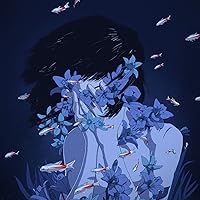
An outbreak of war in orbital space could cause big trouble for the crew of the DS-12, so Hachimaki, Yuri, and the rest of the crew try their hands at anti-war activism.
Oh look, Fee and Yuri are integral to the plot again! And we've got... space war! As the world races towards war we have our hearty crew trying to clean up all the debris and bullets caused by the escalation towards fighting. It's like the previous volume had this big build-up about togetherness and love and the compassion of the human spirit only for this volume to screw it all up as big men in suits take lives to further their own careers.
This was somewhat of an improvement on the previous volume in that I enjoyed around half of it, but it ended up not being quite enough of one. This volume contains chapters 17-21 and a text discussion of the setting along with some diagrams of the spaceships.
What didn't work for me was chapters 17 and 18. 17 introduces the Baron, a character who claims to be a space alien and is obsessed with making friends in spite of having no social skills. Given that the so far hard sci-fi nature of the series makes me doubt the alien part, it's clear he's neurodivergent and also either putting on a character or has something up with him. The idea of exploring friendship and social isolation generally fits thematically with a lot of what the series has been doing with Hachimaki, but the problem is that at this point I don't have much reason to care about this new character and I just didn't find his story all that interesting.
The following chapter focuses on the man responsible for the Jupiter expedition facing the families of the people who died in an explosion during an engine test. Again, an interesting idea, but at this point I'd rather see the actual Jupiter mission and it also doesn't tie in to any of the main cast of characters. The question of whether what he's doing is right and the way it ties to questions about space exploration makes sense for the series, and I think if this story had come earlier and perhaps tied into Hachi or another main character, I would've liked it. But at this point I find my patience with meandering around has worn thin.
I also liked the text section in theory. It discusses the scientific and social changes in the 2070s world of Planetes, and I like the idea of relating the sci-fi back to the modern day and showing some of the creator's thinking. But it's marred by a poor translation that clearly needed more editing, with awkward phrases and the occasional repeated section.
I did enjoy chapters 19-21, and I think if something like them had happened earlier in the series I'd have enjoyed it much more. This returns to a lot of the issues from early in the series about the proper use of space and the need to keep it peaceful. Fee gets a lot of development here, as she's the focus while the crew encounters a space mine and then reacts to the possibility of war breaking out because a US ship is destroyed by a mine. Once again the threat of Kessler Syndrome looms large, which is especially threatening now that Hachi is off to Jupiter. And I liked how the story weaves in Fee's son and his love for animals along with her own childhood encounters with her uncle. The animal stuff is done especially well, as Fee reflects on how she and other astronauts have become domesticated, doing exactly what they're told and never rebelling against the government. In the end it's clear she's decided to do what she can to prevent a war that would destroy humanity's access to space, and I find this a much more compelling character and story arc than the many chapters of Hachi angsting about whether he can maintain his humanity in the cold isolation of outer space.
Still, though, it feels like it's too little too late to really recapture my enjoyment of the first few chapters of this series. And amazingly with only 5 more chapters left, there still hasn't been anything with the Jupiter mission - Hachimaki disappeared completely in this volume. Not that I necessarily mind, but after all the fuss it seems weird. I am going to finish the series, but I suspect I won't be as enthused as a lot of other people clearly are.
Interesting pivot to one of the other characters, the pilot/captain. Still choosing a more direct narrative than the first book. Also, original appearance of the US Space Force!
Where did the plot go? Just when you think you're following Hachimaki's story.. he's completely absent from this volume.
Instead, we get some sort of.. side stories, backstories, for some of the other characters. And I have to admit to being pretty lost on some of them. A woman's son standing up to her when he's the one who has a billion dogs in the apartment and is clearly in the wrong leads her to stand up to a government who's been planting space mines. Or something.
Also, there's an alien. Maybe. He could just be a freaky creep. He doesn't know human norms and cultural stuff. So he feels up a woman's breast. Then later apologizes. Gripping stuff.
Then there's pages and pages of technobabble. Written by whom? The mangaka? Maybe. It's never clear to me. Is it background information about space science? Well, sort of. Is it background information on the world of Planetes? Well, sort of. Is it in serious need of copyediting? You betcha. Is it pretty darned boring? Oh yea.
And a final peeve -- all of starts of the chapters were originally in color. And in previous volumes, they didn't bother colorizing more than the first one. In this volume, there are some glossy color ones. But only for some of the chapters! It was nice. But it was annoyingly inconsistent!
The focus of "Planetes" shifts away from Hachimakin on his long journey towards Jupiter and concentrates more on Fee, who's dealing with ambivalence about her future plans. The penultimate volume of the series combines wonderful character storytelling it established in the very start to a broader, more politically relevant scope. We also get to meet some pretty intesresting supporting characters.
The tone is nicely lyrical throughout, and Makoto Yukimura remains skillful in the way he utilizes surrealism and character storytelling to tell a beautiful tale of a troubled but enchanting future.