Jump to ratings and reviews
Rate this book

Penguin Lines – Celebrate 150 years of the London Underground

What We Talk about When We Talk about the Tube: The District Line

Rate this book
John Lanchester, author of Whoops! and Capital takes us on a whirlwind tour of the Tube to show its secrets, just how much we take for granted about it, and what we're really talking about, since we so often do talk about it. In short, he shows what a marvel it is - part of a series of twelve books tied to the twelve lines of the London Underground.

In John Lanchester's inimiatable style, he unravels the various mysteries of the Underground and explores its true significance for both London and the wider world. Like, what's the difference between the Underground and the Tube? How do tube drivers get to work to start driving the tubes when the tube lines aren't running? And where can you get your hands on driver-point-of-view videos?

87 pages, Paperback

First published March 7, 2013

7 people are currently reading
182 people want to read

About the author

John Lanchester

35 books616 followers
John Lanchester is the author of four novels and three books of non-fiction. He was born in Germany and moved to Hong Kong. He studied in UK. He is a regular contributor to The New Yorker and was awarded the 2008 E.M. Forster Award. He lives in London.

Ratings & Reviews

What do you think?
Rate this book

Friends & Following

Create a free account to discover what your friends think of this book!

Community Reviews

5 stars
56 (29%)
4 stars
99 (51%)
3 stars
31 (16%)
2 stars
6 (3%)
1 star
0 (0%)
Displaying 1 - 30 of 34 reviews
Profile Image for Charles.
53 reviews1 follower
June 30, 2014
This is one of a series of short Penguin paperbacks, commissioned to celebrate 150 years of the London Underground. Lanchester was assigned the District Line, and his elegantly written 87 small pages are an engaging mix of the historical, the personal and the journalistic. He books himself a ride with a train driver all the way from Upminster to Richmond and back, a three and half hour trip, noting that the driver's job is so solitary that it makes even being a writer seem sociable.

Here's some of what I learnt:

1. The Tube is properly the name of the lines that were tunnelled - so not the earliest, which used the 'cut and cover' method for those parts near the centre of London where they had to go underground.

2. So "the Tube is a tube, but the Underground is by no means all underground." In fact, only 45% of the whole network is underground, including more than half the stations on the District Line.

3. The various lines were originally run by different companies, often hostile to each other. A ticket for one line could not be used on the others.

4. The District LIne is the only line that crosses the Thames by bridge (at both Kew and Putney). It also goes under a river: the Westbourne (no, I hadn't heard of it either) runs above the platform at Sloane Square station, through a pipe.

5. The driver has to keep a hand on the lever to make the train move, twisting it to a horizontal angle: once let go, it springs back to the vertical and the train stops. This is the famous 'dead man's handle'.

6. Underground drivers are given their work schedule 110 weeks in advance: they know when they'll be on and off shift two years ahead.

7. At its busiest, the Underground network carries more than 600,000 people - more than the population of Glasgow, the fourth biggest city in the UK.

8. The earliest line, the Metropolitan, opened in 1863. This was before electrification, so steam trains went through the tunnels. It was followed by the District (1868) and the Circle (1884).

9. The Paris Metro didn't open until 1900, and was a more centrally planned system, with everywhere in the centre of the city deliberately within range of a station. But London's more chaotic early start kept the city's lead over Paris in population and prosperity.

10. The tunnels in the tube have a diameter of 11 foot 8 and a half inches. There is no room for air conditioning so if the train stops on a hot day, the temperature in the carriages can quickly exceed the 35 degrees Centigrade, which is the legal limit for the transport of livestock. If the train is really stuck, the power in the line will be switched off, the lights in the tunnel switched on and the passengers led to the next station through an opening in the front of the driver's cab.

There's a lot to be said for finding out a bit of basic information about the world that's around you every day. Perhaps earlier generations were more aware of the wonder of the Underground, as we are today with the Internet. Here's a small piece of evidence of that, quoted by Lanchester: T.S.Eliot's acknowledgment of the difference between the tube and the Underground, in his poem East Coker:

Or as, when an underground train, in the tube,
stops too long between stations
And the conversation rises and slowly fades
into silence


Profile Image for Howard.
185 reviews6 followers
January 10, 2018
part of a series of short books commemorating 150 years of the London Tube in 2013, Lanchester's contribution is full of interesting facts and observations, which i read, as intended, jostling for space with fellow London commuters
Profile Image for Lou Robinson.
572 reviews35 followers
September 9, 2013
This volume about the District Line was exactly what I expected from the Tube series - some good solid facts about the line. I liked it, simple as that.
Profile Image for Emily.
340 reviews7 followers
December 27, 2025
Now this is what I’m talking about. Actual reflections on the London Underground!
Profile Image for Darryl.
418 reviews1 follower
August 8, 2013
London as it exists today would not be the same place without the Underground. The Underground is what gave the city its geographical spread, its population growth, its clusters of spaces and places.

This brilliant book by John Lanchester, whose most recent novel was the highly praised Capital, is part of Penguin's Underground Lines series, which celebrates the 150th anniversary of the London Underground, and it is one of the four books contained in the East-West Penguin Underground Lines e-book I recently purchased. Unlike the trivial and very disappointing books on the Piccadilly and Hammersmith & City Lines, Lanchester's contribution is a superb exploration of the District Line, the Underground as a whole, and the profound effect that the system has had on the growth of the city and the everyday lives of its residents.


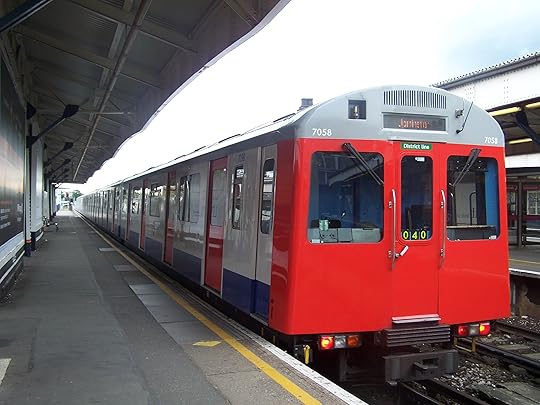
A District line train at its terminus at Richmond station

The District Line, which is aptly described as being like 'an older aunt who has seen better days', originated as the Metropolitan District Railway, and was later known as the District Railway, in order to distinguish it from the Metropolitan Railway, which began underground service in October 1863 between Paddington and Farringdon stations. The District Railway was created to provide a circular subsurface link to the major train stations in London, in order to allow commuters coming from the city's suburbs to quickly travel to their work places without having to navigate the city's congested streets. The first District Line service began operation in December 1868, which carried passengers between the South Kensington and Westminster stations, using steam locomotives to pull wooden carriages. The line has expanded significantly over the subsequent years, providing service to as far west as the posh suburbs of Richmond and Wimbledon, and as far east as Upminster.


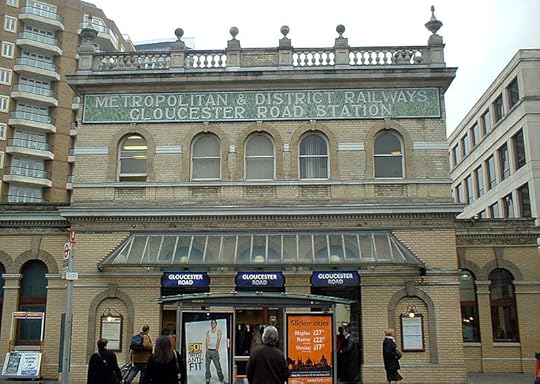
A photo of Gloucester Road station, built in 1868, which was shared by the Metropolitan and District Railways (this was the first Underground station I entered on my initial trip to London in 2007)

Lanchester begins his book with a journey on the 4:53 am westbound train to Richmond leaving from Upminster, the first train of the day on the system. He observes his fellow passengers, initially blue collar workers from the East End off to their jobs in the City, who are then replaced by professionals who are employed in the financial district as he approaches central London and makes the return eastbound trip. He comments about the differences and similarities of the social and demographic groups that use the Underground, and the eastward displacement of the working classes, as the City and immediate East End neighborhoods have become less affordable to those earning modest salaries. Lanchester also speaks to Transport for London (TfL) workers throughout the book, who provide him with valuable insights into the Underground and the passengers who use it:

I asked TfL workers about the demographic difference between the two ends of the line. 'Put it like this,' one of them said. 'If they're annoyed about something, at this end of the line' — we were at Dagenham — 'they yell at you. You know about it straight away. At the other end,' he said with a shudder, 'they write letters.'


In subsequent chapters Lanchester expands his horizon to view the Underground as a whole, the effect of rapid transit on the development of cities, and the comparison of it to the metros of other cities such as Paris and New York, who created their systems decades afterward. He also discusses the psychology of passengers who ride the system; distinguishes between the terms Underground, which refers to the entire system, and the seemingly synonymous term Tube, which properly refers to the deeper level lines such as the Piccadilly, Northern and Bakerloo lines, and not the subsurface ones such as the Circle, District and Hammersmith and City lines; his personal fear of being in Underground tunnels, particularly when the train is halted between stations; the new air conditioned trains that will soon replace the 30+ year old ones that currently are in service; his experience riding alongside the driver of a train, and how it differs from being a regular passenger; the monotonous work day of an Underground train operator; and the different personas that Londoners assume when they travel underground.

The only complaint that I have about this book is that it ended far too soon. I absolutely loved it, and reading it has made me eager to drop everything else and read Lanchester's latest novel as soon as possible.
522 reviews3 followers
August 19, 2013
I loved John Lanchester's "Capital" and loved this as well. Short, perceptive, and elegantly written, it's full of interesting facts about the tube, particularly the district line, and how the underground has affected the city. I would be curious to know whether other books in the series are just as good.
Profile Image for Sam Still Reading.
1,655 reviews66 followers
August 18, 2019
I really enjoy reading about the London Underground, its history and how it continues to grow deep (or not so deep) under one of the world’s most famous series. The Penguin Lines series was commissioned to celebrate 150 years of the London Underground in 2013 with one short book for each line. John Lanchester’s book is about the District Line and is non-fiction, asking questions that you may never have pondered about the Tube and then answering them in an easy to understand, interesting way.

The book opens with asking about how do Tube drivers get to work for the first service of the day. (To be honest, I had always thought that the Tube ran 24/7 because it’s London. But nope, the first train on the District Line leaves the depot at 4:53am. I also learned that the Tube is closed Christmas Day. Wow). It also asks, what’s the difference between the Tube and the Underground. This goes into a brief history of how the Underground began during Victorian times and the various companies and methods of constructing the lines were done. It also explains why there is a lack of air conditioning (to an Australian, that’s a jaw dropping fact). There are many other excellent facts that you shouldn’t announce to a packed carriage (why is covered later when discussing commuting), like rosters for Underground drivers are done 110 weeks in advance.

Overall, this is a friendly read that I read in a couple of sittings. I felt a little bad that I wasn’t reading it on a train, as the books are light with larger than usual font presumably for packed carriage reading (you could fit it nicely under the armpit of the person next to you). I think this series will be a nice midweek or in between longer book reads. It would be great to see a series for other iconic public transport lines, like the London buses or New York subway.

http://samstillreading.wordpress.com
Profile Image for James.
883 reviews15 followers
June 4, 2023
Sometimes you get writers on a topic who try to make it all about them, and at other times you understand why they are professional writers from the way they make the mundane interesting - and this fell into the latter category.

It's a short book but covers a few aspects of the underground - different demographics along the District line, how drivers progress in their career, the nature of the job of tube driver, and how passengers think of their journeys. None of it was groundbreaking, but the unexciting details of the evolution of the word 'commute', rolling stock and terminals were interesting enough within the context of several small essays. The talent of the writer is clear from how many facts and bits of trivia are included without feeling like a particularly dry book.

One minor point of contention from me is that the number of journeys compared to pop culture featuring it is largely irrelevant - lots of people drive to work too but very few films are based around that either apart from Car Share - but the essays partly explored how the underground is influential on the city (in particular, where people can choose to live) without them taking much notice of it. I would actually have liked to read a bit more on similar themes.
Profile Image for Luke Spillane.
2 reviews90 followers
April 1, 2022
I really enjoyed this very short book coming out of a heavy flu ridden week of covid and found myself longing for just a ride on the tube. This was part of a series that passed me by for the 150 year celebration of the London Underground, this edition by John Lanchester focuses on the observations of the District Line (my childhood fav). From the varying contrasts of the city that the line goes through from Upminster to Richmond, the way in which Londoners instinctively differentiate between the ‘Underground’ and the ‘tube’, and the uniqueness of a line that goes above and below a river. I particularly enjoyed listening to the experience of travelling with a driver, how isolated it’s described as and yet how appealing it still sounds as a job to me?? Maybe one day. The whole book talks about something so shared amongst others and yet it feels so personal, the tube to me feels like such an attachment to growing up in London so this whole book was like reading someone else talk about a very old friend. 🚇📚
Profile Image for Leona Grace.
Author 22 books16 followers
February 18, 2019
Delightful little book (87 'small' pages) about the Underground District Line. Quirky, full of interesting facts written in such as way as to engage the reader. I have a particular interest in the London Underground at the moment and when I saw three of these '150th anniversary' books in my local charity shop I couldn't resist them. This is the first one I have read.

The book itself is the same size as a small paperback but the pages have a wider than average margin at the top and a much larger one at the bottom - presumably to make it easier to hold with one hand and read at the same time as travelling on the tube. ;)

Recommended for anyone who likes quirky books about the history of the underground and its effect on the city and its inhabitants.
18 reviews
May 30, 2025
Orson Welles says only sexual intercourse and prayer cannot be adequately be captured on film; Lancaster argues the London Underground fits into this category.

It is a slim volume, but manages relative depth. It’s certainly an interesting insight pre-Covid on the seemingly unconfrontable detriment of commuting underground is for our mental health.
Profile Image for Michael Riess.
119 reviews3 followers
January 20, 2017
Wonderful! That said, you really have to be a Londoner to appreciate this book. 'The Tube' is to London what the nervous system is to human being,..
Profile Image for Frankie.
332 reviews24 followers
June 26, 2024
My favourite tube book so far. Gave me the genuine heebies with its discussion of the difference between the tube and the cut and cover underground, and what happens if you need to evacuate.
110 reviews19 followers
March 9, 2015
Lanchester's book is not purely focused on the District Line but also digresses to encompass a potted history of the London Underground, the everyday experience of the tube driver and some general observations on society and London. The prose is light and easily accessible yet this was not at the expense of insight and thought-provoking commentary.

The history of the system is described very well considering how short the book is. I would definitely recommend it for anyone who was looking for an introductory history, with the proviso that there was the occasional inaccuracy. The Budapest Metro, for example was the second underground railway in Europe rather than the Paris one as was stated here. I also got the impression that the author had a limited amount of time to research the topic as his examination of the tube as portrayed in film and literature omitted the 2004 horror movie Creep and the novels Underground by Tobias Hill and King Solomon's Carpet by Barbara Vine. It is nonetheless curious that the Underground has not made more appearances in fiction; even JG Ballard, an author commited to reflecting the modern world in his work resulting in narratives centred around car parks and tower blocks didn't ever mention the Underground anywhere to my knowledge. This may have been due his home being in Shepperton, a suburb not served by the Tube. The system has also made a few appearances in video games as well including The Getaway: Black Monday, Tomb Raider III (an impresive level set in the disused Aldwych station), and Uncharted 3: Drake's Deception (a fictional station called North Atwood). Most recently 2014's The Evil Within featured a fictional subway system with a station clearly modelled on the London Underground.

Overall though this was a very enjoyable, informative and entertaining read. The brevity of the narrative and compact nature of the publication make it, appropriately, the perfect choice of reading matter for a trip on the Tube.
Profile Image for Gavin Felgate.
721 reviews4 followers
June 12, 2013
The first District Line train out of Upminster in the morning is the first train anywhere on the Underground network. It leaves the depot at 4.53, the only train anywhere in the system to set out from its base before 5 a.m..

The first paragraph of John Lanchester's book on the District Line (part of London's underground system) gives a good idea that you are about to read something very anorak-like, which goes into a lot of detail about the running of the tube network, and this isn't too surprising when you realise that Lanchester used to work on the London Underground.

At first, the book seemed to talk too much about the underground network in general and its history, and it felt a bit too much like a generic textbook, but in the second half of the book I started to enjoy it more, with several humorous anecdotes, which included drivers blaming hold-ups on trains that belonged to other networks, and observations about the behaviour of people on the trains.

I quite enjoyed the social commentary regarding the demographics visible on the District Line, with cleaners mostly coming in from London' East End in the morning rush hour, while white collar workers, lawyers and bankers all came from the west.

Overall, this was an easy book to read, and it proved to be an enjoyable source of trivia for London Underground geeks.
Profile Image for Boorrito.
112 reviews10 followers
November 26, 2013
Two things made me pick up this book: the title and the fact it's the District Line book in this series. As someone who grew up with the District Line at the bottom of my garden, it's the line that I have the most attachment to.

It's a brief book, but that works to its advantage. It's thoughtful without overdoing it which is easy to do with this subject matter, and there were several paragraphs that made me laugh out loud - such as the footnote about Skyfall. And while Lanchester might have not found the driver leading passengers through the front cab if a train gets stuck in a tunnel reassuring, I was because I was thinking about just that last time I was on the Piccadilly line. I have a soft spot for books about London that really understand the city, and this was one of those books, which bumped it up from a three star to a four.

Recommended reading to go alongside this book if you're interested in more of the history, and in fact is mentioned several times in text? The Subterranean Railway
Profile Image for Niklas Pivic.
Author 3 books72 followers
July 23, 2013
This is clearly one of the more funny, intelligently written and entertaining of the bunch of books that are written to commemorate the 150th anniversary of the London subway.

I love the way the author has noted and answered questions like "How do drivers reach the start of their working day if the subway doesn't run before that?" and "What's the difference between 'tube' and 'underground', if any?".

It's also notable that getting stuck in a train while underground may cause temperatures higher than 35 degrees; this is the legal limit for the transportation of livestock - but there really isn't one for humans.

Also, there are words on the complete isolation of the drivers. They may have no human contact for hours, and are forced - by means of concentration - to not listen to music or use their mobile phone while driving.

All in all: too short! I could have read double the amount that the author wrote on the subway, and he's not restricted it much to that of the District line, which is what the book is semi-made to be about.
Profile Image for Micki Myers.
Author 3 books2 followers
August 13, 2014
A series I wish I could have been a part of - combining factual information about a tube line (and by default the entire London Underground system), with personal anecdote. Not only is this book an utter delight to read, but it is a beautiful example of book design in the old school, classic style.
Profile Image for Alan Fricker.
849 reviews8 followers
February 7, 2015
Second of these little books I have read. This is a good one talking not only about the district line but about the experience of using the undergound and the tube. History and the psychology of how we exist in a packed train. Not sure I agree with the observations of patterns of media consumption but these move fast
628 reviews20 followers
March 27, 2013
Lots of interesting insights into the tube and its centrality to London life. If you are not regularly on the tube you aren't a Londoner. And do you know that the Underground and the Tube are not the same thing? If you want to find out the difference read the book.
Profile Image for Andy.
Author 9 books22 followers
December 20, 2022
Stuff about London and tube is an easy sell for me - I mention this bias as it's relevant. However, I shall seek out other things that John has written as he writes well and this book did not disappoint. An easy and informative read.
Profile Image for Stuart.
105 reviews4 followers
May 11, 2013
Lots of fun facts and tales about the Tube or is it the Underground..?!
Profile Image for Laura.
128 reviews9 followers
February 14, 2015
Everyone with even the slightest bit of interest in the underground, from having used it once to commuting on it every day, should read this book. It's brilliant.
71 reviews1 follower
December 2, 2014
Little book giving lots of facts about commuting and the underground. Very good and amusing read
Profile Image for Theresa.
50 reviews
February 24, 2015
Absolutely brilliant, containing lots of information not jut about the Tube/Underground but things such as life in general. I highly recommend it to anyone.
Profile Image for Roxy.
38 reviews7 followers
June 11, 2015
Oddly satisfying. I accidentally read the whole thing in one sitting ... Lanchester's passion for the subject matter is enthralling and somewhat infectious.
Displaying 1 - 30 of 34 reviews

Can't find what you're looking for?

Get help and learn more about the design.