Welcome to the Metrozone - post-apocalyptic London of the future. While the rest of Britain has devolved to anarchy, the M25 cordon protects a decaying city filled with homeless refugees, street gangs, exiled yakuza, crooked cops and mad cults. And something else; something new and dangerous.
Enter Samuil Petrovitch: a Russian émigré with a smart mouth, a dodgy heart and a dodgier past. He's brilliant, friendless, cocky and - armed only with a genius-level intellect, prototype cyberware and a prodigious vocabulary of Russian swear words - might just be most unlikely champion a city has ever had.
Welcome to the future. Mind the gap.
This omnibus edition contains EQUATIONS OF LIFE, THEORIES OF FLIGHT and DEGREES OF FREEDOM
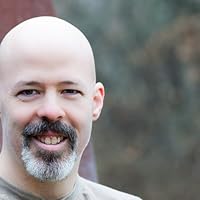
Aka S.J. Morden Dr. Simon Morden, B.Sc. (Hons., Sheffield) Ph.D (Newcastle) is a bona fide rocket scientist, having degrees in geology and planetary geophysics. Unfortunately, that sort of thing doesn’t exactly prepare a person for the big wide world of work: he’s been a school caretaker, admin assistant, and PA to a financial advisor. He’s now employed as a part-time teaching assistant at a Gateshead primary school, which he combines with his duties as a house-husband, attempting to keep a crumbling pile of Edwardian masonry upright, wrangling his two children and providing warm places to sleep for the family cats.
His not-so-secret identity as journeyman writer started when he sold the short story Bell, Book and Candle to an anthology, and a chaotic mix of science fiction, fantasy and horror followed. Heart came out to critical acclaim, and Another War was shortlisted for a World Fantasy Award, but with The Lost Art, things suddenly got serious. Contracts. Agents. Deadlines. Responsibility. Scary stuff. The Lost Art was subsequently a finalist for the Catalyst Award for best teen fiction.
As well as a writer, he’s been the editor of the British Science Fiction Association's writers’ magazine Focus, a judge for the Arthur C Clarke awards, and is a regular speaker at the Greenbelt Arts Festival on matters of faith and fiction. In 2009, he was in the winning team for the Rolls Royce Science Prize.
This was so over the top it could have been bad, but the execution was fantastic. He threw the kitchen sink at this story, but it never became confusing or jumbled. The characters were interesting and had unique motivations.
Throughout the trilogy, there are little bombs - one-liners that have been planned for several chapters. Since this is set only 20-ish years in the future, the 20th century cultural references are not out of place, but they are hilarious. A minor example:
"The Prelate of the Church wants to meet with you." "The Inquisition? That's unexpected."
Underneath the adventure, the quips, and the Russian epithets, the story explores serious sci-fi, political, and emotional themes. This is not a "light" sci-fi book. And how often does the US get portrayed as the bad guys?
The story may be even better if you know the streets of London.
It's an interesting story, had me reading the whole trilogy in a single sitting :) Not too deep in meaning, not too shallow in story. I really need to find a way to translate all the Russian epitaph that the main character uses, I wish kindle edition would have been able to do that!
The First Law of 21st Century Trilogies: Every book in a trilogy will be half as good as its predecessor.
I really enjoyed the first book in this trilogy. It was cyberpunk meets post-apocalyptic meets crime noir. The action was well paced, the plot line engaging, and several of the characters quite interesting. The interplay of multiple people and agencies, each with their own agendas, was well wrought and added to the authenticity of the work.
The second book had incredibly poor pacing and some questionable plot lines. Character progression also fell by the wayside as the main eponymous character got wired up and then instantly became an uber hero, able to counter the most ridiculous odds because of his symbiotic relationship with a sentient AI. The end picked up in quality a little, but by then I was sort of lost.
The third book started out with some promise, but devolved into a soap opera / harem adventure that had me skimming several sections to get back to some sort of plot line, as ludicrous as that plot might have been. All serious thought and writing were thrown out at this stage and I was reading the script to a 90’s action movie. Ironically, the end of the novel would have been a great starting point for a high quality book 2. Let’s see what Petrovich does, when given his own country to run…
I can count on one hand the number of trilogies I’ve read in the last 20 years that were 1. consistent in quality across all three books and 2. meant to be a trilogy versus a financial vehicle (i.e., telling a story that needed 3 parts versus goading the reader into making 3 purchases). This trilogy was not among those, which is too bad as it started out with a lot of promise. Average across the trilogy is just barely rounded up to 3 stars for me (2 if I were in a different mood). There is enough here that I would consider picking up another work by this author, but for this particular series just read book 1 as a stand alone.
Littered with pop culture and computer science references. Fun in a pulpy novel fashion. But, also ridiculously tedious in an all the women fall for the ass of a protagonist fashion. The schtick got old over three books and utterly missed the mark on developing other characters. Additionally, the main character possesses superhuman durability while being portrayed as something of an insubstantial Russian street rat. He takes all sorts of damage and just keeps on ticking somehow. And the Ruskie angle is only used to insert what I presume are curses in Russian without ever making the provenance relevant in any fashion otherwise. Ultimately, dopey to the point of numbing.
This trilogy is an absolute GEM. Take a cyberpunk universe, mix in a sweary physicist, a nun with a gun, gangs running the gamut from Neo-Yazuka to a Ukranian organitskaya, then shake well and enjoy the ride!
I've referred to this as an airport novel when trying to describe it--a post-apocalyptic, sci-fi airport novel, and that's a compliment. It's a just plain fun read, and is how cyberpunk should be done.
The trilogy contains the three books "Equations of Life", "Degrees of Freedom" and "Theories of Flight". You will find that it's a very fast read and that you're sorry that you've reached the end. I can't recommend it enough.
This series was recommended to me by a friend. At first, I was a bit daunted by the prospect of reading over 1000 pages. The storyline was good, Petrovitch was believable as a character but he should have died at least three times and it is a believable future. As an American, I hope this future is off bit but I could believe a future where America has become a hyper-religious state. I enjoyed the book and it rattled me so I can say...it's a good read.
Somebody said that this series is like reading William Gibson before that author started writing editorials for Wired Magazine... That sounds like a perfect comment for that Omnibus edition of three great books from Simon Morden.
I really enjoyed that steampunk series which is well written. The story is a bit repetitive though especially when one reads the Omnibus version, but it is quite good nonetheless !
Good stuff. If you liked William Gibson before his books became Wired-magazine-editorials with dialog, you'll like this, even though it's Wired-magazine-editorials with dialog sometimes. Some of that dialog is improbable too, as is some of the narrative. Neo-conservative America is a little convenient as a bogeyman also. The rest of it more than makes up for that though. Read it. You'll like it.
Good old-school cyberpunk, cynical and funny. This was thoroughly enjoyable. I forget who recommended it to me (Will Parham, maybe?) but this trilogy is now one of my new favorites. Sidebar: it's nice to see a cyberpunk book where the protagonist is trying to un-fuck the future. Usually, in dystopian near-future novels, they spend the whole time trying not to die.
Very tight action and nice characters. The Russian swearing is correct about 60% of the time, though :) For example, author got completely wrong (non-sweary!) translation for "bastard". Also, the book's world doesn't make much sense if you look close at it, so it's more like a video game world, or a Hollywood movie. But it's still great to read.
Very enjoyable read. Actually gets better and better the more you delve into the story. If you are interested in near-future, post (semi-)apocalyptic scenarios, and quirky characters, this is for you. Bonus: you'll learn a dozen Russian swear words too.