

What do you think?

O Perfume da Mentira
O Perfume da Mentira é um livro de catorze contos interligados que se desenrolam em duas aldeias carismáticas de Portugal podendo mesmo ser lido como um romance em retalhos. Os personagens que povoam este livro vivem numa prosa lírica e reminiscente de Marquez, Fuentes e Bowles. Um livro concebido com a eloquência de um verdadeiro contador de histórias. O Perfume da Mentira, (...) marca a estreia de um escritor notável. - Toronto Star Com este livro de contos interligados, paulo da costa adiciona um novo tempero picante ao caldo da literatura canadiana. - The Globe and Mail O Perfume da Mentira é uma estreia auspiciosa onde se sente o trabalho de um escritor experiente. Da Costa é claramente um escritor para termos em conta. - Edmonton Journal A obra mais uniformemente fresca, alegre e com substância que li desde há muito tempo na ficção canadiana. - Vue weekly 2003 Prémio Revelação Escritores da Commonwealth 2002 Prémio do Livro W.O. Mitchell Cidade de Calgary 2001 Prémio do Conto Canongate Books
152 pages, Paperback
First published January 1, 2002
About the author
Paulo da Costa
18 books25 followersBorn in Angola, and raised in Portugal, paulo da costa is a writer, editor and translator living in Canada. He is thrice the recipient of the James H. Gray Award for Short Nonfiction (2024, 2023 and 2020), the 2024 Outstanding Calgary Artist Award, as well as the 2003 Commonwealth First Book Prize for the Canada-Caribbean Region, the W. O. Mitchell City of Calgary Book Prize and the Canongate Prize for short-fiction. His poetry, fiction and non-fiction have been published widely in literary magazines around the world and translated into Italian, Spanish, Serbian, Slovenian and Portuguese.
Trust the Bluer Skies: Meditations of Fatherhood, a book of creative non-fiction, was published in 2024 with University of Regina Press.
Trust the Bluer Skies: Meditations of Fatherhood, a book of creative non-fiction, was published in 2024 with University of Regina Press.
Ratings & Reviews
Friends & Following
Create a free account to discover what your friends think of this book!
Community Reviews
Displaying 1 - 6 of 6 reviews

February 21, 2021
Fourteen short stories that are a mix of realism and fantasy set in rural Portugal. The writing is good and although the author, an editor and a translator in Canada, has not written a lot, just about everything he has written - collections of short stories, a novel and some poetry - has won awards, including this collection. (And this book is highly rated on GR - 4.4.)

In Roses for the Dead, the cruel, rich local landowner dies. At his funeral the priest says all the right things and then…
In Garden of Dreams, a mother and her little girl arrive at an isolated cottage to try to convert an old lady to their religion. But the old lady makes her own miracles.
In the title story, a young girl has an uncanny ability to detect when someone is lying and she’s not shy about confronting everyone about their lies. How will the village deal with her?
A young man has a dilemma in Forever Promises: should he marry the girl he loves or the one his dictatorial father insists he marry?
The Visible Horizon is a re-telling from the boy’s point of view of the apparition of Our Lady of Fatima. (Mary appeared to two girls and a boy.)
Several stories involve Portugal’s wars in Africa:
Chestnut Tree tells the story of a man returning after years of imprisonment in Africa. Everyone, including his wife and child, thought he was dead, so everything has changed.
In A Millstone, Always A Millstone a mother has seen so many boys go off and die in war that she hides the sex of her latest child and raises him as a girl.
In Sardines and Acorns a man is so lazy and considered so useless that everyone wants him to go off to war to bring some money in. “At least if you returned wounded we’d gain the respect of our neighbors. War injuries are an honorable reason to sit idle.”
Some samples of the writing:
“Amelia had never sat in a classroom. Her sweat had begun watering the fields while her cloth doll, clinging to her waist, still longed to play.”
“Prudencio Casmurro was no ordinary man. He had buried his parents, seven wives and the last of his twenty-two children, and showed no readiness to depart the mortal world.”

The author was born in Angola, raised in Portugal, and is now a Canadian citizen. Under the fascist dictator Salazar, Portugal drafted men to fight to hold its colonies against independence movements in Angola and Mozambique from 1971 to 1974. That undoubtedly explains why several of these stories are about Portuguese men going off to war.
Top photo, Piodao, central Portugal, from vortexmag.net
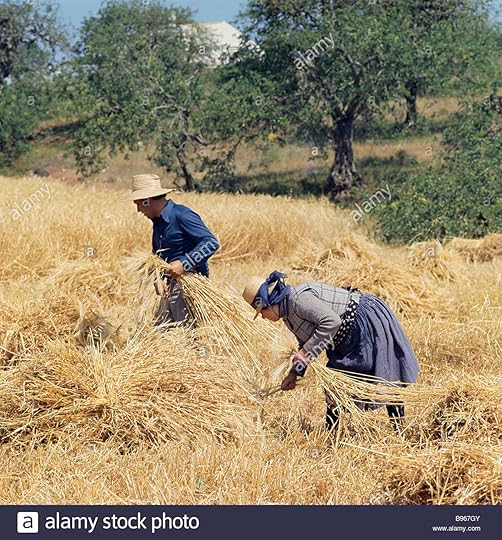
Portuguese farmers from alamy.com
The author from canadianwritersabroad.wordpress.com
In Roses for the Dead, the cruel, rich local landowner dies. At his funeral the priest says all the right things and then…
In Garden of Dreams, a mother and her little girl arrive at an isolated cottage to try to convert an old lady to their religion. But the old lady makes her own miracles.
In the title story, a young girl has an uncanny ability to detect when someone is lying and she’s not shy about confronting everyone about their lies. How will the village deal with her?
A young man has a dilemma in Forever Promises: should he marry the girl he loves or the one his dictatorial father insists he marry?
The Visible Horizon is a re-telling from the boy’s point of view of the apparition of Our Lady of Fatima. (Mary appeared to two girls and a boy.)
Several stories involve Portugal’s wars in Africa:
Chestnut Tree tells the story of a man returning after years of imprisonment in Africa. Everyone, including his wife and child, thought he was dead, so everything has changed.
In A Millstone, Always A Millstone a mother has seen so many boys go off and die in war that she hides the sex of her latest child and raises him as a girl.
In Sardines and Acorns a man is so lazy and considered so useless that everyone wants him to go off to war to bring some money in. “At least if you returned wounded we’d gain the respect of our neighbors. War injuries are an honorable reason to sit idle.”
Some samples of the writing:
“Amelia had never sat in a classroom. Her sweat had begun watering the fields while her cloth doll, clinging to her waist, still longed to play.”
“Prudencio Casmurro was no ordinary man. He had buried his parents, seven wives and the last of his twenty-two children, and showed no readiness to depart the mortal world.”
The author was born in Angola, raised in Portugal, and is now a Canadian citizen. Under the fascist dictator Salazar, Portugal drafted men to fight to hold its colonies against independence movements in Angola and Mozambique from 1971 to 1974. That undoubtedly explains why several of these stories are about Portuguese men going off to war.
Top photo, Piodao, central Portugal, from vortexmag.net
Portuguese farmers from alamy.com
The author from canadianwritersabroad.wordpress.com

August 23, 2017
The best part of Paulo da costa's book of short stories is his love of nature and how it affects the lives of his characters. The down side is not enough cohesion to be a novel, just a collection of short stories with little overlap among them. Being raised in Portugal has enriched his story telling unlike anything I've read before.
February 7, 2014
The book took me into a sun-drenched world of magic, insight, and delight. A pleasure to read.
February 10, 2014
Thought provoking stories that would stay with me throughout the day. An intellectual feast! Well written.

March 1, 2024
The Scent of a Lie is a gripping anthology of folklore that explores elements of magic and realism between two rural cities in the mainland of Portugal. Some characters that are introduced reemerge sporadically across chapters, bringing some familiarity to the esoteric storytelling, however the majority are self contained.
Somber tales are thematic of saudade, the Portuguese word for missing a person, place or thing. These characters face their own mortality with religious implications. They were all born with sin, and as hard as they work to absolve themselves from inherited guilt, their calloused hands tear away all ambition to accept their fate.
These are melancholic stories with righteous undertones. Reminiscent of memories from yesterday and innocence lost, they're all representations of the Beatitudes that describe the kingdom of heaven on earth.
All chapters are united with blind faith and a yearning for an uncertain future but are all carried with the notion that love is all that matters. What these characters recognize to be their god is always at the helm.
This book encapsulates contemporary Portuguese history but not the kind you learn in a classroom. These are lessons taught through lived experiences, exemplifying the mystical Lusophone perspective. Fatalists with a belief in a higher power, these characters mournfully carry on until finding providence. Like interwoven branches from the trunk of a large tree, they are all related and connected by the virtues that Paulo Da Costa proficiently articulates with each tale.
This is more than just an anthology novel but a book of parables.
Somber tales are thematic of saudade, the Portuguese word for missing a person, place or thing. These characters face their own mortality with religious implications. They were all born with sin, and as hard as they work to absolve themselves from inherited guilt, their calloused hands tear away all ambition to accept their fate.
These are melancholic stories with righteous undertones. Reminiscent of memories from yesterday and innocence lost, they're all representations of the Beatitudes that describe the kingdom of heaven on earth.
All chapters are united with blind faith and a yearning for an uncertain future but are all carried with the notion that love is all that matters. What these characters recognize to be their god is always at the helm.
This book encapsulates contemporary Portuguese history but not the kind you learn in a classroom. These are lessons taught through lived experiences, exemplifying the mystical Lusophone perspective. Fatalists with a belief in a higher power, these characters mournfully carry on until finding providence. Like interwoven branches from the trunk of a large tree, they are all related and connected by the virtues that Paulo Da Costa proficiently articulates with each tale.
This is more than just an anthology novel but a book of parables.

March 5, 2014
stepping back in time with a big smile on my face
Displaying 1 - 6 of 6 reviews