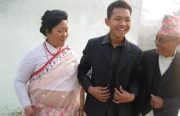
The title may imply that it is the memoir of a young female guerrilla, and indeed it is. But it is not just that. ‘Chapamar Yuwatiko Diary’ by ex-combatant Tara Rai is the tale of a whole generation of guerrillas who sacrificed their youth, loves and lives in the name of the civil war. Tara’s tale might not be as harrowing or tragic as many others we have heard, but it is a representative chronicle of the countless others who shared fates similar to hers before, during and after the ‘civil war’.
This diary is almost a straightforward recounting of Tara’s life from the day she is captured by security forces to the day she is freed a year later. The author lets us peek into her life and experience her troubles, right from the moment her hands are tied back and she is blindfolded. From then on, she takes readers along with her to watch her being shifted from this prison to that, sympathizing with her tribulations and admiring her perseverance.
This work almost totally tears down the stereotypical image of a guerilla – heartless, fearsome and cruel. Tara is a dainty sixteen-year-old when she is caught by the armed forces. On top of that, she is down with heart disease and has to take medication merely to stay alive. It is, then, impossible to conceive of her physical ferocity. But one cannot help noticing her emotional strength, which gets her going even in her lowest period. The readers are also lulled by her diplomatic and mild stance of writing, which is understandable in the turbulent times we live in.
Another myth this book reverses is that guerrillas are by nature unforgiving, lack family ties and have neither remorse nor any pressures to join the party. Tara’s tale brings to light another side of the coin – that many guerrillas in fact just joined the war to cling at something that seemed to offer them a vague promise of a better life. The strained family relations, lack of emotional anchors and an unstable economic condition almost force youngsters to choose a wayward manner of life. While they may have chosen this unconventional way of life, it is wrong to claim that they lack humanism. Tara is ample proof of this. She is fearless enough to expose the inequalities that she sees, like the differences of treatment among the ranks of the armed forces. But she is still tender enough to express her sympathies towards all the victims of the civil war, whichever side they may be in. The way she remembers her mother and siblings; the emotional bonds she forges with her co-prison mates and even the opposing forces persuade readers of her vulnerability. She appears before us not as a firebrand revolutionary but a reminder of a whole generation of vibrant and promising adolescents who have been shunted into the dark alleys of violence and war. There are times when she even mulls about suicide during her dark prison days, but keeps on trying to enrich her life through literature and arts, the littlest bit that she can catch hold of.
This is where Tara’s story acts as an example. She wistfully recounts her childhood, which may not have been idyllic but when at least her innocence did not let her question the discrepancies of her life. At that time, she knows no greater jealousy than seeing her parents carry around a younger sister and thinks nothing of running away to meet a singer. She dreams of being a singer, a writer. But then, as she says, she takes a ‘foolish decision of an immature mind’ and decides to join as a guerilla. And this, as they say, is the point of no return. It is agonizing to realize the degree to which the naïve girl has been brainwashed. Her youth is exploited, yet she thinks she is contributing to a ‘glorious struggle’. The unjustness of it wrenches our hearts. It is also frightening how words only heard in random theories and meaningless speeches – like ‘class struggle’ ‘and ‘attainment of martyrdom’ drop off her so casually.
But kudos to the author for not capitalizing on her experiences by painting them in a dramatic manner. She does not rave at the opposing forces, and nor does she term them all as black. The ambivalence and doubt towards the security forces is portrayed quite naturally. However, she is all praise for the ones who show her the minutest amount of care. In fact, the most poetic and beautiful lines in the book are reserved for the army ‘with the deep eyes’, who is incredibly kind to her and whom she clearly hero-worships. However, the dialogues seem to be rather melodramatic and exaggerated. It seems difficult to believe that someone would speak in such flowery terms in everyday life – “This rifle will not understand the language of your tears.”
The author’s style is succinct, precise, almost as if she were reporting. It recurs throughout the book, sometimes to the point of irritation. For example, early on, she says, “I came out again. Two friends from the party arrived there. We shook hands.” Another annoying factor is the repetition of the same fact time and again. Whether it be a mundane event like eating noodles or a crow cawing or army men calling her ‘sani (the small one)’, the author emphasizes some points so many times that they turn bland after a while. This is more the error of the editor that the writer, who has failed to trim superfluous matter.
The author needs to work very hard is she wants to be known as a good writer, there is no doubt about that. Her command over the Nepali language is, at best, average. There are sentences like ‘Why did you walk along the wrong path, I kept quiet,” which defy all rules of punctuation and grammar. While it is an easy read, and also touching at times, it lacks the intensity and urgency essential for a work of this nature. But if the author works on her language and infuses more expression into her work, there is no reason why the concluding portion of the ex-guerilla’s life-story should garner even more readers.
केहि साना कम्जोरीलाई नजरन्दाज गर्ने हो भने सरकारी संचार माध्यमले “राक्षस” बनाएकाहरु मध्येकी एक उमेर नपुगेकी वाल सैनिक (०४७ मा जन्मेको ०६२ मा समातिएकी) तारा राईको कथा पठनीय छ । राज्यको अन्याय उती बाहिर आएको छैन । माण्ठा डराएको जुगमा केहि लेखिएको छ तर अन्य कतै पढ्न पाएको छैन । त्यसैले पनि यो पढ्दा रोचक लाग्यो ।
it is a good book describing the strikes done by Maoist before People Strike 2062/63. It has also described how the leader don't care to the normal people who has started the strike giving their blood to their nation. Leaders beg to the people when they are not in the power but when they get the power they do not care about the peoples who helped in getting the power. The writer has also expressed how the Nepal Army and the Nepal police used to behave with the jailers. So in my opinion it a book that inspires the young peoples and manpower's to do something for their nation.