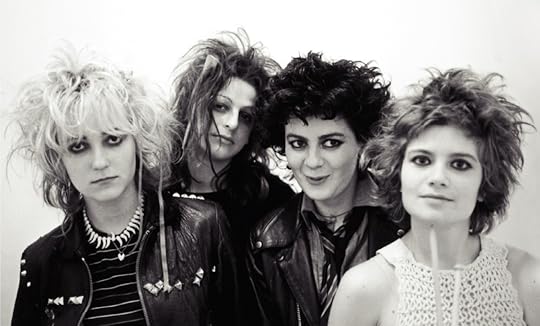
"Anyone who writes an autobiography is either a twat or broke. I'm a bit of both.” What an opening. And then into a first chapter in which the former Slits guitarist gets straight into how she never saw the point of masturbation, but did once have a fantasy about a pack of rabid dogs, and then got embarrassed lest anyone ever find where she’d written it down. All of this as if unaware that she has just written it, not in an old computer, but in an actual book. She’s not unaware, of course, nor even being screwed over by a ghostwriter, having rightly decided (as we later find out) to dispense with the one her shitty manager insisted she needed. It’s not that she has no shame, as such, but that having spent much of her life penned in by one constraint or another, the main lesson she’s learned (and then painfully relearned) is feeling the fear and doing it anyway. At first it was not being a pop star because her dad told her she wasn’t chic enough, then Sid Vicious complaining she never wrote any songs, the other Slits playing up for one or another reason, her husband just plain being a dick…and yet she made it, often by getting some reminder from the cosmos (twice it’s Patti Smith) that she can. So perhaps part of the impetus behind this book, aside from the money thing and the twat thing, is some obligation to pay that same inspiration forward?
Which could risk painting this as a misery memoir or a load of pseudo-inspirational bollocks, either of which would be unfair. It’s the record of a life, and one lived through interesting times and much-mythologised scenes. It’s novel hearing about punk from someone who wasn’t one of the boys (and indeed, since writing this vandalised the bumph at a punk exhibition to protest its erasure of punk’s women) but who got to see most of them close-up. Very close, in some cases: she dated Mick Jones (who comes across as a bit of a sap, bless him) and bedded Pistols, Johnny Thunders, one of the Pop Group, a Subway Sectarian…every bit as impressive a roll-call as any of the great celebrity swordsmen manage in their memoirs, but the really fascinating thing is how many of them she didn’t actually fuck, because the moment was wrong or they were too fucked-up or someone walked in at the wrong moment. And one wonders how many of those famous shaggers are in much the same boat, but never had the guts to admit to it. Meanwhile, out of bed, there’s the usual story about how punk opened the doors - but then the more seldom mentioned other half of the story, where the scene’s judgemental attitude could in many ways be at least as restrictive as any previous emphasis on musicianship. Yes, there were interesting and creative people, but also too many who (precursors of a certain subspecies of modern troll) felt like giving a fuck was losing the game, so what better life than acting like an absolute prick to everyone and, when they finally snap, making out its their fault for not getting the supposed joke? The epitome of this being the pathetic figure of Sid Vicious, only briefly able to drop his emotionless façade once he's on remand and properly shit-scared.
And if the punk scene is a distinctly mixed blessing, the world beyond is worse. All the grime, the beigeness, the street harassment you see on old footage are powerfully and painfully evoked, and you can understand why against this any counterculture would appeal, even if it was in many ways just as tolerant of absolutely shitty behaviour as the straight world. This age of Wimpy burgers and unwashed genitalia is definitely not something to read about over dinner, even before you get into the various read-through-fingers tales of crabs, blood and shit. Curiously, there’s even a reference to the significance of Omo washing powder seen in a window, something I’d only previously seen referenced in another of the most lunchtime-unsuitable books I’ve ever read, Jonathan Meades’ grotesque Pompey. Nor do matters get any less visceral once the Slits’ all-too-brief moment in the sun is over; there’s just as much gory detail of cancer and miscarriage when Albertine attempts to settle down as a wife and mother. But the real pain here is psychological, the sheer bloody boredom of what rapidly becomes a domestic prison. These are the lost years most rock memoirs seem obliged to have in the second half, but where usually it’d be heroin or coke colonising the personality and suppressing the talent, here our narrator is totally subsumed into motherhood instead. And it fucks with her head just as much. The post-partum loathing of her husband is apparently natural (though like so many natural things detailed herein, you see precious little mention of it elsewhere); the slow breakdown of what love existed between them is probably not so simply biochemical, but sounds worse still. And by the end of the book she’s wondering if there’s any third way between being lonely single, or bored in a couple. I suspect if they were honest an awful lot more memoirs would express similar ambiguity, but seldom is life’s quiet desperation given this much unabashed page space (at least not without being palmed off on a fictional avatar).
All that, and I’ve barely mentioned the art. I only really know the Slits through the two ‘hits’, which I clearly need to remedy, but her solo album sounds even more interesting, simply because you don’t get that many middle-aged women singing about life as a middle-aged woman (I mean, I love Kate Bush and Grace Jones and Marianne Faithfull and the work they went on to do, but none of them are exactly chronicling the thoughts underlying life as a Hastings housewife, are they?). And then in the interval between the two, for a time there was film (during which time Albertine gave Christopher Eccleston his big break) and after that, of all things, pottery. Ten years ago I would barely have remembered ceramics was an art form, but between this and Edmund de Waal and Grayson Perry, something’s stirring there, isn’t it? I digress. Love, death (I’ve not even mentioned the fiasco of Malcolm McLaren’s funeral!), striving to find a purpose and a contentment in life…all the big stuff is here. And I suspect if I played or even really understood the guitar I’d find all the stuff about her process and her (re)learning and her sound more interesting still. At least as good as everyone says it is.