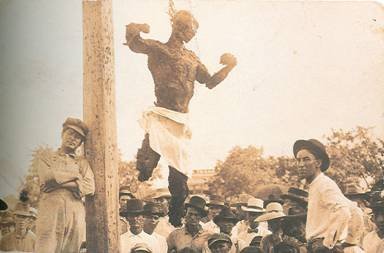
Why do we look at lynching photographs? What is the basis for our curiosity, rage, indignation, or revulsion? Beginning in the late nineteenth century, nearly five thousand blacks were put to death at the hands of lynch mobs throughout America. In many communities it was a public event, to be witnessed, recorded, and made available by means of photographs. In this book, the art historian Dora Apel and the American Studies scholar Shawn Michelle Smith examine lynching photographs as a way of analyzing photography's historical role in promoting and resisting racial violence. They further suggest how these photographs continue to affect the politics of spectatorship. In clear prose, and with carefully chosen images, the authors chart the history of lynching photographs--their meanings, uses, and controversial display--and offer terms in which to understand our responsibilities as viewers and citizens.
The smiling faces in the crowd...as a young man hangs from a tree. One of the hardest books I have ever read - the photos in this book will shock you to the core of your being. When you consider that this was still happening less than 100 years ago it really reinforces how much work we still have ahead if we truly want to live up to our professed commitment to democracy.
This book consists of two essays (plus a short introduction) that deal with the implications of looking at lynching photographs and how such photographs have been used and appropriated for different social purposes. How are we, who look at such photographs, implicated in the crimes they document? Is it better to look or not look? Smith's essay deals mainly with the history of one famous lynching photograph and the ways it was circulated and redistributed. The image clearly displayed the faces of many people in the lynch mob who were never held accountable for the crime, based on the obviously false excuse that their faces could not be seen. This photograph was eventually appropriated for the cover of a Public Enemy album and also for an anti-abortion campaign. Smith makes the point that lynching photographs (as evidence) don't exactly speak for themselves, but offer up a range of meanings that must be actively historicized and interpreted. One of the highlights in Apel's essay is a short section on Emmett Till and the way his mother's decision to publicize his murder/lynching marked a turning point in widespread social perceptions of lynching. This is a really emotionally charged book that will make you grieve and think.
Rather than a co-authored book, this is comprised of two individually authored essays. Smith's essay is nuanced and rigorous. A longer review available here.
Trigger warning: This book contains graphic photographs and descriptions of racial violence, police brutality, rape, abortion, gore, blood, etc. etc. etc.
This book, though troubling to get through, is a really informative resource on lynching in the United States and the role that photography played in depicting, publicizing, perpetuating, and denouncing lynching as a form of vigilante justice. The book is set up as two essays, one by Dora Apel and the other by Shawn Michelle Smith, which take two separate approaches to the topic. Smith's essay focuses primarily on the implications of lynching as a form of white supremacy against blacks, and then on how the images have been appropriated by various people (including anti-abortion groups, rap artists, and more) and how this affects how we view the photographs today. Smith discusses the NAACP and their efforts to use the images to denounce white society for it's ferocious violence against wrongfully accused victims. Apel's essay focuses on the sexualization of lynching and on lynching as a way for the the white men to re-assert their ownership over women (the "carrier's" of race) by eliminating sexual competition in the form of black men. Apel's essay was all the more troubling for revealing the "sexuality" of lynching photographs, which I found it very hard to work through.
This book is certainly not for everyone, it is graphic and potentially triggering and a reminder that the United States' racial problems are far from over. However, if you're interested in the topic, I can't think of a better book to get started with.
This is a book about lynching photographs, not a book of lynching photographs. The vast range of meanings these awful things can have is fascinating, and merits the analysis offered here.
Haunting but so good and informative. A short read really worth your time. I learned about all sorts of things, like James Byrd and other lynchings from the modern era, as well as more details surrounding older lynchings. I also had never been exposed to the Abu Ghraib photos, and that was eye-opening when I looked into it after reading this book.