Fiecare obiect descris în Inventarul lucrurilor dispărute — un tablou de Caspar David Friedrich, o specie de tigru, un poem de dragoste grecesc sau o insulă din Pacific — împărtășește soarta celorlalte: s-a pierdut pentru totdeauna, rămânându-ne doar urma lui pe hârtie. Cartea lui Judith Schalansky este o evocare plină de frumusețe a douăsprezece comori pierdute care, luate ca întreg, alcătuiesc o imagine răscolitoare a felului în care am putea înțelege dispariția și extincția.
O carte care înfruntă genurile literare, inspirată de istorie, filtrată prin fantezie și șlefuită cu ochiul atent al bijutierului. -- The Telegraph
Judith Schalansky tratează toate cele douăsprezece subiecte pe care le descrie în carte cu admirație aproape religioasă, ca un credincios care se lasă pradă spiritelor. -- Los Angeles Review of Books
Strălucitor... o meditație itinerantă, adesea ludică asupra istoriei și a uitării. -- The New York Times
Judith Schalansky își consolidează reputația de inegalabil cronicar al fabulosului, al îndepărtatului, al celor uitate. -- Publishers Weekly
Cea mai frumoasă carte a anului: luând lucruri dispărute și transformându-le în literatură, autoarea a performat un act de magie. -- Die Zeit
Judith Schalansky studied Art History at the FU Berlin and Communication Design at the Fachhochschule Potsdam. After finishing her studies in 2007 she taught Typographic Basics at the Fachhochschule Potsdam until 2009. Her first publication was the typographic compendium Fraktur mon Amour. From then she switched more to writing books for which she also did the graphical design. In 2008 she debuted with the novel Blau steht dir nicht.
Longlisted for the 2021 International Bookerprize. Erudite and eclectic, with a brilliant foreword, but some uneven chapters/essays on human progress, loss and memory
The foreword is very poetic and engrossing, in the Dutch edition I read I by far have the most quotes marked in this section. It's a shame that the rest of An Inventory of Losses is less strong than this part. I must however note that it is clear that the author has made a work of art in general of this book, all chapters are fronted by a black page with the object or concept that is lost.
The first "real" chapter is about captain Cook and "civilization" that mercilessly gobbles up islands in the Pacific. The same theme of the barbarian nature of civilization comes back in the section after, which is told loosely from the perspective of a Caspian tiger being transported to the Colosseum, a theme of people versus animals, and savagery for fun. Piranesi his constructed ruins is an other topic that shows progress of time in Rome and the tension between imagined history and grandeur and the real remnants of a period. Sappho’s fragmentary poetic legacy and the origin of the term lesbian again is fascinating while a story about the youth of the author in the gardens of a burned out castle, and the stories and legends surrounding the demise of the place is solid enough. Manicheistic belief in a world of light and darkness that will end in fire, being rooted out as heresy but surviving in the desert of Egypt being coupled to the Big Bang theory and modern astrophysics is quite brilliant. Also a Swiss man who wants to build an encyclopedia of all human knowledge in his garden, which his heirs ruthlessly cull after his death is quite touching.
The section about a constructed unicorn annex mountain retreat, and the imagination of people in Germany creating fabled animals, dips more into fiction. In general I feel Judith Schalansky writing is less strong the further from non-fiction it goes in this book. A good illustration is the chapter on Greta Garbo walking Manhattan and reflecting on her ageing; decidedly fiction, told from her perspective in an almost caricature manner. The story around the harbour of Greifswald is terribly dull, an overly spun out nature account not leading to any pay off. Also the final section told from the youth of the author, loosely involving the Palast of Republic in Berlin was quite weak.
Dutch quotes: Het behoort tot de talrijke paradoxen die inherent zijn aan het of-of van dood en leven dat door de overledene te benomen als iets wat voorgoed verloren is, het verdriet over zijn verlies verdubbelt en tegelijkertijd halveert, terwijl het in vage gehouden lot van een vermiste of verdwenen persoon de familieleden gevangenhoudt in een diffuse nachtmerrie van bange hoop en belette rouw, die zowel verwerking als verder leven verhindert.
In leven zijn betekent verliezen meemaken.
Een geheugen dat alles zou bewaren, zou feitelijk niets bewaren.
In feite is elk ding altijd al afval, elk gebouw altijd al een ruine en al het scheppen alleen maar verwoesting, net als het werk van al die disciplines en instituten die zich erop beroemen de erfenis van de mensheid te bewaren.
De mythe is immers de hoogste vorm van alle werkelijkheden en, zo dacht ik even, de bibliotheek het ware schouwtoneel van de wereldgeschiedenis.
Het was zo stil dat ik even dacht dat de wereld gestorven was. ik was niet bang, integendeel: het was troostrijk.
... het heden is niets anders dan een toekomstig verleden.
De ouderdom begon vroeg. In feite met de geboorte.
Now Winner of the: TA First Translation Prize from the Society of Authors (for editor and translator) 2021 Warwick Prize for Women in Translation 2021 Helen & Kurt Wolff Translator’s Prize
Also longlisted for the 2021 International Booker Prize in the UK, National Book Award Nominee for Translated Literature in the US
This book, like all others, springs from the desire to have something survive, to bring the past into the present, to call to mind the forgotten, to give voice to the silenced, and to mourn the lost. Writing cannot bring anything back, but it can enable everything to be experienced. Hence this volume is as much about seeking as finding, as much about losing as gaining, and gives a sense that the difference between presence and absence is perhaps marginal, as long as there is memory.
This is a beautifully produced book, and the production is part of the text, as Schalansky explains in the preface (in Smith’s translation):
For me, the inseparability of form and content is the reason why I like not only to write but also to design books.
After a brilliantly written and erudite preface (from which the quote at the top of the review is taken), explaining Schalansky’s mission, the novel consists of 14 pieces, each like the preface exactly 16 pages long, inspired by a lost thing, with each section prefaced by a black page with a faint but relevant picture (not the pictures in my review below) -the barely visible traces reflecting those that remain (rumours, faded pictures, memories, fragments) of the vanished subject.
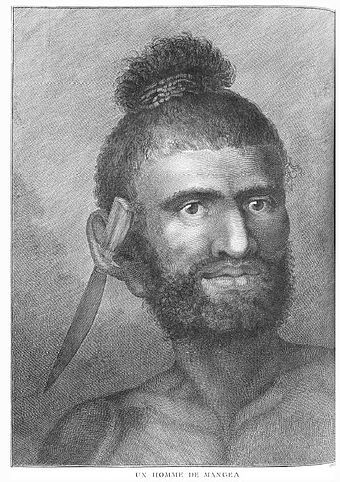
The first piece tells of the lost (if it ever existed) island of Tuanaki in the Southern Cook Islands, as well as Captain Cook’s “discovery” of the neighbouring island of Mangaia, with the page showing a map of the area, and is told in a rather Sebaldian and erudite fashion.
John Webber’s portrait of Mourua, from the island of Mangaia, on Captain’s Cook’s Resolution in 1777 which inspired the piece, which Schalansky references in the text:
But part of the novel's fascination is how the style of the pieces are so varied.
One on the extinct Caspian tiger is framed as fight between a tiger and a lion in the Colosseum.
The day is still young as the emperor steps into his box, pushes back the hood of his robe, shows off his tall sturdy physique, his stout neck, his imposing profile that everyone knows from the coins. When finally he sits down, the dungeon is unlocked, a chasm opens at ground level and a colossal animal of a kind never before seen emerges from the pit, bursts into the ring, races around the enclosure, leaps high against the parapet separating the public from the arena and, with a thunderous din, beats its mighty paws against the iron gate, stops, looks around, and for an infinite moment stands still.
This beast is preceded by a reputation that transcends oceans and mountains: it is said to originate from the depths of the forests of Hyrcania, the wild, rugged, evergreen land that borders the Caspian Sea. Its name is at once a curse and an incantation. It is reputed to be swift as an arrow, wild as the Tigris, the fastest flowing of all rivers, from which it takes its name. Its fur blazes red as an open fire, the sooty stripes akin to branches in the embers, the facial features finely drawn, the ears upstanding, the cheeks powerful, the muzzle bristling with white whiskers, the eyes glowing green beneath heavy brows, and on its forehead a dark symmetrical marking, the meaning of which no one knows.
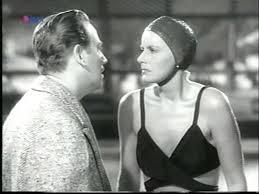
A piece on The Boy in Blue, the first and lost film of F W Murnau, director of Nosferatu, is told via a close third-person perspective story of Greta Garbo (one of only 11 attendees at his funeral, and who kept a death mask of Murnau on her desk) post her retirement from movies, one in which she laments her appearance in her final movie, Two-Faced Woman.
A piece titled Greifswald Harbour begins:
* Between 1810 and 1820, Caspar David Friedrich painted the harbor of his native city of Greifswald crowded with the masts of sailing ships, among them galleasses, brigantines and yachts. The old Hanseatic city was connected with all the major commercial centers via the navigable estuary of the river Ryck, which flows into the Baltic Sea, and even though the channel of the river Ryck was much broader then, it frequently threatened to silt up.
✝ The 94-centimeter-high, 74-centimeter-wide oil painting had been in the possession of the Hamburger Kunsthalle since 1909, and in 1931 went on show at Munich's Glass Palace as part of the exhibition Works by German Romantics from Caspar David Friedrich to Moritz von Schwind. On June 6 a fire broke out there that destroyed more than three thousand paintings, including all the works in the special exhibition.
(the * and ✝ in each chapter's introductuion representing the birth/origin and death/disappearance of the object)
But then is represented by an attempt to create in words what was lost with the pictures, a very detailed, almost over-rich, description of a walk from the source of the Rivee Ryck to its mouth in the harbour:
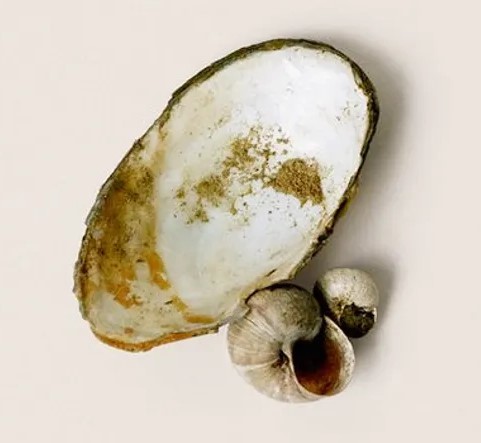
In the grass of the riverbank I find a brown-grained river mussel, as large as a chicken's egg. Its inner surface shimmers in shades of mother-of-pearl. Not far off, some mallard ducks are dabbling in the water. They fly away with an irritable whining and flapping as I approach, more easily startled than their town-dwelling cousins, and gather on the nearby fallow field. Their webbed feet show up in shades of orange and the heads of the drakes shimmer peacock-blue against the grey expanse of the field. ... And beneath a hawthorn bush lie dozens of chalky-pale, shattered snails' shells and the stones where black-birds and thrushes have smashed the armour-plating to extract the soft flesh.
The mussel and snail shells from the author’s collection:
And the book continues in that fascinating vein.
A word of warning though in terms of a reader's expectations - this isn't a novel looking for an underlying story line or connection between the different subject matters: it is much closer to Krasznahorkai's brilliant Seiobo There Below that the works of Sebald in its ultimate form. But the final piece, Kinau's Selenographs, does bring the collection to a very neat end.
Overall a fascinating and beautifully written novel, deserving of major prizes.
Winner of the 2021 Warwick Prize for Translation and (for Jackie Smith and editor Bill Swainson) the US Society of Authors award for First Translation.
A book with a great preface but uneven execution.
I read this book due to its longlisting for the 2021 International Booker Prize.
The first thing to say about this book is that it is beautifully produced – with a lovely dark “marble-effect” cover and a series of similar plates at the start of each chapter. The latter at first glance look black-with-effect but on closer examination have an image which matches the subject of the chapter and captures its lost nature.
This is no accident.
Firstly the author is also a book designer and some of her previous books (most noticably “Atlas of Remote Islands”) have, if anything, been even more beautifully produced.
Secondly the idea of the “inseparability of form and content”, the way in which a print book (as opposed to ephemeral electronic version) can be a way to capture and preserve ideas and experiences – or even further to give them something of a life-after-death is fundamental to the concept of this book, as the author explores in the preface.
The second thing to say is that the preface – like the rest of the book, extremely naturally translated to English by Jackie Smith to the extent that the book has both a wide ranging but entirely natural scope of language - is brilliantly written. It introduces and then explores the concept of lost and discovered objects in an erudite and expansive way – backed up by a topical foreword showing how these concepts occurred even as the author worked on the book.
The third thing is that the book is made up of 12 identical (16-page) length chapters – each starting with an object (in the broadest sense) which is now lost, each introduced like an exhibition/museum piece and then explored – sometimes directly and sometimes tangentially - in a mixture of essay, fiction, fact and digression.
The fourth thing is that unfortunately the body of the book does not live up to either its production or its preface.
For me the chapters were very uneven in their impact and even in their fidelity to the book’s purposes (at least as I saw it).
Some worked really well. Here I would pick out:
- The opening chapter (starting where “Atlas of Remote Islands” leaves off) on the possible Cook Island of Tuanaki – which explores the disappearance of both Islands and indigenous culture (as well as very different world views)
- A brilliant chapter on Hubert Robert, one time Piranesi understudy and brilliant artist whose main subject was semi-fictitious impressions of classical ruins (a nice analogy for Schalanasky’s work)
- A chapter on Sappho’s poems which combines a relatively standard but still well written discussion of how lesbianism was written out of history (and even the legal world) with an exploration of ellipses in poetry
- The last chapter - a kind of half historic, half futuristic tale of a botanist/selenographer seemingly wrongly credited (or perhaps later wrongly discredited) with discovering a moon crater, who in the story ends up setting up a lunar based archive of terrestrial objects
But some failed for me badly. Here I would include:
- A chapter on the Caspian tiger which ends fighting with a lion in a Roman arena - the idea here I think is to show how even from 2000 years ago man-made actions lead to the disappearance of other species and not even for survival purposes, just for entertainment and circuses. And there is a rather clunky link to Claudius as last of his line. But this does not justify for me a 16 page anthropomorphic feline “Boss fight”
- A chapter on a loss film, told, extremely tangentially as a first person dialogue by Greta Garbo (this a link to her famously reclusive personality I assume - and the rather cliched "I vant to be alone") which I found completely disinteresting
- A completely (deliberately?) overwritten nature journal describing a walk by a river with excessive amounts of flora, fauna matched only by the equally excessive amounts of adjectives, similes and metaphors used to describe them. This reads I felt like some form of written exercise - or like someone had been let loose with a Descriptosauras
Some chapters were somewhere in the middle - particularly the rather unremarkable building-inspired short stories (for example the Von Behr Palace, the East German Palace of the Republic) or, while interesting (for example a chapter on the founder of Manichaeism) seemed to me to lack real impetus.
Too often I found myself flicking forward to see how many pages I needed to read through to get to the next chapter (and to decode the next blackened image) - it seems odd that a short 16 page chapter could lose a reader’s interest but too often it happened for me where the chapter’s lacked any real progress or discernible development.
Overall a book I dearly wanted to love but could not.
But still a fascinating addition to the longlist and one very much worth buying and keeping.
One initial caveat straightaway. My review is based upon reading an electronic version of the book. I understood the design was an important integral part for the author. The electronic version does not convey the intricacy of this design. So I am talking here only about the text.
This is another of those “genre-bending” books which has become a genre by itself. Or more likely, it has always been a genre, but less prevailing way of writing than now. It is a mixture of fact and imagination, autofiction, an essay and even poetry sometimes.
I’ve paused for a second to think which adjective am I supposed to add to “writing” in the previous sentence. I was about to go for “imaginative” first. But then, it does not have to be imaginative. Then I thought about “narrative” - still does not have to be that either. I think everything goes here as soon as it is not academic. I can mention quite a lot works I’ve read in the recent years composed in this way. Names include from Rachel Cusk, Claire-Louise Bennett or Rebecca Solnit; even Flights and Second-Hand Time from the two female Nobel prize winners could fall in this category; but also more masculine non-fiction novels byJuan Gabriel Vásquez, Javier Cercas or Laurent Binet.
In the outstanding essay I’ve read and probably would quote for a while, Zadie Smith talks about some writers (and the readers I presume) “being embarrassed by the novel—and its mortifying habit of putting words into the mouths of others—many have moved swiftly on to what they perceive to be safer ground, namely, the supposedly unquestionable authenticity of personal experience.”
Respectively, I think the higher visibility of those works is the response to our collective quest for “authenticity” and perceived lack of it in a pure fiction. It is an arguable point which requires a separate discussion. Here, I’ve just wanted to mention that authenticity for me stems more from my ability to suspend disbelief while reading rather than the factual accuracy. What is “real” in the context of literature?
Notwithstanding with “genre-bending” bit, those works still could be good or not so good; imaginative or boring. This one is exactly in the middle of the road, in my opinion.
The concept of the book is that many things vanish without a trace, but they deserve the place in our collective imagination or at least in words on a page. And this is without doubt a profound thought and a noble endeavour. It reminded me another book I’ve read In Memory of Memory. There, Stepanova is thinking whether to republish in verbatim the set of letters between her deceased family members. She is driven by the similar impulse. Without her, the words in. those letters would very likely disappear into the void bound to non-existence. So she wants them to “shine” at least once more.
Here, the author gives herself even more creative task. She picks up an object or a creature/a human being and uses it as an inspiration for an imaginative story or a short essay. It might be only indirectly related to the initial object, or the object might be in the centre of that writing piece.
The project is ambitious. But unfortunately, the sheer variety of different writing styles the author plays with makes the book uneven. I think it was a deliberate decision be her to vary not only the nature of disappeared objects, but the styles of writing about them. And, she seems to be more accomplished in some pieces than the others. It is not always the lack of imagination. For example, the piece I found the most successful was a battle between a tiger and a lion during an imagined Ancient Roman festivity. It is quite graphic, one could say even cruel piece. But she succeeded to present it from the perspective of those animals and the spectators as well. However, she is less successful with human beings. In a few other pieces, she tried a closed third person or the first person narration, being in a head of her character. And the result was a number of flat, one dimensional constructs. She is more successful with brisk fragmentary writing - another good piece was about Sappho written in short paragraphs, factual but with subtle poetic insights into language and femininity.
She disappointed me in another story where, based upon the object, I was expecting and detour into German romantic art and, instead I’ve got endless pages of her not very eventful walk among the fields.
Another example of variety in style. The piece composed with long sentences. I generally like very long, stylistically challenging sentences. But this:
“Yet it was not these long-unchallenged claims that piqued my interest, but the islands whose one-time existence and subsequent disappearance are vouched for in numerous accounts, and especially the testimonies referring to the sunken isle of Tuanaki, owing in some part, no doubt, to its sonorous name, which has the ring of a long-lost magic word, but above all to the strange reports about the inhabitants of this island stating that fighting was entirely unknown to them and the word “war” was not familiar to them in any of its unpleasant shades of meaning, something that, out of some deep-seated remnant of childlike hope, I was immediately disposed to believe, even if at the same time it reminded me of the wishful utopian dreams outlined in countless treatises which went so far as to claim that another world was possible, but that – as the often verbose descriptions of their increasingly elaborate and hence inhospitable social systems went to show – it was generally only preferable to the existing world in theory.”
This just made me feel exhausted. Seriously should this be one sentence? I can easily split it into 5-6 normal sentences without losing anything. In fact I needed to do it insight of my head to understand what she is after. But I did not enjoy that process a single bit. And it did not bring me any satisfaction at the end like Henry James or William Gaddis would bring. Fortunately, it was just a single piece written like this.
Overall, it is not a bad book. But based upon a well written introduction, I expected something like Optic Nerve, but got something like a Rebeca Solnit without social justice bit but in a more experimental packaging.
Η συγγραφεας σε αυτο το βιβλιο μοιραζει ισοτιμα τις λεξεις της τοσο για τη ζωη, οσο και για το θανατο. Τοσο για το κερδος, οσο και για την απωλεια. Απο πολυ νωρις μαλιστα μας ενημερωνει πως κατα τη διαρκεια της μακροχρονιας συγγραφης του, συνεβησαν παρα πολλα δυσαρεστα γεγονοτα που επηρεασαν σε παγκοσμια κλιμακα, οσα και ευχαριστα. Υπαρχει μια ισσοροπια. Σε αυτο το υπεροχα δομημενο βιβλιο που εξ'αρχης με μαγεψε και με τραβηξε στις σελιδες του, η Σαλανσκυ συγγραφει 12 μαγευτικες ιστοριες, ολες επηρεασμενες απο ενα αντικειμενο, προσωπο, μερος που πια δεν υπαρχει και που ο χρονος δε του φερθηκε με την ιδια ευγενεια που φερθηκε σε αλλα. Αυτο σημαινει πως η αναμνηση του δεν εμεινε ζωντανη μεσα απο ανθρωπους, εγκυκλοπαιδειες, βιβλια...ετσι το καθε κεφαλαιο ξεκινα με μια συντομη περιγραφη του καθε πραγματος, ζωου κλπ και συνεχιζει με μια φανταστικη ιστορια στην οποια περιεχεται καποιο στοιχειο που αποκαθιστα αυτη την αδικια του χρονου. Τι γινεται λοιπόν με την τιγρη της κασπιας που ειναι ενα ειδος που εχει πια εξαφανιστει? Πως το πορτρετο του αγοριου με το γαλαζιο κοστουμι δενει με την σταρ Γκρετα Γκαρμπο, με τους στιχους της Σαπφους που δεν καταφεραν να διασωθουν? Πώς η αναμνηση αυτων εφτασε στις μερες μας με κυματισμους? Η Σαλανσκυ αναλαμβανει να αποκαταστησει την αδικια του χρονου σε ενα απιστευτα ξεχωριστο και πρωτοτυπο βιβλιο που οπως ανεφερα ξεχωριζει για τη δομη του. Αυτο το βιβλιο ξεχειλιζει ΤΕΧΝΗ. Ολες οι αισθησεις δουλευουν στο φουλ, ενω η φαντασια διεγειρεται με την απιστευτη γλωσσα της συγγραφεως για την αποδοση της οποιας αξιζουν συγχαρητηρια στον μεταφραστη, που πραγματικα εκανε τιτανιο εργο καθως και μονο τα επιθετα που χρησιμοποιει η συγγραφεας πρεπει να τον πονοκεφαλιασαν. Τι ωραιο να διαβαζει κανεις τετοια βιβλια και ποσο τα χρειαζομαστε για να ανάγεται η απλη συγγραφη σε λογοτεχνια...
Knowing what to say about this book will be a struggle. It is long listed for the Booker International Prize, which was confusing at first as I thought it was non-fiction. The author takes a list of places or things that are lost to us, researches it, and writes a one page overview followed by a fictional account that pulls the reader inside the place or time. (In the book, the sections are divided by black paper, and the preceding black page has an image also in black that hints of the content to come. The author is known for her book design, so this is one to look at in print. You may also know her, as I did, from Atlas of Remote Islands.)
I found myself drifting off, skimming. The topics were not always the most interesting, and to me the fictionalization (which might have a more proper term) was indulgent. Dree-in-Instagram and I discussed how the style would shift - her fiction uses too many adjectives and is unnecessarily verbose, while when she is writing in a non-fiction style, it is clean and more direct. Is this a side effect of the language of German, or does this reflect a shift she intended? I was deeply invested in her preamble, where she discussed the long list of things that were lost in various ways while she wrote this book. It went downhill from there, with brief peaks of interest for the religious texts of Mani and the Palace of the Republic, both of which I was interested in from a topical standpoint, although the "story" in the Mani section was not very successful. It just took me back to the year I was obsessed with Gnosticism.
The book is an odd bird. It seems more suited to something like the Goldsmiths Prize, which is all about experimental literature. It did not carry the heft of a novel, nor was it intended to, and this puts it in strange company for the Booker International Prize.
The book promised to be something special, and I enjoyed the beginning immensely, thinking it would be an inner travelogue through lost artefacts and people and nature.
And it was exactly that. Yet it left me cold.
Why?
I usually love reflections on things remembered and things forgotten, I love to follow traces of the past to make connections with my present.
In the end, THAT is precisely what I could not achieve. I did not connect to the random bits and pieces of human life that were archeologically restored in chapter after chapter. Each new angle presented left me shrugging my shoulders more, thinking:
"Ok, so what?"
It felt like a box of "Lost and Found" with nothing belonging to me in it.
Past must be tangibly connected to be meaningful, I guess. And as a teacher, I know how hard - and yet essential and important - it is to light the spark in new learners. This method did not work for me, I am afraid.
So more respect than actual pleasure of reading was the somwhat cold result.
Mit dem Vorwort zu ihrem Verzeichnis, hat Judith Schalansky die Messlatte für die folgenden Kapitel bereits sehr hoch gelegt. Ich hatte mich schon gefreut, dass es auf einem ähnlichen Niveau weitergeht. Leider können ihre Geschichten – in der Absicht geschrieben, Abwesendes und Verschwundenes heraufzubeschwören – die einmal geweckten Erwartungen nicht durchweg erfüllen. Zum Teil waren sie mir zu banal oder es gab kaum Anknüpfungspunkte zu den, jedem Kapitel vorangestellten, verlorenen Gegenständen. Die eher essayistisch geprägten Texte (wie z.B. über Sapphos Liebeslieder) haben mir eigentlich noch am besten gefallen. Über aller Kritik erhaben ist natürlich die wunderbare Buchgestaltung, besonders die in dunklen Schattierungen gehaltenen Abbildungen. Nur kann der Inhalt eben nicht immer mit der schönen Verpackung mithalten.
Το να καταφέρεις να μιλήσεις για το συγκεκριμένο βιβλίο είναι μια δύσκολη δουλειά. Είναι σίγουρα από τα πιο ιδιαίτερα βιβλία που διάβασα ποτέ. Χρειάστηκα το χρόνο μου για να καταφέρω να μπω στο κλίμα του και επίσης ήταν τέτοια η σύσταση και η δομή του που πραγματικά ακόμα και αν το περιεχόμενο του δε σε αφήσει εντελώς ικανοποιημένο, η αίσθηση ότι κρατάς στα χέρια σου ένα κομψοτέχνημα από πλευράς αισθητικής παραμένει. Είναι όλα τόσο προσεγμένα και φροντισμένα μέχρι την τελευταία λεπτομέρεια. Το εξώφυλλο του βιβλίου στα πρότυπα μαρμάρινης επιφάνειας συνοδεύεται από αντίστοιχες φιγούρες πλάκες στην αρχή του κάθε κεφαλαίου. Μπορεί στην αρχή να σου δίνουν την εντύπωση ενός σκέτου μαύρου φόντου όμως αν προσέξεις καλύτερα θα βρεις εικόνες σχετικές με το θέμα που πραγματεύεται το κάθε κεφάλαιο πράγμα που μάλλον δεν έχει επιλεγεί τυχαία. «Η ζωή είναι άρρηκτα συνυφασμένη με το βίωμα της απώλειας. Το ερώτημα τι μέλλει γενέσθαι είναι τόσο παλιό όσο η ίδια η ανθρωπότητα, δεδομένου ότι εμπεριέχει την εγγενή όσο και ανησυχητική μη προβλεψιμότητα του μέλλοντος, αφήνοντας έτσι στο σκοτάδι τη χρονική στιγμή και τις συνθήκες του θανάτου. Ποιος δεν γνωρίζει τον γλυκόπικρο αμυντικό μηχανισμό που μας ωθεί να υποφέρουμε εκ των προτέρων, τι μοιραία παρόρμηση να αποτρέψουμε ό,τι φοβόμαστε προεξοφλώντας το νοερά»;
Πάμε τώρα στο δια ταύτα. Δώδεκα ιστορίες λοιπόν όπου η συγγραφέας ανασυνθέτει την έννοια της απώλειας και δίνει φωνή σε ότι έχει χαθεί. Εξαφανισμένα ζώα, κατεδαφισμένα κάστρα, χαμένα ποιήματα της Σαπφούς, 12 αντικείμενα που πλέον εχουν χαθεί και υπάρχουν μόνο ως αναμνήσεις. ‘Ένα βιβλίο για την απώλεια, για τη μνήμη, μια αναζήτηση για ότι μένει πίσω όταν χάνεται κάτι. Ένα ξεχωριστό βιβλίο για τη δύναμη της ανάμνησης και το αναπόφευκτο της λήθης. Αν και δεν λειτουργούν όλες οι ιστορίες με ωραίο τρόπο η περίπτωση του συγκεκριμένου βιβλίου είναι μια περίπτωση αυτού που λέμε καλη λογοτεχνία, δίνοντας στον αναγνώστη την ευκαιρία ν’ ανοίξει τα μάτια του και να συνειδητοποιήσει το πώς ο χρόνος έχει τη δυνατότητα ν αλλάζει τα πράγματα.Τα αντικείμενα μπορει να μη γυρνούν πίσω όμως η συγγραφέας προσπαθεί να μας δείξει ότι τα αντικείμενα μπορεί να μην επιστρέφουν πίσω όμως είναι εξίσου σημαντικό το βίωμα της απώλειας. Πρωτότυπα και ποιητικά όμορφο, αυτό που λέμε τέχνη. Προσπαθώ ν αποφασίσω όμως αν η αρχική ιδέα ήταν τελικά ανώτερη της εκτελεσης της. Δεν είμαι σίγουρη.
Ζούμε σε ένα μη γραμμικό κόσμο, με μόνη σταθερά την αλλαγή. Η ενέργεια του σύμπαντος, διατηρείται, μόνο γιατί αλλάζει διαρκώς μορφή. Και αυτή η συνεχής αλλαγή, φέρνει στα έμβια όντα που αντιλαμβάνονται τη ζωή αλλιώς, πόνο. Η μορφή με την οποία συνδέονται, αλλάζει. Και, μέσα στις άπειρες αλλαγές της, χάνεται.
Αυτή η απώλεια,αυτός ο χαμός από κάτι που κάποτε υπήρξε, για τους νόμους της φύσης, δεν είναι άλλο παρά μια ασήμαντη αλλαγή που συνεισφέρει στη διατήρηση της ύλης, φέρνει απύθμενο πόνο σε ένα ον που συνδέεται ταυτοτικά ως ύπαρξη με τη «μορφή», με μία συγκεκριμένη μορφή ενεργείας και ύλης. Και τελικά, αυτή η απώλεια, ίσως είναι η σταθερά της ανθρωπότητας και η σταθερά της ζωής. Ότι αρχίζει, τελειώνει, και η ύπαρξη, εξ ορισμού, πονάει.
Η Σαλάνσκυ, γράφει το βιβλίο αυτό, για να δώσει «λόγο σε καθετί που έχει βουβαθεί». Τα δώδεκα αντικείμενα που περιγράφονται και γίνονται αφορμή για τα κείμενα στον Κατάλογο απολεσθέντων, δεν υπάρχουν πια με την μορφή τους. Η μορφή τους χάθηκε στο βάθος του χρόνου, στο πηγάδι του κοσμικού χάους, έγινε απώλεια. Η ύπαρξη τους, αποδεικνύεται ως γεγονός, ταυτόχρονα με την απώλεια της, από ίχνη, χαλάσματα που άφησαν, από αναμνήσεις και διηγήσεις. Μουδιασμένες σκιές, «φύσεις» που ακροβατούν επάνω όριο του «υπάρχει», καταγράφονται σε ένα κατάλογο, που δεν μπορεί να «ξαναφέρει τίποτα πίσω αλλά μας επιτρέπει να βιώσουμε να πάντα»
Αν κάτι μπορεί να επιβληθεί στον πόνο του χαμού, της υπαρξιακής απώλειας, αυτό είναι η τέχνη, οι λέξεις. Ο Κατάλογος Απολεσθέντων, δεν γράφεται ως θύμηση, ως κατάλογος αναμνήσεων παραδομένων, στο συμπαντικό σχέδιο της εξαφάνισης.
Γράφεται, γιατί, με το κείμενο ως μέσο, επιβάλλεται στην διαδικασία του χαμού, στη φύση του εφήμερου και τελικά την εξουσιάζει. Το κείμενο, γίνεται μια ακόμα μορφή που υιοθετεί η ύλη, η ενέργεια και έτσι ανατέλλει, έτσι υπάρχει ακόμα, αποδρά προσωρινά από τη μοίρα, από το προτετελεσμένο πεπρωμένο.
Και ο Κατάλογος Απολεσθέντων υπάρχει. Και τα απολεσθέντα αντικέιμενα υπάρχουν μέσω αυτού.
Η Σαλάνσκυ, κοιτά την υπαρξιακή αγωνία, κατάματα. Και αυτό είναι παρήγορο, για όλα και για το Όλο.
Αν μια νύχτα του χειμώνα ένας ταξιδιώτης βρει έναν κατάλογο απολεσθέντων... Ένα πραγματικό κομψοτέχνημα, τόσο από πλευράς περιεχομένου, όσο και από πλευράς μορφής (κι όταν γράφω «μορφής» εννοώ και την υλική του μορφή, την οποία επιμελήθηκε η ίδια η συγγραφέας). Δώδεκα ιστορίες για απολεσθέντα αντικείμενα, υποκείμενα, ιδέες, νησιά, κτίρια, γραμμένες σε διαφορετικό ύφος η καθεμιά και από άλλη αφηγηματική οπτική γωνία, αλλά όλες συγκλίνουν στο κεντρικό θέμα του βιβλίου που δεν είναι άλλο από τη φθορά του κόσμου γύρω μας και το πώς τη διαχειρίζεται η μνήμη. Για τη Σαλάνσκυ μνήμη και λήθη είναι οι δύο όψεις του ίδιου νομίσματος (νόμισμα=αυτό που «νομίζεται») και δεν μπορεί να υπάρξει η μία χωρίς την άλλη. Εξάλλου, αντιστρέφοντας τη γνωστή φράση του Κούντερα, ο αγώνας της μνήμης ενάντια στη λήθη είναι ο αγώνας του ανθρώπου ενάντια στην εξουσία, και αυτό είναι ευδιάκριτο σε όλες σχεδόν τις ιστορίες του βιβλίου, ακόμη κι αν κάποιες φορές αυτή η εξουσία δεν είναι πάντα η προφανής. Σπουδαίο βιβλίο, που αντέχει σε πολλαπλές αναγνώσεις. Το συστήνω ανεπιφύλακτα. Η -κατά πολύ- εκτενέστερη κριτική μου στα Marginalia εδώ: https://marginalia.gr/arthro/an-mia-n...
Ένα βιβλίο κομψοτέχνημα, δεν το πίστευα όταν το έπιασα στα χέρια μου, που θα με κάνει να κλαίω στα ίδια σημεία σε κάθε διήγημα, όσες φορές κι αν το ξαναδιαβάσω.
«Το γεγονός ότι το βιβλίο εξακολουθεί να μου φαίνεται το πληρέστερο απ’ όλα τα μέσα ίσως οφείλεται απλώς στην περιορισμένη δύναμη της φαντασίας μου, παρόλο που το χαρτί, έστω και αν χρησιμοποιείται εδώ και αρκετούς αιώνες, δεν είναι τόσο ανθεκτικό όσο ο πάπυρος, η περγαμηνή, η πέτρα, οι κεραμικές ύλες ή ο χαλαζίας, και μολονότι ούτε καν η Βίβλος, η πιο πολυτυπωμένη και πολυμεταφρασμένη συλλογή κειμένων στον κόσμο, δεν μας έχει παραδοθεί σε πλήρη μορφή: αυτή η πολλαπλή αναπαραγωγή αυξάνει την πιθανότητα να διασωθεί το κείμενο για μερικές ανθρώπινες γενιές, σαν μια ανοιχτή χρονοκάψουλα, με αποτυπωμένα πάνω του τα χνάρια του χρόνου που έχει παρέλθει από τότε που γράφτηκε και πρωτοτυπώθηκε, και με κάθε νέα έκδοσή του να θυμίζει τα ερείπια ενός ουτοπικού χώρου, όπου οι νεκροί αποκτούν φωνή, το παρελθόν ζωντανεύει, η γραφή αληθεύει και ο χρόνος αίρεται. Ίσως το βιβλίο υστερεί από πολλές απόψεις απέναντι στα νέα, φαινομενικά άυλα μέσα που διεκδικούν την κληρονομιά του συγκεντρώνοντας έναν ασύλληπτο όγκο πληροφοριών, και ίσως είναι πράγματι ένα συντηρητικό μέσο, με την πρωταρχική σημασία της λέξης, που ιδίως με την ολοκληρωμένη υλική του υπόσταση, τη συνύπαρξη κειμένου, εικόνας και σχεδιασμού σ’ ένα ενιαίο και αρμονικό σώμα, υπόσχεται όσο κανένα άλλο μέσο να βάλει τάξη στον κόσμο, ενίοτε μάλιστα ακόμα και να τον αντικαταστήσει. Ο θεολογικός διαχωρισμός ανάμεσα σε θνητό και αθάνατο τμήμα –σώμα και ψυχή– ίσως αποτελεί μια από τις πιο παρήγορες στρατηγικές στην προσπάθεια του ανθρώπου να υπερβεί την απώλεια. Για μένα, πάντως, η αδιάσπαστη ενότητα υλικού φορέα και περιεχομένου είναι ο λόγος για τον οποίο μου αρέσει όχι μόνο να γράφω, αλλά και να σχεδιάζω βιβλία.»
Η Σαλάνσκυ αφουγκράζεται τη σιωπηλή γλώσσα των ερειπίων και, μέσα από ψιθύρους, δημιουργεί ένα κολάζ από ιστορίες ανθρώπων, τοποθεσιών, ζώων, και έργων τέχνης, που πια έχουν χαθεί, αναπλάθοντας το παρελθόν μέσω της προσωπικής της ματιάς και καταμαγεύοντας τον αναγνώστη... Εξαιρετική έκδοση από Αντίποδες. Θα ευχόμουν περισσότερα βιβλία να είναι όπως αυτό.
El estilo y el lenguaje de Judith Schalansky me han conquistado sin condiciones. El libro se compone de diversos capítulos con ideas y conceptos que funcionan o impactan con distinto resultado pero todos ellos muy originales y trabajados, algunos magníficos, de temática diversa sobre un eje común a modo de recuerdos de cosas que desaparecen con el tiempo, incluyendo poesía, arte, idioma, religión, mansiones, películas y más, y aunque cambie el objeto, la narración conserva un flujo interior que conecta nuestra percepción humana con el devenir del tiempo. No sé si me vengo muy arriba pero me ha parecido una obra maestra que con naturalidad y a partir del lenguaje nos hace contemplar el significado de una pérdida, poner imaginación a la línea temporal de la vida, y valorar el esfuerzo humano dedicado a la creación, en una búsqueda vana de la eternidad inalcanzable, pues el anhelo de perdurar es una ilusión…
Y tal profundidad la presenta en cada entrada a modo de cuento, ensayo, naturaleza, cultura… Este libro es una joya humanística. Y su autora una artista talentosa y apasionada por la historia del arte, según veo en su biografía, da clases de diseño tipográfico, y se encarga del diseño gráfico de sus libros, y se nota en su estilo que rebosa creatividad.
El capítulo de “las canciones de amor de Safo” me ha maravillado, estudia cada palabra, cada hueco, sobre el poema perdido y todo lo que se ha ido encontrando a lo largo de la Historia, y cómo encaja en la recreación de la vida real de la poeta en Lesbos, y esa comparación de los huecos del poema perdido con el cuerpo femenino (gi) y sus reflexiones sobre el amor, y cómo va tejiendo digresiones maravillosas en el eje de la temática inicial que ríete tú de Ali Smith pero aquí sobre una base documentada e histórica, incluso con sentido del humor, recuerdo una referencia sexual atribuída a Erasmo de Róterdam cuando dejó escrito que "el término permanece, pero creo que la práctica ha sido eliminada", o la batalla judicial para atribuir la exclusividad del término lesbiana a las mujeres nacidas en Lesbos.
El capítulo de Tuanaki es una historia maravillosa que te permite viajar con la imaginación a las islas Cook en su día habitadas pero nadie supo o se enteró de su desaparición, es el lema recurrente de todo el libro, la pérdida y su relación con las historias humanas que nos rodean. O el último capítulo en este sentido es un colofón final apoteósico a esa idea a modo de archivo o biblioteca fuera de nuestro planeta para el recuerdo histórico de la humanidad en La Tierra, y las vicisitudes por la que va pasando su funcionamiento, las decisiones de quienes ejercen el poder para interpretar en cada momento qué se debe conservar, copiar, eliminar…, ha sido una maravilla nivel Cartarescu en no ficción.
E succede che da un momento all'altro si smarrisca qualcosa, magari perché si è sovrappensiero, con la testa e il corpo dissociati a causa di un enorme traffico mentale, difficile da gestire. A volte, e sono le volte peggiori, accade di perdere qualcuno, per una disattenzione, per gesti e parole fuori tempo, fuori luogo, oppure perché la vita ha fatto il suo corso ed è sopraggiunta la morte.
"È innegabile che la morte–e il problema a cui è legata, cioè come gestire allo stesso tempo l’assenza improvvisa di una persona e la presenza dei suoi lasciti, dalla salma agli averi rimasti senza padrone–col passare del tempo abbia richiesto delle risposte e provocato delle azioni, il cui significato ha trasceso il loro fine vero e proprio, facendo sí che i nostri antenati passassero dalla sfera dell’animalesco a quella dell’umano."
È in questi casi che cuore e mente iniziano a fare l'inventario delle cose perdute legate a chi abita il nostro cuore e i nostri pensieri.
E se "Vivere significa fare esperienza della perdita. ", "Una memoria che tutto conserva in fondo non conserva nulla." Si ricorda, ciò che è incastonato nel proprio cuore, ciò che ha lasciato un segno: il resto è lasciato fluire nel fiume dell'oblio. "Ma l’arte dell’oblio è qualcosa di impossibile, perché tutti i segni, anche quando rimandano a qualcosa di assente, rendono le cose presenti."
Dodici storie, dodici tasselli che raccontano la storia del mondo, che non ci sono più nella loro pienezza, ma resistono nelle tracce che continuano a parlare di essi:
Tuanaki La tigre del Caspio L’unicorno di Guericke Villa Sacchetti Il ragazzo vestito di blu I carmi d’amore di Saffo Il castello dei von Behr I sette libri di Mani Il porto di Greifswald L’enciclopedia nel bosco Il Palazzo della Repubblica I disegni della Luna di Kinau
Abbracciando la visione ariostesca, tutto ciò che perdiamo sulla Terra va a finire sulla Luna. E se sulla Terra, un corpo decomposto è sede di vita, "nei crateri di smaltimento lunare non ci attende la rinascita, ma solo la decomposizione in una sottile polvere grigia dotata di carica elettrica – un processo irreversibile su cui la nostra atmosfera cosí rarefatta e simile al vuoto ha un’influenza straordinariamente favorevole."
Se un inventario è un modo per avere cura dei propri luoghi della memoria, per alimentare la nostalgia del ritorno, esso offre anche allo sguardo delle finestre aperte al futuro. Siamo ciò che custodiamo. Siamo ciò da cui siamo rinati.
There's a joke about writers finding a way to make their short stories connect so that they can pass them off as a novel. Well, that joke became a reality here. A series of chapters that are either short stories or short polemics which revolve around the wafer thin theme of loss and time and history and blah blah yawn.
I honestly haven't been bored by a book quite as badly as I was by this one. At first glance, the writing is very good (neat and tidy) and you feel as though there is meaningful content but as the novelty value of the book continues (sporadic looks at the past that have no real connection to one another) you begin to feel drained, as though the writer is somehow stealing all the love, energy, and optimism from your very soul. Even when the book has mildly interesting chapters (actual narratives as opposed to polemics and half-formed thoughts about the human condition), it still somehow manages to fail because as soon as that chapter is over, you are instantly asked to abandon it and embrace the next thoroughly tedious chapter which is bone dry and banal. At no point can you invest in anything, not even a character who runs, like a thread, through the book. It's all just idiotic nonsense that goes nowhere masquerading as something profound and beautiful. One chapter was essentially just the narrator describing foliage and trees and animals -- like I've never encountered any of that before.
I liked the idea of the book: an inventory of things that we have lost or forgotten over the centuries, but I just don't think Schalansky had the talent to turn that into something significant or worthwhile. I was genuinely bored. It honestly did feel like nothing more than a series of jumbled thoughts thrown together without any creativity or vision into a half-baked novel. At moments, W.G. Sebald's influence can definitely be felt but where he would take you on a fascinating (at least worthwhile) historical tangent, Schalansky only manages to make the past seem dry, intangible and brittle.
The only praise I can give the book is the physical book itself. A beautiful thing with a font of gold and chapters that are separated by a black page with a faded image within it. But that's it, though. That's all I can say as a positive.
This book is to some extent a cheat. It is very nicely designed and each of the chapters is preceded by a graphite-coloured print on a black background and by a concise lexical entry that historically locates the subject matter dealt with in each case. The twelve miniatures deal with things that are lost, destroyed, extinct - crisscrossing architecture, art, literature, wildlife, geography, and science. Stylistically, the book also varies: the spectrum ranges from a sober narrative tone to Greta Garbo's fictitious, naive-ordinary inner monologue to an exuberant demonstration of eloquence using an orgiastic feast of vocabulary.
Undeniably, Schalansky is a smart woman. She has put a lot of work into meticulous research. She can write, too. But sometimes less is more. When style degenerates into an end in itself and the stilted presentation in some parts primarily evokes self-adulation, then I think the goal is missed. Nevertheless, one learns something in the book, some passages are beautiful in their precision like the still life of a Dutch master - and others are trivial, downright banal, quite empty. But in the end, this is certainly intentional, because the diversity of the book ultimately reflects life, the world, and all that has disappeared, vanished, and been lost.
By the way, I liked - apart from the chapters about the sunken island Tuanaki and Sappho's love songs - the preface best.
I read this because of its longlisting for the 2021 Booker International Prize. I have been fairly selective about which books from that list I have read, but the premise for this one intrigued me and it sounded like the kind of book I would love. The idea of a book consisting of several different pieces following the conventions of several different genres and looking at something irretrievably lost to the world sounds completely fascinating.
I think the fact that I wanted to love this book so much is part of the reason for my low rating. It’s probably a better book than my rating suggests it is, but I really wanted it to be one of the best books I’ve read if not ever then at least this year.
And there are several things to really like about this book. First of all, the book itself is beautifully produced and the subtle images at the start of each chapter really appealed to me. Secondly, the opening preface and the first main piece are excellent.
The trouble is that, after these two positives, the rest of the book is, for my tastes, rather a disappointment. One or two of the pieces (notably the chapter on Sappho’s poetry) are very good, but several I found very difficult to engage with and I found myself wondering why a book where all the chapters are the same length could feel like some were so much longer than others.
My rating reflects how much I wanted to love this book and, therefore, the sense of disappointment I felt when I didn’t. I’m going to round my 2.5 stars up to 3 because it is a beautiful thing.
I read this fast because for several chapters my eyes just kind of glazed over and I went into “I’ll finish this chapter quick so I can get to the next chapter which I’m sure will be better” mode (it was rarely much better). Hugely disappointed! The best part of this book by far is the preface, where Judith writes in essay format about loss and extinction and memory. So interesting and she has such a great voice for nonfiction! The kind of writing that makes you feel like your brain is expanding with every sentence. Unfortunately the rest of the book is, bizarrely, written in the form of short stories that tangentially relate to a specified “lost” object or place or animal. My problem isn’t that I was caught off guard by the fact that it’s short fiction and not essays like I expected, but rather that every short story is written like a college improv show where the person onstage yells “Give me a word!” and then their sketch is tangentially related to that word but not actually about that word. For example, the story about FW Murnau’s lost first silent film The Boy In Blue is written from the perspective of an aging Greta Garbo who spends 20 pages complaining about how Hollywood has changed, and at one point mentions “at least FW Murnau was my one true friend.” Not what I’m here for! The story about the Caspian tiger is more connected to its topic, describing a Roman gladiator fight preshow where the audience watches a lion and a caspian tigress fighting to the death, but it’s just kind of a miserable read because Judith spends most of it describing in graphic detail how the animals are mutilating each other and dying, and the only takeaway at the end is “humans can be so cruel!” The one about the unicorn is the only story that really held my attention and stood on its own as something subtle and unique and engaging, but one out of twelve is not a good batting average! She’s obviously a really talented essayist and has a lot on her mind here, but as a storyteller she’s just so stiff and dry and faux-arty, and this would have been much much more interesting as sort of half history lessons, half meditations on what it means to lose something to history, like Sebald! Didn’t nearly live up to my expectations. :•(
"This book, like all others, springs from the desire to have something survive, to bring the past into the present, to call to mind the forgotten, to give voice to the silenced, and to mourn the lost. Writing cannot bring anything back, but it can enable everything to be experienced. Hence this volume is as much about seeking as finding, as much about losing as gaining, and gives a sense that the difference between presence and absence is perhaps marginal, as long as there is memory."
مدهش، مدهش، مدهش.
يؤكد هذا الكتاب على حقيقة نعرفها جميعًا وهي أنّ الخسارة جزء أساسي من حياة كل إنسان، نخسر الكثير على طريق الحياة، أحبة وعلاقات وأشياء، الكثير من الأشياء.....
ولكنه يؤكد أكثر على أننا أيضا نتذكر ولا ننسى ما خسرنا ولسان حالنا كلمات صافو:
In een verbluffend voorwoord en twaalf overwegend boeiende essays verkent Schalansky elementen van natuur en mensheid die ooit verloren gingen door verval of vernietiging. Met een encyclopedische vraatzucht à la Borges verspringt ze tussen het kikvorsperspectief van een natuurfanaticus en de arendsogen van een historicus. Met een empirische blik die haar poëtische pen aanstuurt en het inzicht dat het grootste wonder ter wereld de wereld zelf is, bewijst de Duitse dat je tegelijk waarachtig én betoverend kunt schrijven
Wenn man je eine ästhetisierte Form, einen literarischen Versuch betrachten wollte, der die Vorliebe der Postmoderne, des Poststrukturalismus, für das Fragment, die Auslassung, die Leerstelle in eine Form jenseits der Abstraktion, jenseits der Theorie bringt, dann sollte man Judith Schalanskys VERZEICHNIS EINIGER VERLUSTE (2018) heranziehen.
In zwölf Kapiteln (wenn man so will), einer Vorbemerkung und einem wahrlich lesenswerten Vorwort spürt sie mal autobiographisch, mal forschend, mal als Archivarin und gelegentlich als Schriftstellerin, die die Fiktion nutzt, um der Wahrheit nachzuspüren, Verlusten nach, ganz wie es der Titel des Buchs sagt. Meist sind es Verluste des Wissens, wie bspw. den Werken der Dichterin Sappho, die gern als „Dichterin der lesbischen Liebe“ tituliert wird, von der wir tatsächlich aber kaum mehr als rudimentäre Fragmente erster Hand besitzen. Wodurch Sappho auch immer eine Interpretation der Zeit war, die sich mit ihr beschäftigte, sozusagen den Deutern „gehörte“. Es sind aber auch Gebäude, Bräuche, im Falle von Greta Garbo ist es die eigene Identität oder vielleicht: das Eigentliche (im wahrsten Sinne des Wortes), das der Frau hinter dem Image da verloren ging.
Das folgt keiner Handlung, die Autorin springt in Zeit und Raum, wendet sich mal der Antike zu und gleich darauf wieder der jüngeren Gegenwart, beschäftigt sich mit den Büchern Manis, dem Begründer des Manichäismus, oder denkt sich in die Möglichkeit eines anderen Ausgangs des Kampfes zwischen Löwe und Tiger im Circus Maximus zu Rom. Sprachlich probiert Schalansky dabei immer wieder vollkommen unterschiedliche Stile aus, mal überschwänglich, mal dezidiert akademisch, mal schreibt sie eine Kurzgeschichte, nutzt Dialog und Deskription, mal nähert sich ihr Schreiben bereits der Form des Manifests, wobei das Augenmerk hier oft auf der gleichgeschlechtlichen, dezidiert der lesbischen Liebe liegt. Schalansky selbst lebt offen lesbisch in Berlin.
Gemein ist all diesen Funden, Geschichten, Versuchen der Verlust, den sie darstellen, der sie gewissermaßen definiert. Oft sind es – noch einmal sei auf Sappho verwiesen – wenige Fragmente, die aber eine gewaltige Wirkmacht im Laufe der Jahrhunderte, ja Jahrtausende entwickelt haben. Und doch verharren sie letztlich im Mythos, um dessen Zwiespältigkeit Schalansky wahrscheinlich sehr genau weiß. Der Mythos, so sinniert die Autorin an einer Stelle des Buchs, sei letztlich die einzig mögliche „Wahrheit“, die Bestand habe. Denn alles Wissen, das wir anhäufen, ist immer nur vorläufiges Wissen, ist immer nur ein Zwischenstand, eine Häufung, die jederzeit verloren werden kann – ganze Bibliotheken, wie die Alexandrinische, gingen der Menschheit verloren, Archive, die einst von sich behaupten konnten, das gesamte Wissen der Menschheit zu speichern. Geblieben sind immer die Legenden, Sagen, der Mythos, der aus den Verlusten selbst erwachsen ist, den der Verlust immer begünstigt.
Das primäre Speichermedium des Wissens ist (noch) der Text, das Zeichen, das Symbol. Es wird in der Zukunft wahrscheinlich das digitale Zeichen sein. Unter diesen noch gültigen (analogen) Zeichen ist das von uns genutzte phonetische Alphabet eine der nützlichsten Methoden, da es eine unermessliche Menge an funktionalen Möglichkeiten bietet, Wissen zu speichern, zu nutzen und zu vermitteln. Und Judith Schalansky ist eine Schriftstellerin, auch wenn sie weit darüber hinaus auch eine Handwerkerin des Buches ist, stellt sie die von ihr verfassten Bücher doch auch gern selbst her. Doch die Sprache ist ihr Medium und so versucht sie sich in vielen verschiedenen sprachlichen Zusammenhängen, Stilen und Methodiken. Das kann den Leser durchaus enervieren. Manchmal ist die von ihr genutzte Sprache beflissen – der Wille zum Wissen, aber auch der Wille, dieses Wissen zu vermitteln, auszustellen, wenn man so will, ist diesem Schreiben sozusagen eingeschrieben. Gerade in den überaus genau recherchierten Abschnitten des Buches wird der Leser mit Details, aber auch einer manchmal fast affektierten Sprache, die sich am jeweiligen Objekt, dem Gegenstand der Recherche und der Sprache, die ihm und der Forschung dazu ausrichtet. Das wirkt nicht zwangsläufig überzeugend und strengt an beim Lesen. In anderen Abschnitten – u.a. auffällig in jener Selbstreflektion, die Schalansky Greta Garbo bei einem Fußweg durch Manhattan angedeihen lässt – wird das Wissen des Lesers mit einer Sprache konfrontiert, die dieses Wissen konterkariert. Die „Göttliche“, wie die Garbo gern genannt wurde, befleißigt sich da einer ausgesprochen ordinären Sprache, die ihrem Image maximal entgegensteht, es geradezu unterläuft.
Doch dann berichtet Schalansky uns von ihrem Versuch, dem Fluß Ryck von seiner Quelle bis in den Hafen von Greifswald fußläufig zu folgen. Der Leser ersäuft quasi in Adjektiven und weiß sich kaum vor den Adverbialgewittern zu retten. Und in eben jenem Moment, da man diesen Abschnitt für komplett gescheitert hält, begegnet einem der schwarze Rücken dieses Schreibens, sozusagen das Meta-Bewußtsein dieser Sprache. Kann es sein, daß hier eine Autorin das Scheitern in der Naturbeschreibung – wobei sie nicht die erste wäre, die an genau diesem Punkt scheitert – nicht nur in Kauf nimmt, sondern geradezu sucht, ja, es bewußt in Sprache gießt, dieses Scheitern? Denn in diesem Moment stehen wir dem gegenüber, was immer schon verloren ist und doch immer auch wird: Die Natur ist das, was sich der Sprache entzieht, da sie einfach ist. Sagen wir „Natur“, so sind wir bereits wieder in der Sprache angelangt, nur im Sprachsystem selbst ist „Natur“ erfassbar und kommunizierbar. Und genau dort beginnt der Moment des Versagens. Die Sprache beginnt, zu zerfließen. Die Anhäufungen von Adjektiven wirken hilflos, je mehr da angehäuft wird, desto weniger Zugriff scheint die Sprache – die Autorin – auf das zu Beschreibende zu haben. Und Schalansky markiert dieses Scheitern – als Mangel – nahezu perfekt. Dabei geht sie ein hohes, wenn auch kalkuliertes Risiko ein. Dieses Risiko, diese Risikobereitschaft, macht das Buch dann wirklich spannend und zu einer Lektüre, der zu folgen den Leser nicht nur fordert, sondern auch immer auffordert, die eigene sprachliche Position zu hinterfragen.
Dieses Buch endet auf dem Mond, wo ein Gelehrter der Aufklärung ein Archiv allen Wissens einzurichten sich bemüht. Und begreifen muß, daß nur im Scheitern Erkenntnis zu gewinnen ist. Der Mond, in sich schon mythisch – oder mythologisch – besetzt, ist eigentlich der folgerichtige Endpunkt dieses Werks. Hier laufen die Fluchtlinien zusammen, auf jenem kalten Gestirn, das mal als Planet und mal als Trabant betrachtet wurde, das wir, in unserer unendlichen Wissens- und Technologiegläubigkeit, in unserer Klassifizierungs-, Kadrierungs- und Mess-Wut längst eingeordnet, verstanden zu haben glauben und dessen dunkle (Rück)Seite wir doch nie gesehen haben. All unser Wissen – Michel Foucault konnte es uns in der ORDNUNG DER DINGE (erschienen 1966) in seiner ARCHÄOLOGIE DER HUMANWISSENSCHAFTEN (so der Untertitel) so unvergleichlich verständlich machen – ist unseren eigenen Weltanschauungen, unseren aktuell gültigen Perspektiven, den gerade gültigen Diskursregeln geschuldet. Wirklichkeit und Wahrheit – Instanzen, die wir so oft und gern beschwören – sind nichts weiter als Konstrukte.
Judith Schalansky konstruiert Wirklichkeiten, Möglichkeiten und vermeintliche Wahrheiten, die sie ununterbrochen unterläuft, in Frage stellt und – ja – dekonstruiert. Und dies erledigt sie mit und in der Sprache. In bester Tradition französischen Denkens der 60er, 70er und 80er Jahre. Und sie tut es mit viel, viel poetischem Sinn und dem Glauben an die Macht und die Brüchigkeit sprachlicher Zeichen und Aussagen. Das ist anstrengend, klug, sprachgewaltig, bildungsbeflissen, angeberisch, verhalten, demütig – und eben sehr, sehr anregend zu lesen.
Un'isola scomparsa nel Pacifico, lo scheletro di un unicorno, la tigre del Caspio, i brandelli di un papiro, la pellicola di un film muto, i carmi di Saffo
Cosa è successo alle cose che sono scomparse e cosa hanno lasciato?
Guardare a ciò che è appartenuto ai propri cari spesso innesca dolore, tristezza, rimpianto, emozione, perché ciò che fino a poco prima era in uso diventa un oggetto della memoria. Alcune cose vengono conservate, altre dimenticate o eliminate. Judith Schalansky, in Inventario di alcune cose perdute, (frutto di un lavoro lungo e meticoloso) affronta il tema della perdita, quel vuoto improvviso che colpisce la sfera privata, ma anche le culture e le testimonianze della storia, in bilico tra morte e sopravvivenza, adattamento e selezione
La Schalansky si chiede come affrontiamo l'assenza in dodici storie( ognuna dedicata a una cosa smarrita dimenticata o distrutta), in cui la linea temporale di passato e futuro è fragile, dinamica e aperta. L’autrice non lascia dubbi sul fatto che il mondo possa essere visto come un vasto archivio, minacciato dal pericolo della distruzione e della decomposizione, ma in realtà niente è finito, l'assente è sempre presente , così come il presente è sempre un segno del suo futuro Tra scomparse e ritrovamenti, alternando immaginazione saggistica a poesia , questo catalogo di cose e luoghi che lottano contro la caducità mostra che la differenza tra presenza e assenza può essere marginale finché c'è memoria, perché perdita e creazione camminano sempre fianco a fianco.
The ghost of Sebald is definitely flitting between the sentences of An Inventory of Losses. Obviously the book is not a complete homage but there are traces. In fact while Sebald gave the impression of spontaneous bursts of information, this book has a tight structure.
An Inventory of Losses is divided into different chapters, each one dedicated to something that has been ‘lost’ from society. Be it an animal species, a film or even a country. Then all sections are preceded by a plate , some brief facts about the lost item and then an essay, think-piece, anecdote, in one case there’s a fake memoir and even a short stories. Thus while there is structure, there’s a playful element within the contents.
Although on first glance this may seem random but when taken as a whole, the reader gets a picture of the human race. Ultimately we like to destroy exploit, force are influence without taking notice of the after affects. As an example, the first (and personal favorite) section concerns some lost islands, which leads to an essay about the effects colonisers have, another section, which I felt stood out was the lost Sappho works, which segues into an essay about society’s attitude towards lesbians – past and present.
Due to the book’s structure, I think that some pieces stick out more than others. Something which I find with short story collections. None of these sections are weak but some may appeal more than others, really it’s up to personal taste. However, An Inventory of Losses is an admirable book, which pushes the notions of what fiction is and at the same time retains a sense of fun. You’ll also come out of it smarter, which is always a great thing.
Δύσκολο και ιδιαίτερο βιβλίο. Εξαιρετικά καλαίσθητο και πρωτότυπο παρόλα αυτά. Κάποιες ιστορίες μ' άρεσαν πολύ, κι αυτές ήταν η τίγρης της Κασπίας, το αγόρι με το γαλάζιο κοστούμι, οι ερωτικές ωδές της Σαπφούς, εγκυκλοπαίδεια στο δάσος και Μέγαρο της Δημοκρατίας, ενώ κάποιες άλλες (βλ. Το λιμάνι του Γκράιφσβαλντ) δοκίμασαν την υπομονή και την αντοχή μου με τις περιγραφές τους: "Λούπινα στρέφουν όλο μεγαλοπρέπεια τις κυανές ταξιανθίες τους προς τον ουρανό. Εύθραυστα μοιάζουν, αντίθετα, τα λιλιπούτεια βλαστάρια της αχιλλείας με τα ριπιδωτά φύλλα και οι πόες της βερόνικας με τα μικρά βιολετί άνθη. Ανάμεσα σε πλατύφυλλα πεντάνευρα, σαπίζει μια μισοφαγωμένη πέρκα σκεπασμένη με γκριζογάλανα γυαλιστερά λέπια -μάλλον ό,τι απέμεινε από το γεύμα κάποιου ψαραετού." Συνολικά πάντως, είναι ένα βιβλίο που χαίρομαι που το διάβασα, κι ας χρειάστηκε να περάσει κάποιος καιρός για να βρεθώ στη κατάλληλη φάση για να το ξεκινήσω. Είναι ένα κείμενο που δεν θα το διαβάσεις για να περάσεις ευχάριστα και χαλαρά την ώρα σου, θέλει την υπομονή και την αφοσίωση του αναγνώστη, αλλά αξίζει τον κόπο και τον χρόνο.
Όσον αφορά την εξωτερική εμφάνιση, παίζει να είναι και από τα πιο όμορφα βιβλία που μπορεί να έχει κάποιος στη βιβλιοθήκη του. Όσο για το περιεχόμενο, είναι και αυτό με τη σειρά του εξαιρετικά ενδιαφέρον, ιδιαίτερο και πολύ καλογραμμένο, ίσως όχι για όλα τα γούστα και όλες τις ορέξεις, πάντως αναμφισβήτητα έχει αυτό το κάτι που θα σε κρατήσει δέσμιό του μέχρι το τέλος. Δεν μπορώ να πω ότι ξετρελάθηκα από όλα τα διηγήματα/δοκίμια/κείμενα του βιβλίου, όμως όλα τους είχαν κάτι να μου δώσουν, όπως όμορφες εικόνες και ποικίλα συναισθήματα, ενώ όλα τους με έβαλαν σε κάθε είδους σκέψεις για τη ζωή, τον θάνατο και τη μνήμη. Και αν ήταν να επιλέξω τρία κείμενα που μου έκαναν τη μεγαλύτερη εντύπωση, που απόλαυσα περισσότερο, θα ήταν μάλλον αυτά: "Τουανάκι", "Η τίγρη της Κασπίας" και "Βίλλα Σακέττι". Και φυσικά ο πρόλογος. (7.5/10)
Perdita, assenza, vuoto. Malinconia e struggimento ne discendono, come cascate dall’alto di un dirupo. Davvero vertiginosa è l’esplorazione di Judith Schalansky, impegnativa la scrittura che, mantenendo un registro costantemente alto, si differenzia però nello stile e nel modo di raccontare ciascuna delle dodici storie intorno alle cose perdute che vengono considerate in questo libro. Perché si tratta di cose tra loro molto differenti. Che richiedono l’individuazione del linguaggio e della strategia narrativa.
Che cos’hanno in comune, infatti, la sparizione di un’isoletta sperduta nel Pacifico, la tigre del Caspio, lo scheletro del favoloso unicorno, i canti di Saffo, il Palazzo della Repubblica a Berlino est ? Forse soltanto quel sentimento intimo e intenso che i Romantici hanno chiamato Sehnsucht, appunto. Quello struggimento profondo per tutto ciò che il desiderio indica con forza sconsiderata come oggetto di presunta felicità e che rimane tuttavia irraggiungibile. E probabilmente è meglio così. Perché là felicità è per sua natura inafferrabile o, in ogni caso, impermanente. Collocarla in un mondo lontano e perduto ci fa tornare alla nostra natura umana, quella di creature destinate a vagheggiare l’infinito da una prospettiva di finitezza.
“Vivere significa fare esperienza della perdita”, scrive Schalansky, a volte anticiparla col pensiero per riuscire a contenerla, o perché non ci colga impreparati. Ma impreparati lo siamo e lo saremo sempre, almeno fino a quando l’oblio non ci salverà dall’imperio della memoria.
Colmando il vuoto di realtà con la forza dell’immaginazione Judith Schalansky rievoca ciò che è perduto senza però definirlo e ricostruirlo, affinché il gioco tra presenza e assenza diventi una tessitura preziosa e lieve che ci conduce ondeggiando nello scarto inafferrabile tra la memoria e l’ oblio. Ovvero verso l’essenza del nostro essere umani.
Die drei Sterne gibt es für die ausgesprochen schöne und außergewöhnlich Sprache. Wäre Judith Schalansky nicht so sympathisch, könnte man meinen, die Wortwahl wäre aufgesetzt bildungssprachlich und gewollt eloquent. Die Frau kann das aber wirklich und tut nicht nur so. Das Vorwort ist phänomenal. Dieser kurze Text über das Werden und Vergehen verdient es, gesondert publiziert zu werden.
Mehr Sterne gebe ich aber nicht, da die Einzelgeschichten, aus denen das Buch besteht, mich tatsächlich gelangweilt haben. Ich bin mit den Gedanken oft abgeschweift und habe es am Ende abgebrochen. Leider haben hier die schönen Worte nicht gereicht, um eine Welt oder ein Gefühl zu schaffen und wirkte leer auf mich.
Ich weiß aber, dass dieser Text für andere eine Offenbarung gewesen ist.