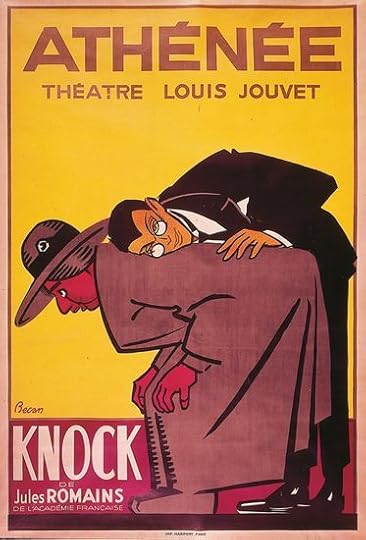
LE TAMBOUR - Quand j'ai dîné, il y a des fois que je sens une espèce de démangeaison ici. Ça me chatouille, ou plutôt ça me gratouille. KNOCK - Attention. Ne confondons pas. Est-ce que ça vous chatouille, ou est-ce que ça vous. gratouille LE TAMBOUR - Ça me gratouille. Mais ça me chatouille bien un peu aussi... KNOCK - Est-ce que ça ne vous gratouille pas davantage quand vous avec mangé de la tête de veau à la vinaigrette ? LE TAMBOUR - Je n'en mange jamais. Mais il me semble que si j'en mangeais, effectivement, çà me gratouillerait plus.
Jules Romains, born Louis Henri Jean Farigoule (August 26, 1885 - August 14, 1972), was a French poet and writer and the founder of the Unanimism literary movement. His works include the play Knock ou le Triomphe de la médecine, and a cycle of works called Les Hommes de bonne volonté (Men of Good Will).
Jules Romain was born in Saint-Julien-Chapteuil in the Haute-Loire but went to Paris to attend first the lycée Condorcet and then the prestigious École normale supérieure. He was close to the Abbaye de Créteil, a utopian group founded in 1906 by Charles Vildrac and René Arcos, which brought together, among others, the writer Georges Duhamel, the painter Albert Gleizes and the musician Albert Doyen. He received his agrégation in philosophy in 1909.
In 1927, he signed a petition (that appeared in the magazine Europe on April 15) against the law on the general organization of the nation in time of war, abrogating all intellectual independence and all freedom of expression. His name on the petition appeared with those of Lucien Descaves, Louis Guilloux, Henry Poulaille, Séverine... and those of the young Raymond Aron and Jean-Paul Sartre from the École normale supérieure.
During World War II he went into exile first to the United States where he spoke on the radio through the Voice of America and then, beginning in 1941, to Mexico where he participated with other French refugees in founding the Institut Français d'Amérique Latine (IFAL).
A writer on many varied topics, Jules Romain was elected to the Académie Française in 1946, occupying chair 12 (among the 40 chairs in that august academy). In 1964, Jules Romains was named citizen of honor of Saint-Avertin. Following his death in Paris in 1972, his place, chair 12, in the Académie Française was taken by Jean d'Ormesson.
Jules Romains is remembered today, among other things, for his concept of Unanimism and his cycle of 27 novels in Les Hommes de bonne volonté (The Men of Good Will), a remarkable literary fresco depicting the odyssey over a quarter century of two friends, the writer Jallez and politician Jerphanion, who provide an example in literature of Unanimism.
زمانی تصمیم گرفتم هر کتابی که محمد قاضی ترجمه کرده رو بخونم و هنوز سر این تصمیم هستم چون هر بار راضی برگشتم از خوندن کتابهایی که ترجمه کرده. اینبار یک نمایشنامه عالی خوندم و جدا کیف کردم از خوندنش. ماجرای نمایشنامه راجع به پزشکی به اسم کنوک هست که قراره بره داخل یک بخش دور از شهر و بعد از ۲۵ سال به جای پزشک قبلی به اسم دکتر پارپاله مشغول به خدمت بشه. اما دکتر کنوک از اون دست پزشکانیه که معتقده «آدم سالم» وجود نداره. حالا این یعنی چی؟ اگه بیشتر بگم داستان لو میره، پس بهتره خودتون بخونیدش🙄 موضوع اصلی این نمایش تزویر و دروغه که البته علت اصلی چنین تزویری طمع ماله. حتی پزشکان هم که حرفه مقدسی دارن آلوده به این طمع میشن و چقدر راحت از بی دانشی و کم سوادی عامه مردم میتونن سود ببرن. صد البته که پزشکان مثال هستن و چنین افرادی که دیگران رو با روشهای تبلیغاتی فریب میدن توی هر صنفی پیدا میشن. خلاصه که خوندن این کتاب یه تلنگر اساسیه چون این حس طمع توی وجود همه هست و خیلیها حاضرن برای ارضا کردنش خیلی کارها بکنن. پس حواسمون به خودمون و اطرافیانمون باید خیلی جمع باشه. فک کنم جایی میخوندم این کتاب جزو اولین تجربههای ترجمه محمد قاضی بوده، و این چند جا به چشم میومد. اما در کل قابل اقماضه و اصلا باعث نمیشه از خوندن این داستان شیرین و در عین حال تلخ لذت نبرید😊.
Voilà une pièce de théâtre qui fait bien rigoler. Le livre était sur les étagères de notre petite bibliothèque depuis que je puisse m'en souvenir, et pourtant je n'ai jamais eu l'intention de le lire. Bien dommage! C'est l'histoire d'un certain docteur Knock, qui, après avoir été docteur au bord d'une voile en Inde, est venu s'installer à Saint-Maurice et commence à pratique la médecine. Knock est rusé, et bien que son prédécesseur, le docteur Parpalaid, n'avait pas une large clientèle, Knock réussit à persuader les habitants du village, et même les voyageurs qui passent par le village de différents cas médicaux qu'on en souffre. Et dans trois mois, Knock réussit à se faire gagner une large clientèle bien convaincue qu'elle souffre terriblement.
Knock est une pièce unanimiste. Le docteur Knock vient à Saint-Maurice pour appliquer sa méthode au sujet de l’expérience médicale. Trois mois plus tard c’est une expérience très réussie. Il a une théorie que la santé est une « vieille notion qui ne tient plus devant les données de la science actuelle » et il utilise sa théorie pour construire une armée et contrôler la population du canton.
Le docteur Knock est un type de dictateur. Tout en contrôlant toute la population, Knock dit « qu’il faut des gens bien portants, ne serait-ce que pour soigner les autres, ou former, à l’arrière des malades en activité, une espèce de réserve ». Cependant, si une des personnes bien portants commencent à « affaiblir l’esprit médical de la population, » le docteur prend l’action. Par exemple, « le colosse » M. Raffalens est « au lit » à cause de ses vantardises et les deux gars, qui essayent de se moquer du docteur dans le premier acte, sortent, tous les deux avec « des mines diversement hagardes et terrifiées ». « Ça y est », Knock contrôle toute la population quoiqu’elles ne le sachent pas.
En pratique, les méthodes de Knock transforment la population comme il les souhaite. Pendant trois mois il assemble son armée et il établit son « petit roulement » des malades à Saint Maurice. Il transforme l’hôtel en un type d’hôpital et il même commence à tomber victime de ses propres méthodes. Knock commence à ébaucher en lui-même un diagnostic comme pour tout le monde et il dit à Parpalaid « j’évite de me regarder dans la glace » de peur de m’auto-diagnostiquer.
Knock a réussi parce qu’il est très habile et un vrai démagogue. Il comprend le peuple du canton et il sait comment les manipuler. Knock a acheté « une clientèle de tous points assimilable à » la guimbarde de Parpalaid et il « les détermine, il les amène à l’existence médicale. » Le docteur Knock fait une transformation totale de la ville et du canton de Saint-Maurice. Le peuple pense que Knock mène une vie de forçat qu’il ne travaille que pour eux, mais en effet c’est le peuple qui est le forçat de Knock.
the play was published almost a hundred years ago, but still relevant today as healthcare is still as vulnerable to greed now as it was before, maybe even more so.
Brilliant. Dr. Knock purchases the medical practice of Dr. Parpalaid located in St. Maurice, a town in a country district where only one doctor serves a few thousand residents, all apparently free of affliction, at least at curtain rise. Dr. Parpalaid moves to Lyon while Dr. Knock awakens the locals to their lurking, untended medical conditions, courtesy of free consultations, a novelty for the region. He assigns medical regimes based on the incomes of his patients now eager for cure. Business quickly booms for Dr. Knock, the local pharmacist, and even the Hotel de la Clef. Dr. Parpalaid returns for a visit three months following his departure to realize immediately both the charade being perpetrated and the profits left unharvested through his years. The curtain falls with Dr. Parpalaid about to enter Dr. Knock’s care through another free consultation. No one escapes the advance of medical science.
Though a comparatist specializing in drama—Shakespeare, Moliere, Lope— I never heard of Romains' (Louis Farigoule's) Knock, ou le Triomphe de le Medicine, until my old age, here on Goodreads. A century ago in France people did not know inherited diseases could lodge in healthy-appearing associates. That is, France was not the U.S. in our time, where many cities’ great employer, their biggest business, is health: hospitals, clinics, nurses aids, nurses and physicians. Not to mention building construction an maintenance, plus janitorial support.
In Romains’ play, a physician Parpalaid has practiced for a quarter century with little impulse for house calls because everyone paid once yearly, on St Michael’s Day, September 29. He looks for a replacement in early October, who will have to wait a year to be paid. He chooses Knock, who is dismayed by the prospect of non-payment. But Knock has several advantages: he recently finished his doctoral thesis in medicine, he has a flair for business and advertisement (hiring the town crier, Le Tambour, to spread the word of free consultations on Monday, 9:30-11:30), also, he engages the town educator (Bernard, “Le Instituteur,” to spread knowledge of disease) and finally, he offers the druggist (think of Homais in Madame Bovary) a new profitability.
The prior physician, Le Docteur signs over to Knock, who enlists first the public announcer, and then the teacher to spread health knowledge and worries. Knock urges Bernard to hold a conference on typhoid fever, unsuspected sources from “eau, pain, lait, coquillages, legumes” water, bread, milk, shellfish (p.30). Bernard should explain about “bacilles formidablement grossis” large bacilli, about excrement from typhoid, giving details in full color. Bernard resists, “If I do that, j’ai n’en dormirai plus” I’d never sleep again (31). Knock corrects, “No, no you should speak so that they don’t sleep. Because their error is to sleep in error, awaken only from disease.”
Knock’s clients on his first free consultation are two women and two men, the first woman, La Dame en Noir, 44, “qui respire l’avarice paysanne,” owns a big farm with 18 cows, two bulls, a dozen pigs and two rams, six goats and many chickens. The next, La Dame en Violet, 60, dressed royally, visits the free clinic to set an example for her many employees, though indeed she worries about her investments. When Stock alludes to them, she says “Aie! vous avez touché le vif de la plaie!” you’ve touched the sore spot (40). She asks Stock about her investment in coal (how resonant for the U.S. in 2022, Sen Joe Manchin).
The Woman in Black has some digestive problems which Stock relates to her falling from a ladder; he writes a prescription, “ordonnance,” but mainly takes her off solid food for a week, only Vichy water every two hours, and a half biscuit twice a day, followed by a little milk, “un doigt de lait” (39). After a week, he’ll check to see if she’s improved, or is weaker, can only lie in bed (of course, such a diet will weaken her) and he’ll commence treatment.
The Woman in Purple, who still keeps six servants and a coach and four, who also gathers her salon around a Louis XV teapot, nevertheless worries about her peasants and her farms. She has had to sell a farm of 160 hectares (400 acres) named Michouille, from mycodium, hatred of mushrooms—so there are no mushrooms on all the sun-drenched fields. Her worries keep her from sleeping. Had she consulted Dr. Parpalaid? Yes, he had suggested she read at night three pages of law, the Code Civil. Knock reverses Parpalaid’s humor, suggesting some insomnia very grave, from circulation in the head, “circulation intracérébrale”(43). Stock offers hope of cure over a long period of treatment, with radioactive medicine. Since La Dame en Violet lives nearby, Dr. Stock will visit to treat her every morning except Sunday and Monday (because of his free consultations).
نمایشنامهی دکتر کنوک، برای من یادگار واحد انسانشناسی پزشکی و سلامت با دکتر ودادهیر است. کلاسی که اطلاعات پراکندهام دربارهی این حوزه را به بهترین شکل جمعبندی و تکمیل کرد و جزو مفیدترین دروس کارشناسی ارشد بود. بنابراین فارغ از خود محتوا، دکتر کنوک برایم اثری بهیادماندنی است؛ کتابی دربارهی تجاریشدن پزشکی و گستردهشدن معنای بیماری، در طب مدرنی که نقشی خدایگون برای پزشکان قائل است.
کنوک: من اصولاً بنا را بر این میگذارم که اهالی ای بخش همهشان واقعاً مشتری مسلم ما هستند. موسکه: همهشان که چه عرض کنم! کنوک: من میگیرم همهشان باشند. موسکه: بلی، بالأخره یک وقتی هر یک از افراد این بخش در عمر خود ممکن است یکبار برحسب تصادف مشتری ما بشود. کنوک: برحسب تصادف خیر، بلکه مشتری ثابت، مشتری دائم. موسکه: به هر حال باید مردم مریض بشنوند تا به اینجا بیایند. کنوک: «مریض شدن» فرضیهی کهنهای است که امروز دیگر در مقابل اصول و قواعد علوم جدید قدر و اعتباری ندارد. تندرستی حرفی بیش نیست و اگر از فرهنگ لغات حذف شود زمین ��ه آسمان نخواهد آمد. به عقیدهی من هیچکس نیست که کم و بیش بیمار نباشد و کم و بیش چند بیماری مخلوط با هم نداشته باشد و هر یک از این بیماریها کم و بیش رو به توسعه و تکامل سریع نرود. طبیعی است که شما وقتی به مردم بگوئید حالشان خوب است و کسالتی ندارند از خدا میخواهند که حرف شما را باور کنند ولی شما ایشان را گول میزنید. تنها عذر موجه شما ممکن است این باشد که مریض زیاد دارید و به معالجهی بیماران تازه نمیرسید. موسکه: به هر حال این فرضیهی بسیار خوبی است! کنوک: بلی آقای موسکه، این فرضیه کاملاً بدیع است. خوب فکرش را بکنید. فرضیهای است که با فکر عالی «نظام مسلح» که هم اکنون قدرت و نیروی کشور ما را تشکیل میدهد خویشاوندی نزدیک دارد.
الدكتور كنوك او انتصار الطب، مسرحية ساخرة للكاتب الفرنسي جول روما، تروي قصة طبيب يأتي الى بلدة ويبدا مهمته الطبية، وسرعان ما تنتشر خدماته على الناس في البلدة بسرعة كبيرة ويصبح عدد المراجعين والمرضى اعدادا هائلة بسبب قدرات الطبيب الشاب.
الفكرة من المسرحية فكرة مهمة لكل شخص لفهم مهنة الطب ورؤية الجانب المظلم منها الذي يمارس من قبل كثير من الأطباء، وهو جانب تعظيم شأن المرض والايحاء لكل من يراجع او حتى من يقابل الطبيب لشأن آخر بأنه مريض ويعاني من علة خطيرة، مؤديا الى توجه الناس كأنهم منومون مغناطيسيا للاستطباب.
كذلك القصة قد تكون مشوقة أكثر للاطباء والعاملين بالمجال الطبي جميعا، حتى انه يمكن الاستفادة من طرق الدكتور كنوك وتطبيقها!!!
الكوميديا السوداء كنوك ليس طبيبا إنما حاصد أموال يقتات من إقناع الناس بأنهم مرضى حتى وإن كانوا في تمام الصحة ليدفعوا له لقاء علاجهم المسرحية المستمرة في كل زمان وفي كل مكان أصحابه على درجة من الجهل
تحولت المسرحية إلى فيلم مصري من بطولة فريد شوقي اسمه أنا الدكتور لكن القصة أضيف لها طابع رومانسي كأي فيلم مصري وانتهت بندم كنوك (إبراهيم في الفيلم) على استغلال الناس وهو ما لم يحدث في المسرحية
plutôt sympa, c’est vraiment une lecture complémentaire à faire avec le malade imaginaire, on y retrouve les mêmes thèmes de sociétés mais un peu plus modernisés, carrément certains moment me rappelait le covid et c’est mentionnez dans mon édition pour mettre en rapport avec des faits récents, c’est facile à comprendre mais pas ouf non plus, très crazy et un peu marrant quand même
دکتر کنوک در شهرستانی کوچک جانشین دکتر پارپائه میشود و تصمیم میگیرد کِرم اضطراب برای سلامتی را به جان همهی اهالی بیندازد و پولی درآورد. روابط او با داروچی (اقتصاد دارو)، جارچی (رسانه) و البته معلم (نهاد علم) در این شهرستان بسیار جالبتوجه و نمادین است.
Ce livre m'a beaucoup plus, d'autant que je l'avais déjà lu quand j'avais 6 ans (a peu près) et n'avais rien compris du tout. Cet fois, le sense et le message caché du livre m'a sembler très claire, et j'ai presque lu ce livre comme un message philosophique. Je l'ai lu pour ma classe de Français (pendant les vacances).
«Les gens bien portants sont des malades qui s'ignorent.» - Ƙησcк
À première vue, ce livre n'est qu'une comédie amusante d'un 'docteur' (Knock) qui est en faite qu'un escroc.
Mais, après reflection, on comprend que c'est presque une histoire d'horreur (enfin, une qui ne nous fait pas très peur). Knock est un manipulateur presque dictateur. Les habitants de ce Saint-Maurice croient que le docteur s'use et travaille sans relâche pour eux, mais en vérité, c'est lui qui les manipule et les utilise. Il contrôle toute la population. Si l'une des personnes bien portantes commence à « affaiblir l’esprit médical de la population » le docteur les mets immédiatement au lit.
Je pense que ceci est un livre a lire deux fois, et même trois fois: pas forcément parce qu'il est très bien écrit, mais aussi car je trouve que la première fois/deuxième fois (selon le lecteur) on absorbe plus le comique. La relecture permet de voir le/les messages cachés et la philosophie à travers les répliques.
☞ Ne pas relire ce livre si vous ne l'avez pas aimer la première fois; ceci sera une perte de temps.║ᶰᵒᵗᵉ: ᴾᵒᵘʳ ᶜᵉᵘˣ ᵠᵘᶤ ᵃᵇᵃᶰᵈᵒᶰᶰᵉ ᵐᶤ⁻ᶜʰᵉᵐᶤᶰ ᶜᵃʳ ˡᵉ ᵈᵉ́ᵇᵘᵗ ᵉᶳᵗ ˡᵒᶰᵍ ᵉᵗ ᵉᶰᶰᵘʸᵃᶰᵗ˒ ᶜᵒᶰᵗᶤᶰᵘᵉᶻˑ ᶜᵉˡᵃ ᵛᵃ ᵛᶤᵗᵉ ᶜʰᵃᶰᵍᵉʳ ᶳᶤ ˡ'ᵒᶰ ᵖᵒᶳᶳᵉ̀ᵈᵉ ᵘᶰ ᵖᵉᵘ ᵈᵉ ᵖᵃᵗᶤᵉᶰᶜᵉˑ
☞ Si on a aimer cette pièce (moyennement ou beaucoup), je vous conseille fortement de relire; vous pourrez vous régalez encore plus la deuxième fois.
Bon, je résume: livre très bien mais compliqué parfois a comprendre. Il faut s'y accrocher! :)
Comédie et humour, c'est une pièce magnifique! Je l'ai adorée. C'est l'histoire du docteur Knock qui vient d'installer dans un nouveau village et ouvre un cabinet de consultation. Malheureusement pour lui, les gens de ce village sont de bonne santé et ne connaissent que rarement les maladies. Afin de gagner de l'argent, Knock essaye de persuader les habitants qu'ils sont vraiment malades alors qu'ils l'ignorent, et nécessitent donc des traitements de long terme.. «Les gens bien portants sont des malades qui s'ignorent.» - Knock. Ainsi le docteur réussit à gagner sa vie et il réalise le Triomphe de la Médecine. J'aimerai bien la relire une autre fois.
کُمدی متوسطی بود. از اوایل پردهی دوم به بعد دست نویسنده رو شدهبود و دیگه چیز زیادی برای ارائه نداشت. و در ادامهی پرده دوم و پردهی سوم هم با موقعیت خاص و ویژه و شگفتانگیزی روبرو نمیشدیم، بلکه همهچیز طبق انتظار و پیشبینی جلو می رفت؛ یکنواخت و کسلکننده. میشه گفت پردهی سوم بهکل زیاد بهنظر میرسید و جز وراجی و پرحرفی چیز دیگهای نداشت. میشد به جاش نوشت: همونا که خودتون حدس زدید در عین ناباوری ترجمهی «محمد قاضی» هم اصلاً خوب نبود. جدای از چند غلط دیکتهای، جملات نامفهوم و غیرفارسی زیادی داشت و اصلاً دلنشین و دلچسب نبود
الدكتور كنوك الذي ذهب إلي قرية كان فيها طبيب يصف للناس القليل من الوصفات الطبية، ,وفي ثلاثة أشهر فقط اصبح كل شيء مختلف حيث فعل الطبيب كنوك العديد من الامور التي غيرت هذا كله.
ذهب الدكتور كنوك إلي الصيدلي واتفق معه على المزيد من الدخل، وقام بعمل يوم مجاني للفحص، وبدأ يخترع للناس المزيد الامراض ووصفات طبية اكثر ثمناً وباهظة الثمن.
الفرق بين الطبيبين أن احدهما دجال يتاجر في هموم الناس، واخر نقي يقول ما يرى فقط.
Une comédie légère, tres agréable qui dénonce les manipulations et l’abus de confiance de la médecine mercantile. Quand l’acte est intéressé, il devient fichtrement percutant et précis comme un scalpel qui vous ouvre le porte-monnaie comme par magie.
Knock : « Les gens bien portants sont des malades qui s'ignorent ! »
Bon bah let’s go j’ai fini ! En vrai j’ai abusé sur le fait de repousser la lecture parce que c’était hyper rapide mmddrrr.
Bon du coup petite lecture rapide. On voit bien les liens avec le Malade Imaginaire. Knock est littéralement un crack ptdrrr. Mais par contre je suis un peu frustrée de la fin. Jsp trop ? Bref en soit c’était pas trop chiantos donc carré 🤟🏾
A surprise, as this book as been on my to read shelf for ages because it didn't really appeal to me. A good surprise actually, for the superb irony as for the brilliant dialogues. A classic that is worth reading, especially when it is at the same time so easy and so clever!
Un peu déçue. J'ai acheté ce livre à l'occasion du Festival Lumière parce que c'est un classique du théâtre français et qu'il me semblait intéressant pour son rapport déclaré avec Molière. L'interprétation de Louis Jouvet de cette pièce est très connue et, lors du festival, j'ai apprécié le film Quai des Orfèvres, donc je me suis dit que ce serait un signe pour lire quelque chose de nouveau et faire une belle découverte. Mais je n'ai pas aimé. Naturellement, il s'agit de théâtre, je le sais bien, mais les pages ne sont pas très agréables à lire, contrairement à d'autres pièces. Quel ennui ! Il n'y a pas d'ironie dans les échanges, pas de mordant noté par les critiques, pas de situations bien exploitées. Juste une pièce qui commence et se termine sans laisser grand-chose. Un peu dommage parce que j'avais de grandes attentes. Ce sera pour la prochaine fois.