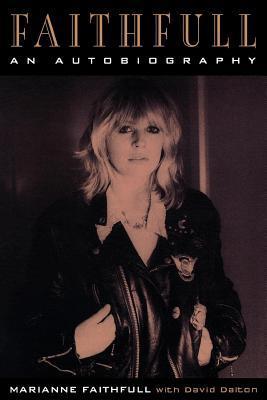
A Rolling Stones girl memoir for you this time. What a morbidly fascinating character Marianne Faithfull is! What I was most struck by in this book was the image creation and press-hounding that never let her alone. That fame machine was so one-dimensional and manufactured, especially for women. From the get go, upon being discovered at seventeen, Andrew Loog Oldham spins this PR story about her being this virginal little waif, aristocratic and bohemian and ethereal. Later, she becomes the wayward child overtaken by the satanism of the Rolling Stones and drugs, which she scoffs at in the book. Later still, she's the hopeless junkie, branded as Mick Jagger's Fallen Ex-Girlfriend forever and ever. She's an innocent, no she's a slut. The press can't seem to make up their minds. Upon finally (finally) making it to rehab in the 80s, she realizes she has no story of her own. When asked to tell their story at the program, she offers up a copy of a tell-all book by a Rolling Stones handler ,hilariously nicknamed Spanish Tony. " 'You want my story? Read that.' Because in those days I really didn't know I had a story of my own. I was just part of their story and I saw my own only through these books." Good thing she got to write down her story in this book. And boy is it unflinching.
To get it out of the way, I'll just give a quick run-down of the Rolling Stones' story, as seen through Marianne's lens (sorry Marianne, I'll get to you and your own agency in a sec.) I loved Keith Richards' account of all this stuff in his autobiography, but it was interesting and maybe even truer from the perspective of someone not in the band. Marianne saw the Brian-Mick-Keith relationship as a battle for dominance, and specifically, as a Brian-Mick competition for Keith's attention. It's like the Kardashian sisters' pettiest fights! In Keith's autobiography he writes with still-brimming resentment towards Brian's irritating demeanor at the end of his life. Marianne feels badly for him, and sees how desperately he craves Mick and Keith's attention. She says he was just uncool. They cruelly make fun of him, which Marianne notes must have been hellish for sensitive, insecure, paranoid Brian. Marianne says that in the Stones, someone always had to be "it." First it was Andrew Loog Oldham when they fired him for Allen Klein, then it was Brian. She teases it will eventually be her (dun dun dun!) Marianne thinks Brian never fully recovered from the first time he took LSD. She says he was totally paranoid and sickly in the last years of his life. And obviously rageful and abusive towards Anita.
After Anita leaves Brian for Keith, it's all over for him. The rest of the group is cemented into the two couples (with some girlfriend-swapping going on too obviously--the sixties!!) In one rather heartbreaking anecdote, Mick feels guilty and calls up Brian for a dinner date with him and the girlfriends. Brian is so stoked and delighted but prissy bitch Mick immediately complains about the food and he and Marianne leave to go to a restaurant in the middle of the dinner party! Which effectively devastates Brian. After Brian's death, Marianne goes on an LSD bender of her own, and has a bit of a psychotic break. Staring into the mirror and looking out at the hotel pool, she thinks she *is* Brian and gets it into her head she should be dead too. An absolutely chilling scene. She comes to and if this precise dialogue in this autobiography is to be believed, gives Mick the lyric for Wild Horses: "Marianne, you're alright!" "Wild Horses couldn't drag me away."
The other Stones move right along after Brian's death. Marianne writes about their career and elevation into (second) best of the best (editorial my own, sorry Stones. You know my allegiance.) Understatement, but they really had some good stuff! So much of it inspired by Marianne herself: Let's Spend the Night Together, Wild Horses, You Can't Always Get What You Want, Sister Morphine obviously. Marianne doesn't seem bothered by the credit-sharing war for the last one. Even though it is quite obviously her song lyrics and her story to a tee, Allen Klein told her it was some bureaucratic tie-up. Oh well! She writes about the Stones' songs and talent with the adoration of a fan and the knowledge of the inner circle. From blues and rock beginnings to Byronic, LSD-infused, mysticism (wonder who they got the mysticism from? Rhymes with Schmorge Schmarrison.) That mysticism stuff was kind of funny to me. Anita Pallenberg truly believes she is a witch, Brian too especially in their most trippiest trips. They all wear these very Baroque, sixties, frilly ruffled shirts and drape themselves in scarves and dance around (Mick especially.) It's all very gender-bending in a sixties, drug-addled way. And the press is all over them, fear-mongering their alleged satanism calling to wayward youths. At the famous drug bust at Redlands, Marianne was naked and wrapped in a fur rug, and that image stays with her forever. Some of the pills the police confiscates are actually hers and she begs Mick and Keith to let her take the fall for it. They won't hear of it and do their few months time to try to save her, but the press rakes her through the coals anyway. Upon visiting a scared and weeping Mick Jagger in prison, Marianne says she was honestly a little turned off by his display of vulnerability. "Straighten up and fly right!" and then a little kinder, "Use it to write a song dear." Here is a great example of how different she was from her sixties image. She could be very no-nonsense and blunt. She was up for literally anything and had no qualms. She was a complete hedonist which would obviously be her downfall, but in the decadence of the Swinging Sixties, she's still able to be on her own two feet and insult Mick Jagger.
Except not totally. By the end of that relationship, she feels totally trapped and can't seem to find a way out. She is sick of Mick's controlling nature, she's no longer in love with him. She may never have been really in love with him. She gets a kick out of him in the early years certainly, his softer, feminine side, but she freely admits she was in love with Keith Richards, and says the best night of her life -- best!-- was when she slept with Keith shortly before getting with Mick! " 'Y'know who really has it bad for you, don't you?' 'No darling, who's that?' 'Mick!'... I was speechless. He was telling me that I shouldn't bother with him. I should pursue Mick instead. He set me up and I simply accepted it as a fait accompli. Incredible isn't it? It's all these funny things you do when you're very young (and on acid!)" The whole impetus to her infamous relationship with Mick Jagger was a gentle rejection from Keith Richards!
Boy, Mick Jagger. What a complicated personality that one is. Controlling doesn't even begin to describe it. Marianne says ultimately Mick hates women, which is pretty evident in some of his songs. There's literally a song called, hilariously, Stupid Girl directed at his ex-girlfriend Chrissie Shrimpton who he left for Marianne. It's all about her being too vain--rich coming from you Mick--and there is literally a line that says "She's the worst thing in the world." Not very poetic. And all of this after dumping her! (Great song though.) She also writes wittingly about Mick's affairs with men and his fluid sexuality. She says she never minded it, but interestingly draws a line from that to his hatred of women too. Women, ugh! You just have to sleep with them sometimes! Apparently, he had the hots for Keith and he said as much to Marianne, audibly when Keith was in the next room! She said he had a "dolly fascination," and mentioned the theory that he really wanted Julie Christie but settled for her. Later, he marries Bianca, who Marianne calls just another version of himself. Ha! Mick's persona at this time was the foppish little prince, with his Baroque clothes and sexual promiscuity. Later in the seventies I guess is when you get the rooster-face, hopping-around Mick who wears headbands. But he definitely always had a yearning to be a part of the aristocracy. But you know what, he wrote Wild Horses about the end of their relationship and losing her to drugs and I have to say listening to it honestly brings a tear to my eye.
Alright, drugs. There were a lot of trippy descriptions of the various trips she's been on. (Quite a good memory actually for the minutiae of Mick's dancing with scarves during an acid trip... I'm always skeptical of hyper-detailed scenes like this one in autobiographies, but it was all very atmospheric.) Then of course, she tries heroin and it's all over. Those parts were so rough. Mick did try to help her but she didn't want the help, she just wanted to feel nothing and do nothing. Just like Anita actually. After finally breaking it off with Mick she takes up with some minor English aristocrat, oddly getting engaged but not living with him. She's in and out of her mother's house, a complete ghost. She lives with her friend Pamela for a time, playing the role of Worst House Guest in History. She leaves her dirty needles in plain view of Pamela's kids. She shoots up one day, draws a scalding hot bath, passes out, and requires Pamela to yank her out of the tub, which causes her to slip and hit her head, knocking her out cold. Jesus. Then she goes off to join the other "junkies and winos on the wall." The Wall. She just shoots up and sits on the wall for like two years, barely eating. So bleak. In her addict mind, all she wants is to do take drugs. She has no understanding of how it affects the people who love her. She finds a glamour in it, even on the wall. What a terrible existence. "If I can't stand it, I'll just kill myself."
After the wall, she takes up with a few more boyfriends, all of them deep into drugs too. She keeps going with heroin and cocaine for a few decades, somehow able to make a few comeback records and act in a play or two in that time. I listened to her comeback album Broken English while reading. Not bad. The rest of the 70s and 80s go by rather repetitively until she gets herself into rehab FINALLY and takes sobriety a little more seriously (with the occasional relapse.) At the time of writing this book, she says she is completely uninterested in having a relationship again. Probably smart. Every one she had before was predicated on scoring together.
I was fully engrossed in this book. This time period will never not be fascinating to me.