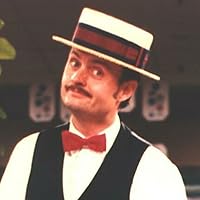
Showmanship for Magicians is a 1943 work by semi-professional magician and author Dariel Fitzkee. It is the first in the Fitzkee Trilogy, a classic collection that is still read widely by magicians, conjurors and illusionists alike. There is little information available on the life of Dariel Fitzkee outside of his written work. Born in Annawan, Illinois, in 1898 as Dariel Comp Fitzkee, he later changed his surname to Fitzroy during World War II. But he continued to write under the name Fitzkee throughout his life. Fitzkee's early books were shorter works focused on specific magic tricks. Books like Cut and Restored Rope and Manipulation (1929) and Linking Ring Manipulation (1930) described multiple variations of these classic tricks. Fitzkee was also a regular contributor to Genii Magazine, which is still published today. He wrote two recurring magic columns in the 1930s called "Thoughts are Things" and "Glimpses of Strange Shadows." Fitzkee also contributed a book and magazine review column called "Paper and Ink" that ran for over 12 years. For all of his analysis and study on the subject, it seems that success as a professional magician eluded him. Fitzkee is said to have had an unsuccessful touring act from 1939 to 1940, after which he stopped performing. But his most enduring written works were yet to come in the form of the Fitzkee Trilogy, starting with Showmanship for Magicians . Many magicians throughout the second half of the 20th century have considered it to be a cornerstone work in the field, including the actor Steve Martin who was fanatical about magic as a young man. He described the book as "...more important to me than The Catcher in the Rye ."Fitzkee was frustrated with the quality of magic at the time of his writing. He felt that the mediocrity that dominated the stages did damage to the reputation of the entire field of magic. One of his biggest issues with magic in the 1940s was that its performers were still treating the trappings of the late 1800s as the "standard" for magic. Performers often dressed in out-of-date tuxedos, wearing top hats or turbans. They adorned the stage with old-fashioned round "Magician's tables" that had been popularized some 70 years before. Fitzkee felt that magic should be "...geared and attuned to the times" to keep it fresh and interesting for the audience. Fitzkee analyzes the components of other successful forms of entertainment, like film, sporting events, theater, opera, and more. He breaks these down into a list of 39 "Audience Appeals" - music, color, comedy, conflict, etc - that can then be incorporated into a magic performance. The second book in the Fitzkee Trilogy is The Trick Brain published in 1944. This work condenses all magic tricks into 19 basic effects, such as getting a solid item to penetrate another without damaging either. It also examines how to combine effects into new and updated tricks. The final book of the trilogy, Magic by Misdirection (1945), concerns the psychology of deception, or "the attack the magician makes upon the spectator's mind." The books were written in this order on purpose. Fitzkee felt that entertainment was the primary purpose of a magician. Whatever else an audience may expect, the first thing they expect is to be entertained. Then he gets into the mechanics of magic in The Trick Brain , helping the entertainer to hone his or her skill and create original tricks. And finally, in Magic by Misdirection , Fitzkee examines the mental aspects of magic, from both the magician and the spectator's point of view.
In case you weren’t aware, I’m not a magician. I enjoy magic. I’d love to have a handful of quality magic tricks up my sleeve, but I don’t have the the motivation to invest the time necessary. So I’ll stick to enjoying the skills of others. (Here’s one of my favourite tricks).
So why would I pick up a 60 year old book aimed specifically at magicians? It is part curiosity, part recognition that there are always interesting things you can learn from other fields of expertise. As a theologian and preacher, I think there are few areas of learning that can’t offer some insightful tidbit. Showmanship is not a term I would ever think to use to describe my own work, but underlying lessons on presentation could always offer something surprising.
The book is written specifically for magicians, and I found it quite incredible how well it has aged. Fitzkee is very critical of the magicians of his day and their lack of showmanship, in contrast to other entertainers of his day. He sees his task as helping magicians to grow their own self-respect and give the people what they want.
So much of what he writes is useful not only for magicians, but for anyone in any form of entertainment, or, wider still, any form of presentation (including those not necessarily aimed at entertaining – this is where I come in). He offers some fascinating and very practical advice. The magician-specific pieces are obviously very targeted. But I didn’t find it too difficult to read between the lines to consider how his thoughts might apply in my own context.
So, what exactly is showmanship?
showmanship is accenting and accentuating the important parts of your act, bringing out the points clearly and deliberately, just as you accent important words in your everyday speech. Showmanship is the portraying of likable characters, and likable human qualities. It is in emphasizing the difficulty of something so that it seems more difficult, thus emphasizing your skill. It is emphasizing the danger in the situation, so as to enhance your daring. It is in emphasizing every quality—comedy, music and all of the others—so that the audience will like you more. Really, showmanship is merely skillful emphasis. It is skillful emphasis combined with good solid bedrock psychology.
That’s not just a good lesson for magicians. That’s a good lesson for any communicator. And this is where I found real value in this book.
Who wrote it
Dariel Fitzkee was a 20th century magician, and author of several books aimed at magicians. From his personal stories retold in this book, it seems he was probably quite a prominent and ahead-of-his-time sort of magician.
Why I read it
I think I came across this book via watching something of comedian Steve Martin talking about the influence of the book on his own career.
What I liked
It’s always interesting to read a well-written book in a field you aren’t very familiar with. It was a pleasant surprise to find out that much of his thoughts apply more broadly that just to magicians.
I really liked the way he mixed personal story and very practical application at every turn. If you were an aspiring magician, this would surely be a gold-standard book to help inform how you go about your craft. But the practical applications are just as relevant to any form of public presentation, making this a very useful book of sorts.
I really appreciated his psychological analysis of an audience, and teasing apart the nature of the presenter-audience relationship throughout the book.
What I didn’t
My only real critiques of the book are all rather unfair. There are sections where he does go heavy into details that only magicians will understand. Some of it was interesting, some of it I just skimmed over. Certainly not a fault of the book. Just harder to engage as someone reading from outside the field.
Major Takeaway
The strongest appeals are invariably to the instincts, not to the mind. When you appeal to the mind, thought is necessary and sometimes reflection. To convince the mind, argument is necessary. And sometimes an argument is lost. But the responses caused by our instincts are subconscious. They are involuntary. These instincts must respond to the appeals to them because we are constructed that way. That is why rhythm, beauty, skill, sex appeal, coordinated effort, physical action, harmony, melody, comedy, movement, youth, personality, romance, sentiment, nostalgia, surprise, situation, character, conflict, music secure reactions almost automatically. The response comes almost before we think. It is a subconscious response, a reaction to an instinct to which we are attuned.
showmanship is accenting and accentuating the important parts of your act, bringing out the points clearly and deliberately, just as you accent important words in your everyday speech. Showmanship is the portraying of likable characters, and likable human qualities. It is in emphasizing the difficulty of something so that it seems more difficult, thus emphasizing your skill. It is emphasizing the danger in the situation, so as to enhance your daring. It is in emphasizing every quality—comedy, music and all of the others—so that the audience will like you more. Really, showmanship is merely skillful emphasis. It is skillful emphasis combined with good solid bedrock psychology.
ultimate success as an entertainer, whether you wish to spend all of your time at it as a professional or whether your appearances are limited to strictly occasional shows, rests upon your ability to sell yourself.
Who should read it
Worth a read for those: curious about magic; those who regularly perform presentations of any kind, and enjoy hearing ideas from slightly left-field sources.
One of three books that I believe every magician worth his salt should study. The other two being The Trick Brain and Magic by Misdirection. All by the same author: Dariel Fitzkee
I have owned a hardcover copy of this since I was young, and I learned a great deal from it. Since I am now in the winter of my years, and no longer perform, I feel that I should pass on my library of books, with some exceptions, to the up and coming young people just starting out. So, I have sold many books and those I still wish to possibly use in the future, I have repurchased as Kindle or PDF documents.
Fun book. Steve Martin mentioned in an old interview that he read as a teen and really influenced him. You totally see the influence on his acts. Fitzkee had a very harsh take on amateurs and doesn’t hold back. Then has really good insights on how to perform and interact with an audience. Good practical nuggets. Hard to follow the writing and context sometime since it’s from 1944
Never allow what a tricks costs to establish its place on your program.
I got into this because I heard it was good for the fundamentals of presenting to an audience in an engaging way. To it's credit it does that really well. Unfortunately it's also jam packed with descriptions of common magic tricks, magic parlance and discussions of stage and screen personas from long before I was born. So the content is in there, it just takes a lot of reading to extract it.
Dariel Fitzkee really does know how to apply the showmanship skills of the normal entertainment into the world of magic and I think that is one of the things that a lot of magicians are missing today. Too many focus on what magicians like and then expect the world to follow along, when in reality, that just isn't true. Though a lot of the material that was presented was out dated and it was hard to follow because I had no clue about a lot of the examples he provided. Other than that, it is a great read for anyone who wants to add a bit more to there magic act (but I think that this could also be used in any forms of entertainment because the fundamentals are for everyone).