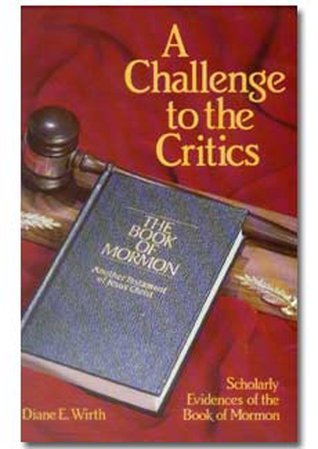
"A Challenge to the Critics" is a carefully documented book that covers a wide spectrum of anti-Mormon claims concerning the Book of Mormon. It systematically exposes fraudulent assertions by presenting irrefutable evidences drawn from the findings of historians, anthropologists and archaeologists. Intriguing topics such as the Smithsonian statement, metal plates, stone boxes, wordprints, chiasmus, and Hebraisms are discussed, as well as early codices, ancient American scripts, and reformed Egyptian. Other important themes include the Nephite monetary system, the wheel, and the existence of elephants, horses and bees in ancient America. The author also provides evidence and new insights concerning the Jaredite, Mulekite and Israelite origins. The Lehi Tree of Life stone figures prominently in this discussion, and most significant is the evidence given concerning the coming of Christ to the Americas. In a decisive and straightforward style, this carefully researched book establishes a major challenge to anti-Mormon critics, carefully exposing many of the misrepresentations, false assertions and unsubstantiated claims of those who have attacked the veracity of the Book of Mormon as scripture revealed by God.
Diane E. Wirth is a writer and independent researcher specializing in art history and iconography, the latter interpreting symbols in art and antiquities.
A RESPONSE TO CRITICS, LARGELY BASED ON SCIENTIFIC EVIDENCE
Author Diane Wirth wrote in the Acknowledgments of this 1986 book, “This book expresses my personal findings as well as those of others who have spent hundreds of hours correlating recent archaeological, anthropological, literary, and theological findings relating to the Book of Mormon claims.”
She begins Chapter 1, “The Book of Mormon was published in 1830. Ever since, anti-Mormon critics have attempted to repudiate the book’s authenticity. Statements and conclusions drawn by these critics are often based on inaccurate or incomplete information. Recent archaeological finds and results of various studies will be discussed to challenge those arguments and to support the contention that the Book of Mormon record of ancient Americans is, indeed, authentic.” (Pg. 15)
She acknowledges, “One area in which there is a difference of opinion among LDS Book of Mormon scholars is … as to where the Book of Mormon story took place. In the early days of the Church it was assumed that this geographical area encompassed the whole of North, Central, and South America whereas the Book of Mormon refers to this territory only as the ‘land northward’ and the ‘land southward.’ … As study on the subject has progressed over the years, most LDS scholars … now support the limited Tehuantepec theory: the lands north and south of the Isthmus of Tehuantepec in Mexico would be, in the Book of Mormon, the narrow neck of land separating the land north from the land south. The record does not, therefore, include that entire Indian population, as critics would have the public believe.” (Pg. 17)
She notes, “Indians do not grow beards---this is a genetic fact… their bodies have much less hair than do American Caucasians. So how are the numerous sculptures, the stone bas reliefs, the terracotta portraits of bearded Indians explained? Are they true ‘Indians,’ as these early Americans were called?” (Pg. 29)
She argues, “Critics… often assume that the monetary names used in the Book of Mormon refer to coins. However, nowhere in this record is the word ‘coin’ mentioned… Money does not necessarily denote coinage. In fact, the Egyptians and Babylonians used pieces of metal in conventional shapes whose value was determined by its shape. It is possible that the Nephites did not use coins, as we know them, and may even have employed another system used by the Egyptians which archaeologists refer to as ‘ring money.’ There may be other forms we are not aware of at this time.” (Pg. 46-47)
What about horses in ancient America? She states, “It is… reasonable to assume that, as a result of Lamanite rustling and the Nephite’s need to sustain their people, the horse became extinct. The extinction of the horse can be likened to the near-extinction of the bison in the early west.” (Pg. 56)
How about wheels? “*Terracotta-wheeled objects were buried with the dead in Mesoamerican as well as in Old World cultures. *At least five methods of attaching an axle to a wheel were known in pre-Columbian America. *Small-wheeled carts have been discovered which were undoubtedly patterned after larger models. *The wheel was a sacred emblem to the Indians and, for this reason, may have been considered ‘taboo’ for utilitarian purposes.” (Pg. 64)
She admits, “LDS archaeologists are not in total agreement with regard to the interpretation of this complex stela. They all admit, however, that there is a strong parallel between elements portrayed on the stela and similar themes found in the Old World. Therefore, in the Mormon community, there is no singular opinion regarding this stela. As discussed earlier, archaeological interpretations are theories---not Church doctrine.” (Pg. 67)
She reports, “in Joseph Smith’s time, pre-Columbian Indians were considered to be illiterate. Even today there is the unresolved question of whether or not the ancient inhabitants of the Americas had a written script… Although various styles of writing have been found in the Americas, LDS scholars do not claim any of them as ‘proof’ of the Book of Mormon. In fact, aside from Mayan hieroglyphs, few of these means of a communicating language are alike.” (Pg. 77)
This book may interest those studying LDS apologetics (particularly in the areas of archaeology and anthropology).