Jump to ratings and reviews
Rate this book

Content and Consciousness

Rate this book
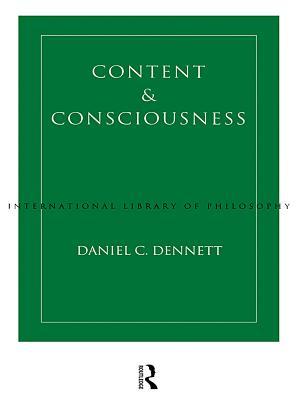
First published in 2002. In this pioneering book, Daniel Dennett sets out clearly what he believed constituted a genuine analysis of the mind. His work over the last twenty years and more, culminating in his major study, Consciousness Explained, has increased rather than diminished the power of his first book. This edition also includes the 1986 preface which places the book in the context of recent work in the area.

214 pages, Kindle Edition

First published January 1, 1969

17 people are currently reading
429 people want to read

About the author

Daniel C. Dennett

80 books3,063 followers
Daniel Clement Dennett III was a prominent philosopher whose research centered on philosophy of mind, science, and biology, particularly as they relate to evolutionary biology and cognitive science. He was the co-director of the Center for Cognitive Studies and the Austin B. Fletcher Professor of Philosophy at Tufts University. Dennett was a noted atheist, avid sailor, and advocate of the Brights movement.

Dennett received his B.A. in philosophy from Harvard University in 1963, where he was a student of W.V.O. Quine. In 1965, he received his D.Phil. from Christ Church, Oxford, where he studied under the ordinary language philosopher Gilbert Ryle.

Dennett gave the John Locke lectures at the University of Oxford in 1983, the Gavin David Young Lectures at Adelaide, Australia, in 1985, and the Tanner Lecture at Michigan in 1986, among many others. In 2001 he was awarded the Jean Nicod Prize, giving the Jean Nicod Lectures in Paris. He has received two Guggenheim Fellowships, a Fulbright Fellowship, and a Fellowship at the Center for Advanced Studies in Behavioral Science. He was elected to the American Academy of Arts and Sciences in 1987. He was the co-founder (1985) and co-director of the Curricular Software Studio at Tufts University, and has helped to design museum exhibits on computers for the Smithsonian Institution, the Museum of Science in Boston, and the Computer Museum in Boston. He was a Humanist Laureate of the International Academy of Humanism and a Fellow of the Committee for Skeptical Inquiry.

Ratings & Reviews

What do you think?
Rate this book

Friends & Following

Create a free account to discover what your friends think of this book!

Community Reviews

5 stars
17 (15%)
4 stars
42 (39%)
3 stars
36 (33%)
2 stars
7 (6%)
1 star
5 (4%)
Displaying 1 - 8 of 8 reviews
Profile Image for Dave Peticolas.
1,377 reviews45 followers
October 8, 2014

After reading Darwin's Dangerous Idea, I decided to read Dennet's other books. This book is Dennet's Ph.D. thesis in which he sets out the problem of mind, disposes of some of the common fallacies in the philosophy of mind, and maps out some of the parameters that an analysis of the mind would have to adhere to. Although not as exciting as Darwin's Dangerous Idea, the writing shows Dennet's trademark clarity and I look forward to reading his subsequent efforts.

Profile Image for Vinicius  Apolinario.
25 reviews1 follower
October 6, 2023
This book is a waste of time. Dennett's earlier career was based on analysis of ordinary language and a dry metaphysical conception of empirical. The most important contribution is the supposed important distinction between "personal" and "subpersonal" mental processes. He seems to think that the personal processes (the intentional language of beliefs, desires, hopes, and experiences) are irreducible to subpersonal processes (brain networks, neurophysiology, etc.). This is a response to the failed philosophical attempts to explain how the intentional processes are explained by physical processes, the infamous mind-body problem. I'm not sure what Den has achieved with this first book. The advancement of the cognitive sciences shows that it is possible to explain plenty of cognitive phenomena by "subpersonal" causal explanations. As a student of the embodied mind tradition, I see these attempts in firsthand. Maybe the irreducibility of personal to subpersonal is a theoretical curiosity from the 60's philosophy obsessed with ordinary language and conceptual analysis.
This entire review has been hidden because of spoilers.
Profile Image for Koen Crolla.
821 reviews236 followers
May 10, 2011
Tedious, tedious. This was worth a D.Phil.?
I don't know why I bother to read Dennett anymore; it's clear that when it comes to philosophy of the mind, he's all style and no substance. While Content and Consciousness isn't as bad as some of his other books on the subject, which have tended to read like Sokal hoaxes, it's still full of obfuscatory tangents and meaningless word games which, while sometimes conceivably moderately entertaining (you know, to someone else), are completely irrelevant and utterly unelucidatory.
Not that any of this is strictly Dennett's fault; he merely reflects his field, and his field is full of naked emperors. At least Dennett sometimes comes to his sense and writes outside it. For that, I'm even willing to forgive him his ignorance of AI — his shameful, inexplicable ignorance, which is not justified by the fact that this was written in 1969, somewhat before AI researchers would have let know-nothing philosophers anywhere near their expensive toys.
Profile Image for Ann Michael.
Author 13 books27 followers
November 19, 2015
This book is essentially Dennett's PhD thesis. I've read some of his later work, so this one is interesting in terms of where his ideas were formulated--it's also nice to note the philosopher's trademark humor goes back to his beginnings as a writer in the fields of philosophy, neurology, etc (consciousness and theories of minds).
Profile Image for Sumeyye Pa.
70 reviews6 followers
October 7, 2017
better than I expected. Older philosophy books I find better informative and argumentative in an attractive balance.
547 reviews68 followers
April 3, 2012
Dennett's first work, based on his DPhil from the mid-60s. The influence of Wittgenstein, Ryle & Anscombe is large and acknowledged, but he is already impatient with the linguistic concerns of Oxford philosophy and moving into direct speculations about cog.sci. The broad structure of his approach is laid down, and is the same as the programme he has followed since. Although much of the positive theories sketched out here have been revised, the main negative points (rejection of private objects, mental language, etc.) can be found again in "Consciousness Explained" 20 years later.
Profile Image for Johnny.
36 reviews12 followers
January 10, 2011
Certainly some of the most eloquent, engaging, and insightful philosophy I've read. Some of the content is probably a bit dated but I don't know enough to say so.
Displaying 1 - 8 of 8 reviews

Can't find what you're looking for?

Get help and learn more about the design.