

What do you think?

The Tamarind Seed
Judith worked for the United Nations Secretariat, handling classified information. She never suspected that the attractive stranger she met on holiday in Barbados might be connected with Russian espionage. Until the secret police intervened in their love affair to suggest that Judith might help them obtain the secrets she dealt with at the UN - or see her lover die.
Paperback
First published January 1, 1971
About the author
Evelyn Anthony
118 books96 followersEvelyn Anthony was the pen name of Evelyn Bridgett Patricia Stephens Ward-Thomas,
Started her career as a writer of historical fiction, later switched to writing contemporary thrillers, often with an espionage theme.
She met Michael Ward-Thomas on a double date in The Dorchester and both were attracted to each other.] He worked for the Consolidated African Selection Trust. They switched partners and were married a few months later.
They bought Horham Hall in 1968 but found that it was costly and sold it in 1976 and moved to Naas, County Kildare where she had relatives. Increased income from her writing allowed her to buy Horham Hall back in 1982.
In 1994 she became High Sheriff of Essex, the firswt woman in over 700 years to hold this office.
In 1995 her daughter Kitty died of a heroin overdose, leading Evelyn to not write for another seven years.
In 2004 her husband died of a stroke.
She was survived by her children Susan, Anthony, Ewan, Christian and Luke as well as 16 grandchildren.
NB:Some sources give Ms Anthonys year of birth as 1926.
Additional information added from Wikipedia
Started her career as a writer of historical fiction, later switched to writing contemporary thrillers, often with an espionage theme.
She met Michael Ward-Thomas on a double date in The Dorchester and both were attracted to each other.] He worked for the Consolidated African Selection Trust. They switched partners and were married a few months later.
They bought Horham Hall in 1968 but found that it was costly and sold it in 1976 and moved to Naas, County Kildare where she had relatives. Increased income from her writing allowed her to buy Horham Hall back in 1982.
In 1994 she became High Sheriff of Essex, the firswt woman in over 700 years to hold this office.
In 1995 her daughter Kitty died of a heroin overdose, leading Evelyn to not write for another seven years.
In 2004 her husband died of a stroke.
She was survived by her children Susan, Anthony, Ewan, Christian and Luke as well as 16 grandchildren.
NB:Some sources give Ms Anthonys year of birth as 1926.
Additional information added from Wikipedia
Ratings & Reviews
Friends & Following
Create a free account to discover what your friends think of this book!
Community Reviews
Displaying 1 - 30 of 50 reviews
January 19, 2023
4.5★
Judith takes her bruised heart to Barbados and meets a compelling and mysterious stranger. She is then drawn into a world of espionage and betrayal.
I've read two of Ms Anthony's other books. (Voices on the Wind & The Persian Ransom) I gave Voices on the Wind 5★, even though it wasn't a 5★ read the whole way through, but I can't quite do that with this title. The story dragged a bit at the start and at first I felt quite exasperated with Judith! The last quarter of the book was quite thrilling though and I really wasn't sure what the outcome was going to be.
I may even try to get hold of the old movie starring Julie Andrews!
https://wordpress.com/view/carolshess...
Judith takes her bruised heart to Barbados and meets a compelling and mysterious stranger. She is then drawn into a world of espionage and betrayal.
I've read two of Ms Anthony's other books. (Voices on the Wind & The Persian Ransom) I gave Voices on the Wind 5★, even though it wasn't a 5★ read the whole way through, but I can't quite do that with this title. The story dragged a bit at the start and at first I felt quite exasperated with Judith! The last quarter of the book was quite thrilling though and I really wasn't sure what the outcome was going to be.
I may even try to get hold of the old movie starring Julie Andrews!

https://wordpress.com/view/carolshess...
February 28, 2025
1971
The Cold War sure was good for plots.
This is the story of a British woman becoming friends with a Russian Spy on the island of Barbados. The Tamarind Seed is a myth involving a slave and a tree.
There are also a million spies.
There was a 1974 film of this starring Julie Andrew’s and Omar Sharif.
The Cold War sure was good for plots.
This is the story of a British woman becoming friends with a Russian Spy on the island of Barbados. The Tamarind Seed is a myth involving a slave and a tree.
There are also a million spies.
There was a 1974 film of this starring Julie Andrew’s and Omar Sharif.

July 26, 2012
This has remained one of my favorite spy/romance novels of all time. I still go back and re-read it on occasion.

March 22, 2020
I enjoyed this page-turner of a Cold War spy story very much, and now want to see the film. Also am glad to discover this author, and her prolific list.

June 23, 2019
A Russian diplomat's affair sparks a thrilling case of counter-espionage.
https://www.youtube.com/watch?v=BR4-P...
https://www.youtube.com/watch?v=BR4-P...

October 8, 2015
This Cold War espionage novel was first released in 1971, and it occasionally reads like an older book. I noticed that in the long paragraphs of politics that show up now and then. They didn't overshadow the excellent character development and suspense, though. The author did a good job drawing me into her web, and by the 80% mark I was really worried about the MCs. Would they survive and how would they manage it? I knew things would go wrong, but there were so many possibilities I couldn't tell exactly where the story would go. All in all it made quite a satisfying read. I hope I look forward to trying more books by this author.

June 1, 2009
Read it again, liked it as well or better than before. I'm re-reading my Evelyn Anthony books and will be looking in the library for more. I only hope they are not too old to be available.
2024: it was a little frightening to hear what goes on behind the scenes in government. We kind of know it's there but don't usually hear about it.
2024: it was a little frightening to hear what goes on behind the scenes in government. We kind of know it's there but don't usually hear about it.
December 8, 2015
Not having been a fan of reading spy/espionage tales, I was a little surprised when the plot seemed to be a little familiar. And then I recalled the movie that was based on the book.
Although not ‘great literature’, Evelyn Anthony’s ‘Tamarind Seed’ has sufficient interesting characters and a page-turning plot to keep one interested until the end.
It’s always a challenge for an author to create characters who earn the readers’ sympathy, even when the ‘bad guys’ could be the ‘good guys’ and vice versa. “Only doing my job, ma’am” seems to be the watchword. There is a genre of novels like this, where the reader is invariably left with the very real and justified frustration of wondering if one ever really knows the whole truth about what goes on in any country’s foreign relations. Is the Cold War ever over?
Although the somewhat uninteresting Judith with her poor taste in men seems an unlikely match for Feodor, perhaps in fiction that’s what makes it work.Fergus and Margaret Stephenson are no better matched, nor are Paterson and his wife. It’s a tale full of mismatched spouses and alliances from marriages to international agreements which seem to work on the surface but are in various stages of corruption and disintegration below the water line. This seems to be the tension needed to move the plot along and, or course, there is always that ‘seed’ in the back of our minds: is it one of hope, or is it a fantasy that cannot exist or survive? In the pre-computer and mobile phone world, with no James Bond machines in sight, the plot depends merely on characters and intrigue to survive.
Perhaps in international affairs, hiding in clichés is the safest: “A little knowledge is a dangerous thing” and “Ignorance is bliss”.
‘The Tamarind Seed’ may not be a brand new story but it survives and is well worth reading.
Although not ‘great literature’, Evelyn Anthony’s ‘Tamarind Seed’ has sufficient interesting characters and a page-turning plot to keep one interested until the end.
It’s always a challenge for an author to create characters who earn the readers’ sympathy, even when the ‘bad guys’ could be the ‘good guys’ and vice versa. “Only doing my job, ma’am” seems to be the watchword. There is a genre of novels like this, where the reader is invariably left with the very real and justified frustration of wondering if one ever really knows the whole truth about what goes on in any country’s foreign relations. Is the Cold War ever over?
Although the somewhat uninteresting Judith with her poor taste in men seems an unlikely match for Feodor, perhaps in fiction that’s what makes it work.Fergus and Margaret Stephenson are no better matched, nor are Paterson and his wife. It’s a tale full of mismatched spouses and alliances from marriages to international agreements which seem to work on the surface but are in various stages of corruption and disintegration below the water line. This seems to be the tension needed to move the plot along and, or course, there is always that ‘seed’ in the back of our minds: is it one of hope, or is it a fantasy that cannot exist or survive? In the pre-computer and mobile phone world, with no James Bond machines in sight, the plot depends merely on characters and intrigue to survive.
Perhaps in international affairs, hiding in clichés is the safest: “A little knowledge is a dangerous thing” and “Ignorance is bliss”.
‘The Tamarind Seed’ may not be a brand new story but it survives and is well worth reading.

October 11, 2019
Very well written Cold War spy, thriller, romance. The author is British and slots her story neatly into locations that allows us to see events of that time from a different angle. This is not James Bond, this is slow building tale until there is a lot at stake and it is all about to fall down. There is a broad cast of believable characters that are talking and thinking is ways that do not stretch the limits of reality. It takes adjusting to a time when people sent cables, used phone booths, and wrote letters. No computers nor cell phones. The ending was very well done. There is a movie made of this book and it is available on Prime. We will have to watch it to see how well they did it.
This entire review has been hidden because of spoilers.
May 3, 2022
WHY DID YOU READ THIS BOOK?
After having seen the 1974 movie a few months ago, I made a note to be sure to read the book because some of the conversations between the two main characters contained nuggets of insight with regards to Eastern vs Western notions, albeit the author is a Westerner herself.
WHAT DID YOU LIKE ABOUT THIS BOOK?
I really like the author's writing style. Not a sentence is wasted, and the vocabulary is edifying. I appreciate the movie is faithful to the book, except for the ending that extends a tad bit past the book's ending. Naturally, the pithy conversations that I had recognized in the movie are all there in the book. Actually, there are many insightful passages by the third-person narrator, and that's why typically a book is better than a movie rendition.
In the story, sometimes the two main characters are playfully antagonistic towards each other's value systems, which is how the author was able to drop in her nuggets. For example, in a discussion about the namesake tamarind seed, which resembles the head of a black slave, the main female character, Judith Farrow, believes the slave owners probably had felt guilty about an incident involving a slave back in early Western colonial times. Sverdlov, the main male character, then says, "You think they were worried? You think they had a conscience?" Farrow then retorts by saying, "Everyone has a conscience [. . .] You must know that's true. After all, your whole ideology was based on righting a basic wrong—some people with far too much and the rest with nothing!" The ideology she refers to is communism of course.
In another example, Sverdlov attacks Farrow's idealism of justice by saying, "there is no force outside this world which gives justice to the weak. There is nothing but man, and his standards of justice are not consistent. One year you are right to do a certain thing, then the next year it has become a crime. There are no standards, only expediencies." He finally concludes that "Survival [ . . . ] is the only end worth any effort. To live; because afterwards there is nothing [ . . . . ] There is no reward for the good and no punishment for the evil. There is just darkness; nothing. A man has to live for himself. To be alive is the important thing."
I think many of us can relate to Sverdlov's last point, which implies that we all gotta to do what we gotta do to survive, and for some it's to practice obsequiousness in the face of violent extremists while for others it's to practice rugged individualism.
WHAT DID YOU DISLIKE ABOUT THIS BOOK?
I know I make my fair share of typos when I write publicly and chide myself severely when I do so, but I cannot help but to have high expectations for commercial publishers, and-so I became annoyed with the many typos in the particular electronic version of the book I read.
Also, the romance portion of this story is quite dull. A little more lust on the part of the female might have helped.
DO YOU RECOMMEND THIS BOOK?
I recommend this book to anyone who enjoys reading good writing.
After having seen the 1974 movie a few months ago, I made a note to be sure to read the book because some of the conversations between the two main characters contained nuggets of insight with regards to Eastern vs Western notions, albeit the author is a Westerner herself.
WHAT DID YOU LIKE ABOUT THIS BOOK?
I really like the author's writing style. Not a sentence is wasted, and the vocabulary is edifying. I appreciate the movie is faithful to the book, except for the ending that extends a tad bit past the book's ending. Naturally, the pithy conversations that I had recognized in the movie are all there in the book. Actually, there are many insightful passages by the third-person narrator, and that's why typically a book is better than a movie rendition.
In the story, sometimes the two main characters are playfully antagonistic towards each other's value systems, which is how the author was able to drop in her nuggets. For example, in a discussion about the namesake tamarind seed, which resembles the head of a black slave, the main female character, Judith Farrow, believes the slave owners probably had felt guilty about an incident involving a slave back in early Western colonial times. Sverdlov, the main male character, then says, "You think they were worried? You think they had a conscience?" Farrow then retorts by saying, "Everyone has a conscience [. . .] You must know that's true. After all, your whole ideology was based on righting a basic wrong—some people with far too much and the rest with nothing!" The ideology she refers to is communism of course.
In another example, Sverdlov attacks Farrow's idealism of justice by saying, "there is no force outside this world which gives justice to the weak. There is nothing but man, and his standards of justice are not consistent. One year you are right to do a certain thing, then the next year it has become a crime. There are no standards, only expediencies." He finally concludes that "Survival [ . . . ] is the only end worth any effort. To live; because afterwards there is nothing [ . . . . ] There is no reward for the good and no punishment for the evil. There is just darkness; nothing. A man has to live for himself. To be alive is the important thing."
I think many of us can relate to Sverdlov's last point, which implies that we all gotta to do what we gotta do to survive, and for some it's to practice obsequiousness in the face of violent extremists while for others it's to practice rugged individualism.
WHAT DID YOU DISLIKE ABOUT THIS BOOK?
I know I make my fair share of typos when I write publicly and chide myself severely when I do so, but I cannot help but to have high expectations for commercial publishers, and-so I became annoyed with the many typos in the particular electronic version of the book I read.
Also, the romance portion of this story is quite dull. A little more lust on the part of the female might have helped.
DO YOU RECOMMEND THIS BOOK?
I recommend this book to anyone who enjoys reading good writing.

November 15, 2018
I read the first chapter and thought, "this feels like reading a james bond movie". That impression turned out to be accurate throughout. This was a fun spy thriller, full of intrigue, suspense, and 70s tropes. It also accurately describes the cultural biases and attitudes of the time: dismissive attitudes towards women, jocular cold war one-upmanship, apathetic racism (aka ignoring non-white people except to notice that they are hot). I liked many of the female characters; I felt most of the sexism was described, not embodied, by the author.
Overall fun read. I'll make an effort to watch the movie (apparently Julie Andrews made 10% of the profits. Good negotiating!)
Overall fun read. I'll make an effort to watch the movie (apparently Julie Andrews made 10% of the profits. Good negotiating!)

July 15, 2017
While I totally appreciated finding this book in the laundry room of a campsite because it gave me some summer reading, I can't say it was amazing literature. It could just be because it is quite dated in its casual use of the n-word. Or that it's female protagonist, which having some dimension, still seemed to have to adapt to sexual harassment as seduction. Ai, not cute. But it was a fun thriller and I did finish it because I wanted to know what happened in the end. Not bad for vacation reading.
November 13, 2017
Very entertaining
I saw the movie with Julie Andrews and Omar Shariff and I have liked the story since then. What a pleasant surprise to find the book at Amazon! Using easy, everyday language, she builds a good espionage plot and I simply could not put it down! I like it the same way I like Rebecca, Trustee in the Toolroom and most of the books by Agatha Christie. It will most certainly be read again and again, and I definitely recommend it.
I saw the movie with Julie Andrews and Omar Shariff and I have liked the story since then. What a pleasant surprise to find the book at Amazon! Using easy, everyday language, she builds a good espionage plot and I simply could not put it down! I like it the same way I like Rebecca, Trustee in the Toolroom and most of the books by Agatha Christie. It will most certainly be read again and again, and I definitely recommend it.

December 2, 2015
A very competent and enjoyable spy story from the Cold War era. A little dated, perhaps, but none the worse for that really. All the classic tropes of the espionage thriller are here – exotic locations, shady characters, double-dealing, bit of romance, and so on, but all blended together in a thoroughly readable manner, well-plotted and well-paced and just generally a good read all round.
October 16, 2015
I read this many years ago and Iloved it. Decided to revisit it to see how it held up. I still loved it. The movie that was based on this starred Julie Andrews & Omar Sharif & directed by Ms. Andrews' husband, Blake Edwards, was pretty true to the novel and is worth watching.

January 4, 2014
Sparing prose that belies intense emotion. Good combination of spy thriller and romance.
November 4, 2016
Rating 4.5. The first half moves a bit slowly, but the end is amazing. One of her best books.
April 14, 2020
Very Good Spy Story
A Cold War love story with a Soviet spy thriller sprinkled in makes for an entertaining read. This was first published in 1975.
A Cold War love story with a Soviet spy thriller sprinkled in makes for an entertaining read. This was first published in 1975.
October 15, 2015
Romance and intrigue are the ingredients in this book - and film - once famous, perhaps faded in the proverbial mists of time that deserves a new look.
Well written, carefully plotted, nevertheless I found the pace plodding though seasoned with enough suspense to make one read on – perhaps the question is: Do you care enough about these characters for the suspense to work on you, especially since the Cold War a presence when this was published, is history.
Yet I think it is still an enticing read – well, why not? Romance and intrigue? A delicious mix!
Well written, carefully plotted, nevertheless I found the pace plodding though seasoned with enough suspense to make one read on – perhaps the question is: Do you care enough about these characters for the suspense to work on you, especially since the Cold War a presence when this was published, is history.
Yet I think it is still an enticing read – well, why not? Romance and intrigue? A delicious mix!

March 17, 2015
This novel is an interesting mix of cold war sensitivities, thinking man's thriller, and romance. Because Anthony wrote accurately within a contemporary timeframe, it now works effectively as a historical cold war novel. The characters are well developed. There are few twists here, but the story flows well.
July 16, 2015
Published over 40 years ago, this book is still a good read. Set in a time before mobile phones and computers, it still manages to keep a fast pace. Enjoyable alternative pick from my normal category of books that I read.

August 14, 2023
Evelyn Anthony Scores Again With This Book
Long one of Anthony’s followers, I avoided this one. Don’t know why. I haven’t seen the movie either. Talk about intrigue, this one is a grabber. It comes closer to my favorite, The Defector, than any of her other very good books. WOW!
Long one of Anthony’s followers, I avoided this one. Don’t know why. I haven’t seen the movie either. Talk about intrigue, this one is a grabber. It comes closer to my favorite, The Defector, than any of her other very good books. WOW!

December 19, 2008
A mixed bag - peppered with racism and sexism - I cringed through most of this book but the basic story is good and the writing skillful.
February 11, 2009
Makes you long for the cold war and sexy Russian spies. YUM! One of my favorite books of all time
July 26, 2021
Loved this. A tad dated yet the writing was fresh. I read this author years ago and think it’s time to revisit. This was a decent thriller.

Did Not Finish
May 5, 2026Cold War romantic suspense. The heroine is a young English widow working in New York for an important UN official. When the story begins, she has just had her heart broken by her boyfriend, a diplomat based in Washington DC, who bamboozled her into an affair while hiding that he had a freshly pregnant wife. She goes on vacation to Barbados to lick her wounds and who is staying at the vacation hut next to her? None other than the KGB’s top man in the US. lol. Unsurprisingly, they fall in love. They argue about capitalism versus communism, god versus atheism, and romanticism versus cynicism. In a local museum, the heroine sees an exhibit about a local legend, a tamarind tree that grew seeds shaped like the head of an unfortunate enslaved person murdered by his oppressors centuries ago. The hero does not believe the tree ever existed. The heroine believes it did but was cut down. Tamarind seeds become an inside joke between them hence the title of the book. I lost interest at this point. I like the odd romantic suspense and I really enjoyed this author’s murder mystery set in the horse racing world, titled The Silver Falcon. Cold War spy stories however are not my cuppa. Dommage.
June 3, 2023
it's 2:27 am and I just finished reading this book. Once you start chapter 9 you wont be able to put it down. Wow! I found this gem for $1 at a local bookstore, ready to be discarded and forgotten in the abyss, but the brief summary caught my attention and I decided it would be a fun summer read, something outside of what I'm used to. THOSE ARE ALWAYS THE BEST READS. I think this is the fastest book I've read to date (favorite book still being Where the Crawdads Sing), and it brought me to a time warped place I've never been and didn't understand, yet it was completely digestible.
With little understanding of diplomatic roles and political agencies, following this story was hardly a challenge. The Tamarind seed is not a sappy romantic comedy, but a complex indulgence of mystery and intrigue...sprinkled with attempted romantic advancements persisted by an atypical yet oh so typical man.
However - with all the praise comes the unfortunate reality regarding the use of casual racism and misogynistic undertones. Would be a 5 for me without those.
This ending is everything I wanted, a story well written, Bravo.
With little understanding of diplomatic roles and political agencies, following this story was hardly a challenge. The Tamarind seed is not a sappy romantic comedy, but a complex indulgence of mystery and intrigue...sprinkled with attempted romantic advancements persisted by an atypical yet oh so typical man.
However - with all the praise comes the unfortunate reality regarding the use of casual racism and misogynistic undertones. Would be a 5 for me without those.
This ending is everything I wanted, a story well written, Bravo.
July 18, 2023
I liked this Cold War spy romance thriller. Although I didn't think the romance to be all that swoon-worthy, the intrigue and suspense was really good leading up to an intense and emotional finale that left me wishing there was an epilogue.
Movie adaptation:
The Tamarind Seed (1974)
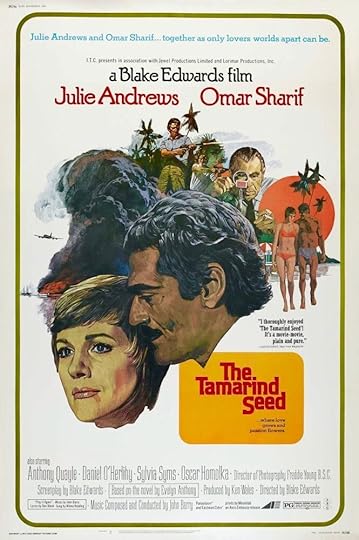
I love this movie and think it's a great adaptation that goes well with the book, enhancing it and even improving it in some areas like the romance that I was way more invested in because of Julie Andrews and Omar Sharif.
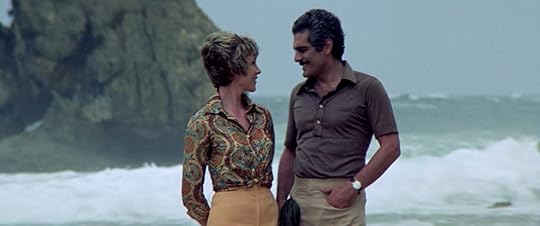
They left such an impression on me that I even dreamed about them as Judith Farrow and Feodor Sverdlov.
And I love the ending! It's like the book, but better. It's basically the epilogue I wish the book had.
Movie adaptation:
The Tamarind Seed (1974)
I love this movie and think it's a great adaptation that goes well with the book, enhancing it and even improving it in some areas like the romance that I was way more invested in because of Julie Andrews and Omar Sharif.
They left such an impression on me that I even dreamed about them as Judith Farrow and Feodor Sverdlov.
And I love the ending! It's like the book, but better. It's basically the epilogue I wish the book had.

July 16, 2026
This book, originally written in the 1970's was one of my favourites but the passing of time has now made it seem rather dated.
It is based in the Cold War and concerns Judith, who works in the UN and her meeting with Sverdlov, who turns out to be a high ranking Russian KGB who wants to defect before the Russians deport him home, never to be seen again.
It is a well crafted story and the characters are all convincing but the attitudes of Sverdlov to Judith, especially in the beginning, are uncomfortable in today's climate and could be seen as controlling and manipulative.
The story is exciting, well paced and comes to a satisfactory and a nicely unexpected, clever ending.
It is based in the Cold War and concerns Judith, who works in the UN and her meeting with Sverdlov, who turns out to be a high ranking Russian KGB who wants to defect before the Russians deport him home, never to be seen again.
It is a well crafted story and the characters are all convincing but the attitudes of Sverdlov to Judith, especially in the beginning, are uncomfortable in today's climate and could be seen as controlling and manipulative.
The story is exciting, well paced and comes to a satisfactory and a nicely unexpected, clever ending.

April 8, 2022
I initially read Evelyn Anthony's novel "The Tamarind Seed" after seeing the motion picture version starring Julie Andrews and Omar Sharif. The novel and the screenplay follow each other closely but the motion picture provides a resolution of the relationship whereas - unless there was something wrong with my Nook e-reader - the novel does not - seemingly! Ms. Anthony was a very good writer, and I enjoyed reading it again.
Displaying 1 - 30 of 50 reviews