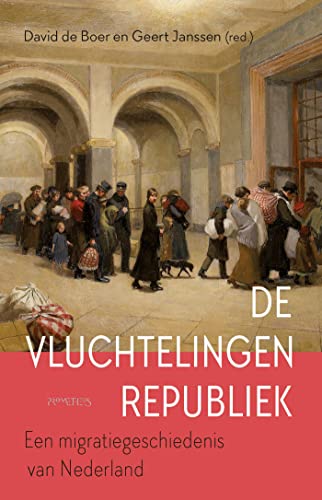
Van Willem van Oranje tot Anne Frank en van Frans Hals tot Ayaan Hirsi Nederland is in veel opzichten gevormd door vluchtelingen. Maar met hun komst stak ook al eeuwen geleden de angst voor asielzoekers als een bedreiging voor onze veiligheid, welvaart en cultuur de kop op. Geen vluchtelingencrisis lijkt aan Nederland voorbij te gaan zonder een fikse identiteitscrisis. In De vluchtelingenrepubliek vertellen vijftien vooraanstaande en aanstormende historici hoe vluchtelingen ons in de afgelopen vijf eeuwen hebben gemaakt tot wie we zijn. Waarom waren ontheemde Vlamingen de eerste mensen die zich Nederlander gingen noemen? Hoe werden vluchtelingen een vloek en een zegen voor de koloniën? En welke Nederlanders openden hun deuren voor de miljoen Belgische asielzoekers aan het begin van de Eerste Wereldoorlog?
Door de belangrijkste historische vluchtelingenstromen naar en uit Nederland in kaart te brengen vertelt De vluchtelingenrepubliek het grotere verhaal over gedwongen migratie, nationale identiteit en de fluïde grenzen van onze gastvrijheid. Daarmee zoekt het boek vanuit het verleden ook naar een nieuw perspectief op de vluchtelingencrises van vandaag en morgen.
Uiterst informatief boek over migratie door de eeuwen heen met mooie doorkijkjes naar de gebeurtenissen in de beschreven tijd. Geschiedenis is een mooi vak en deze geschiedenis weet het huidige denken over migratie aardig te relativeren. Er blijkt weinig nieuws onder de zon te zijn wat betreft willekeur, racisme, morele verontwaardiging, economische belangenafwegingen, eigen volk eerst en meer van dat weinig principiële denken.
A collection of historical essays on the role of refugees, Dutch and not Dutch, for the history of the Low Countries.
The first essay is on Dutch religious refugees during the second half of the 16th century, when religious persecution against non-Catholics was strong, and many became internal refugees, or fled to neighbouring countries, which was followed, a few years later, by another wave of refugees, when resistance to the Spanish throne was strong enough to take control of a number of cities. From 1568, refugees who left for other countries, educated abroad by those more Calvinistic, less Catholic, radicalized, and started to pursue guerrilla tactics. These ‘watergeuzen’ started to pirate trade ships to financially become sustainable (p. 21). On the whole, the picture that is painted of a country in civil war is impressively recognizable, compared to modern countries in similar conflicts; the death, destruction, suffering, and eventual apathy.
The second chapter follows from this, with the movement of refugees between the northern, now Protestant, Netherlands, and the southern, Catholic, occupied by the Spanish, the Habsburgs. Predominantly, refugees went from south to north, but a smaller flow also moved in the opposite direction, not putting much stock on the claims by William of Orange, disproven by the facts on the ground, that Catholics would not be touched (p. 35). Interesting, the motives for those fleeing the south were often multi-faceted; though religious prosecution played a role, financial prospectives, and lack of them, as well as plain poverty, played an important role, too. This story is told through a painting by Rembrandt of Marten Soolmans and Oopjen Coppit, which saw a controversial sale in 2015, contested by France and the Netherlands. Painted in 1634, Coppit’s family was established in Amsterdam, but Soolmans was the son of an immigrant from Antwerp, whose father Jan, had started to make money through trade in sugar and pepper, and had started a sugar refinery for sugar from America and the Caribbean (p. 38). This economic rise, through immigration and slave and spice trade, resulted in the expansion of Amsterdam from 30000 to 100000 inhabitants, as well as the creation of the grachtengordel (p. 40), the circular expansion of canals Amsterdam is now famous for. Also, because of the societal stress these immigrants created, and their eventual inability to return to the south, to cement their presence and position, they, wealthy, positioned themselves as patriots, collectively pushing back against the Spanish invaders, supporting the Dutch generals, while also being essential for the economy. In fact, they were important, perhaps essential, in creating a sense of what it meant to be ‘Dutch’ (p. 42); Liberal freedom with a strong support for the Oranjes. Meanwhile, French speaking immigrants lived in their own enclaves in the larger Dutch cities, spoke their own language, and were not integrating, nor were facilitated to integrate. These southern immigrants and their wealth were instrumental in the success of Holland in the 17th century and the founding of both VOC and WIC. The Flemish and Walloons were encouraged to enter the service of the WIC and VOC. New Amsterdam, modern Manhattan, more resembled 'New Walloonia'. Also a consequence was the rise of international support for those of similar faith, struggling elsewhere. A kind of birth of humanitarianism.
Chapter three addresses the arrival of the first Jews in Amsterdam around 1600. Like the Protestants in the previous chapter, they left Antwerp for economic opportunities during the 80 year war. But, these Sephardic Jews were ‘conversos’, who had been forced to convert to Catholicism when Islam had been driven out from the Iberian peninsula, and who had, consequently spread out through Europe, the Americas, and Asia. But, in secret continuing to practice their original religion. They brought the precursor to the typical Dutch ‘oliebol’, a fried piece of dough laced with exotic fruits, and connected the almighty doughnut. Other Dutch treats of Jewish origin are lekkerbekken (a fried fish) and sour herring, sour little onions, boterkoek, and more. Out of fear of unrest, Jews were barred from lots of professions, limiting their focus to trade, finances, printing, tobacco, and sugar. Some also brought their black slaves. Though slavery was illegal in The Netherlands, and these servants were de facto free men. They typically stayed in the service of their masters, and created the first black community of Amsterdam. Maurits, the Dutch governor of Brazil, invited 100s of Jews to Dutch Brazil. Several had invested in the WIC, and many already had connections with the colony under Portuguese control, through their connections in Portugal. In the colony, restrictions on what they could do were much more limited, that is, they had more freedom. Jews were 20% of the 7000 colonists in Dutch Brazil. Because of existing connections, it was mostly Jews who were the middle men between the slave trade of the WIC and the plantation owners in the colonies. The religious acceptance of Jews then also resulted in Jewish refugees, or migrants, coming from Eastern Europe. These were mostly very poor Ashkenazi Jews, who needed a lot of support from the existing Jewish community, who were obliged by the Amsterdam city council to look after their own. Then, in 1654, with the Portuguese recovering Dutch Brazil, a number of Jews, sometimes with their slaves, returned to the Netherlands. To lighten the financial burden on the Jewish community, poor Jews were encouraged to emigrate through a financial push, on the condition they moved east, beyond Poland and Italy, typically meaning taking up residence deep inside Ottoman territory. After 1656, this also included emigration to Esequebo and Pomeroon, both in modern Guyana.
The next chapter focusses on the French Protestants, Huguenots, who came to Holland. 35000, 2% of the Dutch population, by 1700. Very interestingly, cities were competing for the favors of these new immigrants, assuming an economic revival similar to what happened under the previous migration. And, perhaps surprisingly, immigrants were necessary to keep population levels from dwindling. It was during this period that the term ‘refugee’ was starting to be used. And, also, a nascent differentiation between ‘true’ and ‘false’ refugees, true refugees being those that had fled for religious reasons.
Chapter 5 deals with fleeing slaves in Suriname, marrons, who settled in the bush, outside of nominal reach of plantation owners and the state. Conditions were tough, life expectancies low. By 1740, nine out of ten slaves were born in Africa. An estimated 300000 slaves were transported to Suriname.
Chapter 6 follows Johan Frederik Rudolph Van Hooff, who, at the end of the 18th century, ended up as the mayor of Eindhoven, while advocating against the prominent role of the Prince of Orange, descendants of William the silent. After a conflict which saw Prussian soldiers take Utrecht and Amsterdam, the Orange counterrevolution ended up on top and van Hooff eventually fled abroad, him and many others moving to France. Persuing their cause, they wrote a pamphlet in 1788, condemning the Dutch system of governance, focused around the stadhouder, and promoted equality between men; the document contained a first version of human rights. Then, in 1793, shortly after the beheading of the French king, to export the Revolution, the French invaded the Netherlands with the objective to depose William V. This quickly failed and, with the French situation quickly evolving, van Hooff was imprisoned. But, with the execution of Robespierre, fortunes changed again; the Dutch patriots, with the French, chased Willem out of the Netherlands, who moved to England. Van Hooff ended up in the newly formed parliament in 1796, and a constitution was put together which guarantees human rights and a separation of church and state. Oddly, with the rise of napoleon I. France and, later, the creation of the Dutch monarchy, plenty of the patriots, pointedly against a royal system, survived politically, some even thriving.
Next, a short chapter on upper class migration, mostly from south to north, after the Belgian Revolution of 1830, in which Belgian gained independence, shortly after the reunification of the Netherlands after the defeat of Napoleon.
Then, some background on the estimated 1 million Belgians that fled to the Netherlands during the First World War, during which the Netherlands remained neutral.
Chapter 9 looks at Jewish refugees to The Netherlands in the run up to the second world war, who, generally, were not treated too well. Particularly Jews from to the east of Germany were, by definition, not accepted as refugees or allowed to settle.
Next, a focus on the estimated 800 Jewish refugees who, during the Second World War, managed to escape from the Netherlands to the Dutch and British Caribbean. The chapter is primarily based on personal interviews of the author with members of the actual escaped families, able to draw from personal archives. Most did not stay in the Caribbean after the war.
The next chapter tells stories of immigrants coming from the Dutch indies after the Second World War, totaling between 300000 and 400000 individuals. The stories are based on personal interviews conducted with over 700 people at the turn of the millennium.
Chapter 12 discusses the changes to the process of accepting, or not, refugees and asylum seekers after the Second World War, up to 1989. Shortly after the war, the number of asylum seekers was small, perhaps dozens per year, while by 1989, the number had risen to about 14000 per year. At first, very few individuals were involved in handling asylum requests, and these were typically handled on a personal basis. This evolved, and the Dutch asylum process became judicial, complex, slow, unpredictable.
In the 1990s the source of asylum seekers diversified more, with a large group arriving from what once was Yugoslavia. Interesting: Dutch newspapers have used the term refugee at least since the beginning of the 20th century, but the term asylum seeker was not used before the mid 1980s.
The last chapter looks at the more current situation of Dutch immigration policy. In Europe, Dutch policy is considered generous, but in practice, it does not work well. Political pushbacks also restricted acceptance and have elongated procedures. There’s a plan to designate asylum seekers who have been denied as ‘undesirable’ who are required to leave the country and, if not following through with that, can be imprisoned for up to six months, and fined.
In the afterword, the editors point out that the concept of refugee, legally defined through the declaration on human rights in 1948, and the refugee convention of 1951, has always been primarily focused on Europe, has been used as a tool by the west in the Cold War, and, generally, was wrapped in an ideological political battle which, with the broadening of global politics and the resulting multipolarisation, has been shown to be inadequate and inconsistent. It’s also reiterated that, often, not the state, but socio-cultural organizations drive the desire, intention, and implementation, of receiving refugees, these organisations typically ideologically, ethnically, or religiously connected to the refugees themselves. However, with the decline of civil society from the 1990s onward, coupled with the rise of individualism, the state has been given more control and responsibility on the reception of refugees. Not only, naturally, does this result in more dissatisfaction with the public, this also dovetailed with the rise of political extremism, and with a lack of societal outlets on a local level.
Een geschiedenis van vijf eeuwen migratie in Nederland. Elk hoofdstuk is geschreven door een andere historicus en eindigt met een handig overzicht van de historische literatuur over het onderwerp van het hoofdstuk. Ik vond de eerste hoofdstukken over de Vlamingen, hugenoten en sefardische joden het interessants, maar dat komt ook dat het 20e eeuwse deel voor mij iets te bekend was.