Jump to ratings and reviews
Rate this book

The Cow

Rate this book
From Library Journal
The pastures of Hans Knuchel's Swiss farm blossom with happily grazing cows. At the herd's lead walks Blosch, the biggest cow Ambrosio has seen since leaving Spain to become a guest worker in "the prosperous land." While he had expected large cows, he had not expected the hostility of the Swiss toward foreigners, their harsh looks and harsher treatment. Yet he endures first the old-fashioned ways of the Knuchel farm and then the creeping modernization he finds at his later job in the slaughterhouse. Sterchi's first novel is an imaginatively structured narrative on the topic of bovines, one that will excite few readers. This is not The Jungle, and Sterchi seems painfully aware that he falls short by comparison: references to Sinclair's masterpiece abound. Topic aside, however, the three-part focus glued together with the character of Blosch shows real skill. Unfortunately, this isn't enough to make Cow a prime choice.
- Paul E. Hutchison, Fishermans Paradise, Bellefonte, Pa.

Copyright 1990 Reed Business Information, Inc.

Paperback

First published January 1, 1983

11 people are currently reading
236 people want to read

About the author

Beat Sterchi

11 books1 follower

Ratings & Reviews

What do you think?
Rate this book

Friends & Following

Create a free account to discover what your friends think of this book!

Community Reviews

5 stars
24 (23%)
4 stars
42 (41%)
3 stars
31 (30%)
2 stars
3 (2%)
1 star
2 (1%)
Displaying 1 - 19 of 19 reviews
Profile Image for Left Coast Justin.
613 reviews201 followers
July 21, 2023
===Re-Read Review from Sept. 2021===
What happens in a book isn't necessarily what the book is about. This is not a dainty, quiet novel of ideas but instead has such a clangorous, in-your-face foreground that often it's difficult to think about anything else. Let's be clear: a large part of this book is filled with the violence that people do to animals. On those pages that are swimming in blood, intestines, feces, bile and other biofluids--and there are many of these pages--one may think that this is really the point. To bring the reader into the abattoir. To make the reader think twice about his/her next burger. But I don't think so; not totally.

* * * * *
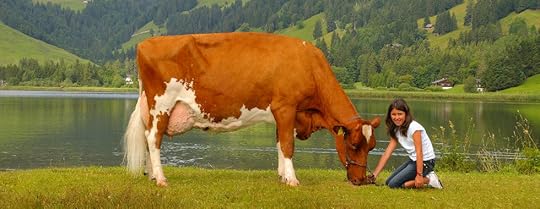
This book should be better known. But Berne, Switzerland is not a hotbed of the publishing industry, and the writer was a virtual unknown (this is his first book), and the English title "The Cow" is just wrong, like naming Romeo and Juliet "Two Kids" or something. The original German title Blösch would have been better translated as "Blush," which is the name of the giant, queenly, reddish Simmintal cow in the Swiss highlands:
description
Tending to Blösch and her eleven fellow milk-cows are the Knuchel family and their farmhand, a Spaniard named Ambrosio. Ambrosio is the beneficiary of a Swiss "guest worker" program in which small, dark folks from down south are invited in to do difficult and nasty work, though not in any sense invited to settle in and become part of the local village life. Ambrosio is capable and uncomplaining, though, and he and Knuchel develop a solid relationship.

But trouble is afoot in the kingdom, and this dark-skinned foreigner is one of the signs. Artificial insemination! Milking machines! Foreigners! What the hell is happening to this country? Is there no pride left in good honest farming?

And out in the abattoir behind the high fence on the edge of the beautiful city, the first cow appeared in the doorway of the cattle-cart. She hesitated and mooed. The skin crinkled between the black orbs of her eyes that looked dully out into the grey morning. The cows barged back towards the darkness of the goods wagon. Her forelegs were stiff, she had spent the journey tethered on a short rope, and in today's markets trade in quality slaughter animals was good, with supply short and demand up, occasionally brisk to lively. But in quiet, rather dull markets, Bologna cattle changed hands at little over contract prices, and Foreman Krummen pulled roughly at her halter and swore, while weigher Krähenbühl jabbed at the cow's skinny belly with his wad of papers and said, "Yah, move, you stupid cow!"

And later,
He backed out of the hall. He was splashed with blood. His boots squelched with every step as though he were wading through a swamp. Where his trousers weren't covered by his rubber apron, they stuck to his legs. For Thou hast made him Lord of all Thy creation: setting all beneath his feet: sheep and oxen, and the beasts of the field.

Clearly, modern industrial slaughterhouses were not quite what the Lord had in mind with that passage.

Look, for as far back into the record as we're able to discern, humans have killed animals, mostly as a food source but also for ceremonial purposes. Whether you believe faunicide at this scale is okay or not is up to you, but the transformation of this activity into modern slaughterhouses is much less defensible (except in purely financial terms. Somebody, trust me, is already working on how to make those damned Bologna markets a little less dull.) We all know that working for large corporations strips at least some of the dignity out of work, but we may not appreciate exactly how dehumanizing it is to kill animals day in and day out.

And that's what this book is really about.

It is an exceptional first novel, very well written, and those unattributed italicized quotes were very effectively deployed. It would have benefited from some editing. The scenes in the slaughterhouse were relentless, to the point they stop being shocking. Maybe that was the author's intent -- to desensitize us to it in the same way the workers are desensitized -- but the power of the writing is diminished, eventually. But so much more is captured in this book than I've touched on here. I hate to describe books as "important," because it makes me sound hectoring and the book sound dull. This book isn't dull, and it really is important.
Profile Image for Warwick.
Author 1 book15.4k followers
December 29, 2018
In the early 1960s, a Spanish labourer called Ambrosio arrives in rural Switzerland to work on a cattle farm. Living with the farmer's family, he becomes intimately acquainted with their animals including their pride and joy, the head milk-cow Blösch.

Seven years later, now working relentless shifts in a city slaughterhouse, Ambrosio recognises an older, emaciated Blösch as she is pushed through the abattoir door to be shot, bled and chopped up for sausage-meat.

This is the basic contrast at the heart of this book – an important book, I think, and one which has only become more relevant and powerful since it was first published in the 80s. Sterchi's subject is not just our attitude to animals, but also industrialisation itself and the nature of our behaviour towards each other, themes which are evoked through a brilliant mixture of pastoral lyricism, dense paragraphs of Joycean, intercut conversation, and sparse industrial narration.

Sterchi's descriptions of Swiss village life are spot-on – he builds up a cast of gentle, kindly characters who, however, also exhibit an underlying communal xenophobia. It means that life for Ambrosio is always a negotiation, though one often marked by beauty, as in his first impressions of the village:

the scale and proportions of barns and outbuildings silhouetted in the night, trees and bushes, the contours of the land and the hush up above, everything etched itself into his mind, in colours and forms he barely noticed for themselves, in melodies and shadings. Months later, he could still remember exactly how the first, the second, the third apple tree by the track had smelled, of resinous buds, and the exact blue-grey glint of the fenceposts.


Chapters of this kind of thing – told from a genial third-person perspective – alternate with chapters in ‘the city’ (probably Bern), which are mostly narrated in a dazed, clipped first-person narrative from an unnamed apprentice at the slaughterhouse.

Piccolo slits the cows' bellies open, pulls out the guts and makes a bit of room inside. Then he saws through aitchbone and sternum.…

I'm already cutting my seventh throat.

The loneliness of the headless bodies behind me, the hopeless gurgles ahead.

The guts, still digesting, bloat the stomachs round as cannonballs. A thin whoosh of air, and I smell the pressure released through the relaxed sphincter.

Bony beside every body, the appropriate peeled skull, with empty eye sockets.


The effect of these juxtapositions can be quite dramatic. On the farm, the cows are individuals; we learn their names, their personalities; they are still all milked by hand, because the farmer ‘just couldn't conceive of his cows being fed into a network of pipes and valves and pumps’. At the abattoir, they have no names; they are kicked and sworn at; they are reduced to anatomies and fed into a grotesque conveyor belt of death and dismemberment.

It's important to understand that Sterchi's point is not that one picture is Good and the other Bad. His point is that one depends on the other: that the world of the farmyard, which everyone knows about, is built on the world of the slaughterhouse, which everyone pretends not to know about. The traditional, cosy image of Swiss rural life, of cowbells clunking over Alpine pastures, is one that depends for its existence on a second, hidden world of piss and shit and blood and exploited immigrant labour.

This is a particularly strong message from a Swiss author in a Swiss setting, since Switzerland has spun its identity around the image of a nativist agricultural idyll – but of course it's relevant anywhere cows are ‘forced by butter mountains and excess milk production into state-subsidized slaughtering programmes’. You can see why fans of this book reach for some lofty comparisons: Moby-Dick comes up a lot, which is not really about a whale in the same way that this is not really about a cow.

Michael Hofmann's translation of Blösch was first published in the late 1980s and promptly sank without trace, despite his recommendation to the publisher that the original was likely to be the best German-language book for a decade. This 2018 reissue, now unambitiously retitled Cow, should be hailed from the rooftops. ‘It's the book that made me a translator,’ Hofmann says in his foreword (though I'm sure he's previously said the same thing about the works of Joseph Roth). I go back and forth on what I think of Hofmann, but here, although he struggles with some of the slangy conversational scenes in the slaughterhouse, the rural sections are handled with exquisite sensitivity, and he wields a ruthlessly exact vocabulary in the descriptions of cutting animals to pieces.

Such descriptions are many and detailed, and have a stomach-churning cumulative quality that starts to make you feel trapped in a Dantesque nightmare – except that it's determinedly factual. Sterchi's father was a butcher, and he apparently followed him into the trade for a few years, so there is a terrifying sense of verisimilitude to this stuff – by the end of the book, you feel you could practically take a cow apart yourself.

In its final chapters, Cow builds to a hallucinatory scene of rebellion and revolution (somewhat reminiscent of the final scenes of Lindsay Anderson's If…), and here Sterchi's prose finds yet another mode – that of historic irony.

The cow stood and bled, and it was as though she knew the long history of her kind, as though she knew that she was one of those mothers cheated of their rich white milk, who had offered their teats for thousands of years, and for thousands of years been devoured in recompense. It was as though she knew that her kind had always had to beat their hooves sore on the stoniest of fields, that for her kind there was no escaping the leather harness of the plough that kept this world alive. It was as though this cow knew about her ancestors, understood that she herself could only be a pale reflection of the mighty aurochs, who with his curved, arm-length horns had established a dominion that stretched from the bright woods and rich parkland of central Europe as far as the distant heart of China, an empire on which the sun seldom set, and that neither the treacherous Asian yak nor the sullen gaur had been able to take away from him.


I stopped eating animals a couple of years ago now – and having moved to the Swiss countryside last year, right next door to a family cattle farm, this book would certainly have finished me off if I hadn't already decided. At the same time, it's only fair to warn potential readers that although I highly recommend it, it isn't the kind of book you look forward to curling up in bed with at the end of a hard day. In various ways it can be challenging. But if you like fiction that tackles big, modern themes in innovative ways, then this feels like a novel whose time has come.
Profile Image for Mariel.
667 reviews1,211 followers
June 11, 2013
I don't want any more stiff animal carcasses under my blankets.
Is that too much to ask?
I just want a couple of hours of sleep to drown my gnawing thoughts.
A little refuge in darkness, a refuge I don't have to explain or account for to anyone. A couple of paces into the Beyond of sleep.


His hands are scarred, used up. His body small, knees burned and knobbly from a life worked on them. Crawled on them, but proud. Helplessly proud. Seven years hard labor. Ambrosio arrives in the Swiss village of Innerwald. The highlands where they know man's place to beast to land. Off the short bus in short pants. He doesn't speak a word of German. Their laughter could go down minus the malice. Time stops for a moment and he feels he's a stranger in a strange land. Everyone looks. Everyone seems to look. There are whispers of the lazy Spaniard before he is stooped again. I gazed into the cud chewing eyes and the bottom was emptier than cruelty. I felt tired for his days before they have started again. He watches past the bus and imagines going home again. The clock strikes for more is it life and the Spaniard gets to work for the Farmer Knuchel and his flat headed children. Knuchel the farmer sows seeds of expectation. The owner of the cooperative will argue against buying the small man good working clothes. I felt depressed when they good clothes didn't fit. Is it too late to catch the next bus out of there. I knew that Spaniard guy wasn't going to show. He showed. I knew he was going to take off in the middle of the night. I knew he was going to take to milking like a lovely lass in a hot chocolate advertisement. In Knuchel's eyes dance dreams of the future for his new employee, for his eldest son, for the pride of the dairy farm of the highlands. We don't need no new fangled milking machines on my farm. The dark eyes glaze over in Babe or Charlotte's Web nightmares. If Babe doesn't dance for his dinner good enough tonight he's dinner. There's a new dance every night. Don't pay any more attention than you have to towards the red cow and her stupid bull calf. Stupid fat Blösch. The pig. She's on hunger strike. She never delivered anything but bull calves. Farmer Knuchel is a mean horny bastard who takes it out on the objection of his affection when his wet dream doesn't come to fruition. He'd take it out on her if he got his balls off. Where else would the once proud queen of the brood go than the abattoir? I wonder if it isn't too late to catch another bus. I want to take her out of there. I kept thinking about that cow that escaped in Germany not too many years ago. The Germans decided to let her live free. At least that one got away. They caught the escaped zoo monkey when I was vacationing in St. Pete, Florida last year. I kept thinking about that too.

Go to work in the slaughterhouse. The animals don't scream. Slice and dice and all sterile blade clean to eat off of and catch your own blank expression in. But they do scream. It isn't that tree falling in the woods thing. Some of the guys shoot them. There are guys to do that sort of thing. You know, guys. Men with jobs and clock out machines and growing short like Ambrosio under the weight of red lights beckoning to the clock out machine. Day in and out and death. Their minds grind out like meat factory machines of just a little peace. Just a little sleep. Just like the dark eyes of the proud red calf that the Spaniard felt his human connection to. Animal connection to. I have a hard time saying human about anything they do in The Cow. There's a train. There's taking someone and shooting them in the back of the head. You can't even do it to their face kind of death. Ambrosio doesn't learn much German. My Spanish was just good enough to be able to read his rare thought. He has friends, sort of, in his new coworkers. When it isn't like the farm when the cows push their way to the water trough in their brief moment of freedom. He thinks about telling them about what had happened before, about the farm, when he finds himself surprised. Blösch is in the abattoir.

What did Bössinger then successfully look for in the mincing machine?
Ambrosio's pulped finger. To avoid the sausage-meat having to be impounded.
How did Bössinger say he was able to recognize it?
By the colour. He had seen a lighter coloured patch.
Was that Ambrosio's worst experience in the slaughterhouse?
One of the worst.


I am having a hard time seeing the circle of life angle in this right now. Ambrosio sees himself in Blösch and I saw Ambrosio in the tired eyes of his fellow slaughterhouse workers. There wasn't nothing but I am feeling pretty damned low right now. I read articles about shark fin soup and shark hunting today after finishing this book and, yeah, I feel pretty damned bad. Oh yeah, good book. The stoop of life, the breath you need to somehow get up another day. If you can manage to not sense malice in everything. IF you can somehow be surprised that the slaughterhouse is where that cow ended up. But I wish I hadn't read it because my day amounted to trying to get through the day and feeling a lot less human than feeling connected to another misplaced soul who was shit unlucky to be where they were. It would be like going home from work and finding that the work day had started over again and you missed reading, or taking a nap, playing with your dog. Anything that might make you feel happier. I wish I could muster up the energy to write about the life goes on of the "stupid Baby" cow (the prima donna usurper, or wannabe usurper). I read that cows have best friends and pine for each other when they are apart. The red cow didn't get to have that. The obsession of the Farmer Knuchel could not have meant anything to her. The lay it out on the carving table honesty about what it is they are really doing. That's what I saw in her eyes. I appreciated a lot that Sterchi wrote about what these men felt for animals and fellow man in an unsentimental way. If you are lucky it looks less black and ugly. If you are unlucky you are blessed if you can still have something left for empathy.

Michael Hofmann translated. I found the book by looking up his translated works (again). The book was published in 1983 and the translation was released in 1988. I have no way of knowing what the German looked like, of course. From what I've read of his translations so far I think he is gifted at a respectful distance. When you know you don't have to know everything about a person. You recognize the right to life and if you are human enough to want to know something about them than that is on you. Sterchi and Hoffmann's book doesn't cut open Ambrosio's heart. It doesn't slice up the red cow. You don't follow the slaughterhouse workers into their dreams. But damned do they have the right to have them. That's something. That means something to me to be able to respect people like that.
144 reviews
Read
June 16, 2024
I put off reading this translation (by Michael Hofmann) of Blösch by Beat Sterchi for a couple of years because I knew it contained violent scenes in an abattoir. I imagined brutal scenes and plenty of macho content, such as you might find in the novels of Cormac McCarthy and Larry McMurtry. I thought I would need to steel myself to get through it.

'Cow' does contain shockingly violent (and accurate) scenes of slaughter, but is about so much more, important as that is. Sterchi combines the lyrical but unsentimental rhythms of a small Swiss farm with scenes of gut-wrenching brutality in a large abattoir. The switches between human-scale farming and industrialisation run through the novel with an undercurrent of regret and sadness, epitomised in the life of 'Blösch' ('Blush'), the magnificent red, matriarchal Simmental, with whom Spanish Gastarbeiter Ambrosio forms a bond when Blösch is in her prime. When she arrives, broken and condemned, at the abattoir seven years later, Blösch achieves a seemingly impossible dignity, and as well as our grief at the suffering she endures, we are compelled to witness her superior nobility. Somehow, Blösch rises above her travail, giving nuance to her name in the mortifying shame she brings on the system that exploits and persecutes her and her kind. Just as Ambrosio has previously traced his longed-for homeland in the patches on a cow's coat, he now identifies with the suffering animal:

'The emaciated body that had been dragged out of the cattle truck onto the ramp, that mooed so pathetically into the morning mist, that body was also Ambrosio's body. Blösch's wounds were his own wounds, the lost lustre of her hide was his loss, the deep furrows between her ribs, the hat-sized hollows round her hips, they were dug into his flesh, what had been taken from the cow had been taken from himself.'

Like 'Jungle', Upton Sinclair's study of Chicago's meat-packing district, 'Cow' isn't about animal suffering alone. We also witness the cruel, dehumanising effect of slaughter on Ambrosio and his fellow workers, not just through the sheer physical anguish they inflict (and experience) daily, but in the soul-destroying mass-production techniques that assign each worker to a specific, repetitive task on one part of the animal's body. The climax is as moving and heart-breaking an ending as anything I've read.

'Cow' is a kaleidoscope of voices: the third-person narratives of Ambrosio and his fellow workers sit beside the internal monologue of a shadowy apprentice who, not yet inured to his murderous task, observes the chaos around him with a mixture of horror, despair, grief and a terrifying black humour. Occasionally, surreal Joycean wordplay appears, as do the stultifying wording of husbandry manuals, the coarse banter of butchers and, inevitably, the words of the Bible. As a poet, Hofmann must have relished the translation task.

This is a truly extraordinary novel and – without hyperbole – I have to name it as the most accomplished and affecting literary endeavour I have ever come across, surpassing my previous 'top three', 'Tristram Shandy', 'Moby Dick' and 'Ulysses'. It is a book that acknowledges the bleakness of the relationship between humans and farmed animals, yet somehow finds compassion and poignancy there. Don't be afraid to read it; look into the abyss.
Profile Image for Jonathan.
994 reviews54 followers
January 17, 2019
This is one of those books that is about more than it would appear at first glance. The basic story concerns a Spanish worker who has come to Switzerland to work at the Knuckel's dairy farm. Originally published in 1983 this part of the book is very resonant of the experiences of European workers working in other countries at this time. Attitudes and opinions don't often change.

In his introduction, the translator Michael Hofmann recalls that upon first reading the book he felt he was reading a cow version of Moby Dick. The reason for this is that the other part of the book is set in a slaughterhouse, seven years after the story begins. The author leads us in graphic detail through the processes undergone from delivery of the animals to, in the final chapter, the removal of the parts of them for which there is no use. As such it is similar to the chapters in Moby Dick which describe the processing of the whale. Although this is written more than thirty years before my reading, I imagine the principles haven't changed all that much; and still a lot of blood and guts.

There is a moment after all the gore that is quite surreal, as some of the workers in the slaughterhouse lead a cow who is due for what is termed 'emergency slaughtering' through the abattoir, garlands around her horns, a bell around her neck; indeed just the image of a cow grazing on a Swiss mountainside. And it is as though she knows all that has been expected of her kind in slavery to men, working under the yoke, producing milk for years, and then being sent to slaughter for meat. This is such a powerful image, and one which is thought-provoking, even, I would hope, to those who have no problem with eating animals. Far from an easy read, but an unusual and worthwhile one.
Profile Image for Annet.
215 reviews3 followers
January 14, 2025
Als je al geen vegetariër bent, dan word je het wel bij het lezen van deze roman. Aanvankelijk waan je je op een vakantie in het Innertal in de Alpen. Boer Knuchel draait op een traditionele manier zijn boerenbedrijf. Hij melkt zijn koeien met de hand, vertroetelt ze en is wars van kunstmatige inseminatie. Helaas wisselen deze idyllische hoofdstukken af met die over het nabijgelegen abattoir. Je maag draait er keer op keer van om.
Het moet voor (oud-collega) Wil Hansen een cadeautje geweest zijn om dit taalrijke werk te mogen vertalen. Sterchi heeft de tegenstelling tussen de twee werelden kracht bijgezet door afwisselend romantisch en bijna mechanisch, gevoelloos te schrijven. Zo werd het een aanklacht tegen de vleesindustrie.
Geen aanrader, maar toch ...
Profile Image for Nicola.
48 reviews
Read
August 30, 2024
[mild spoilers below, very hard to avoid] This book felt to me like a flawed masterpiece. It is undoubtedly a very unusual and original book, in several ways. First, the author gets us to see the world of Bloesch, the cow central to the narrative, but without simply describing her mental space. Bloesch moves from a fairly traditional farm in Switzerland, where she spends time out in the field and is milked by hand, to the abbatoir later in the book. The other main character is Ambrosio, a Spanish immigrant worker who first meets Bloesch on the farm and then in the abbatoir. Sterchi also takes us deep into Ambrosio's life, the contempt and outsider status he endures. Second, the style of the book is very unusual: there is highly immersive stream of consciousness, word play and long strings of dialogue, extracts from abbatoir regulations and more traditional narrative. The fact it's a translation is remarkable as Michael Hofmann seems to have managed to maintain word play and alliteration. The third point that's worth noting is that it is unrelentingly and precisely descriptive of every procedure that happens in abbatoirs. The juxtaposition of the formally-worded regulations and the reality of the acts they describe is incredibly powerful.The descriptions did not feel over the top: indeed, it describes what happens in just the way that every abbatoir worker will experience every day of their working lives, and this is why I felt able to continue reading it. Many people might find reading this difficult and I did find I took breaks, especially when I happened to be staying in a house by a field of cows. (NB I've been vegetarian most of my life and I think it's important to look fully in the face of the consequences of our actions in the world.) I almost feel I can't mention flaws given what an amazing book, but here goes. The flaws I felt were towards the end of the book. The abbatoir narrative felt to me to go on too long and there were many distinct and believable characters but I started getting a bit mixed up given the large number of people, and towards the end we switch to the pig slaughtering section: I wasn't sure of the author's purpose in doing that. There are really big themes in the book -- mechanisation, the Ford-style production line of the abbatoir where each worker has his job on a very specific part of the process and body part, the brutalisation of both the animals and the people working there and the othering of immigrant workers. It does get over the unrelenting nature of such a job and of the unending slaughter of farmed animals, but I felt I had got that point well before the book ended -but maybe I'm missing the point there in how unrelenting it is. I was sorry about this as it is an incredible book, the writing and the translation are brilliant and I've never read a book quite like it.
Profile Image for Eric Boot.
154 reviews117 followers
June 20, 2023
Een onvergetelijk gruwelijk boek over de waanzin van het eten van dieren. Van de idyllische Zwitserse alm tot in het inferno van het slachthuis. In september wordt 'ie in het Nederlands heruitgegeven met een voorwoord van Marieke Lucas Rijneveld.
Profile Image for David.
112 reviews
August 14, 2016
This book is, well, strange. It opens with a Spanish man, emigrating to Switzerland, seeking work as a dairy farm worker. The early chapters alternate between the small, non-mechanized farm where the farmer knows his ten or so cows by name and treats them with loving kindness, and, set about seven years in the future, the slaughter house where the cows, now old and abused are butchered. The final chapters are set almost entirely in the slaughter house. The workers dislike their jobs, despise their supervisors, and fear being automated into unemployment. I believe this is the sort of book which should be read and reread several times to tease out all the symbolism and hidden meanings. Not for me however, I found it far too disturbing to read again any time soon. It is definitely not for the squeamish.
Profile Image for Julie Richert-Taylor.
248 reviews6 followers
August 8, 2019
A penetrating psychological look at work: and what it does to people when they are defined by it. Here, specifically it is dairies and abattoirs, but it could encompass so many other settings. The abrupt shifts between pastoral and industrial were jarring and sobering, the trajectory of men seeking financial success and self-worth by sheer might and force of will is a heartbreak.
There is no joy to be found here, and no redemption. But a very solemn reminder to choose wisely how we assign value to life, and to living.
Profile Image for Joseph Spuckler.
1,519 reviews33 followers
October 8, 2020

Cow by Beat Sterchi is something more than a story of a Spanish worker and a cow.  Sterchi apprenticed as a butcher after secondary school. In 1970 he emigrated to Canada, where he carried out various activities and incidentally completed an evening school. He completed his studies in English at the University of British Columbia near Vancouver with a bachelor's degree. In 1975 he went to Honduras, where he worked in the capital Tegucigalpa until 1977 as an English teacher and first poems published in English and German. From 1977 to 1982 he studied at McGill University in Montréal and worked as a teacher at the local Goethe-Institut.  Cow is his first novel.

What starts as a simple story of a Spanish guest worker arriving to work in a small Swiss dairy village.  He works on the farm earning the respect of the farmer, Knuchel.  The Knuchel treats him, Ambrosio, well and even buys new clothes for his worker.  Ambrosio arrived in shorts and sandals and the clothes of the warmer Spanish climate.  He earns the farmer's respect.  Bolsch is the farmer's prize cow and has the run of the farm she is the queen in the matriarchy of cows.  Ambrosia next finds himself in the slaughterhouse after seven years of hard work.  Bolsch also finds herself in the same slaughterhouse.

Sterchi gives the reader a very detailed look into milk cows from milking to calving.  The new textbook descriptions blending well with the story.  Also, the reader will be introduced to the workings of the slaughterhouse as well as the men who wind up working there.  The reader follows the animals from stunning, to draining the blood:

I open your throat, following the strands of neck muscle, cut you open as far as the gristly white of your windpipe I sever muscle from muscle, vessel from vessel.

Even the blood is saved by and adding a declotting agent. (It will be used in feed).  A man removes the offal careful not to cut into the intestines and organs.  A slip will ruin the meat.  The reader will learn which vertebrae is separated on steers and cows when quartering the carcass.  It is all part of the disassembly line. The slaughterhouse has no redeeming qualities to it.  It is where the unuseful animals are sent and less desirable men work.  It is a darkness that exists outside of the dairy village.

The farm represents a lighter place.  Knuchel cares for his cows.  He treats their wounds, fusses over their diet, and follows the politics of his heard.  There is a positive connection between man and animal, even if the animal is clearly a servant of man and will one day wind up in the slaughterhouse.  One day; but not today.  The farm is life to the slaughterhouse's death.

The Cow is deeper than it appears.  Ambrosio is clearly an outsider and treated rather poorly by everyone in the village except Knuchel.  To drive the xenophobia home, the town itself is called Innerwald strictly translated it means a paused woodland.  On the surface, it sounds like an inside place, introverted.  There is a battle between Knuchel and the rest of the village over milking machines and artificial insemination.  Knuchel opposes both.  Ambrosio is hired as a milker instead of giving the job to machines.  Knuchel tells the mayor when getting Bolsch inseminated by a bull that he couldn't drink the milk of an inseminated cow.  There is something unclean and unnatural about the process.  Cow is also a story of flaws. Ambrosio is flawed because he is an outsider and does not speak any German.  He is essentially run out of town.  Even in the slaughterhouse, we are reminded that he is flawed by his losing a finger.  Bolsch is also flawed despite her greatness and standing; she does not produce a useful cow.  In seven attempts it is always a useless male calf. She, for all her greatness, will not produce a prize milk cow.

More than simply a novel Cow is literature.  It contains far more than entertainment.  It teaches and instructs the reader.  The violence of the slaughterhouse is used to reinforce the other messages in the book.  This is not an easy book to put down or to forget.


The forward is written by the translator Michael Hoffmann and the introduction is by Eileen Battersby.  Available February 8, 2018.
16 reviews
April 30, 2025
Une histoire intéressante et édifiante sur l'élevage et l'abattage des vaches (et autres). Néanmoins c'est un livre assez dur à lire car les passages à la première personne sont écrits dans un style différent et c'est assez rébarbatif. Une lecture difficile aussi car l'abattage est tout simplement horrible.
Profile Image for Nelleke.
749 reviews24 followers
February 4, 2014
Geen boek voor op de nuchtere maag. De hoofdpersoon Ambrosio is een gastarbeider uit Spanje die zijn geluk in Zwitserland gaat beproeven. Hij komt terecht op de traditionele boerderij van boer Knucher. Terwijl de rest van het dorp overgaat op melkmachines en kunstmest, zweert boer Knucher bij het melken met de hand en ouderwetse koeienmest. De boer is blij met Ambrosio in tegenstelling tot de rest van het dorp die hem zien als indringer. Zeven jaar later leeft Ambrosio nog steeds in Zwitserland, maar werkt hij in een slachterij. Een slachterij waar het niet zo nauw met de voorschriften wordt genomen. Als gastarbeider geniet Ambrosio nog steeds weinig aanzien en hij leeft zijn leven totdat Blosch, de beste koe van boer Knucher, op de slachtbank langs ziet komen.
Een bijzonder verhaal, waarbij het mooie alpenlandschap afgewisseld worden met bloedspetters en rondvliegende darmen in de slachterij en tussendoor het leven als gastarbeider ook nog neergezet wordt.
13 reviews
March 11, 2015
Certainly an unusual book but it was this book that made me decide I wanted to be a vegetarian!
Profile Image for Katy.
21 reviews
March 19, 2018
A wild little read - I appreciated it even more after learning that it was originally published 35 years ago. Ever relevant and contemporary in 2018. Very visceral read which will be hard to forget.
Displaying 1 - 19 of 19 reviews

Can't find what you're looking for?

Get help and learn more about the design.