

What do you think?
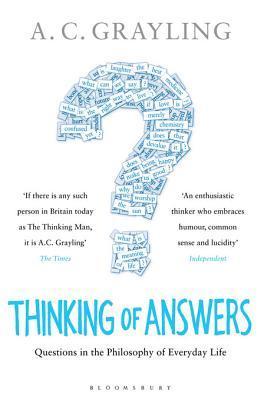
Thinking of Answers: Questions in the Philosophy of Everyday Life
The essays in this book, drawn mainly from A. C. Grayling's columns in "Prospect, "the" Dubliner "and" The Times," are in fact responses to questions set by editors and readers." " If beauty existed only in the eye of the beholder, would that make it an unimportant quality? Are human rights political? Can ethics be derived from evolution by natural selection? If both sides in a conflict can passionately believe that theirs is the just cause, does this mean that the idea of justice is empty? Does being happy make us good? And does being good make us happy? Are human beings especially prone to self-deception? As in his previous books of popular philosophy, including the best-selling "The Reason of Things "and "The Meaning of Things," rather than presenting a set of categorical answers Grayling offers instead suggestions for how to think about every aspect of a question, and arrive at one's own conclusions. As a result "Thinking of Answers "is both an enjoyable and inspirational collection.
352 pages, Kindle Edition
First published March 1, 2010
About the author
A.C. Grayling
96 books684 followersAnthony Clifford "A. C." Grayling is a British philosopher. In 2011 he founded and became the first Master of New College of the Humanities, an independent undergraduate college in London. Until June 2011, he was Professor of Philosophy at Birkbeck, University of London, where he taught from 1991. He is also a supernumerary fellow of St Anne's College, Oxford.
He is a director and contributor at Prospect Magazine, as well as a Vice President of the British Humanist Association. His main academic interests lie in epistemology, metaphysics and philosophical logic. He has described himself as "a man of the left" and is associated in Britain with the new atheism movement, and is sometimes described as the 'Fifth Horseman of New Atheism'. He appears in the British media discussing philosophy.
He is a director and contributor at Prospect Magazine, as well as a Vice President of the British Humanist Association. His main academic interests lie in epistemology, metaphysics and philosophical logic. He has described himself as "a man of the left" and is associated in Britain with the new atheism movement, and is sometimes described as the 'Fifth Horseman of New Atheism'. He appears in the British media discussing philosophy.
Ratings & Reviews
Friends & Following
Create a free account to discover what your friends think of this book!
Community Reviews
Displaying 1 - 24 of 24 reviews

February 15, 2012
What is it, in our day-to-day lives, that prevents us from stepping back—perhaps lowering the arm presently occupying (or occupied by) some gadget—and examining the aspects, and indeed limitations, of humanity? We have stuff to do. Time is money. We’re not getting any younger and our daughters have ballet rehearsal at six and oh shit we forgot to pick up our jacket from the dry-cleaner! Is there still time? Nope—I suppose we’ll just—oh wait, it’s our wives/husbands texting us, telling us we’re out of Cheez-Itz®, Clorox® disinfecting wipes, Charmin® Ultra Soft toilet paper, Crest® Extra Whitening toothpaste, and Jif®, not Skippy®, Jif® creamy peanut butter and could we please pick all that up at Wal-Mart® on our way home from our cubicle under which a flickering light we have been complaining about for two weeks has yet to be replaced?
Is this what happiness feels like? Are these facets of the good life? Would we even think about these things, and does any of it matter? Were commerce, the stock market, credit default, et al inevitable? Are we sacrificing happiness for goodness, or vice versa? Can we achieve both? Is one dependent on the other?
If Grayling is correct in stating that philosophy is “opposed to on-size-fits-all nostrums, to authorities ancient and modern who claim to have all the answers”, I think the world at large, and American society in particular, could benefit greatly from a restitution of many such schools of thought. Philosophy is not dead, as Stephen Hawking inappropriately proclaimed, because thinking is not dead. Hawking said this in a rather different context, but without a philosophical curiosity, our everyday lives would still be overcast with shadows of general ignorance, because from whence came the drive to the development of our scientific methods? Discovery is a philosophical endeavor accelerated now by scientific tools, which we acquired by our philosophical quandaries on the nature of things. There are many questions which do not yet have answers, many answers which should continue being questioned, and perhaps even questions which have not yet been asked.
These multifarious, bite-sized essays deliver quick bolts of thought and, importantly, don’t purport to arrive at unassailable truths (even if well-established facts do factor into his quandaries). Neuroscience, for example, is a vast frontier in its infancy which, in time, could erode certain notions about various aspects of the mind, and solidify others. Grayling wonders what implications could be discerned regarding morality and relativism if so-called ‘mirror-neurons’ in the motor cortex can be shown to influence one’s social behavior (with some researchers already proposing a link between mirror-neuron dysfunction and autism). We’re largely treading on speculative and hypothetical ground when it comes to neuroscience, and should be cautious, but moral philosophy should take great interest in this developing field. This specific subject is covered by Grayling in little more space than I have just provided it, and its conciseness has the added benefit of making for a terrific discussion starter for groups and classes, as any of the subsequent essays would. Morality and ethics play parts in several of the entries, as one might expect (moral hypocrisy, Darwinian ethics, human rights, poverty, self-abusive religious practices, water use and conservation, business and profit, remorse), and far from using these terms interchangeably, he scrupulously includes a discussion on the philosophically loaded terms, morality and ethics, and suggests that, for instance, pundits and politicians should be more restrictive in their use of the word moral, because “ethics includes morality”, but I wonder if ethics shouldn’t supersede morality, not only putting an end to the confusion, but also to do away with the buzzing mosquito of religious insistence upon objective morality, the exceptions upon which they are of course equally insistent. Could this be beneficial, or detrimental? Perhaps, after all quibbling, a pragmatic Aristotelian view is superior, if only everyone could agree that “doing one’s moral best” is as easy as being honest and forthright, but who knows how much this flies in the face of human nature?
Interlude:
(Don’t get me started on hypochondria versus valetudinarianism because I’ll start naming off all the terminal conditions and viruses with which I have convinced myself I am afflicted. Much appreciated.)
But other questions on health are less anxiety-inducing, such as the benefits of laughter (being a necessary response to the absurdity of life), abstaining from food (specifically calorie-intake, to promote longevity) and the harmful effect of restrictive drug laws, which is important to consider because if addicts could be directed on how much could be administered before it becomes a lethal dose, treatment would conceivably be easier, and they would at least be conscious (recognizing that, as with alcohol, there will still be abusers) of its dangers because it could contain those medical directions right on the box of narcotics (oh, and that drug war is a right fucking mess, isn’t it?)
Those familiar with Grayling’s philosophical canon will know that a frequent target of his critical inquiry is religion, and one of his longer essays in this collection is on the intersection of science and religion. He defines his terms in using science, specifically, in this case, referring to Darwinian evolutionary theory, and religion, or ‘religious belief’, ascribing to it “any belief in the existence and activity of supernatural agencies, or one such agent (a ‘god’), either in the universe or outside it (‘outside it’ because allegedly outside space and time) but somehow operative in or on it.” He stakes his territory on matters such as these, and becomes more tendentious, and I support him in doing so, but we must be willing to hear what others would define religion as, or entailing, provided it’s nominally coherent. This definition however, is simple and clear enough to work with for his piece. A lot of theological and pseudoscientific rhetoric finds its way into the science-religion debate, and it never seems to clarify whether science is of their god, or whether it’s just wrong and heretical. Most educations religionists claim the former now, but go on to deny a plethora of established scientific discovery, most notoriously evolution, but also, and more immediately dire, climate science, because, you know, ‘God destroyed the world with a flood once, and He said he wuddn’t gon’ do it agay-un’, so we’ve got nothing to worry about. Relax.
In short (nudge, nudge), anything discussed in this book could be, and has been, the subject of many exclusive tomes, but it wouldn’t hurt to read one of these daily (if you have time to take your vitamins and brush your teeth, you have time to read one in the morning) and bring it up in conversation with someone along the way, or return to this thread and discuss any specific entry (many of which I haven’t even mentioned), and hopefully they will do the same, and we can be more thoughtful in our daily, wind-and-grind existences that get so tedious we forget to ask ourselves what we’re all doing here anyway.
Is this what happiness feels like? Are these facets of the good life? Would we even think about these things, and does any of it matter? Were commerce, the stock market, credit default, et al inevitable? Are we sacrificing happiness for goodness, or vice versa? Can we achieve both? Is one dependent on the other?
If Grayling is correct in stating that philosophy is “opposed to on-size-fits-all nostrums, to authorities ancient and modern who claim to have all the answers”, I think the world at large, and American society in particular, could benefit greatly from a restitution of many such schools of thought. Philosophy is not dead, as Stephen Hawking inappropriately proclaimed, because thinking is not dead. Hawking said this in a rather different context, but without a philosophical curiosity, our everyday lives would still be overcast with shadows of general ignorance, because from whence came the drive to the development of our scientific methods? Discovery is a philosophical endeavor accelerated now by scientific tools, which we acquired by our philosophical quandaries on the nature of things. There are many questions which do not yet have answers, many answers which should continue being questioned, and perhaps even questions which have not yet been asked.
These multifarious, bite-sized essays deliver quick bolts of thought and, importantly, don’t purport to arrive at unassailable truths (even if well-established facts do factor into his quandaries). Neuroscience, for example, is a vast frontier in its infancy which, in time, could erode certain notions about various aspects of the mind, and solidify others. Grayling wonders what implications could be discerned regarding morality and relativism if so-called ‘mirror-neurons’ in the motor cortex can be shown to influence one’s social behavior (with some researchers already proposing a link between mirror-neuron dysfunction and autism). We’re largely treading on speculative and hypothetical ground when it comes to neuroscience, and should be cautious, but moral philosophy should take great interest in this developing field. This specific subject is covered by Grayling in little more space than I have just provided it, and its conciseness has the added benefit of making for a terrific discussion starter for groups and classes, as any of the subsequent essays would. Morality and ethics play parts in several of the entries, as one might expect (moral hypocrisy, Darwinian ethics, human rights, poverty, self-abusive religious practices, water use and conservation, business and profit, remorse), and far from using these terms interchangeably, he scrupulously includes a discussion on the philosophically loaded terms, morality and ethics, and suggests that, for instance, pundits and politicians should be more restrictive in their use of the word moral, because “ethics includes morality”, but I wonder if ethics shouldn’t supersede morality, not only putting an end to the confusion, but also to do away with the buzzing mosquito of religious insistence upon objective morality, the exceptions upon which they are of course equally insistent. Could this be beneficial, or detrimental? Perhaps, after all quibbling, a pragmatic Aristotelian view is superior, if only everyone could agree that “doing one’s moral best” is as easy as being honest and forthright, but who knows how much this flies in the face of human nature?
Interlude:
(Don’t get me started on hypochondria versus valetudinarianism because I’ll start naming off all the terminal conditions and viruses with which I have convinced myself I am afflicted. Much appreciated.)
But other questions on health are less anxiety-inducing, such as the benefits of laughter (being a necessary response to the absurdity of life), abstaining from food (specifically calorie-intake, to promote longevity) and the harmful effect of restrictive drug laws, which is important to consider because if addicts could be directed on how much could be administered before it becomes a lethal dose, treatment would conceivably be easier, and they would at least be conscious (recognizing that, as with alcohol, there will still be abusers) of its dangers because it could contain those medical directions right on the box of narcotics (oh, and that drug war is a right fucking mess, isn’t it?)
Those familiar with Grayling’s philosophical canon will know that a frequent target of his critical inquiry is religion, and one of his longer essays in this collection is on the intersection of science and religion. He defines his terms in using science, specifically, in this case, referring to Darwinian evolutionary theory, and religion, or ‘religious belief’, ascribing to it “any belief in the existence and activity of supernatural agencies, or one such agent (a ‘god’), either in the universe or outside it (‘outside it’ because allegedly outside space and time) but somehow operative in or on it.” He stakes his territory on matters such as these, and becomes more tendentious, and I support him in doing so, but we must be willing to hear what others would define religion as, or entailing, provided it’s nominally coherent. This definition however, is simple and clear enough to work with for his piece. A lot of theological and pseudoscientific rhetoric finds its way into the science-religion debate, and it never seems to clarify whether science is of their god, or whether it’s just wrong and heretical. Most educations religionists claim the former now, but go on to deny a plethora of established scientific discovery, most notoriously evolution, but also, and more immediately dire, climate science, because, you know, ‘God destroyed the world with a flood once, and He said he wuddn’t gon’ do it agay-un’, so we’ve got nothing to worry about. Relax.
In short (nudge, nudge), anything discussed in this book could be, and has been, the subject of many exclusive tomes, but it wouldn’t hurt to read one of these daily (if you have time to take your vitamins and brush your teeth, you have time to read one in the morning) and bring it up in conversation with someone along the way, or return to this thread and discuss any specific entry (many of which I haven’t even mentioned), and hopefully they will do the same, and we can be more thoughtful in our daily, wind-and-grind existences that get so tedious we forget to ask ourselves what we’re all doing here anyway.

May 12, 2010
I am nearly at the end of this book and it is absolutely brilliant. Anything by Grayling is a gift, here is a collection of short essays from his previous publications, and they touch any imaginable topic such as an importance of education, the phenomena of genius, the value of money and when to say the truth or to lie. He has 2 essays on Shakespeare in this book, one is Shakespeare as a thinker and another is a humanist and they make you want to read his plays again. In one book there is a chapter on robots and should we be afraid of them and the moral dilemma of using the stem-cells. He talks about the Shock Art and Renaissance Portrait, about science, medicine and religion. This book has to be read again, not in a hurry,
July 4, 2018
Several of these short essays are worth noting specifically: Democracy, History, Stendhal on Love, Gender and Sex, Personal Identity, Brain and Mind, Relativism
There is one quote that could be interesting to the topic of “civility”:
“A few minutes at the zoo is enough to convince most people that apes and monkeys are close kin to humankind. Some say that a few minutes watching proceedings in any parliament is enough to show that humans are close kin to monkeys and apes.” (In the essay “Ape and Man”, p. 137)
Some books cited appear noteworthy:
“On Love” by Stendhal
“Sexing the Body”, by Anne Fausto-Sterling
“Shakespeare the Thinker”, by A.D. Nuttall
“Shakespeare Revealed”, by Rene Weis
“The Most Dangerous Animal: Human Nature and the Origins of War”, David Livingstone Smith
“Protagoras”, Plato (for original responses to relativism)
Essays and other references worth noting are:
“Oration on the Dignity of Man”, Pico della Mirandola
“Principles of Human Action”, William Hazlitt
“The Myth of Sisyphus”, Albert Camus
There is value in practically every essay in this book, but the ones that stand out are those entitled:
Democracy
History
Stendhal on Love
Gender and Sex
Personal Identity
Brain and Mind
Remorse
Relativism
Protest
A New Ten Commandments
Happiness
Enlightenment
Self-Deception.
There is one quote that could be interesting to the topic of “civility”:
“A few minutes at the zoo is enough to convince most people that apes and monkeys are close kin to humankind. Some say that a few minutes watching proceedings in any parliament is enough to show that humans are close kin to monkeys and apes.” (In the essay “Ape and Man”, p. 137)
Some books cited appear noteworthy:
“On Love” by Stendhal
“Sexing the Body”, by Anne Fausto-Sterling
“Shakespeare the Thinker”, by A.D. Nuttall
“Shakespeare Revealed”, by Rene Weis
“The Most Dangerous Animal: Human Nature and the Origins of War”, David Livingstone Smith
“Protagoras”, Plato (for original responses to relativism)
Essays and other references worth noting are:
“Oration on the Dignity of Man”, Pico della Mirandola
“Principles of Human Action”, William Hazlitt
“The Myth of Sisyphus”, Albert Camus
There is value in practically every essay in this book, but the ones that stand out are those entitled:
Democracy
History
Stendhal on Love
Gender and Sex
Personal Identity
Brain and Mind
Remorse
Relativism
Protest
A New Ten Commandments
Happiness
Enlightenment
Self-Deception.
December 16, 2012
This book is worth its weight in gold and I wish I could give it more stars. In it, Grayling devotes a few pages to a whole range of issues, including democracy, science, drugs, religion, evolution, robots, and anything else you care to think of. These are all in some way relevant to modern existence and almost every page has something to teach you and get your brain cogs whirring. A testament to how relevant these mini-essays are is the fact that I was constantly noticing things around me that I’d just finished reading Grayling’s opinion on. This book is really the stuff of life; if you let it, it will open your eyes to the world around you.

April 27, 2012
I really liked this book, however I didn't finish it. I borrowed this from the TAFE Library, but the format of the book is questions posed and short(ish) answers. It's not really a book to sit and read through from cover to cover ans in this way is similar to one of the author's other work, the Secular Bible. It is a lot better to dip in and read just one and then spend time considering the answer and your own opinion. So, one to buy not to borrow.

February 11, 2025
Grayling’s essays consider everything from climate change, Celebrity, Poverty, God, Confucius, Smoking and the moral worth of truth. This 330-page book raises a lot of questions finishing with what is the meaning of life. He doesn’t give you the answers but he does give you suggestions and arguments on perplexing and ongoing questions.
The book is easy with written responses to the questions he poses to the reader.
The book is easy with written responses to the questions he poses to the reader.

November 9, 2020
I agree with most of what he says, but the title is deceptive. Grayling doesn't ask questions. Far from it - he gives you his one-sided opinions.
He sees no value in and does not entertain a truly balanced view of Catholicism or communism or any belief system other other than this. When it comes to abstract questions like whether god exists, he - with the arrogance typical of atheists - dismisses all religious, spiritual and secular stances without any hint of doubt and positions his view as the “better answer” even without any empirical evidence. Chapters like ‘Prudery’ are surprisingly saturated with *only* his opinion, and follow wider narrative themes which include, for instance, defending prostitution legalization and promiscuous - even adulterous - behavior. By the time you’re halfway through the book, your understanding of his opinion means you can accurately predict exactly what he’s going to say. Plato wouldn’t be proud of that, would he?
And speaking of Plato, when it comes to historical figures he admires, he drops all critique and just gives us a moment of ‘5 minute history.’ The chapters ‘Confucius’ and ‘Shakespeare’ are essentially Wikipedia pages + masturbatory praise. And then you have some chapters which are mind-numbingly obvious. The summary of ‘Protest’ is basically “democracy is good, and speed is good too but haste is bad.”
The back cover promises that Grayling would “show us how to discover our own answers to life‘s challenges,” but that’s the most false advertising I’ve seen in a while. This book is just a diary of his more intellectual thoughts. It’s an interesting read, but that seems a little beside the point.
He sees no value in and does not entertain a truly balanced view of Catholicism or communism or any belief system other other than this. When it comes to abstract questions like whether god exists, he - with the arrogance typical of atheists - dismisses all religious, spiritual and secular stances without any hint of doubt and positions his view as the “better answer” even without any empirical evidence. Chapters like ‘Prudery’ are surprisingly saturated with *only* his opinion, and follow wider narrative themes which include, for instance, defending prostitution legalization and promiscuous - even adulterous - behavior. By the time you’re halfway through the book, your understanding of his opinion means you can accurately predict exactly what he’s going to say. Plato wouldn’t be proud of that, would he?
And speaking of Plato, when it comes to historical figures he admires, he drops all critique and just gives us a moment of ‘5 minute history.’ The chapters ‘Confucius’ and ‘Shakespeare’ are essentially Wikipedia pages + masturbatory praise. And then you have some chapters which are mind-numbingly obvious. The summary of ‘Protest’ is basically “democracy is good, and speed is good too but haste is bad.”
The back cover promises that Grayling would “show us how to discover our own answers to life‘s challenges,” but that’s the most false advertising I’ve seen in a while. This book is just a diary of his more intellectual thoughts. It’s an interesting read, but that seems a little beside the point.

December 18, 2021
Very short essays so this was easy to read in one (fast) go, but it might be more useful to read one at a time and contemplate on each topic. Some of it was very thought-provoking and some of the topics you might take for granted but are worth a little contemplation such as the true definition of friendship. The title is pretty misleading though as the author definitely left the impression that there are wrong and right answers to these questions.

June 2, 2021
A good collection of thought-provoking ideas explored with entertaining and erudite writing. I especially liked the chapter on "the new Ten Commandments" because it made me realize that some of the Buddhist platitudes that are popularly shared about can be quite silly and impractical if you look at it differently.

December 18, 2018
Not up to the mark though some of the answers shake you.

January 14, 2012
I thought this was a great 'taste' of a wide variety of topics, which is just what AC Grayling intended - to just get the reader thinking about the philosophy of everyday life. I love AC Grayling's writing voice, and the fact that he can so eloquently express ethics sans religion. He just has a way with words that gives you that feeling of "aha! That's what I was thinking! I just couldn't articulate it nearly as well." With that said, I only give the book 3 stars because it left me with far more questions than answers, and I just simply wanted more about a lot of the topics. While I think perhaps that was also his intent, I suppose it was the form of the book that just didn't suit me that well. I felt that he could have covered fewer topics, going a bit more in depth on each one, and still met the goal of the book.

February 12, 2016
Grayling is one of my favorite writers and philosophers. The essays in this book, like those from his other essay books, are filled with many questions we really need to be asking ourselves more. He doesn't come to many hard conclusions, rather just giving his thoughts on the subject, so it lets you ponder deeper into the matter.
Grayling is a humanist philosopher, so he believes strongly in the arts, philosophy, critical thought, mindfulness, the environment, social justice, leading a good and moral life, and friendship. He touches on all these subjects and gives more thought to them than you would think you could get out of a 2 page essay. I highly recommend this book.
Grayling is a humanist philosopher, so he believes strongly in the arts, philosophy, critical thought, mindfulness, the environment, social justice, leading a good and moral life, and friendship. He touches on all these subjects and gives more thought to them than you would think you could get out of a 2 page essay. I highly recommend this book.

June 2, 2013
Maybe of the worst books i have ever read related to philosophy. This was not a book of questions, it was a book of graylings opinions. No sources, no attempts to explain, a lot of religion bashing and complaining by attacking strawmen. I hope people arent foolish enough to read this book, its so poorly written i have a hard time believing someone with academic credibility like grayling could have done this. This book will only leave you more confused about what you didnt know, and make you think you know something about subjects he addresses that are completely false.

December 7, 2010
I have previously read another A.C. Grayling title so while I still enjoyed reading this it felt a bit repetitive and I'd have liked that each of his books focus on a discrete topic. The super-short essay / column format makes for quick pick-up & put-down and Grayling's wonderfully critical style of all that is illogical and foolish in this world makes this a fun book to read a few minutes at a time.

November 4, 2014
In "Thinking of Answers," AC Grayling covers a plethora of philosophical topics, most of which have relevance to just about everyone's lives. His writing is eloquent, his analysis rigorous, well-reasoned and logical, and his own positions well thought out and nuanced. I really enjoyed this book and found it engaging, although I think I would have preferred if it had covered fewer issues and spent more time on the rest.
May 13, 2016
A.C. Grayling knows a lot about a lot of stuff but the books he writes are just superficial. I mean, they get you to think (and probably that is his goal) but in the end you just end up with little knowledge and a lot of information. It's just like reading newspaper articles. Plus, when he cares to give a personal opinion about something he's writing, it just comes in the form of a dogmatic phrase. This (and many of his other books) are just bathroom readings.

June 28, 2012
This is a book well worth reading. A.C. Grayling uses his knowledge of philosophy on quite everyday issues, but also gives some answers to questions that are larger than life. This is a collection of short texts and it is aimed squarely at general public. It is no heavy reading at all, even if it is a work by a real heavy-weight philosopher.

January 19, 2012
interesting read but i don't agree with some of the points presented on this book so SUCK ON THAT!
i'm going to keep this short because i could just rage on and on and well you wouldn't want that.
no, but really. a must-read.
i'm going to keep this short because i could just rage on and on and well you wouldn't want that.
no, but really. a must-read.

January 8, 2014
It's a book that can teach anyone something as it goes through so many topics and gives all of the problems in the world a well-argumented opinion.
It's a clever sarcastic and witty way of looking at life.
It's a clever sarcastic and witty way of looking at life.

May 2, 2011
An enjoyable, if not profound, read.

June 17, 2011
Thought-provoking and easy to read, but not something I'd likely read again (specific essays, maybe, but not the whole book).

August 5, 2011
Good book if you're only hoping to be exposed to some very, very basic philosophic concepts.

July 1, 2014
Outstanding !!
April 16, 2017
Thinking of Answers is a sizeable collection of philosophical essays of varying lengths - but all being quite short. Hence my sole criticism; each essay provides just enough to whet one's appetite, but sometimes not quite enough to satisfy it.
Each is presented initially with a question, and then the ensuing essay seeks not to answer the proposed question, but rather to steer the reader in the general direction of the answer. Indeed, philosophy is not always about the answers, but rather the enquiry into said answers - thus cultivating a more refined mind in the process.
Throughout these 300-or-so pages, Grayling offers insight into myriad topics, ranging from religion to society to mortality to literature, and everything between and beyond. I'd suggest this book to everyone looking to dive into philosophy without drowning on the way.
Each is presented initially with a question, and then the ensuing essay seeks not to answer the proposed question, but rather to steer the reader in the general direction of the answer. Indeed, philosophy is not always about the answers, but rather the enquiry into said answers - thus cultivating a more refined mind in the process.
Throughout these 300-or-so pages, Grayling offers insight into myriad topics, ranging from religion to society to mortality to literature, and everything between and beyond. I'd suggest this book to everyone looking to dive into philosophy without drowning on the way.
Displaying 1 - 24 of 24 reviews