The French colonial empire began to fall apart after World War II, first in Madagascar and then in Vietnam and Cameroon. In 1954 nationalist forces in Algeria began an effort toward independence that lasted until 1962 and grew into a brutal struggle that ripped apart French society—in much the same way that the war in Vietnam would later split the United States.
Algeria’s proximity to Europe, its political integration into France, and its large population of French settlers made it a unique possession. As France sought to hold on to its colony, both sides escalated the nature of the conflict to a point where it became a shameful betrayal of historic French values.
Lisa Lieberman tells the story of this “dirty war” and in particular its impact on French intellectuals and political and military leaders. Coming so soon after the Nazi atrocities of World War II and the heroism of the French Resistance, the war in Algeria became a blot on the conscience of the French republic.
I can date my desire to become a writer to the day I read a poem entitled "What" by Stephen Dunn. I was twenty years old and the closing stanza stopped me in my tracks:
people die between birthdays and go on for years; what stops things for a moment are the words you've found for the last bit of light you think there is
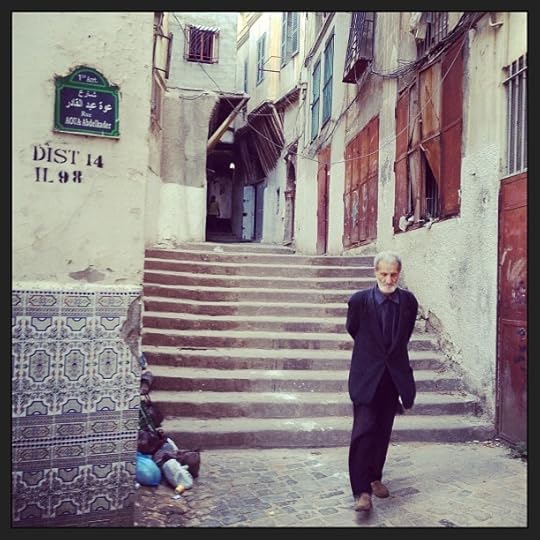
It's only just over fifty years since the end of the Algerian War. But I guess a lot has happened to Algeria since then, and little of it positive. When I was in Algiers last year I spent a fair amount of time wandering around the Casbah and looking for landmarks that I knew of from reading about the conflict. ‘Do you know where this street is?’ I kept asking locals, in my shaky Moroccan Arabic, clutching a list of correspondences between old street-names and new ones. ‘It might be called this now…or this…’ Blank stares. I might as well have been asking about the First Punic War.
Only, occasionally, you'd turn a corner and see marks left on the walls by the French army when they divided the city up into zones of interest:
After I took that picture, the guy you can see walking past stopped me and asked what I was doing; he ended up inviting me back to his house and we had tea on his roof. ‘We don't talk about that any more,’ he said, of the Algerian War. To be fair, they have had an extraordinarily violent civil conflict to worry about in the meantime.
Still, it's a shame in some ways because there's certainly a lot to talk about. As the title of this essay suggests, the nightmare of 1954–62 really was a dirty war, perhaps the first modern war where the issue of military torture was really brought to the fore. The infamous gégène – a portable generator, referred to as a ‘telephone’ in this book because that's what it was originally used to power – captured the horrified imagination of the French public, especially after Henri Alleg wrote about how he had been waterboarded and had his genitals electrocuted every day for a month by the French – and him a nice white guy, too. The government tried to ban his book, but the cat was long out of the bag and several French generals were already cheerfully confessing that torture lay well within their remit. And who could blame them, with the FLN sending women to blow themselves up in a nasty bomb campaign against civilians?
What this essay does particularly well, I think, is position these arguments in the context of France's wartime past. It is impossible to understand why torture was such a live subject for the country without realising how deeply it had been affected under the Nazis not long before. At the height of the Battle of Algiers, Paul Teitgen, the head of the Algiers police force, was asked for permission to torture detainees to obtain information about live bombs in the city; he had himself been tortured by the Gestapo, so his ‘no’ should echo with some force. And at least one general who had fought the Germans even resigned over misgivings about how the French military were conducting things in Algeria.
This is also a very important piece of the puzzle when it comes to assessing such contemporary events as the Charlie Hebdo attack and its aftermath. It is one thing to use free speech to attack the elites and the powerful; it is something else for the French to use it to mock a minority that, in Algeria, was subjected by them to some of the worst effects of colonialism's death-throes. Which, of course, is not to offer any sort of justification but simply to contextualise some of the responses.
And if you want context, this is a great place to start. It's well written and very well sourced, and though it doesn't offer any particular new thesis or argument, as a compact summary of what happened and why it matters, it's excellent.
I think having a good background about French post 1945 would help. Still, this short essay did make me very interested in learning more about the French/Algeria war as well as adding more understanding to the whole discussion about Zidane and his importance in French Foolball - besides the fact he is a genius. It also provides background for current French debates about immigrants.
There is also quite about the influence of writers during the war. Compelling.
Thank you Lisa Lieberman. I would not have read the Question without you.
Very short but very revelation-ary book about the infamous french-Algerian conflict in the 1950's. I have fallen in love with the French apologists lately, check some of their narrative justifying continued subjugation of the Algerian people.
The Muslims were not ready to take up superior Western values yet, therefore French presence is essential till they learn proper conduct.
AND
Revolutionaries were fighting for their ancestral rights to poverty.
And
Violence is useful for the colonized people? Why, because it helps them overcome their inferiority complex, master their fear, set aside their despair, and regain their dignity.
Actually, I agree with all the three statements resoundingly, as complex, fear and despair over prolonged periods become habit, which must be broken by violence. Is there any other way?
This short history by Lisa Lieberman explains the revolution that took place in Algeria between 1954 and 1962, where Algeria attained independence from being a French colony. But the French would not give up one of their territories quietly. Both sides would use brutal tactics to achieve victory, leaving moderates trapped between two increasingly violent and radical sides, and creating more violence. "Evidence suggests that most Algerians preferred reform to revolution. When given the opportunity to vote on a referendum in 1958, 80 percent of the non-European population of Algeria, men and women, endorsed de Gaulle's Fifth Republic despite the FLN's call to boycott the election and in the face of significant intimidation. The vote is particularly striking since at the time de Gaulle was committed not to outright independence but to an "evolution" of Algeria "within a French framework." But as the battle between terrorists and the French army intensified, compromise became a luxury that few Algerians possessed. Failure to comply with FLN demands meant death, but so did compliance. Algerian civilians suspected of aiding the insurgents were treated brutally by the French." This is how the conflict was allowed to spin wildly out of control. This is an understudied piece of world history, and the themes discussed are very much still relevant in modern world politics.