When one false step can lead to disaster, only the most intrepid dare venture into the Borgia labyrinth. Matteo da Fermo must make that journey, compelled by a duty of revenge. His path takes him into the dark heart of Renaissance Italy. We watch him transform from dreamy, lovelorn adolescent to courageous soldier and nerveless spy. We move from army camps and besieged hilltop towns to noble palaces and the glittering decadence of papal Rome. Along the way, Matteo meets brutal assassins, devious courtesans, flamboyant cardinals, and a rich cast of historical characters, including Niccolò Machiavelli and Leonardo da Vinci.
While negotiating this vivid and colorful world, Matteo is also charting his way through the equally treacherous landscape of love and desire, forced to balance his feelings for his childhood sweetheart Nicolosa with the dangerous attractions of the women who form part of his dangerous odyssey. The most fascinating of these is Felice della Rovere, daughter and spymaster to his patron Cardinal Giuliano della Rovere, a woman “whom the devil seemed to have sent to this earth specifically to bring him to grief.”
Set during the time when Cesare Borgia was ruthlessly exploiting his father’s papal authority to carve out a new empire in central Italy, The Subtlest Soul crafts a colorful and enthralling panorama of life in this remarkable era.
Virginia Cox was born in England and educated at Cambridge University, where she received her PhD in Italian literature in 1990. She taught at the universities of Edinburgh, UCL, and Cambridge before moving to the Department of Italian Studies at New York University in 2003. Her fields of specialism are Italian Renaissance literature and intellectual history and the history of rhetoric. She lives in New York and London.
As the sequel to this delightful historical novel has now been published, The Peril, and since I had read this first volume in the Merchant of Secrets series (hopefully there will be more than two) five years ago, I decided to read it again before embarking on the new volume.
Having traveled a few times to Italy during these intervening years, visiting amongst other places, Urbino, Pesaro and Rimini, this second reading was even more enjoyable than the first. I have understood better what Cox has done, and appreciated with greater relish all the subtleties she has included that prove her thorough understanding of the period.
Now onto the second. ...
******
Gracious Fortuna visited me with this book.
No matter how tall my pile of To-Read books may be, this one climbed to the top swiftly. I downloaded it into my gadget, as I was embarking on a visit to Tuscany, to keep me suitable company during my travels. After a few months of reading on culture, art and history of the Italian Quattrocento and Cinquecento, I thought reading this fictional story set in those times would be like basking in the sun after a vigorous swim. It was.
Or may be not quite. I certainly had to keep awake. The plot is thick with the thick intrigue that simmered in the politics of the multi-country Italy of the time. Here we have the great family clans of the Borgias, the Medici, the Montefeltros, the Della Rovere and their power struggles. In this mesh of conspiracies and spies one sometimes feels some vertigo perching over the gripping plot. Gripping as a lesson of history.
This was the age that produced the most famous treatise on political deceit, The Prince. And its author is a convincing character in this fiction. This was also the age that developed an unprecedented and highly sophisticated art based on the deceit of perceived space. And one of its most famous practitioners also receives a slot in this tale.
During my read I kept thinking that the author, Virginia Cox, must have had a great time conceiving it. As a scholar specializing in writing by women during the 15C, 16C and 17C in Italy, as well as in gender studies during the Italian Renaissance, she knows her period well.
And this shows. In her excellent Afterword she dissects her work delineating and dissecting the fiction from the fact. Even if it is clear with some aspects or elements, this analysis underlines how very close to history she has remained. For this she has created a smart device: the completely invented protagonist Matteo da Fermo. He is a somewhat hermaphroditic male, which Cox, with her knowledge of gender differences at that time, admirably represents as entirely suitable to the period.
Man? Woman?
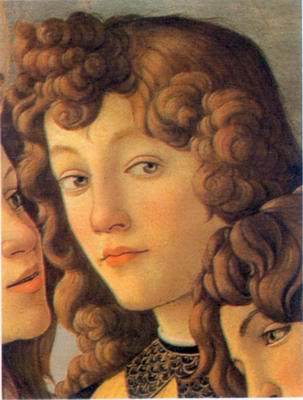
One can imagine her Matteo and his Subtle Soul as one of Botticelli’s young precious males. But Matteo is not just beauty, he is also a perfect mechanism to move through these complicated times, when the various Italian units engaged in a military, and political, and courtly dance with the two competing powers: France and Spain. When these two countries became such, they soon felt the urge to flex their muscles and might and the Italian cornucopia of riches was their chosen terrain to display their rivalry. Cox has also offered us a welcome Introduction to the political setting of her narration which immediately hooked me in.
Her Matteo then functions as a Google peg-man with whom we can walk through the Rome, and several of the cities in Umbria, Romagna, and Tuscany, and meet the popes Alexander VI, Julius II and the pope-to-be Leo X (still as Cardinal Giovanni Medici), as well as Cesare Borgia, Leonardo da Vinci, Felice della Rovere, and Niccolò Machiavelli in very convincing images. The foul-mouthed Machiavelli in particular seemed to me the most successful portrayal. We become the Matteo peg-man in this illusion.
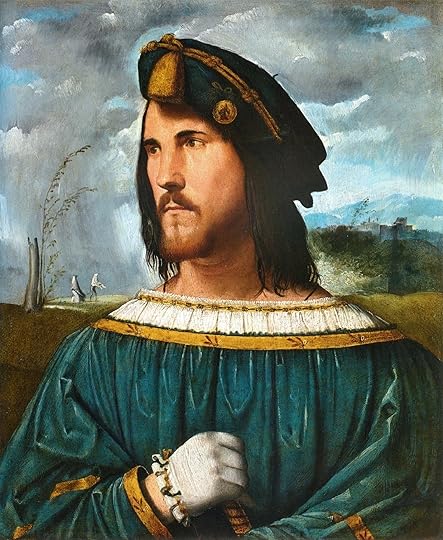
Cesare Borgia
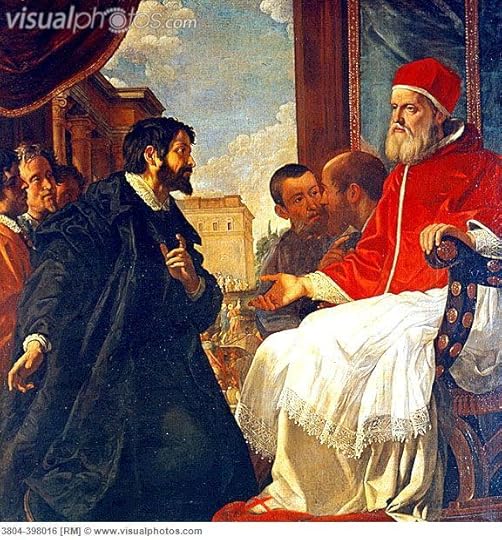
Julius II
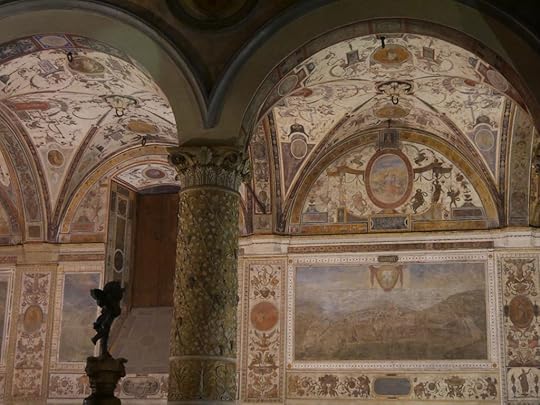
Cox’s expertise makes the historical texture of her setting also highly convincing and hypnotizing. Domestic interiors; eating manners with the new utensil—the fork; practices in private education; clothes with the doublets and brocades and cowls and detachable sleeves; the new French disease and the widespread of malaria; the wars with the condottieri and the looting and their barracks; the ubiquitous daggers and the priced killing metals; the landscapes with the rounded hills; the differences in the provinces and the dialects; the rise of the “cortigiana”. I particularly liked reading on what a visit to the then recently discovered Domus Aurea”, Nero’s Villa, must have been like around 1500. During the Tuscan visit I had the opportunity to admire the plethora of Renaissance wall paintings from based on the unearthed Roman models.
Palazzo Vecchio, Florence, à la Nero.
In addition to all this, one can also feel the life in her real and less real characters. Virginia Cox must have had great fun sitting back, taking a break from her scholarly work, and writing this fascinating story.
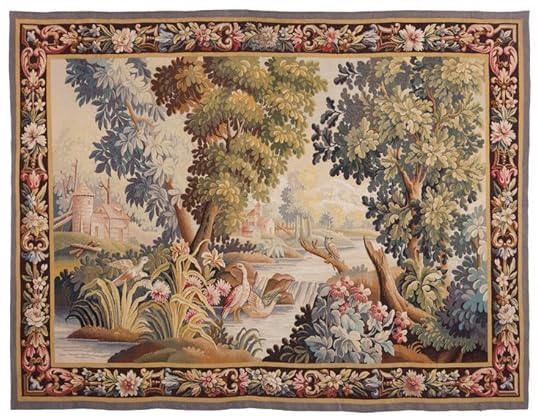
Towards the end of this well-told story, there's an episode where Cesare Borgia tears a leech from his body and hurls it with such violence that it explodes in a bloody mess against the peaceful scene depicted in a tapestry on his bedroom wall. That peaceful scene could have been Italy before the Italian Wars, and the exploding leech is the perfect symbol for the bloody conflicts that broke out across the Italian territories during the last decade of the fifteenth century as the powerful families of the region battled with each other to become ‘top dog’ of their area, spurred on by the French and Spanish courts. The leech scene is a great example of Virginia Cox’s narrative skills. There are many such clever images in the book. They fix themselves in the reader's mind and provide a back drop for the action.
I hardly ever read historical fiction so it was with surprise and pleasure that I found myself drawn into this story. It helped that Virginia Cox chose to write the book as the memoir of a man caught up in the intrigues of the Italian Wars. Matteo da Fermo's first person narrative convinced me in a way that a third person omniscient narrative would fail to do; I’d find myself questioning the author, asking how he knows what such and such an historical personage actually said or felt. But since Matteo (who is fictional) involves the reader in his account, frequently reminding us that we will have seen or heard of things similar to those he is recounting, I found it easy to suspend disbelief.
Matteo’s memoirs reminded me very much of Benvenuto Cellini’s autobiography from around the same period. In fact Matteo’s fictional account rings truer than Benvenuto’s because he’s not nearly as boastful as the Florentine. And Benvenuto’s factual account is quite as full of miraculous escapes and last minute reprieves as Matteo’s. What it all comes down to is meticulous research on the part of the author of The Subtlest Soul. Matteo’s voice convinces because it reads like an historical document. When he speaks of the slim modern volumes Aldus had begun to publish in Venice—a book you could hold in a single hand, almost weightless, a wondrously novel thing at that time, we wonder alongside him. When he mentions visiting the court of Urbino, and reminds us that Castiglione wrote that elegant book on the perfect courtier four or five years after his own visit to the court, we believe he was there and that he has read the book. When he visits the recently excavated Domus Aurea in Rome, and describes the thrill of stepping on stones that Nero had walked on, we feel the thrill alongside him.
An added pleasure for me while reading about Matteo’s adventures was the fact that I was visiting Italy at the time. And although I didn't visit Matteo’s home town of Fermo (the church of San Fermo in Verona was the nearest I got) I came across many echoes of his story on my travels. I visited Milan where there are still traces of the powerful Sforza family who possibly triggered the Italian Wars in the first place, and who are mentioned by Matteo. From there I went to Mantua, the historical seat of the Gonzaga family where I saw a detailed fresco showing how they drove out the ruling Bonacolsi family and then sent a mission to Rome to seek papal recognition for their brutal actions. Part of Matteo’s adventures involve just such a bloody take over and a similar mission to Rome to legitimize it. In Verona, I visited the Castelvecchio, a well preserved fortress that resembles the various fortresses described by Matteo. I discovered too that Verona had been ruled by the Della Scala family, one of whom had ousted the rulers of several neighboring cities, becoming a very powerful figure in the region. His name was Cangrande, and that name sums up the kernel of Matteo’s tale: Cangrande means ‘top dog’!
This novel tells the thrilling story of the fictitious character, Matteo da Fermo, who becomes a spy to not one, but to three powerful and very dangerous people, one of them being Cesare Borgia. He betrays two of his masters, and would like to be free of the third, but circumstances preclude fulfillment of his desire.
Matteo finds himself in various precarious situations, and this is how Virginia Cox describes his angst: "Fear painted a smile on my face, assisted by wine, of which I drank more than was prudent. I even managed to eat a little, though I have never felt less appetite and feared that each mouthfull would stick in my gullet. The meat on my plate looked repellent to me, as if I were being forced to eat something alive." And on another occasion: ""My face and voice could not be left to their own devices in his presence; they must be disciplined like soldiers to obey my orders. "Smile," I would command, and my features would resolve themselves into a lying mask of amiability. "Flatter," I would instruct, and my mendacious tongue would find some new way to lick the vanity of my lord.""
This is how we first meet Cesare Borgia (referred to as the Duke or Valentino in the novel): "the Duke was mounted on a white stallion, and when I say white, I mean white - the gleaming white they call candidus in Latin. His grooms must have been up all night washing the creature's coat and mane and tail until they shone. Valentino was dressed all in black, but his hat was decked with scarlet feathers, and two standard-bearers rode behind him carrying banners with his emblem of a red bull."
There are appearances by many famous and infamous people of the period, including Niccolò Machiavelli, Felice della Rovere (daughter of Pope Julius II) and Leonardo da Vinci. This is Matteo's view of Leonardo: "This was the true dream of this madman, I realized at this moment. He saw himself soaring through the air like some great pigeon, his hair and beard streaming in the wind."
The story takes place during the sixteenth century Italian wars, and this dark period is well described: "You can read of tyrannies in history and know in your mind that these things happen, but nothing can prepare you for the shock of finding yourself amid these atrocities. It is like the difference (I imagine) between reading the Inferno of Dante and feeling those dark gates close behind you yourself." It seems incredible that at the same time as these wars, magnificent artworks were produced by the Italian Renaissance artists.
This novel was a serendipitous find on the very day that I finished reading Hella Haasse's 'The Scarlet City" which deals with the same period of history as this story.
Now, this is awkward. It began as a mesmerizing journey through torn apart sixteenth century Italy – a dream of every avid reader of non-fiction who has ever imagined what it’d be like to be a part of the era which produced famous condottieri and notorious Il Principe, Leonardo and The Warrior Pope. It turned out to be a reminder why I normally avoid fiction books which feature my historical crushes.
The story is told from the point of view of Cox’s fictional character (and plot moving device) Matteo da Fermo, a tailor’s son (not to give anything away), a spy and a handsome youth full of testosterone. In fact, The Subtlest Soul is Matteo’s memoirs which is a smart and liberating move on Cox’s part as memoirs give her the right to go as wild as she wishes – in the end, it’s Matteo’s story and he has a right to tell it the way he fancies. And yet I have a question. Why on earth did Matteo outlive the most powerful, cunning and brilliant people of his century? How did he manage to serve three masters at the same time and befriend (sort of) Machiavelli? We’ll never know. As well as we’ll never know if he’s that subtle soul who gave the book its title or not. Actually, if there’s any subtle soul in this book, it’s Giuliano della Rovere, but he’s mostly behind the curtain so he hardly counts. In the course of the novel Matteo mostly concentrates on his unrequited love, personal revenge, dreams about pursuing his own life, and every time he actually has an opportunity to act as a smart person in his position should, he tells us not about his clever scheme, but about his doubts and fears. Can’t the Borgia and Della Rovere families just sort things out by themselves and let poor Matteo live his own life with his beloved? Of course, they can. They don’t need Matteo to keep bloodshed going, as well as Matteo doesn’t need them to keep suffering (it’s sixteenth century, life is tough enough!). Anyway, the gap between these two storylines is huge, and while Matteo’s life is often boring and predictable, confrontation of the mighty always (very weirdly, as Matteo is in the midst of it) remains at a distance.
I doubt that Matteo’s purpose was to enlighten his potential readers. Quite the opposite, I presume. His goal was to tell his own story accidentally intertwined with clash of mighty clans. Then why does he write something like ”As you probably know, it is customary for a pope’s body to be displayed after his death to the faithful”. They know, Matteo, your potential readers live in the same reality as you do. They probably don’t, Virginia Cox, your potential readers live in the 21st century, but there’re smarter ways to tell them about it because you’re writing memoirs not a monograph. Speaking of the way the story is told, there’re a few exquisite passages which bring to life the breathtaking world of Renaissance Italy, and there’re lots of plain metaphors and explicitly symbolic scenes which seem to be awkwardly naïve. Though the most awkward thing is literally any description of naked body and intercourse. Such as: Why did Matteo (and Virginia Cox) even include these descriptions (in abundance, as Matteo is a passionate boy) in the text? They lack finesse and make even without that one-dimensional character a lust driven puppet. Why didn’t Matteo (and Virginia Cox) include more details about feasts, towns, people instead? Why not include something meaningful, something to do justice to the fantastic historical background of Matteo’s story? Apparently, it has something to do with poor writing. It’s not all the time that bad. As I’ve said, there’re some stunning passages, but mostly the quality of writing simply cannot make up for the lack of captivating story.
To me, the main problem with this book is that its fictional and historical storylines can perfectly do without one another – they are rather believable separately, but somehow do not fit together. Of course, it is impossible not to give Virginia Cox a credit for (mostly) staying true to the period she wrote about - unlike many other historical fiction books, The Subtlest Soul is very precise and backed up with solid research on the subject. Also, I cannot but mention, that The Subtlest Soul is a novel where Machiavelli is used mostly to discuss a love affair, and Leonardo Da Vinci to provide a concoction which helps with remaining celibate.
An enjoyable read, especially at the beginning. Sadly, I now have to compare historical novels to Memoirs of Hadrian and most anything by Conn Iggulden, and Hilary Mantel. That's a tough crowd. The bar has been set high. The strength in this novel is in the narrative voice. The setting is sketched, as are many of the characters who appear like a Who's Who of the time period. Others, like Machiavelli were better, but still mainly caricatures. The women, although having to work from the sidelines, were interesting in motivation and cunning. After a bit of a drag in the middle, the end kicks into gear and settles festering scores. This is not meant as a historical romance, but love comes into play as a powerful motivator. So, while I recommend this novel, I was not as absorbed as in other historical fictions.
Almost perfection; 4.5 stars. Skillfully blends historical events with the protagonist's fictional character and cameo appearances by Machiavelli and da Vinci.
The author avoids overblown prose and unnecessary drama, and sprinkles the text with inspired vocabulary. So refreshing to read something intelligent in contrast to the dumbed-down edits from Big House publishers.
The only criticism would be pacing, i.e., the pace of things was overly uniform and too smooth; and that might have been cured with something as simple as scene breaks to highlight events.
I really liked this book and agree with a previous poster in that this book deserves a wider audience. I would like to see what an agent and publisher would do with it, but that's just me wondering. I am not a historian but had some familiarity with Machiavelli and the Borgias before reading the book, which helped me understand it, especially at the beginning. There is a wide cast of characters. If you want quick education on the period presented in this book, watch Showtime's The Borgias. The author will probably cringe at me saying that, but many/most Americans are not that familiar with the Renaissance period, including me. The protagonist in this book is male, and, as a female, I thought Ms. Cox did a good job portraying a man about town in Renaissance Italy. I'd like to know what men think about it. I wished the book were longer and that there were a sequel, as I finished it in a few days. Ms. Cox, I think you definitely have the potential for a new career as a novelist. This is a highly entertaining read, and I liked the fact that the female characters weren't flat and had some interests and activities of their own that weren't solely related to the men in their lives. Bravo!
A hidden gem that deserves a far larger audience! With her immense knowledge of the era and her equally immense writing talent, Virgina Cox brings Renaissance Italy vividly to life in this wonderful historical fiction novel. The wealth of historical details and beautiful writing breathe life into a perfectly crafted story of political intrigue, war and romance that will guarantee many late nights reading "just one more chapter" and the characters, historical and fictional (including Machiavelli, Cesare Borgia, Leonardo da Vinci and many more) alike, are without exceptions life-like and complex. A beautiful novel I fell in love with within the first few pages and enjoyed tremendously all the way through.
I found Virginia Cox’s as an award winner at the Historical Novel Society site and was quite pleased that I fully agreed with the assessment of historical novelist Elizabeth Chadwick, judge of the award, when she said, “The history felt real and right. It was an immersive experience. It was one of those books where I needed to know what happened next and kept having to go back and pick at it - you know like when you have that opened bar of chocolate in the fridge!”
We are proud to announce that THE SUBTLEST SOUL by Virginia Cox is a B.R.A.G.Medallion Honoree. This tells a reader that this book is well worth their time and money!
The book has two merits - Its historical accuracy of main events and easy to read language. And still all way through I needed to fight off boredom. Borgias, Medici, Machiavelli and da Vinci - they all (and many more persons of interest) are there. Plot moves from conspiracy to conspiracy, from treachery to treachery, and the hero has very busy life being liked and used by practically every man and woman of any significance in land, and using himself with equal eagerness those of lesser importance. There are so many things happening that you can’t resist thinking that you, as a reader, should feel at least something. Intrigue, compassion, repulsion. Something. Anything. But it is just nothing. All those events, all people passing by throughout the book leave no thought or feeling behind. They are empty shells, and so is main character. I do not believe in what he (and the author) tries to convince me. He is bored in his attempt to convince me of anything at all, and I am bored to read about it.
I have to admit I picked Virginia Cox’ book up out of curiosity (and perhaps a little envy). We had both been shortlisted for the HNS 2014 Indie Award for Best Historical Fiction. So, I wondered, what made Dr. Cox’ book stand out for the judges among the many great submissions (all of which are worth reading).
Now I know. While other reviewers here already told some of the plot, I am going to talk about the language: Delicious – and subtle, as the word was used during the Renaissance, the age that produced Da Vinci, Michelangelo, Dante and – ah, let’s not forget – the Borgias and Machiavelli.
Subtle then meant to be clever, insinuating, shrewd, artful, tricky and, last but not least, devious. That perfectly fits the handsome young narrator (hence, the title). Of low birth, he compensates by being a bit vain and “subtly” squirms his way into the graces of the powerful but murderous elite. While some of his actions stem from revenge against the murderer of his family, it appears he becomes accustomed to favors bestowed upon him – even though his duplicity leads him into more treachery and great danger.
But it is the language used for young Matteo de Fermo to tell his story. His words burble along like a tranquil brook. Then, before you know it, you are in the midst of the most horrendous battles, ghastly murders, and lusty whoring. Young Matteo talks about it all seemingly devoid of remorse over his actions. The “subtlety” of Ms. Cox’ language made me chuckle quite a few times – how very Machiavellian!
No wonder, “The Subtlest Soul” was the winner. Deservedly, the book also received the hard-to-come-by B.R.A.G. Medallion. Congratulations to Dr. Virginia Cox for an outstanding novel.
If you are not familiar with the notorious Borgias, the book might be a little hard to follow, but if you've watched any of the Borgia television productions, you'll be able to get in to this story easily. The narrator, Matteo, is fostered by his godfather after being orphaned, and as a young man, becomes a soldier. He has many reasons to hate his commanding officer, and eventually comes up with a plan to exact revenge. The story has Matteo in the thick of intrigue, ending up spying for & on three different powerful, dangerous men - at the same time! The historical characters in the story include the most famous of the Borgia Pope's sons, Cesare, Machiavelli, and even Da Vinci. Matteo is a likable guy in general, though with many flaws and a very, very complicated love life. For me, the book was extremely enjoyable. I felt it was well written, and it drew me in to the story very quickly; I could hardly put it down!
Another historical period that fascinates me (Renaissance Italy, featuring the Medici and Borgia), written by someone with expertise in her field rather than an English major who chose to write about the topic. To my knowledge Virginia Cox does not have the clout of other authors, but perhaps that position deserves reassessment. I've wanted to read this book for a while but held back because of the book's cost ($16 for a paperback--I've clearly been spoiled).
Until now. I have until after Christmas to finish Measuring the World (an excellent story so far).
An interesting read with a different perspective on the life and times of the Borgias. I enjoyed the story. Today's politics are a poor reflection of the political intrigue of the Borgias court