

What do you think?

The Real Jane Austen: A Life in Small Things
In The Real Jane Austen, acclaimed literary biographer Paula Byrne provides the most intimate and revealing portrait yet of a beloved but complex novelist.
Just as letters and tokens in Jane Austen’s novels often signal key turning points in the narrative, Byrne explores the small things – a scrap of paper, a gold chain, an ivory miniature – that held significance in Austen’s personal and creative life.
Byrne transports us to different worlds, from the East Indies to revolutionary Paris, and to different events, from a high society scandal to a case of petty shoplifting. In this ground-breaking biography, Austen is set on a wider stage than ever before, revealing a well-traveled and politically aware writer – important aspects of her artistic development that have long been overlooked.
The Real Jane Austen is a fresh, compelling, and surprising biography of the author of some of our most enduring classic books – from Pride and Prejudice to Sense and Sensibility, Emma to Persuasion – and a vivid evocation of the world that shaped her.
Just as letters and tokens in Jane Austen’s novels often signal key turning points in the narrative, Byrne explores the small things – a scrap of paper, a gold chain, an ivory miniature – that held significance in Austen’s personal and creative life.
Byrne transports us to different worlds, from the East Indies to revolutionary Paris, and to different events, from a high society scandal to a case of petty shoplifting. In this ground-breaking biography, Austen is set on a wider stage than ever before, revealing a well-traveled and politically aware writer – important aspects of her artistic development that have long been overlooked.
The Real Jane Austen is a fresh, compelling, and surprising biography of the author of some of our most enduring classic books – from Pride and Prejudice to Sense and Sensibility, Emma to Persuasion – and a vivid evocation of the world that shaped her.
400 pages, Kindle Edition
First published January 29, 2013
About the author
Paula Byrne
15 books160 followersPaula Byrne is a British author and biographer. She is married to writer Jonathan Bate, the Shakespeare scholar.
Ratings & Reviews
Friends & Following
Create a free account to discover what your friends think of this book!
Community Reviews
Displaying 1 - 30 of 454 reviews

Read
July 8, 2013Not too long ago there was an uproar in Jane Austen circles at the discovery of a drawing that was labeled Jane Austen, depicting an upright woman of middle years whose face betrays illness. She is posed by a window, she has writing implements before her in a prominent place, and she wears what appears to be a spinster's cap. According to speculation going around, the author of this book was given the drawing by her husband, after which they both pushed hard to get it authenticated; some speculated that were this to be so, they could turn around and sell it for millions.
Knowing this, I circled this book warily. I'm already over the quick-for-cash Austen books, both fictional and non (the latter sometimes being pretty close to fiction in their wild surmises about the lacunae in Austen's sparse records), but the subtitle drew me to take a look.
I do think that this book could have used an editor who knows things Austen; I suspect publishers see "Jane Austen, oh good, it's almost as surefire as Harry Potter for a cash cow, ram it into publication!" But to write this one off as another hastily done Austen rip would be doing it a vast disservice.
In the opening pages, Byrne says that she is going to try to present Austen through the little details, the things Jane Austen left behind, and she sets out most assiduously to do just that. Where the book falls down is when she cannot resist telling us what Austen thought. The book is strongest when presenting the world that Jane Austen lived in, the signs of Jane left in objects, such as the amber crosses her brother brought back for her and Cassandra, in the family actions after a contested will, in furniture and others' letters and in the houses where she worked and stayed. A signed royalty check (on which, by the way, Jane spelled her last name "Austin" in usual haphazard-about-spelling eighteenth century fashion).
Byrne does a superlative job in presenting the literary side of the eighteenth century, especially with respect to the quick tumble of theater, both professional and private. And there is plenty of evidence that Austen eagerly participated in home theater, from her mother's annoyance at a shy cousin refusing to act in family productions to the bald list for auction of theater trappings stored in the Steventon barn.
Byrne engages thoroughly, and sympathetically, with two aspects of Jane Austen that get short shrift: her Christianity, and Lady Susan; it seems to me that more conservative scholars are fine with the first, but tiptoe past the second, whereas postmodern scholars whistle past the first, and use the second as evidence of her being "modern" in outlook.
The philosopher's stone seems to be the "rears and vices" pun that Austen puts in the mouth of Mary Crawford. I'm amazed at those who want to think that Jane Austen could possibly be ignorant about such things; this is a woman who had two brothers in the navy--whose letters make it clear she read the horrible case of a man put on trial, and executed, for sodomy. Whose character, Tom Bertram, is either gay or aro.
Byrne deals with that head on, gleaning details that Austen most certainly heard about, like the fact that the famous case was the result of a girl dressed as a boy on board a ship spying through a peephole at the accused. By reading the newspapers of the day, Byrne provides context for some of the glancing references in the letters. Shopping, imports, the cushions in private chapels, great estates, London and all its bewitching possibilities, the problematical notice of the Prince Regent and his obsequious secretary who had no ear for fiction, each are explored in fascinating detail.
We get a good look at Jane Austen through others' letters and diaries, including the contradictory quotes from Mary Russell Mitford, who really seems to have been poisonously jealous of Austen. (This subject needs further delving!) We see Jane Austen taking care of children, and entertaining them.
Where Byrne falls down, and falls hard, is when she cannot resist telling us what Austen thought. Like: Jane Austen had a phobia about childbirth. Excuse me? There is NO evidence of that. Quite the contrary. The letters betray a wary respect for the dangers of frequent pregnancies that were a part of the life of a married woman, but there is absolutely no evidence of a phobia about lying-in. There is equally no evidence that she turned down a young clergyman suitor because she fell in love with the sea (page 315). Or that she would not have been ashamed to be in the company of Mrs. Robinson or Madame de Stael. Or that she "sacrificed" her prospects of marriage in order to write. (308). Which, by the way, would obviate the phobia about lying-in, right? It's no sacrifice to stay away from the thing you are afraid of, is it?
Then there is the disingenuous (at best) comment on page 82 that Fanny Burney was the first to depict homely heroines, as in Cecelia [1796], "Without her, it would not have been possible for Jane Austen to reject the convention that a heroine must be beautiful." Jane Austen makes quite clear in the juvenilia (that Byrne describes quite engagingly) that she was already tossing eighteenth century fictional conventions out the window, that one being one of the first to go. Then there is the non-observant comment that Austen writes in third person narrative, when that should be omniscient, sometimes first person omniscient.
A judicious editing would have forced Byrne to correct or to justify these leaps more convincingly. But they are throwaway comments, in the main, leaving the bulk of the book full of family lore (and what a tangle of relations!), naval anecdote, depictions of Bath and London and life in the country, making it very well worth the read for the Austen lover who can never get enough.
As for the contested drawing, Byrne deals with that pretty gracefully, making her case but no absolute claim. She acknowledges the modern person's wish that this might be our clearest look into the face of the woman whose work changed literature.
Knowing this, I circled this book warily. I'm already over the quick-for-cash Austen books, both fictional and non (the latter sometimes being pretty close to fiction in their wild surmises about the lacunae in Austen's sparse records), but the subtitle drew me to take a look.
I do think that this book could have used an editor who knows things Austen; I suspect publishers see "Jane Austen, oh good, it's almost as surefire as Harry Potter for a cash cow, ram it into publication!" But to write this one off as another hastily done Austen rip would be doing it a vast disservice.
In the opening pages, Byrne says that she is going to try to present Austen through the little details, the things Jane Austen left behind, and she sets out most assiduously to do just that. Where the book falls down is when she cannot resist telling us what Austen thought. The book is strongest when presenting the world that Jane Austen lived in, the signs of Jane left in objects, such as the amber crosses her brother brought back for her and Cassandra, in the family actions after a contested will, in furniture and others' letters and in the houses where she worked and stayed. A signed royalty check (on which, by the way, Jane spelled her last name "Austin" in usual haphazard-about-spelling eighteenth century fashion).
Byrne does a superlative job in presenting the literary side of the eighteenth century, especially with respect to the quick tumble of theater, both professional and private. And there is plenty of evidence that Austen eagerly participated in home theater, from her mother's annoyance at a shy cousin refusing to act in family productions to the bald list for auction of theater trappings stored in the Steventon barn.
Byrne engages thoroughly, and sympathetically, with two aspects of Jane Austen that get short shrift: her Christianity, and Lady Susan; it seems to me that more conservative scholars are fine with the first, but tiptoe past the second, whereas postmodern scholars whistle past the first, and use the second as evidence of her being "modern" in outlook.
The philosopher's stone seems to be the "rears and vices" pun that Austen puts in the mouth of Mary Crawford. I'm amazed at those who want to think that Jane Austen could possibly be ignorant about such things; this is a woman who had two brothers in the navy--whose letters make it clear she read the horrible case of a man put on trial, and executed, for sodomy. Whose character, Tom Bertram, is either gay or aro.
Byrne deals with that head on, gleaning details that Austen most certainly heard about, like the fact that the famous case was the result of a girl dressed as a boy on board a ship spying through a peephole at the accused. By reading the newspapers of the day, Byrne provides context for some of the glancing references in the letters. Shopping, imports, the cushions in private chapels, great estates, London and all its bewitching possibilities, the problematical notice of the Prince Regent and his obsequious secretary who had no ear for fiction, each are explored in fascinating detail.
We get a good look at Jane Austen through others' letters and diaries, including the contradictory quotes from Mary Russell Mitford, who really seems to have been poisonously jealous of Austen. (This subject needs further delving!) We see Jane Austen taking care of children, and entertaining them.
Where Byrne falls down, and falls hard, is when she cannot resist telling us what Austen thought. Like: Jane Austen had a phobia about childbirth. Excuse me? There is NO evidence of that. Quite the contrary. The letters betray a wary respect for the dangers of frequent pregnancies that were a part of the life of a married woman, but there is absolutely no evidence of a phobia about lying-in. There is equally no evidence that she turned down a young clergyman suitor because she fell in love with the sea (page 315). Or that she would not have been ashamed to be in the company of Mrs. Robinson or Madame de Stael. Or that she "sacrificed" her prospects of marriage in order to write. (308). Which, by the way, would obviate the phobia about lying-in, right? It's no sacrifice to stay away from the thing you are afraid of, is it?
Then there is the disingenuous (at best) comment on page 82 that Fanny Burney was the first to depict homely heroines, as in Cecelia [1796], "Without her, it would not have been possible for Jane Austen to reject the convention that a heroine must be beautiful." Jane Austen makes quite clear in the juvenilia (that Byrne describes quite engagingly) that she was already tossing eighteenth century fictional conventions out the window, that one being one of the first to go. Then there is the non-observant comment that Austen writes in third person narrative, when that should be omniscient, sometimes first person omniscient.
A judicious editing would have forced Byrne to correct or to justify these leaps more convincingly. But they are throwaway comments, in the main, leaving the bulk of the book full of family lore (and what a tangle of relations!), naval anecdote, depictions of Bath and London and life in the country, making it very well worth the read for the Austen lover who can never get enough.
As for the contested drawing, Byrne deals with that pretty gracefully, making her case but no absolute claim. She acknowledges the modern person's wish that this might be our clearest look into the face of the woman whose work changed literature.

July 18, 2021
A strong biography – engaging, nicely structured, with well-researched details and strong interpretations. I'd definitely recommend, though this is probably more suited to those who know a bit about Jane Austen's life already.

January 23, 2023
Byrne's love of Austen shines through and there is some fascinating material here particularly around her and her family's connections to Caribbean sugar estates and slavery, something which Austen scholarship has been uncovering for some time.
But the issue I have with Byrne is that she's sloppy in her analysis and consistently makes great leaps to assert things for which there is no evidence. It's fine that she takes issue with the Austen family's own memoir of Aunt Jane shaped as it was by historicised assumptions of what single womanhood was supposed to look like, but this book actively reconstructs Austen as a wilful businesswoman who deliberately chose not to get married and have children because she knew her vocation was authorship. We're even told that Austen had a phobia about childbirth and determined not to go through it herself. Evidence? Hmm, nothing substantial just the well-known facts that childbirth was dangerous in that period and that Jane knew women who had died as a result.
It's not only in the big things that Byrne over-claims: she tells us what Austen was thinking and feeling with no evidence; she allows slippages from 'might have' to, in the the next paragraph, 'did'. An example is the cutely named chapter 'The Laptop': this is a portable writing desk and a receipt of Austen's father shows he bought one ahead of her birthday. There's no evidence but Byrne makes the suggestion that this might have been for Jane's birthday then goes on to take this assumption as read to claim that this proves that her father believed in and supported Austen's ambition to be a published writer. He might well have done, but the unattributed receipt of a portable writing desk that might never even have been given to Jane is not evidence of that fact. This book is full of such unscholarly assumptions and slippages.
It's a shame because the idea of retelling Jane Austen's life via material objects in her world is a good one - I just find Byrne unreliable as she jumps from object to intuition or wish-fulfillment and claims this as an authentic account. Her eagerness to over-claim makes me cautious about accepting what is well-researched and evidenced: her own insistence on passing off guess-work as 'truth' undermines the validity of the whole project for me.
But the issue I have with Byrne is that she's sloppy in her analysis and consistently makes great leaps to assert things for which there is no evidence. It's fine that she takes issue with the Austen family's own memoir of Aunt Jane shaped as it was by historicised assumptions of what single womanhood was supposed to look like, but this book actively reconstructs Austen as a wilful businesswoman who deliberately chose not to get married and have children because she knew her vocation was authorship. We're even told that Austen had a phobia about childbirth and determined not to go through it herself. Evidence? Hmm, nothing substantial just the well-known facts that childbirth was dangerous in that period and that Jane knew women who had died as a result.
It's not only in the big things that Byrne over-claims: she tells us what Austen was thinking and feeling with no evidence; she allows slippages from 'might have' to, in the the next paragraph, 'did'. An example is the cutely named chapter 'The Laptop': this is a portable writing desk and a receipt of Austen's father shows he bought one ahead of her birthday. There's no evidence but Byrne makes the suggestion that this might have been for Jane's birthday then goes on to take this assumption as read to claim that this proves that her father believed in and supported Austen's ambition to be a published writer. He might well have done, but the unattributed receipt of a portable writing desk that might never even have been given to Jane is not evidence of that fact. This book is full of such unscholarly assumptions and slippages.
It's a shame because the idea of retelling Jane Austen's life via material objects in her world is a good one - I just find Byrne unreliable as she jumps from object to intuition or wish-fulfillment and claims this as an authentic account. Her eagerness to over-claim makes me cautious about accepting what is well-researched and evidenced: her own insistence on passing off guess-work as 'truth' undermines the validity of the whole project for me.

February 16, 2015
In this engaging and scholarly biography of Jane Austen, Paula Byrne successfully dispels many of the myths swirling around her subject. According to Byrne, Miss Austen was a well-traveled, urbane sophisticate who demonstrated a vibrant interest, not just in literature - both classical and contemporary - but in politics, theology and the theater. Byrne identifies objects and relationships that were familiar to Austen and uses them to illuminate important aspects of Austen's personal life and connects them to her plots and the characters in her fiction. As she writes in her prologue:
Small things in Jane Austen’s world do not only evoke distant places. They can also be the bearers of big emotions. The intense emotions associated with love and death are often refracted through objects. Letters and tokens are of great importance in the novels: focus upon an object is often a signal to the reader that this is a key sequence in the emotional unfolding of the narrative. This biography is an attempt to write Austen’s life according to the same principle.
Byrne draws on her vast knowledge of Austen's prose and her correspondence. While her conclusions are speculative, they are rarely without corroboration. I particularly liked her analysis of Mansfield Park where she argues persuasively about its Abolitionist subtext, and her extensive discussions of the scribblings from the Vellum Notebooks, which provide a window into Austen's earliest literary efforts. The fact that Austen took the time and effort to transcribe them indicates her confidence in her potential for eventual fame. Byne has uncovered a never-before-seen drawing of Austen; she compares it to images of her closest relatives to establish its veracity. It is in sharp contrast to the famous, idealized Victorian portrait commissioned by her descendants, just as this biography counters the sanitized version of her life that they also promulgated.


December 13, 2021
Não será a biografia mais completa porque não está escrita nos moldes convencionais de uma biografia, seguindo uma ordem cronológica e detalhando a vida do visado do inicio ao fim. Contudo, é a biografia perfeita para quem quer conhecer o suficiente das vivências de Jane Austen e formar uma imagem clara da mulher, da escritora, e da forma como relacionou as suas experiências com as histórias que escreveu.
Jane era divertida, irónica, mordaz até, e que me pareceu tirar o máximo proveito de uma vida convencional, mas que ela desfrutava de maneira muito particular.
Lamentavelmente, a sorte não lhe sorriu e partiu aos 42 anos.
Jane era divertida, irónica, mordaz até, e que me pareceu tirar o máximo proveito de uma vida convencional, mas que ela desfrutava de maneira muito particular.
Lamentavelmente, a sorte não lhe sorriu e partiu aos 42 anos.

July 26, 2018
True fans of Jane Austen can never get enough of reading about her novels or her life, sparse though both may be. This is a book to please true fans, especially those not deeply immersed in the more academic end of Jane Austen research. It might be classed as biography but is not a "starter" bio, being arranged as a series of essays instead of a birth-to-death narrative.
Byrne has chosen to focus on a series of objects that belonged to Jane Austen or touched her life in some way, ranging from a laptop desk to a velvet cushion, as jumping-off points for her chapters, each devoted to one aspect or another of Austen's life. The book proceeds more or less chronologically but not linearly. I have read several Austen biographies but few of the more recent ones, so Byrne's narrative contained many details previously unknown to me, especially those drawn from the study of her extended family and friends.
Byrne's scholarship appears respectable and I saw little reason to question her rendering of facts about Austen's life and times. She is unusually well read in the literature, especially plays, that would have been known to Austen and her family. Byrne also is unafraid to take issue with some of the received wisdom of JA scholarship, sometimes in convincing fashion (I agree that Austen gave up writing The Watsons for artistic reasons not because the story hit too close to her personal experience and that the presumption that she hated living in Bath can be challenged) and sometimes less convincingly (the idea that Mrs. Knight paid for the publication of Sense and Sensibility rests on the flimsiest of bases). Fair enough; biographers should speculate. Many biographers go much further into speculative psychologizing than Byrne does.
This book is not for everyone but should please many.
Byrne has chosen to focus on a series of objects that belonged to Jane Austen or touched her life in some way, ranging from a laptop desk to a velvet cushion, as jumping-off points for her chapters, each devoted to one aspect or another of Austen's life. The book proceeds more or less chronologically but not linearly. I have read several Austen biographies but few of the more recent ones, so Byrne's narrative contained many details previously unknown to me, especially those drawn from the study of her extended family and friends.
Byrne's scholarship appears respectable and I saw little reason to question her rendering of facts about Austen's life and times. She is unusually well read in the literature, especially plays, that would have been known to Austen and her family. Byrne also is unafraid to take issue with some of the received wisdom of JA scholarship, sometimes in convincing fashion (I agree that Austen gave up writing The Watsons for artistic reasons not because the story hit too close to her personal experience and that the presumption that she hated living in Bath can be challenged) and sometimes less convincingly (the idea that Mrs. Knight paid for the publication of Sense and Sensibility rests on the flimsiest of bases). Fair enough; biographers should speculate. Many biographers go much further into speculative psychologizing than Byrne does.
This book is not for everyone but should please many.

June 19, 2017
I listened to this for a month on my drive back and forth from work and it was delightful. I learned a lot about Jane Austen and I'm even a bigger fan now.

December 2, 2022
Not a traditional biography, but the format of this book conveys a wealth of information about Jane Austen, her sources of inspiration, and the times in which she lived.
Pictures or illustrations depict many items which featured in both Austen's fiction and in her life — such as the card of lace, the cocked hat, and the crimson velvet cushions. There are also the Vellum notebooks, in which Jane wrote and revised her earliest works, and the bathing machines located on beaches, in which ladies changed into their dipping attire before being wheeled into the waves.
One of my favourite sections, called "The Laptop," discusses the laptop desk or portable writing desk used by Jane to write letters and all her major novels. Oh, how I want one of these!
I also learned that some of the money used to support the Austen family came from drugs — specifically the opium trade.
For readers who love reading about favourite writers this book will be a delight. For someone who doesn't know very much about Jane Austen or isn't already familiar with the major characters in her novels, this book might be in places hard to grasp.
Here is something that made me smile, because often I am so amusingly dense. A holiday destination in Wales was being discussed, and a major attraction of Teignmouth "were the 'Amazons of Shaldon' — muscular women who pulled fishing nets while 'naked to the knee'."
I had first imagined that "naked to the knee" meant they were only wearing rubber boots! It took me some time to realize that naked to the knee meant their legs were bare, with ankles and calves daringly exposed.
There is much in this wonderful book to enjoy, and now I feel a little closer to dear Jane and love her even more.
Pictures or illustrations depict many items which featured in both Austen's fiction and in her life — such as the card of lace, the cocked hat, and the crimson velvet cushions. There are also the Vellum notebooks, in which Jane wrote and revised her earliest works, and the bathing machines located on beaches, in which ladies changed into their dipping attire before being wheeled into the waves.
One of my favourite sections, called "The Laptop," discusses the laptop desk or portable writing desk used by Jane to write letters and all her major novels. Oh, how I want one of these!
I also learned that some of the money used to support the Austen family came from drugs — specifically the opium trade.
For readers who love reading about favourite writers this book will be a delight. For someone who doesn't know very much about Jane Austen or isn't already familiar with the major characters in her novels, this book might be in places hard to grasp.
Here is something that made me smile, because often I am so amusingly dense. A holiday destination in Wales was being discussed, and a major attraction of Teignmouth "were the 'Amazons of Shaldon' — muscular women who pulled fishing nets while 'naked to the knee'."
I had first imagined that "naked to the knee" meant they were only wearing rubber boots! It took me some time to realize that naked to the knee meant their legs were bare, with ankles and calves daringly exposed.
There is much in this wonderful book to enjoy, and now I feel a little closer to dear Jane and love her even more.

January 1, 2019
A biography of Jane Austen with a wonderful host of details. The author has a tendency to theorize and assume beyond the facts; she has too many little stories that she just made up, or thoughts she thinks Austen definitely had. On the other hand, there's a luminous quality to the writing at points and I love learning about all of the little details of life around Austen, from a cousin's escape from the Terror to the make of her writing desk.

March 6, 2013
4 Teacups to "The Real Jane Austen: A Life in Small Things" by Paula Byrne
Some very interesting things and descriptions in this book. Interesting concept to do the book by objects, rather than from beginning of her life to the end. The chapter about the two Topaz Crosses, for example, was worth the price of admission(lol, I obtained it from the P.L.). I won't recommend this book to someone who hasn't read a conventional bio(try Carol Shields' book!) and all six completed books(Sanditon and the Watsons make appearances too!). I think Paula Byrne goes on too much about her theory that Jane Austen was a professional writer. The point was already proven. Yes, yes, yes...Jane wasn't St. Jane that her brother Henry and her nephew James would have us believe. Any reading of the remaining letters would confirm that. By the way, Paula, while I admire you making the chapter on the portrait your husband found, and you champion as Jane Austen, very small....I didn't see that info above in the book. Perhaps I missed it? I did see a comment, after I finished the book, on the dusk jacket. While I hope the portrait is real, I'm very rather doubtful. The Rice portrait, on the hand, must be Jane as it's such a delightful image! :)
4/6/25 What he said! :)
Some very interesting things and descriptions in this book. Interesting concept to do the book by objects, rather than from beginning of her life to the end. The chapter about the two Topaz Crosses, for example, was worth the price of admission(lol, I obtained it from the P.L.). I won't recommend this book to someone who hasn't read a conventional bio(try Carol Shields' book!) and all six completed books(Sanditon and the Watsons make appearances too!). I think Paula Byrne goes on too much about her theory that Jane Austen was a professional writer. The point was already proven. Yes, yes, yes...Jane wasn't St. Jane that her brother Henry and her nephew James would have us believe. Any reading of the remaining letters would confirm that. By the way, Paula, while I admire you making the chapter on the portrait your husband found, and you champion as Jane Austen, very small....I didn't see that info above in the book. Perhaps I missed it? I did see a comment, after I finished the book, on the dusk jacket. While I hope the portrait is real, I'm very rather doubtful. The Rice portrait, on the hand, must be Jane as it's such a delightful image! :)
4/6/25 What he said! :)
This entire review has been hidden because of spoilers.

July 17, 2022
A splendid read! This is up there with my other favorite biography about Abraham Lincoln by Doris Kearns Goodwin. What I love about Jane Austen’s life is that it was both remarkable and unremarkable. Byrne captures both these things brilliantly. Jane was an ordinary woman, a daughter, a sister, an aunt, a friend. She was concerned like every other human about what she wore and ate, what she could earn by writing, the safety and well-being of her large family and acquaintance, etc. And then there is her genius and the fascinating tension of nature and nurture. This is another line Byrne walks brilliantly. She explores the effects of Jane’s family and friends and situation on her writing while also holding fast to her innate talent as a writer.
Byrne is also able to flesh out a picture of Jane’s world and the people and objects in it without losing sight of Jane herself. I feel like my sense of Jane and her family and connections is richer. The Georgian era comes alive as well along with its contrast to the later Victorian period that wanted to make Jane much more demure than she actually was. Byrne mentions that it can be hard to get at Jane’s real thoughts in her letters because of how snarky her tone is. This is true in her fiction as well. I really do feel that Austen’s style is unique. John Mullan has said that a Jane Austen sentence can only be hers. I agree.
So much more I could write and maybe I will add more later. It’s enough to say for now that I ordered my own copy of this book before I had even finished it.
Byrne is also able to flesh out a picture of Jane’s world and the people and objects in it without losing sight of Jane herself. I feel like my sense of Jane and her family and connections is richer. The Georgian era comes alive as well along with its contrast to the later Victorian period that wanted to make Jane much more demure than she actually was. Byrne mentions that it can be hard to get at Jane’s real thoughts in her letters because of how snarky her tone is. This is true in her fiction as well. I really do feel that Austen’s style is unique. John Mullan has said that a Jane Austen sentence can only be hers. I agree.
So much more I could write and maybe I will add more later. It’s enough to say for now that I ordered my own copy of this book before I had even finished it.

June 13, 2025
Quite enjoyed this. I appreciate reading these types of books on Austen as they give a lot of context for her books, which I dearly love. This is my second biography type book about her this year and definitely my favourite. Really rounded out Austen’s character which I quite enjoyed and managed to resolve the snarky playful woman with the woman who was also obviously a very religious person and how both things could be true. I suspect it’s why the letters between Austen and Cassandra were burned. It was interesting to have context with items such as her writing desk or the crosses her brother bought her and her sister. Very interesting and thoroughly engaging. Has me hankering to reread me some Austen, especially Mansfield Park, with the author’s insights in mind.
January 15, 2013
This insightful, fascinating perspective on Britain’s most beloved novelist is a must-read for all literary fans and aficionados!
Reading ‘Pride and Prejudice’ or ‘Northanger Abbey’ from a young age are some of my fondest memories, as my childhood, teenage years and adulthood have been interlaced with Austen’s elegance, erudition and perception on romance. Her stories (read in books and watched on film in numerous adaptations) are as dear to me as history itself, for they speak of truth and are a perfect example of acute character-study. Austen understands people so well that regardless of whether it is 1800 or 2013, we are able to relate to her works and as a result can spot a Cornel Brandon or a Lizzie Bennett anywhere.
This beautiful, exquisite book is a delight to behold and is something that many an adoring fan of Jane Austen will treasure for all-time. This landmark biography reveals the woman behind her works, by painting a vivid picture of this iconic writer whose entire person has altered and defined our lives (for I cannot think of anyone who has not herd of Austen?!).
In this new biography, bestselling author Paula Byrne explores the forces that shaped the interior life of Britain’s most beloved novelist: her father’s religious faith, her mother’s aristocratic pedigree, her eldest brother’s adoption, her other brothers’ naval and military experiences, her relatives in the East and West Indies, her cousin who lived through the trauma of the French Revolution, the family’s amateur theatricals, the female novelists she admired, her residence in Bath, her love of the seaside, her travels around England and her long struggle to become a published author.
Byrne uses a highly innovative technique whereby each chapter begins from an object that conjures up a key moment or theme in Austen’s life and work—a silhouette, a vellum notebook, a topaz cross, a laptop writing box, a royalty cheque, a bathing machine, and many more. The woman who emerges in this biography is far tougher, more socially and politically aware, and altogether more modern than the conventional picture of ‘dear Aunt Jane’ would allow. Published to coincide with the bicentenary of Pride and Prejudice, this lively and scholarly biography brings Austen dazzlingly into the twenty-first century…
Utterly absorbing, vibrant and beautifully detailed this captivating, enchanting read is just wonderful and is something that certainly brought a sense of nostalgia to mind. Austen’s stories are so familiar to so many and if asked ‘do you think that he is like a Mr. Darcy or a Willoughby?’ most of us would be able to reply, but it does beg the question- what about Jane. This non-fiction narrative (that reads like a novel) is full of rich detail, extensive research and fascinating facts on a woman who captured the hearts of many and yet who remained unmarried herself. Highly readable, warm and witty this brilliant book is a must-read and one that I guarantee you will find incredibly hard to put down!!
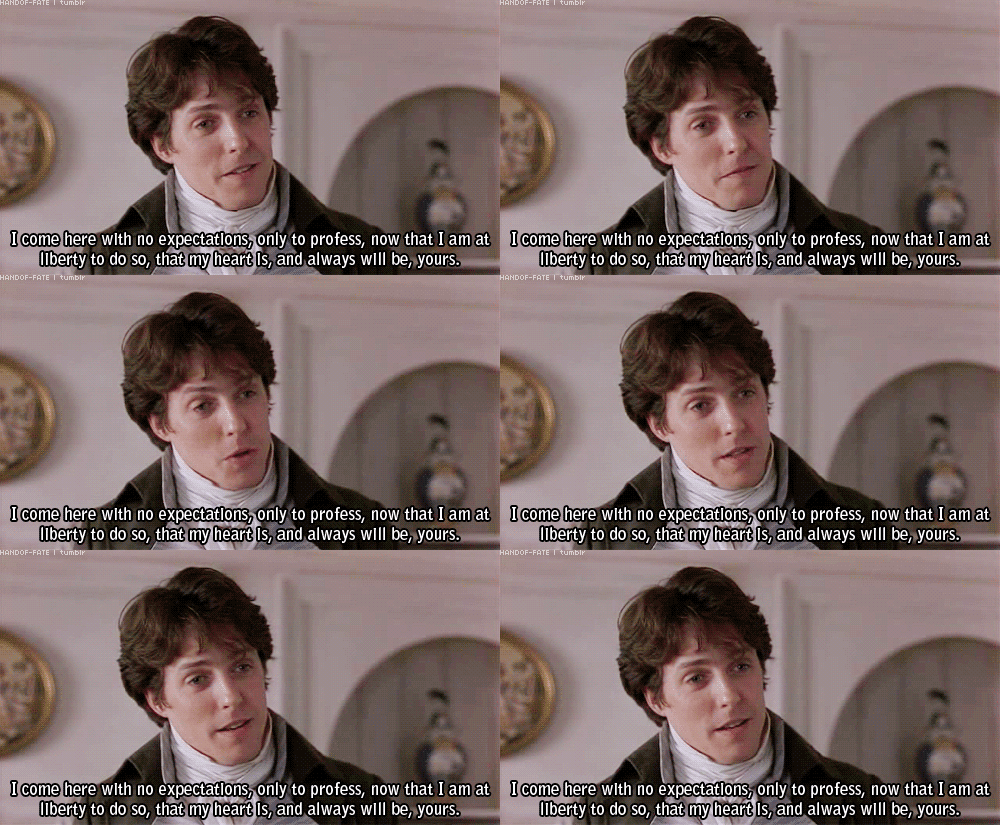
Reading ‘Pride and Prejudice’ or ‘Northanger Abbey’ from a young age are some of my fondest memories, as my childhood, teenage years and adulthood have been interlaced with Austen’s elegance, erudition and perception on romance. Her stories (read in books and watched on film in numerous adaptations) are as dear to me as history itself, for they speak of truth and are a perfect example of acute character-study. Austen understands people so well that regardless of whether it is 1800 or 2013, we are able to relate to her works and as a result can spot a Cornel Brandon or a Lizzie Bennett anywhere.
This beautiful, exquisite book is a delight to behold and is something that many an adoring fan of Jane Austen will treasure for all-time. This landmark biography reveals the woman behind her works, by painting a vivid picture of this iconic writer whose entire person has altered and defined our lives (for I cannot think of anyone who has not herd of Austen?!).
In this new biography, bestselling author Paula Byrne explores the forces that shaped the interior life of Britain’s most beloved novelist: her father’s religious faith, her mother’s aristocratic pedigree, her eldest brother’s adoption, her other brothers’ naval and military experiences, her relatives in the East and West Indies, her cousin who lived through the trauma of the French Revolution, the family’s amateur theatricals, the female novelists she admired, her residence in Bath, her love of the seaside, her travels around England and her long struggle to become a published author.
Byrne uses a highly innovative technique whereby each chapter begins from an object that conjures up a key moment or theme in Austen’s life and work—a silhouette, a vellum notebook, a topaz cross, a laptop writing box, a royalty cheque, a bathing machine, and many more. The woman who emerges in this biography is far tougher, more socially and politically aware, and altogether more modern than the conventional picture of ‘dear Aunt Jane’ would allow. Published to coincide with the bicentenary of Pride and Prejudice, this lively and scholarly biography brings Austen dazzlingly into the twenty-first century…
Utterly absorbing, vibrant and beautifully detailed this captivating, enchanting read is just wonderful and is something that certainly brought a sense of nostalgia to mind. Austen’s stories are so familiar to so many and if asked ‘do you think that he is like a Mr. Darcy or a Willoughby?’ most of us would be able to reply, but it does beg the question- what about Jane. This non-fiction narrative (that reads like a novel) is full of rich detail, extensive research and fascinating facts on a woman who captured the hearts of many and yet who remained unmarried herself. Highly readable, warm and witty this brilliant book is a must-read and one that I guarantee you will find incredibly hard to put down!!

July 11, 2021
Every scholar approaches their subject with their own interpretations and insights. There is always something new to learn about Jane Austen, no matter how many books I read about her. Byrne's book is interesting, and I had a good time reading it. She examines Austen through the perspective of real items that have had an impact on her life. Yes, the renowned amber cross given to her by her brother is one, as is her writing desk given to her by her father. Also included are the lace card her aunt was accused of stealing and the bathing machines Austen would have used while staying at her favorite oceanfront resorts. Each object represents a different part of Austen's life that is explored in the chapter.
Of particular interest are insights into Austen's novel Mansfield Park (which is really great timing for me because I joined the Mansfield Park read-along for the Jane Austen July Challenge).
Jane had visited the genuine Lord Mansfield's estate, where they had adopted a niece as their heir. Dido, the illegitimate daughter of Mansfield's nephew and an enslaved black woman, raised her. Byrnes delves into Jane's understanding of slavery through Mansfield, close and distant relatives, and her naval brother Franks' interception of slave ships and abolitionist ideas. Norris was also the name of a prominent slave dealer, thus the family name had implications.
Byrnes dissects the novel's plot's background as reflecting what was going on in Antigua, such as the dependency on slave labor, soil depletion, and simmering discontent. She observes that Fanny is the sole person who wishes to question Mr. Bertram about the slave trade.
I was one of those who liked Mansfield Park. The morally superior, powerless, and sensitive Fanny stood her ground, which impressed me. But I did not consider what Byrnes addresses: that the word 'home' was used 140 times in the novel. She asserts that the importance of home is a main theme. "Is it a place or is it a family?", she queries. One of the transformative events in my life was moving at age ten, leaving me homesick and forever wondering about true homes and the homes we make out of necessity.
We can only know Austen through her surviving letters, her novels, and one authenticated portrait--of her back. I appreciate Byrne's deep exploration of these sources which helps to further fill out our understanding of the 'real' Jane Austen.
Of particular interest are insights into Austen's novel Mansfield Park (which is really great timing for me because I joined the Mansfield Park read-along for the Jane Austen July Challenge).
Jane had visited the genuine Lord Mansfield's estate, where they had adopted a niece as their heir. Dido, the illegitimate daughter of Mansfield's nephew and an enslaved black woman, raised her. Byrnes delves into Jane's understanding of slavery through Mansfield, close and distant relatives, and her naval brother Franks' interception of slave ships and abolitionist ideas. Norris was also the name of a prominent slave dealer, thus the family name had implications.
Byrnes dissects the novel's plot's background as reflecting what was going on in Antigua, such as the dependency on slave labor, soil depletion, and simmering discontent. She observes that Fanny is the sole person who wishes to question Mr. Bertram about the slave trade.
I was one of those who liked Mansfield Park. The morally superior, powerless, and sensitive Fanny stood her ground, which impressed me. But I did not consider what Byrnes addresses: that the word 'home' was used 140 times in the novel. She asserts that the importance of home is a main theme. "Is it a place or is it a family?", she queries. One of the transformative events in my life was moving at age ten, leaving me homesick and forever wondering about true homes and the homes we make out of necessity.
We can only know Austen through her surviving letters, her novels, and one authenticated portrait--of her back. I appreciate Byrne's deep exploration of these sources which helps to further fill out our understanding of the 'real' Jane Austen.

February 10, 2014
I have never really been a big Austen fan, which along with my relative indifference to Shakespeare and Chaucer when I began my first degree reaaaally made other lit students look at me askance. I still think that those three are pushed upon us to a ridiculous degree, and often its not even their best work that is touted as The Book To Read (for example, I favour Troilus and Criseyde over The Canterbury Tales, and pretty much anything over Romeo and Juliet). But anyway, I've slowly come to appreciate them a little bit more, which will probably horrify my mother (at least where Austen is concerned). Sorry, Mum.
Paula Byrne's biography of Jane Austen is quite a common sense one. Instead of looking first to her fiction and then trying to extrapolate out to her life, it looks at the objects that surrounded her or inspired her and teases out things from there. I'm not really a scholar of the period in any sense, so I can't speak as to the accuracy of it, but it reads well and I appreciated this view of Jane Austen as a practical, witty and determined woman, fully supported by her family and with no doubts about her chosen course in life. It debunks ideas like the picture some people have of her being very sheltered and not in contact with the world, putting us in touch with the politics she would have been aware of and the places she went. It has some nice inserts with some of the objects mentioned pictured in colour.
I'm not keeping this book, but I'm certainly donating it to my library -- I know that someone who is more of an Austen fan than me will doubtless appreciate it even more, and I'm willing to bet there's a member of even our tiny little library who fits the bill.
Paula Byrne's biography of Jane Austen is quite a common sense one. Instead of looking first to her fiction and then trying to extrapolate out to her life, it looks at the objects that surrounded her or inspired her and teases out things from there. I'm not really a scholar of the period in any sense, so I can't speak as to the accuracy of it, but it reads well and I appreciated this view of Jane Austen as a practical, witty and determined woman, fully supported by her family and with no doubts about her chosen course in life. It debunks ideas like the picture some people have of her being very sheltered and not in contact with the world, putting us in touch with the politics she would have been aware of and the places she went. It has some nice inserts with some of the objects mentioned pictured in colour.
I'm not keeping this book, but I'm certainly donating it to my library -- I know that someone who is more of an Austen fan than me will doubtless appreciate it even more, and I'm willing to bet there's a member of even our tiny little library who fits the bill.

November 11, 2019
Very insightful and interesting biography. The author reveals Jane Austen's close family relations and her motivations, ambitions and determination as a writer. Excellent synopses of her novels and how her personal life influenced those novels.

August 3, 2022
An engaging biography, but not the best one to start with if looking for a chronological portrait of her life.

June 13, 2017
First of all, “The Real Jane Austen: A Life in Small Things” is a fascinating, well-written, and intriguing book, with a very few small problems.
Even so, I would never suggest Paula Byrnes book to someone who had not read at least one conventional biography of Jane Austen beforehand, just to to get a clearer chronological order of events. (See, strictly for an example, Jane Aiken Hodge’s “Only A Novel: The Double Life of Jane Austen,” which is from the point of view of an experienced novelist.)
This is not because Paula Byrnes’ biographical material is bad: It is very good, and produces evidence supporting some unusual positions about Jane Austen's life and characteristics, quoted from the letters and family documents. Some arguments rely heavily on other period documents, and reader may feel that the arguments are sometimes stretched thin: but they are at least interesting.
The problem for the novice would be that the book designedly is made up largely of fascinating “digressions,” which tend to overwhelm the main lines of Jane Austen’s life before the reader gets to the next milestone event.
While in more-or-less chronological order, the chapters are built up around physical objects surviving from Jane Austen’s life, her family, and contemporary events: manuscripts and printed books, a newspaper clipping, the cocked hat of a militia officer (a role filled by one of her brothers), Jane’s portable writing desk, etc. etc. (Hence the subtitle, “A Life in Small Things.”) The main objects are illustrated in attractive plates.
This is a technique which takes may take time to get used to, but which provides some interesting insights.
However, although the Author's Note refers to “plate sections throughout the book,” in the Kindle edition (at least) the plates are all gathered near the end, instead, which is reasonable; but in a section called, in the table of contents, simply "Insert," which is a bit opaque. (It took me a while to figure that one out.)
The plates, some of which, at least, can be expanded on a Kindle for closer inspection, should not be confused with the line drawings of the same subjects at the heads of chapters, which do save one from having to refer constantly to another part of the book (there are no hyperlinks to or from the plates).
The book is full of information about the Austen's relatives, friends, and neighbors (even some of their descendants), the city of Bath, London, theaters and plays Jane attended, or may have attended (when we have no surviving letters to tell us whether and what she saw), the careers of her brothers, places she visited and how they appear in the novels, etc.
In most biographies (that I have seen, at least), such topics usually are relegated to the notes, or are the subject of special studies, whether in academic journals or more popular books (such as Maggie Lane’s “Jane Austen and Food,” or John Mullan’s “What Matters in Jane Austen?: Twenty Crucial Puzzles Solved”).
Some of this information can be dug out of the notes in the long-standard “Oxford Edition of Jane Austen,” edited by R.W. Chapman in the 1920s, or B.C. Southam’s revision in the 1970s, but these are not usually ready to hand. Only part of the information appears in more popular annotated editions, such as those from Penguin or the Oxford World’s Classics. (The latter provided the base text for Byrne’s quotations from the novels.)
As with most Austen biographies, too, it is filled with spoilers: I would not suggest it to anyone who has not already read the novels (and probably the short “Lady Susan”). Besides giving away too much about the plots, some of the comments are going to be less than helpful to anyone who doesn’t know the fiction well enough to see the connection being made.
For example, it is especially good on the *very* complex background to "Mansfield Park,” picking up on allusions that would have been clearer to contemporaries, and showing where Jane Austen found realistic details for her descriptions of buildings and estates, the implications of characters’ and places’ names, and the like.
I'm not familiar enough with most of these topics to identify errors. However, Byrnes slips up at least once (or twice) in this same chapter. Rather than leaving this hanging as an unsubstantiated complaint, I will go into a little detail.
In the discussion of Jane's Naval brothers we are told that one of them (Charles) was awarded prize money for his heroic role in capturing an enemy ship (which relates to one of the characters in “Mansfield Park” receiving prize money from a capture).
I've read enough serious non-fiction about the Royal Navy in the Napoleonic wars to be aware that, according to law and regulations, prize money was allocated to a ship's company -- and the admiral commanding the fleet or station -- by rank. So far as I have ever been able to find out, *nothing* was drawn from the total to reward specific acts.
For one thing, such a practice would foster favoritism, and it would reduce, however slightly, the total to be divided among the others. Someone would be sure to consider it a grievance, something the system was supposed to eliminate.
Various “Patriotic Societies,” ship-owner’s associations, etc., did present expensive ceremonial swords, and the like, to officers they regarded as especially heroic, or to whom they were grateful, but this was not in the Admiralty’s control; and may have given rise to some hard feelings, anyway.
Since Byrnes acknowledges help from internet sites (including the ability to access scarce books from Jane Austen’s reading), it is a pity that she did not check Wikipedia’s article on Prize Money, describes the complex way that it was allocated by the Royal Navy, and follow up from there. (Or perhaps the article was not yet available; even so, a bit more research should have turned this up.)
This is, of course, not an issue vital to the book: but it will disturb some readers who (like me), are acquainted with the relevant history.
There is a problem in the same passage, concerning how the real and the fictitious prize money was spent, in life and in “Mansfield Park.” Unless the topaz crosses their brother Charles brought out of his prize money for his sisters Jane and Cassandra were also made in part of amber (as separators?), the book muddles them with the amber cross bought for the book’s heroine, Fanny Price, by *her* brother, referring to "beautiful amber crosses, made out of topaz." Or perhaps “amber” describes the color of the topaz, in which case it ought to have been made clearer.
All told, though, a very interesting book: one which I expect to read again.
Even so, I would never suggest Paula Byrnes book to someone who had not read at least one conventional biography of Jane Austen beforehand, just to to get a clearer chronological order of events. (See, strictly for an example, Jane Aiken Hodge’s “Only A Novel: The Double Life of Jane Austen,” which is from the point of view of an experienced novelist.)
This is not because Paula Byrnes’ biographical material is bad: It is very good, and produces evidence supporting some unusual positions about Jane Austen's life and characteristics, quoted from the letters and family documents. Some arguments rely heavily on other period documents, and reader may feel that the arguments are sometimes stretched thin: but they are at least interesting.
The problem for the novice would be that the book designedly is made up largely of fascinating “digressions,” which tend to overwhelm the main lines of Jane Austen’s life before the reader gets to the next milestone event.
While in more-or-less chronological order, the chapters are built up around physical objects surviving from Jane Austen’s life, her family, and contemporary events: manuscripts and printed books, a newspaper clipping, the cocked hat of a militia officer (a role filled by one of her brothers), Jane’s portable writing desk, etc. etc. (Hence the subtitle, “A Life in Small Things.”) The main objects are illustrated in attractive plates.
This is a technique which takes may take time to get used to, but which provides some interesting insights.
However, although the Author's Note refers to “plate sections throughout the book,” in the Kindle edition (at least) the plates are all gathered near the end, instead, which is reasonable; but in a section called, in the table of contents, simply "Insert," which is a bit opaque. (It took me a while to figure that one out.)
The plates, some of which, at least, can be expanded on a Kindle for closer inspection, should not be confused with the line drawings of the same subjects at the heads of chapters, which do save one from having to refer constantly to another part of the book (there are no hyperlinks to or from the plates).
The book is full of information about the Austen's relatives, friends, and neighbors (even some of their descendants), the city of Bath, London, theaters and plays Jane attended, or may have attended (when we have no surviving letters to tell us whether and what she saw), the careers of her brothers, places she visited and how they appear in the novels, etc.
In most biographies (that I have seen, at least), such topics usually are relegated to the notes, or are the subject of special studies, whether in academic journals or more popular books (such as Maggie Lane’s “Jane Austen and Food,” or John Mullan’s “What Matters in Jane Austen?: Twenty Crucial Puzzles Solved”).
Some of this information can be dug out of the notes in the long-standard “Oxford Edition of Jane Austen,” edited by R.W. Chapman in the 1920s, or B.C. Southam’s revision in the 1970s, but these are not usually ready to hand. Only part of the information appears in more popular annotated editions, such as those from Penguin or the Oxford World’s Classics. (The latter provided the base text for Byrne’s quotations from the novels.)
As with most Austen biographies, too, it is filled with spoilers: I would not suggest it to anyone who has not already read the novels (and probably the short “Lady Susan”). Besides giving away too much about the plots, some of the comments are going to be less than helpful to anyone who doesn’t know the fiction well enough to see the connection being made.
For example, it is especially good on the *very* complex background to "Mansfield Park,” picking up on allusions that would have been clearer to contemporaries, and showing where Jane Austen found realistic details for her descriptions of buildings and estates, the implications of characters’ and places’ names, and the like.
I'm not familiar enough with most of these topics to identify errors. However, Byrnes slips up at least once (or twice) in this same chapter. Rather than leaving this hanging as an unsubstantiated complaint, I will go into a little detail.
In the discussion of Jane's Naval brothers we are told that one of them (Charles) was awarded prize money for his heroic role in capturing an enemy ship (which relates to one of the characters in “Mansfield Park” receiving prize money from a capture).
I've read enough serious non-fiction about the Royal Navy in the Napoleonic wars to be aware that, according to law and regulations, prize money was allocated to a ship's company -- and the admiral commanding the fleet or station -- by rank. So far as I have ever been able to find out, *nothing* was drawn from the total to reward specific acts.
For one thing, such a practice would foster favoritism, and it would reduce, however slightly, the total to be divided among the others. Someone would be sure to consider it a grievance, something the system was supposed to eliminate.
Various “Patriotic Societies,” ship-owner’s associations, etc., did present expensive ceremonial swords, and the like, to officers they regarded as especially heroic, or to whom they were grateful, but this was not in the Admiralty’s control; and may have given rise to some hard feelings, anyway.
Since Byrnes acknowledges help from internet sites (including the ability to access scarce books from Jane Austen’s reading), it is a pity that she did not check Wikipedia’s article on Prize Money, describes the complex way that it was allocated by the Royal Navy, and follow up from there. (Or perhaps the article was not yet available; even so, a bit more research should have turned this up.)
This is, of course, not an issue vital to the book: but it will disturb some readers who (like me), are acquainted with the relevant history.
There is a problem in the same passage, concerning how the real and the fictitious prize money was spent, in life and in “Mansfield Park.” Unless the topaz crosses their brother Charles brought out of his prize money for his sisters Jane and Cassandra were also made in part of amber (as separators?), the book muddles them with the amber cross bought for the book’s heroine, Fanny Price, by *her* brother, referring to "beautiful amber crosses, made out of topaz." Or perhaps “amber” describes the color of the topaz, in which case it ought to have been made clearer.
All told, though, a very interesting book: one which I expect to read again.
September 25, 2020
Every scholar brings their own interpretations and insights to their subject. No matter how many books on Jane Austen I read, there is always something new to learn.
Byrne's book is entertaining and I enjoyed reading it. She considers Austen through the lens of physical objects that impacted her life. Yes, the famous amber cross gifted by her brother is one, and her writing desk gifted from her father. Also, the card of lace her aunt was accused of stealing and the bathing machines Austen would have used when staying at her beloved oceanside resorts. Each object is symbolic of an aspect of Austen's life discussed in the chapter.
Of particular interest are insights into Austen's novel Mansfield Park.
Jane had visited the estate of the real Lord Mansfield who adopted a niece to be their heir. She was raised with Dido, the illegitimate daughter of Mansfield's nephew and an enslaved black woman. Byrnes explores Jane's knowledge of slavery through Mansfield, close and distant relatives, and her naval brother Franks' interception of slave vessels and his abolitionist beliefs. The Norris family name also had associations, for it was the name of a notorious slave trader.
Byrnes dissects the background to the novel's plot as reflecting what was going on in Antigua, the reliance on slave labor, the depletion of the soil, and brewing unrest. She notes that Fanny is the only one who wished to ask Mr. Bertram about the slave trade.
After reading Sense and Sensibility and Pride and Prejudice, I was the only one of my university classmates who liked Mansfield Park. The morally superior, powerless, and sensitive Fanny stood her ground, which impressed me. But I did not consider what Byrnes addresses: that the word 'home' was used 140 times in the novel. She asserts that the importance of home is a main theme. "Is it a place or is it a family?", she queries. One of the transformative events in my life was moving at age ten, leaving me homesick and forever wondering about true homes and the homes we make out of necessity.
We can only know Austen through her surviving letters, her novels, and one authenticated portrait--of her back. I appreciate Byrnes deep exploration of these sources which helps to further fill out our understanding of the 'real' Jane Austen.
Byrne's book is entertaining and I enjoyed reading it. She considers Austen through the lens of physical objects that impacted her life. Yes, the famous amber cross gifted by her brother is one, and her writing desk gifted from her father. Also, the card of lace her aunt was accused of stealing and the bathing machines Austen would have used when staying at her beloved oceanside resorts. Each object is symbolic of an aspect of Austen's life discussed in the chapter.
Of particular interest are insights into Austen's novel Mansfield Park.
Jane had visited the estate of the real Lord Mansfield who adopted a niece to be their heir. She was raised with Dido, the illegitimate daughter of Mansfield's nephew and an enslaved black woman. Byrnes explores Jane's knowledge of slavery through Mansfield, close and distant relatives, and her naval brother Franks' interception of slave vessels and his abolitionist beliefs. The Norris family name also had associations, for it was the name of a notorious slave trader.
Byrnes dissects the background to the novel's plot as reflecting what was going on in Antigua, the reliance on slave labor, the depletion of the soil, and brewing unrest. She notes that Fanny is the only one who wished to ask Mr. Bertram about the slave trade.
After reading Sense and Sensibility and Pride and Prejudice, I was the only one of my university classmates who liked Mansfield Park. The morally superior, powerless, and sensitive Fanny stood her ground, which impressed me. But I did not consider what Byrnes addresses: that the word 'home' was used 140 times in the novel. She asserts that the importance of home is a main theme. "Is it a place or is it a family?", she queries. One of the transformative events in my life was moving at age ten, leaving me homesick and forever wondering about true homes and the homes we make out of necessity.
We can only know Austen through her surviving letters, her novels, and one authenticated portrait--of her back. I appreciate Byrnes deep exploration of these sources which helps to further fill out our understanding of the 'real' Jane Austen.

September 1, 2016
Μία εξαιρετική βιογραφία της Jane Austen που ακολουθεί μία πολύ ενδιαφέρουσα προσέγγιση. Αντί για μία κλασική βιογραφία που ακολουθεί το αντικείμενο της από τη γέννηση ως το θάνατο διαβάζουμε κάτι άλλο. Η συγγραφέας παίρνει αφορμή από διάφορα αντικείμενα, που πολλά από αυτά ανήκαν στην Jane Austen για να περιγράψει μία πτυχή της ζωής της αλλά και της συγγραφική της πορείας. Το αποτέλεσμα είναι είναι μια συγκινητική αφήγηση, με πολλές πληροφορίες που όμως δεν δυσκολευόμαστε να αφομοιώσουμε. Οπότε πρόκειται για ένα απαραίτητο ανάγνωσμα για αυτούς που θέλουν να μάθουν περισσότερα για αυτήν τη σπουδαία συγγραφέα.

October 25, 2013
This was a really enjoyable biography - such an excellent idea to have 18 chapters, each one beginning with an different object. This object (also photographed in colour) becomes the theme of the chapter, telling us more about Austen, her family and her life.
Byrne is at pains to shatter the myth of the lonely spinster never stirring far from home and unaware of the 'bigger picture' of her times. She produces plenty of evidence to show that not only was Austen well travelled, but her wide network of friends and relatives kept her well informed of events and happenings right across the world.
A family tree would have been invaluable!
Byrne is at pains to shatter the myth of the lonely spinster never stirring far from home and unaware of the 'bigger picture' of her times. She produces plenty of evidence to show that not only was Austen well travelled, but her wide network of friends and relatives kept her well informed of events and happenings right across the world.
A family tree would have been invaluable!

January 25, 2018
Have been savouring this book over the last month or two and was so sad when it came to an end. It's so special, giving intimate details of Jane Austen's life that I had not read elsewhere. I feel like I know the person, the author, the sister so much better now. I loved, loved it.
July 5, 2022
4 stars. Read for the Jane Austen July 2022 challenge - Read a non-fiction work about Jane Austen or her time. I found this to be very intriguing. I love learning new things about Jane Austen and this one definitely had some interesting and new to me tidbits which was fun. I liked the writing style and found it engaging and easy to get into. There was also a lot of cool pictures in this and really added to the reading experience. I’d recommend this for any Austen fan. It’s a pretty fascinating read.

July 26, 2023
Possibly the best Jane Austen biography I have read. The non-chronological structure made it exciting and engaging to read and Byrne's research made the overall reading experience incredible. Because of the structure, this shouldn't be the first Jane Austen biography you read - I would recommend Jane Austen at Home by Lucy Worsley as your first.

August 2, 2013
This new book uses ordinary objects from Jane Austen's life to examine the famous author's life and times. Paula Byrne seeks to show that Jane Austen was far more than the demure spinster aunt her family portrayed her in the Victorian era. Instead of a life limited to "Three or four families in a country village," Jane Austen had a wider range of experiences that influenced her writing. Each chapter revolves around one particular object and shows how that object fit into Jane Austen's life. Paula Byrne quotes extensively from Austen family letters, novels (Jane wasn't the only novelist in the family), period book reviews and other primary sources as well as biographies and travel books. This book paints a picture of a woman who lived a rich life. Through her family, neighbors, friends and visits, Jane Austen obtained a wide knowledge of the world. She developed her sly wit early on with the influence of her literary family, she enjoyed fame when it finally arrived and she loved the money that she earned from her writing. In contrast to being depressed and unproductive during her Bath years, Paula Byrne argues that Jane was busy socializing, shopping, waiting for Susan to be published, writing The Watsons and revision First Impressions and Elinor and Marianne. This statement is a bit controversial but it makes a lot of sense given the evidence provided. I'm inclined to agree that Bath was a productive time for Jane Austen.
Paula Byrne also speculates on the identity of the sitter of a portrait she believes could be Jane Austen. The portrait has caused a lot of uproar in the Jane Austen community. Byrne states there is evidence that the portrait is authentic to the time period and the woman looks very similar to the known portraits of the Austen men. I agree that it looks like it could be an Austen, but my personal opinion, knowing nothing about art, is that perhaps the face was done while Jane Austen sat and the rest was filled in later and or the portrait was done from memory. In the epilogue, Byrne admits that we will never know Jane Austen because she never showed her true face to the world. The only known true portrait of her shows her with her back to the viewer. Even Cassandra's famed watercolor is not said to be a true likeness.
Some of this book is biography but in places it is also a social history, examining the world in which Jane Austen lived. It's also literary criticism. The author makes some bold statements such as Tom Bertram was homosexual and Jane Austen understood she was making witty jokes in Mansfield Park (Mary Crawford's quip about "Rears and Vices" was intended as a double entendre). Byrne also can't tell the difference between Charlotte and Emily Bronte but her conclusion about the country house as a setting is valid.
Some of the chapters went off on tangents about distant relatives, distant connections and so forth. I needed a family tree to keep them all straight. Those parts really dragged for me and made the book less interesting. It seemed like the author was reaching to make a connection between Jane Austen and that object when there really wasn't a good one.
This is a long book but it can be picked up and read a little at a time, out of order or in order, however the reader wishes. It took me (a fast reader) two weeks to read it a little at a time. I've read many biographies and Jane Austen blogs so not all the information was new to me, but I really liked the way it was presented and I learned a lot from it. This volume is a good addition to any serious scholar's library and worth a read for everyone who loves Jane Austen and her time period.
Paula Byrne also speculates on the identity of the sitter of a portrait she believes could be Jane Austen. The portrait has caused a lot of uproar in the Jane Austen community. Byrne states there is evidence that the portrait is authentic to the time period and the woman looks very similar to the known portraits of the Austen men. I agree that it looks like it could be an Austen, but my personal opinion, knowing nothing about art, is that perhaps the face was done while Jane Austen sat and the rest was filled in later and or the portrait was done from memory. In the epilogue, Byrne admits that we will never know Jane Austen because she never showed her true face to the world. The only known true portrait of her shows her with her back to the viewer. Even Cassandra's famed watercolor is not said to be a true likeness.
Some of this book is biography but in places it is also a social history, examining the world in which Jane Austen lived. It's also literary criticism. The author makes some bold statements such as Tom Bertram was homosexual and Jane Austen understood she was making witty jokes in Mansfield Park (Mary Crawford's quip about "Rears and Vices" was intended as a double entendre). Byrne also can't tell the difference between Charlotte and Emily Bronte but her conclusion about the country house as a setting is valid.
Some of the chapters went off on tangents about distant relatives, distant connections and so forth. I needed a family tree to keep them all straight. Those parts really dragged for me and made the book less interesting. It seemed like the author was reaching to make a connection between Jane Austen and that object when there really wasn't a good one.
This is a long book but it can be picked up and read a little at a time, out of order or in order, however the reader wishes. It took me (a fast reader) two weeks to read it a little at a time. I've read many biographies and Jane Austen blogs so not all the information was new to me, but I really liked the way it was presented and I learned a lot from it. This volume is a good addition to any serious scholar's library and worth a read for everyone who loves Jane Austen and her time period.

November 6, 2020
MooWhile there are a many things to like about this particular biography there is sufficient reason to doubt its reliability. The book is set up with each chapter focusing on a particular item of significance as it related to Ms. Austen. Some chapters were superb as there was little doubt the author was accurate with her assertions. For instance, chapter 14 revolves around two topaz crosses purchased by Charles Austen and gifted to his sisters Jane and Cassandra. The author then goes on to touch briefly on navy and military life, the wars her brothers fought in and it's affect on Jane's home life, and how it "inspired" or at least gave her significant knowledge to write her own naval and military characters with accuracy.
Unfortunately, much of the book is taken up with information that only barely touches on Jane Austen's life directly. I can't entirely fault the author because so little is know about Jane Austen's life that it must be incredibly difficult to know anything for certain. The true issue with this work of nonfiction is in the amount of fiction it seems to contain. Chapter 16 is entirely based on a personal lap desk wittily referred to as "the laptop". At the beginning of the chapter the author states "Given the timing, it is PROBABLE (sic) that it was intended as a present for his daughter Jane's nineteenth birthday." Ok, that is somewhat reasonable but in no way is it the only logical explanation. Then the reader turns the page and the author has suddenly decided to accept that the only explanation is that that lap desk was for Jane Austen and treats it as a fact. "The nineteenth-birthday present was highly significant to Jane Austen. It was a symbol of her father's faith in her and his encouragement of her writing."
Was it? Are you sure? Because less than a page ago it was merely probable and now it is fact and has come to represent her relationship with her father and his faith in her as a writer! WHAT?!! Then in the final chapter the author states "She would have had no way of knowing Addison's Disease, from which she was probably suffering, appears to be linked to specifically to stress." Alright, again the author claims it was probable. Then we read down a paragraph and "...seems to have precipitated her Addison's. If her second Addison's crisis was the family's..." She took the very much debated idea of Jane Austen dying from Addison's and ran crazy with it! All of the sudden we are drug back in history and every time Jane Austen suffered from stress we are shown "proof" she suffered physical affects and from there it is a forgone conclusion is was Addison's Disease. Very frustrating!
How can a reader trust anything an author present as nonfiction when the author herself can't seem to tell the difference between nonfiction and fiction. Maybe the author was trying to inform the reader of what such a gift from her father would have likely meant to the young Jane Austen and how if she had Addison's her stressful life as a poor dependent relation would have made her incredibly ill, but she dropped them ball when she continued to mix her hypotheticals with facts!
3.5 stars because I was entertained and I learned a lot about Jane Austen's family, friends, travels and Goergian and Regency life in general. I would recommend this book to others with the caveat that I'm not sure how accurate the author's information is and that's really sad for a biography.
Unfortunately, much of the book is taken up with information that only barely touches on Jane Austen's life directly. I can't entirely fault the author because so little is know about Jane Austen's life that it must be incredibly difficult to know anything for certain. The true issue with this work of nonfiction is in the amount of fiction it seems to contain. Chapter 16 is entirely based on a personal lap desk wittily referred to as "the laptop". At the beginning of the chapter the author states "Given the timing, it is PROBABLE (sic) that it was intended as a present for his daughter Jane's nineteenth birthday." Ok, that is somewhat reasonable but in no way is it the only logical explanation. Then the reader turns the page and the author has suddenly decided to accept that the only explanation is that that lap desk was for Jane Austen and treats it as a fact. "The nineteenth-birthday present was highly significant to Jane Austen. It was a symbol of her father's faith in her and his encouragement of her writing."
Was it? Are you sure? Because less than a page ago it was merely probable and now it is fact and has come to represent her relationship with her father and his faith in her as a writer! WHAT?!! Then in the final chapter the author states "She would have had no way of knowing Addison's Disease, from which she was probably suffering, appears to be linked to specifically to stress." Alright, again the author claims it was probable. Then we read down a paragraph and "...seems to have precipitated her Addison's. If her second Addison's crisis was the family's..." She took the very much debated idea of Jane Austen dying from Addison's and ran crazy with it! All of the sudden we are drug back in history and every time Jane Austen suffered from stress we are shown "proof" she suffered physical affects and from there it is a forgone conclusion is was Addison's Disease. Very frustrating!
How can a reader trust anything an author present as nonfiction when the author herself can't seem to tell the difference between nonfiction and fiction. Maybe the author was trying to inform the reader of what such a gift from her father would have likely meant to the young Jane Austen and how if she had Addison's her stressful life as a poor dependent relation would have made her incredibly ill, but she dropped them ball when she continued to mix her hypotheticals with facts!
3.5 stars because I was entertained and I learned a lot about Jane Austen's family, friends, travels and Goergian and Regency life in general. I would recommend this book to others with the caveat that I'm not sure how accurate the author's information is and that's really sad for a biography.

July 9, 2015
Very original and interesting biography ! I couldn't put it down. Presents Austen as the total bad ass I can guarantee she was along with the dysfunctional, intelligent, close-knit family of which she was a part! Inspiring woman and writer!

January 14, 2013
From BBC Radio 4 - Book of the Week
Paula Byrne explores the forces that shaped the interior life of the popular novelist
Paula Byrne explores the forces that shaped the interior life of the popular novelist
May 18, 2026
3.5 stars
The author organised the book thematically and so every chapter focuses on one object in Jane Austen’s life, with relevant details of Austen’s life and times being explored.
I don’t this is a good way of organising a biography. It can be confusing to read at times. The author seems to assume that her readers are all familiar with Austen’s family and relations and social background.
The book did explore things I didn’t know about Austen. Her family’s connection with the British Empire and its colonial history surprised me. I also like that Austen’s attempt to get published and her communication with her publishers were thoroughly depicted.
Overall, it is a biography worth reading if you wish to know more about Austen and her times, but I would recommend reading some other JA biographies before coming to this one.
The author organised the book thematically and so every chapter focuses on one object in Jane Austen’s life, with relevant details of Austen’s life and times being explored.
I don’t this is a good way of organising a biography. It can be confusing to read at times. The author seems to assume that her readers are all familiar with Austen’s family and relations and social background.
The book did explore things I didn’t know about Austen. Her family’s connection with the British Empire and its colonial history surprised me. I also like that Austen’s attempt to get published and her communication with her publishers were thoroughly depicted.
Overall, it is a biography worth reading if you wish to know more about Austen and her times, but I would recommend reading some other JA biographies before coming to this one.
December 26, 2016
I'm glad to have read a biography of one of my favorite authors, Jane Austen, especially one that contains many pieces of her personal writings in the form of letters and journals. The book was clearly well research (and annotated and cited, too) and there was an abundance of tie-ins from Austen's life to the lives of her characters in her books. I don't know why her family said that she did't want people to know she was the author of her books, or that she didn't insert any people she was acquainted with in real life into her books. Austen was a rather vivacious and intelligent woman and, like most excellent authors, she drew her material from what and who she knew best and used that as an outline for something greater.
About the actual biography I have only one chief complaints: that it seemed rather lengthy and didn't really grip my attention in some spots. But I made it through and that is that. I was also pleased that there were sketches, black and white photographs, and color photographs throughout the book. And who can resist adding a u into words to transform them from something colorful to something colourful?
Displaying 1 - 30 of 454 reviews