What do you think?
Rate this book


368 pages, Paperback
First published January 1, 1989
“The ceremonial designed for the court of Spain by Charles V was well calculated to make kingship at once impressive and remote. The effect of Philip II’s adoption and adaptation of that ceremonial was to make it impressive but withdrawn. Charles, with his peripatetic court, combined grandeur with a high degree of visibility. Philip, in settling his court and government in Madrid in 1561, reduced the degree of visibility by withdrawing himself geographically to a central location in Castile. But the process of withdrawal was more than merely geographical. Philip also engaged in what might be described as a psychological withdrawal, as he moulded Spanish kingship to the forms of his own temperament and style of life. The muted style of the court under Philip II, underlined by the gravity of the king’s deportment and the sobriety of his dress, found an appropriate embodiment in that mausoleum of monarchy, the Escorial.” ~Chapter VII: The Court of the Spanish Habsburgs, page 154.
“Not surprisingly, the frozen ritual of Spanish court etiquette was also reflected in the deportment of the king. Foreign observers were struck by his impassivity. Philip IV was described by Francois Bertaut in 1659 as a ‘statue’. The pattern of a royal audience was always the same. Those admitted to the king’s presence would invariably find him arrimado a un bufete — standing at a console table — as they entered the audience chamber. He would raise his hat as they came in, and then stand motionless throughout the audience. The studiously non-committal remark that closed the audience at least indicated that the statue talked.” ~Chapter VII: The Court of the Spanish Habsburgs, page 150.
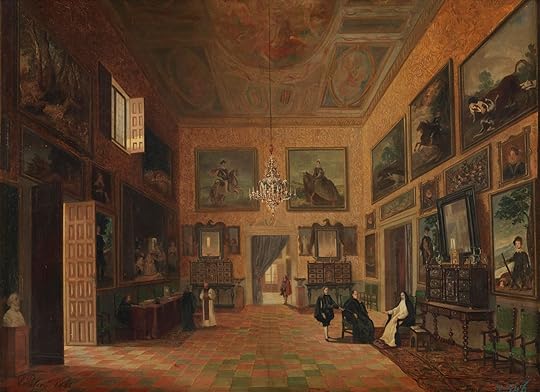
The Chamber of Felipe IV (Philip IV) in the Buen Retiro Royal Palace by Vicente Poleró y Toledo