Geographer Danny Dorling tells the stories of the people who live along the 32 stops of the Central Line to illustrate the extent and impact of inequality in Britain today - part of a series of twelve books tied to the twelve lines of the London Underground.
Like the trace of a heartbeat on a cardiac monitor, the Central Line slowly falls south through west London, rises gently through the centre and then flicks up north through the east end of the capital. At the start of the journey life expectancy falls by two months a minute. Between the first four stations every second spent moving on the train is exactly a day off their lives in terms of how long people living beside the tracks can expect to live. By telling the personal stories of the very different people who live along the Central Line, the people who really make up The 32 Stops, geographer Danny Dorling explores the class and wealth divides that define our lives. His work shows the widening gap between rich and poor in the UK, and how where you live determines so much about your chances in life.
Danny Dorling is a British social geographer researching inequality and human geography. He is the Halford Mackinder Professor of Geography of the School of Geography and the Environment of the University of Oxford.
Danny Dorling has lived all his life in England. To try to counter his myopic world view, in 2006, Danny started working with a group of researchers on a project to remap the world (www.worldmapper.org). He has published with many colleagues more than a dozen books on issues related to social inequalities in Britain and several hundred journal papers. Much of this work is available open access and will be added to this website soon.
His work concerns issues of housing, health, employment, education and poverty. Danny was employed as a play-worker in children’s summer play-schemes. He learnt the ethos of pre-school education where the underlying rationale was that playing is learning for living. He tries not to forget this. He is an Academician of the Academy of the Learned Societies in the Social Sciences, Honorary President of the Society of Cartographers and a patron of Roadpeace, the national charity for road crash victims.
A story told through statistics, linked to each stop on a London Tube line. That’s The 32 Stops in one sentence. But as boring as that may seem, it definitely isn’t. I think it’s a great way to talk about statistics, and to demonstrate the inequality of different areas in Britain. It looks at crime rates, GCSE scores, income and percentage of children living below the poverty line. In the space of a minute or two of travel, life expectancy and income can change dramatically.
The story of the Central Line is told over one Saturday, with a vignette for each stop. Interestingly, the western and eastern points are quite similar demographically. In between, it’s a mix from the very rich (hello Bank) to the very poor. Incomes, education and ethnicities all change on that one trip. In some places, you might be more likely to end up in prison. In others, your GCSE might be higher. Some areas have a higher number of rich immigrants. Some have great-grandmothers in their fifties. There is an incredible range here, from the expensive apartments to the council housing. Danny Dorling is well appointed to tell the reader the story, being a professor of social science and having published on the inequalities of those in England. The way he knits together the tables of statistics and makes them into little stories of nameless people (some who fit the average and some who are on the ends of the bell curve) really brings the numbers to life. (Plus, if you’re interested in the data, the book is extensively referenced…must read some of those ward newsletters one day).
It’s a quirky idea and may not fit everyone’s tastes. I thought it was a great taster in social geography as well as giving some eye-opening facts in an open way and linking it to people you might see in your travels. (Not to mention the dinner party useless fact that most bankers do live in Bank).
Danny Dorling, a social geographer, takes a journey on a stretch of the Central Line, comparing key social characteristics as he takes us eastwards from Ruislip. Each stop is made human with a little fictional vignette, designed to illustrate a number of social values, status, demographic and circumstances. These little illustrations suffer from being a little leaden and from rather wooden dialogue, but I absolutely get why he chose to do them, to present the relevant statistics in this very accessible way. And the statistics hold the show: differences in life expectancy, and other life chances, drawn in the seconds, minutes or number of stops between stations on that line are stark, damning. It's a slender tome, an engaging, uncomplicated read with a very accessible set of end notes for references; and illustrated throughout by bar charts drawn from his early co-produced work mapping London characteristics.
I'm (seemingly endlessly) fascinated by London - how its defined, its past and its future. I love the city and the suburbs, and I love the Underground. I just spent a weekend going from Ruislip, where I live, to Waterloo, to Crystal Palace and Anerley (where my friend lives), then the next day to Brixton, before going to the South Bank and coming back to my north-west outer London suburb for tea and sleep.
My reading on the tube journeys this weekend was The 32 Stops, which is a book published as part of the Underground's 150th anniversary. It takes the form of vignettes that explore the socio-economic factors in each place along the Central Line's London stops. The disparity in life expectancy, weekly income, GCSE results and so on, even from one stop to another (look at the difference in life expectancy between Holborn and Chancery Lane for example, or the level of children in poverty in White City) is perhaps the biggest take-home message for me.
It made me grateful for the boring, average bit of London I can call mine.
I see people moaning about uninspired writing here. Well, this is different from the other books in the series. 'Hard facts' don't easily translate into stories we can identify with, but Dorling at least tries. Thumbs up for that. It's never a bad idea to try to open people's eyes to class differences that always seem to be just around the corner in London.
I read a whole ass non fiction book!! Does this make me a real person? I say that, but this is a book that highlights the inequalities throughout London through different narratives (so it’s not really big grown up non fiction). It was very readable and I felt very respectable reading it on the underground and all. I think it is very cleverly written as it emphasises just how far apart the richest and poorest groups are in London in terms of wealth by how close they are in terms of geography. The way that Dorling relates every change back to how far away (in minutes in the tube) it is from the last place is very clever and puts everything into very graspable perspective. Often talking about distance doesn’t mean much but by tube journeys is very impactful I think it’s just such a good idea. If you live in this London this book will resonate with you in some way. On the writing again - I love how each ‘chapter’ starts with the next household talking about something that the previous one was discussing but in a new light, under new circumstances. I read this book because I’m supposed to do a presentation on it in school for my personal statement so I chose it off of the list. I’m glad I did though because it’s good to read non fiction every now and again (sounding like my dad) - It makes you think more and that’s never a bad thing. One thing that this book didn’t have was any mention of solutions for the problems mentioned. I did get the vibe that wasn’t the point of the book tho. It seemed to just highlight what it’s like to live in areas. It’s about people and experiences which is just as important as numbers. But we still need solutions guys!! Another small criticism I have is that I’m very aware of the fact that it only mentions the experience of one household per area and it is important to recognise the diversity even within the smaller areas - obviously you can’t get this all down in a short book so I don’t think this takes away from it, it’s just something to consider when reading.
This was fairly readable which was a relief given it was written by an academic (although he appears to have written several books) but it did feature one of my least favourite characters, or rather about 32 of them: the statistical composite.
The concept worked, of very small scenarios for the type of person that lived near each station on the main section of the Central Line, omitting many of the Essex ones. The idea was to show the differences between neighbourhoods and their demographics, including education, income and life expectancy. It was illustrative, but you always knew the people were stereotypes, however based in fact they were. There were the middle-class parents obsessed with schools, the rich people who just wanted to get rid of the poor people to somewhere else, and the elderly woman living on her own who killed herself after being unable to cope in a changing neighbourhood.
There were some bits of trivia that were new, and the contrast between neighbouring wards was often interesting - but it was easy to tell that these weren't real people and the author didn't hide his politics, so it was a bit like a Guardian feature linked to, but not quoting, real testimony. But at other times your were reading caricatures of people who fitted the profile you'd expect to live in certain areas. It wasn't bad, but I'm not sure what it was for.
Information and the London Underground,my two favourite things mixed together! I liked how the two were weaved together, although the charts were a bit too cumbersome to read. Still it was an adequate companion on the bus and provided me with several insights into the development of the Central Line running through the heart of London. It is something that is formative for the city and extends beyond it. It was quick to read and quite digestible, as well as introducing me to the series.
Highlights poverty and inequality in a developed country. Humanises it by telling us the wants, needs and dreams of people in deprived places shows us that we are very similar to everyone else. Shows the importance of ironing out social inequality as people are dying much sooner we than they should.
This was actually a really good read! I got told to read this for help with my A-Level geography coursework and surprisingly enjoyed reading this! I loved how Danny Dorling mixed fiction with actual statistics, making the book more interesting to me.
a very readable, interesting and subtle illustration of inequality through snapshots of life at every stop of the central line - very cool concept and made the geographer in me happy
This is the second of the two books I bought from Penguin's set of twelve celebrating 150 years of London Underground. They're pretty little things. The other one I bought was A History of Captalism According to the Jubilee Line, which I very much enjoyed.
The 32 Stops is based around an unusual concept. Dorling takes you on a journey from west to east along the Central Line, but without actually descending underground; instead he character-hops a waking day at half-hourly intervals, giving you a few minutes with each person.
This he does using a wealth of real-life sources and statistics to present a snapshot of what life is actually like for people living beside that part of the Line. It's fact-based fiction as social commentary, played out along one of the city's main arteries.
It's an ingenious way of communicating a selection of socioeconomic statistics. I like a good geek out as much as the next blogger, but this is the first time I've ever put a book on this sort of stuff to the top of my reading list. A clever ploy.
And Dorling does a surprisingly good job of giving each new character or set of characters fairly unique circumstances. He is a Professor after all, not a novelist, and his characterisation is admirable, even if the writing itself is just a touch clunky at times.
It does get a little bit samey after a while though, as each inhabitation is too brief to delve deeply into the individual's circumstances. Wisely there's a non-fictional recap every four stops or so to tie together the disparate tales into a coherent thread, but it's still only a surface glimpse of the different layers.
Another minor complaint is that I found Dorling's politics took ever so slightly too forward a seat: the characters on the less enviable sides of the median lines are much more sympathetic than those on the other sides. That might be inevitable - I don't know how I would go about instilling sympathy for a dozen different well-to-do characters; you can't give them all cancer - but it was a weakness for me all the same.
(I suppose it's predictable that Dorling would be a lefty. I wonder whether there are any conservative 'quantitative social geographers' out there?)
It's also a surprisingly depressing read. Real life, with its massive inequality and commonplace deprivation, dictates that many of the characters will be in difficult circumstances, but the bleakness is fairly unrelenting. Dorling also adds a further layer of complexity to the book by incrementally increasing the characters' age at each stop, so that a lifetime as well as a day is experienced across the journey as a whole. Although this is again ingenious, it amounts to an inexorable ride towards death through a multitude of lives filled with little more than constant worries about money and children. That is, it's a bit too realistic to be enjoyable as well as informative.
Still, overall The 32 Stops is an impressive accomplishment, and a credit to Penguin's bravery and powers of selection.
As I said, it's a lovely volume, but in case you don't like to fill your shelves with things both lovely and edifying, the thorough and at times rather witty notes include a link to a website currently under construction that looks as though it will soon provide an equivalent experience online. It too is already looking very snazzy:
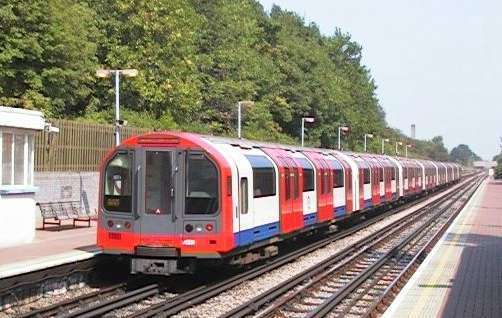
The Central Line, as its name implies, cuts through the heart of central London, traveling from West Ruislip station in Hillingdon eastward to its terminus at Epping station in Essex. It passes through several key junctions with other lines en route, particularly those at Oxford Circus, Tottenham Court Road, Holborn, Bank and Stratford stations. It is the longest Underground line, as the journey from West Ruislip to Epping is nearly 55 kilometers (just over 34 miles), and it serves over 260 million passengers every year. Service between the Shepherd's Bush and Bank Stations began in 1900, and the line was lengthened considerably in the years following World War II.
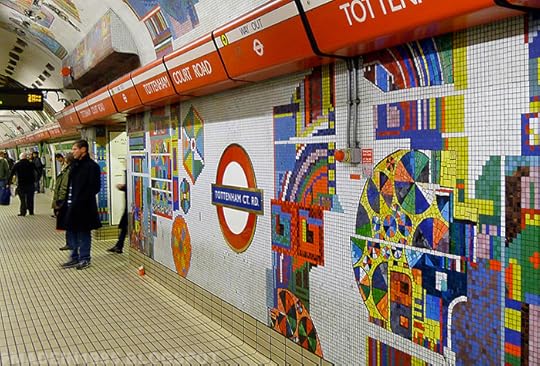
Mosaic tiles in Tottenham Court Road station
Danny Dorling, a professor of human geography at the University of Sheffield, has written widely on social inequalities in England. In [The 32 Stops: The Central Line], he applies that topic by comparing and contrasting the average General Certificate of Secondary Education (GCSE) scores, life expectancies, percentage of children in poverty, household incomes, etc. of the residents who live in the neighborhoods served by 32 of the 49 stops on the Central Line. Each station includes a brief narrative about a typical person or family that lives there, which is interspersed by the author's descriptions of the differences and similarities of those who live from one station to the next, which are enhanced by graphs and charts.
Although I applaud Dorling's work in elucidating the human geography of the Londoners who live alongside the Central Line, I did not enjoy reading this book. The narratives felt contrived and quickly became tiresome to read, especially when the characters began to quote statistics that enhanced Dorling's points but seemed forced and surreal. Other than very brief descriptions at the beginning and end of the book there was no discussion of the Central Line itself, which made this a very dry and tasteless read.
"At the start of the journey, life expectancy falls by two months a minute", writer Danny Dorling states near to the start of his book, referring to the districts that you will pass through if you are travelling west on London's Central line from its western terminus.
This book revolves entirely around demographic and statistical information for areas of London located on the Central Line, talking at length about life expectancy, number of children living in poverty and average exam results. However, instead of just being in the form of an essay, the information is presented as a series of Vignettes about (evidently fictional) people living in varying conditions across London.
At first, I wasn't too impressed; each of the stories that featured in the book seemed to be about families arguing about things that I thought no one in real life would spend much time talking about, but after a while I started to enjoy the vivid way that life across London was portrayed, and how one group of residents can be rich and living in luxury, while people close by are living almost in squalor. The narrative style put me in mind of Michael Moorcock's Mother London, except set in modern times.
Politics are a strong influence on the entire book, and at some point it feels at though the writer is getting up on his soapbox, but throughout you can tell that a lot of research has been carried out, and there is an almost obsessive attention to detail regarding statistics.
Overall, I thought this was an okay book; it's probably not something that a lot of people would read for pleasure though.
This is the one in the Penguin Lines / 150th anniversary of the London Underground series that most jumped out at me - Danny Dorling being the social economist fellah who has a great gift for using data to shame the arse off the social-solidarity-free British voter. Plus I saw him speak at a company event once and his speech, uniquely for that setting, included a number of genuinely meaningful thoughts.
There's the bones here of something almost...well, literary too (the imagined specimen characters). In fact it's probably a better job than the fabled 90's sort of 2.0 tube novel '253' by Geoff Ryman (which I own, but have never got down to reading because it really does just look like a folder of one page biographies of made-up-people - whereas this is grounded in the statistics, yeah).
"London's most striking line, the red one, the one that looks like a heartbeat." - Central Line
I read the book as a tribute to London tube which has served locals and tourists for 150th years. The book contains fictional elements but they are all based on statistics and data. It's a unique and interesting approach to look at the tube and the social topography along the line.
As a tourist, I only managed to see the glamourous side and perhaps the less glamorous side superficially. Yet, the book shows me a lot more - a complex and multi-faceted greater London and its population.
I truely believe that next time when I visit London and travel along Central Line, I will have a totally different experience.
What statistics on London! The average life expectancy drops with 10 years if you travel for a few minutes. A lot of bankers do live around the Bank subway station. An average income differs huge amounts depending on where you live (surprise, surprise).
All in all, this is a very lubricated experiment in mixing factual numbers with fiction, and the outcome is sublime, chocking and very intelligently written about sociology, everyday life, crime, monetary factors, family life and all else that permeates the modern person when it comes to numbers and living. It's a lot better than I make it out to be.
I really enjoyed this book, much to my surprise. I don't usually read a lot of non-fiction, and certainly not Geography! But this book gripped me when I casually picked it up from our shelves. Starting at one end of the Central Line, it tells the story of a fictional typical character from that stop, using geographical and statistical information. It is a fascinating story of how school grades fall and rise through the stops, life expectancy and crime rates, and other factors. The story takes places throughout one day and many different protagonists. A short read, with links to all the statistical data to back up what he says, but nevertheless never dry or boring. Recommended!
Uninspired writing, despite superficially interesting idea of quality of life indicators dipping and rising like a roller-coaster across London's variegated social landscape. Yes, in some parts of London the average life expectancy of local residents dips by a year for every minute of travel along the line, etc...but so what? That doesn't really tell us anything novel about London itself.
Primarily useful for the links to quantitative census data fuelling Dorling's ongoing study of changing patterns of inequality in London.
A short piece from Danny Dorling as part of a series for 150 years of the tube. It uses the Central Line as a thread to link some social geography with a short fact packed entry for each station. I felt a little swindled as while I used to live in the area covered by the book I have now drifted out to a section beyond the edge of london and therefore outside of the text. This probably makes me fairly stypical in some ways!
Sure, it is a bunch of statistics dressed up as short stories, but that does not make the book any less interesting. The landscape of London may be almost flat, but look at the numbers per ward for average income and life expectancy etc. and it is more like the Alps. The little stories make these numbers less abstract. In that the book has achieved its goal.
It also makes me want to visit the city to see these places for myself.
As with any decent writings on current social and political issues, this is a great read but pretty grim - invaluable nonetheless. The writing style is ingenious, using short sequential narrative segments to illustrate the issues at hand (poverty and social mobility), and particularly clever is how they all link up to each other not just as stops on a line - give it a read and you'll see what I mean.
An interesting dip into a discipline I wouldn't generally dip into and good to see London from a different perspective. I think I would have liked to have read more personal stories, true to life rather than based on statistics, but was quite interesting reading while actually travelling on the Eastern section of the Central Line. Will definitely pass this on to my husband!
Do persevere with this slim volume because it offers plenty to think about. However, the task of communicating inequality could have been done a little better than just making the characters speak the statistics of their area. It's unrealistic and tires quickly. You can sense the author trying to find new ways to cover the same ground having committed himself to covering 32 stops.
Celebrating 150 years London Underground train system, Penguin commissioned some authors to write a book about the separate lines. Growing up in Bethnal Green on the Central Line I decided to read this one. It was quite interesting, taking one London station after the other, and naturally for me familiar territory. I enjoyed the little book very much.
"At the start of the journey life expectancy falls by two months a minute" across the 32 stops in London the Central Line subway makes. This books is Dorling's sociological study of the vast disparities of wealth, health, education, opportunities, and general quality of life encompassed by that short trip, stop by stop.
A snapshot of London is given through data and imagined examples of possible people and types living along the central line. One thing about this book is that it gets you to think about your journey to work more and think about inequality, education, housing etc as you progress along the journey.
Got more interesting as it went on--a mixture of Fiction and Non Fiction. I think it would be more interesting to readers who live in the south east and have travelled on the Central line. Lots of interesting statistics.