

What do you think?

Schools of Dune #1
Sesterstvo Duny
Uplynulo osm desetiletí od chvíle, kdy byl v bitvě o Corrin zničen poslední z myslících strojů, zapřisáhlých nepřátel lidstva, a kdy Fajkán Služebník převzal jméno Corrino a ustanovil se prvním imperátorem nové říše. Chystají se změny, které ovlivní budoucnost celého vesmíru.
Válečný hrdina Vorian Atreides se obrátil k politice a k impériu zády. Potomci Abulurda Harkonnena přísahali Vorovi pomstu a ve své nenávisti k němu nejsou sami…
Raquella Berto-Anirulová coby první Ctihodná matka založila na Rossaku, planetě džunglí, benegesseritskou školu, v níž si ženy zdokonalují mysl i tělo, a začala budovat pověstné Sesterstvo. Následníci Aurelia Venporta a Normy Cenvy ovládají mocnou společnost, která s nasazením zmutovaných kormidelníků navádí vesmírné lodě zakřiveným prostorem. Gilbertus Albans, svěřenec nenáviděného robota Erasma, zřídil na planetě Lampadas školu, v níž učí lidi, jak se stát mentaty. Hnutí Služebníků, zavrhující jakoukoli formu „nebezpečných technologií“, vede Manford Torondo s pomocí oddaného mistra meče Anari Idaha. Jeho skupina táhne poznaným vesmírem a za podpory fanatických davů ničí všechno, co jí stojí v cestě.
Ti všichni se zapletou do sporu mezi rozumem a vírou. Všichni si budou muset zvolit stranu v nevyhnutelném křížovém tažení, které by mohlo navěky vyhladit lidský rod…
Válečný hrdina Vorian Atreides se obrátil k politice a k impériu zády. Potomci Abulurda Harkonnena přísahali Vorovi pomstu a ve své nenávisti k němu nejsou sami…
Raquella Berto-Anirulová coby první Ctihodná matka založila na Rossaku, planetě džunglí, benegesseritskou školu, v níž si ženy zdokonalují mysl i tělo, a začala budovat pověstné Sesterstvo. Následníci Aurelia Venporta a Normy Cenvy ovládají mocnou společnost, která s nasazením zmutovaných kormidelníků navádí vesmírné lodě zakřiveným prostorem. Gilbertus Albans, svěřenec nenáviděného robota Erasma, zřídil na planetě Lampadas školu, v níž učí lidi, jak se stát mentaty. Hnutí Služebníků, zavrhující jakoukoli formu „nebezpečných technologií“, vede Manford Torondo s pomocí oddaného mistra meče Anari Idaha. Jeho skupina táhne poznaným vesmírem a za podpory fanatických davů ničí všechno, co jí stojí v cestě.
Ti všichni se zapletou do sporu mezi rozumem a vírou. Všichni si budou muset zvolit stranu v nevyhnutelném křížovém tažení, které by mohlo navěky vyhladit lidský rod…
634 pages, Hardcover
First published January 3, 2012
About the author
Brian Herbert
261 books2,224 followersBrian Patrick Herbert is an American author who lives in Washington state. He is the elder son of science fiction author Frank Patrick Herbert.
Ratings & Reviews
Friends & Following
Create a free account to discover what your friends think of this book!
Community Reviews
Displaying 1 - 30 of 614 reviews

April 13, 2022
A very pleasant surprise! This is the best Dune book since Frank’s last, Chapterhouse, in 1985.
When Frank Herbert died in February 1986, he left notes for more books, a universe of science fiction, a son who could also write and legions of fans clamoring for more.
Since then, a schism of Frank purists and fans of Brian Herbert’s later books have been at odds almost as vehement as the Butlerians that Frank referenced and Brian and his writing collaborator Kevin J. Anderson described. The Frank jihadists insist that Dune is comprised of six books. No more. The expansionists, while conceding that Frank’s work is superior, enjoy the expanded universe provided in the later published works.
As I turned the last page on Chapterhouse, having read the original six through twice (though I’ve read Dune maybe four times) I found myself at a crossroads: should I start again at Dune or go on to read Brian and Kevin’s work? I discovered that I was just too curious to learn more about the amazing world building and found myself in the camp of the expansionists. Frank Herbert is one of my favorite authors and Dune is on a very short list of my all-time favorite books, but I see no dilemma in also enjoying Brian Herbert’s work.
The first trilogy, the Prelude to Dune, comprises the “Houses” of Dune and is from the decades immediately preceding the events of Frank’s Dune. These are fun and provide great background stories for the characters we know in Dune but are overly long, rambling and in need of some strict editing.
Next we come to the Legends of Dune, the DEEP prequel of more than 10,000 years before Dune and describe the events of the Butlerian Jihad fighting the thinking machines. Also fun and thought provoking science fiction, these are also overly long and inconsistent, as though written by two collaborators who did not communicate well. Still good, but with problems.
Then I picked up the first in the Schools of Dune trilogy, the Sisterhood of Dune. First published in 2012, we find the result of Brian and Kevin’s more than a dozen years hammering out more Dune stories – and maybe having listened to a few critics!
Sisterhood is a very manageable 496 pages and is a much more tightly woven story, the ramblings and inconsistencies seemed to have been worked out and this purred along nicely and describes the beginnings of the great schools of thought in the Dune universe – the sisterhood of the Bene Gesserit’s origins, the Mentats and the navigators. We also learn more about the Swordmasters and about the beginnings of the Corrino empire.
This takes place about 80 years after the events in The Battle of Corrin and Vorian Atreides is still alive and kicking. Agamemnon’s life extending process seems to have worked nicely and the scenes where Vorian has gone into quiet exile, living his best long life while his wife and family grow old around him reminded me of Heinlein. Vorian is pulled, Michael Corleone like, back into public life and this emergence creates a ripple of other events.
We also get to meet some very early Harkonnen’s and Valya Harkonnen is a force to be reckoned with as she learns to be a sister in the newly founded order of the Bene Gesserit (though not yet named so) while still loyal to her family.
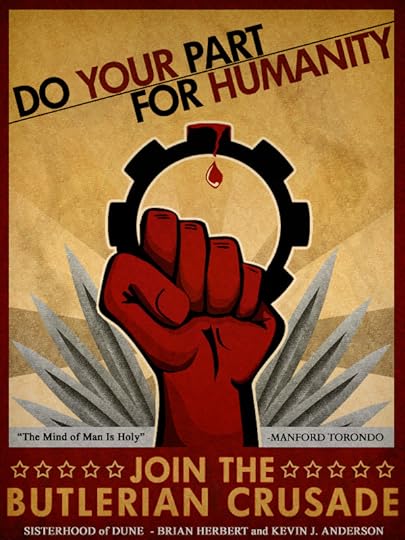
Most noteworthy, and what makes this work so well and makes me want to read more, is the ongoing Butlerian jihad. The war with the thinking machines is decades over, but some zealots want to stamp out any trace of thinking machine technology. Like dragon slayers the world over, if there are no dragons to slay, then you make up dragons or redefine what is a dragon and for these high-minded jihadists, what determines disallowed technology has become a slippery slope. The Butlerian movement is headed by a populist terrorist named Manford Torondo and the writers have outdone themselves in the creation of this malevolent antagonist. This somewhat transcends SF and explores the result of bigotry and mob rule in a quasi-theological context.
For expansionist Dune fans this is highly recommended and for the purists who are on the fence, a little curious about the expanded universe, this is a great start to a very cool trilogy.
I’m on to the next in the series, Mentats of Dune.
When Frank Herbert died in February 1986, he left notes for more books, a universe of science fiction, a son who could also write and legions of fans clamoring for more.
Since then, a schism of Frank purists and fans of Brian Herbert’s later books have been at odds almost as vehement as the Butlerians that Frank referenced and Brian and his writing collaborator Kevin J. Anderson described. The Frank jihadists insist that Dune is comprised of six books. No more. The expansionists, while conceding that Frank’s work is superior, enjoy the expanded universe provided in the later published works.
As I turned the last page on Chapterhouse, having read the original six through twice (though I’ve read Dune maybe four times) I found myself at a crossroads: should I start again at Dune or go on to read Brian and Kevin’s work? I discovered that I was just too curious to learn more about the amazing world building and found myself in the camp of the expansionists. Frank Herbert is one of my favorite authors and Dune is on a very short list of my all-time favorite books, but I see no dilemma in also enjoying Brian Herbert’s work.
The first trilogy, the Prelude to Dune, comprises the “Houses” of Dune and is from the decades immediately preceding the events of Frank’s Dune. These are fun and provide great background stories for the characters we know in Dune but are overly long, rambling and in need of some strict editing.
Next we come to the Legends of Dune, the DEEP prequel of more than 10,000 years before Dune and describe the events of the Butlerian Jihad fighting the thinking machines. Also fun and thought provoking science fiction, these are also overly long and inconsistent, as though written by two collaborators who did not communicate well. Still good, but with problems.
Then I picked up the first in the Schools of Dune trilogy, the Sisterhood of Dune. First published in 2012, we find the result of Brian and Kevin’s more than a dozen years hammering out more Dune stories – and maybe having listened to a few critics!
Sisterhood is a very manageable 496 pages and is a much more tightly woven story, the ramblings and inconsistencies seemed to have been worked out and this purred along nicely and describes the beginnings of the great schools of thought in the Dune universe – the sisterhood of the Bene Gesserit’s origins, the Mentats and the navigators. We also learn more about the Swordmasters and about the beginnings of the Corrino empire.
This takes place about 80 years after the events in The Battle of Corrin and Vorian Atreides is still alive and kicking. Agamemnon’s life extending process seems to have worked nicely and the scenes where Vorian has gone into quiet exile, living his best long life while his wife and family grow old around him reminded me of Heinlein. Vorian is pulled, Michael Corleone like, back into public life and this emergence creates a ripple of other events.
We also get to meet some very early Harkonnen’s and Valya Harkonnen is a force to be reckoned with as she learns to be a sister in the newly founded order of the Bene Gesserit (though not yet named so) while still loyal to her family.
Most noteworthy, and what makes this work so well and makes me want to read more, is the ongoing Butlerian jihad. The war with the thinking machines is decades over, but some zealots want to stamp out any trace of thinking machine technology. Like dragon slayers the world over, if there are no dragons to slay, then you make up dragons or redefine what is a dragon and for these high-minded jihadists, what determines disallowed technology has become a slippery slope. The Butlerian movement is headed by a populist terrorist named Manford Torondo and the writers have outdone themselves in the creation of this malevolent antagonist. This somewhat transcends SF and explores the result of bigotry and mob rule in a quasi-theological context.
For expansionist Dune fans this is highly recommended and for the purists who are on the fence, a little curious about the expanded universe, this is a great start to a very cool trilogy.
I’m on to the next in the series, Mentats of Dune.

February 16, 2012
I’m so glad I’m not a Dune purist. I just glanced over several reviews of Sisterhood and found that most people were in one of two camps. There are those who loved the original series and resent the backstories presented by Frank Herbert’s son and Mr. Anderson. Then, there are those like me, who loved the Dune series and want more.
When I picked up Sisterhood of Dune, I was hoping for an escape from the dark historical books I had been reading. I wanted entertainment and excitement, and that is exactly what Herbert and Anderson delivered.
One of my favorite storylines from the original Dune series was narratives about the Bene Gesserit Sisterhood. I was excited to see more info in this book regarding the continuation of the sorceresses into the sisterhood, their fascination with bloodlines and breeding, and the evolution of Reverend Mothers. Make no mistake, the book isn’t entirely about the Sisterhood (which did disappoint some reviewers), but this book has several other terrific plots and storylines, so I didn’t mind.
We also see the return of Erasmus, the evil robot – although he’s pretty much just limited to his memory core. It doesn’t bode well for the future of humanity. Also a danger to humanity are the negative forces at work: the Butlerians – who once freed humanity from the computers who would enslave them, now a right-wing faction bent on destroying all machines and the people who would promote them. Another positive turned negative: VenHold – home of the space Navigators, has turned into a ruthless organization, determined to establish power and superiority through monopoly.
Fast-paced and exciting, the authors deftly establish new Dune stories within the parameters of the old. Wonderful stuff!
When I picked up Sisterhood of Dune, I was hoping for an escape from the dark historical books I had been reading. I wanted entertainment and excitement, and that is exactly what Herbert and Anderson delivered.
One of my favorite storylines from the original Dune series was narratives about the Bene Gesserit Sisterhood. I was excited to see more info in this book regarding the continuation of the sorceresses into the sisterhood, their fascination with bloodlines and breeding, and the evolution of Reverend Mothers. Make no mistake, the book isn’t entirely about the Sisterhood (which did disappoint some reviewers), but this book has several other terrific plots and storylines, so I didn’t mind.
We also see the return of Erasmus, the evil robot – although he’s pretty much just limited to his memory core. It doesn’t bode well for the future of humanity. Also a danger to humanity are the negative forces at work: the Butlerians – who once freed humanity from the computers who would enslave them, now a right-wing faction bent on destroying all machines and the people who would promote them. Another positive turned negative: VenHold – home of the space Navigators, has turned into a ruthless organization, determined to establish power and superiority through monopoly.
Fast-paced and exciting, the authors deftly establish new Dune stories within the parameters of the old. Wonderful stuff!

October 31, 2019
There are so many elements of Dune that I adore. The myriad Machiavellian factions, their complexities, strategies and drama. Its dazzling tapestry of politics, religion, genetics and environmental resource stitched through with the vibrant wildcard thread of prescience. The way the vastness of its planetary scope never overshadows the individual's travail. I appreciate the structure; each chapterhead a slice of evocative historical quote or observation. Is it a memoir of our past or of our future? I appreciate that the first twenty pages act as a literary cover charge - only those readers of intent manage to plow through it. I love that the work is so ridiculously substantial and yet, in the end, such genuinely great fun. I've read this classic many times, all six in the original series many times, enough even to acquire a fondness for God Emperor (admittedly hard to do) if only because it provides manifest evidence for why Paul pulled back and ran away. Not everyone can face making that kind of long-term, tough love commitment to the human race. Sometimes, yes, it falls to our sons.
And then sometimes it probably shouldn't.
Dune was published in 1965. Five sequels followed. When Frank Herbert died in 1986 his son, a sci-fi writer of burgeoning reputation, was encouraged by the publishing world to continue the string. Unfortunately, while many cartons of his father's papers had been left behind, none could be found with reference to where he'd planned to take the story. So Brian Herbert took what he had (work notes on the original world-building) and teamed up with Kevin J. Anderson to produce a trilogy of prequels. It was during this prequel-writing stage, eleven years after his father's death, that a Seattle bank notified the family of two safe deposit boxes leased in Frank's name. These boxes contained copious notes and outlines for the seventh installment of the original Dune series.
Well, hurray-hurray! This is great! And it's certainly understandable that Brian and Kevin would carry on with the prequel project while they poured through the newly-discovered material for the long-awaited seventh installment to the original series. House Atreides, House Harkonnen and House Corrino were duly written and released. Oh, and while they were at it, hey, might as well...here comes a second prequel trilogy: The Butlerian Jihad, The Machine Crusade and The Battle of Corrin. (Are you beginning to squint? Because I'm beginning to squint.) That's six books. Big books. Six big books of, it must be said, diminishing quality. Were they tired? Overworked? Fried by the complicated Dune universe? No clue, but it's such a shame because by the time they got to that glorious seventh part of that glorious original series - which they doubled down, of course, into two novels, Hunters of Dune and Sandworms of Dune - suffice to say it was, to this reader at least, ever-so-distinctly underwhelming. (Tolerance, as George R.R. Martin and Patrick Rothfuss will tell you, is not a reader-quality you really want to mess with.) But why stop there? In addition, these tomes were produced: Paul of Dune, The Winds of Dune, Sisterhood of Dune, Mentats of Dune, Navigators of Dune...
It's never going to end. (It really isn't.) And I've gone from five stars (Frank's work) to four to three and now two - because the story's as flat as a tech manual and the dialogue is simply atrocious. I mean, E.L. James atrocious. But, you know, it's idiots like me who once upon a time fell in love with a book who keep this gravy train rolling.
So choo-choo, Antigone. It's all on you.
And then sometimes it probably shouldn't.
Dune was published in 1965. Five sequels followed. When Frank Herbert died in 1986 his son, a sci-fi writer of burgeoning reputation, was encouraged by the publishing world to continue the string. Unfortunately, while many cartons of his father's papers had been left behind, none could be found with reference to where he'd planned to take the story. So Brian Herbert took what he had (work notes on the original world-building) and teamed up with Kevin J. Anderson to produce a trilogy of prequels. It was during this prequel-writing stage, eleven years after his father's death, that a Seattle bank notified the family of two safe deposit boxes leased in Frank's name. These boxes contained copious notes and outlines for the seventh installment of the original Dune series.
Well, hurray-hurray! This is great! And it's certainly understandable that Brian and Kevin would carry on with the prequel project while they poured through the newly-discovered material for the long-awaited seventh installment to the original series. House Atreides, House Harkonnen and House Corrino were duly written and released. Oh, and while they were at it, hey, might as well...here comes a second prequel trilogy: The Butlerian Jihad, The Machine Crusade and The Battle of Corrin. (Are you beginning to squint? Because I'm beginning to squint.) That's six books. Big books. Six big books of, it must be said, diminishing quality. Were they tired? Overworked? Fried by the complicated Dune universe? No clue, but it's such a shame because by the time they got to that glorious seventh part of that glorious original series - which they doubled down, of course, into two novels, Hunters of Dune and Sandworms of Dune - suffice to say it was, to this reader at least, ever-so-distinctly underwhelming. (Tolerance, as George R.R. Martin and Patrick Rothfuss will tell you, is not a reader-quality you really want to mess with.) But why stop there? In addition, these tomes were produced: Paul of Dune, The Winds of Dune, Sisterhood of Dune, Mentats of Dune, Navigators of Dune...
It's never going to end. (It really isn't.) And I've gone from five stars (Frank's work) to four to three and now two - because the story's as flat as a tech manual and the dialogue is simply atrocious. I mean, E.L. James atrocious. But, you know, it's idiots like me who once upon a time fell in love with a book who keep this gravy train rolling.
So choo-choo, Antigone. It's all on you.

December 20, 2011
Sisterhood is a prequel, taking place over 10,000 years before the Paul Atreides timeline of the regular Dune novels. It is best read after the Legends of Dune trilogy: The Butlerian Jihad, The Machine Crusade and The Battle of Corrin, however it does provide enough explanation that you will understand what is going on, even if this may be your first Dune novel.
This is an origins story, but it easily stands on its own within the main Dune series. A generation has passed since the Butlerian Jihad, when humans defeated the AI and cyborgs that enslaved them. The story visits Dune institutions such as the Bene Gesserit, the Spacing Guild, Swordmasters, Suk school, the Mentats and even a visit to Arrakis with the Fre(e)men. All of the groups struggle to find their places within the new universe and alternatives to compensate for the Butlerian prohibitions on thinking machines.
Brian Herbert and Kevin J. Anderson really hit their stride with this novel. It has plenty of action and intrigue and the pace is quick. I didn't feel that too much time was spent with any one character, or not enough. This is my favorite "new" Dune book yet.
This is an origins story, but it easily stands on its own within the main Dune series. A generation has passed since the Butlerian Jihad, when humans defeated the AI and cyborgs that enslaved them. The story visits Dune institutions such as the Bene Gesserit, the Spacing Guild, Swordmasters, Suk school, the Mentats and even a visit to Arrakis with the Fre(e)men. All of the groups struggle to find their places within the new universe and alternatives to compensate for the Butlerian prohibitions on thinking machines.
Brian Herbert and Kevin J. Anderson really hit their stride with this novel. It has plenty of action and intrigue and the pace is quick. I didn't feel that too much time was spent with any one character, or not enough. This is my favorite "new" Dune book yet.

April 17, 2025
I started this one after watching the TV series, which I greatly enjoyed. But I got sidetracked - it didn't hold my interest at the moment - and last week I decided to pick it up again. I initially thought will be a DNF given my experience with Paul of Dune, however I must say I got hooked after a third or so.
The timeline starts ~80 years after humanity defeated Omnius and ~ 10,000 years before the events in Dune. It was great to learn the origins of Bene Gesserit (not yet with this name though), of Mentats (I had forgotten how Eramus taught Gilbertus Albans to become the first of them), and also of the Navigators.
It's part history, part various actions following also some of the characters which we already met in the Legends of Dune Series, alert and quite compelling; a great addition to Dune's universe.
The timeline starts ~80 years after humanity defeated Omnius and ~ 10,000 years before the events in Dune. It was great to learn the origins of Bene Gesserit (not yet with this name though), of Mentats (I had forgotten how Eramus taught Gilbertus Albans to become the first of them), and also of the Navigators.
It's part history, part various actions following also some of the characters which we already met in the Legends of Dune Series, alert and quite compelling; a great addition to Dune's universe.

May 9, 2021
I'm a completionist at heart. That means that I even have to read this (ahem) pre-prequel-sequel if I am going to have any pride in my completionism.
So? Why? What? Ok, so, about 80 years after the Butlerian Jihad, we get the founding of the three big schools and their chaotic origins. The Bene Gesserit kicks it off.
I ADMIT that I would have loved the idea of reading about them anyway even if I was stuck reading another attempt to cash in on Dune. But I also admit that my expectations were not all that high, either.
So how did this one go?
All right, actually. I'm recalling the events of the earliest-timeline trilogy and the after-aftermath is actually a bit MORE interesting than the actual war that freed mankind. Early days is actually pretty interesting.
Throw in weak leaders, demagoguery, and Butlerian barbarians that want to take everyone to the stone age, giving us a massive cusp-of-the-dark-ages feel, and it actually works pretty well.
If I had read this novel as a standalone with different names, without the weight of the DUNE universe to back it up, I would have been pretty happy. As it is, I think it's slightly better than the run-of-the-mill B. Herbert/Anderson team-up.
It's still not at F. Herbert's level and there's a HUGE matter of worldbuilding continuity with the original series and a personal pet peeve about throwing family names about as if they're ALWAYS going to be a direct line of importance across ten thousand years... but *deep breath* fine. Whatever. This is fan service, I guess, meant for the low-bar name recognition stuff.
I'll still continue, but I just have to lower my expectations if I want to enjoy it.
So? Why? What? Ok, so, about 80 years after the Butlerian Jihad, we get the founding of the three big schools and their chaotic origins. The Bene Gesserit kicks it off.
I ADMIT that I would have loved the idea of reading about them anyway even if I was stuck reading another attempt to cash in on Dune. But I also admit that my expectations were not all that high, either.
So how did this one go?
All right, actually. I'm recalling the events of the earliest-timeline trilogy and the after-aftermath is actually a bit MORE interesting than the actual war that freed mankind. Early days is actually pretty interesting.
Throw in weak leaders, demagoguery, and Butlerian barbarians that want to take everyone to the stone age, giving us a massive cusp-of-the-dark-ages feel, and it actually works pretty well.
If I had read this novel as a standalone with different names, without the weight of the DUNE universe to back it up, I would have been pretty happy. As it is, I think it's slightly better than the run-of-the-mill B. Herbert/Anderson team-up.
It's still not at F. Herbert's level and there's a HUGE matter of worldbuilding continuity with the original series and a personal pet peeve about throwing family names about as if they're ALWAYS going to be a direct line of importance across ten thousand years... but *deep breath* fine. Whatever. This is fan service, I guess, meant for the low-bar name recognition stuff.
I'll still continue, but I just have to lower my expectations if I want to enjoy it.

November 5, 2011
Now to start, I'll begin with a bombshell.
This is the best Dune book they have written.
WHA? Has Amp turned traitor? GET THE HANGIN TRIPOD!
No no no my fellow cast out, let me explain.
When I say best, remember the caveat that this is still a KJA book, meaning it was still written by the most philistine hack alive. (Hey Kev, philistine means you don't hold anything sacred.)
What I mean is that this book is not a Brian Herbert and Kevin J Anderson 'Dune' book. This is a Brian Herbert and Kevin J Anderson and TOR's entire production/editorial staff trying to resuscitate a milked-dead cash-cow.
The first two chapters stank of a third hand (or more) overlooking the process. It felt as if Team McDune had sat down and edited, re-editied, polished and actually thought about a finished product, rather than simply letting it fall out the mouth of a hiking hack onto paper.
The font and type appear to be much smaller and more closely spaced in order to give it a more serious appearance, rather than the larger kid-friendly (less imposing) type of the other books.
EDIT: This is the best Dune book they have produced. Make more sense now?
After the first few chapters it returns to the same unedited tripe.
Maybe it's just KJA self-editing, after all:
(reposted from twitter) "@TheKJA Watched REAL STEEL while keying in corrections to Frank Herbert's never-published novel HIGH-OPP. Doing double-duty.
11:16 PM - 29 Feb 12 "
What kind of professional would ever make such a post?
Yes, obviously this is the first in (yet another) trilogy*. It suffers from the SPace Opera: Nowhere! syndrome and what I mean by that is that in many cases, they are taking elements of the Dune mythos and running them in the complete opposite direction not only from their previous work but from the originals as well:
The Butlerians have broken down into mindless religious fanatics who are Obviously Bad Guys.
Next we have the bastardization of the CET. We are beaten over the head with the message: RELIGION BAD! That Religion was mindless and evil was not Frank's purpose at all.
The Swordmasters ally with the Butlerians for what reason? Just Because?
And why, when working for the anti-tech fanatics do they use lightsab...sorry "Pulse-swords" and then centuries later they use normal swords? Obvious reason: fanboys love pulse/lightsabers. Normal swords are apparently too boring for an LCD read.
Wait... In Frank's discussion of the CET, the Guild and the Sisterhood are already around...
KJA acts like a Feudal Lord demanding the right of Prima Nocte with anything Dune. The originals might have had something come out this way, but it was really E** behind the scenes in everything.
The Guild is actually a shipping company in competition with cheaper, less safe spacefolders. Its owned by Venport. He has no reason to give up his monopoly, yet the Guild obvious isn't a company owned by one family. Maybe we'll see this guy spacefolded into a million pieces by renegade Navigators...except that that isn't how spacefolding works. I mean Norma-God can do it, because like all KJA creations she's a billion times more powerful than whatever Frank made. We'll be seeing Norma Deus-Ex-Machina a lot of things in this trilogy. She's already started doing it in this book, twice.
The "Freemen" in this book make the Museum Fremen in God Emperor look like the Fremen in Dune by comparison. If you understand that analogy, you'll understand how deep an insult that is. KJA sells Fremen for their water. There is no consistency to them at all, no honor, and if they are trying to live a secret life then they fail miserably. Its as if random extras were pasted into the book, and the scene was shot in the desert and we're told to believe that these are the Fremen when everything they do is to act completely counter to how real Fremen would act.
I mean I would assume that a "duel to the death" is "to the death". It's right there in the name. And its kinda pointless to let both characters live in a "duel to the death" ESPECIALLY when you pointlessly kill one of them in the next scene.
Harlon Ellison sued James Cameron over parts of the Terminator IP. I think Cameron needs to sue KJA for the same reasons. The terminator twins are classic KJA. Steal an idea from sci-fi then make it a billion times more powerful just because.
I'm completely baffled at how many 5 star reviews this book has received. I honestly think they received a different text than I did.
*Why do they always come in packs? It's because these books aren't meant to tell a story, they are meant to sell you a product. As with all manufactured products the process is to create them as fast as possible and ship them out. Why would KJA tell you a story in one book when he can sell a trilogy?
** I refuse to use some of the names they give characters, Erasmus among the first. Desiderus Erasmus was a great human mind, not the retarded robot in this book.

October 10, 2023
Wow, What a book! I've been a fan of Kevin Anderson and his writing style, and have known that he has had many detractors. However, he just truly shines in this book. (So does Brian Herbert!)
While the Dune Houses Trilogy (House Atreides, House Harkonnen, and House Corrino) dealt with familiar characters, this book deals with entirely new characters set thousands of years in the past. I think this helps Anderson and Herbert, as they are able to tell original stories and not run into continuity issues. Several planets, families, and groups show up and are the main focus of this group, but they are incredibly removed from the OG Dune portion of the timeline that their is real danger and uniqueness to the story.
Where this book truly shines is in its deep themes. What? A Kevin Anderson book that is really deep? I know, I was shocked when I realized this, that it is not only Anderson's most deep book I've read to date, but also one of the deepest books I've read this year! The themes about technology, extremism and fanaticism, governmental control, and revenge were fantastically done!
After the Butlerian Jihad, where Machines had control of humans and the humans had to fight back, we have in this book an instance where the humans have overcorrected...WAY overcorrected. The humans have outlawed not just AI, but all forms of technology and computers, except "human computers". Anderson and Herbert explore the ways that sometimes the reaction to evil can be just as harmful as the evil itself, an idea that is incredibly relatable to today's society. And while Anderson and Herbert do lay this theme on pretty thick, they actually include some nuance that gives the book flavor.
This book also explores the ideas of revenge well. This is a minor plotline comparatively, but this was a plotline that I was sure I knew how it would go, and I was pleasantly surprised by the twists and turns it had.
As always, the most fun (and foundational) element of the book here is the political intrigue. I loved the Intrigue in the Original Dune book, but felt the Sci-Fi elements weighed it down, and felt that the sequels Dune Messiah and Children of Dune weren't as good as the philosophical and sci-fi elements weighed them even more! But Anderson and Herbert have found a way to tell interesting political intrigue stories while still keeping some Sci-Fi and philosophical elements intact. As mentioned before, being separated by 10,000 years actually helps Anderson and Herbert, as they are able to have relative free reign with the universe.
This book also did something that I absolutely loved. It had the perfect balance of storylines and characters to juggle. I will admit that some of Anderson's books have too many plotlines and characters to truly follow, and you can easily forget or misunderstand them. This one had just enough to tell a truly complext and riveting story, but never felt like it had too many. In fact, I never found myself wanting to leave one plotline to go to another, I was interested in every single one. Truly impressive work!
Overall, I love this book. Definitely a top book of the year for me. I loved every element of it and cannot wait to read the sequels later this year. 9.8 out of 10!
While the Dune Houses Trilogy (House Atreides, House Harkonnen, and House Corrino) dealt with familiar characters, this book deals with entirely new characters set thousands of years in the past. I think this helps Anderson and Herbert, as they are able to tell original stories and not run into continuity issues. Several planets, families, and groups show up and are the main focus of this group, but they are incredibly removed from the OG Dune portion of the timeline that their is real danger and uniqueness to the story.
Where this book truly shines is in its deep themes. What? A Kevin Anderson book that is really deep? I know, I was shocked when I realized this, that it is not only Anderson's most deep book I've read to date, but also one of the deepest books I've read this year! The themes about technology, extremism and fanaticism, governmental control, and revenge were fantastically done!
After the Butlerian Jihad, where Machines had control of humans and the humans had to fight back, we have in this book an instance where the humans have overcorrected...WAY overcorrected. The humans have outlawed not just AI, but all forms of technology and computers, except "human computers". Anderson and Herbert explore the ways that sometimes the reaction to evil can be just as harmful as the evil itself, an idea that is incredibly relatable to today's society. And while Anderson and Herbert do lay this theme on pretty thick, they actually include some nuance that gives the book flavor.
This book also explores the ideas of revenge well. This is a minor plotline comparatively, but this was a plotline that I was sure I knew how it would go, and I was pleasantly surprised by the twists and turns it had.
As always, the most fun (and foundational) element of the book here is the political intrigue. I loved the Intrigue in the Original Dune book, but felt the Sci-Fi elements weighed it down, and felt that the sequels Dune Messiah and Children of Dune weren't as good as the philosophical and sci-fi elements weighed them even more! But Anderson and Herbert have found a way to tell interesting political intrigue stories while still keeping some Sci-Fi and philosophical elements intact. As mentioned before, being separated by 10,000 years actually helps Anderson and Herbert, as they are able to have relative free reign with the universe.
This book also did something that I absolutely loved. It had the perfect balance of storylines and characters to juggle. I will admit that some of Anderson's books have too many plotlines and characters to truly follow, and you can easily forget or misunderstand them. This one had just enough to tell a truly complext and riveting story, but never felt like it had too many. In fact, I never found myself wanting to leave one plotline to go to another, I was interested in every single one. Truly impressive work!
Overall, I love this book. Definitely a top book of the year for me. I loved every element of it and cannot wait to read the sequels later this year. 9.8 out of 10!
March 7, 2012
Only mildly interesting at times.
The series of "prequel"books co-written by Herbert and Anderson are generally, in my opinion, very weak in storytelling and, especially, dialogue compared to any of Frank Herbert's Dune novels. The prequels' authors do not appear to even attempt to emulate FH's style or approach to character development or story structure. Much of what they write - and this novel is a prime example - is just flat narrative with occasional unconvincing dialogue. I read most of what they've written, initially to make sure I had the full "background" for their planned completion of the original series (direct sequels to "Chapterhouse Dune"). Once I'd read those "final" works - which were only somewhat better than the family house-centered series that let up to them, I figured I was done. I read this one because I was favored (no sarcasm intended) with an advance copy and felt it only fair to read and at least rate the thing, since I didn't pay for it.
This story returns to the universe of the prequels, some years after the defeat of Omnius and his robotic hoards. It attempts to explain the origins of the Bene Gesserit, among other things, but the same, plodding narrative style robs the story of whatever spark of interest the reader may have for the characters or plot.
Sorry, I'm not going to even apply for any future free copies of these prequels.
The series of "prequel"books co-written by Herbert and Anderson are generally, in my opinion, very weak in storytelling and, especially, dialogue compared to any of Frank Herbert's Dune novels. The prequels' authors do not appear to even attempt to emulate FH's style or approach to character development or story structure. Much of what they write - and this novel is a prime example - is just flat narrative with occasional unconvincing dialogue. I read most of what they've written, initially to make sure I had the full "background" for their planned completion of the original series (direct sequels to "Chapterhouse Dune"). Once I'd read those "final" works - which were only somewhat better than the family house-centered series that let up to them, I figured I was done. I read this one because I was favored (no sarcasm intended) with an advance copy and felt it only fair to read and at least rate the thing, since I didn't pay for it.
This story returns to the universe of the prequels, some years after the defeat of Omnius and his robotic hoards. It attempts to explain the origins of the Bene Gesserit, among other things, but the same, plodding narrative style robs the story of whatever spark of interest the reader may have for the characters or plot.
Sorry, I'm not going to even apply for any future free copies of these prequels.

January 31, 2025
A fast paced and exciting story and the first book in the Dune prelude trilogy, Schools of Dune.
Originally I picked this up as the purported source material for the show Dune:Prophecy. I should say right off that the book and the show bear very little resemblance to each other. That’s not a bad thing because even though I thought Dune: Prophecy was ok to watch, it also had a confusing storyline and many WTF moments left unexplained.
In contrast, the book is easy to follow and really quite entertaining. It’s not Dune, that’s for sure, but it doesn’t need to be. I don’t know how this book compares to the other many prequel and sequel Dune books written by Brian Herbert and Kevin J. Anderson, but I thought this was a decent story and I enjoyed reading it.
This book also clearly forms part of a larger ongoing story arc, so I plan to at least complete this particular prequel trilogy.
Originally I picked this up as the purported source material for the show Dune:Prophecy. I should say right off that the book and the show bear very little resemblance to each other. That’s not a bad thing because even though I thought Dune: Prophecy was ok to watch, it also had a confusing storyline and many WTF moments left unexplained.
In contrast, the book is easy to follow and really quite entertaining. It’s not Dune, that’s for sure, but it doesn’t need to be. I don’t know how this book compares to the other many prequel and sequel Dune books written by Brian Herbert and Kevin J. Anderson, but I thought this was a decent story and I enjoyed reading it.
This book also clearly forms part of a larger ongoing story arc, so I plan to at least complete this particular prequel trilogy.
April 7, 2025
Big Fan

March 30, 2025
"We are animals, yet are expected to be so much more. Although honour requires us to make altruistic decisions, even acting for the benefit of other people keeps coming back to self-interest, no matter how much one attempts to conceal it."
Sisterhood of Dune is an exhilarating journey that bridges the intricate world created by Frank Herbert and the imaginative expansion that Brian Herbert has brought to the Dune universe. As a lifelong fan of Frank's original works, I approached this book with both excitement and trepidation. Could Brian write a story that captures the depth, complexity, and profound themes of his father’s legacy? The answer is a resounding yes!
From the very first page, Brian crafts a narrative that feels familiar yet refreshingly unique. The focus on the Bene Gesserit and their foundational role in the struggle for power and survival is nothing short of brilliant. The character development is rich and compelling, especially with the likes of Valya and other new figures that emerge from the shadows of Dune's history. Brian writes, "In a world of chaos, knowledge is the greatest weapon," and this mantra resonates deeply throughout the novel, driving many pivotal moments and character arcs.
What truly stood out for me was Brian's ability to delve into themes such as loyalty, betrayal, and the manipulation of power in ways that are strikingly relatable to our modern lives. He masterfully weaves political intrigue with personal sacrifice, reminding us that even in a vast universe, the struggles of individuals are at the heart of any great story. The scenes depicting the trials faced by the Sisterhood are thought-provoking, forcing me to consider the lengths to which one must go for their beliefs and the importance of sisterhood in a patriarchal society.
While some readers may still yearn for Frank Herbert's prose and philosophical depth, Brian’s narrative flows smoothly, keeping the pages turning. It’s evident that he has poured his heart into this saga, and that passion shines through in every chapter. The pacing is brisk, filled with action, suspense, and moments that left me contemplating long after I put the book down.
In comparison with other recent entries in the Dune universe, Sisterhood of Dune stands tall as a testament to the evolution of this epic saga. Brian has not only honored his father's legacy but has also added his own voice—a voice that is distinctly engaging.
So if you’re craving a captivating tale that interlaces rich character development with a complex world, look no further. I highly recommend diving into Sisterhood of Dune. It’s a must-read for fans and newcomers alike, offering a unique lens through which to view a beloved and influential universe.
Sisterhood of Dune is an exhilarating journey that bridges the intricate world created by Frank Herbert and the imaginative expansion that Brian Herbert has brought to the Dune universe. As a lifelong fan of Frank's original works, I approached this book with both excitement and trepidation. Could Brian write a story that captures the depth, complexity, and profound themes of his father’s legacy? The answer is a resounding yes!
From the very first page, Brian crafts a narrative that feels familiar yet refreshingly unique. The focus on the Bene Gesserit and their foundational role in the struggle for power and survival is nothing short of brilliant. The character development is rich and compelling, especially with the likes of Valya and other new figures that emerge from the shadows of Dune's history. Brian writes, "In a world of chaos, knowledge is the greatest weapon," and this mantra resonates deeply throughout the novel, driving many pivotal moments and character arcs.
What truly stood out for me was Brian's ability to delve into themes such as loyalty, betrayal, and the manipulation of power in ways that are strikingly relatable to our modern lives. He masterfully weaves political intrigue with personal sacrifice, reminding us that even in a vast universe, the struggles of individuals are at the heart of any great story. The scenes depicting the trials faced by the Sisterhood are thought-provoking, forcing me to consider the lengths to which one must go for their beliefs and the importance of sisterhood in a patriarchal society.
While some readers may still yearn for Frank Herbert's prose and philosophical depth, Brian’s narrative flows smoothly, keeping the pages turning. It’s evident that he has poured his heart into this saga, and that passion shines through in every chapter. The pacing is brisk, filled with action, suspense, and moments that left me contemplating long after I put the book down.
In comparison with other recent entries in the Dune universe, Sisterhood of Dune stands tall as a testament to the evolution of this epic saga. Brian has not only honored his father's legacy but has also added his own voice—a voice that is distinctly engaging.
So if you’re craving a captivating tale that interlaces rich character development with a complex world, look no further. I highly recommend diving into Sisterhood of Dune. It’s a must-read for fans and newcomers alike, offering a unique lens through which to view a beloved and influential universe.
April 12, 2012
Hmmm. Perhaps the best bit about this book is the cover - and even that's a painting of a pseudo - Hawk out of Space 1999 - but what's it doing with anti - shipping missiles fitted to it on a planet like Dune ????? The mind boggles.....
Anyway, as you can probably gather I wasn't exactly enamoured with this novel. Okay so it was nothing like as bad as The Butlerian Jihad, but it's still a terrible waste of ink and paper. Perhaps the most worrying thing is that it proudly announces upon the cover that it's Book One of the brand new trilogy of 'The Schools of Dune.' Whatever next ? 'Municipal Buildings of Dune ?' 'Pickle Factories of Dune ???'
This is so far away from Frank Herbert's original epic novel it makes me weep. On the strength of this showing, the only novel I shall await with bated breath from these two is..... 'VITRIFICATION OF DUNE !'
Anyway, as you can probably gather I wasn't exactly enamoured with this novel. Okay so it was nothing like as bad as The Butlerian Jihad, but it's still a terrible waste of ink and paper. Perhaps the most worrying thing is that it proudly announces upon the cover that it's Book One of the brand new trilogy of 'The Schools of Dune.' Whatever next ? 'Municipal Buildings of Dune ?' 'Pickle Factories of Dune ???'
This is so far away from Frank Herbert's original epic novel it makes me weep. On the strength of this showing, the only novel I shall await with bated breath from these two is..... 'VITRIFICATION OF DUNE !'

September 5, 2024
"The Sisterhood of Dune" starts a new arc called "The Schools of Dune". But, it takes place about 90 years after the events of the Butlerian Jihad series. I really enjoyed this book. While none of the series compares to the original, this should be judged for the additional information and stories they tell.
Salvador Corrino is Emperor. He is advised by his brilliant and loyal brother, Roderick. The anti-machine forces of the Butlerians are still causing trouble for all forms of technology. The Imperium must try to balance their fanaticism with development.
As this is happening, the Butlerians are led by Manfred Tornado and his fanatics will run into conflict with Aurelius Venport and his technology. We will learn a lot about the development of the navigators and how Venport comes under assault from the Butlerians.
The Sorcereress who are researching genetic records will also come into conflict with the Throne and in their destruction the seeds for the Bene Gesserit will be set. The story also delves into the development of the Mentant school by Gilbertus Albans, who still hides a gel copy of Erasmus, the deadly sentient robot.
Finally, the long-lived Vorian Atreides must deal with threats from the Harkonnen family, which seeks revenge, and with two children of the cymek Agamemnon.
A really good book that fills in a lot of the holes in the story of Dune. While never reaching the soaring heights of the original series, this is a fun series that helps to round out the lore of this magnificent world.
Salvador Corrino is Emperor. He is advised by his brilliant and loyal brother, Roderick. The anti-machine forces of the Butlerians are still causing trouble for all forms of technology. The Imperium must try to balance their fanaticism with development.
As this is happening, the Butlerians are led by Manfred Tornado and his fanatics will run into conflict with Aurelius Venport and his technology. We will learn a lot about the development of the navigators and how Venport comes under assault from the Butlerians.
The Sorcereress who are researching genetic records will also come into conflict with the Throne and in their destruction the seeds for the Bene Gesserit will be set. The story also delves into the development of the Mentant school by Gilbertus Albans, who still hides a gel copy of Erasmus, the deadly sentient robot.
Finally, the long-lived Vorian Atreides must deal with threats from the Harkonnen family, which seeks revenge, and with two children of the cymek Agamemnon.
A really good book that fills in a lot of the holes in the story of Dune. While never reaching the soaring heights of the original series, this is a fun series that helps to round out the lore of this magnificent world.

July 26, 2016
This book has been sitting in my TBR pile for too long so I dove in. The beginning was too slow; in fact, I think the first interesting thing did not happen until page 100 or so. I thought the characters were a bit unidimensional, and that some of the themes (man versus machine) have already been fully covered in earlier novels. Yet, once the story got going, it was entertaining, especially the twins, Vorian Atriedes, and the Corrins. I did not care for the demagogue, Manford Torondo (nor his devotee Swordmaster), but I suppose that was the point.
December 20, 2011
Having read all of the other books in the original Dune series by Frank Herbert and all of the offshoot series created by Brian Herbert (along with Kevin J. Anderson) I was obviously looking forward to reading this novel as well. To be fair, I must admit that prior to reading each of the other two prequel trilogies (Legends of Dune and the Houses trilogy) I had hesitations relating to how well the stories would mesh with the original series. The same is true of this series as well. I've always been torn between wanting to know the details of the past in the given series I've read and wanting to maintain the "mystery" of the past to imagine how it is myself. Like all things, sometimes our imaginations can provide a better "story" than the details themselves can provide.
With that said I believe this novel (like the other prequel trilogies) does a great job at providing the storyline and further enhancing the history of the universe created by Frank Herbert. While it doesn't have the unique flare the original Dune novel had, it still tells a compelling story that draws you back for more. It follows the origin of all of the major groups we learn to love and hate in the original Dune series (the Bene Gesserit, the Spacing Guild, the Corrinos, the Fremen, the Suk, and of course the Mentats). Brian Herbert and Kevin J Anderson manage to tie all of these distinct groups into a well-meshed storyline despite the jumping back and forth between the different groups throughout the novel. There were some minor plot elements that seemed somewhat contrived but overall the plot stood for itself.
In conclusion I believe any fan of the Dune series will find this a welcome expansion to the storyline. It's not a ground-shattering novel by any means but is an enjoyable read regardless.
With that said I believe this novel (like the other prequel trilogies) does a great job at providing the storyline and further enhancing the history of the universe created by Frank Herbert. While it doesn't have the unique flare the original Dune novel had, it still tells a compelling story that draws you back for more. It follows the origin of all of the major groups we learn to love and hate in the original Dune series (the Bene Gesserit, the Spacing Guild, the Corrinos, the Fremen, the Suk, and of course the Mentats). Brian Herbert and Kevin J Anderson manage to tie all of these distinct groups into a well-meshed storyline despite the jumping back and forth between the different groups throughout the novel. There were some minor plot elements that seemed somewhat contrived but overall the plot stood for itself.
In conclusion I believe any fan of the Dune series will find this a welcome expansion to the storyline. It's not a ground-shattering novel by any means but is an enjoyable read regardless.

January 14, 2012
IMO, this is the best book so far of the Dune prequels or expanded universe, whichever you prefer. It is a nexus in the Dune universe, a node from which many branches remain to be explored. I wanted to give it 5*, but only Dune gets that in this universe. It approaches 4.5*.
The book is about beginnings—beginnings of the major powers of Dune. The title is somewhat deceptive. Though it does explore the Bene Gesserit's beginnings (here called The Sisterhood) and the 1st Reverent Mothers, it gives almost equal time to the beginnings of the Mentats, the Suk doctors and hints about imperial conditioning, the Emperium, The Laandstrad, the Thulaxu, The Navigators, the Fremen and Spice Mining, the Atreides-Harkonnan feud... All of these join in this nexus and I can imagine each being explored in more depth in further novels. It is quite an exciting prospect.
Further, the book is about the Butlerian Jihad, not against the Thinking Machines, they're dead and gone, but against humans who would use any technology to enhance their lives. In exploring this thing, the authors create a scathing polemic against the forces of fundamentalism, conservatism and theocracy that plague our own civilization today. They show that exploring the future can be like exploring the past, that humans will always be doomed to destruction and chaos by the righteous.
Many give short shrift to the Dune prequels by Brian and Kevin. I have enjoyed them, agree they have not maintained the literary quality of Frank's seminal novels, but I most strongly recommend this novel to Dune lover's, even if one has not read the other prequels. The Sisterhood of Dune can stand on it's own with perhaps a little help from The Dune Wiki
The book is about beginnings—beginnings of the major powers of Dune. The title is somewhat deceptive. Though it does explore the Bene Gesserit's beginnings (here called The Sisterhood) and the 1st Reverent Mothers, it gives almost equal time to the beginnings of the Mentats, the Suk doctors and hints about imperial conditioning, the Emperium, The Laandstrad, the Thulaxu, The Navigators, the Fremen and Spice Mining, the Atreides-Harkonnan feud... All of these join in this nexus and I can imagine each being explored in more depth in further novels. It is quite an exciting prospect.
Further, the book is about the Butlerian Jihad, not against the Thinking Machines, they're dead and gone, but against humans who would use any technology to enhance their lives. In exploring this thing, the authors create a scathing polemic against the forces of fundamentalism, conservatism and theocracy that plague our own civilization today. They show that exploring the future can be like exploring the past, that humans will always be doomed to destruction and chaos by the righteous.
Many give short shrift to the Dune prequels by Brian and Kevin. I have enjoyed them, agree they have not maintained the literary quality of Frank's seminal novels, but I most strongly recommend this novel to Dune lover's, even if one has not read the other prequels. The Sisterhood of Dune can stand on it's own with perhaps a little help from The Dune Wiki

February 19, 2012
Another good start to a prequel series of Dune set shortly after the victory over the Thinking Machines, 10,000 years before Dune takes place.
I decided to reread this by audiobook listening to one of my favorite performers, Scott Brick, as he narrates the story of the beginning of the Bene Gesserit, the Mentats, and the Navigators.
I decided to reread this by audiobook listening to one of my favorite performers, Scott Brick, as he narrates the story of the beginning of the Bene Gesserit, the Mentats, and the Navigators.
Read
February 8, 2012Since there are only glowing endorsements of 'Sisterhood' here, I would like to mark some points of objective criticism. As a DUNE purist and fanatic, I've been watching the title come dislodged from the stars of Sci-Fi, and plummet to Earth. Many complaints have been made against Brian Herbert and Kevin J. Anderson for the direction they've taken Frank Herbert's opus. Terms like "Dune dumbed-down" and "McDune" are commonly batted around. Where the original works were thought provoking, and insisted that the reader use their imagination, the latter day productions come with the content already chewed and partially digested for the consumer. Like a weary streetwalker, who's forced by her 'manager' to stay out past 4AM, Herbert and Anderson are milking the franchise for every opportunity for a buck.
The plot and theme to 'Sisterhood' is fine for the most part. This is the story of the beginnings of the Bene Gesserit Sisterhood and the controlled introduction of Reverend Mothers; the development of Guild Navigators; seeds of Corrino corruption on Salusa Secundus. Another sub-plot in 'Sisterhood' is centered around the Atreides-Harkonnen feud. It's there that the art of storytelling devolves suddenly. Like Thufir Hawat's assessment of the Baron in the original novel, it's plain that the authors babble too much. Anderson is chiefly noted for being a Young Adult writer. He's also known for the glut of books he's churned out in his nearly 40 years as a writer (an average of one book every 6.4 months), making him the modern personification of a pulp fiction contributor. The majority of his titles are in conjunction with another, primary writer; this being the reason why he is widely regarded as a literary lamprey.
Brian Herbert penned ten works of his own since 1981, and several more with others, including his father, Frank. So, while he has firsthand experience with Frank's writing style, there are many portions of 'Sisterhood' that are KJA's rambling, over-explained plot lines. At times, the actual grammar is poorly thought out, and an over-use of the same, repetitive adjectives is common.
Several new characters are introduced into the Dune universe in 'Sisterhood'. Unfortunately, while there are some enduring cast members, many of the people who are involved in crucial story arcs are entirely forgettable. A common theme in the 'Latter Day Dune' novels is for the authors to fill up page after page with rehashed back stories. Whereas Frank Herbert relied on his readers' intelligence to retain the basics of his previous works.
We're introduced to a bumbling and temperamental Emperor Salvador Corrino, who is under the thumb of the anti-technology Butlerian movement, headed by Manford Torondo. An ancestor to Duncan Idaho, Anari is also part of the updated Cultist movement (and, what a coincidence, she's also a Swordmaster). Gilbertus Albans has founded an academy for Mentats, and walks a fine line between supporting man and machine. The Guild is in it's fourth generation of management, while the Bene Gesserit still have their founder at the helm. Vorian Atreides was a principal player in all three 'Legends of Dune' books. In 'Sisterhood', he's pulled out of history's dustbin to fill the most plodding and anticlimactic role of the story. Opposite Vor is Griffin Harkonnen, who's eventually badgered into taking his vendetta against the Atreides seriously.
Not to worry though. All the major issues are resolved by the end of the book. The only way anybody is left hanging here is with the conclusion of the book: Plenty More Where This Came From!
The plot and theme to 'Sisterhood' is fine for the most part. This is the story of the beginnings of the Bene Gesserit Sisterhood and the controlled introduction of Reverend Mothers; the development of Guild Navigators; seeds of Corrino corruption on Salusa Secundus. Another sub-plot in 'Sisterhood' is centered around the Atreides-Harkonnen feud. It's there that the art of storytelling devolves suddenly. Like Thufir Hawat's assessment of the Baron in the original novel, it's plain that the authors babble too much. Anderson is chiefly noted for being a Young Adult writer. He's also known for the glut of books he's churned out in his nearly 40 years as a writer (an average of one book every 6.4 months), making him the modern personification of a pulp fiction contributor. The majority of his titles are in conjunction with another, primary writer; this being the reason why he is widely regarded as a literary lamprey.
Brian Herbert penned ten works of his own since 1981, and several more with others, including his father, Frank. So, while he has firsthand experience with Frank's writing style, there are many portions of 'Sisterhood' that are KJA's rambling, over-explained plot lines. At times, the actual grammar is poorly thought out, and an over-use of the same, repetitive adjectives is common.
Several new characters are introduced into the Dune universe in 'Sisterhood'. Unfortunately, while there are some enduring cast members, many of the people who are involved in crucial story arcs are entirely forgettable. A common theme in the 'Latter Day Dune' novels is for the authors to fill up page after page with rehashed back stories. Whereas Frank Herbert relied on his readers' intelligence to retain the basics of his previous works.
We're introduced to a bumbling and temperamental Emperor Salvador Corrino, who is under the thumb of the anti-technology Butlerian movement, headed by Manford Torondo. An ancestor to Duncan Idaho, Anari is also part of the updated Cultist movement (and, what a coincidence, she's also a Swordmaster). Gilbertus Albans has founded an academy for Mentats, and walks a fine line between supporting man and machine. The Guild is in it's fourth generation of management, while the Bene Gesserit still have their founder at the helm. Vorian Atreides was a principal player in all three 'Legends of Dune' books. In 'Sisterhood', he's pulled out of history's dustbin to fill the most plodding and anticlimactic role of the story. Opposite Vor is Griffin Harkonnen, who's eventually badgered into taking his vendetta against the Atreides seriously.
Not to worry though. All the major issues are resolved by the end of the book. The only way anybody is left hanging here is with the conclusion of the book: Plenty More Where This Came From!

January 5, 2012
Anderson is a master space opera writer and I always sense his style very strongly in these Dune prequel novels. The large number of points of view and the tone reminds me very much of Anderson's Saga of the Seven Suns, one of my favorite series. But the main thing that's fun is just seeing how the authors fit the stories together into a tighter and tighter weave of the historical document that they've been designing that spans millennia. As they add each strand to the loom and make it work, and work well, it's just fun to watch. I really applaud their vision and execution. Where I think the books filling in pieces of the late Dune cycle (Paul, Jessica) are a bit weak, the prequel books have all been really entertaining. And I think it's pretty remarkable that Frank Herbert wrote Dune over 46 years ago but the ideas of Navigators, Reverend Mothers and Mentats are still so fascinating to this day that there is still a ton of story to be told about them. The origin tales are compelling. And there are very few authors that have managed to write about such huge sweeps of history and keep filling in the pieces of the story from beginning to end in such an entertaining way, I think these guys deserve some credit. Yes. Frank Herbert wrote the original series, but Brian's and Kevin figured out (with his notes) how to complete it, and how to pull it all together with the origin tale about Omnius that made it all make sense.
Anyway, as for this book more specifically, no one on this book is a hero, that's for sure. Vorian (Atreides of course) come close, he's practically perfect, a bit annoyingly so, His only flaw is that he just isn't greedy or ambitious. His part of the book was the weakest, it's too isolated from the rest. It's clearly leading somewhere for the next book, and the visit to Arrakis was fun sentimentally, but it was too much like a weird short story that was isolated from what was going on in the rest of the book.
But the rest of the characters are all frighteningly corrupt. Of course they don't think so, they justify their own actions at every turn. The most frightening is of course the anti-technology religious fanatic, who the authors are smart enough to give a tiny bit of legitimacy to by having him have Erasmus' personal journals, including the quote, "Given time they will forget... and will create us again. Yes, we can wait." Seeing that, it's more understandable that a man would fight against all technology, that's pretty haunting stuff after 1000 years of slavery by the thinking machines. And yet the hypocrite uses spaceships and advanced weapons and has nothing against human slavery, just machine slavery. Power corrupts.
I really enjoyed watching the authors weave their story, stand by strand, tighter and tighter. Nothing will ever compare to the majesty of the original Dune. But I enjoy the space opera quality that these prequel books have and look forward to the next one.
Anyway, as for this book more specifically, no one on this book is a hero, that's for sure. Vorian (Atreides of course) come close, he's practically perfect, a bit annoyingly so, His only flaw is that he just isn't greedy or ambitious. His part of the book was the weakest, it's too isolated from the rest. It's clearly leading somewhere for the next book, and the visit to Arrakis was fun sentimentally, but it was too much like a weird short story that was isolated from what was going on in the rest of the book.
But the rest of the characters are all frighteningly corrupt. Of course they don't think so, they justify their own actions at every turn. The most frightening is of course the anti-technology religious fanatic, who the authors are smart enough to give a tiny bit of legitimacy to by having him have Erasmus' personal journals, including the quote, "Given time they will forget... and will create us again. Yes, we can wait." Seeing that, it's more understandable that a man would fight against all technology, that's pretty haunting stuff after 1000 years of slavery by the thinking machines. And yet the hypocrite uses spaceships and advanced weapons and has nothing against human slavery, just machine slavery. Power corrupts.
I really enjoyed watching the authors weave their story, stand by strand, tighter and tighter. Nothing will ever compare to the majesty of the original Dune. But I enjoy the space opera quality that these prequel books have and look forward to the next one.

April 15, 2012
Of all the books within the Dune universe written by Kevin J Anderson and authorized by Brian Herbert, this is the most irrelevant.
The writing aesthetic of Sisterhood of Dune, is very, very simple and pedantic. Kevin's prose are brief and hardly, if ever, fleshed out. A typical chapter runs around three to five pages and always ends on a cliffhanger. Each chapter feels like I am reading a screenplay for a hour long television drama.
Sisterhood of Dune suffers further from completely flat characters and vapid plotting. The characters in Dune are completely statically fixed to their onset alignment, which is usually established and inevitably rehashed at the onset of each chapter. Kevin's characters have no development and there is absolutely no investment in hoping these characters accomplish their aims.
On the subject of characters, Erasmus continues to be a plague of the KJA/BH universe. The independent machine's development from a synthetic Josef Mengele within the Legends Trilogy and Sisterhood, to a messiah machine in Sandworms of Dune, continues to make very little sense. Erasmus functions only as a plot device and it feels as though the writers use him only to push the story along. Hopefully, this can be fixed within the remaining books of this new trilogy.
Also, Norma Cenva exists only as deus ex machina. Cenva is absolutely the only way this author duo can resolve their stories. She saves the day in Legends, Dune 7, and this new novel.
This book is nothing more than a rehash of the Legends trilogy. It has no new themes, no real conclusion, and no real purpose.
The writing aesthetic of Sisterhood of Dune, is very, very simple and pedantic. Kevin's prose are brief and hardly, if ever, fleshed out. A typical chapter runs around three to five pages and always ends on a cliffhanger. Each chapter feels like I am reading a screenplay for a hour long television drama.
Sisterhood of Dune suffers further from completely flat characters and vapid plotting. The characters in Dune are completely statically fixed to their onset alignment, which is usually established and inevitably rehashed at the onset of each chapter. Kevin's characters have no development and there is absolutely no investment in hoping these characters accomplish their aims.
On the subject of characters, Erasmus continues to be a plague of the KJA/BH universe. The independent machine's development from a synthetic Josef Mengele within the Legends Trilogy and Sisterhood, to a messiah machine in Sandworms of Dune, continues to make very little sense. Erasmus functions only as a plot device and it feels as though the writers use him only to push the story along. Hopefully, this can be fixed within the remaining books of this new trilogy.
Also, Norma Cenva exists only as deus ex machina. Cenva is absolutely the only way this author duo can resolve their stories. She saves the day in Legends, Dune 7, and this new novel.
This book is nothing more than a rehash of the Legends trilogy. It has no new themes, no real conclusion, and no real purpose.

March 25, 2012
*SPOILERS AHEAD * BEWARE * I have a thirst for more Dune! I didn't realize how much I longed for more about the sorceress' of rossak, the mutated navigators, the mentat school of Gilbertus Albans, or the evil independent robot Erasmus. This book updated my internal chronology of the Dune Universe, and inserted some seemingly irrelevant side stories (i.e. the twins of Juno and Agamemnon). I was glad of the inserted stories though, because it deepened my interest and the value of the Dune Universe. The depth of the Dune Universe is perhaps it's greatest asset, it is not just about Paul Muadib, the planet Arrakis, or the Imperial jihad against the thinking machines, it's the ensemble.
I particularly enjoy the current events that seem to pop their way into the plotline -- perhaps a 'sign of the times' where 'ripped from the headlines' is truly well done in science fiction. We are moving towards extremism in society, and luddites are at the moment just a part of the equation, but an important one. The vengenance sought by Doctor Ptolemy is a reaction to the extremes of Rayna Butler's followers and the excesses of hatred and violence they created themselves. The cycles of hatred and abuse leading to violence are fully explained in the subtext of this Azhar Book of life meets art.
One of the best Dune books ever, if not the best. Also, clearly sets up an entire interquel/prequel series to continue adding to the ensemble that is Dune -- yey!
I particularly enjoy the current events that seem to pop their way into the plotline -- perhaps a 'sign of the times' where 'ripped from the headlines' is truly well done in science fiction. We are moving towards extremism in society, and luddites are at the moment just a part of the equation, but an important one. The vengenance sought by Doctor Ptolemy is a reaction to the extremes of Rayna Butler's followers and the excesses of hatred and violence they created themselves. The cycles of hatred and abuse leading to violence are fully explained in the subtext of this Azhar Book of life meets art.
One of the best Dune books ever, if not the best. Also, clearly sets up an entire interquel/prequel series to continue adding to the ensemble that is Dune -- yey!

April 2, 2012
I got this as an Goodreads First Reads win and was excited to read it because I enjoy sci-fi and fantasy novels and the original Dune series.
I barely made it a few chapters before giving up on it. The characters were cardboard, the story shallow and boring, and I just could not stay interested in it. This is a rarely occurring thing for me because I can usually power through books I don't enjoy but I just could not stick with this book. I was that bored and uninterested in the story.
So this will be a low-rated, "did not finish", book because for it to get above one star to me, it has to keep me reading and this book did not.
I may revisit this book in the future to see if a different time/mood makes me better able to read this book.
++++Note: The one star rating is one I rarely use and is more a personal choice according to how the book appealed to me. Others may really love the book but if I mark it as one star, even as a "DNF", it means it was not my cup of tea...at all.
I barely made it a few chapters before giving up on it. The characters were cardboard, the story shallow and boring, and I just could not stay interested in it. This is a rarely occurring thing for me because I can usually power through books I don't enjoy but I just could not stick with this book. I was that bored and uninterested in the story.
So this will be a low-rated, "did not finish", book because for it to get above one star to me, it has to keep me reading and this book did not.
I may revisit this book in the future to see if a different time/mood makes me better able to read this book.
++++Note: The one star rating is one I rarely use and is more a personal choice according to how the book appealed to me. Others may really love the book but if I mark it as one star, even as a "DNF", it means it was not my cup of tea...at all.

December 31, 2011
I thought this book needed to be edited down to a more concise story. It was too detailed and repetitive at times and caused it to drag out. The dialogue wasn't so great, either. However, there were some interesting story lines and the history of the Dune universe was fleshed out some more, which is what keeps me coming back to any new Dune Saga release.
July 11, 2016
"The mind of Man is Holy"
apparently the Butlerian aphorism does not protect you from low quality repetitive puff pieces. I love the whole Dune universe and while I enjoyed the earlier Jihad trilogy, this feels more like a grind than actual enjoyment, especially since you already know how things end, and all you have to see is the road taken.
apparently the Butlerian aphorism does not protect you from low quality repetitive puff pieces. I love the whole Dune universe and while I enjoyed the earlier Jihad trilogy, this feels more like a grind than actual enjoyment, especially since you already know how things end, and all you have to see is the road taken.

May 10, 2024
Años después de la Batalla de Corrin, en la cual la humanidad gana la guerra contra Omnius y su ejército de Máquinas Pensantes, los seres humanos tratan de mantener un imperio bajo el mando de los Corrino. Sin embargo, parece que la liberación de las máquinas pensantes no fue una solución, pues continúan los malos momentos: humanos que esclavizan a sus congéneres en pro del dinero, fuerzas políticas y religiosas que no dudan en sacrificar a otros por lograr sus propios intereses.
El emperador Salvador no es competente en su papel de guía de la humanidad, la escuela de doctores Suk se encuentra en bancarrota, Gilbertus Albans crea la escuela Mentat para crear humanos capaces de hacer cálculos al nivel de las máquinas pensantes, con las ensañanzas y guías de su mentor, el robot Erasmo.
Las hechiceras de Rossak crean una escuela denominada la Hermandad, en cabeza de la Reverenda Madre Raquella Berto-Anirul, quien busca crear muchas más Reverendas Madres. Con ayuda de computadoras, descubren que la línea genética del emperador Salvador Corrino pondrá en peligro a la humanidad en siglos posteriores (referencia a Leto Atreides II, conocido como El Tirano).
Los Butlerianos, en cabeza de Manford Torondo, se han convertido en fanáticos anti tecnológicos, que buscan continuar la cruzada de Rayna Butler (ahora convertida en mártir) de eliminar cualquier tecnología que exista en el mundo. Son tantos sus adeptos, que logra manipular el imperio para cumplir con sus intereses, incluso por encima del Emperador Corrino y la liga del Lansraad.
Se crean facciones entre los humanos y los Butlerianos crearán a sus adversarios, encabezados por Josef Venport (biznieto de Norma Cenva). quién ayudará a las Hermanas de Rossak, a varios Tlulaxa y al científico Tolomeo. La guerra parece estar creándose al final de la historia.
El héroe de la Yihad, Vorian Atreides, vive en carne propia las consecuencias del cambio en el universo. A pesar de ser el más opcionado para estar en el trono, nunca quiso estar en él y por eso trató de desaparecer del mapa. Sin embargo, las situaciones lo obligan a tratar con la familia Corrino, la familia Harkonnen y descendientes de su padre, el Cimek Agamenón.
Intrigas y los mejores ejemplos del peor comportamiento de los seres humanos, son plasmados en esta historia, que sigue mostrando lo mejor de la saga DUNE.
El emperador Salvador no es competente en su papel de guía de la humanidad, la escuela de doctores Suk se encuentra en bancarrota, Gilbertus Albans crea la escuela Mentat para crear humanos capaces de hacer cálculos al nivel de las máquinas pensantes, con las ensañanzas y guías de su mentor, el robot Erasmo.
Las hechiceras de Rossak crean una escuela denominada la Hermandad, en cabeza de la Reverenda Madre Raquella Berto-Anirul, quien busca crear muchas más Reverendas Madres. Con ayuda de computadoras, descubren que la línea genética del emperador Salvador Corrino pondrá en peligro a la humanidad en siglos posteriores (referencia a Leto Atreides II, conocido como El Tirano).
Los Butlerianos, en cabeza de Manford Torondo, se han convertido en fanáticos anti tecnológicos, que buscan continuar la cruzada de Rayna Butler (ahora convertida en mártir) de eliminar cualquier tecnología que exista en el mundo. Son tantos sus adeptos, que logra manipular el imperio para cumplir con sus intereses, incluso por encima del Emperador Corrino y la liga del Lansraad.
Se crean facciones entre los humanos y los Butlerianos crearán a sus adversarios, encabezados por Josef Venport (biznieto de Norma Cenva). quién ayudará a las Hermanas de Rossak, a varios Tlulaxa y al científico Tolomeo. La guerra parece estar creándose al final de la historia.
El héroe de la Yihad, Vorian Atreides, vive en carne propia las consecuencias del cambio en el universo. A pesar de ser el más opcionado para estar en el trono, nunca quiso estar en él y por eso trató de desaparecer del mapa. Sin embargo, las situaciones lo obligan a tratar con la familia Corrino, la familia Harkonnen y descendientes de su padre, el Cimek Agamenón.
Intrigas y los mejores ejemplos del peor comportamiento de los seres humanos, son plasmados en esta historia, que sigue mostrando lo mejor de la saga DUNE.

January 7, 2025
As with many books, the difference in page numbers between a paperback and hardcover varies. The paperback version I read had 720 pages, whereas the hardcover had 496. Which forces me to do some mathematical estimation in recording my progress. No biggie. Sisterhood of Dune was really vast and encompassed many worlds and many characters. It comes at a point in the Dune Universe where the machines and Omnius have been defeated and humanity was on the rebound. The various splinter groups we know from the Dune timeline of Paul Atreides are just being formed and their birth struggles are myriad. The main conflict in this story is between the Butlerians, who are totally against any machines, whether they help mankind or not, and those who want to use machines to advance humanity. It's basically science versus non-science. Progress vs stagnation. I liked parts of this book and I liked several characters but could not give it 5 stars because the multitude of plot lines seemed to hinder the story moving forward.
The series Dune: Prophecy is based on this book, but other than some names and places, I found little resemblance to the series. I assume the events in the series take place after the events in the book. To be clear, I did not dislike this book; I liked a lot of it. But it didn't keep me locked in like others have.
The series Dune: Prophecy is based on this book, but other than some names and places, I found little resemblance to the series. I assume the events in the series take place after the events in the book. To be clear, I did not dislike this book; I liked a lot of it. But it didn't keep me locked in like others have.

December 23, 2025
Ich bin etwas enttäuscht von diesem Buch. Geködert wurde ich mit der Neuausgabe vom Heyne-Verlag, passend zum Look der Neuausgabe des originalen und ersten Dune. Die originalen Werke von Frank Herbert sind richtig gut geschrieben. In den Sequels schreiben sein Sohn, Brian Herbert, und Kevin J. Anderson aufgrund von hinterlassenen Notizen die Vorgeschichte von Dune. Letztens wurde nun auch Dune: Prophecy in einer Serie verfilmt. Ich wollte also unbedingt dieses Buch lesen und mehr von der Schwesternschaft erfahren. Was nicht klar war: dieses Buch ist der erste Teil einer Trilogie und es geht nicht ausschließlich um die Schwesternschaft.
Der große Nachteil der Werke von Brian Herbert und Kevin J Anderson ist, dass es unglaublich viele Infos und zahlreiche POVs gibt. Jeder und sein Sohn bekommt eine POV, alle paar Seiten wechselt sie direkt wieder zur nächsten. Da bereits so viele Sequels vor Dune: Prophecy erschienen sind und ebenso viele danach, wird sich die Zeit genommen und sehr langsam erzählt. Jedes Buch hat 700+ Seiten. Gleichzeitig stimmt das Verhältnis von Buchseiten und erfahrbaren Infos einfach nicht. Das Buch (und bestimmt jedes andere der beiden) ist unglaublich langatmig und trocken geschrieben. Dies hat nur einen Vorteil: wenn mal etwas passiert, fühlt es sich an, als wäre man hautnah dabei, weil es so krass ist, dass überhaupt mal was passiert. Leider lohnt es sich bei der Seitenanzahl überhaupt nicht, diesem Gefühl hinterherzujagen.
Weil ich auch erst am Ende erfahren habe, dass dieses Buch Teil einer Trilogie ist, hat sich nichts am Ende aufgeklärt, somit hat es sich angefühlt, als hätte es sich nicht gelohnt, das Buch zu lesen. Die Konflikte und behandelten Themen (Mensch vs Denkmaschine, Stagnation vs Fortschritt) sind wirklich spannend, aber da kann man sich doch besser den Wikipedia-Eintrag durchlesen. Obwohl ich es ein bisschen vermissen werde, schon fast in Echtzeit die Konflikte im Buch zu durchlaufen, ist es leider einfach Zeitverschwendung.
Der große Nachteil der Werke von Brian Herbert und Kevin J Anderson ist, dass es unglaublich viele Infos und zahlreiche POVs gibt. Jeder und sein Sohn bekommt eine POV, alle paar Seiten wechselt sie direkt wieder zur nächsten. Da bereits so viele Sequels vor Dune: Prophecy erschienen sind und ebenso viele danach, wird sich die Zeit genommen und sehr langsam erzählt. Jedes Buch hat 700+ Seiten. Gleichzeitig stimmt das Verhältnis von Buchseiten und erfahrbaren Infos einfach nicht. Das Buch (und bestimmt jedes andere der beiden) ist unglaublich langatmig und trocken geschrieben. Dies hat nur einen Vorteil: wenn mal etwas passiert, fühlt es sich an, als wäre man hautnah dabei, weil es so krass ist, dass überhaupt mal was passiert. Leider lohnt es sich bei der Seitenanzahl überhaupt nicht, diesem Gefühl hinterherzujagen.
Weil ich auch erst am Ende erfahren habe, dass dieses Buch Teil einer Trilogie ist, hat sich nichts am Ende aufgeklärt, somit hat es sich angefühlt, als hätte es sich nicht gelohnt, das Buch zu lesen. Die Konflikte und behandelten Themen (Mensch vs Denkmaschine, Stagnation vs Fortschritt) sind wirklich spannend, aber da kann man sich doch besser den Wikipedia-Eintrag durchlesen. Obwohl ich es ein bisschen vermissen werde, schon fast in Echtzeit die Konflikte im Buch zu durchlaufen, ist es leider einfach Zeitverschwendung.
December 6, 2011
I love the continuation with the Dune series by Brian Herbert and Kevin J. Anderson. Yes, it is not Frank Herbert, but it is as close as you are going to get, and it is Wonderful.
I got an ARC of the book. It is really great. I love the Dune series that Kevin and Brian have written. It keeps the story alive for me.
Perhaps I loved Sisterhood of Dune best because it dealt with what I think is the best part of the Dune story line, the Bene Gesserit.
The authors have done a great job telling the back story, although for me, I had already read what is called the Legends of Dune series, which includes the Butlerian Jihad, the Machine Crusade and Dune:the Battle of Corrin. You don't need to read these books to enjoy this book, but I enjoy the series and it is impossible for me view this with fresh eyes, the back story is told very well, so you don't need to read the other books.
Although I read an ARC of the book I also got the audiobook so I can hear Scott Brick add his voice to this book. For me he is the voice of the Dune series.
It is a great telling of the background of Bene Gesserit School and how the Mentats developed.
For me it closed the loop on a lot of things just mentioned in the original Dune series and started a new chapter.
I got an ARC of the book. It is really great. I love the Dune series that Kevin and Brian have written. It keeps the story alive for me.
Perhaps I loved Sisterhood of Dune best because it dealt with what I think is the best part of the Dune story line, the Bene Gesserit.
The authors have done a great job telling the back story, although for me, I had already read what is called the Legends of Dune series, which includes the Butlerian Jihad, the Machine Crusade and Dune:the Battle of Corrin. You don't need to read these books to enjoy this book, but I enjoy the series and it is impossible for me view this with fresh eyes, the back story is told very well, so you don't need to read the other books.
Although I read an ARC of the book I also got the audiobook so I can hear Scott Brick add his voice to this book. For me he is the voice of the Dune series.
It is a great telling of the background of Bene Gesserit School and how the Mentats developed.
For me it closed the loop on a lot of things just mentioned in the original Dune series and started a new chapter.

November 26, 2011
I'm a big sucker for the Dune books, I've read all the originals, many times over. The Dune books written by Frank Herbert's son Brain and Kevin Anderson are good fun but don't quite have the weight that the originals. Both in style and substance, they are not quite up to what Frank did. But of course that may be an unfair judgement, as it doesn't let these books stand for what they are, which is well produce and written Sci-Fi. I really do enjoy them, and love that I still get new content from a world and universe that enjoy.
Sister's of Dune takes place 100-ish years after the Battle of Corrin, the ending of the Machine Series of books from the same universe by the same authors. All new characters, and it's just as well done as all the other non-original books the duo have produced. Fun, interesting, but not rocket science. On the simplest of measures, I enjoyed it and that's what counts. Also I'll be eagerly awaiting the next book, as the story in this book is far from being complete, and so obviously another book is coming.
Sister's of Dune takes place 100-ish years after the Battle of Corrin, the ending of the Machine Series of books from the same universe by the same authors. All new characters, and it's just as well done as all the other non-original books the duo have produced. Fun, interesting, but not rocket science. On the simplest of measures, I enjoyed it and that's what counts. Also I'll be eagerly awaiting the next book, as the story in this book is far from being complete, and so obviously another book is coming.
Displaying 1 - 30 of 614 reviews