These ancient stories from the cradle of civilization--ancient Mesopotamia--stand alongside the Odyssey in their popularity. The collection includes the great literary composition, The Epic of Gilgamesh, a story of a heroic quest for fame and immortality. mortality.
Books can be attributed to "Anonymous" for several reasons:
* They are officially published under that name * They are traditional stories not attributed to a specific author * They are religious texts not generally attributed to a specific author
Books whose authorship is merely uncertain should be attributed to Unknown.
Myths from Mesopotamia is a great read if you're into the stories and [ ] of Ancient [ ].
It does help if you've read summaries of the [ ] first because they're translated from clay tablets which have (suffered?) a lot of damage leaving many [ ] in the text.
That said, it's great to have [ ] Epic of Gilgamesh as it's the oldest hero story we have. I think the most moving part of that story is
12 LINES MISSING
The Epic of Creation is another good read especially since it's more intact. It's also a great [ ] in how a new power supplants an old one, as Marduk, the god of Babylon, takes on the role of heroic (creator?) once assigned to other deities.
That's a complete book in terms of translations and the translators' notes, allowing for a more complete understanding of the historical and social context of those who wrote these texts. It is an excellent option, especially if accompanied by art-related works (sculpture, reliefs, etc.) from the same period.
In many ways, you could call this a 5-star book in terms of its scholarship and detailed information about these ancient texts, but as for readability, it's more 1 or 2 stars. The reason is that the texts have various fragments from different extant versions of the stories incorporated into the text. This breaks up the flow a bit and at times becomes confusing and frustrating. This is not necessarily a terrible thing, but if you're looking for more readable versions, they're out there.
As a scholarly work, it's excellent; as a literary "pleasure" read, it leaves much to be desired.
I picked up this edition because it contains several Akkadian texts listed in Steven Moore's The Novel: An Alternative History: Beginnings to 1600. If you're curious about these ancient texts and their history, I would definitely recommend this book as a good starting point.
This book has been on my shelf for years waiting patiently for me to be ready to read it.
What amazed me about this read is that I enjoyed it. I was expecting a dry, difficult read with poems I would not be able to connect to but this surprised me.
All the works, including the two versions of Gilgamesh come with lines missing but I didn’t mind this. I have read Gilgamesh but as a prose. The hardest part of reading this was making all their connections and purpose of the many characters mentioned, but I’m thinking this will get easier with each read as it did with The Iliad, the most thrilling part is to read something so very old.
I was crazily into Near Eastern archaeology for six years - something of a personal record - and became something of an expert. I specialised in cylinder seals, which were used to mark items of property by rolling them out over soft clay then letting it dry. They contain some wonderful designs. This book presents all the myths of the time. My favourite is Gilgamesh, mythical king of Uruk. I loved the names of the cities - Nippur, Uruk, Babylon, Nineveh, Sippar. They were all walled and spread across the floodplain, often in sight of each other, and constantly at war. The barren mounds of dust which is all that is left of them can only hint at the dramas enacted over thousands of years. In my mind's eye they come to life in all their ritual, colour and character. I watched Apocalypso last year on DVD and liked the way the Aztec civilisation was brought to life - quite apart from the hackneyed storyline - by an act of imagination. So anyway, the myths give an insight into the minds of people who were just like us, who invented the first cities and most of the institutions we take for granted - tax, insurance, schools, businesses, books. Their books were written on clay in a cuneiform script by highly trained scribes, and stored in often vast archives which have survived fire and flood. Thousands have been translated, but more remain in the storerooms of museums and under the sands in Iraq. I wish I could have stayed involved with Assyriology, but the dog became restless.
Great primer on the myths of the Mesopotamian world. Good selection of stories and good translations. The introductions are helpful but some could be longer. This book is well worth a read!
Stephanie Dalley’s collection and translation of Mesopotamian myths from the Akkadian cuneiform is a magnificent work. She renders each epic or poem or myth in a balanced spirit, achieving accuracy, some essence of the rhythm, and with a poetic style that doesn’t pretend to mirror modern tastes or expectations. The works stay true to their ancient shape, unmoored from contemporary poetic or fiction tropes and structures, with ritualistic repetitions, instructive description as though a listener is not merely hearing a narrative but being taught important truths, and cosmic drama that only sometimes concerns itself with the fates of human beings. It feels as authentic as I think a translation can of material this old and incomplete.
Its accuracy is helped by the fact that her sigla and abbreviations used throughout the texts indicate the fragmentary quality of the existent tablets and amulets on which the myths have been recovered. Large gaps are sometimes present due to damage in the clay, some missing text is restored from parallel versions of the myth, other times words are explicitly inserted to help in English understanding, sometimes words or phrases are explicitly omitted when they are unknown.
Many of these works appear in various forms because they were spread orally over the lands over many centuries, and eventually recorded by scribes or students. In this collection, the works range from Old Babylonian versions (early second millennium BC), Middle Assyrian versions (late second millennium BC), Standard Babylonian versions (early middle first millennium BC - standardized versions found in Assyrian and Babylonian libraries), and Late versions, dating from sometime around 612 BC to the end of the Seleucid era. Each of the ten myths is accompanied by an informative introduction with history of the work, its background and any relevant context.
To discuss each of the ten myths would be overkill. I will only touch on some standout myths, although most are worthy of lengthy discussion and praise.
Atrahasis is the flood story, and the name of that story’s hero. The gods become tired of their labor so they create humans to do it for them. Mother goddess Mami, with the help of Ea, known in Sumerian as Enki, god of fresh water, wisdom, and incantations, create humans from clay mixed with the blood of Ilawela, a god slain so that his intelligence might be put into people. But the humans are loud, annoying, and disgusting, and so Ellil, perhaps chief among the gods, orders them destroyed through a flood. The goal is not to kill all humans, just many of them, to reduce their numbers. Atrahasis, the early Noah, also known by other names, builds a boat and saves many of these humans from drowning, but not all. Eventually it is decided that the human problem can be solved by making them mortal and dying of old age and other causes without having to wipe them all out. The poem is forceful and cosmic and even amusing, as we follow the frustrated gods and their attempts at quelling the human population.
This story is told in a shorter form from Atrahasis’s (Utnapishtim’s) perspective in the 11th tablet of Gilgamesh. I won’t be discussing the Epic of Gilgamesh here, since I’ve written about it elsewhere. What this version captures that no other has is how fragmented the existent epic really is, and how our modern renditions are the product of many stitched together variants, some of which have contradictory elements. This collection also includes the Old Babylonian version of Gilgamesh, a much shorter version, almost a clipped summary without many of the qualities of the standard we know.
Etana, like Gilgamesh, appears in Sumerian king list. This story sees an eagle and a snake at first befriend one another and swear an oath to Shamash, sun god and god of justice and omens, agreeing that whoever oversteps the bounds set by Shamash will pay for it. After some time the eagle lord against the snake and eats its children. The snake prays to Shamash for justice, and Shamash arranges for the snake to hide in the guts of a bill and to attack the eagle when he comes to feast, rip out his feathers, and throw him in a pit to starve. The snake does this in retribution, and the eagle, likewise, prays to Shamash to have his ordeal alleviated. Enter Etana, whom Shamash sets to free the eagle by working with him. As repayment the eagle offers to do anything Etana would like, which is to fly him through the sky and to Heaven. Etana and his wife have a series of dreams that seem to foretell something great for Etana, and with the help of the eagle he is able to enter Heaven. What happens next we do not know, for the remaining fragments and tablets are lost.
In the epic named after its titular villain, Anzû steals the Tablet of Destinies from Ellil while the god bathes in holy water. He has stolen the Ellil-power from the gods - he now controls the rites of the gods. At his utterance he can turn an enemy to clay. The gods, the Igigi, intend to destroy him for this crime. Adad is sent to attack him with lightning, promised shrines and cult centers and greatness. Adad declines from fear. Gerra, son of Anunitu, is asked next, to burn Anzû with fire, promised the same rewards. He rejects. Shara, son of Ishtar is asked to do the same with his weapon, and he also refuses.
Ninurta the warrior, son of Mami the creator of all human life, is finally chosen to avenge the crime, and confronts Anzû. Anzû marshalls the Seven of Battle, Ninurta marshals the seven evil winds. They engage in cosmic battle with godly weapons. The Tablet of Destinies protects Anzû by deflecting all projectiles aimed at him. When Ninurta eventually slays Anzû, he is celebrated far and wide and we are allowed a glimpse at his glory as we are told all the names he is known as across the lands. One of these names, Lugalbanda, suggests he is Gilgamesh’s father, at least in some versions of the epic.
Similar to Anzû in theme and similar to the Epic of Gilgamesh in grandness is the Epic of Creation, sometimes known as Enūma Eliš. It tells us of the creation of many of the gods. Apsu, husband of Tiamat, both primeval gods and parents of many other gods, has decided the other gods are too much, and wants to see them destroyed. Ea discovers Apsu’s plot and slays him, creating Marduk inside of him. Somehow, Ea’s wife Damkina bears Marduk inside of her despite Marduk being created inside Apsu’s corpse. Marduk is the superior god, greater than all others. Anu creates four winds and gives them to Marduk as weapons. In the meantime, gods rally around Tiamat and urge her to vengeance for her slain lover. “They convened a council and created conflict.” They create weapons — giant snakes, ferocious dragons with fearsome rays, a horned serpent, a mushussu-dragon and a lahmu-hero, an ugallu-demon, a rabid dog, a scorpion man, umu-demons, and many more. She promotes Qingu above all other gods, her new lover, makes him leader of her armies, ruler of the Anunnaki - chthonic deities of fertility and the underworld in a Sumerian myth, and judges in the underworld in Babylonian myth. As in the Anzû epic, Qingu is given the Tablet of Destinies, giving him command over the dates of all gods.
The epic tells of the victory of Marduk (or Assur in the Assyrian versions) over Qingu and all the terrible cosmic weaponry and armies of Tiamat. Eventually Marduk and Tiamat face each other in epic combat, who finally is sliced in half, has her heart slit, has her skull crushed by a mace, her arteries severed, and all of this carried off by the North Wind as good news. Marduk divides her mosntrous shape and creates marvels from it: the waters and the heavens of earth, created constellations, and arranged the months and time and stands of the gods, made mountains, turned Apsu into a dwelling of land, designed cults, shrines, and too many miracles to cite here. So great is Marduk that the last parts of the epic are devoted to his praise and the description of his many names and forms.
This covers about half of the myths contained in the book, and I certainly can’t do any one of them justice. This is a rare kind of book that not only conveys the ancient splendor of the world’s oldest known epics, but presents them faithfully, with uncertainties and open questions attached. We get the sense that as archaeology and Mesopotamian scholarship advance, these myths will become more complete, allowing us better glimpses at the ancient stories and beliefs of buried civilizations.
A collection of stories from the beginning of civilisation 20 June 2012
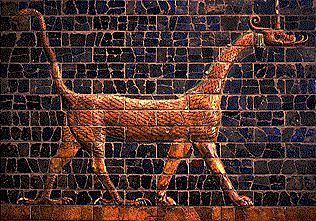
Okay, before I begin by discussion of this book, I will mention that the book itself was first published in 1989 and was edited by Stephanie Daley, however the reason that I have gone for the original dates is because I am more interested in the content of the ancient myths than any commentary or translation. There are many translations of these texts available on the internet or even in book form and Daley is really only one of many (or not so many as the case may be) that have looked at and translated these texts. Okay, I cannot read cuneiform (the Ancient Mesopotamian written language) and I also suspect that there are numerous phrases and words that are difficult to translate, however while I will give credit to the translators for allowing me to access these stories, I generally do look beyond them to the original author (whoever that may be). Now I have already looked at three of the myths in this book elsewhere, the Atrahasis, the Epic of Gilgamesh, and the Enuma Elish, so I will not go over ground that I have previously explored. However before I look at some of the other myths in this book there are a couple of things that I wish to point out. First of all we encounter creatures with what appear to be untranslatable names, such as the Mushussu Dragon. Now there is a page of drawings (page 316 of this edition) which includes pictures of some (but not all) of these creatures, so if you would like an idea of what they are referring to, look at that page. Anyway, there is a Mushussu Dragon (I originally wrote this prior to working out how to use HTML):
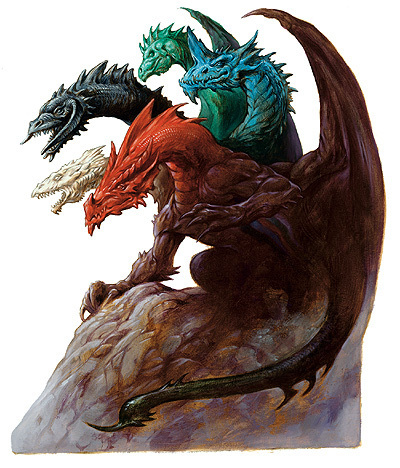
However there are some instances where we don't even have a description; one case is that of Tiamat. Now, being a roleplayer of old, I cannot help but envisage Tiamat as a multiheaded dragon.
The truth is that there is no connection between the Dungeons and Dragons image of Tiamat (above) and the Mesopotamian image. Maybe there is a drawing of her somewhere, but from the Enuma Elish, all we know is that she had a tail.
The myths I want to touch upon include Ishtar in the underworld. Ishtar was a major female deity in Mesopotamian mythology, probably connected to the female deities in other religions (such as Isus or Hera), however here we see her take on the role of Persephone in that she travels to the underworld. However, unlike the Greek myth, she is not kidnapped, but goes down herself and performs a hostile takeover. It is interesting, and we see a similar thing in the story of Nergal (though that is a marriage) in that to reach the underworld, she must not only pass through seven gates, but must perform a ritual at every gate, which involves her removing an item of clothing so that when she does reach the underworld she is naked. Maybe that is a representation that in death we are not able to take anything with us, or maybe even a reflection that for us to be able to truly ascend (or in her case descend, but remember this is a power grab) one must dispense of all worldly wealth, which is what Ishtar has done. We have another couple of myths, the Entana and the Anzu, which also seem to be stories of power grabs. Unlike Ishtar and Nergal, this is not a power grab in the underworld (apparently taking authority over the realm of the dead) but rather a power grab in heaven. We see quite a few of them, with Tiamat making a grab for power in the Elish Enuma. The Anzu is more detailed than the Elish Enuma as here we have Anzu stealing the Tablet of Destiny as a means of securing his authority in heaven. It looks as if the authors of the Forgotten Realms Avatar Trilogy stole the idea from Mesopotamian mythology (and it isn't the first time that the creators of Dungeons and Dragons have done that, as per my comment on Tiamat above). Now, the Tablets of Destiny represent the law as handed down by the gods (or at least the original creators of civilisation). It appears that in stealing the tablets, Anzu gives himself authority because he now is the one who holds the law. This is the nature of power in our world. The legislators create the law, the executive enforces the law, and the judiciary interprets the law. It is also a theme that runs through the Bible, in that he (or she) who holds the law has power and he (or she) who can create and enforce the law, has power. Now I will finish off with a word on the structure of these stories. While some of the stories (Gilgamesh and Enuma Elish) seem to be complete in themselves, others seem to simply be a bare bones outline. There really does not seem to be much in the way of padding in these stories. For instance in Nergal we have a list of seven gates which Nergal passed through to enter the underworld, however there is no indication of what Nergal confronted when passing through the gates, or what rituals were required to be performed (as in the case of Ishtar). My suspicion is that these clay tablets served more a prods to memory that actually being the story itself, and if they were spoken as is, it would probably have taken no more than 10 minutes to tell. We see similar things in the Bible where we have a 10 minute sermon recorded, though it is likely that the writer only noted the salient points that we needed to know or understand. The classic example is the Sermon on the Mount. The Bible seems to suggest that Jesus taught a lot longer than what is recorded in Matthew (and Luke). I suggest that the same is the case here. This is probably also a good explanation as to why the stories seem to change. My final comment will be on the last myth in this book and that is Erra and Ishum. At the very end of this story we have what could be considered an Ancient Assyrian copyright notice. Assurbanipal pretty much says that this story was written by him, and woah betide anybody that attempts to plagerise his work. It seems as if copyright and plagerism were as important back then as it is today. Oh, and I should also mention that a number of names (such as Marduk) appear in the Bible as well, though they tend to refer to blind, death, and dumb idols. That is not surprising because we are talking about people who, at the time that the biblical account was written, were long dead. Okay, while a persons legacy may have an influence on future history (such as Socrates) praying to them and asking them for help is pointless: they are dead. What the Bible is doing is not undermining any reality that may have existed for these particular people, but rather pointing out the fruitlessness of ancestor worship. If there is only one true God, and this one true God can hear and answer prayers, it is futile to pray to a dead person who, in reality, cannot respond.
I can't really properly rate any of the works in here given how fragmentary they are, but this is certainly quite the scholarly achievement from Dalley in compiling so many Mesopotamian texts, with incisive commentary, and in one single volume.
While the continuity of a language isn’t always synonymous with that of a civilization, the former can undoubtedly facilitate the latter. The Akkadian language—or language group, depending on how one classifies its Assyrian and Babylonian dialects—was the lingua franca of the Near East for nearly two thousand years, from the middle of the third millennium BCE to the middle of the first; and this allowed for the development of an extraordinarily rich and stable common culture that persisted in a feedback loop with a wide array of local cultic permutations, floating above the insularity of city-state regimes and the transience of regional empires subject to rapid collapse and replacement. The stories told, retold, and adapted for contemporary circumstances by these “black-headed people” would exert a conspicuous influence on the mythographies of their Canaanite and Israelite cousins as well as on those of the Greeks. If one accepts the premise of a contiguous entity called “Western Civilization,” it would follow that two of its three prongs—Athens and Jerusalem—took shape on the peripheries of a much more vast and ancient ecosystem dominated by Akkadian speakers, and were partially nourished by their cultural output.
The quest for personal immortality and permanence in communal life are prominent themes in these writings, as is the conviction that life itself, for gods and men, is the object of a perpetual zero-sum struggle. Life is perceived to be of limited quantity, with the most powerful and knowledgeable enjoying the largest share; a vision reflecting the inherent tension in ancient Near Eastern societies between the procreative instincts of humanity, the finitude of resources and spaces conducive to urban life, the presence of other nations and clans as rivals for these means of sustenance, and the ubiquity of superhuman forces—famines, plagues, floods, and wars, often hypostatized as the work of gods and demons—that violently cut a flourishing population down to size. Since the human world is an extension of the divine one, with no fixed border between them, the conflicts and contradictions characteristic of the former are inseparable from those of the latter. The human order is simply the bottom rung of the divine order: humanity is a servile class which is both the offspring of clashing divine-natural forces and a release valve for their accumulated tensions; useful for menial labor but also noisy, quarrelsome, and a bit too clever for their own good.
Thus, according to the Atrahasis myth, human beings were created to resolve a labor dispute between two races of gods: the noble Anunnaki and their younger and more subordinate counterparts, the Igigi. The Igigi were set to work digging out the watercourses of the Tigris and Euphrates, but quickly grew weary of the onerous yoke set upon them. They protested their lot by gathering around the home of Ellil, the “counsellor of the gods,” and demanding relief. Ellil convened a council of the Annunaki, who determined that a new race should be created to carry their workload. But because the amount of life in the world doesn’t change, only who has access to it, the creation of humanity required the sacrifice of one of the Annunaki. Ilawela, “who had intelligence,” was slain, and under the guidance of Ea/Enki—the god of wisdom, who would prove to be sympathetic to humanity, much to Ellil’s consternation—Mami mixed his flesh and blood with clay, whereupon “a ghost came into existence from the god’s flesh, and she proclaimed it as his living sign. The ghost existed so as not to forget (the slain god).” The human life essence is therefore the ghostly afterlife of a dead god, and the human heartbeat an echo of the drums used in the sacrificial ritual. The gods spat on the clay, Ea treaded it, and Mami pinched it off into two groups of seven: seven men and seven women, the first human beings.
The creation of humanity allowed the Anunnaki and Igigi to settle their differences and maintain the life of leisure befitting nobility. But within a few generations, this new proletarian race had proven worrisomely fecund. From the perspective of the propertied few, the danger posed by the working poor lies precisely in their numbers and their capacity for rapid proliferation. When some of them are considered part of a separate, foreign people, their very capacity for multiplication is often portrayed as an existential threat, a fifth column for external enemies, and even as a sign of their own stupidity and malevolence; they are caricatured as mindless breeders and sexual aggressors preying on the native and well-to-do. In Genesis, antediluvian humanity increases in wickedness as it increases in population. Contemporary Israeli fears of Palestinian demographic growth and the perennial portrayal of the latter as proxies for Egypt under Nasser, Iraq under Saddam Hussein, or Iran under the ayatollahs, are perfectly analogous to the rationale offered by Pharaoh at the beginning of the Exodus story for enslaving the Hebrews and ordering the murder of their newborn sons.
Fed up with human beings and their racket, Ellil makes several attempts to eliminate them through plague and famine. In each case, Ea confides to a wise man named Atrahasis the secret of which god to propitiate with sacrifices to bring relief. When Ellil resolves to send the Flood to rid the world of this nuisance once and for all, he makes Ea and the other gods take an oath of secrecy, which Ea subverts by revealing to Atrahasis indirectly in the form of a dream that he should dismantle his home, build an ark, and fill it with living things. When the Flood comes and Ellil spots the ark, he rages at Ea and curses women with stillbirths, the “pasittu-demon” who “snatch[es] the baby from the mother’s lap,” and the institution of the Nadītu, a class of women connected to the cult of Shamash in Sippar who were forbidden from marrying or having biological children. Given that the version of the myth presented in this volume was written in Sippar, it was likely intended to explain the purpose of this very institution as a means of population control to avert the wrath of Ellil.
The Enuma Elish, the great Babylonian creation epic, tells quite a different story, but one with many of the same basic elements. As in the Atrahasis myth, the creation of humanity requires the sacrifice of a god; but here the victim is Qingu, the defeated champion of Tiamat, who led her army of chaos demons in its failed effort to destroy the gods of order and return the cosmos to its original quietude. Apsu and Tiamat had created the gods by mixing their waters together, but Apsu, like Ellil vis-à-vis humanity, had become weary of their commotion and plotted to destroy them. Ea had learned of this plot and preempted it, killing Apsu, stealing his crown, and ruling in his stead. An enraged Tiamat raised her own army to accomplish the deed her lover had intended, but Ea had a secret weapon of his own: Marduk, the great warrior-god and patron of the Babylonians (known by the Assyrians as Assur), who Ea and Dankina had created inside the slain Apsu.
Marduk ensnares Tiamat in his net, uses the winds given to him by Anu as a weapon to force her mouth open and distend her belly, and splits her down the middle with an arrow, fashioning the heavens and the earth from her corpse. He founds the city of Babylon and makes it his personal dwelling place, as Yahweh would later do with Jerusalem and its temple. At his request, Ea creates humanity with the blood of Qingu so that the gods can rest from their labors. Marduk is acclaimed absolute ruler of the cosmos by the entire pantheon, and the epic ends with a long list of his names and titles, probably reflecting Marduk’s assimilation of local cults as the avatar of the Babylonian Empire and the proto-image of its king. The prevailing motif here is not so much a distinction between classes or estates that runs through the divine and human worlds, but rather one between order and chaos. All the forces of cosmic order, from the gods to the kings and nobles who stand in for them on earth, to the great body of common people, are engaged in a common struggle to impose and maintain order amidst the forces of chaos and disintegration. It is the perfect imperial ideology.
The power and prosperity of the Babylonian people depends on their unique relationship with Marduk: “Though the black-headed people share out the gods, as for us, no matter by which name we call him, [Marduk] shall be our god.” Compare this with Deuteronomy 32:8-9, which states that when the supreme god Elyon divided out mankind, he assigned each nation to one of his divine sons, and that Israel is Yahweh’s portion; or with Exodus 6, in which Yahweh tells Moses that whereas the patriarchs knew him as El Shaddai, he will now reveal his true name as Yahweh when he liberates Israel from the Egyptians and takes them to be his own people. The background to this is likely the replacement of El by the warrior-god Yahweh as the head of the Canaanite/Israelite pantheon near the turn of the first millennium BCE.
Atrahasis has a number of alter-egos in ancient literature, the best-known being Noah and Deucalion, who, according to Ovid’s Metamorphoses, on the advice of his father Prometheus, built a “chest” in which he weathered a Flood unleashed by a wrathful Zeus. But the one most directly pertinent to the Atrahasis story is Ut-napishtim, who Gilgamesh makes a long and perilous journey to meet after the death of his companion Enkidu—traversing a mountain pass guarded by scorpion-men in total darkness, sailing across a sea no mortal had ever spanned—to learn the secret of immortality. We learn from Ut-napishtim that he himself has become immortal: a gift bestowed upon him by Ellil after Ea and the other gods, pleased at the aroma of his postdiluvian sacrifice, were able to convince Ellil that trying to wipe out all mortal life because he found humanity annoying was a bit of an overreaction. Despite his own immortality, Ut-napishtim scolds Gilgamesh for seeking to overcome death, the common fate of all—well, most—people. The gods, he says, have reserved eternal life only for themselves, and it is futile and destructive to wish it were otherwise. He instructs Gilgamesh to stay awake for six days and seven nights, but Gilgamesh succumbs to sleep, further illustrating the impossibility of resisting the great sleep that awaits every mortal. But as Gilgamesh prepares for his return journey to Uruk, Ut-napishtim offers him a consolation prize: at the bottom of the Apsu—the primordial freshwater sea encompassing the entire cosmos—there is a special plant that restores youth to the one who eats it. Gilgamesh ties stones to his feet, sinks to the bottom of the Apsu, and recovers the plant. He resolves that once he arrives home he will test the plant on an old man. But it isn’t to be: while Gilgamesh bathes, a snake steals the plant and immediately sheds its skin.
Gilgamesh isn’t the only one for whom immortality is tantalizingly just beyond reach. When the fisherman Adapa breaks the wing of the South Wind after it capsizes his boat, Anu summons him to the heavenly court to explain himself. Before this fateful audience, Ea instructs Adapa to avoid eating the food Anu presents to him, telling him that the food of the gods is deadly for mortals. It is unclear whether Ea is deliberately deceiving Adapa or is merely mistaken, but it turns out that the food Adapa dutifully refuses is the bread and water of eternal life.
Such are the best-laid schemes of mice and men. But even the gods can lose their power over fate. One myth tells the story of Anzu, a demon with the body of an eagle and the head of a lion, and his theft of the Tablet of Destinies, a device that empowers Ellil to govern the cosmos and redirect the course of fate. Ninurta undertakes the task of confronting Anzu; but when he fires his bow, Anzu uses the Tablet to order the materials of the bow and arrows to return to their places of origin: the arrow shaft to the forest, the bowstring to the ram’s gut, and the feathers to the birds. On the advice of Ea’s messenger, Ninurta wears Anzu down until he sheds his protective pinions, then looses the arrow that finds his heart.
The Mesopotamians struggled for life, yearned for its proliferation and its ultimate victory over death, even as they acknowledged the apparent futility of their hopes in the face of inexorable time and fate. But their greatest triumph, and perhaps the true vehicle of their immortality, was the struggle itself, enshrined forever in their stories and retold in numberless iterations to the ends of the earth.
It's a middle of the road text, better than most, but far from complete. I'm not just talking about the missing fragments, either, although that's understandable. We've got ranges of over a thousand years of text printed in this volume, ignoring some older texts, like Inanna's descent being ignored in favor of Ishtar's more elaborate, but nonetheless curtailed, descriptions. The tale of Gilgamesh is almost always a required reading, of course, and the genesis story is very interesting, but we're still missing whole texts of Dumuzi or Tammuz which were nonetheless much more important to the people of the times than was even brought up here in this text. At best, I can say that this work is merely a short sampling of three whole civilization's written legends. I suppose I'm going to have to keep looking for a single source that collects and breaks down the altered generations of tales, perhaps even dovetailing their metamorphosis into early Greek and Zoroastrian. It would be much too much to ask to see how Inanna became Aphrodite and Isis, or how they became Mary mother of Jesus. I despair to see how Dumuzi the shepherd became the heart of rebirth and how his idea became Jesus. It's just too much of a concept to touch upon this early in our day and age. Quite a shame.
Then again, such concepts were probably too volatile for a mainstream edition and an editor thought it would be best to leave such works undisturbed for fear of shocking the plebs. Of course, nowadays, such a fearless edition would probably be heralded as innovative and bright, but I'm still looking. Perhaps I'd write one if I actually knew how to read the original text. Alas. I'm stuck here.
Here I review the whole book, not just Gilgamesh. I will do that elsewhere. I appreciate this collection as some of these selections helped me to understand better The Epic of Gilgamesh. Since these are the myths were selected to accompany Gilgamesh, I am certain all these myths were selected to shed light on the epic. Sometimes I see the connection more clearly and sometimes more dimly. But always. The GR group member making suggestions to me, told me that The Epic of Atrahasis/The Flood would help with background information to the telling of the Flood in Gilgamesh. He also suggested the selection Nergal and Ereshkigal as background for understanding the Underworld.
I would have preferred the longer form of Nergal and Ereshkigal rather than the shorter form included here. Ancient Superwoman showing her stuff and making her claim of the throne of the Underworld. Oh well. Dalley the translator says that the shorter form is all that is needed to inform Gilgamesh. I will find a copy elsewhere. The short form is included to highlight/inform an Underworld visit.
I chose the Oxford edition over a knowledgeable yet basic Penguin edition. I did not want the too-much-to-grasp Norton. Once again the Oxford has enough information to help an experienced reader who does not need deep understanding.
4 stars for being an excellent collection of the earliest Mesopotamian myths.
This book marks the beginning of my journey through a self-curated list of the “great books” in history. My interest in doing this started in 2020, when the words “postmodern” and “critical race theory” first landed on me. They were obviously a big deal. I knew I wanted to read the primary texts, but wasn’t sure where to start. Turns out, if you want to understand a theory or movement, you’ve got to look into what inspired it. Well, this led to that and I realized I might as well start as early as it gets. The amount of times philosophers, theologians, novelists, etc. allude to mythological figures and events is actually remarkable. Since starting this journey, I’ve picked up on a few times John Calvin refers to myths in his Institutes. Who would’ve guessed. It’s also very relevant for understanding the myths that shaped the identity of Babylon and the whole of Assyria in Old Testament times. It is in true Lewisian spirit to understand ancient myths not as threats to the Christian faith but as a “garbled and confused. . . word of the coming invasion to the ancient pagans,” the invasion being the incarnation of Christ and the inauguration of his kingdom (Joe Rigney, Lewis on the Christian Life).
The Epic of Gilgamesh and the Epic of Creation were my favorites. The battle between Marduk and Tiamat in the Epic of Creation is awesome.
I've decided to revisit my mythological studies. It seemed reasonable to start with Middle Eastern mythology. I had read this previously, and this is a great collection—albeit not exhaustive by any means. These would be considered the most standard texts on Mesopotamian mythology though. One must also admit that we are relegated to what has actually been discovered when discussing Middle Eastern religion and mythology. To a degree, one could probably surmise that works like the Epic of Gilgamesh and the Enuma Elish were not only important for the Fertile Crescent but also widely influential beyond that locale. You mainly have Accadian, Sumerian, Old Babylonian, and Assyrian texts here. Often, the texts of latter civilizations help fill the lacuna of earlier texts. Most of these texts are still fragmentary, but the overall stories can often be ascertained, and they are indeed interesting.
These texts are not new to me. I first became acquainted with them in Pritchard's Ancient Near Eastern Texts. Every once in a while I feel the need to revisit them because of their foundational character and influence. This collection can be purchased at a decent price and serves as a great introduction.
I've been reading mythology since I was a kid, and I'd read most of these tales before, but this is a superior presentation. Most of the introductory and explanatory information in other books reads like a professor speaking to students. Here we have a writer talking to readers. I appreciated that very much. For people who like stories from antiquity, this is a fun read. For those who prefer current best sellers, don't bother. The fragmentary nature of the stories will irritate you. But if you like Greek mythology, for instance, this will be a natural expansion of your literary experience.
أساطير من بلاد ما بين النهرين / ستيفاني دالي / ترجمة نجوى نصر / 490 صفحة .
في هذا الكتاب مجموعة كبيرة من أهم واروع أساطير وملاحم العراق القديمة التي كشف النقاب عنها والتي تشمل على سبيل المثال لا الحصر ( ملحمة كلكامش، نزول عشتار للعالم السفلي، ادابا، ايتانا، الطوفان، الخليقة، انزو ) وغيرها من الأساطير التي تركتها الاقوام القديمة في تلك الفترة الزمنية ووجدت طريقها إلينا . الكتاب جيد ومهم للتعرف على الفكر الديني العراقي القديم وما هي المعتقدات التي كانت سائدة، لكنه لن يكون ممتعاً نوعاً بسبب طريقة الترجمة الأكاديمية والتي قد يلاقي الشخص غير المطلع على هذه الأساطير والملاحم مسبقاً صعوبة في هضم مادتها .
This is an interesting collection of ancient Mesopotamian myths, of which the Epic of Gilgamesh is the most well known. It is difficult to read these stories as if you were reading just another novel. For me the myths were interesting mostly as a historical document. The texts are too fragmented and the religious context is too difficult to grasp for someone to read it purely for entertainment.
I found it especially interesting to see the parallels between these Mesopotamian myths and later biblical, Greek, and Roman stories. For example, Atrahasis (the Flood) is strongly reminiscent of the Arch of Noah, Gilgamesh is a prototype of both Odysseus and Heracles, and the parricides in the Theogony of Dunnu can also be found in Hesiod's Theogony (i.e. the succession of Uranus, Cronos, and Zeus).
When Alexander the Great conquered Babylon in 331 BC, the myths recounted in this book were already ancient. (Indeed, we owe what we know today in good part to a book written by a Babylonian priest to educate the newly-arrived Hellenistic conquerors.)
A fascinating work. The myths are interesting, their similarity to related mythology is interesting, what they tell us about life in Mesopotamia 4,000 years ago is interesting. The text is fragmentary, in places, and good portions of it are open to interpretation -- but as we are dealing with millennia-old stories, which would have been changing over time, inscribed in cuneiform on stone tablets, the fact that we have as much as we do is nothing short of remarkable.
This is a scholarly work. There are ample notes explaining the context, mentioning various alternative translations of key words, and directing the interested reader to other works.
This is a collection of some of the most well-known myths from the earliest human civilization. Given the great age and condition of the sources there are many gaps in the texts. Also, their role in ritual means that they are often repetitive. Leaving all that aside, these are wonderful stories with great characters. Here are pre-Biblical flood stories; Gilgamesh's quest for immortality; the passionate Ishtar's journey through the Underworld; and the deeds of the wise, mercurial god Enki, whose cunning protects humanity from the brute strength of his brother Enlil. Fabulous imagery and the emotions of the characters bring closer a world so different to our own, yet which laid the foundation for future urban societies.
This edition was a great introduction to Mesopotamian mythology and it had very insightful introductions and notes. The chronology of the myths enabled a natural expansion of the mythology to the reader. I particularly liked the occasional comparisons between the texts and other ancient texts such as the old testament and Greek mythology, and would personally have preferred more of that than the notes on different translations and styles. Some stories were a lot more interesting to me than others as a studying object in that sense, ie The Flood, Gilgamesh and the Epic of Creation, Gilgamesh being the reason I got this edition in the first place.
Finished: 13.08.2018 Genre: myths Rating: C Conclusion: I have to agree with another reader about this book: "Fascinating stories.....but rough going reading." But I did manage to write down how I survived this roller-coaster ride!
‘’(...) The alewife spoke to him, to Gilgamesh, ‘Gilgamesh, where do you roam? You will not find the eternal life you seek. When the gods created mankind They appointed death for mankind, Kept eternal life in their own hands. So, Gilgamesh, let your stomach be full, Day and night enjoy yourself in every way, Every day arrange for pleasures. Day and night, dance and play (...)’’ (Gilgamesh, the old babylonian version)
I denna bok finner vi tio mesopotamiska myter (däribland Gilgamesh eposet) som här har översatts från de akkadiska lertavlorna. Tyvärr har en hel del av dessa lertavlor kommit att skadats så pass mycket under de senaste tusen åren att berättelserna inte går att restaurera i sin helhet (vilket resulterar i att det blir en hel del glapp när man läser). Men (!) flera av dessa myter och legender fördes även under denna tid muntligt vidare av resande till helt nya platser, där de även kom att skrivas ner och bevaras. Man har således kunnat hitta mer eller mindre identiska versioner av berättelserna; något som också har möjliggjort att man i vissa fall har kunnat fylla några av de där glappen som uppstått (även om man inte kan vara heeelt säker på att det är rätt såklart). Men ja, det är himla spännande att få ta del av oavsett! Många av myterna som skildras går även att känna igen från bland annat det Gamla Testamentet, Iliaden, Odysséen samt Tusen och en natt! T.ex. den första myten berör Atrahasis (flodberättelsen), där gudarna straffar mänskligheten genom att utlösa en storm som ska svepa över jorden och översvämma den tills allt liv är utplånat… Guden Ea varnar dock Atrahasis om detta, varpå han bygger sin ark som ska rädda honom och de i hans närhet. Det finns helt enkelt en hel del som är bekant i dessa myter. Stephanie Dalley inleder dessutom varje berättelse med en övergripande introduktion till dess bakgrund som breddar ens förståelse och gör det lättare att ta till sig berättelserna (trots att de inte går att läsa i sin helhet då). Önskar just att dessa introduktioner var liite längre pga det är verkligen intressant! Superspännande läsning hur som! För den som är intresserad rekommenderar jag även Stephen Mitchells tolkning av just Gilgamesh, där han mer försöker fånga berättelsens essens och skriver om den till en slags helhet! 🤍✨
I suspect that for a student or scholar of Mesopotamia, this is an incredibly valuable resource, as the author’s translations of these texts seems extraordinarily precise - precise, unfortunately, to a fault, because by so meticulously notating every single gap & uncertainty in these infamously fragmentary texts, Dalley often produces English in what can hardly be called sentences at all. This is not her fault, nor is it the fault of the original mythographers, but rather the fault of time - all the same, while some of these stories (in most cases, the ones which are least fragmentary) are rich, fascinating reads, it is extraordinarily hard to recommend this book. Gilgamesh in particular has been rendered so faithfully as to be essentially unreadable, which is a shame, as it’s a magnificent story, one worth reading - just not here.
The myths present here are organized in a strange order, in my opinion, so that I often found myself thinking “oh, this is providing context for the previous myth,” and accordingly, I often wished I had read a given myth before the previous one. As a major plus though, I commend this volume for its detailed & thorough glossary, which consistently answered any questions I had about who the characters in a story were.
In short, a serious student of Mesopotamian myth will probably get much more out of this book than I, a layperson, did. Categorize yourself accordingly, and take all this as you will!
When reading the myths, I expected to discover more information on Ishtar and Tiamat. I've done personal research on Mesopotamian gods and belief systems, and I thought that in reading this, I would compliment that research with more, in depth information. Yes, this tradition stems from the oral tradition, so I understood that in some cases the myths would be limiting, but I had no idea so much of the myths were missing. There are huge gaps in most if not all myths in this collection. It did make reading both frustrating and almost fruitless. I am glad I read this collection, but at the same time it feels that general information off the Internet is just as good if not better than the stories here. You can get better synopsis than what was presented here. There are some very interesting tidbits in the story, but unfortunately no one understands exactly why they're there (for instance, the ritual for keeping someone protected from ghosts once they pass). Sad that there's so much missing.