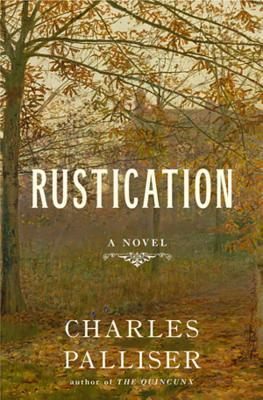
It is winter 1863, and Richard Shenstone, aged seventeen, has been sent down — "rusticated" — from Cambridge under a cloud of suspicion. Addicted to opium and tormented by sexual desire, he finds temporary refuge in a dilapidated old mansion on the southern English coast inhabited by his newly impoverished mother and his sister, Effie. Soon, graphic and threatening letters begin to circulate among his neighbors, and Richard finds himself the leading suspect in a series of crimes and misdemeanors ranging from vivisection to murder.
Charles Palliser (born December 11, 1947) is an American-born, British-based novelist. He is the elder brother of the late author and freelance journalist Marcus Palliser.
Born in New England, Palliser is an American citizen, but has lived in the United Kingdom since the age of three. He attended Oxford University in 1967 to read English Language and Literature, and took a First in June 1970. He was awarded the B. Litt. in 1975 for a dissertation on Modernist fiction.
From 1974 until 1990, Palliser was a Lecturer in the Department of English at the University of Strathclyde in Glasgow. He was the first Deputy Editor of The Literary Review when it was founded in 1979. He taught creative writing during the Spring semester of 1986 at Rutgers University in New Jersey. In 1990 he gave up his university post to become a full-time writer when his first novel, The Quincunx, became an international best-seller. He has published four novels which have been translated into a dozen languages.
Palliser has also written for the theatre, radio, and television. His stage play, Week Nothing, toured Scotland in 1980. His 90 minute radio play, The Journal of Simon Owen, was commissioned by the BBC and twice broadcast on Radio 4 in June, 1982. His short TV film, Obsessions: Writing, was broadcast by the BBC and published by BBC Publications in 1991. Most recently, his short radio play, Artist with Designs, was broadcast on BBC Radio 3 on 21 February 2004.
He teaches occasionally for the Arvon Foundation, the Skyros Institute, London University, the London Metropolitan University, and Middlesex University. He was Writer in Residence at Poitiers University in 1997.
In 1991, The Quincunx was awarded the Sue Kaufman Prize for First Fiction by the American Academy and Institute of Arts and Letters which is given for the best first novel published in North America. The Unburied was nominated for the 2001 International IMPAC Dublin Literary Award. Since 1990 he has written the Introduction to a Penguin Classics edition of the Sherlock Holmes stories, the Foreword to a new French translation of Wilkie Collins’The Moonstone published by Editions Phebus, and other articles on 19th century and contemporary fiction. He is a past member of the long-running North London Writers circle.
”You foolis old bitch when your husband was a rich cannen you thoht you were better than everiboddy. Everiboddy laffin at you no Your hor darter is getten fucked every day and everiboddy know it. They all know it xcpe you.
dont be proud the erls nevys grinding her. he sticks his dick werever he can men boys women girls cows sheep goat monkies. Even that wite corps Eenid. Damn his eyes. Hes done wrong to me and mine and I wont deny that I arent the man to give him a good thrashing.”
The Harroer.
Richard Shenstone has just recently been rusticated from the hallowed halls of Cambridge. Under the gloom of suspicion he returns home to the small coastal English town to a frosty reception from his relatives. Since his father’s untimely death, or maybe more timely than everyone thought, his mother has fallen on hard times. She lost his pension due to the circumstances of his dismissal from the church. She also, as it turns out, did not have as solid a claim on her recently deceased father’s estate either. Richard learns only bits and drabs and has to sort out the truth from the innuendo and the outright lies he is encountering.
Everything is a bit cloudy because he is seventeen, extremely horny, and addicted to opium. Not to worry, in 1863 those are fairly typical problems for a young man of means.
Things really start to heat up when all the women in this small community, one by one, receive these horrid, dastardly, titillating anonymous letters from an obvious illiterate. An example is the very one that I began this review with. The illusion to goats and monkeys is a bit of a giveaway that the man has read Shakespeare and so Shenstone believes the person to be an educated person working hard to disguise that fact with a peasant’s hand.
The letters only begin once our hero Shenstone arrives. Everyone knows he has literary aspirations. Working for a newspaper in London is his latest ambition especially since his Uncle has no interest in clearing up his debts at Cambridge. He also wishes to avoid the deportation to far climates that has been the latest suggestion from his family. It seems they want rid of him.
He is suspect numero uno.
The other niggling concern is that though all the letters are barbaric, rude, and crude there are a basis of facts weaved into each narrative that create uneasiness and real blushes in old and young alike. As Shenstone investigates it seems that everyone has gossip and everyone is willing to share a bit of it with him even if they do suspect him.
”You must promise solemnly never to breathe a word of it to a living soul.”
Ahh, yes, those words of swearing secrecy, most likely the same ones that were whispered in the ear of the person about to share some insidiousness with you about someone else. Gossip must never be confused with truth, but unfortunately lies or worse half lies always take on a life of their own.
He has suspicions about the purity of his sister, Euphemia. Effie has been seen, by himself and others, in the company of a local lord in a compromising section of town. She for reasons unknown has developed a powerful loathing for her brother. He, on the other hand, is starting to see her in a completely different light.
”She wore her hair up and was in a dark green velvet gown I’m sure I had never seen before. It left her shoulders perfectly bare and was cut so low that it emphasized her bosom in the most striking manner. There were raindrops running down her naked shoulders and onto her front and into the top of her bodice. She has become a very handsome girl--tall, black hair, large grey eyes, regular features.”
He can be forgiven for feeling the sway of lust for his lovely sister. After all he is walking around with an unusual gait that sways him from one side to the other depending on the current gravitational pull of his John Thomas.
Effie, feeling the power of her sensuality, uses it to evil purposes to induce poor Richard to do things he most assuredly does not want to do.
Meanwhile someone is butchering animals creating more havoc and more suspicion to be heaped upon the head of the young man seen frequently wandering about at night in what we know to be a blissful haze of opiates.
Richard continues to blunder about making spurious accusations against various people he believes to be involved in the plot against not only him, but the whole community.
He is, most unfortunately, wrong every time.
When he isn’t too busy making a complete ass out of himself he is trying to seduce the fourteen year old housemaid Betsy with bits of ribbon and honeyed sweets.
”She may not be beautiful but she is a girl and she’s young. Is she too young? She has little budding breasts. She must have begun to feel the sweet pain of unsatisfied desire. How I’d love to run my fingers round the back of her neck, burrow under the hem of her little blouse.”
Well and let’s just say it...her greatest asset is that she is conveniently located in his house.
Richard is keeping a journal of all these events. The more lurid moments involving lust have been carefully concealed in Greek letters. Luckily for us Charles Palliser provided the translations for us so we too can marinate in the soupy sexual desire of young Shenstone.
When the perpetrator is revealed Richard is gobsmacked. The truth about his father makes a life on a distant shore much more attractive. The willingness of his relatives to throw him beneath the nearest fast moving carriage has left him cold. The judgments of the community which are so hypocritically revealed are an eye opener for Richard as well. Every finger pointed in one direction might as well be pointed backwards as well. A very revealing portrait of a small town, filled with small people who all have secrets to keep as they gleeful divulge the secrets of others. An enjoyable quick read which reminds me of how much I’ve always enjoyed Palliser novels.
ten years after he wrote The Quincunx, a nearly 800-page book with really small type, charles palliser returns with this one - a 217-page book which looks like this on my nook:
so on the one hand, it's like COME ON, PALLISER!! FIT MORE WORDS IN THERE!!
and on the other hand, it is a perfectly good book that shows his facility with historical fiction and an unreliable narrator who keeps the secrets from the reader by going off half-cocked in about eighteen different directions as he tries to figure out what is going on through an opium haze complicated by a handful of unrelated personality disorders.
it's a sea full of red herrings.
palliser gets another chance to show off his knowledge of victorian english estate law, and this time he gets to work a little blue, all in the guise of just being charles palliser, the man who found this manuscript and is simply a disinterested presenter of historical artifacts, not the man who wrote these dirty violent bits.
and while this does fall into my "books that could have been completely avoided if its characters had about three conversations" pet peeve, it is a very fast-paced book that gives the reader enough "oh, i know what is going on" moments to feel puffed-up with confident pride in their deduction-skills, but then throws on so many layers of additional confusion/misinterpretation/new complications that after a while, the reader is uncertain what they have been told and what they thought they had figured out all by themselves. which in a book this short, is really something.
unreliable narrator, old crumbling house in the middle of nowhere, sudden poverty, and murrrderrrrr...
Love Gothic toned novels and this was a new author for me so I did not know what to expect. Loved it, it is not scary but is very suspenseful, a winding puzzle, and many characters that are unlikable. Our main character is a young man who has been sent down from college he, has been rusticated, for reasons he feels it is in his best interests to keep secret. He is a very unreliable narrator, addicted to opium, obsessed with sex, well that covers just about every nineteen yr, old. so not unexpected, and should be very unlikable. He is not however unlikable, a bit self-centered but his musings were very entertaining.
A scandal, a plot , a cook who does not really know how to cook, an old house, threatening letters, a murder and there you have it, all the ingredients for a wonderful story. Those letters are very graphic in nature but are necessary to the story. They actually provide clues, though I was not able to decipher these clues and spent most of the book wondering what was going on. Love these types of stories and this one was very good.
Coming home to find your mom and sister have moved into the House of Usher is worse.
But that’s not the only problem facing 17-year-old Richard, the feverish narrator of “Rustication.” Richard’s father has just died, deeply in debt, amid rumors of unspeakable acts. His tubercular mother has a tenuous claim on an inheritance, but until that judgment comes through — any day now, surely — the family huddles around a fading fire in a decaying mansion on a peninsula on the southern coast of England. At night you can hear the ghost of a dead baby in the chimney. (I imagine the real estate agent gushed, “Quirky charm!”)
“Rustication” — an antique word for suspension from college — is the fifth novel by Charles Palliser, an American who lives in London but writes in the 19th century. (“Quincunx,” his debut, was an international bestseller.) His new gothic mystery comes to us in the form of Richard’s recently discovered journal, which sheds light on a once notorious murder. “Someone has pasted into it a number of the anonymous letters relating to the case,” Palliser explains in the foreword. “I have reproduced them exactly as and where I found them.” And true to his word, there’s one of these letters on the very first page, reproduced in the scrawled font of a maniac — or an overachieving page designer — and containing such shocking threats of sexual violence that any good Victorian lady would faint dead away.
These notes — heavy on rape, castration and challenging yoga positions — are the garnish sprinkled throughout Richard’s journal of what happened during four winter weeks in 1863. By comparison, any family troubles you have over the holidays will seem like a Norman Rockwell painting — unless your holidays involve addiction, incest, pedophilia, vivisection, infanticide and murder, in which case you should stop reading this review and jump immediately to Carolyn Hax.
The sordid pleasure of “Rustication” arises from watching Richard try to make sense of the skewed world he discovers at home, where it’s so wet and dank that this novel should come with a tube of fungicide. He arrives from college trailing clouds of disgrace only to find that his newly impoverished family doesn’t want him either. “Why are you here?” his mother asks, while his sister greets him by saying, “You should leave as soon as possible.” Both women are unnervingly evasive; they leak provocative tidbits and then mutter, “I shouldn’t have said so much!” Richard is hiding his own indecent secrets, too — he’s 17, after all — but he can’t get a straight answer about his father’s death or their financial situation. He constantly has the feeling that he has interrupted conspiratorial conversations. “Why do you have to find a mystery everywhere?” his sister snaps at him as she scurries off mysteriously.
Since no one will tell him anything, Richard must solve the problem himself, but this investigation will require all his mental dexterity, which might be sharper if he didn’t spend every night toked up in his room on pipes full of opium — his “lovely little friends.” Like any addict, he repeatedly promises himself, “I will never smoke again,” but then as bliss washes over him, the benefits seem undeniable: “I am not fleeing from daily reality,” he claims, “but experiencing it more intensely.” (Tell that to the mutilated sheep, Richard!)
Palliser keeps us off balance by leaving us locked in Richard’s wildly unreliable narration. Strolling about the dank village — sometimes late at night — Richard finds that people react to him erratically, with inexplicable hostility. Could it be because he’s the one sending rape threats through the mail? Could be. But when he’s not high as a loon running around half-naked in the rain, he seems like such a nice young man — granted, one who’s been freebasing “Northanger Abbey.”
The novel’s weird genetic makeup is strangely alluring. Much of the story is taken up with ladies’ gossip, romantic strategizing and plans for the big upcoming ball. When they’re not worried about being raped and sliced open by a knife-wielding maniac, these women speculate about who the earl’s nephew will dance with first. In her greatly diminished economic station, Richard’s sister is still struggling to maintain her place in a rough game of marital competition, and somebody seems willing to kill to even the odds. Fortunately, Richard is on the case, analyzing those vile, anonymous letters and gradually decoding the deadly social tensions in this village as though he were the hero of a Victorian version of “The Curious Incident of the Mad Dog in the Night-Time.”
Palliser blows dark fog over the marsh just as adeptly as he choreographs the great battle of an afternoon tea. A literary Dr. Frankenstein, he has stitched together parts of Jane Austen and Edgar Allan Poe. The result is deliciously wicked, particularly as the violence grows creepier, the sexual tension more febrile. “I can’t throw off the feeling,” Richard writes in his journal, “that something malign is coming nearer and nearer. And in this house at the end of a promontory, I’m trapped.” I kept wanting to scream at him: “The journal entries are coming from INSIDE THE HOUSE!”
The pacing is generally good in “Rustication,” but the details of the plot get a little clotted toward the end. Just when we want the madness to climax, there’s a great effort to explain everything, which is considerably less satisfying than the full paroxysm of madness we crave.
Of course, if we knew for sure whether Richard was the maniac terrorizing this village, the novel wouldn’t have much suspense at all. Not to give anything away, but at one point, he tells his mother that he plans to support himself by moving to the city and becoming a book reviewer. At that moment, I knew he was crazy.
Palliser has written a tale that is interesting as a period piece, set in 1860’s England, but I can’t say much else positive about it. The story is told via a series of journal entries written by a young man named Richard Shenstone between December 12th, 1863 and January 13th, 1864. I found RUSTICATION to be unwholesome, tedious and without any redeeming characters. The author of the journal is a seventeen year old opium smoker who has been rusticated from Cambridge and has sexual fantasies about nearly every young woman he meets. In this tale, there are a series of vulgar anonymous letters, animal mutilations and a murder that are never resolved and very little for me to recommend. This is a novel for those with an insatiable interest in the crueler aspects of Victorian society, whoever they may be.
Puzzling and mesmerizing, this gem takes you by the hand and leads you from finding the protagonist and narrator a detestable little pervert (although an extremely engaging writer) to rooting for him against all odds, sinking into the atmosphere of a gloomy, impoverished family home and questioning every word and action from the entire mysterious, fascinating cast. Additionally, this reads as exquisitely historically accurate. I do wish we could have had a more conclusive ending though, and that could have been achieved by forgoing that whole "old manuscript found and published by the author" structure, which I tend to dislike.
A fantastic read until the last 1/4, where it sputters and spits away to nothing. The ending was extremely disappointing. What attempts to pass for mystery and intrigue seems more hurried than anything else. I was disgruntled with the way the story was wrapped up.
ETA: there is not a single likable character in the book save one, and I might be wrong about her. I wanted to like this, and it had such promise, but in the end it was just mediocre.
Loved it, loved it, loved it. I had to write that three times to convey my enthusiasm. Rustication is a delightfully creepy mystery narrated by a complex young man who has been sent home from Cambridge under mysterious circumstances.
Instead of settling in at his family home in Thurchester, Richard finds that his mother and sister have relocated to an embarrassingly shabby house in a depressing hamlet. Former friends shun the family. His mother wastes what little money the family has left in the corrupt Chancery court. Richard has also recently learned that his father died, and no one will explain the circumstances or why no one failed to notify him. His sister Euphemia, a dichotomous young woman who fluctuates between being an amusing companion and a spiteful harpy, will stop at nothing to obtain tickets to a Christmas party that the family cannot afford by any means.
Richard spends his days lamenting the loss of his luggage, which he can't retrieve until the roads dry. He seems to sleep in late and frequently takes walks late at night, and often sees lanterns or other evidence that he's not alone outside. He's not above spying on people either. The only friend he seems to have is a kindhearted widow, Mrs. Paytress, but the villagers subject her to vile gossip.
Things are bad enough, but become much worse. Residents receive cruel letters from an anonymous sender that make horrific allegations, yet may be rooted in grains of truth, as based on gossip that Richard picks up. Farm animals are the next victims, though I'll leave those graphic and disturbing images alone. All evidence points to Richard.
It comes together in a stunning and exciting conclusion.
The writing is superb - I truly felt like I'd set foot in the most miserable place in England. Mr. Palliser does an excellent job of describing the town and interpreting actions through Richard's eyes. We see Richard make false assumptions and change his mind frequently, thus keeping the reader unnerved in a delightful way. It's important to pay attention to every detail in this book. Nothing is gratuitous. I had to flip back and reread sections frequently.
There are some problems with the book. For starters, all dialogue is in italics. I found this to be extremely distracting. In a way, it could help remind the reader that we're only hearing conversations as Richard remembers them. However, it caused some eyestrain and I think it was unnecessary.
The animal torture - that was difficult to read and I found it unnecessary to the overall plot. There are other devices that could be used to inflict fear into the villagers, and this was why I couldn't give the book 5 stars (if there were half star ratings available, this would be a 4 1/2). The letters and tokens were disturbing enough.
There are a number of unresolved subplots. In a way, they were sort of red herrings that enhanced the story, but I wanted to know what happened. Namely,
And if I may allow one complaint: the back cover of the book and the Goodreads synopsis above reveal what I consider to be a fairly important spoiler:
I received a copy of this book in a Goodreads giveaway. This in no way influenced my review.
*I received this book as an ARC through a Goodreads giveaway.*
I wanted to like this book, I really did. First off, Charles Palliser is an excellent writer, that is evident right off from the first few pages. His tone is engaging, a bit formal but elegant. I haven't read any of his other books, but he is clearly talented and I would gladly give any of his other works a try.
But this one...first thing that drove me crazy: the dialogue was only printed in italics, no quotation marks used anywhere! It was so bizarre, I simply couldn't get used to it. Half the time I had to re-read sections because I wasn't sure which character was speaking. I don't know if this is a quirk of the author's or if it's because it was an ARC copy. Either way, DID NOT LIKE. Second, and this was the big one- the characters are all awful. Richard, the lead character is selfish, narcissistic, lazy, and a drug addict who can't stop fantasizing about opium and sexual acts with every female he meets. His sister is no better, with her insane mood swings and all-around cruel streak towards all around her. The mother, a simpering beaten down woman who can't even make her own children behave under her roof. The supporting characters are just as bad too. Now I've read books with some truly horrendous lead characters (Gillian Flynn, anyone?) but there was always at least one point where I felt pity or sympathized with the character in some part of their experiences. I felt none of that with the characters of Rustication. The plot was fairly intriguing to begin with, but still slow going and every time I felt a bit closer to something truly interesting, one of the characters would have a tantrum again and I would get irritated and not want to continue. Honestly, halfway through I just stopped caring and lost interest in what was happening. Sadly this book was definitely not for me.
One day I shall read ‘The Quincunx’, Charles Palliser’s much lauded, neo Victorian debut novel; but it’s such a very big book that I know that I have to save it until I can give it the attention that I am sure it deserves.
I loved the novel that followed that one. ‘The Unburied’ wasn’t quite so long, and it was the most wonderful pastiche of the Victorian novel; a complex mystery, that came to light and was paid out to a conclusion when, in 1919, records that had lain in the Thurchester Records Office were unsealed.
When I saw ‘Rustication’, another neo Victorian novel, not nearly as long as that one that came before, also drawn from documents held by the Thurchester Records Office.
It’s a much simpler affair: this one young man’s account of a dark time in his life, recorded in his diary.
Rustication In December 1863, on a wild and dark night, seventeen year-old Richard Shenstone, was travelling to a new home, a dilapidated and apparently haunted house in the Kentish marshlands. His family fallen terrible since he had left his old home for Cambridge, since his clergyman father’s sudden death; and he had been sent down – rusticated – for smoking opium and being involved, in a way he was disinclined to explain, in the suicide of a similarly intoxicated friend.
His mother was not pleased to see him; and she would not explain why he had not been called home for his father’s funeral, or why she had lost so much and been brought so much lower than she should have. All she wanted was for him to leave.
His sister, caring only for her own position, wanted the same.
He didn’t want to stay but he had nowhere else to go, and he wasn’t prepared to go until he had answers to his many questions about his family’s circumstances.
His mother and his sister maintained a cold silence; the only warmth in his new home came from Betsy, the new, young maidservant, who sometimes allowed him to make late-night visits to her garret.
It is not long after his arrival, that anonymous letters begin to circulate among his neighbours. The letter are obscene, they are threating, and it seems that they always contain at least a grain of truth. And there are attacks on animals, and other strange happenings, carried out in the dark of the night.
Shenstone is regarded with suspicion and so he sets out to find the culprit. He considers Miss Bittlestone, a poor relation of the local rectory family. He considers the enigmatic Mrs Paytress, who has only recently settled in the district, and whose history is unclear. And he considers his sister, Euphemia, who he comes to believe is involved with the bastard son of the local earl.
But can he find the answers he needs before the net closes on him?
The plot is wonderfully complex; there are twists and turns, there are secrets and lies, and there are many questions of authenticity and reliability to consider. The atmosphere and the evocation of the period is pitch perfect, and the detail is so very, very rich.
But I found a great deal wrong with this book.
The story of the anonymous letters and the animal attacks is reminiscent of ‘Arthur and George’ by Julian Barnes. I know that story was inspired by real history, and that this book might have been inspired by the same history, but I didn’t want to read it again. Was the author not aware, or did he not care?
I also have to say that there was too much in this book that was familiar from other neo Victorian novels. It might be that I have read too many of them now, but I am inclined to think that Charles Palliser was once ahead of his contemporaries, but that he hasn’t moved forward, and that they have caught up with him now.
And then there was the diarist. His voice rang true, but I found it difficult to care for this self-obsessed, sexually obsessed young man, and his account felt so one-dimensional. There was a fine story of a troubled family at the heart of this novel, and it would have felt so much richer if only more documents had been archived with the account that I read.
The details of the diarist’s sexual fantasies were gratuitous. The animal attacks were not gratuitously described, but I really didn’t think that they were necessary at all.
I also have to question that diary itself. I didn’t believe that the young man at the centre of the story would have written in his diary as he did.
Of course he could be unreliable, the diary could be a fabrication; it’s an interesting possibility but I can’t quite believe it as that either.
But I really don’t want to go on thinking about this book.
I hate having to write so negatively, but when I pick up a book that I expect to love and find much to hate I have to.
Charles Palliser still writes and plots brilliantly; but I have to question his choice of material and his attention to this book as a whole.
In this sordid Victorian mystery, seventeen year-old Charles returns to his family home after getting kicked out of college, only to find his mother and sister living in a horror movie. Lots of weird noises in the night, meaningful glances and hints at unspeakable deeds, that sort of thing. Richard is a mellow guy, being addicted to opium, and mostly just wants to smoke his pipe and poke every girl in the county with his manhood. Sadly, he is constantly distracted from his simple pleasures by the escalating madness around him. Someone is sending obscene anonymous letters to the ladies and mutilating farm animals, and more than a few fingers are pointed at Richard. Richard, being a little slow on the uptake, blunders into the parlors of the local gentry, and finds that these ladies and gentlemen are anything but. Vicious gossip, social bullying and rumor mongering abound. Victorian mean girls really are the worst.
It's well written, suspenseful and clever, though the ending was a little disappointing after the build-up. If you're tired of filthy, horny, unreliable narrators, you most likely will not enjoy this. I find that filthy, horny, unreliable narrators tickle my funny bone. I had such fun reading this I feel I must be very indecent and unladylike indeed.
What an exceptional book this was! From the description I wasn't quite sure what to expect, but it seemed intriguing. I loved how the story kept deepening and twisting about just as I thought I had my head around it. I did figure it out but only just before the big reveal, which was perfectly fine by me.
Most surprising was how much I enjoyed hating, and then becoming sympathetic to, the young narrator. He's just awful in just about every way - selfish to say the least - but you never forget that he is a child. Rather I think the character unintentionally never lets you forget, because he would absolutely say he's a grown up. Anyway, I thought the way he was written was absolutely brilliant.
Well done Victorian novel can be such a treat and Palliser has received so many accolades for his work, this looked worth a try, but it failed to impress. Which is to say that Palliser is certainly talented, but it shows in the writing so much more than in the plotting itself. For a plot there is an epistolary story told by a 17 year old young man who comes home after being thrown out of college to discover a nefarious goings on in his home and surrounding area, secrets his family and the townsfolk are hiding. So, sort of a crossbreed of a historical mystery and a classic victorian drama, but it comes across as neither Holmsian or Downton Abbeyish. The narrator is an annoying petulant junky. His family are all sorts of morally challenged. The plot is somewhat muddled and unnecessarily stretched out. It was a quick read and it was decent enough, but not the best of introductions to an author. On the positive note, the readers get to discover lovely antiquated words like lucubrate and rustication itself.
Charles Palliser has pulled off a very difficult feat. He has written a book that both draws on familiar territory (Wilkie Collins' "Woman in White"; Dickens' "The Mystery of Edwin Drood") and creates a completely new reading experience. "Rustication" uses familiar Victorian themes-class consciousness, opium addiction, genteel poverty, to name a few-to lull us into a sense of complacency and then turns the whole plot upside down not once but several times. "Rustication" has been referred to as a kind of "Gone Girl" for historical fiction fans, but it is a much better book than that. While "Gone Girl" is memorable mainly for the audacious party-trick at its heart, Palliser's book will linger as much for its perfect pace, its flawed, fascinating characters and its use of language, which is both spare and elegant. A cracking good read, ideal for mystery lovers, fans of the Gothic novel and anyone who thinks they've read it all !
Whenever I read Charles Palliser I think of edifices. His books call to mind that memorable remark made by Ian Rankin in his novel ‘Knots and Crosses’ ... ‘that Edinburgh was all appearances’ ... a city ... ‘of fur coats and no knickers’. Palliser’s edifices are like that; whether they are Architectural, Social or Moral, invariably they are to be found woven together into a rich texture creating a facade behind which the true fabula can flourish. This penetralia of the narrative, the naked backside of its characters, is frequently the location for a bitter core of hypocrisy and class-ridden pretence, a recurring theme to which all his characters are seemingly in thrall. In ‘The Quincunx’ (1989) for instance, by any authorial standards a magnificent achievement, the edifice is not merely built from the social mores and the probity of behaviour and entitlement in exalted circles, but from the sheer volume of text too, all designed to enclose and obfuscate the great mystery at the centre of the book. It has all been done before, of course, most notably by Dickens, but that in itself does not diminish what Palliser has accomplished. In his novel ‘The Unburied’ (1999), Palliser’s study of death, and forgiveness for transgression of the social code, architectural edifices, in the shape of a Cathedral and its Close are brought to bear in way that is reminiscent of the atmosphere created by such works as ‘The Mystery of Edwin Drood’ and the short stories of M R James. In this case the architecture is both a reminder of, and a metaphor for, the oppression of history, the established beliefs it represents, and the claustrophobic influence the past can bring to bear over the present.
‘Rustication’ (2004) is a shorter novel than the other two I have mentioned, but it bears all the hallmarks of a Palliser text. Careful, precise use of language, a central elusive mystery and a close analysis of the precarious nature of social structures in Victorian England. The narrative is told in the form of a journal by one Richard Shenstone who is sent down, or ‘rusticated’ from Cambridge, and arrives back at the family home, a dilapidated mansion on the South Coast of England in the winter of 1863. This device enables us to see ‘polite’ society through an individual who is effectively an outsider, a deviant who does not conform. For Shenstone rustication soon becomes ostracism; what he encounters amongst local society are crooked secrets and lies which include every kind of perverse behaviour hidden behind a wall of social propriety, even in his own family. These edifices soon begin to break down as Shenstone’s own sexual and social repression acts as a catalyst for the disintegration of the carefully prescribed relationships and prejudices in the community. I will not spoil the carefully constructed plot but suffice to say that the ‘knickerless’ population is ultimately revealed for what it is, a superficial structure built on sand. Perhaps at its bleak heart the novel reminds us that all artificial social structures, the necessity for ‘getting along’ with our fellow human beings, requires that we hide our true selves behind a mask of supposed civility. Those who do not aspire to this convention risk the opprobrium of an unforgiving world unable to accept certain truths about individuals, but tacitly requiring an idealised version instead. The really terrifying conclusion from this is that when all the niceties are stripped away, a meaningless void is all that is left. Society is always one step away from anarchy.
This is hardly revolutionary stuff; Dickens and others have already made us aware of the hypocrisy rife in Victorian middle and upper-class life, but is Palliser, writing in this day and age, actually asking us to consider, when we look deep into our own souls, that the intolerances and prejudices of our own time are really any different? Can we honestly say that difference and diversity are uniformly tolerated? It’s certainly a question that needs asking.
Whilst ‘Rustication’ is not Palliser’s best novel, it’s hard to see how he can improve on ‘The Quincunx’; it is what he does supremely well. For that and the pages of elegant, occasionally savage writing, and intriguing mystery, it is well worth reading.
I'm flummoxed by this. I've been waiting a long time (10 years) for more novels from Charles Palliser. This has so been worth the wait and the anticipation was completely rewarded. First of all the physicality of this edition - it's an over-sized paperback so feels quite substantial. The pages are a thick, creamy, gorgeous smelling creation. The text format is magnificently worked as a recently discovered journal. I love this kind of novel as I think epistolary/journalistic writings heighten the realism, they do for me anyway. I was completely drawn in from the first sentence. The characters are very realistic and flawed individuals, there are few likeable characters. The story is told through the eyes of a young man returned shamefully from Cambridge under a cloud of his own scandals to find his mother and Sister are struggling with their own. The story is released slowly and tantalisingly over the course of a few weeks. The narrator, Richard is completely unreliable and shown to be a devious, manipulative liar who has an opium habit. I really don't want to say anymore as I do not wish to ruin it for new readers. This is my favourite book of the year so far.
One of those potato chip type books--not very good, but crunchy, salty, and hard to stop eating, I mean reading. But despite the intriguing start, it is confused, and (it almost goes without saying) a big ol' letdown at the end. Yet Palliser writes very well and he certainly knows how to conjure up paranoia, and a dark nasty 19th century gothic atmosphere. I wish this book had been a little more meaty. I wish the narrator was more sympathetic and thoughtful. All he does is whine and not understand what is going on. Oh, and take opium.
I wish that all writers would understand that unattractive characters can be quite compelling, and that readers will be happy to make the journey of the novel with a less than perfect character. BUT, truly tedious, shallow, and whiney characters grate on the nerves after a very few pages. I can't stand people like that in my life, so why would I endure chapter after chapter of a wanker like the dude in this story? The guy is a real drag but I had to put up with him so I could find out what the mystery was all about.
I've never read Palliser before, but I certainly will now. Rustication is excellent historical fiction. Atmospheric, well-written, and hard to put down. When Richard Shenstone is sent down from school, and shows up at the creepy, empty house that his poverty-stricken mother and sister have retreated to after his father's ignominious death, you know from the start that things are not going to go well. As the reader begins to grasp the forces that are closing in around him, the tension of Richard's naivete begins to become unbearable. When vicious anonymous notes begin to circulate, and someone starts mutilating animals, things grow steadily worse. As Richard stumbles about, trying to find his way amidst unforgiving and self-righteous neighbors, rumors and gossip, his own actions become suspect, and the reader must decide just how much to trust him. While I thought the ending was just a bit flat, it wasn't enough to ruin the book for me. The story is great, and well worth reading.
Wow this book was really addicting!! I had to stay up until 1 o'clock in the morning to finish it. Super compelling, mysterious, and also disturbing. It had several of my favourite things (to read about): opium addiction, murder, the Victorian era, haunted houses, scheming neighbours, secrets, etc. I loved how Palliser really turned the reader into a detective by telling the story through Richard's journal and having Richard be clearly an unreliable narrator. It made me race to read through the pages to find out what was really going on and to interpret the other characters' actions/words differently than Richard himself did. I guessed at a few of the mysteries before they were revealed to Richard but that was kind of the point! Anyway, really great story, really great mystery, really creepy and dark characters, ominous, atmospheric setting and well written! Really enjoyed this book! This is why you read!
This book is a perfect example of why it's ok to not finish a book if you just aren't enjoying it. I knew from page 2 we had a problem, but I gamely kept trudging on. But an overly convoluted plot, not a sympathetic character in the bunch, and the italics for speech (often unanchored to a clear speaker) were the death of this story. Nope nope nope. It's possible the gothic novel is just not for me.
Well, 3 and a half star. I lost the plot a few times but overall it was a fun read and I loved the setting of the rainy, muddy, derelict squalor of victorian England.
I saw in a bad review that someone called this book "unwholesome", which made me like it even more. Also, rustication is a great word. A real page turner, especially towards the end.
Lest readers of Rustication be disappointed, they should know that despite the M. R. Jamesian setting, absolutely nothing supernatural or paranormal occurs & Palliser never strays from 'realistic' fiction - tho' I thought the evil plot here was too complicated ever to work in 'real' life. Personally I was disappointed but not surprised - Palliser already used all the gothic trappings in The Unburied but it turned on a mundane earthly device.
I've not read The Quincunx - too long - but I understand Palliser is reputed expert on the Victorian period. Generally I found the details here pretty accurate tho' I cannot believe a 'varsity man' like Richard would allow himself to be addressed as 'Master Richard' (as if he were a 12 year-old) by condescending snobs. That a character like old Fordrinier (who seems to have wandered in from Scott's The Antiquary) would employ the archaic insult 'sirrah' is just possible but I suspect Palliser is simply decorating the novel with ye olde phaque antiques. Whilst Richard's recently deceased father was merely a cathedral canon, his widow says she & her daughter were left with £100 a year. That figure is believable, but she adds that's'one eighth of the income the family was used to, which seems a very large stipend for a minor church dignitary. She is also disappointed that her husband never got 'a mitre' tho' we who've spent some time in the cathedral close @ Barchester will note the absence of any of the political connexions that might lead to such expectations. Also I could not believe that the obscene illiterate letters - full of 'fuks' & 'coks' - would have been discussed by mixed company @ a dinner party, tho' after the ladies withdrew the letters might well have been the subject of lively comment by both sexes. Pallliser got one detail right. The letters usually spell 'nephew' as 'nevue', which is indeed the old pronunciation. I heard it used by an elderly lady in Bath nearly fifty years ago. I wonder if it's ever heard today. One howler really jarred me - no Victorian (or any educated person before the 1970s) would have said 'gender' to mean 'sex' unless being facetious. Even the most proper Victorian authors often refer to women as 'the fair sex' or 'the sex'. Palliser commits this solecism twice in the dialogue.
Not that Richard is very proper; he resembles the narrator of Victorian pornographic novels like My Secret Life, altho' the 14 year-old servant girl he takes advantage of proves to have real spunk. Almost all the other characters are sleazy hypocrites @ best. There is a police sergeant from 'the detective' who seems to have wandered in from a Wilkie Collins novel. Most of the characters appear to have no spiritual or moral qualities whatever. Towards the end, Richard appears to develop something that looks vaguely like a conscience, & I could almost believe he wouldn't jump @ a post in China, where he would have indulged ad lib in opium & sex. Yet despite the depressing lack of anyone to admire in Rustication, I have to give it four stars for being a riveting read with a complex & twisted plot that wouldn't let me go till I found out what was going on. It's good sleaze, well aged.
I find Charles Palliser difficult to review because his work is layered, nuanced, and thoughtful. It's also entertaining, so do I go with a scholarly, analytic approach, or do I discuss what a fun read it was?
For the executives in the room, if you liked The Quincunx, you'll like this one. Same era, same vibe, same sense of looming peril.
If you haven't read Palliser, what you get is a story that immerses you in the world of Victorian England, with all the savagery of class and the crushing realities of economics that this implies. Our protagonist, Richard Shenstone, has been "rusticated", which means "thrown out of school" (Cambridge) and "sent back to the country". (It also implies "sent back down to the lower classes and denied the education that would pull you out of poverty" -- a subtlety that's one of the reasons I like Palliser so much).
Anyway, the book opens with Richard returning home to his Mother and Sister who are living in a dilapidated, moldering mansion perched on the edge of the marsh. Immediately, things are suspicious -- his Mother mistakenly calls him "Willy", there are increasingly suspicious circumstances surrounding his Father's death, and his Sister is playing some kind of game.
But what makes this story so wonderful is that Richard is no saint himself and not the most reliable of narrators. The circumstances of his rustication emerge slowly, along with the plot. And Richard makes decisions that are clearly less than wise. Mother mistrusts Son, Son mistrusts Sister, Village mistrusts family. And in this midst of all this is, of course, a murder that has to do with inheritance of great wealth.
The Quincunx is one of may favorite books of all time. It's one that I remember a decade later and how many books can you say that about? But it's also big and complex and daunting. If you're looking to give Palliser a try, then you can't go wrong with Rusticated.
Adult/High School–Purporting to be a real journal from the 1860s found by the author, Palliser’s brilliant gothic novel sketches the bizarre events in a small town in rural England that leads to a brutal murder. Seventeen-year-old Richard Shenstone, the journal writer, having been “rusticated” (that is, expelled) from Cambridge for mysterious reasons, returns home to find his family circumstances greatly changed. His father has died–after being fired from his position in the church for a scandal known throughout the town but kept secret from Richard–and his mother and sister are living in poverty. Meanwhile, seemingly every eligible woman in town, including Richard’s sister, Euphemia, is after the hand of the heir to the local Earl and hoping to catch his eye at an upcoming ball. But amid preparations for the ball, various townspeople begin to receive shockingly sexual and violent poison-pen letters, setting off a wave of hysteria and suspicion, which quickly tightens around Richard. Readers, meanwhile, don’t know what to make of Richard, as his strange psychology is a perfect storm of unreliability: addicted to opium, carrying a dark secret from Cambridge, and in the grips of sexual frustration that leads him to flights of fancy and to believe at some point or another that practically every young woman in town is in love with him. The abundant mysteries and finely tuned prose keep the narrative moving compulsively forward, but Richard’s broiling late-adolescent sexual energy, which mature teen readers may find themselves alternately repulsed by and drawn to, is the novel’s anchor.–Mark Flowers, John F. Kennedy Library, Vallejo, CA



 come to my blog!